

Mysterious little crosses, a Cossack who is not ours and angry little suns. What the ancient cemeteries of Podillia hold

· 15 min read
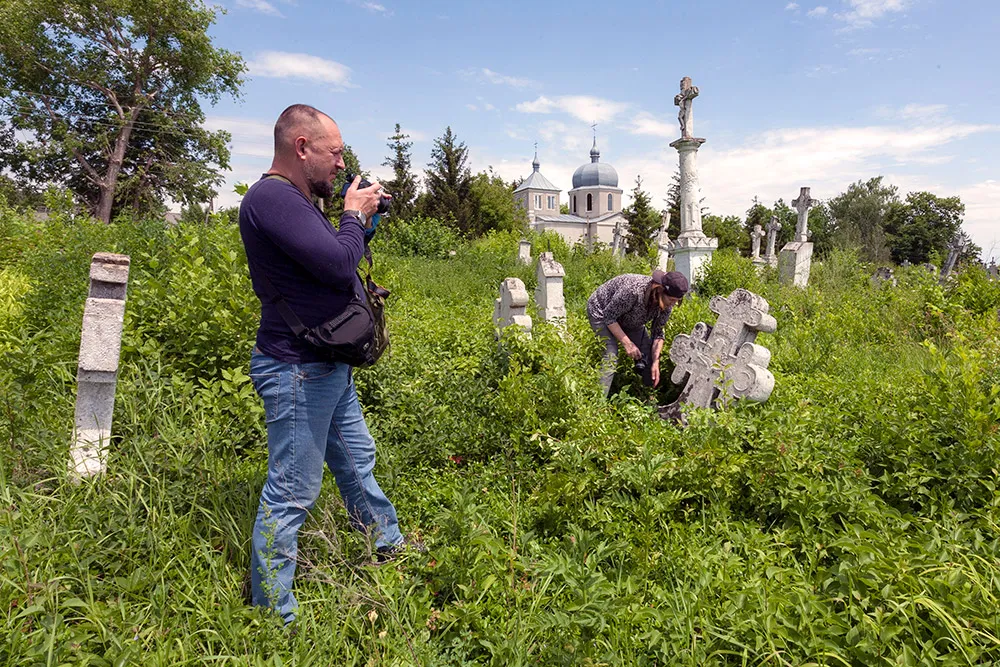
Expedition to the cemetery in Radkovytsia
Anyone with even a slight interest in history should know about the project of the public organization “Ukraine Incognita” to study ancient Ukrainian cemeteries. Its geography is all of Ukraine, except, of course, the occupied and frontline territories.
The aim of the project was explained by its leader Roman Malenkov: “In Ukraine there is no register of old cemeteries at all, and in the vast majority of cases such cemeteries are neglected or in ruins. The situation is especially dire with old Ukrainian (Cossack) cemeteries, which are not included in the registers of monuments, are of no interest to the local authorities, are desecrated by vandals and are disappearing. We want to put this situation right and revive historical memory,” he stressed.
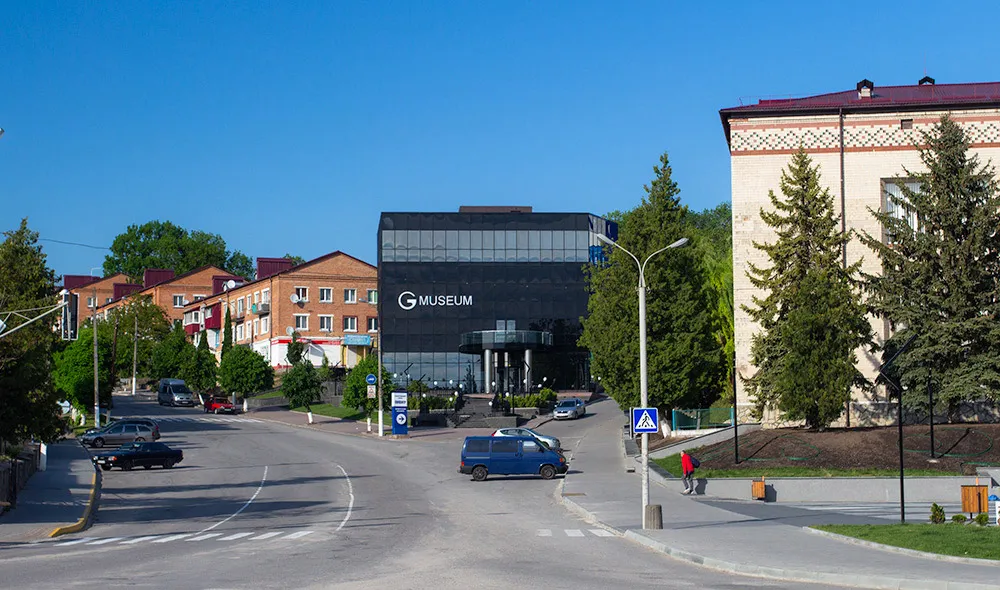
G-Museum – an innovative museum in Horodok in Khmelnytskyi Oblast
When it became known that the “Incognita people” were heading for the banks of the Zbruch, the author of these lines decided to join the expedition. The journey around the Zbruch region began in Horodok in Khmelnytskyi Oblast. But not with cemeteries: it began with a visit to the local museum of local history (“G-MUSEUM”), probably the only one of its kind outside the big cities. Unfortunately, the visitors to Horodok did not see the most interesting exhibits. Since last year they have been removed from the display and carefully packed in case of urgent evacuation. Perhaps at that time there was some logic in this, but today it would be good to put everything back in its place.
Right after the high-tech building of the “G-MUSEUM”, the researchers had to plunge into a real wilderness. Probably to feel the contrast.
Lisovody: a mysterious cross and a palace in ruins
The village of Lisovody, a mere 7 km from Horodok, once resounded across the whole USSR as one of the most advanced farms in Ukraine. In 1970 it was in Lisovody that the once-famous film comedy “Among the Tall Grain” was shot, which was meant, among other things, to demonstrate happy and joyful collective-farm life.
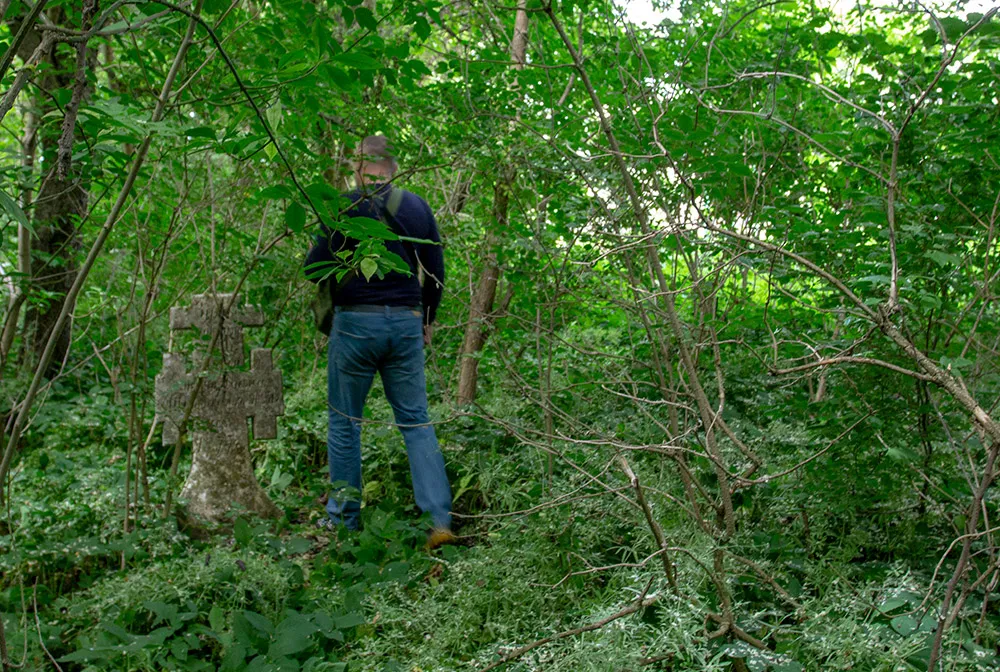
The thickets of the old Lisovody cemetery
The old section of the Lisovody cemetery could easily have been the set for a thriller called “Among the Tall Bushes”. From the start the eye fell on archaic flat “cross-ended” crosses, in which each arm is itself a separate little cross. In this part of Podillia such crosses are the most common.
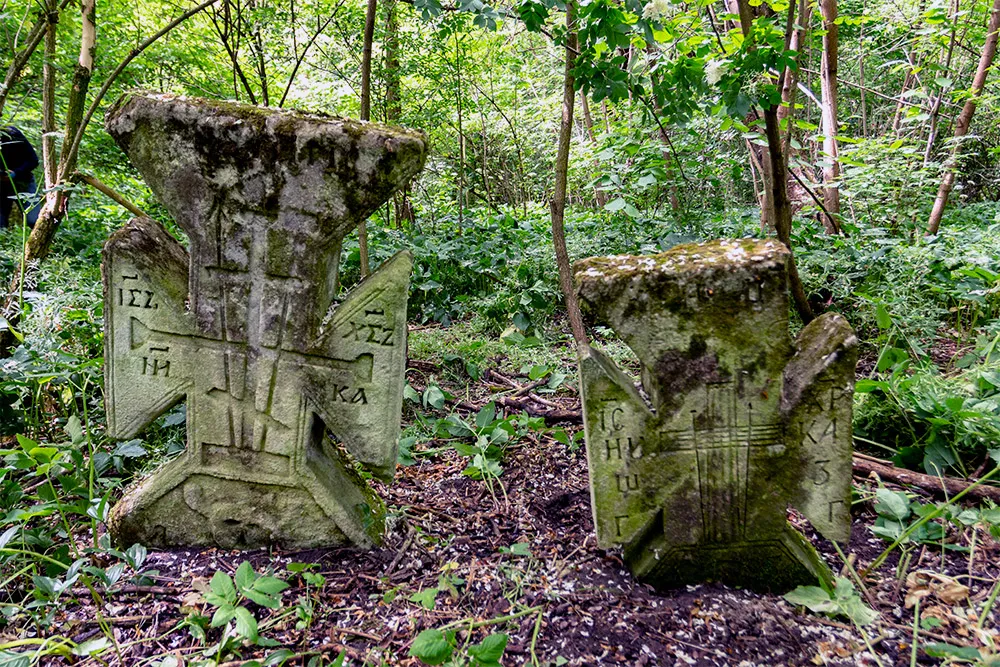
Burial of Ivan Shpeta (left), 1810. Note the sun and moon on the smaller cross
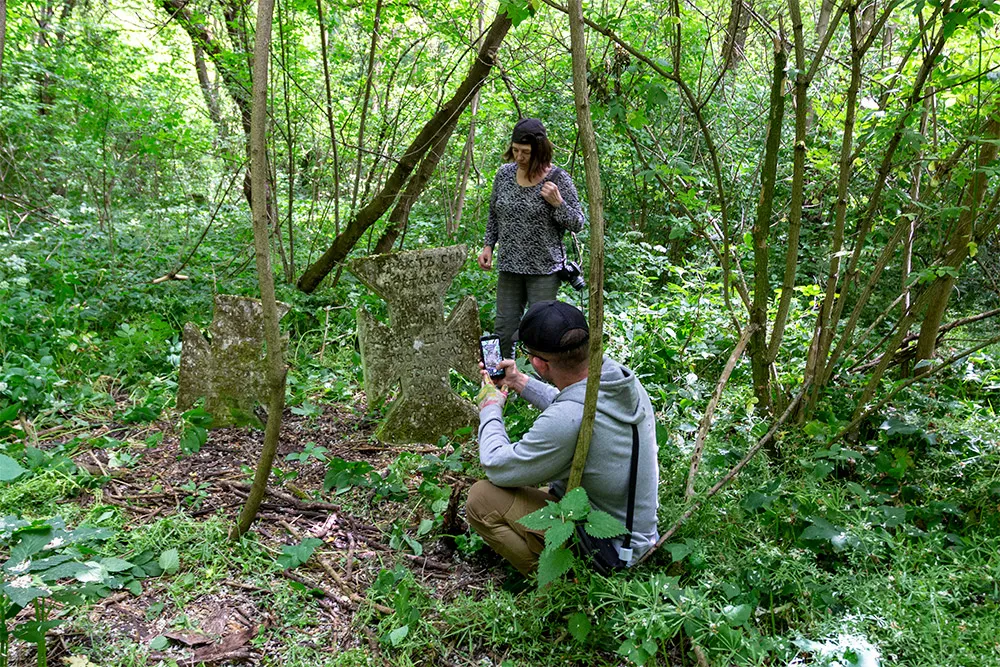
The same crosses, seen from the opposite side
The oldest of the gravestones, dating to the early 19th century, were in the form of crosses that people call “Cossack”. They also turned out to be the most decorated. Let us single out a fairly large cross on the grave of Ivan Shpeta (1810): its outer side is adorned with a very interesting variant of the “Calvary cross” and the instruments of the Saviour’s torture. The epitaph is no less interesting. Instead of the traditional “Here lies the servant of God…” we read: “This cross is erected over the servant of God Ivan Shpeta…”. The gravestone next to it surprised us because on either side of the “Calvary cross” the master carved a sun and a crescent. This is a fairly uncommon motif for cemeteries of this part of Podillia.
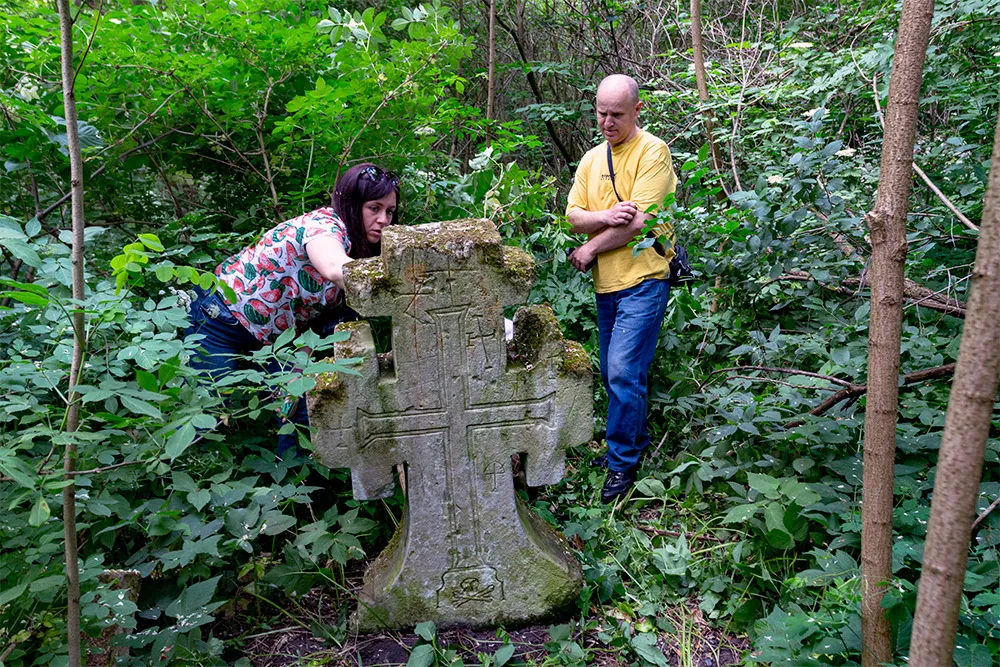
A gravestone covered with little graffiti crosses turned out to be absolutely unique
But the greatest discovery of the Lisovody cemetery, and probably of the whole Zbruch expedition of “Ukraine Incognita”, was the gravestone on the grave of Pantylymon Kopytok, who lived 75 years and died in 1860.
The expedition colleagues took this find quite calmly. But in the author of these lines it caused a whole explosion of emotions. It so happened that a month earlier he had had to study a huge body of information connected with similar cross-petroglyphs that pilgrims once scratched on the walls of cave monasteries. The subject is quite specific and very narrowly specialized, because few people deal with this type of monument. Accordingly, the author was the only member of the expedition who understood WHAT had come into view.
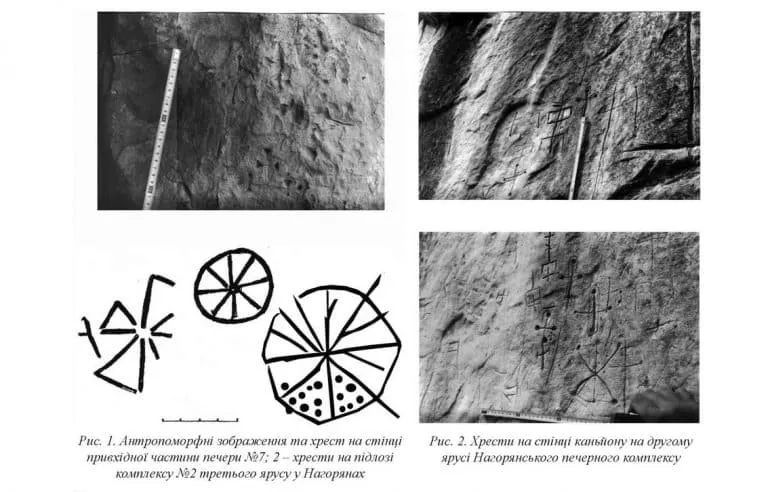
Cross-shaped images in the caves of the Dniester basin. Photo: spadok.org.ua
Cross-petroglyphs and graffiti were long signs of pilgrimage and showed that a certain person had once visited a holy place. In Ukraine such marks usually date to the 11th–18th centuries. It was also believed that a scratched little cross was supposed to bring the “scratcher” some good fortune in life and strengthen his prayers. Many such marks can be seen on the walls of the Church of the Holy Sepulchre in Jerusalem.
The gravestone on the grave of Pantylymon Kopytok also turned out to be covered with graffiti depicting various crosses (19 images in all). But a real understanding of the scale of the find came later, after consultations with leading historians of Ukraine. The general conclusion from what we heard: the find is unique, amazing and one of a kind.
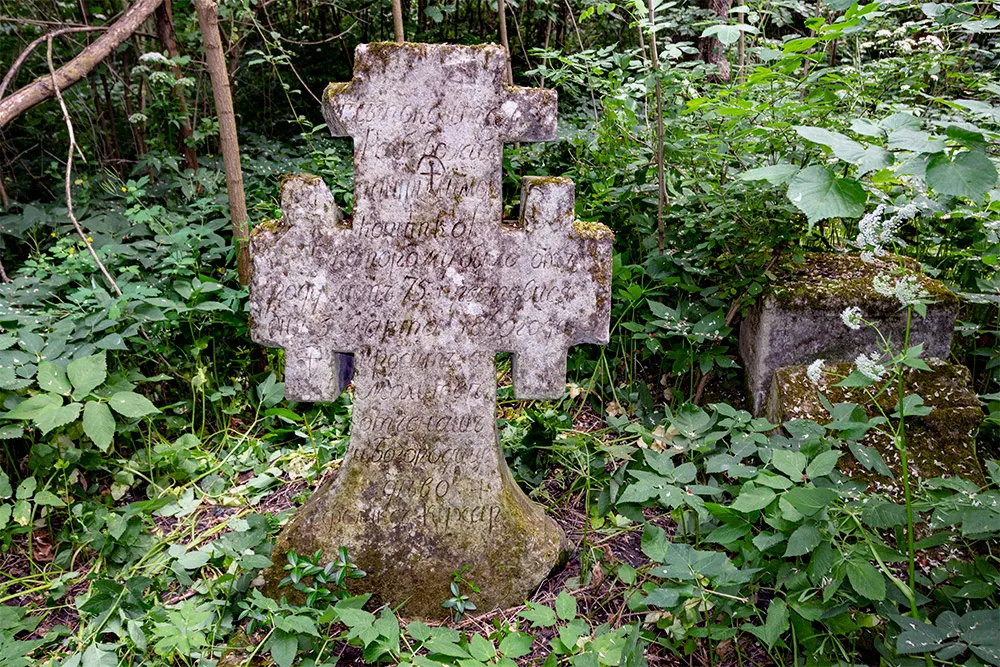
Some graffiti are scratched even over the epitaph
“The cross found in Lisovody has a feature that I have never encountered in my practice,” comments the Podillia historian and archaeologist, Candidate of Historical Sciences Pavlo Nechytailo. “These are images of small crosses of various forms carved on different planes of the cross. They include crosses with a semicircular little roof, crosses with T-shaped ends of the arms and the vertical bar, and crosses with triangular expansions at the ends. These crosses occur in Christian rock-cave monuments of the Middle Dniester region and have a wide chronology (12th–18th centuries). Given the age of the cross (1860), these are the latest relatively dated cross-shaped images of this kind in the region and possibly in Ukraine.”
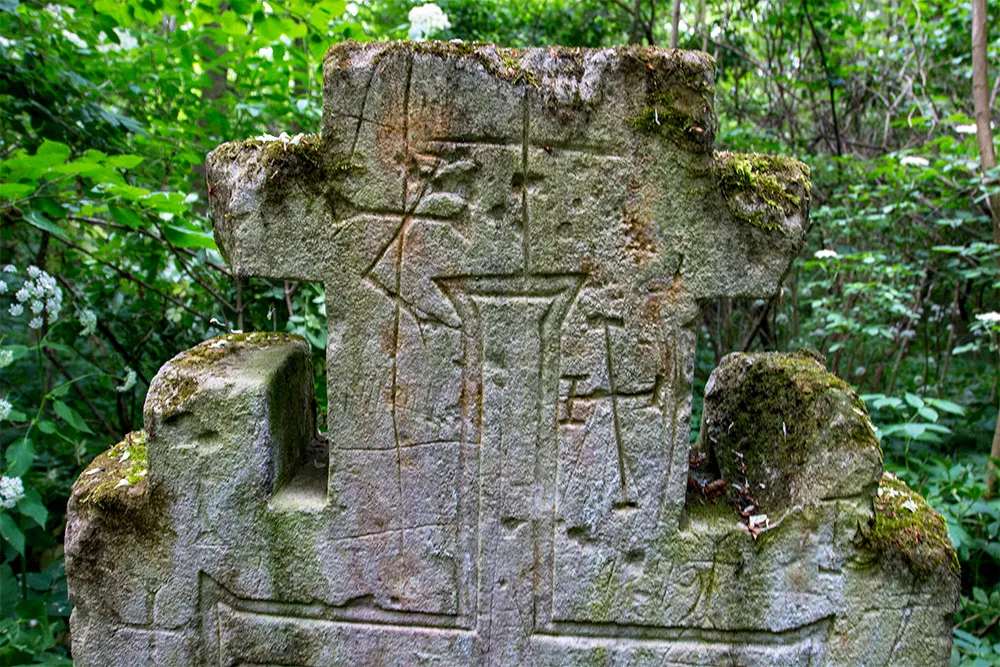
At the bottom right you can see a graffiti cross with the date 1872
The historian also added that “similar scratched crosses in Western Europe are called “pilgrim crosses”. They are found in churches and places of pilgrimage and are dated quite broadly, from the Middle Ages to modern times.” Historian and archaeologist Professor Bohdan Ridush, who has done a great deal of research on cave sacred complexes in the Dniester region, including similar cross-petroglyphs, also confirmed the exceptional nature of the find and noted that photographs of the Lisovody graffiti should be published in scholarly journals so that researchers have them as a benchmark of what types of crosses were still being drawn in the mid-19th century.
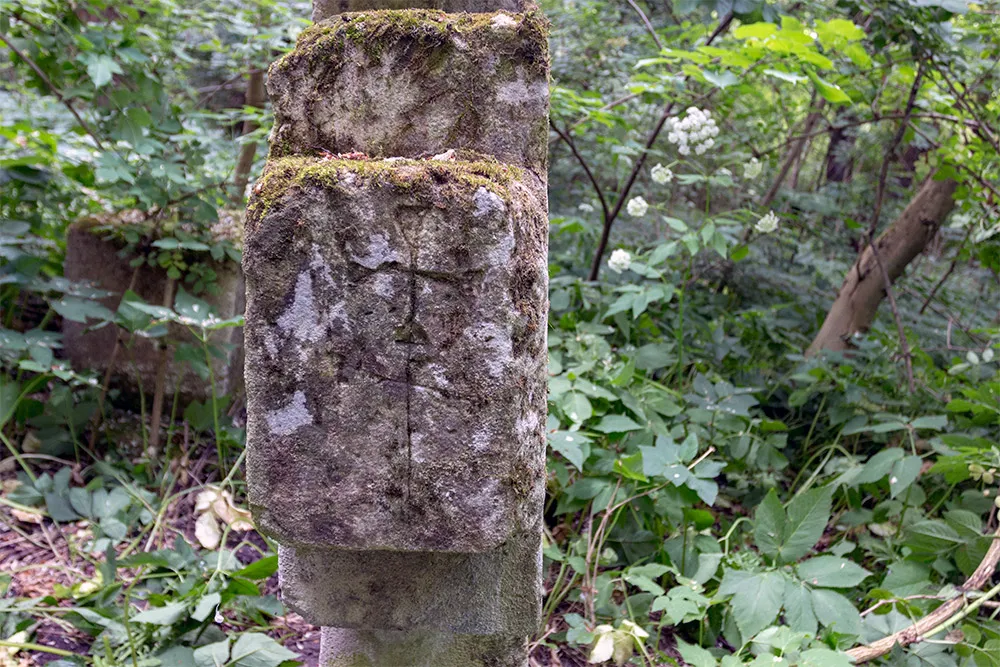
Graffiti on the side surface of the mystery cross
Unfortunately, the parish registers of Lisovody for precisely 1860 are missing, so it is impossible to find out who was buried or why he was given such an honour. We plan to question the village’s old-timers; perhaps someone has heard something. The author inclines to the version that this is the grave of some very authoritative healer in these parts, to whose grave people kept coming with prayers for help even after his death. The version of some uncanonized local saint is not fantastic either.
Candidate of Historical Sciences Tymur Bobrovskyi, by contrast, believes this is not necessarily so: “These crosses may be like flowers brought to a grave. Perhaps that Pantylymon had many friends. Or each cross was scratched in fulfilment of the prayers stated in the text of the epitaph.” The historian means the request for prayers, “Our Father” and “Virgin Mother of God”, stated in the epitaph.
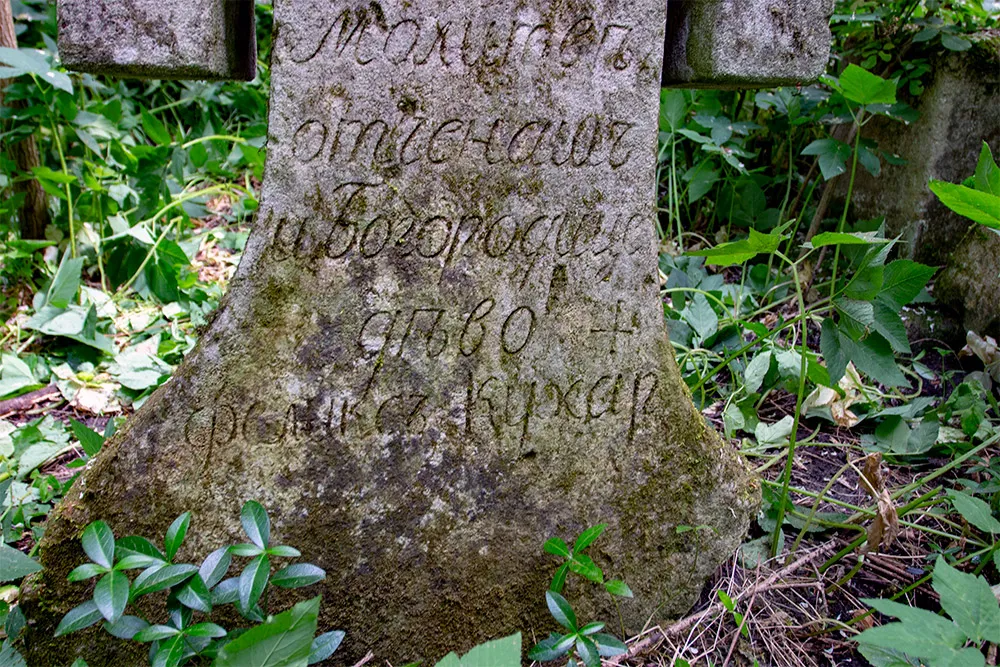
Request for prayers
“A cross can be a substitute for the prayer ‘Our Father’,” the scholar continues. “Since it is a Gospel prayer that Christ personally gave to the apostles.” But this still does not fully answer the question of why only this gravestone is covered with graffiti. Moreover, it is not by the road but deep inside the cemetery. That is, one could reach it only deliberately, and would also have to carry some sharp object. The author reserves the version that these are “pilgrimage crosses”. Besides, one of the graffiti crosses is even dated (1872). Graffiti with dates are typical precisely of “pilgrim” ones.
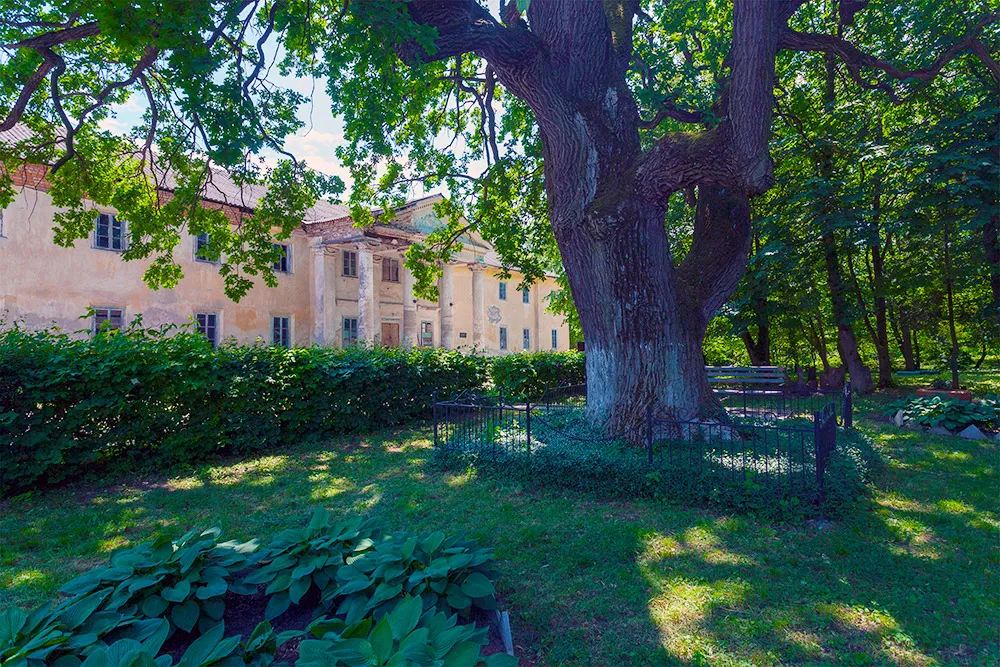
A dying palace and a famous oak
In Lisovody the expedition also viewed the famous palace of the Raciborowski-Żurowski nobles (about 1830), one of the most beautiful in Khmelnytskyi Oblast, and the five-hundred-year-old oak in front of it. Today the abandoned palace is gradually collapsing. It formerly housed an orphanage and then a vocational school.
Radkovytsia: a mother’s tragedy and angry little suns
The next stop was the village of Radkovytsia in the Horodok community. Probably sometime last autumn the local villagers cleared it, so new bushes have not yet had time to grow.
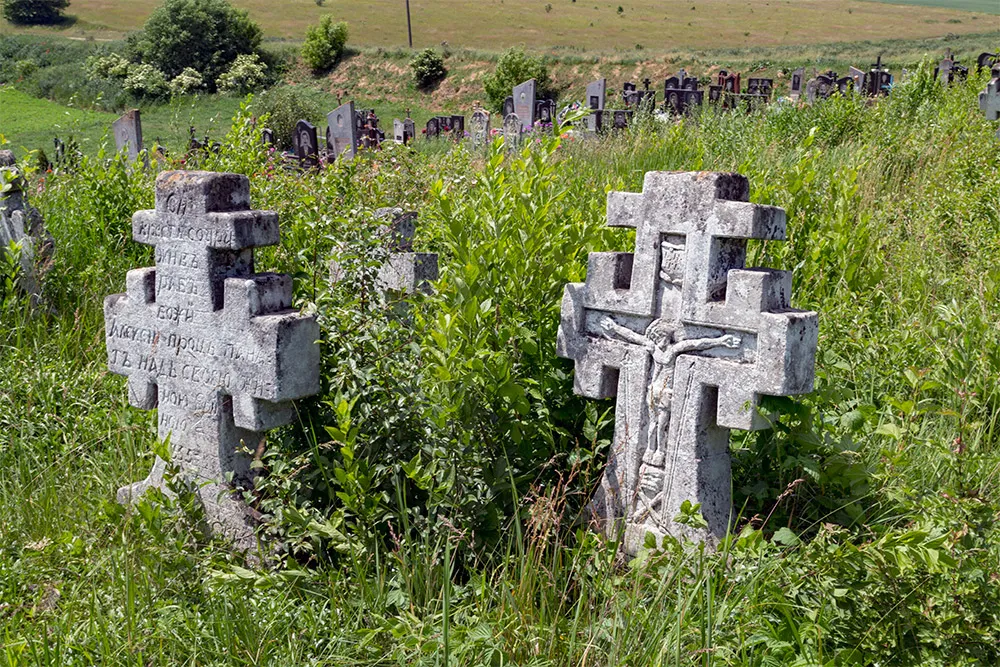
Cemetery in the village of Radkovytsia. Burial of the mid-19th century
The old part of the cemetery in Radkovytsia is not just large but very large: it has several hundred gravestones dating from the first half of the 19th century to the early 20th century. Mostly these are archaic “cross-ended” crosses. There were also plenty of crosses that pre-revolutionary surveys of the stone trade in Podillia for some reason called “lordly”. This is a monument assembled from several parts, whose lower part is a tall rectangular prism on which the cross itself was set.
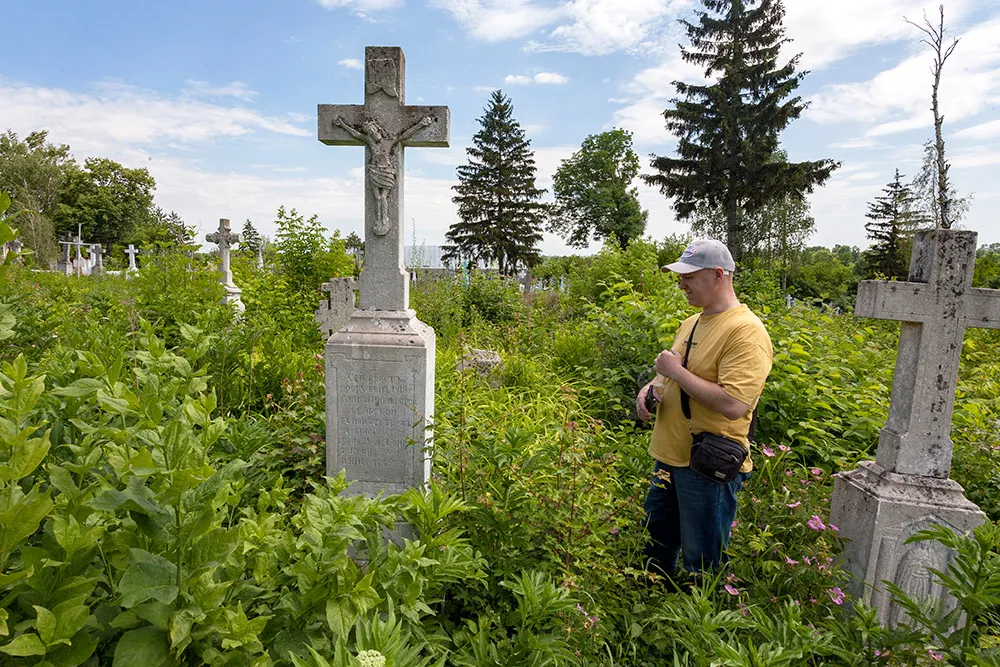
Cenotaph grave, 1919
Of the “lordly” crosses, the most striking was a cenotaph monument (a symbolic grave) erected in 1919. On one face of the pedestal was written: “This cross was erected in 1919 by Anna Nykyfora of the village in memory of her three sons: Stefan, 35, Konstantin, 24, and Nikolai, 20.”
On the adjacent face the inscription continues: “Fallen on the field of battle in the Russo-Austro-German war in 1914–1916.”
A terrible testimony to the grief of a Ukrainian mother who lost three sons at once, only because the Russian people once again felt a craving for blood and “greatness”, for the seizure of new lands, the Black Sea straits and “a cross on St. Sophia in Tsargrad”…
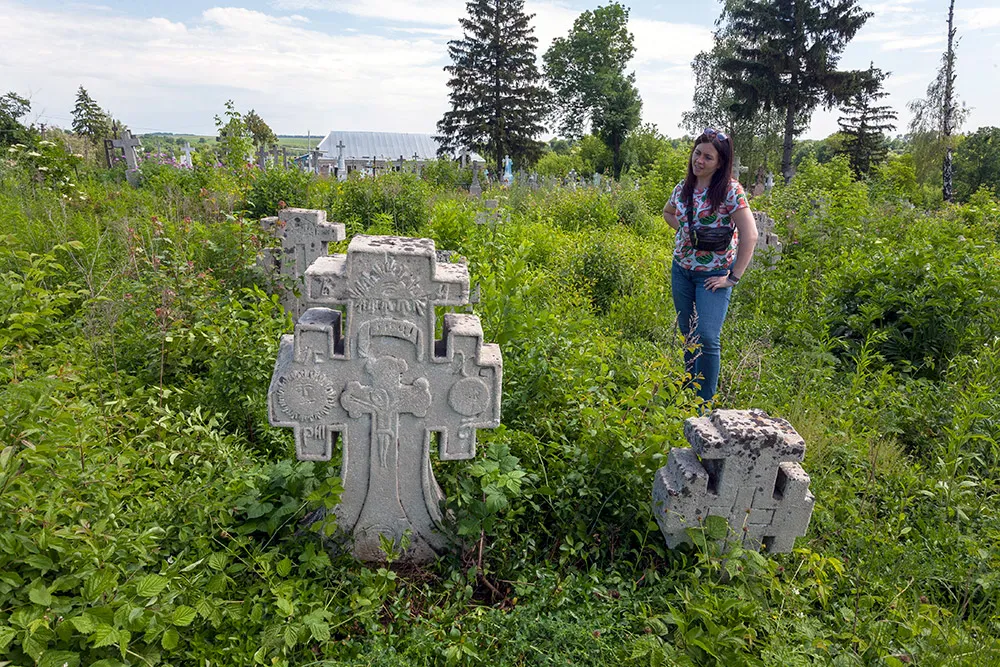
A cross with a sun and a crescent
Three practically identical “cross-ended” crosses are worth singling out (two of them with rounded tips, which brings them somewhat closer to the “petal” type), dating to the mid-19th century. They stand out both for their highly skilled carving and for their original decoration. In particular, they are adorned with images of the “All-Seeing Eye” (but in a design atypical for this area), as well as a little sun and a crescent. The little suns here, true, are somehow angry.
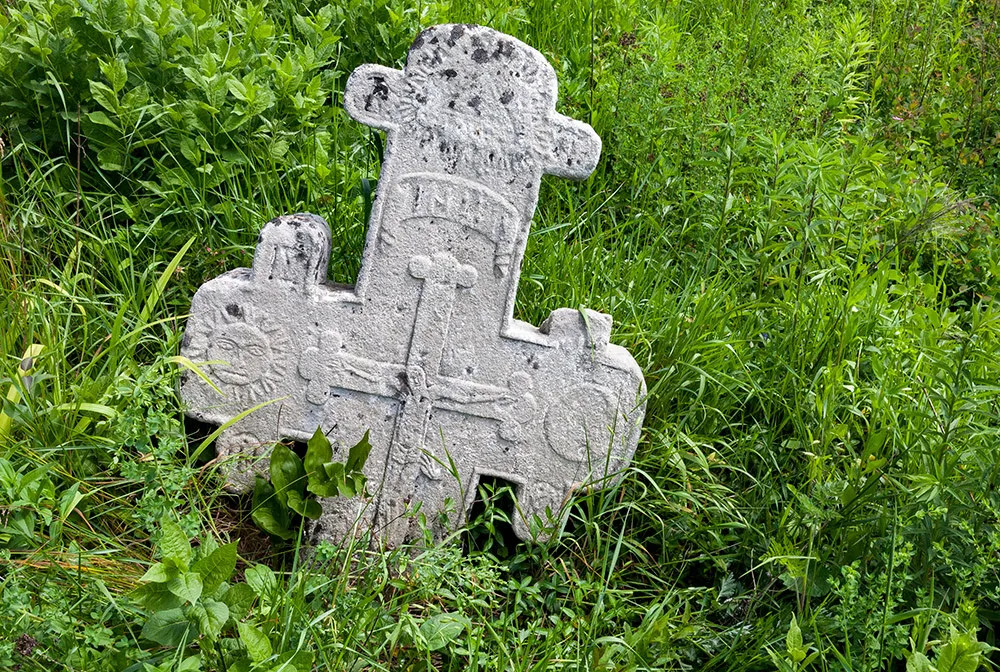
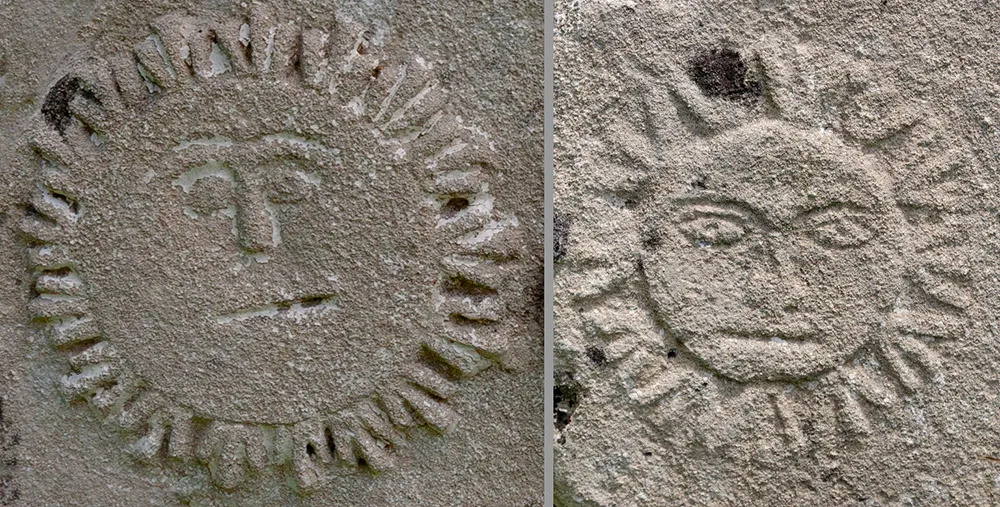
Among the local curiosities one should single out the epitaph style that is original to this cemetery. Many of them begin with information about who put up the monument: “This cross was erected by the servant of God Paraskeva over her husband…”. There are gravestones with epitaphs similar to the Lisovody ones. For example: “Under this sign (that is, the cross – author’s note) the servant of God Fedor…”. But there are plenty of traditional ones too: “Here lies the servant of God…”
Sataniv: plague and cholera
The main aim of the trip to Sataniv was to see the material traces of ancient epidemics: the local “cholera cemetery” of the victims of the 1830–1831 epidemic and the so-called “plague crosses” set up on the graves of people who died of the plague in 1770–1771 and were buried simply on their own farmsteads. It was also planned to view the burials of monks near the local monastery dating to the 17th century.
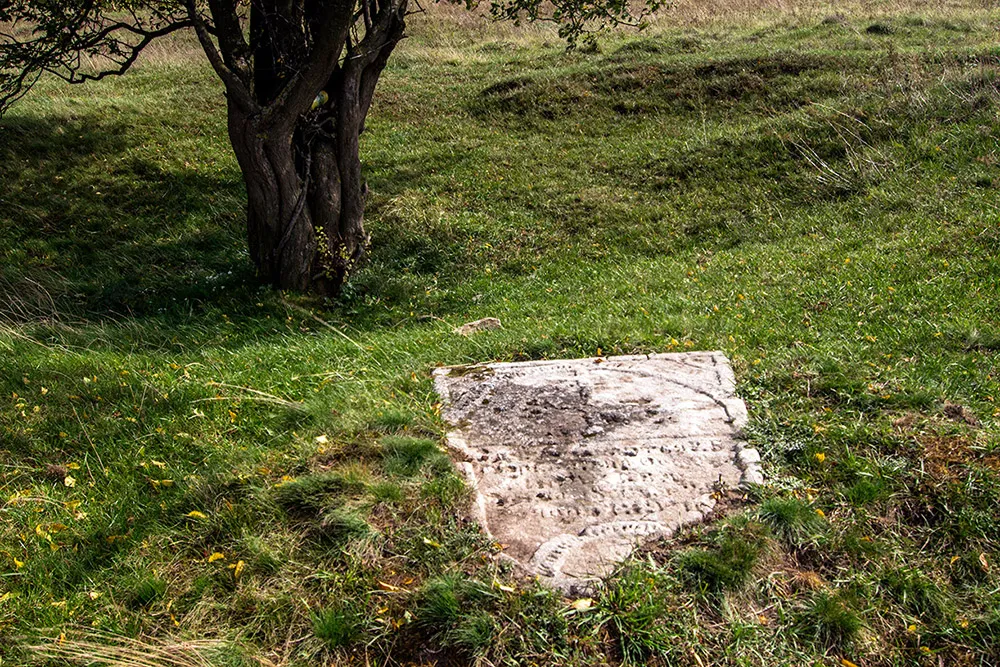
One of the burials of the cholera cemetery. Autumn 2021
Of the once sizeable “cholera cemetery” only 5 gravestones can be seen today, and a pedestal on which a figure of the Mother of God once stood.
The gravestones of the cemetery have not gone anywhere. The burials were simply of the “under-slab” type, once popular in Podillia. This is when the grave was covered with a rectangular slab on which the epitaph was carved. Such burials quickly sink into the ground and are then covered with turf. On the cemetery grounds dozens of characteristic little mounds are clearly visible, under which the ancient gravestones are hidden.
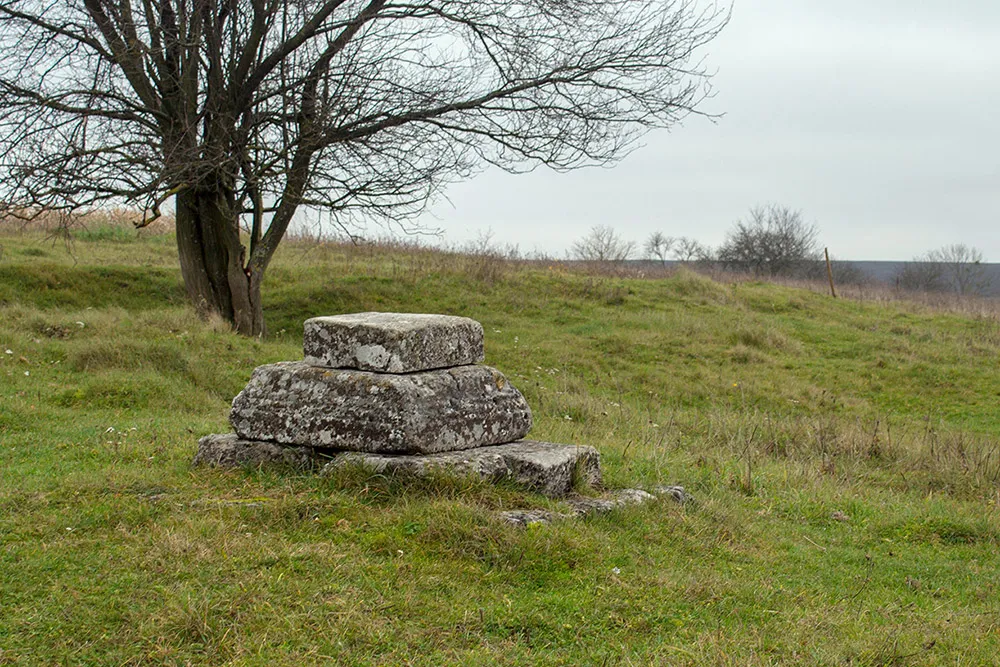
Pedestal of a sacred figure (photo, autumn 2021)
Six decades before the cholera epidemic, the “Pale Rider” came to Sataniv. The plague of 1770–1771 is still recalled by legends and by the grim numbers of the dead recorded in ancient chronicles. In the hamlets of Sataniv, the villages of Kamianka and Spasivka, crosses on the graves of plague victims still stand in the middle of people’s farmsteads. So as not to spread the plague through the village, those who died then were buried right by their houses. A quarter of a millennium has passed since then, but touching the crosses on the plague graves is still taboo.
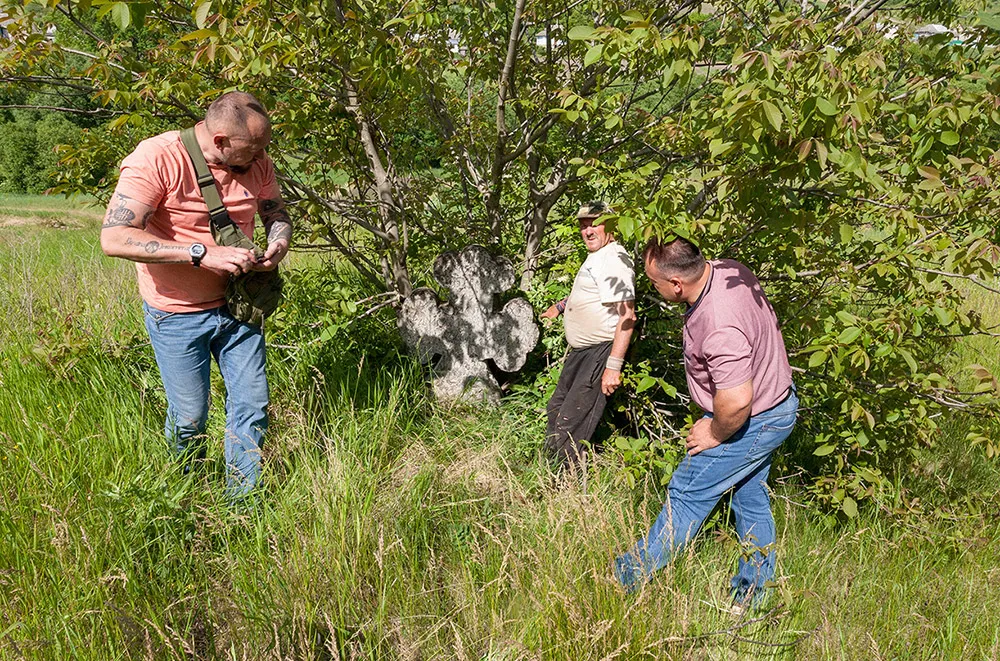
A “plague” cross
It is impossible to find them on your own. Here the expedition was helped by Oleksandr Smolinskyi, director of the Sataniv House of Culture. The farmstead in the middle of which one of the crosses stood turned out to be abandoned. The owners moved to town some ten years ago. The cross could not even be seen up close. It was covered by the broad branches of a young walnut tree. To see the object of our search we had to pull the branches aside. The cross turned out to be of the “petal type”, where the arms form a trefoil. The epitaph was barely legible, but we managed to make out that the bodies of the servants of God Vasyl and Ahafia are buried here. The date on the cross is written in Church Slavonic letters: “az-psi-on-az”, that is, the year 1771.
On the opposite side of the street, some hundred metres away, there is another lone cross. Also of the “petal” type, but of a slightly different kind. And also in the middle of an old farmstead. The epitaph is very indistinct, but one can read that Hryhor Kadon, who died in October 1790, is buried here. On the reverse, where in most cases an image of a cross is carved, there is another large text in small letters, but they are so worn that nothing can be read.
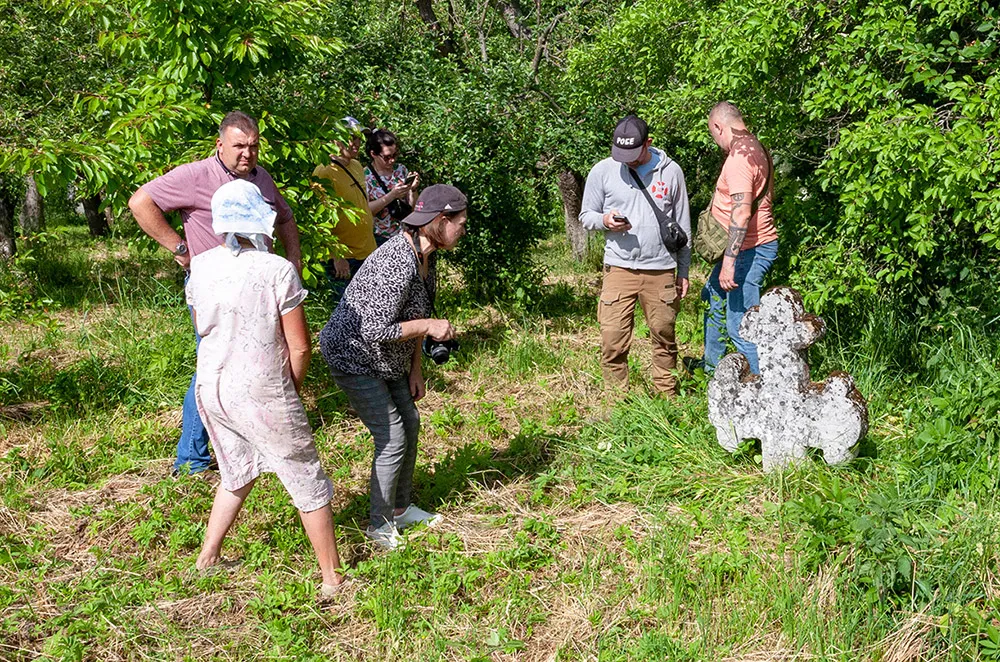
Grave of Hryhor Kadon, 1790
A question arose at once: as of 1790 no epidemics were recorded in this area. Why, then, is Kadon buried outside a cemetery? Perhaps the answer lies in the almost obliterated inscription, but it cannot be read without special equipment.
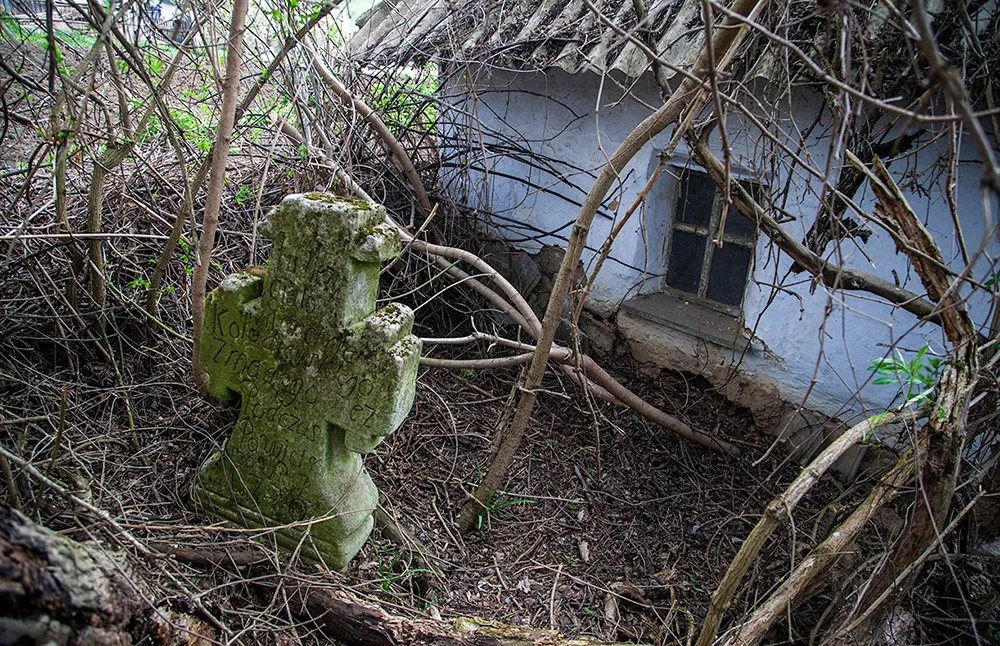
A classic Ukrainian cross with a “Polish” epitaph
In neighbouring Kamianka, beside a very old house abandoned for some twenty years, another “plague cross” sticks out of the thickets. Although its type is entirely Eastern-rite (“cross-ended”), a Pole, a certain Marcin Kołodziejski, is buried beneath it. The epitaph moreover states directly that he died during the plague in 1770. Why a classic Ukrainian cross was put on the grave of a Roman Catholic and a Pole is clear: at the height of the epidemic they used what was at hand.
***
Insert from “Ukraine Incognita”.
After the article had come out, in the forest on the outskirts of Sataniv another “plague cross” was found. Local historian Anatolii Kobiletskyi worked on it. Local historians had long known that there was an old cross in that forest. But it was thanks to Mr Anatolii, who cleared it of a thick layer of moss, that it turned out to be a “plague” one too. This was vividly attested by the date A-Psi-O (the year 1770 in Church Slavonic numerals).
At first it seemed that “Maiden ??? Anna” was buried there. But after a more thorough clearing it turned out that the name of the person buried is Magdalena.
Here there is a certain mystical coincidence. The grave of Magdalena, who died of the plague, was found on the eve of the day of St. Magdalene, who is greatly revered in Sataniv. Her wonderworking icon, kept in the local church, is believed to have saved Sataniv from a cholera epidemic in the early 20th century.
***
Ivankivtsi: a Cossack, but not ours
The cemetery in Ivankivtsi (formerly Ivankivtsi Satanivski) turned out to be the most impressive as a complex monument.
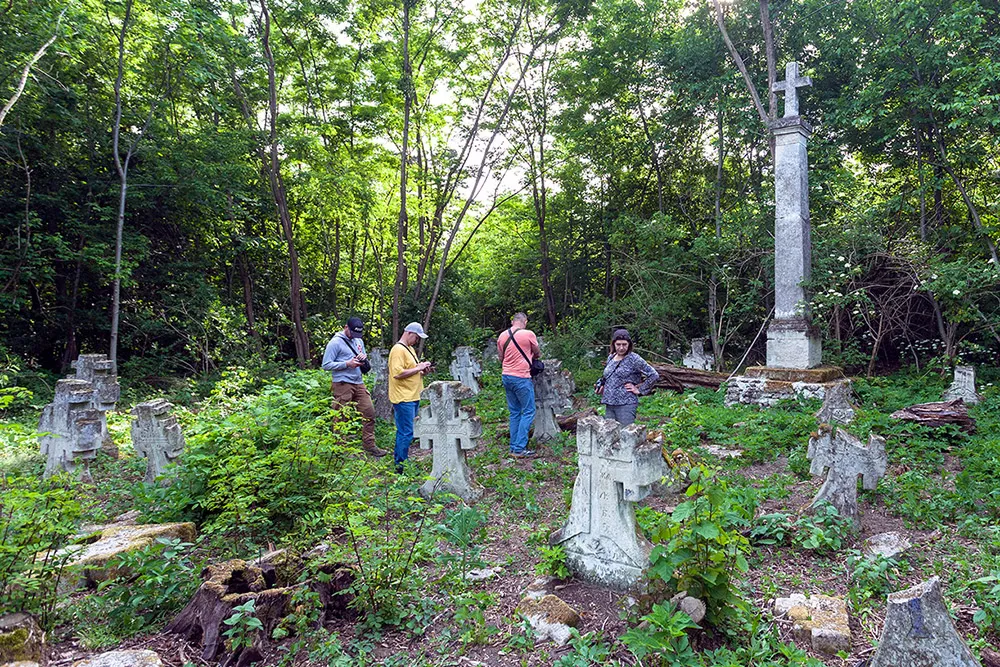
Cemetery in Ivankivtsi
Here there is a very interesting detail: a very tall obelisk with a cross at the centre of its old part. Most likely it is not a gravestone but a kind of sacred figure marking the consecrated cemetery territory. Ivankivtsi has many archaic “cross-ended” crosses dating from the late 18th century. An interesting feature of this necropolis is that crosses of this shape were used here as late as the mid-20th century (the fashion for “lordly” crosses of the late 19th and early 20th century somehow bypassed this village). There is nothing like it anywhere else.
A genuine Cossack grave of 1799 was found here too. Only the one buried there is not a kozak but a kazak, a Don Cossack. The epitaph states: “1799, August 10th, here is buried the servant of God of the Don Host Cossack regiment of Sulin 7th, from Medveditsa Berezovskaya, Ananii Artemiev, son of Atamanov.”
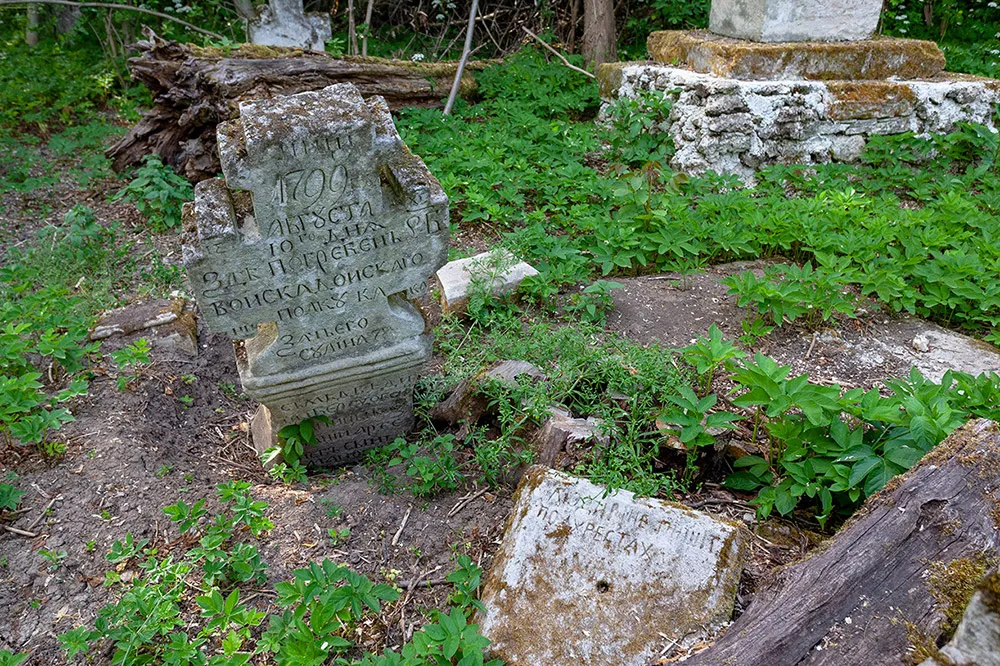
The grave of the Don Cossack. At the side on the stone, a touching Podillian line: “People, do not write on the crosses” (the obelisk next to it is covered entirely with “Vasya was here” scribbles)
Sulin’s regiment was once “famous” for taking part in the destruction of the Sich, and at the end of the 18th century performed border service on the newly established border between Russia and Austria. Summing up this stage of the “Ukraine Incognita” expedition, its leader Roman Malenkov remarked: “In Lisovody, Radkovytsia, Ivankivtsi and Vilkhivtsi we saw cemeteries with special forms of crosses, “cross-ended” ones, which are not typical of most of Podillia. Such crosses occur in large numbers only in the south of Ukraine, in Cossack necropolises. Why this form is present in the Zbruch region requires further study.”
Dmytro Poliukhovych. “Dilova Stolytsia”


