What wine did Ukrainians like in the 18th century?

· 7 min read
“The Cossacks descend in their boats along the Borysthenes to Ochakiv and Crimea, carrying various wares. They sell hides, tobacco (kasak-tutun), ropes, hemp, linen, coal and fish, and buy salt, wines, dried fruit, oil, soap, incense, horse equipment, and sheepskin coats called “felts” (postaki)…”
“Wine.Crimea produces excellent wine and plenty of it: it is all very light white and very diuretic. Only the wine of the canton of Sudak is strong, and it can be counted among the liqueur wines. The cantons with the most esteemed wines are Soudag, Belbek, Katchi & Elma. The greatest quantity of these wines is sold in the country. However, the Cossacks of Ukraine & the Zaporozhians export a hundred thousand ocques of wine every year, which they carry in wagons of a thousand ocques… The wine of Sudak usually costs from 5 to 6 paras; that of Belbek from 3 1/2 to 4 paras; & in the other cantons from 2 to 2 1/2”.
Quotations from the French book “TRAITE SUR LE COMMERCE DE LA MER NOIR” (more about its author below).
(“Treatise on the Black Sea trade”), 1787: https://books.google.com.ua/books?id=6sZOAAAAcAAJ&pg=PA54…
As we can see, the Cossacks had refined tastes and drank not only vodka (one day I will write a separate post about the dishes typical of the Cossack era, about asparagus, Parmesan and other delicacies) ?
Vodka, as can be seen from the excerpts of the book that I will give in the photos below, was also sold to Crimea ?
Ukrainians and Crimeans had long and successful economic ties and traded goods for centuries.
And then came what imperial historians themselves described like this:
“The invasion of Russian troops in the mid-18th century could not fail to affect the economic life of the region, in particular viticulture. No less damage was done to this branch by the expulsion from Crimea in 1778 of more than 30,000 people of the Christian faith (most of whom were Armenians and Greeks, who engaged in viticulture on the peninsula).”
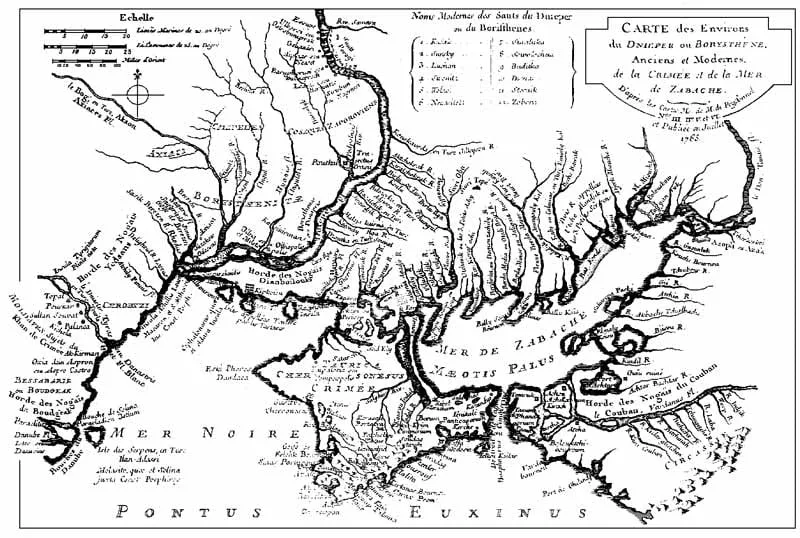
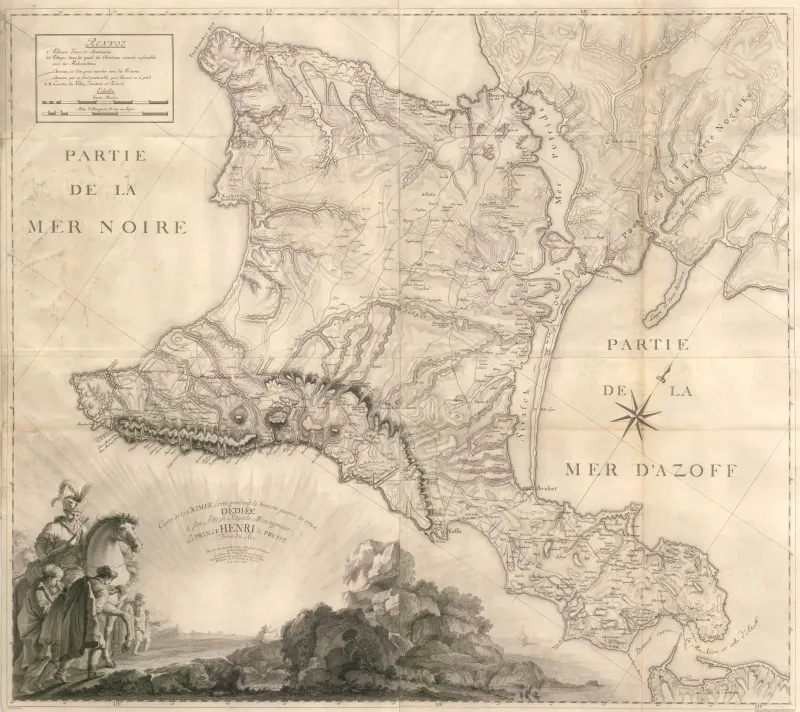
Islands and peninsulas: Snake Island – Isle des Serpens,
en Turc Ilan-Adassi, Melasite, quae et Selina juxta
Const. Porphirog. (Snake Island, in Turkish –
Ilan Adassi, Melazit, also Selina, according to
Constantine Porphyrogenitus); the floodplain island between the Dniester and the Turunchuk branch –
Insula Tyragitarum Plinio nota (Island of the Tyragetae
according to Pliny’s notes); Berezan – Insula Achillis,
Leuce, Macaron et S.Aetherei Ins. Const. Porph.
(island of Achilles, Leuke, Macaron and the Island of St. Etherius, according to Constantine Porphyrogenitus);
the floodplain island at the mouth of the Dnieper – ins. St.
Georgii (island of St. George); the western
part of the Tendra Spit – Cephalonesus quae
et Adara Insula (Cephalonesus, also the island of Adara); the central part of the Tendra Spit –
Adara I. (island of Adara); the eastern part of the Tendra Spit – Rosphodus Insula (island of
Rosphodus); for the whole of the Tendra Spit – Isles appellées Tenteré par les Tartares
(islands called Tentere by the Tatars). The Kinburn Peninsula – Cursus Achillis (the Race of Achilles). Rivers: the Danube – Paraclitus, Danube
Fl. Ister seu Danuvius (Paraclitus, the river Danube,
Istros or Danuvius); the mouths of the Danube – Bouches
du Danube; the Sulina mouth – Bouche de Selina
vel Paracladion Ostium (mouth of Selina or mouth of Paracladion); the Dniester – Le Dniester, Tyras
en Turc Tourla (the Dniester, Tyras, in Turkish Turla); the Kuialnyk and (or) Hadzhibei estuaries – Atchily. Penius Fl. (Atchily, the river Penius); the Tylihul estuary – Deligheul R. (the little river
Deligel); the Sasyk river and the Sasyk bay of the Berezan estuary – Sasik Berezen R. Rhodus
(Sasyk Berezen. The river Rhodus); Berezan and the Berezan estuary – Berezen R. Sagaris Fl.
Sagaricus Sinus. Golfe de Berezen (the little river Berezen. The river Sagaris. The bay of Sagaris. The Berezen bay); the Southern Buh – Le Bog, en Turc Aksou.
Axiaces Fl. (the Buh, in Turkish Aksu. The river Axiaces); the Hnylyi Yelanets (left tributary of the Southern
Buh) – Gelanitz (Gelanets); the Inhul – L’Ingul R.;
the Hromokleia (right tributary of the Inhul) –
Gramkleikoi (Gramkleikoi) and L’Ongul (the river Ongul, in its lower course – ?); the Inhulets – Hyanis
(Hypanis) Fl. Inguletz R. (the river Hypanis, the little river
Inhulets); the Vysun (right tributary of the Inhulets) –
Bechka R. (the little river Beshka) and, finally, the Dnieper –
Boristhenus seu (or) Danapris.
Of the settlements contemporary with Peyssonnel,
the map marks: Caușeni –
Kichela (Kyshla); Topal – Topal; Purcari –
Pourkar; Olănești (or Tudorovo) – Sultan
Souvat (Sultan-Savati-khan); Palanca –
Palanca (with a clarification beside them:
Moldaves sujets du Khan de Crimee – Moldavian subjects of the Crimean Khan); Bilhorod-Dnistrovskyi (Ak-Kerman) – Ak-Kirman. Oxia
dein Aspron seu Aspro Castro (Ak-Kirman. Oxia, later Aspron or Aspro Castro); Ochakiv – Okzakow; Kizikermen – Kasikirman;
Kinburn (fortress) – Kilbouroun; and also
Kipkoiou (Kipkioi) on the Black Sea coast.
In addition, the same map marks Southern
Bessarabia or Budjak (Bessabaria ou Boudgeak), and the habitats of three hordes of the Nogai Tatars (Hourde des Nogais): the Budjak (Boudgeak), the Yedisan (Yedsans) in
the Buh-Dniester interfluve, and the Dzhambuluk (Dianboïlouks) on the left bank of the lower
Dnieper (Fig. 1; 2).
The actual ancient settlements
are marked by Peyssonnel in these places: Oxia, as already said, is linked with the town and
fortress of Akkerman; Axiaca (Acsiaca) with
the upper reaches of the left bank of the Berezan estuary; Odessus (Odessus) directly with
Ochakiv; Olbia (Olbia seu Olbiopolis et
Miletopolis) with the left bank of the mouth of the Inhulets river, and Tamiraca (Tamiraca) with the shore of the Tendra or Yahorlyk Gulf. In addition,
the published map marks the habitats of four ancient peoples: Chrobizi (the Chrobizi or Crobyzi) – in the interfluve between the Dniester and the Kuialnyk estuary; Axiaci
(the Axiaci) – on the right bank of the Southern Buh, in
the area of the rivers Kodyma and Savran; Callipides (the Callipidae) – in the upper reaches of the Inhul and Hromokleia rivers;
Borysthenitae (the Borysthenites) – in the coastal
interfluves from Berezan to the Dnieper.
__________________________________
The Frenchman Charles de Peyssonnel (1727-1790) left us a whole series of splendid works that tell many interesting things about southern Ukraine.
He himself came from Marseille, born into the family of the well-known diplomat and archaeologist Charles de Peyssonnel the Elder, and so had a gift for history from a young age. The younger man continued the family tradition and also chose a diplomatic career. Like his father, he was first an envoy in Smyrna, after which he was sent to Constantinople, and in 1754 to Crimea as consul of the French king at the court of the Crimean khan. He stayed there until at least the end of 1758. Later he was in Candia, Smyrna and elsewhere, until he took up publishing numerous essays and diaries, which became a true treasure for historians and were republished in various languages in many countries.
One of de Peyssonnel’s best-known works, “Historical and geographical observations on the barbarian peoples who lived on the banks of the Danube and the Pontus Euxinus”, is devoted mostly to the ancient and medieval history and geography of the northern Black Sea region. And in 1787 his “Treatise on the Black Sea trade” appeared, which at once gained still greater fame and circulation; it was published in Amsterdam under the title “Observations sur le commerce de la Mer Noire” (Observations on the Black Sea trade) and was later published in German translation. Such was the interest in the Black Sea region that then existed in the advanced countries of Western Europe.
Peyssonnel placed Ukraine in Europe, but designated its people in a curious way: “Slavonic or Sarmatian Scythians”.
And he identified the name itself with an unknown “Acheronia”, placed by ancient authors beyond the Borysthenes, mentions of which were contained in the tomb of the Roman consul, governor of Moesia, Tiberius Plautius Silvanus Aelianus (1st century AD). Quoting the text of this epitaph, Peyssonnel concludes: “This province of Acheron, which was beyond the Borysthenes, closely resembles in its name “Ukraine”.”
The core of this people, in his view, was the Cossacks. Their settlement covered a territory wider than that which was called Ukraine in his time: “The Cossacks of Ukraine are the most numerous, so called are all those who live in the province of Ukraine, part of Podolia and of Red Rus (that is, Galicia)”.
Author: Ihor Poluiektov
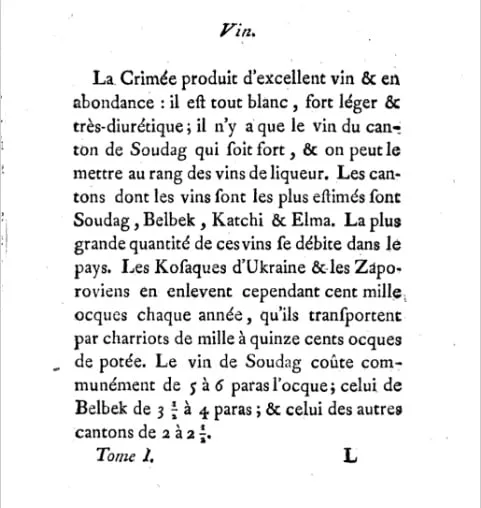
The Cossacks’ favourite wines: Soudag, Belbek, Katchi & Elma
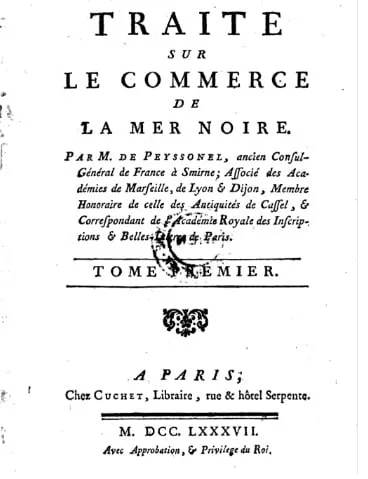
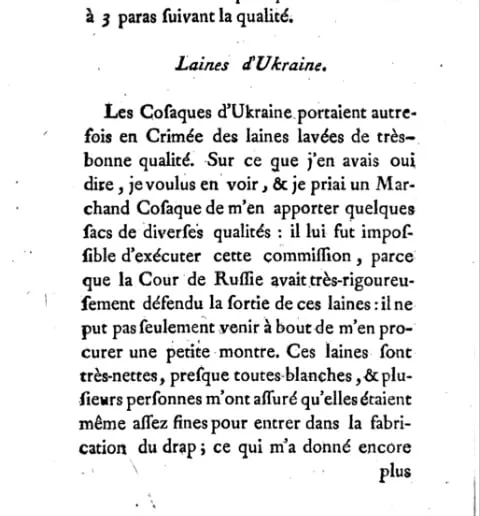
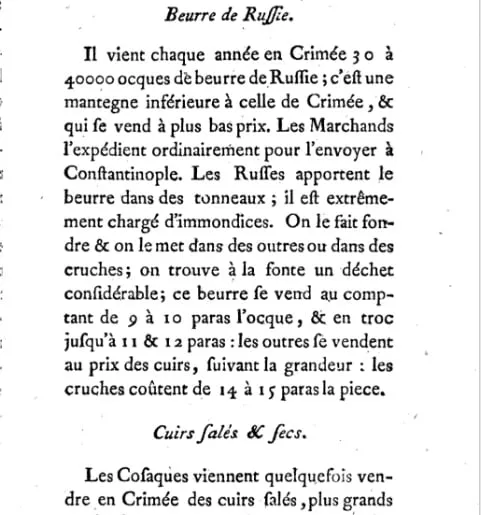
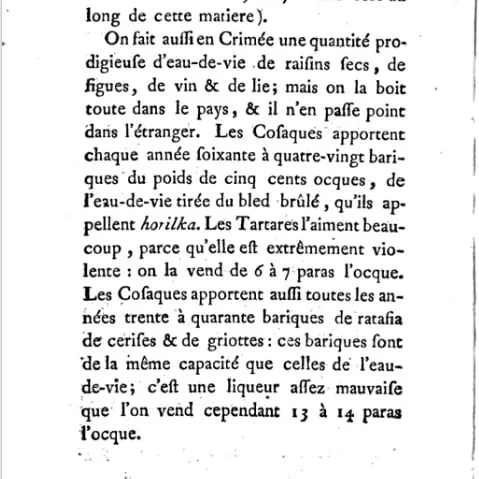
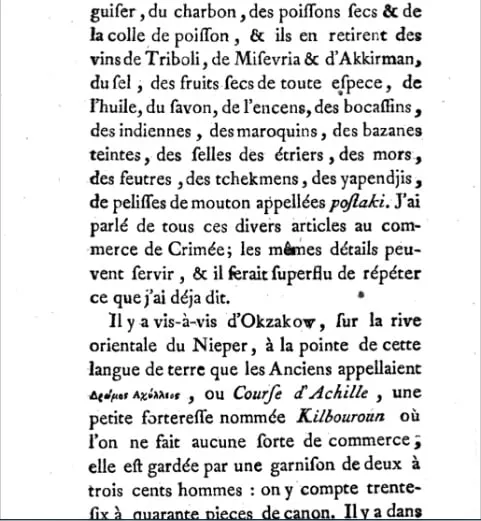
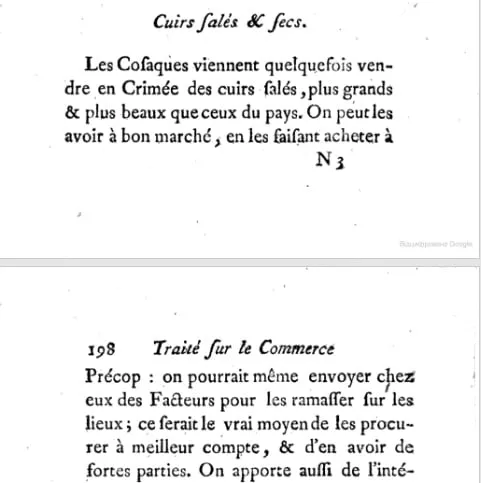
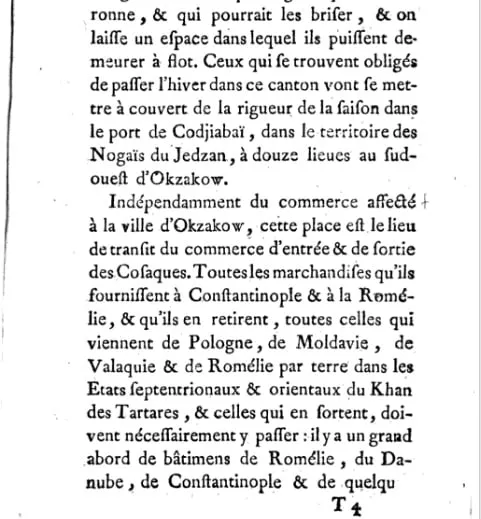
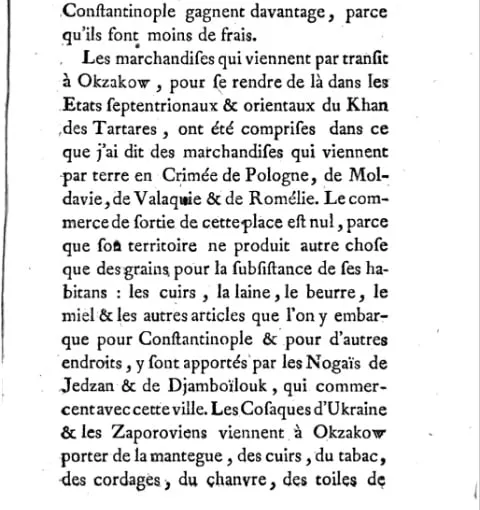
The original of the French work, showing what and how the Cossacks traded with the Crimeans