The first nationwide uprising in Ukraine. Krzysztof Kosynskyi

· 10 min read
In the 14th century Lithuania effortlessly annexed Ukraine (Southern Rus), which had been exhausted by the struggle against the Mongol-Tatars. Having freed the Ukrainians from the Tatar yoke, Lithuania imposed neither its religion nor its culture on them. The Lithuanians did not take land from the Ukrainians and practically did not suppress the identity and self-awareness of the Ukrainian people.
The situation in Ukraine changed radically when in 1569, under the Union of Lublin, Ukrainian lands passed to Poland. Mass colonisation began. Slowly but quite steadily the Polish ethnos spread across Ukraine. Estates and towns of the Poles were built. Bans on the Ukrainian religion and language began, and peasants were drawn into compulsory labour for the lords (corvée). The life of the population became unbearable. But there were passionately driven people who tried to remind the people of past greatness and freedom. Undoubtedly, Khrystofor (Krzysztof) Kosynskyi, who raised a peasant-Cossack uprising against Polish oppression at the end of the 16th century, can be counted among them.
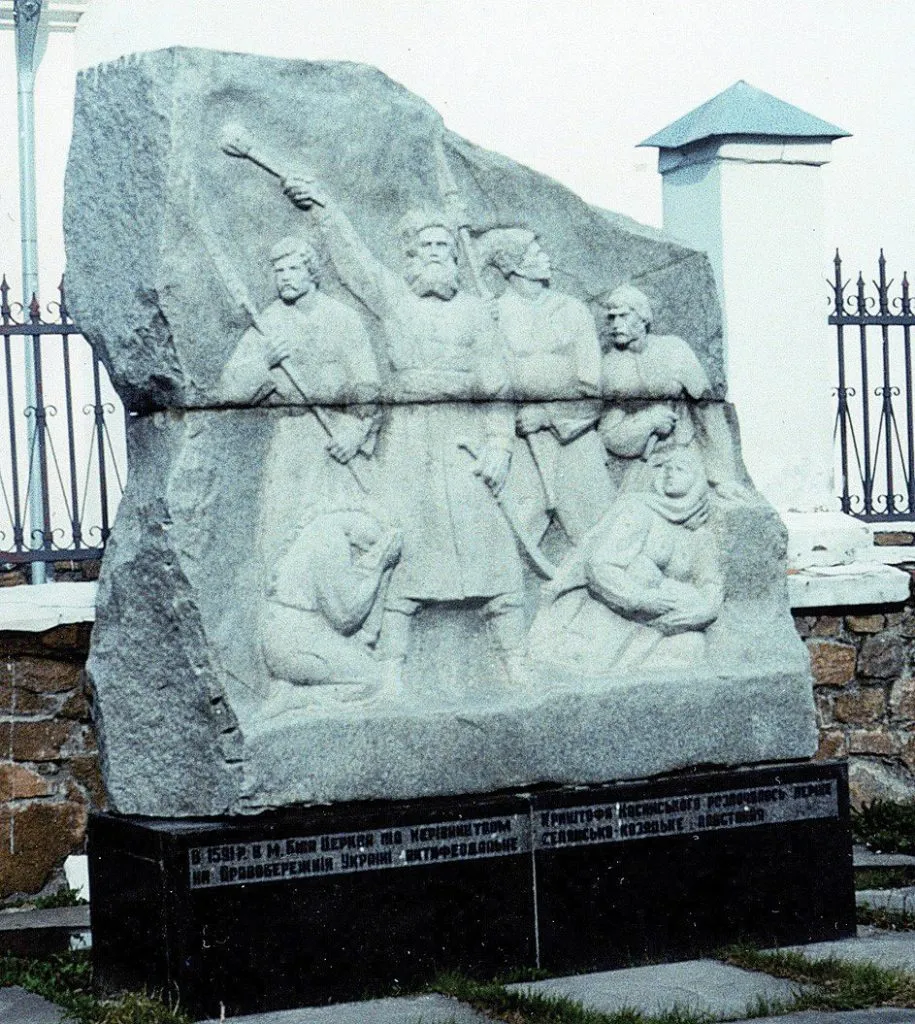
Monument to the Kosynskyi uprising in Bila Tserkva
On the eve of the great explosion
In 1587, after the death of King Stephen Báthory, the crown of the Polish–Lithuanian Commonwealth passed to Sigismund III – the son of the King of Sweden and his wife, the Polish princess Catherine. The new monarch’s plans included creating an empire that would comprise Poland, Lithuania, Belarus, the Muscovite principality, Sweden and Ukraine. But the king was unable to carry out his intentions – the era of his reign (1587–1632) became the beginning of the complete decline of Ukraine, and after it of Poland.
The reign of Sigismund III Vasa was marked by the oppression of the popular masses and the expansion of the nobility’s rights. The Sejm became the sole ruler of the Commonwealth, and it was seated by the nobility, who hated everything Ukrainian – language, religion, culture. On Ukrainian lands the Polish language and Catholicism were forcibly imposed and peasants were enserfed. Placed in inhuman conditions, Ukrainian peasants and townspeople sought a force that could protect them. And such a force was found – the Cossacks, who under the leadership of Khrystofor Kosynskyi waged the first Cossack war against Poland. This uprising began a period of almost incessant wars between Poland and Ukraine, which lasted two hundred years and so exhausted both countries (along with other wars) that it was fairly easy for neighbouring states to tear them apart and deprive them of freedom, which they did.
Khrystofor (Krzysztof) Kosynskyi
His contemporaries did not know when Khrystofor Kosynskyi was born. It is not known whether he was a Pole or a Ukrainian, or what religion he professed. He was a petty nobleman from Podlachia (present-day Belarus, the environs of Brest) who found refuge among the Zaporozhian Cossacks. The first mention of this man is found in a letter of the Kish otaman Bohdan Mikoshynskyi, in which Kosynskyi is spoken of as a deserving member of the Zaporozhian brotherhood.
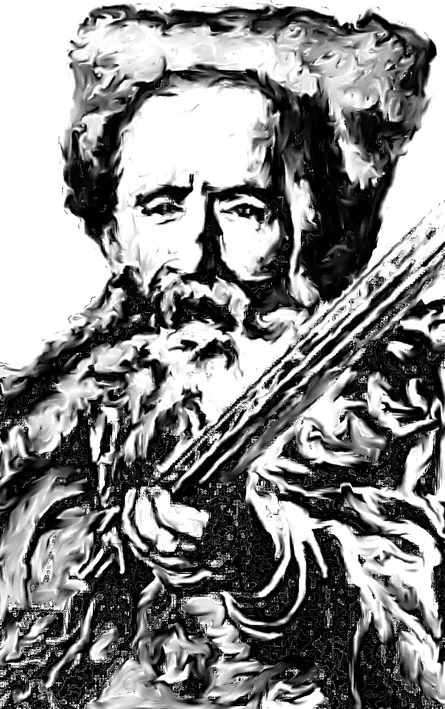
Khrystofor (Krzysztof) Kosynskyi
Kosynskyi emerged onto the historical stage in 1590. The Sejm, for outstanding service in the war against the Tatars, granted Khrystofor an estate in the Kyiv region, near the Ros River. This was the village of Rokytne (today a district centre in Kyiv Oblast), surrounded by the lands of the Bila Tserkva starosty. The starosta of Bila Tserkva was Janusz Ostrogski, son of Prince Vasyl-Kostiantyn Kostiantynovych Ostrogski, voivode of Kyiv and senator. Janusz did not let Kosynskyi settle on the granted lands – somehow he obtained from the king a charter for the possession of Rokytne, most likely without informing Sigismund III that this estate already belonged to Kosynskyi, and seized the village, adding it to the lands of the starosty. It is hard to describe the indignation and wrath that seized Khrystofor. He gathered a considerable Cossack detachment around him and on 19 December 1591 attacked Bila Tserkva, hoping to take revenge on Janusz Ostrogski.
The uprising
Bila Tserkva Castle was one of the most important strongholds of the Commonwealth in eastern Ukraine. It was meant to block the path of the Tatars and keep the local population in submission, preventing peasants from fleeing to Zaporizhzhia. Only a year had passed since the suppression of the uprising of the Bila Tserkva townspeople*, so the situation in the town was very tense: the court had sentenced the most active participants in the uprising to death in absentia, and the starosty administration cruelly punished townspeople for the slightest sign of discontent. So it is no wonder that the townspeople, who hated the Ostrogskis, fully supported Kosynskyi and went over to his side. Bila Tserkva Castle was taken practically without a fight. The rebels seized artillery and ammunition. Janusz Ostrogski was not in the town at that time.
Kosynskyi was proclaimed hetman of the Cossack army. The rebels’ success stirred up the local population. Peasants began driving the nobility from their estates and seizing their lands and property. Many peasants proclaimed themselves Cossacks and joined the army of Khrystofor Kosynskyi. The rebels captured Trypillia (now a village in Obukhiv district of Kyiv Oblast), which at that time had a well-fortified castle, and a little later Pereiaslav (now a district centre in Kyiv Oblast – Pereiaslav-Khmelnytskyi).
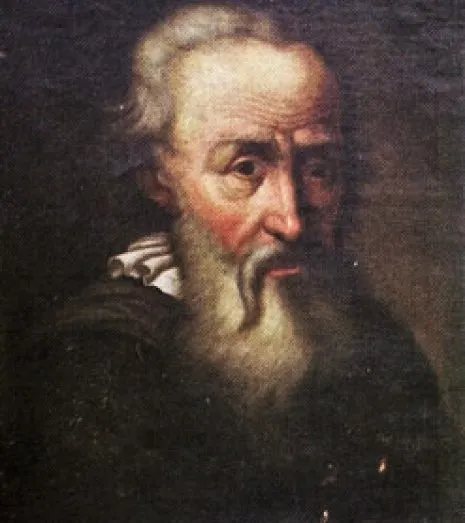
Vasyl-Kostiantyn Ostrogski
Frightened by the scale of the popular movement, Sigismund III already in January 1592 appointed a commission to investigate the “wilfulness” and punish the guilty. The royal investigators – Yakiv Pretvych, starosta of Terebovlia, Oleksandr Wiśniowiecki, starosta of Cherkasy, Strus, starosta of Bratslav, Hulski, starosta of Bar, and others – under the command of Prince Jazłowiecki set off with a large military detachment for Trypillia, where the rebels had encamped. The noble army halted near Fastiv (now a district centre in Kyiv Oblast). A letter was sent in Jazłowiecki’s name to the rebel camp, in which the Poles proposed that Kosynskyi be handed over and weapons laid down. The rebel leaders accepted the letter and began negotiations, fearing to engage the Poles in battle, whose army outmatched the rebels, above all in weaponry and possibly in numbers. Through the negotiations the leadership of the uprising tried to gain time and to bring about the disbanding of the Polish army. Persuading the commissioners that Kosynskyi had already lost the hetman’s mace, the Cossack leadership promised to recognise as hetman whomever the Poles appointed and to submit to them completely. An agreement was concluded on these terms, after which the commissioners left their positions near Fastiv and dispersed to their starosties.
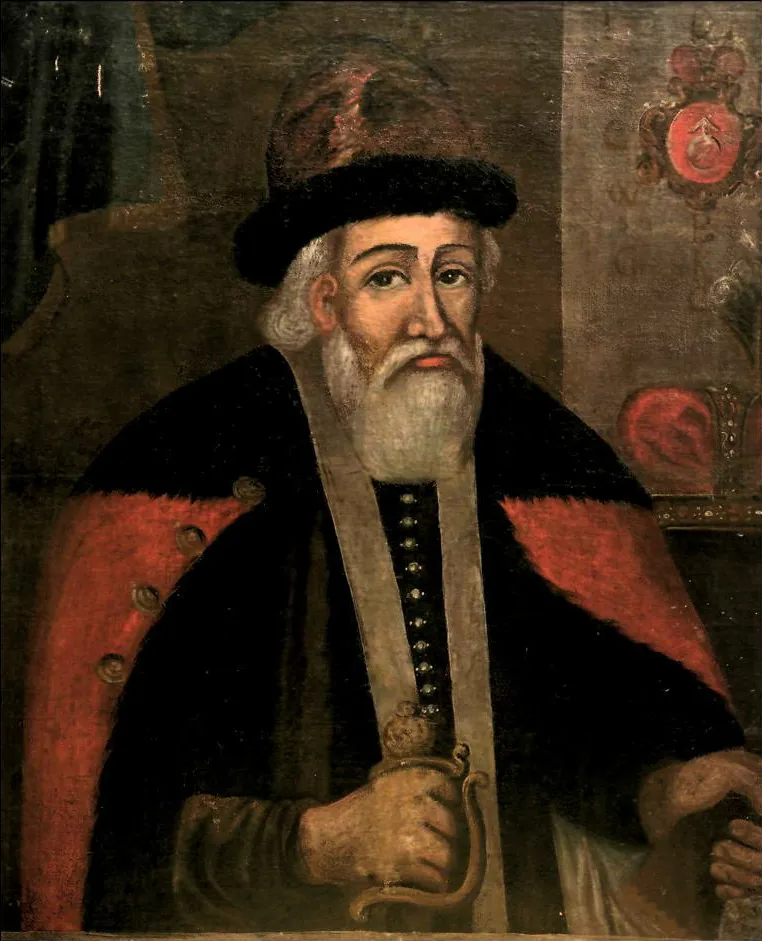
Janusz Ostrogski
But the rebels had no intention of observing the terms of the agreement. The uprising spread quickly. Several times the peasant-Cossack army surrounded Kyiv Castle and plundered the environs of Kyiv. During 1592 and the winter of 1593 the uprising spread to the Volhynian and Bratslav voivodeships. The rebels dealt harshly with the nobility and introduced Cossack order on the seized lands.
Kosynskyi fiercely hated the Ostrogskis, evidently because of the estate taken from him, or perhaps for some other reason that history has not passed down to us. He constantly tried to hurt them, seizing and destroying estates and castles.
At the September Sejm of 1592 the Ukrainian magnates led by Kostiantyn Ostrogski – deputies from Ukraine – demanded that the crown army be sent to suppress the uprising, but their appeal was not supported by deputies from the central Polish lands. Most deputies rejected the demand to send the crown army to Ukraine.
Prince Kostiantyn Ostrogski gathered around him practically all the nobility of the Kyiv, Volhynian and Bratslav voivodeships; his detachments consisted of noble cavalry and German hired infantry. Janusz Ostrogski hired soldiers in Galicia and Hungary. In all, the Ostrogskis had at their disposal a large, well-armed army properly prepared for war. Setting out on the campaign, the nobility hoped for a quick victory. Kostiantyniv (now Starokostiantyniv, a district centre in Khmelnytskyi Oblast) was designated as the assembly point for the army.
Defeat
The poorly armed and equally poorly equipped rebels, mostly unfamiliar with military matters, seemed unable to resist the noble army. At that time there were severe frosts, and the infantry, which formed the main strength of the peasant-Cossack detachments, could not dig in in the frozen ground. The rebels’ situation was extremely hard. Because of the cold and food shortages many of them went home.
The peasant-Cossack army was stationed near Ostropil (now an urban-type settlement in Starokostiantyniv district, Khmelnytskyi Oblast), but under pressure from the enemy’s superior forces Kosynskyi began to withdraw the rebels to more advantageous positions. On 23 January 1593 a battle began near the town of Piatka, near Chudniv (now a district centre in Zhytomyr Oblast). On the first day the light Cossack cavalry went on the offensive and defeated part of the noble army. The soldiers of the vanguard detachments began to scatter, and the Cossacks rushed to pursue them, but Ostrogski’s main forces arrived and the rebels were forced to take shelter behind the town walls. For a whole week Kosynskyi’s army defended itself, suffering enormous losses. Two thousand rebels fell in this battle.
It is not known exactly how negotiations between the nobility and the rebels began or why Ostrogski agreed to conduct them. Most likely his army had also suffered significant losses, so the prince decided to stop the bloodshed. On 31 January 1593 Kostiantyn Ostrogski, on behalf of the lords’ army, and Khrystofor Kosynskyi with the military scribe, on behalf of the Cossacks, signed an agreement shameful for the latter side, under which the Cossacks lost all their artillery and banners. They were also to return everything looted from the lords, immediately remove Kosynskyi from the hetmancy and reduce the number of registered Cossacks to a minimum. However, despite his hatred of him, the prince nevertheless let Kosynskyi go.
Without thinking long, Kosynskyi set off for Zaporizhzhia, where he began preparing a new uprising. In the summer of 1593 a Cossack army of two thousand set out from the Zaporozhian Sich. In two detachments, one of which sailed in boats, the Cossacks approached Cherkasy, where the starosta of Cherkasy, Prince Oleksandr Wiśniowiecki, was staying. The siege of the town began. Realising the hopelessness of his position, Wiśniowiecki decided to resort to trickery. He invited Kosynskyi into the town supposedly for negotiations, where he treacherously seized and killed him. According to folk legends, the lords, having seized Kosynskyi, walled him into a pillar in one of the Catholic monasteries.
After Khrystofor Kosynskyi’s death the uprising did not subside, and the Cossacks did not lift the siege of Cherkasy. Wiśniowiecki was forced to sign an agreement under which the registered Cossacks received the right to free contacts with the Sich, as well as the right to complain to the voivode about starostas and the starosty administration.
In the autumn of 1593 the uprising flared up with new force. An army of four thousand approached the walls of Kyiv. But the siege did not last long, because the Cossacks received alarming news – the Tatars led by the khan had attacked the Zaporozhian Sich. The Cossacks set off to defend the Sich. In Zaporizhzhia at that time there was only a small detachment, which after a short but courageous fight abandoned the camp. The Tatars destroyed it completely but gained little from it, since the Sich was empty.
By harsh measures the Polish authorities and local lords managed to tame the revolt begun by Kosynskyi. But this victory was short-lived, for not even half a year passed before a new, still more formidable uprising broke out, led by Prince Ostrogski’s former sotnyk Severyn Nalyvaiko.
Kosynskyi’s revolt was drowned in blood, but its significance for Ukrainian history is inestimable. It was the first organised mass nationwide action of the oppressed Ukrainian population. A strange coincidence of circumstances made the rebels’ chief executioner a leader of Ukrainian education and fervent defender of the Orthodox faith, Prince Vasyl-Kostiantyn Kostiantynovych Ostrogski.
*The uprising in Bila Tserkva. In 1589 King Sigismund III granted Bila Tserkva Magdeburg law, but the Ostrogskis arbitrarily abolished this privilege, demonstrating to the inhabitants their omnipotence and independence from royal authority. Dissatisfied townspeople rose against the Ostrogskis and seized the town and castle. The uprising lasted a whole year – several thousand armed townspeople for a long time admitted neither royal commissioners nor the servants of Voivode Kostiantyn Ostrogski into the town. The prince had to gather forces from almost the entire Kyiv voivodeship to suppress the uprising.
Author: Roman Malenkov
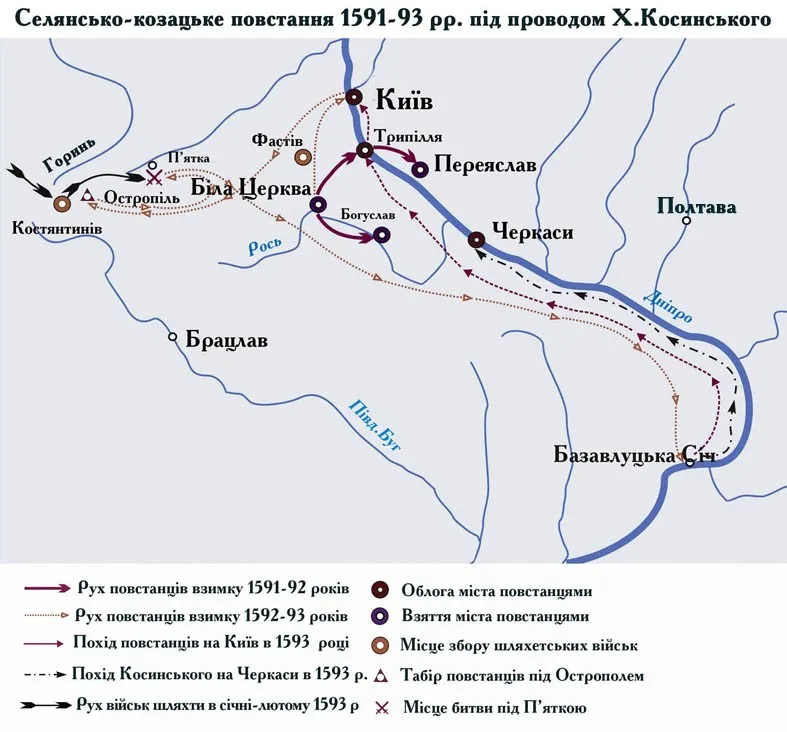
MAP OF THE PEASANT-COSSACK UPRISING OF 1591–1593