Semen Palii

· 9 min read
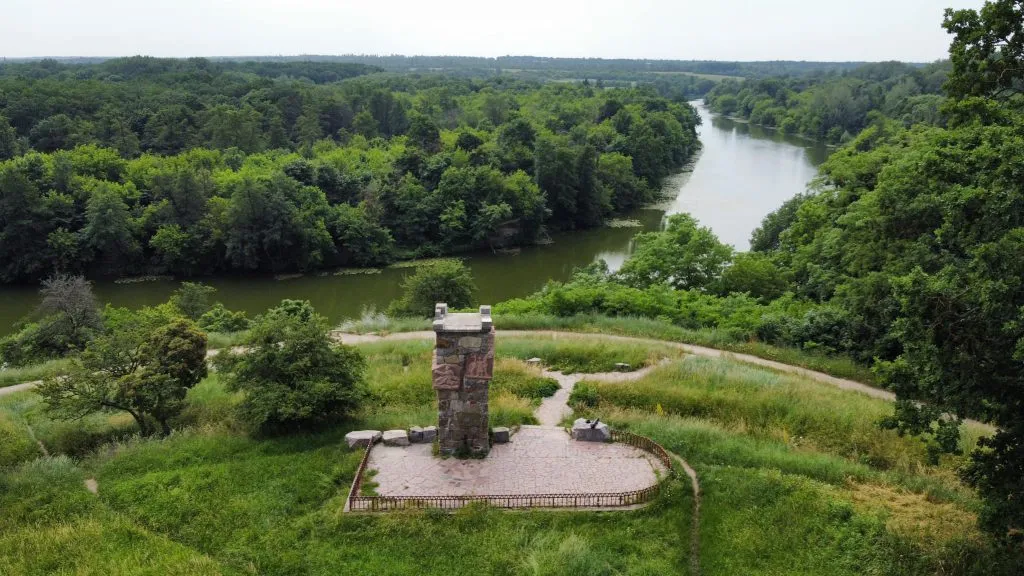
In Bila Tserkva, above the cliffs of the Ros River, rises a monument in the form of a stone tower with a bas-relief of Cossacks and scenes from their military life. Next to the tower stands a cast-iron cannon with cannonballs. This hill bears the name of an outstanding Cossack, Semen Palii.
Franciszek Zamoyski described the Cossack colonel and his activity in Right-Bank Ukraine in the last decades of the 17th and the early 18th century as follows:
“One who wants to rush at the sun with a hoe.”
This apt expression by a Polish official referred to a man about whose heroic deeds legends were composed even in his lifetime, to whom folk tales, songs and kobzar dumy were dedicated. Somewhat later, starting from the second half of the 19th century, historical novels and scholarly monographs began to be written about Palii, and famous artists and folk sculptors embodied his image in their works.
Coming from a Cossack or well-off burgher family, Palii received a decent education; perhaps he studied for some time at the Kyiv Collegium. Here historians’ opinions differ: some note a clear and confident hand, like that of a man accustomed to writing (V. Antonovych), others point out that he wrote Polish badly (M. Vozniak, M. Andrusiak). N. Polonska-Vasylenko tries to reconcile them, drawing attention to the hero’s Left-Bank origin (Borzna in the Chernihiv region), and hence the problems with Polish.
He met the events of the Ukrainian national revolution of 1648-1676 as an ordinary Cossack enrolled in the register of the Nizhyn Regiment. He married, had property, and at first stood out little among the other Cossacks of the Nizhyn Regiment.
But later Palii’s life took a different and glorious path.
Having been widowed, he went to the Zaporozhian lands, where he was in the early 1680s, and soon distinguished himself there both by his military merits and by his organizational abilities. He quickly won authority among the Cossacks and received the nickname Palii.
Later he responded to the summoning universals of the Polish king John III Sobieski and in the summer of 1683, at the head of a unit of Zaporozhian Cossacks, set off for the Austrian capital, Vienna. He took part in the recapture from the Ottoman Empire of the fortresses of Párkány, Esztergom and Szécsény (Hungary, Slovakia), as T. Chukhlib writes.
For this, and for other great victories over the southern invaders, he earned respect from the Polish authorities as well.
King John III in his letter of 6 December 1694 wrote flatteringly to Palii, showering him with gifts:
“…having attacked Budjak, you laid waste the enemy lands with fire and sword, and all that you did laudably, as can only serve to multiply the holy faith and humiliate the enemy… and also for the essential handing over of the prisoners brought in, we wish to do enough so that the activity and courage of your loyalty and your men may be properly rewarded. When we order clothing to be distributed to the other Zaporozhian regiments, we shall certainly not forget the men of your loyalty, who so bravely carried out the present campaign. As for winter quarters, so that they may be longer-lasting and more comfortable than for a year, we give our letter to the most illustrious Castellan of Kraków, that for such evident service he be willing to devise a suitable reward for the proper men, and we do not doubt that he will do so, and we, wishing good health from the Lord God to your loyalty, greet all your lads.”
They were followed by letters of 22 December 1694 from Stanisław Jabłonowski, mentioned in the royal letter, and also from Franciszek Zamoyski, who reported even more flatteringly on the gifts delivered and the king’s gratitude: “…His Grace the benefactor is so grateful for the ‘tongues’ sent and so honours the courage of your lordship… that he will express it himself in his letter. He has already allotted pay and clothing to the deserving army of your lordship, gracious sir, through his lordship the regimentary Mr. Wilga, and likewise due satisfaction to your lordship himself, gracious sir…”.
But the times were hard, and from gratitude to betrayal is one step. One that was often covered in a matter of days. Soon everything turned upside down and they tried to ban the Cossacks by a decision of the Sejm.
Palii did not agree with the decisions of the General Sejm of the Commonwealth of 1699 on such a ban on the Cossacks in the Right Bank.
Together with several hundred Zaporozhians he founded a regiment centred in the town of Fastiv. Under his administration was the territory of the former Bila Tserkva, Kaniv, Chyhyryn and Uman regiments. Palii wrote: “I found this land a desert and worked around Khvastiv as around my own farm. Wide fields were sown with grain, the number of inhabitants grew… and I built God’s churches and adorned them to the glory of God.”
From then on began the colonel’s active activity, which was not only military but also state-building in character. The region was actively restored and populated. Regimentary Druzhkevych wrote to King John Sobieski in 1692 that “Palii is organizing an appanage region around Fastiv; he fortifies towns, gathers people from all around and lays claim to the whole region up to the Sluch.”
Information about Palii’s military activity was circulated in the “flying leaflets” of Austria, Venice, Holland, Germany, Poland and France.
In 1701 the Polish crown army began a broad offensive against the Cossack statehood of Right-Bank Ukraine, and S. Palii broke off all political relations with the king and his protege, declaring his possessions a “free Cossack region”.
In 1702 representatives of the Ukrainian nobility, Cossacks, burghers and clergy decided at a council in Fastiv to raise an anti-Polish uprising. In June of the same year it began with armed actions in Podillia and the Bratslav region and soon spread to the Kyiv region and Volhynia. Memories of the Khmelnytskyi era were still fresh in the memory of the Ukrainian people. Many participants of that heroic epic were still alive.
The uprising was desired neither by the Polish occupation authorities nor by the Muscovites. And if the Poles lacked the strength and ability to defeat the Cossacks, the customary help of the Muscovites completed the rout of the Ukrainian army.
On 2 March 1704 Peter I, in a special letter, urged Palii to hand Bila Tserkva over to the Poles immediately and capitulate, otherwise Muscovite troops would force him to carry out the order. Samus, as acting hetman, handed the mace to Mazepa on 5 February 1704. Palii, on the contrary, rejected the tsar’s demand and intensified the struggle. Partisan detachments stepped up their activity in Volhynia, Polissia and Galicia.
On the evening of 31 July 1704 he was arrested in the Cossack army camp near Berdychiv. In June 1705 he was sent under guard to Moscow. By a tsarist decree of 30 July the Cossack colonel was exiled to Siberia, first to Verkhoturye, then to Tobolsk, where he stayed until the end of 1708.
Semen Pylypovych Palii (Hurko) died a natural death after 24 January 1710 and was buried with honours in the Mezhyhirskyi Transfiguration Monastery near Kyiv.
About this last page in the life of the Cossack hero Taras Shevchenko wrote brilliantly, in effect capturing the difficult turns of the tragic fate and the deathbed feelings of an outstanding figure of our history:
In Kyiv on the Podil
There once was… and never
Will return what happened,
Will return what was hoped for,
Will not return… But I, brother,
Will still go on hoping,
Will still go on looking out,
Giving sorrow to my heart.
In Kyiv on the Podil
Our brotherly freedom,
Without serf and without lord,
All by itself in its zhupan
Unfurled in merriment,
Spreads velvet on the roads
And covers them with silk
And turns aside for no one.
In Kyiv on the Podil
The Cossacks carouse.
Like water, by pail and bucket,
They pour out the wine.
Cellars, taverns with tavern-keepers,
With wines and meads
The Zaporozhians bought up
And drink from their ladles.
And the music roars and plays,
Cheering the people.
And from the Brotherhood the students
Look out in silence.
A bare-pocketed school has no freedom,
Or it would have pleased them…
But who is that the people
Have crowded round with music?
In red velvet trousers
Sweeping the street with their wide seat
Walks a Cossack. — Oh, years! years!
What have you done! — And with that
The old man struck his heels,
So that dust rose! There!
And the Cossack even sings along:
— Along the road a crayfish, crayfish,
Let it be so, so.
If only the young women
Would sow some poppy, poppy.
I’ll give woe to the heels,
I’ll give woe to the heel-plates,
What’s left I’ll pass on.
And those heels already
Have had their fill of woe and torment!
I’ll give woe to the heels,
I’ll give woe to the heel-plates,
What’s left I’ll pass on!
All the way to Mezhyhirskyi Spas
The grey-haired man danced.
And after him the company
And all holy Kyiv.
He danced right up to the gate,
Shouted: “Hoo! hoo!
Greet, holy monks,
A comrade from the Meadow!”
The holy gate swung open,
They let the Cossack in,
And again the gate was shut,
Shut forever
On the Cossack. Who is this grey-haired man
Who bade farewell to the world?
Semen Palii, the Zaporozhian,
Not finished off by woe.
Oh, high the sun rises,
Low it sets.
In a long cassock along the cell
An old monk walks.
The monk goes to Vyshhorod
To look at Kyiv,
And sit on the hillock,
And at least grieve a little.
The monk goes to Dzvonkova
Down the ravine to drink water
And recalls how hard it was
To live in the world.
The monk goes to his cell
Between the silent walls
And recalls his years,
The years of his youth.
He takes the holy writ in his hands,
Reads aloud…
But in his thoughts the old monk
Flies far away.
And God’s words fall silent
And in the cell, as if in the Sich,
The glorious brotherhood comes alive.
And the grey-haired hetman, like an owl,
Peers into the monk’s eyes.
Music, dances and Berdychiv.
Fetters clank… Moscow,
Pine forests, snows and the Yenisei…
And from his eyes there rolled
Tears onto his cassock… Bow down!
And pacify your aged flesh.
Read the holy scripture,
Read, read and listen to the bell,
But do not indulge your heart,
It led you to Siberia,
It fooled you all your life.
Lull it to sleep and abandon
Your Borzna and the Fastiv land,
Everything will perish, you yourself will perish.
And none will remember that you ever lived…
And the old man sobbed bitterly.
He stopped reading the scripture.
He paced the cell. He paced,
And then sat down and grew sorrowful:
— Why was I born into the world,
Why did I love my Ukraine? —
For matins the great bell
Howled from the belfry. My monk rose,
Put on his klobuk, took his staff,
Crossed himself, took his prayer beads…
And to pray for Ukraine
The old monk hobbled off.
Author: Ihor Poluiektov