

At the One Street Museum on Andriivskyi Descent you can touch death and immortality at once
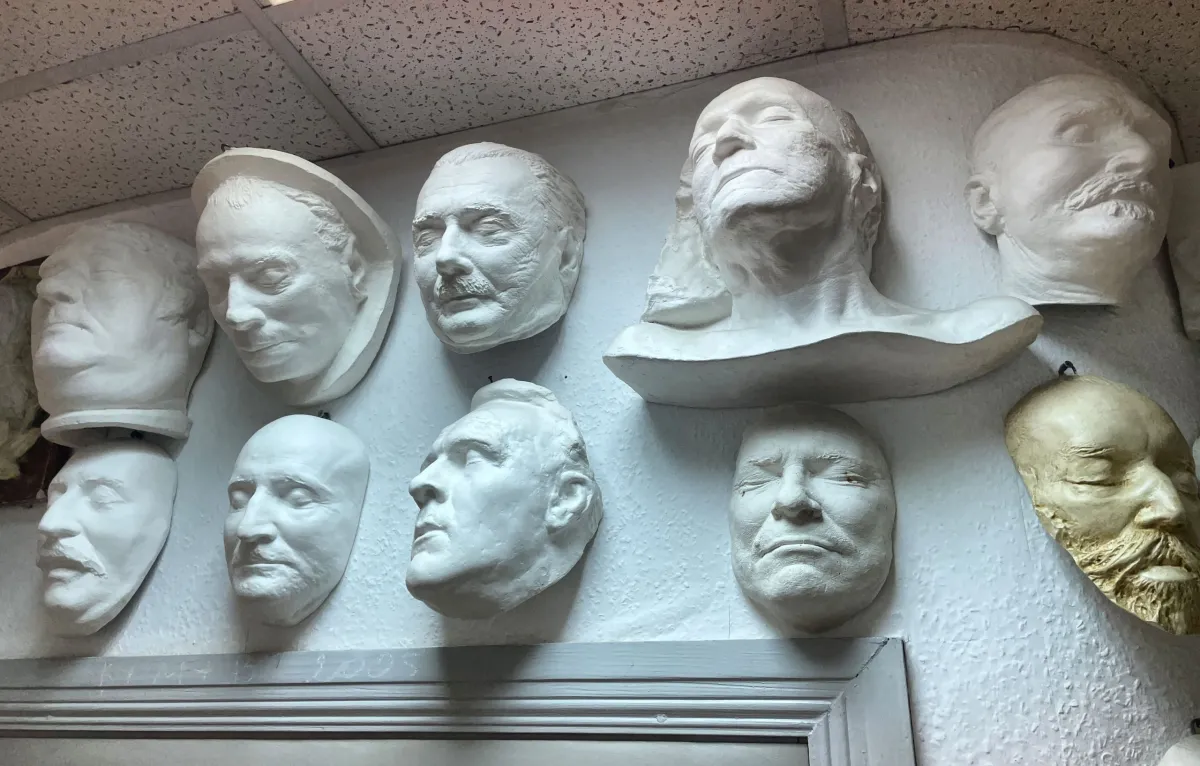
The One Street Museum on Andriivskyi Descent now displays a huge collection of death masks of outstanding and famous people. And it has a unique feature: such exhibitions usually focus exclusively on “their own”. In France — the French, in Italy — the Italians, in Poland — the Poles. But on the Descent we see Ukrainian figures and foreign celebrities side by side.

The collection was born back in 2002, and was first shown — then not yet so extensive — in 2003. At first it was counted in dozens; today there are more than 350 exhibits.
Death masks are valued not only for the stature of the person from whom they were taken. They were usually made by professional sculptors, often very famous ones, so such casts are considered works of art. There is even a separate field of death-mask collecting.

“Our collection began with a few masks found in Kyiv art studios,” said the museum’s director Dmytro Shlionskyi. “At first we collected everything, but later decided to stop at originals or, at least, first copies of originals.”.

Mask of Kemal Atatürk
Originals are casts made directly from the mould taken from the face. Among such originals or very old 19th–20th-century copies that the collection can boast are the masks of Taras Shevchenko, the Swiss educator Johann Pestalozzi and the famous English organist Walter Parratt, author of the musical arrangement of the “Kyivan Kontakion” that was recently heard at the farewell to Queen Elizabeth II.

Mask of Dante
Masks come into the collection in different ways: from foreign museums, from sculptors who took them themselves, or from descendants. Thus the mask of Dmitri Shostakovich was donated by the daughter of the well-known sculptor Nikoghayos Nikoghosyan, who created it. The mask of the painter Martiros Saryan was given by his granddaughter. The museum also tracks auction sales — in particular, the mask of Walter Parratt was bought on the famous eBay.

Mykola Gogol
Some stories resemble a tangled detective tale. Such is the story of the mask of Lesya Ukrainka. For a long time it was considered the “mask of an unknown woman” and was kept in the diaspora. A few years ago an unknown man handed it to the Solomiya Krushelnytska museum in Lviv. A copy for the One Street Museum was made by the well-known Lviv sculptor Petro Dzyndra. Given the striking resemblance to the poetess, a wide expert examination was carried out, which confirmed: this really is the death mask of Lesya Ukrainka, the existence of which no one had known before.

Lesya Ukrainka
The mask was probably kept in the family and taken to Europe by Lesya’s sisters when they left Ukraine. Later it came to people who no longer knew whose face was immortalized, but understood that the relic was connected with Ukraine, and returned it to the Motherland.
The death mask of Taras Shevchenko is also a pride of the collection.

Mykhailo Starytskyi
For a long time after Taras Shevchenko’s death nothing was known about a death mask having been taken from his face, until in 1877 the then student of the St. Petersburg Academy of Arts, later the famous painter and illustrator Opanas Slastion (1855–1933), became interested in this story.

Symon Petliura
In his memoirs, published in 1931, he recalled: “At the Academy of Arts I still found the old, completely grey-haired model Taras Mykhailov, a friend of T. H. Shevchenko. He was a very interesting white-bearded old man with well-preserved forms of his sturdy, perfectly built body; cheerful, talkative and fairly educated. Grandfather Taras drew the general attention of all the students, who often turned to him with various questions about artists, professors, their works, paintings, relationships, behaviour, various anecdotal incidents and so on…

Yevhen Konovalets
And about T. Shevchenko Taras Mykhailov told me this: “At my request, Shevchenko’s mask was taken from the dead poet by my old friend, the mould-maker Riepin, who has his workshop opposite the Academy gates… And I (O. Slastion) obtained that mask through the recommendation of Academician P. Zabello, because the ninety-year-old Grandfather Riepin did not want to look for the mould that was lying somewhere in storage.

Mykola Sadovskyi
When I saw this mask, magnificently executed, where every pore is visible and there is no pockmarking, as someone wrote, I ordered several more pieces from the old man. From one such mask, which I then gave to the late V. L. Berenshtam, a bronze mask was cast at the Chopin foundry and sent to Kyiv.”

Taras Shevchenko
And for the jubilee Shevchenko exhibition of 1911, O. Slastion cast a dozen copies from his original, which quickly scattered among admirers of the great poet and artist.
The collection of the One Street Museum includes an early cast from the mould of Taras’s death mask that belonged to relatives of his close friend Oleksii Senchylo-Stefanovskyi, who had an estate on the Descent, directly opposite St. Andrew’s Church.
Let us stop here, because the story could grow to the size of a book.
Visit the exhibition — and you will see and learn more for yourself!


