Kyiv stories about the Tuptalo family, Dimitry of Rostov, Meletii Dzyk and the Church of St. Cyril

· 21 min read
We used to be taught that tsars and empresses had some connection to my capital, some right to be known to me, and from every corner, every tour and every information booth people tried to convey that they were part of the history of this glorious city, while the true history of Kyiv and of the famous families who really made it was something I was not supposed to know.
It is good that we can at last learn more, discuss and admire those who truly were part of Kyiv’s history.
And I would like to help preserve the memory of them. How? I will show it through the example of two remarkable families that were lost in history, yet deserve to be known, honoured and remembered by us.
I will tell you about:
– how I want to help the Church of St. Cyril and restore lost artefacts that told of outstanding figures of our history;
– how people became saints;
– how long-livers lived through three centuries, surviving the most glorious Cossack era from Sahaidachny to Mazepa;
– how the Cossacks nurtured Kyiv;
– how Kyiv families combined Cossack glory, noble privileges, high European education and devotion to local traditions and faith;
– how curiously the destinies of Kyiv families and outstanding architectural monuments are intertwined, monuments that have survived to our day, preserving the memory of generations and still retelling these stories, which would have been forgotten had it not been for the stone walls of the shrines.
If this longread is too much for you, please skip straight to the end of the text and read about my initiative to help old Kyiv.
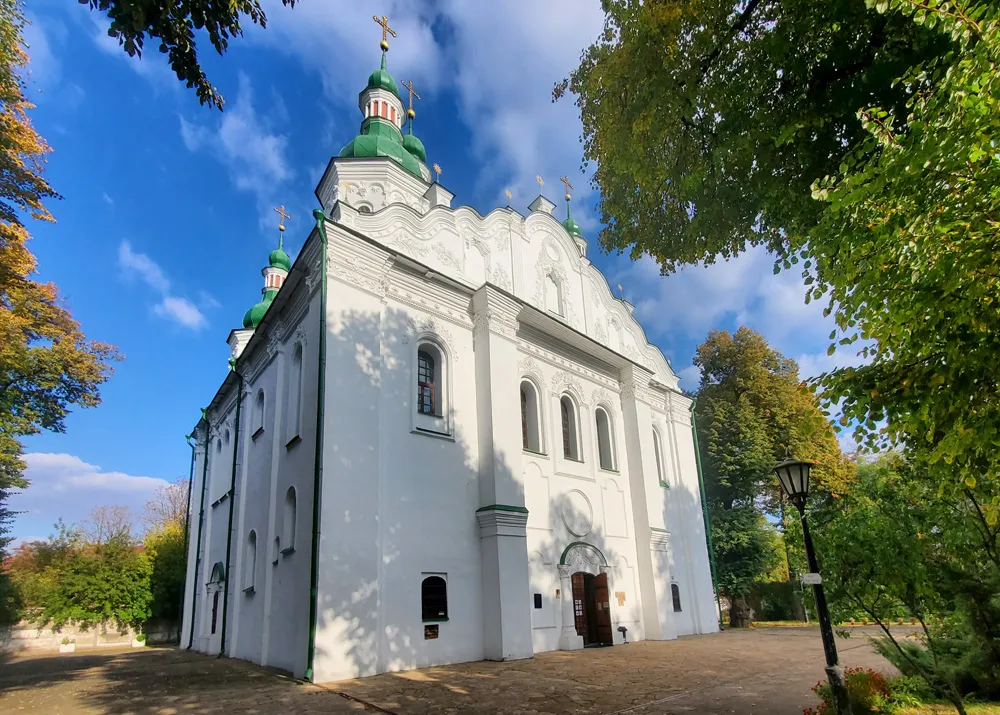
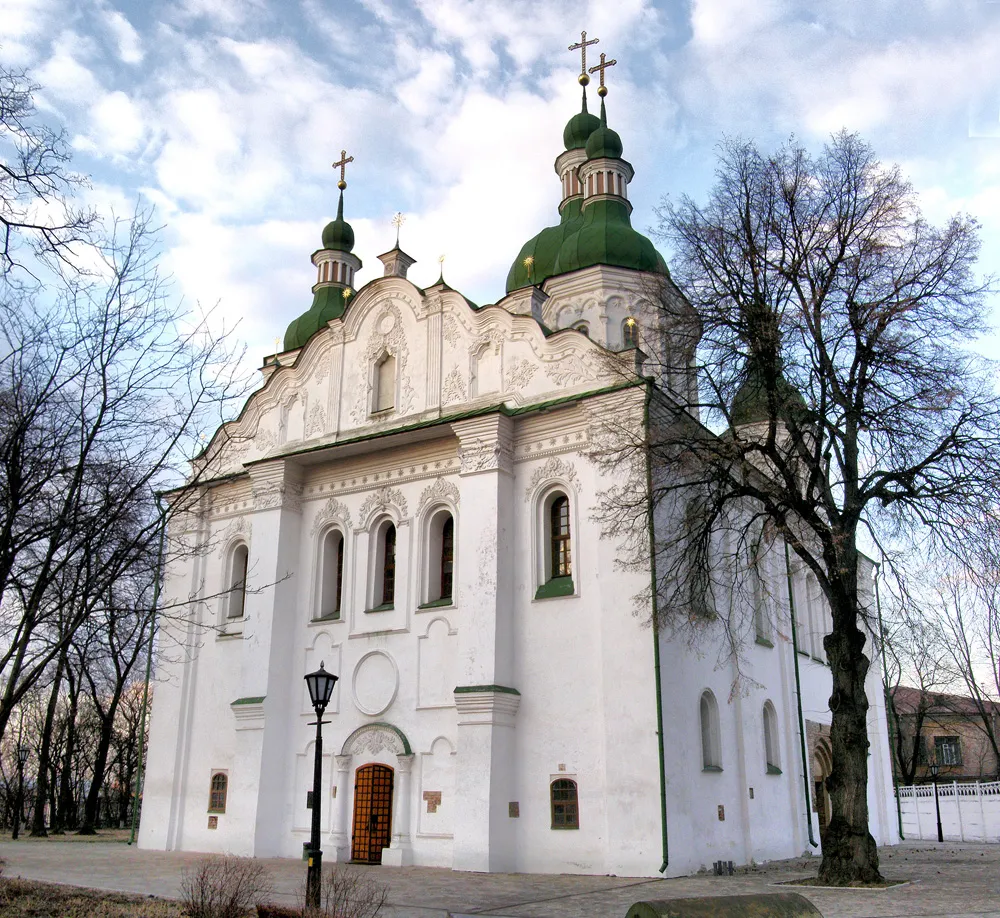
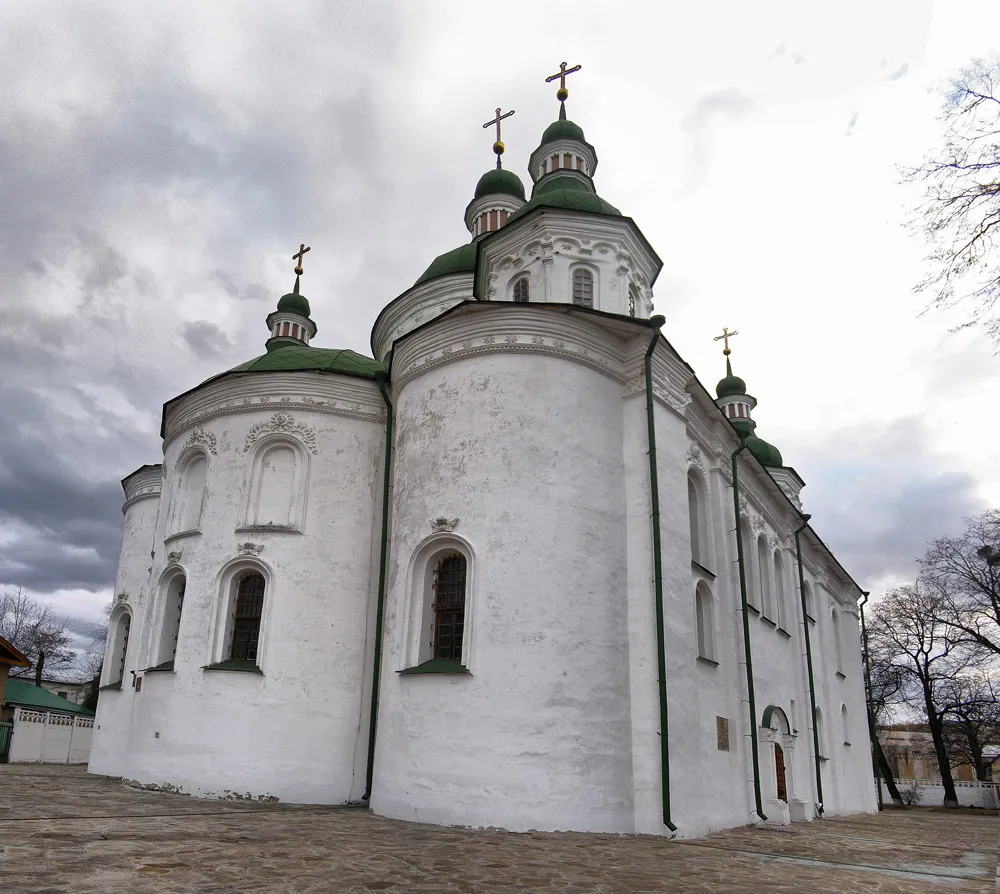
Photo: Church of St. Cyril
Our story begins in 1599, when Savva was born into the family of Hryhorii Tuptalo, and managed to catch a glimpse of the 16th century with one eye.
While his father was a minor Orthodox nobleman, another relative, Bishop Innokentii Tuptalo of Podillia, was a prominent figure at the Synod of Brest in 1596, where he spoke against the union and for the independence of the Greek (Orthodox) Church.
Young Savva grew up amid grand events unfolding before his eyes: under Hetman Petro Konashevych-Sahaidachny the Cossacks carried out their legendary sea campaigns against Varna (1606-1608, 1612), Perekop and Ochakiv (1607), Bilhorod and Izmail (1609), Trebizond and Sinop (1614, 1616) and Istanbul (1615, 1616); the campaign against Caffa (Feodosia) (1616) won the greatest renown, not only in Ukraine. A successful war against Muscovy went on, in which many of its towns were burned and plundered and Moscow itself was besieged by the Cossacks (1610, 1618); Cossack bread was earned by military craft as far as Prague (1619-1620); and in 1621 the great battle against the Ottomans took place at Khotyn.
Such examples could raise true heroes, and Savva Tuptalo became one, lending a strong Cossack hand with a sabre to the restoration of his native land’s independence. It is a unique case of being part of the era of the glorious Petro Konashevych-Sahaidachny and the legendary Bohdan Khmelnytskyi, and ending his military and administrative service already under the hetmanship of the renowned Ivan Mazepa.
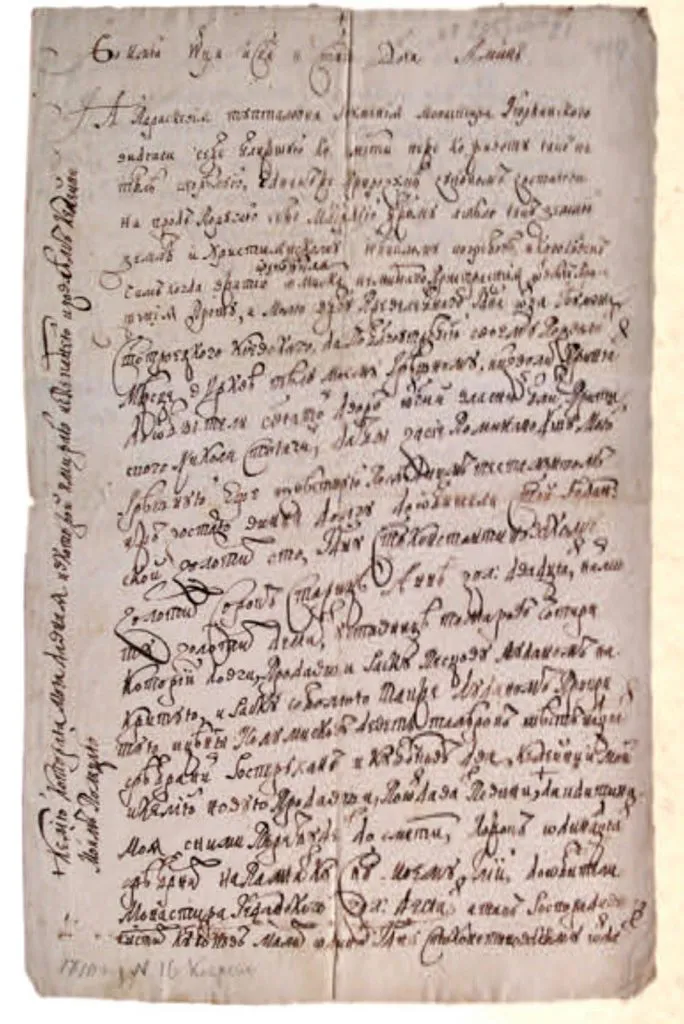
Photo: The will of the last daughter of the Tuptalo family concerning the family estate near the Church of St. Nicholas Prytysky. The house and land remained in the Tuptalo family’s possession until 1710, when the youngest, Paraskeva, before her death bequeathed “her paternal courtyard near Prytysky Nicholas” to the Kyiv Cyril Monastery
One of the documented events of his life was Polish captivity, into which he fell in 1670-71. It was followed by an unexpected release, and Savva was sent with a group of officers to Dymer. “And from Dymer Colonel Pyvo sent him to Poland to Hetman Jan Sobieski.” The Crown Hetman had clashed with the Turkish army at Khotyn. Knowing for certain that the sultan would seek revenge for the defeat, Sobieski courted the Cossacks and sent a captured captain to Petro Doroshenko, Hetman of Right-Bank Ukraine.
As an ordinary Cossack, Savva took part in almost all the battles and campaigns of the Kyiv Regiment as a military unit of the Zaporozhian Host. At the end of the 1650s Tuptalo was elected captain. He also collected the “toll”, a fee for crossing the Irpin near the village of Mostyshche, owned property in Kyiv, a farmstead in Priorka, several hayfields, the fish-rich Chernech Lake and other good sources of income.
He served until the last days of his life: at the age of 85 we still find reports of him on horseback (the noted Cossack scholar T. Chukhlib cites such data; other sources show that he was still a captain in 1686), but he also devoted much time to other important matters of the city’s development.
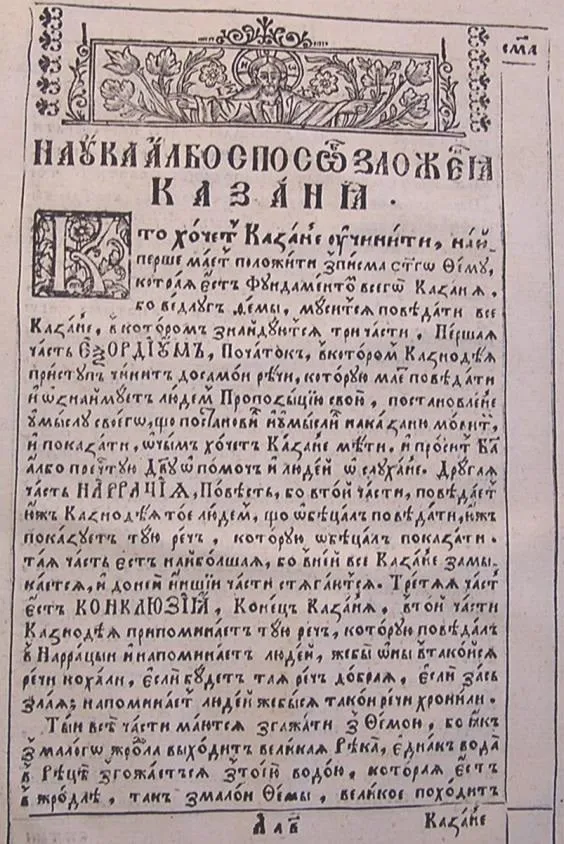
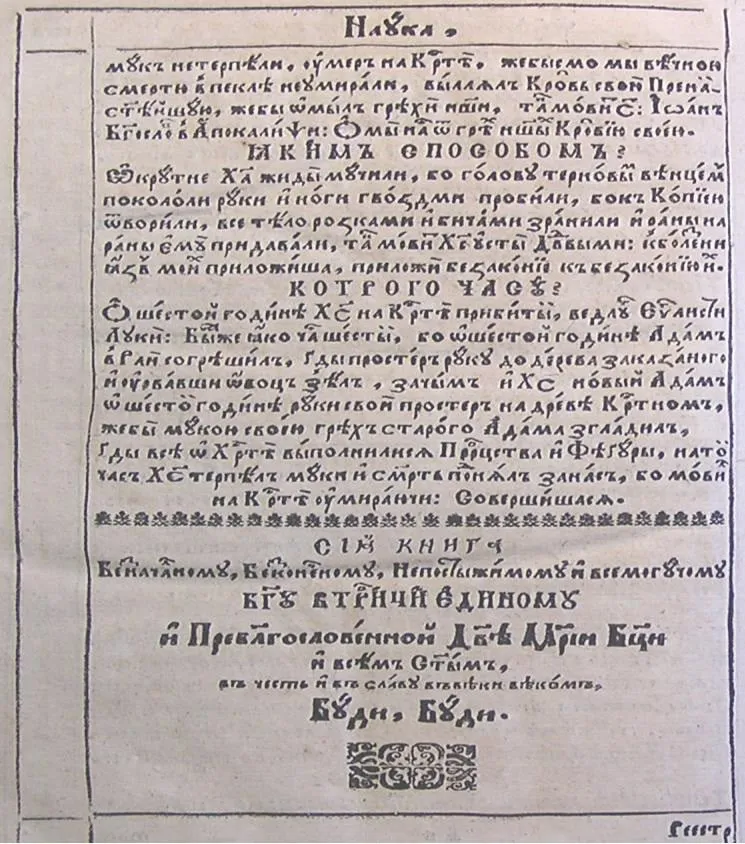
Photo: Ioanykii Haliatovskyi, author of the first native textbook on rhetoric, “The Science, or the Way of Composing a Sermon”. A splendid specimen of the Old Ukrainian language
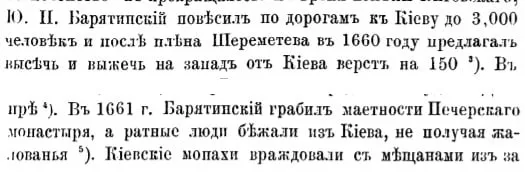
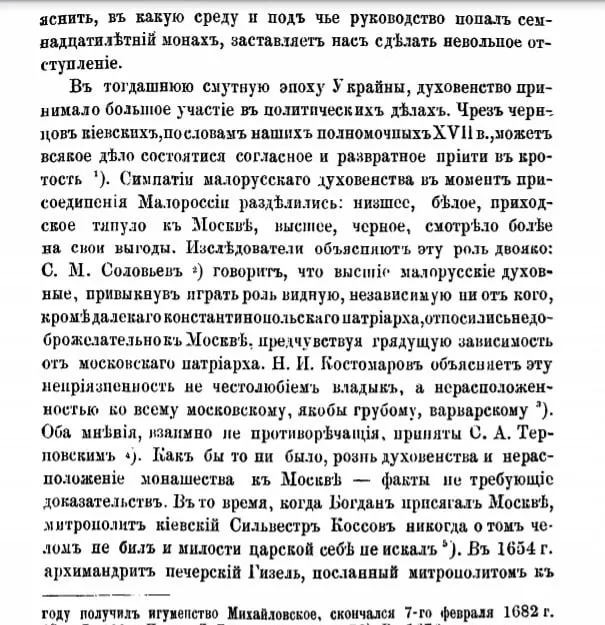
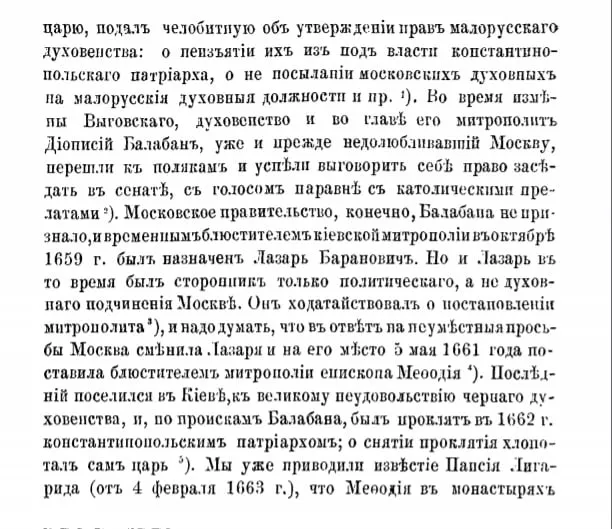
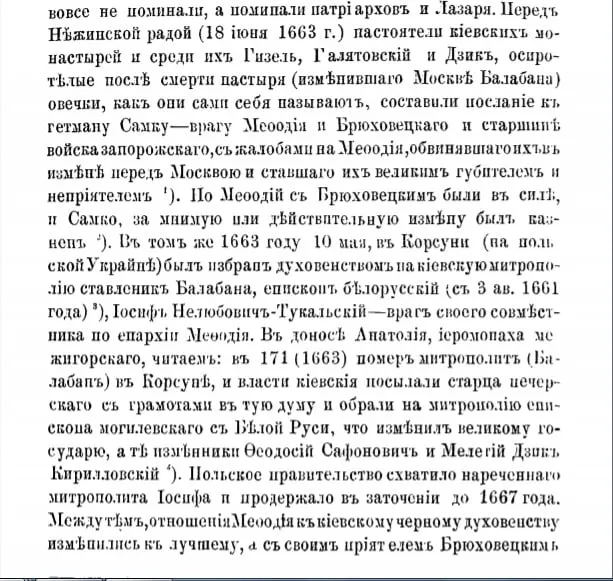
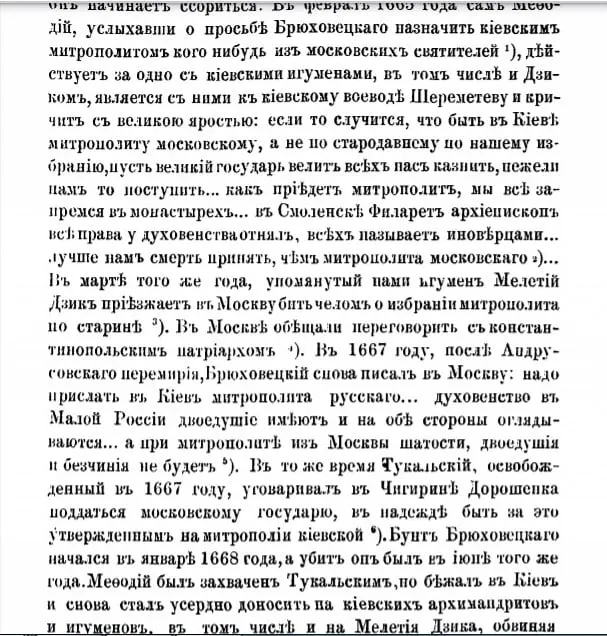
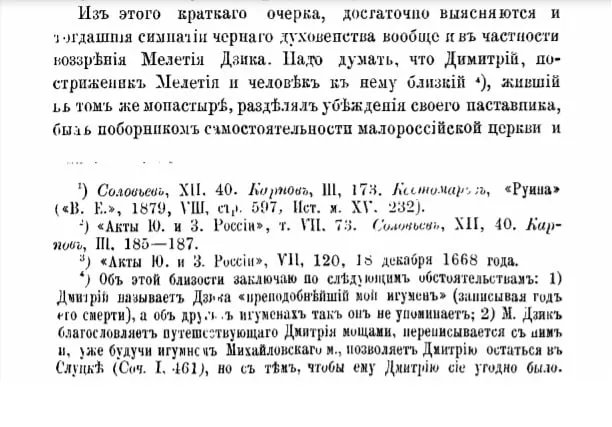
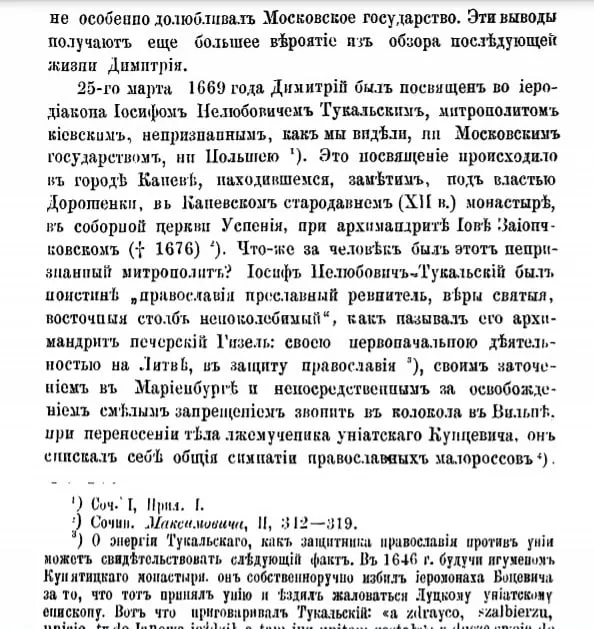
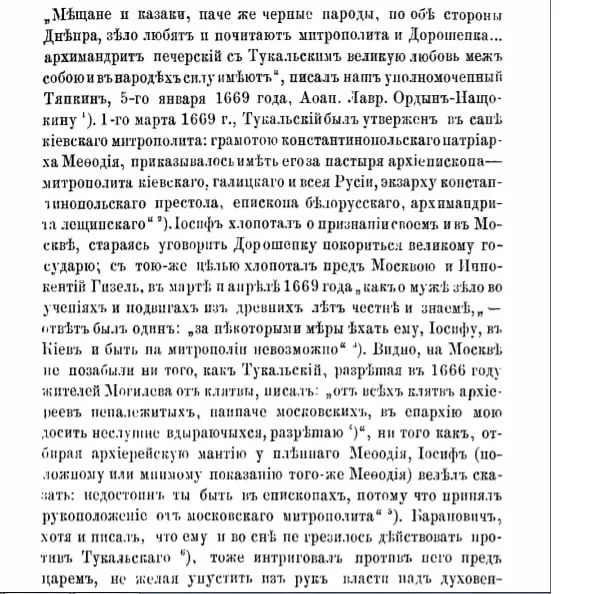
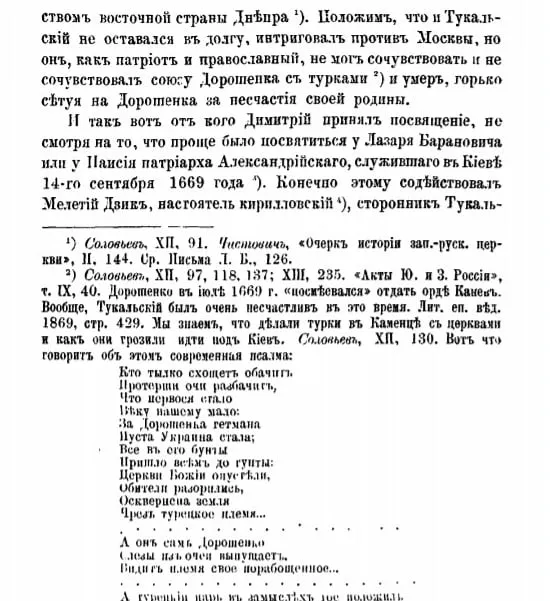
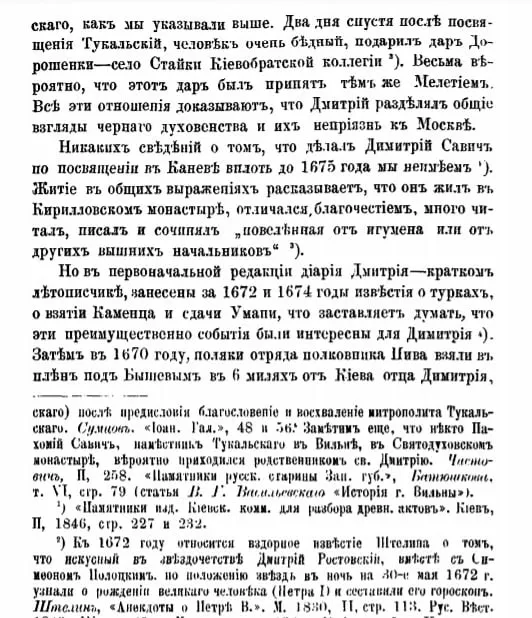
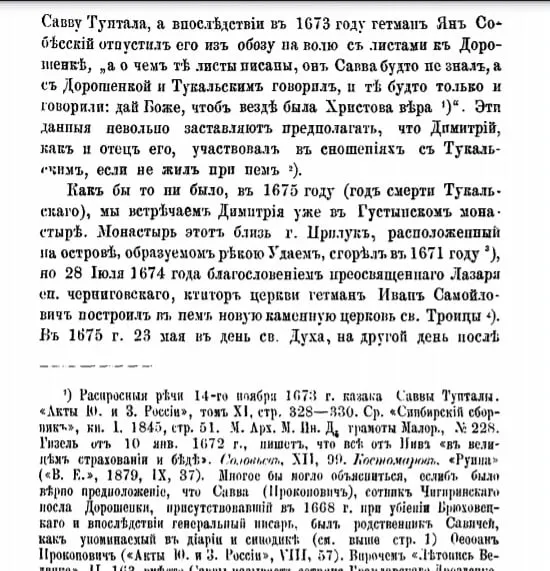
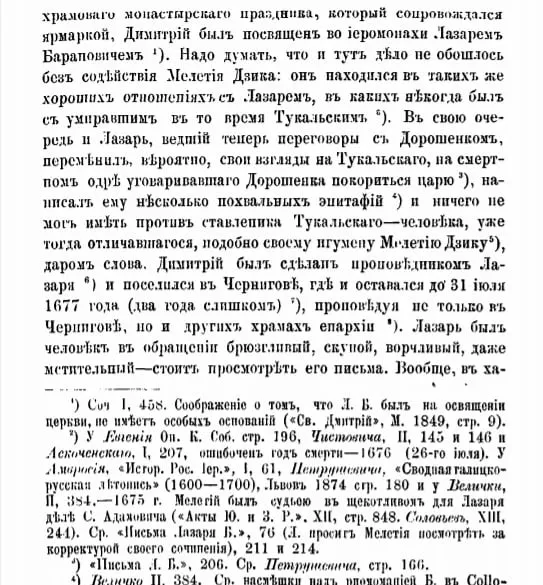
Photo: From the book by the Russian I. O. Shliapkin “St. Dimitry of Rostov and His Time” (1891), on the intentions and misdeeds of the Muscovites in Kyiv
A son, Danylo, was born, who would enter the history of several countries as a saint of the Orthodox Church (under the church name Dimitry of Rostov Tuptalo), as well as four daughters. The saint himself later wrote in his own hand in his “Diary” that his mother “bore him in sin in the year 1651, in the month of December”, “at that time there was the war of Radziwiłł, and he was enlightened by holy baptism”.
Savva’s wife, Maria Mykhailivna, was very devout, and therefore raised her children with respect for traditions, for glorious Kyiv and for their country.
The Tuptalo family donated a large part of their money to charity and helped to preserve numerous Kyiv shrines. This took on special significance in the times of the Ruin.
Savva was a ktitor (patron) of the Cyril Monastery, which would become the burial place of the whole family. The Tuptalo family was commemorated as benefactors in the Brotherhood Epiphany Monastery and in the Kyiv-Mohyla Collegium. He helped the Church of Sts. Helena and Constantine in Podil. Later, in memory of this, another altar in honour of his son was built there. The Nicholas-Jordan Monastery was also restored with the funds of Captain Savva Tuptalo.
The family estate stood between the Florivskyi Monastery and the Church of St. Nicholas Prytysky, which he also supported. The house and land remained in the Tuptalo family’s possession until 1710, when the youngest, Paraskeva, before her death bequeathed “her paternal courtyard near Prytysky Nicholas” to the Kyiv Cyril Monastery (see the photo below). But fate decided otherwise, and the church parish school of the Church of St. Nicholas Prytysky was housed there.
Savva’s daughters also dedicated their lives to service: they founded a convent at the Jordan Church, subordinate to the Kyiv Cyril Monastery, and one after another served as its abbesses: the eldest, Oleksandra, then Pamfiliia, Fevroniia and Paraskeva. The last of them was married before taking monastic vows and, from her marriage to Roman Artemiev, had daughters Sofia and Feodosia and a son, Illia. Paraskeva’s daughter Sofia (1708-1811) was known in Kyiv as “Artemykha”; she was Savva Tuptalo’s granddaughter and the niece of Saint Dimitry, and like her grandfather lived to 103. Her sister Feodosia was married to Ivan Drabynka-Leshkevych. Their daughter Palazhka married the Kyiv architect Andrii Melenskyi in 1810 (the architect of Kyiv’s oldest monument, the Magdeburg Law column, which I am looking after right now and continuing to repair). From this marriage they had a daughter, Feodosia, and a son, Ivan. Palazhka and Andrii Melenskyi’s daughter Feodosia married Vice-Governor Fedorov. Two of their children are known, a daughter, Olena, and a son, Serhii, who lived in Kyiv in the second half of the 19th century.
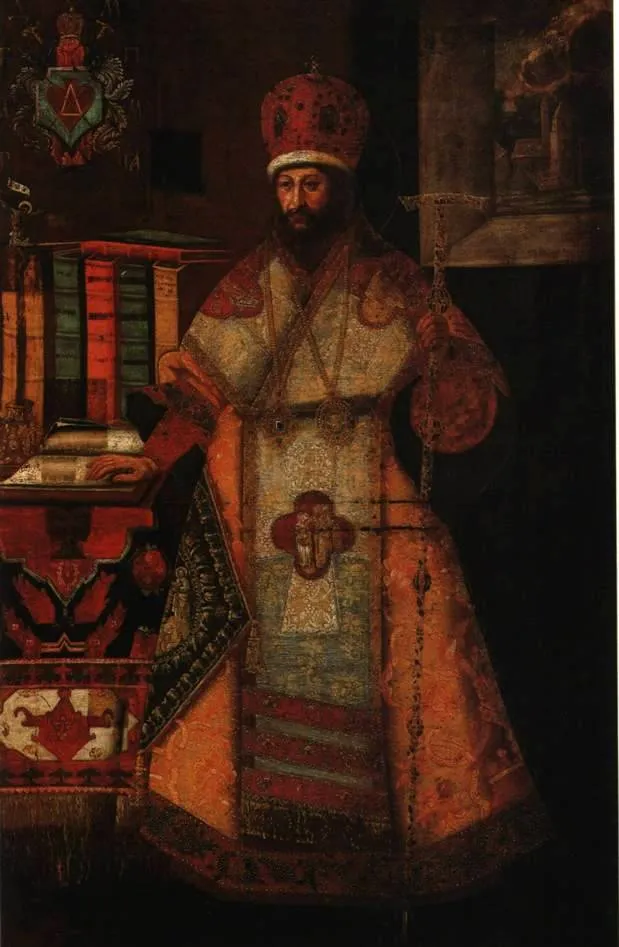
Photo: Dimitry of Rostov
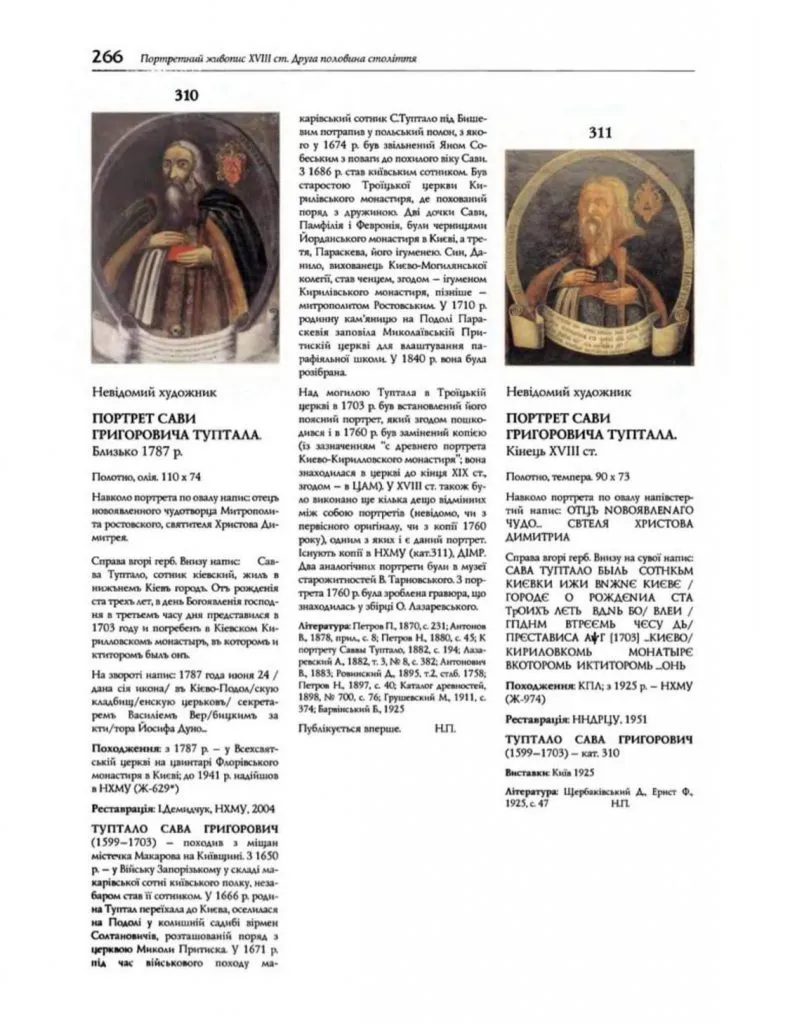
Photo: About the portrait of Savva Tuptalo, a copy of which I want to restore and place above his burial in the Church of St. Cyril
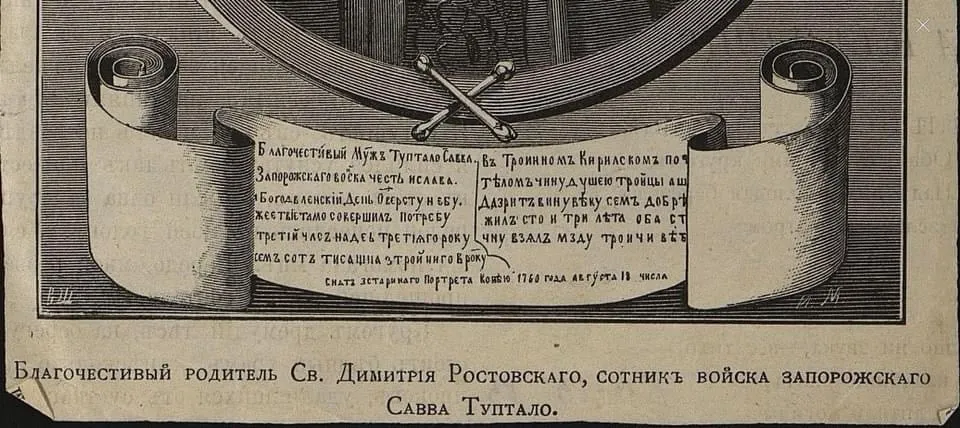
Photo: The inscription that was on the portrait
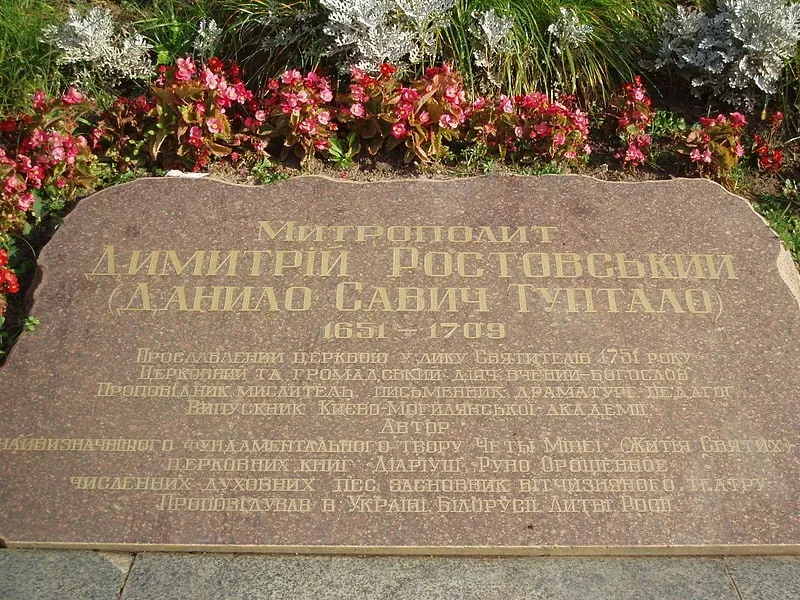
Photo: Memorial plaque in honour of Saint Tuptalo
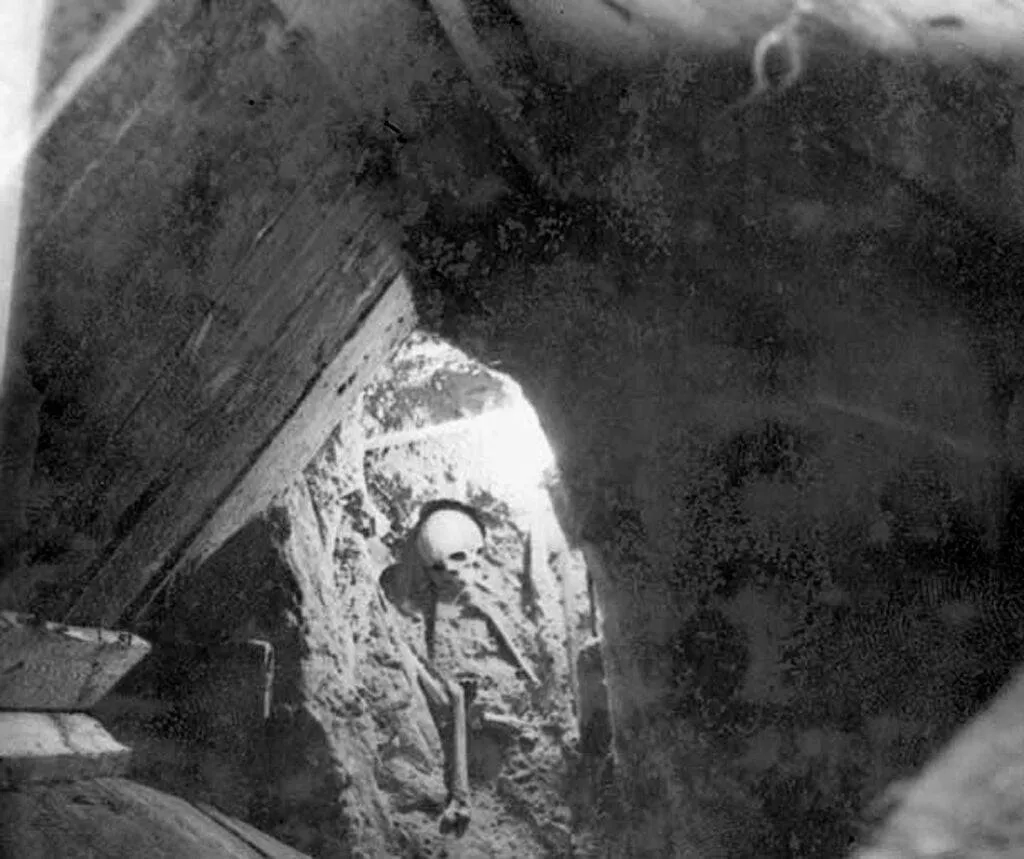
Photo: Burials in the Church of St. Cyril
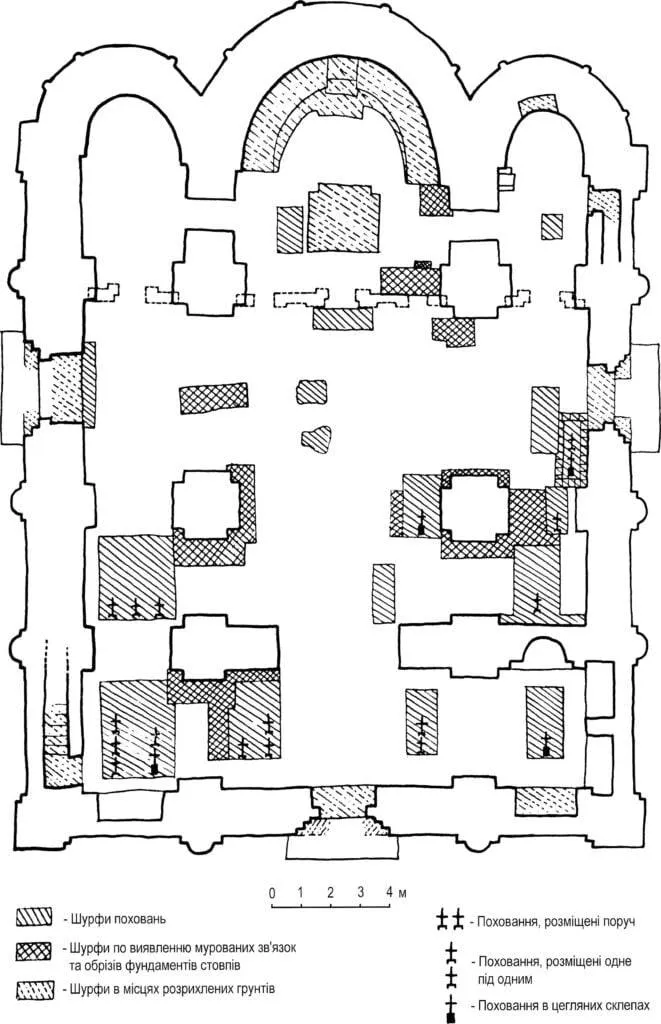
Photo: Plan of the burials in the Church of St. Cyril
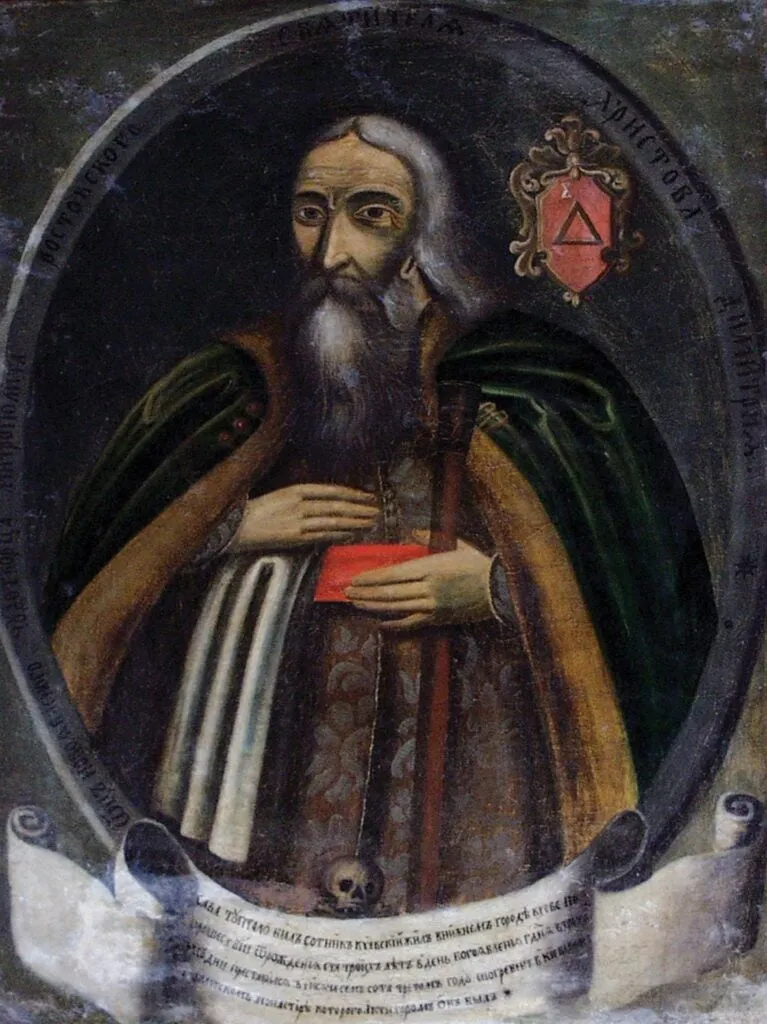
Photo: The portrait of Savva Tuptalo that needs to be restored
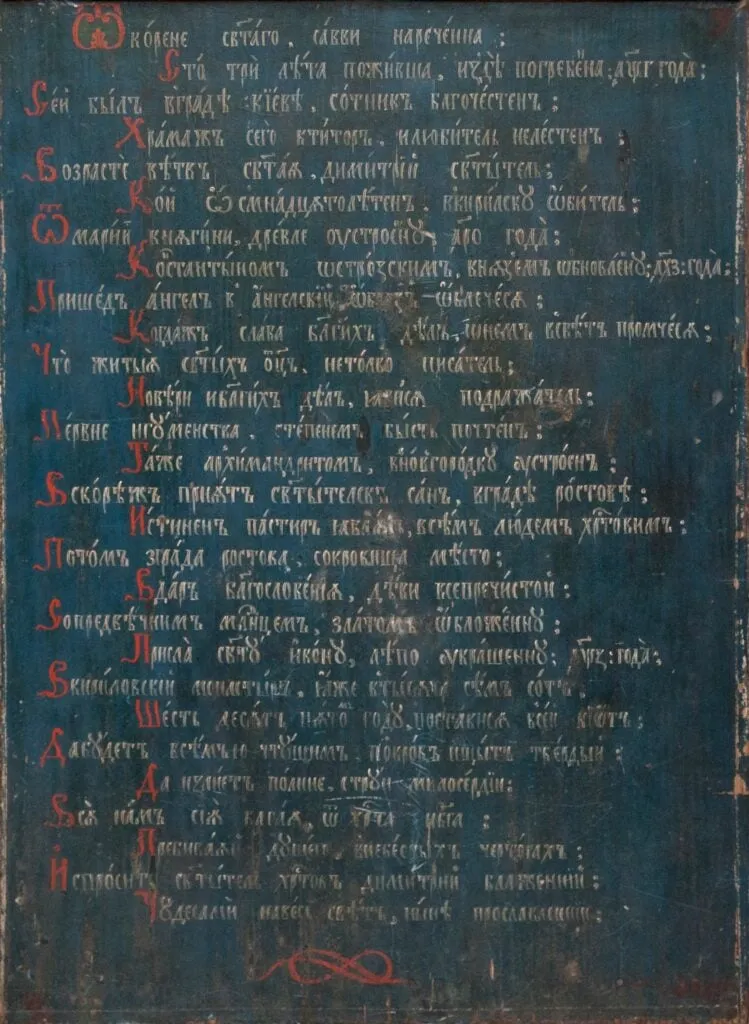
Photo: The original plaque that hung above Tuptalo’s burial in the Church of St. Cyril was lost, and then accidentally found in St. Sophia Cathedral in Kyiv
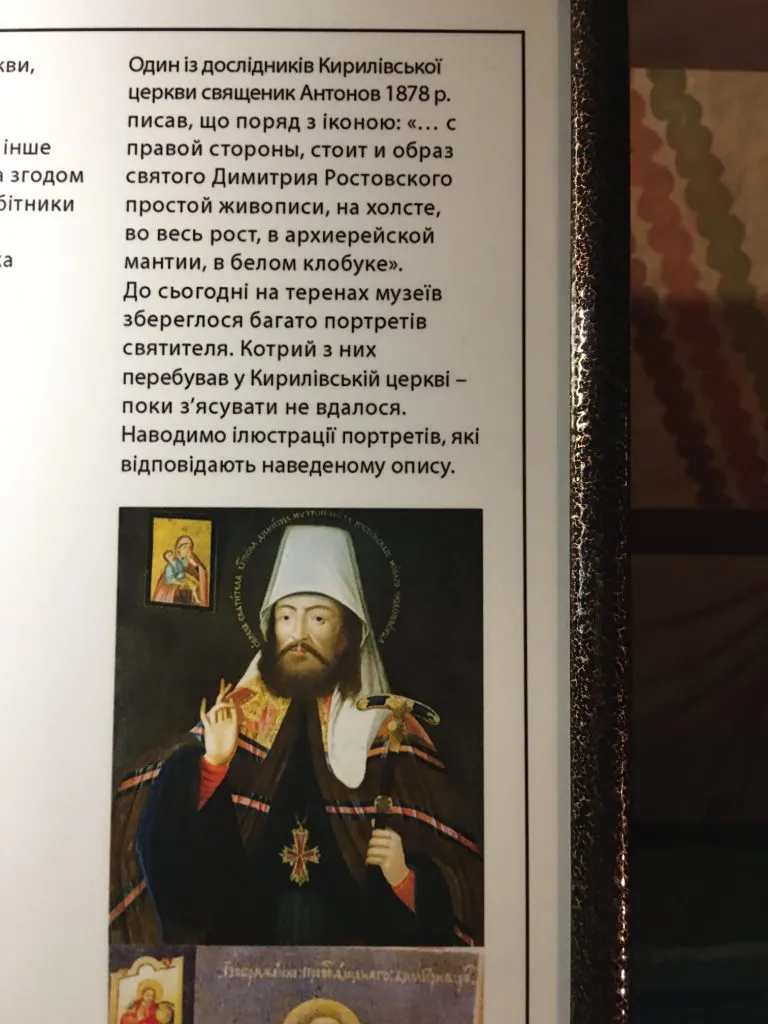
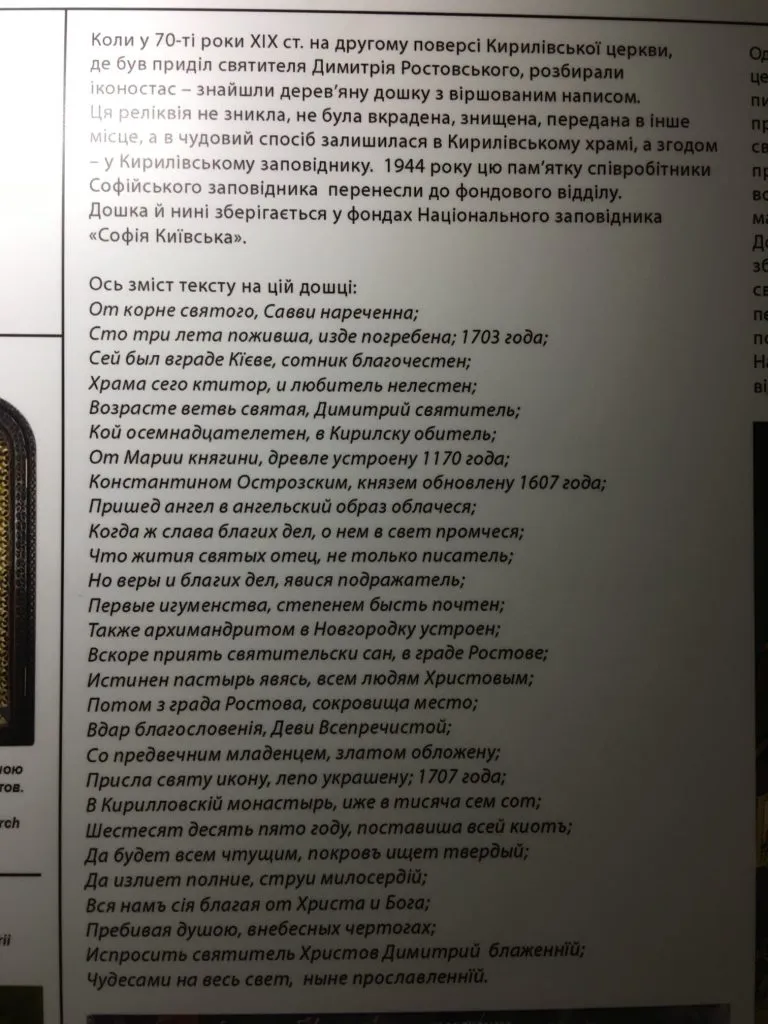
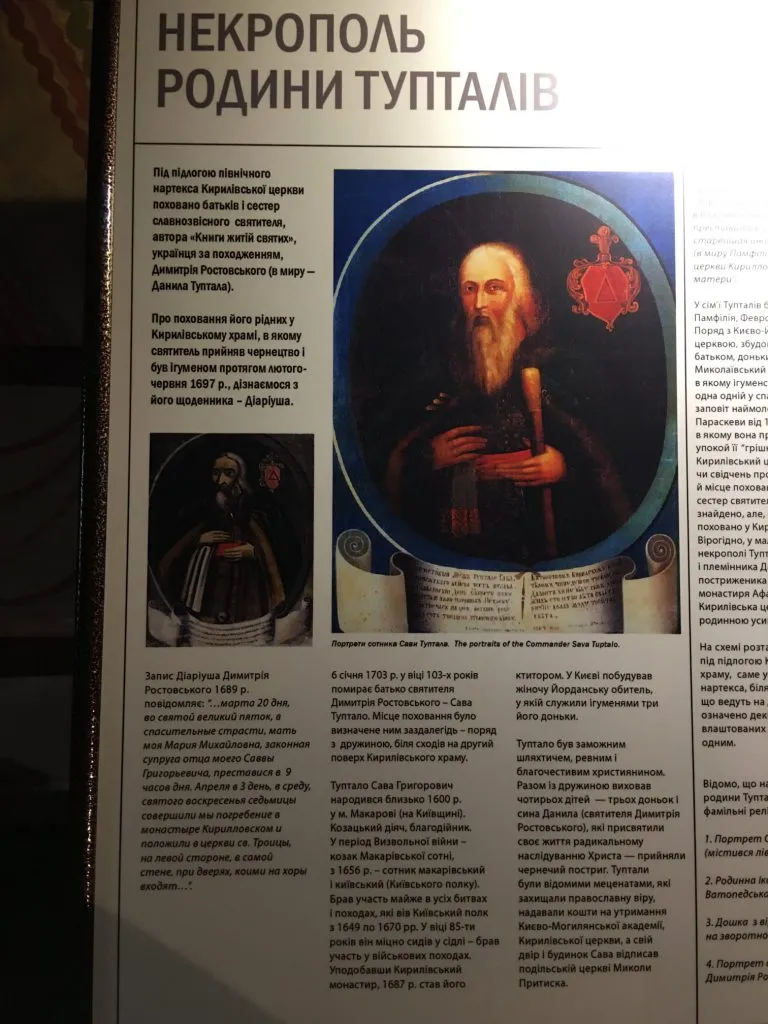
Photo: First attempts to restore the memory of Tuptalo in the Church of St. Cyril
The family was glorified even more by the extraordinary genius of its son, Danylo Tuptalo.
From his very first years he was drawn into a whirl of events that few were fated to live through. Poor health, as well as his mother’s piety, influenced his choice of place in the stormy kaleidoscope of change. He chose one of those paths where the struggle for Ukraine required his talent: education. And since at that time education was inseparably linked with religion, from his youth Danylo mastered the sciences, first at the Kyiv-Mohyla Collegium and a little later at the Cyril Monastery, where he was fortunate to meet extraordinary mentors. He learned Greek, Latin and a number of classical subjects.
His first teacher was Archimandrite Ioanykii Haliatovskyi, author of the first native textbook on rhetoric, “The Science, or the Way of Composing a Sermon” (I show this splendid specimen of Old Ukrainian in the photo).
Next came the well-known hegumen Meletii Dzyk, professor of poetics and rhetoric.
Another example was the outstanding Innokentii Gizel, who had an excellent European education.
Another teacher and friend was Innokentii Monastyrskyi, hegumen of the Cyril Monastery. A characteristic episode that united their destinies was their participation in the famous debate between Muscovite and Ukrainian clergy “On the Transubstantiation of the Holy Gifts”. Danylo shared the position of Monastyrskyi, who showed himself in the polemic far superior to Patriarch Joachim in erudition and in the humanity of his views.
The years that were hard for the Collegium, poor health, deep religiosity and a wish to withdraw from worldly dangers and passions brought Danylo Tuptalo, still very young, to the Kyiv Cyril Monastery, which stood on a picturesque hill on the edge of Kyiv. In his seventeenth year he took monastic vows. The tonsure was performed by the same hegumen Meletii Dzyk on 9 July 1668, who gave him a new name in honour of the holy Great Martyr Demetrius of Thessalonica (so he first became Dimitry Tuptalo, and later remained in history under the name Dimitry of Rostov).
He would serve as hegumen of the monasteries of Baturyn, Hlukhiv, Chernihiv, Novhorod-Siverskyi, Kyiv… Dimitry’s high education, wisdom and humanity raised his authority so high that his name became known throughout Ukraine, Belarus and Lithuania.
Service to God and people was always combined with service to Ukraine, for he was one of those who tried to the last to defend the independence of the Ukrainian Church from Moscow. Having taken monastic vows from the hands of Hegumen Meletii and passed his monastic obediences under his spiritual guidance, he thereby showed that he had joined “that party of the Ukrainian clergy that upheld the independence of the Ukrainian Church (under the jurisdiction of Constantinople) and its independence from Moscow”. Another fact speaks in favour of this: in 1669 he was ordained a hierodeacon by Metropolitan Yosyp Neliubovych-Tukalskyi, and not by the locum tenens of the Kyiv Metropolia appointed by Moscow. This ordination took place in the ancient 12th-century monastery in Kaniv, which was at that time under the authority of Hetman Petro Doroshenko.
From 1684 the main concern of Saint Dimitry’s life became the preparation for publication of the “Book of the Lives of the Saints” (Chetii-Minei), on which he worked until the end of his life. It was a titanic labour. These became the most widespread and beloved books for family reading and upbringing, because here the universal human ideal was presented not in the form of tedious sermons, but through literarily crafted images of holy ascetics.
His further pastoral and archpastoral feat is a separate page of his majestic earthly life, which was crowned by a blessed repose and glorification 54 years after his death.
Tuptalo’s life is the life of dozens of similar great Ukrainians of that period. It was they, Ukrainians, such as M. Smotrytskyi, I. Gizel, I. Vyshenskyi, L. Baranovych, H. Konyskyi and many others, who carried native Baroque culture of the 18th century into neighbouring lands. And among them is the talented figure of Dimitry of Rostov, whom historians called “the brightest personality in the church world of the 18th century”.
Hegumen Meletii Dzyk loved Dimitry like a son. Before his death Meletii bequeathed to Dimitry of Rostov two gold ducats for the remembrance of his soul. He offered sincere prayers for Dimitry, including for the drama so needed by the Church, especially in those hard times for Ukraine, when “…in search of solitude Danylo Tuptalo unexpectedly found himself in the whirl of the struggle for the church status of Ukraine, which was ideologically supported by all the leading monasteries of Ukraine”.
Mykhailo (Meletii in monasticism) Dzyk.
The formation of Danylo Tuptalo (Dimitry of Rostov) was greatly influenced by a wise professor of poetics and rhetoric, who not only taught the sciences but also “ordained” the future saint as a monk.
Mykhailo Dzyk was rector of the Kyiv-Mohyla Collegium in 1655-1657 and 1662-1665, hegumen of the Cyril Monastery in 1658–1677, and from 1677 until his death on 7 February 1682 hegumen of St. Michael’s Golden-Domed Monastery.
What connected him with the Tuptalo family was that he became Danylo Tuptalo’s favourite teacher, and then the personal mentor of the future saint and author of the “Lives of the Saints”.
Dzyk was not just one of the most educated church figures of his time, but became famous as a true Ukrainian patriot, a supporter of Hetman Doroshenko, and still more as an open champion of Ukraine’s independence and against the subordination of the Kyiv Metropolia to Muscovy. Together with Sylvestr Kosiv, Yosyf Tryzna, Varlaam Yasynskyi and Pylyp Orlyk, Meletii Dzyk was a convinced supporter of Ukraine’s state independence and set himself the goal of tearing Ukraine away from Moscow. He was one of those whom the Kyiv Orthodox hierarchy sent on 9 March 1666 to the Muscovite tsar with a letter also signed by Innokentii Gizel, Feodosii Sofonovych, Feodosii Uhlytskyi, Varlaam Yasynskyi and Oleksii Tur. The hierarchs then defended the rights of the Kyiv Metropolia to independence.
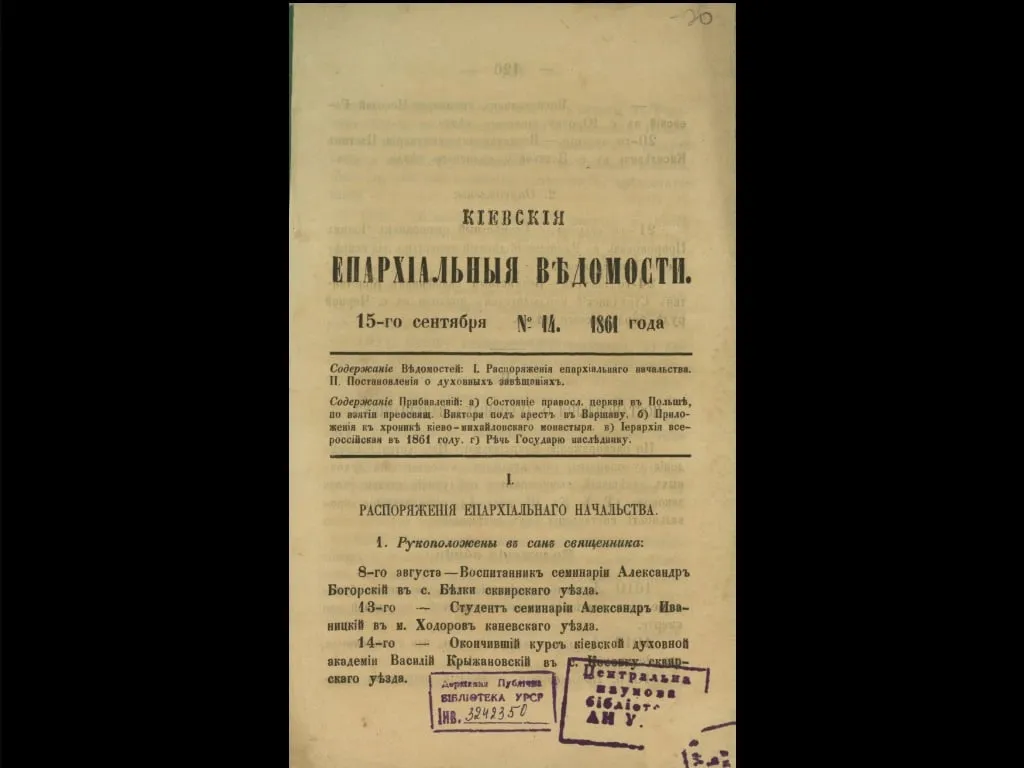
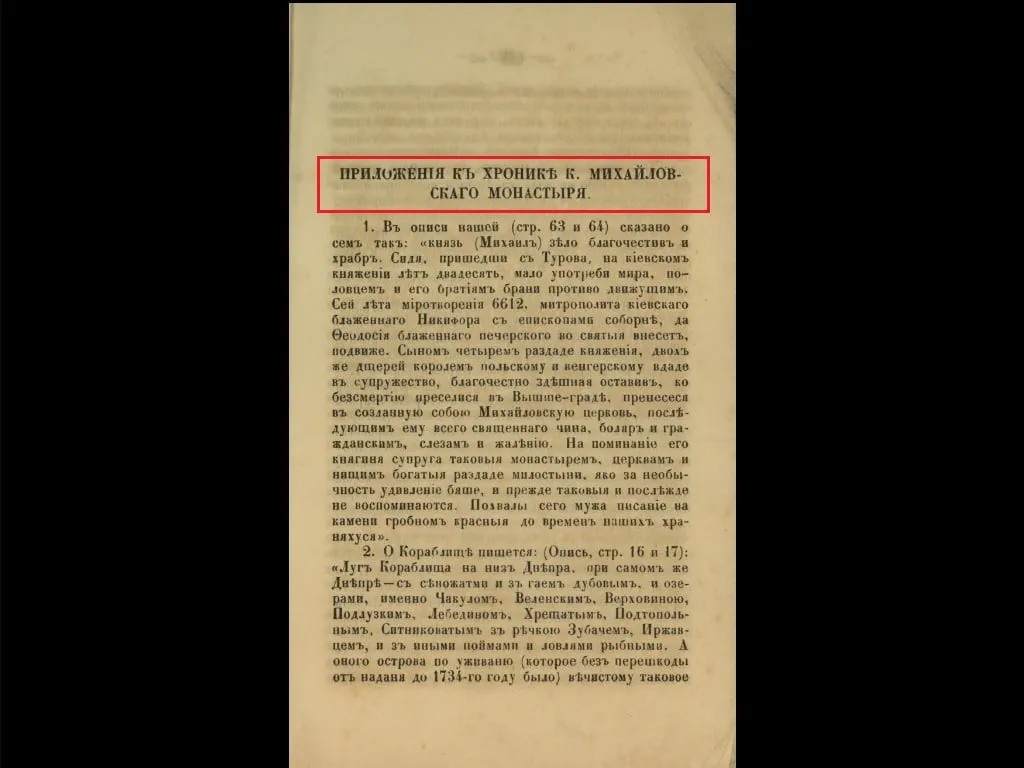
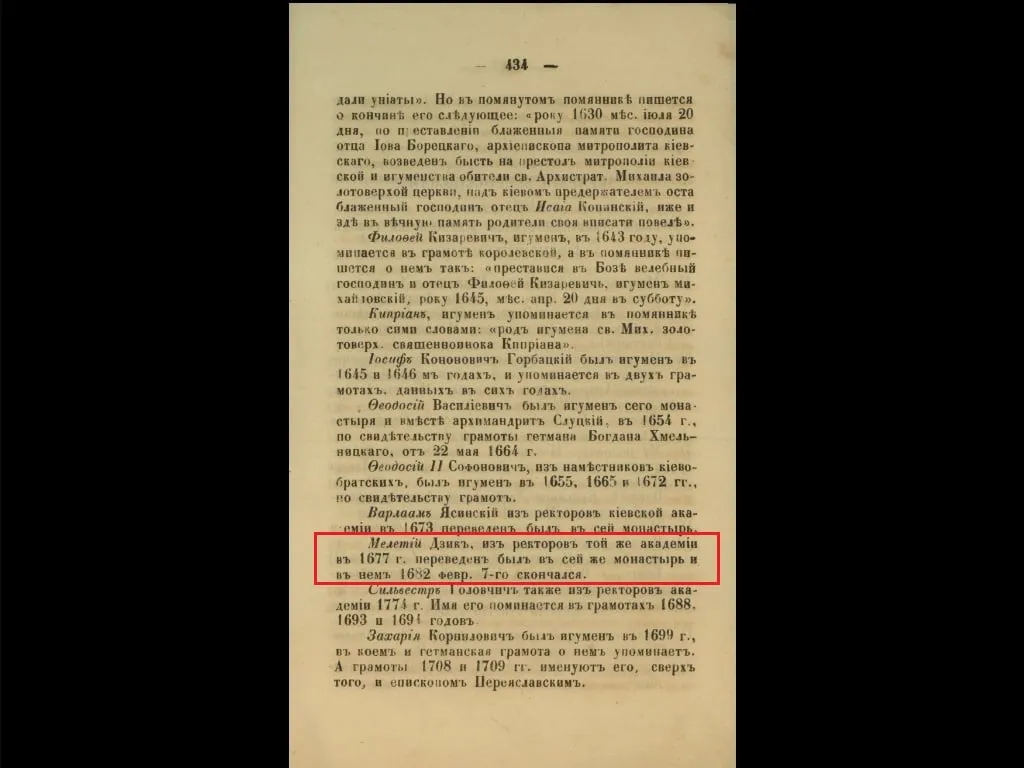
Photo: St. Michael’s Golden-Domed. The record about M. Dzyk.
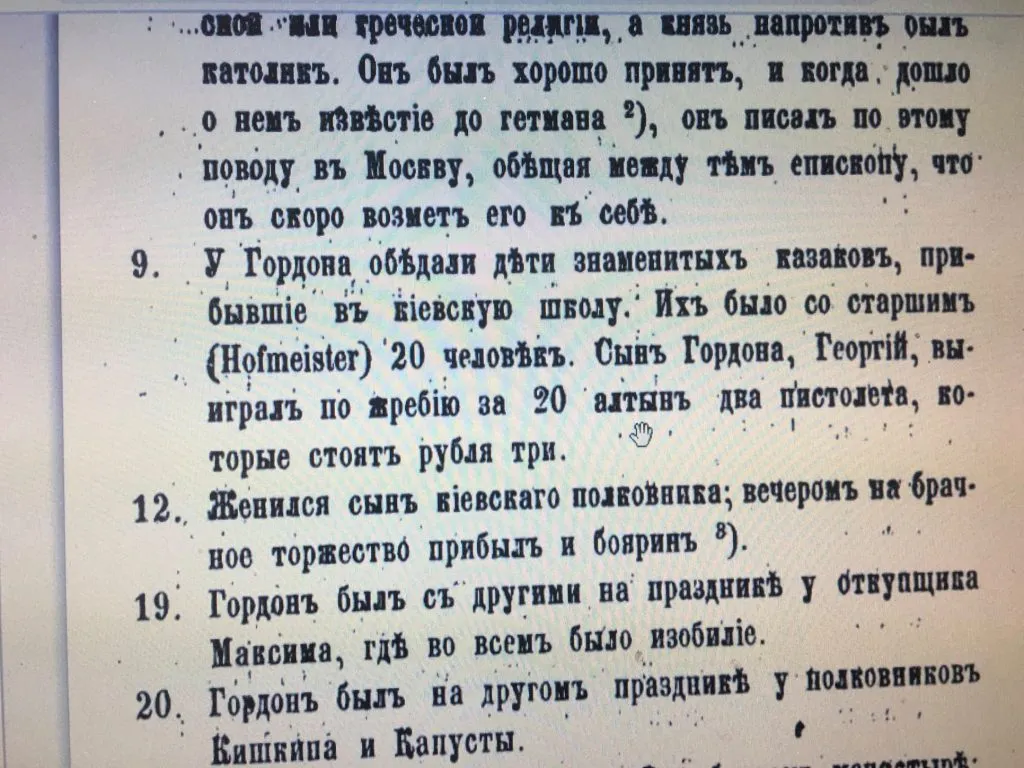
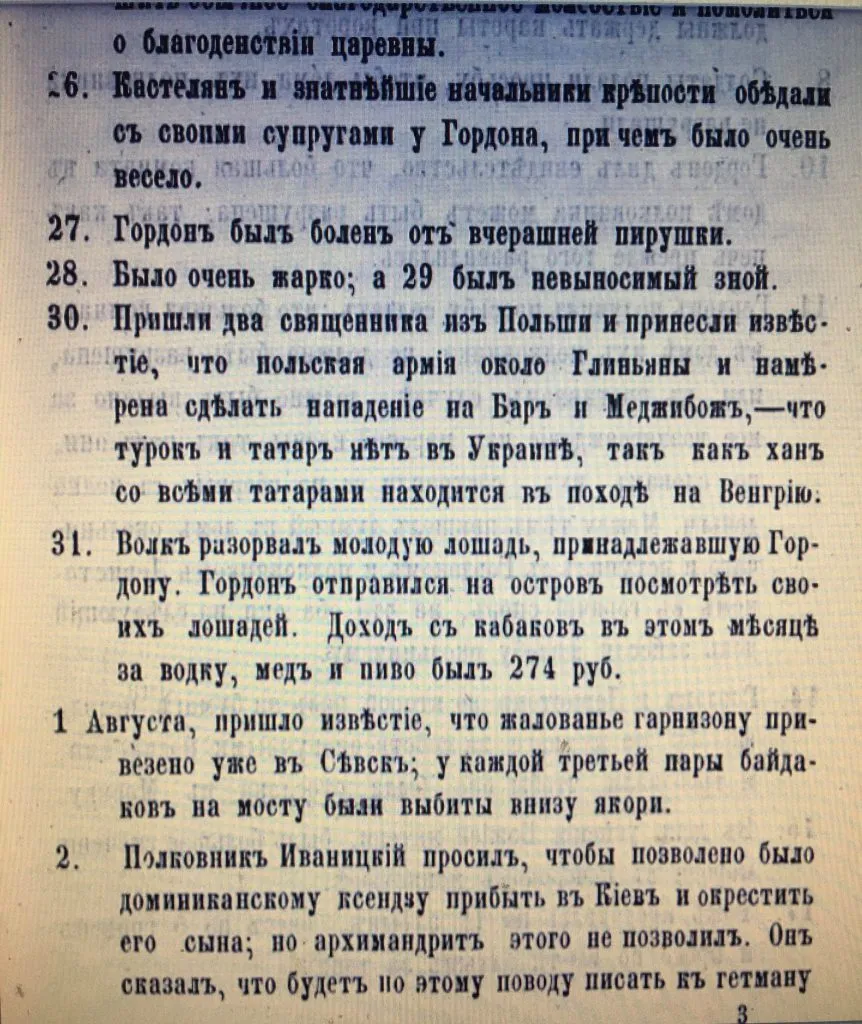
Photo: From the diary of the Scotsman P. Gordon, who knew the Tuptalo family and Dzyk and left us some information about that Kyiv
All this very subtle and complex game of Ukraine’s wise spiritual leaders made an impression on young talents, among whom the future Saint Dimitry stood out.
In the best work about his life, by the Russian I. O. Shliapkin, “St. Dimitry of Rostov and His Time” (1891), we see a vivid example of Muscovite propaganda, an attempt to present Ukraine and its European path as unsuccessful and unattainable, and salvation as union with Muscovy; yet the author cannot conceal some obvious facts about Ukrainians’ rejection of Muscovite rule, and is therefore forced to admit that hegumens of that time declared directly to Muscovite representatives: “…it is better for us to accept death than a Moscow metropolitan”.
And under the influence of Dzyk’s self-sacrificing activity, he states about Dimitry of Rostov: “…the then sympathies of the black clergy in general and in particular the views of Meletii Dzyk become clear. One must think that Dimitry, Meletii’s tonsured disciple and a man close to him, living in the same monastery, shared the convictions of his mentor, was a champion of the independence of the Little Russian church and did not particularly like the Muscovite state. These conclusions gain even greater probability from a survey of Dimitry’s subsequent life.”
I cut out interesting episodes of that struggle of the Ukrainian Church, the role of M. Dzyk in it and his influence on Dimitry from the book and give them below as photos (whoever wants to better understand all the intricacies of those events, I advise reading the 10 pages of the insert).
Mykhailo Dzyk’s relatives were equally nationally conscious, such as the one who went down in history as the first to record himself in the university registers of Europe as “Ukrainian”, Danylo Dzyk.
The 1660 entry at the University of Padua (Italy) irritates some Russian historians too much. They resort to every manipulation to somehow try to downplay this entirely concrete and irrefutable proof of the self-identification of 17th-century Ukrainians, who in 1648 had again won their state in battle, and with it new meanings of self-naming.
The discussion between the Russian Doctor of Historical Sciences F. Haida and the Ukrainian Inha Shpihel about the correctness of the translation of this entry was interesting. Inha’s position, as a Latin specialist, appears better argued and proven. Moreover, it is confirmed both by the arguments of the historian who first researched and published the document (H. Nudha), and by modern scholarship.
The text of the historical entry of 1660 from Padua: “Joz.Daniel Dzik, wikaryuz katedralny lucki «natione Vkrainensis de districtu Kiiouiensi»”, that is, “a Ukrainian from the district of Kyiv”, or, according to the original study: “Josef Danylo Dzyk, cathedral vicar of Lutsk, nationality Ukrainian, Kyiv district”.
But this is not the only flaw in the Russian author’s position. He also failed to take the historical context into account and erred in locating the Dzyks’ origin. He calls them Polish nobles from Lutsk.
As I managed to establish in the archives, the Dzyks (Mykola) are listed in the document “Count of settlements and houses of the Bratslav Voivodeship, for collecting the tax ‘podymne and mlynove’ in 1664”. In the historian Lypynskyi we find one more mention, information about old Mykola Dzyk, who goes with the army through the Bratslav region, and about his sons: “Petro serves in the Zaporozhian Host as colonel of Khvastiv”, and “Meletii… rector of the Mohyla Academy”. We can conclude that the family came from the Bratslav region, some serving in Fastiv, some in Kyiv. And Danylo quite unambiguously signed in the registers of the University of Padua that he was from the Kyiv region (Kiiouiensi).
The Cossacks played a considerable role in consolidating Ukrainian culture, in particular in providing material help to the Kyiv and Lviv brotherhoods and their schools, in constant support of the Kyiv-Mohyla Collegium and later the Academy, and in supporting and preserving Kyiv’s shrines in the hardest years. The educated part of the Cossacks consisted of pupils of the Lviv, Ostroh, Kyiv and other brotherhood schools, and then of the Kyiv-Mohyla Collegium and Academy. A great role was played by the nation’s spiritual leaders, who, often risking their lives, bore their share of the struggle. Former students became not only military scribes but also brave Cossacks, captains, colonels and hetmans, and joined diplomatic missions as secretaries and translators, above all from Latin and Polish, which they spoke fluently; some chose the path of service to scholarship and religion, which were then closely linked, and reached remarkable heights in that service. Among them are the heroes of our story.
An intriguing mystery is the burial place of Hegumen Meletii Dzyk.
For a long time it was believed that since he died as hegumen of St. Michael’s Golden-Domed Monastery, he must be buried there. In support of this I found in the Kyiv Diocesan Gazette for 1861 (No. 14)
“Appendices to the Chronicle of the St. Michael’s Monastery”:
“Meletii Dzyk, from the rectors of the Kyiv Academy, was transferred in 1677 to this same monastery and died in it on 7 February 1682” (I show the document in the photo).
But his grave has never been found. Another document gives us a hint that the ties with the Tuptalo family, which grew into mutual affection and friendship, may have helped the Cyril Monastery, which ultimately became the Tuptalo family burial place, to receive Dzyk’s body as well. This fact was studied and described by the Candidate of Historical Sciences I. Marholina, who refers to an archival document of the Church of St. Cyril dated 5 October 1869:
“…on the outside of the church, on the left side, there are two recesses in the wall, in which, as eyewitnesses say, two images on copper (30 pounds each) were installed, one above the grave of the parents of Saint Dimitry of Rostov, and the other above the grave of the hegumen who ordained Saint Dimitry to monasticism, and that these icons were removed in 1865 to renew the faces of the saints…” (their further fate is sad: they were melted down).
An entry in the Diary of Dimitry of Rostov for 1689 reports: “…on the 20th day of March, on Holy Great Friday, in the saving Passion, my mother Maria Mykhailivna, lawful wife of my father Savva Hryhorovych, passed away at 9 o’clock in the day. On the 3rd day of April, on Wednesday of the week of Holy Resurrection, we performed the burial in the Cyril Monastery and laid her in the church of the Holy Trinity, on the left side, in the very wall, by the door through which one enters the choir…”.
Saint Dimitry’s friend and mentor Meletii Dzyk died in 1682, and the saint’s mother in 1689. By the time of Dimitry of Rostov’s tenure as hegumen of the Cyril Monastery, these two people close to him were already in heaven. Thus his wish to perpetuate their memory with images and inscriptions placed on the outer north wall of the church is entirely understandable.
On 6 January 1703, at the age of 103, Saint Dimitry of Rostov’s father, Sava Tuptalo, died. The place of his burial had been decided in advance: next to his wife, by the stairs to the second floor. Dimitry’s sisters would also find rest nearby.
Today we have a surviving plan of the burials beneath the floor of the Cyril Church (I show it in the photo), but no official reports on the study of these burials and their exact identity have been found.
Therefore we can rely only on written sources and some material finds from collections, such as the wooden dedicatory plaque to the late Savva, which hung above the Tuptalo burials in the Church of St. Cyril and was later accidentally found on the floor in the storerooms of St. Sophia Cathedral (I show its photo).
In the northern outer wall of the Church of St. Cyril there are two small empty niches whose purpose remained unknown for a long time. Only the discovery and study of the archival documents mentioned above showed that these niches once held memorial plaques with inscriptions about the notable burials in the church (Tuptalo and Dzyk).
I hope that everyone who has read this story, like me, wants above all for these glorious names to be known to our children, for them to be told about on tours of Kyiv, for the place of their service, charity and repose in the Church of St. Cyril to be honoured, and for those images and portraits that once adorned this church and retold the history of two glorious families to be restored.
And since I managed to take part in helping the Magdeburg Law monument, I now dream of helping the Church of St. Cyril restore what has been lost.
I have already talked about this with representatives of the Department for the Protection of Cultural Heritage, the well-known historian Dr. Taras Chukhlib, and Iryna Marholina, head of the research department of the St. Sophia of Kyiv National Reserve, who supported the initiative and assured me of help in word and deed.
So it now remains only to bring this wonderful idea to life.
To do this we need to find:
1. a sculptor who could work with copper to restore two images once placed on the façade of the Church of St. Cyril: “…on copper (30 pounds each), one above the grave of Tuptalo, and the other above the grave of the hegumen…” (in the photo I show the place on the façade where they were located);
2. an artist who could paint a copy of the portrait of Savva Tuptalo (I include it in the photos).
If anyone has ideas, advice, a wish to help, or acquaintances among sculptors and artists ready to carry out the plan, I will be glad of every comment, share and recommendation.
Write who could join the project and, by joint efforts, restore the memory of outstanding Ukrainian families and what has been lost in the Church of St. Cyril.
Share this post so that more people learn about the Tuptalo and Dzyk families and join in restoring lost memory.
Author: Ihor Poluektov
Below: The history of the struggle for the independence of the Ukrainian Church in the book by the Russian I. O. Shliapkin “St. Dimitry of Rostov and His Time” (1891) (caution, Muscovite propaganda)