

A Ukrainophobe or a patriotic Kyivan. What to do with Bulgakov’s legacy in the capital

· 10 min read
How to treat the figure of the writer during city tours – an opinion piece by Roman Malenkov for RBC-Ukraine
The disputes about whether Kyiv needs the Russian writer Mikhail Bulgakov do not subside. Guides, too, continue to debate whether tourists should be told about him at all during tours.
It is not easy to convince the writer’s Kyiv fans. But there are those who waver and do not know who Bulgakov really was and what he wrote about Kyiv in his works.
In an opinion column for TRAVEL RBC-Ukraine, the well-known Ukrainian traveller, local historian and founder of the company “Ukraine Incognita” Roman Malenkov analyses whether there is room for this figure against the background of the war that Russia has unleashed against Ukraine.
Bulgakov’s father censored authors who wrote in Ukrainian
I often hear that Bulgakov was a man of his time. But in the era of revolutions, including national ones, in the era of turbulent events, Mikhail Afanasyevich continued to profess monarchism. He did not accept Ukrainians – there is not a single kind word about them in his works.
Bulgakov was the son of settlers from Oryol Governorate. His father was in fact a censor responsible for purging everything printed of the Ukrainian and Polish languages. So Bulgakov was not a man of his time, but rather a man of his own “information bubble”.
Let me say right away that I treat Bulgakov as a writer with respect. I consider him a talented author. I have read almost all his works, some of them repeatedly. But talent does not cancel out the fact that he was a Ukrainophobe, a monarchist and, on top of that, a pillar of the “Russian world”.
Mykhailo – or rather Mikhail, as his name is written in the title of his Kyiv museum – was born into a priest’s family. His parents came to Kyiv from Oryol Governorate. His father Afanasii taught history at the Kyiv Theological Seminary. And from 1893 until his death in 1907 he worked as a censor of Western literature, censoring authors who wrote in Polish and Ukrainian, the latter then banned.
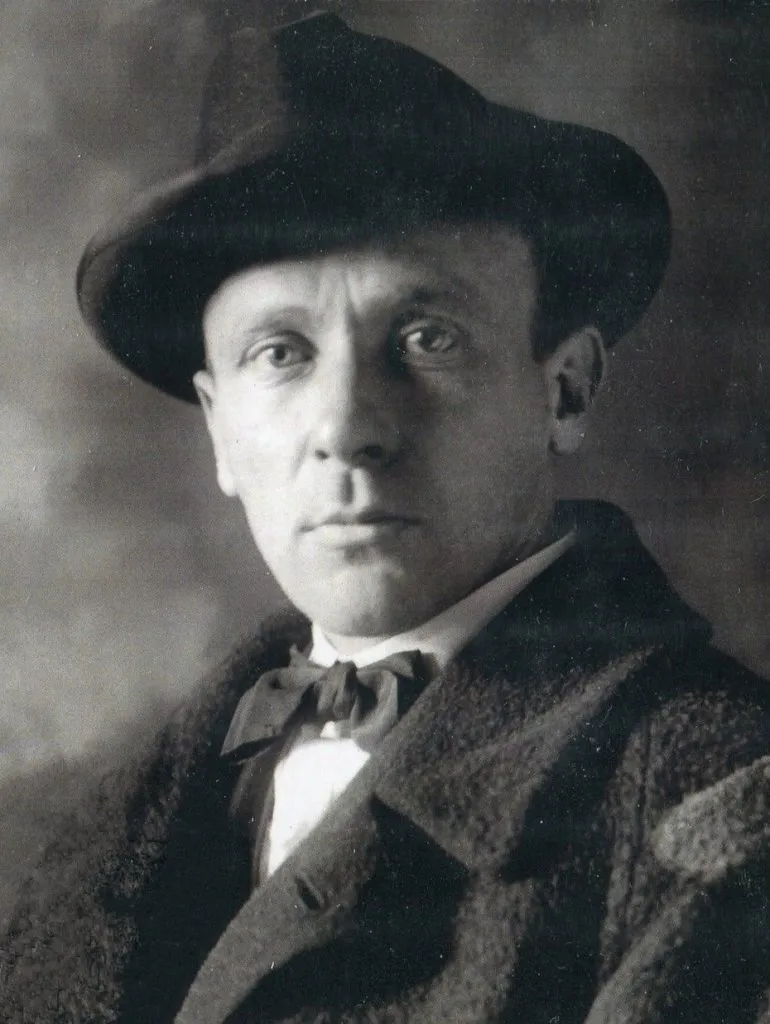
Photo: Mikhail Bulgakov (wikipedia.org)
Can you imagine the atmosphere in which Mikhail grew up? This is what he showed in his only significant work about Kyiv – “The White Guard”. It is also worth noting that in this work he deceives his readers in the spirit of Moscow propagandists, forming the image of a Russian-monarchist Kyiv captured by a caricatured separatist-peasant Ukrainian minority.
Tour guides have “invented” Bulgakov places in Kyiv: where he liked to walk and sit in the park
Kyiv has a museum and a monument to Bulgakov, and also a plaque from the interesting project “Shukai”. A monument and a museum to someone who did not accept the Ukrainian nation and language. Bulgakov tours are run in Kyiv. I once went on two of them. Russian-speaking, pro-Russian – on these tours I simply could not understand whether Ukraine is independent or is still “a part of Russia”.
Most of the tourists, in my opinion, were openly deceived by advertising, fashion and propaganda – for decades they had been told that Bulgakov is the only world-class literary star born in Ukraine, although Gogol might qualify too. The tours also said how Bulgakov revered universal human values – honour, love. Uh-huh, I thought at once, he valued human values – just remember his double betrayal of Tatiana Lappa, his first wife, who saved his life.
There are very serious doubts about Bulgakov’s world stardom. Mikhail Afanasyevich was never a star on the level of Dickens, Balzac or Hemingway. I would compare the level of his popularity to footballers – Andriy Shevchenko, winner of the Ballon d’Or, and Andriy Yarmolenko, a talented, goal-scoring playmaker well known in Ukraine.
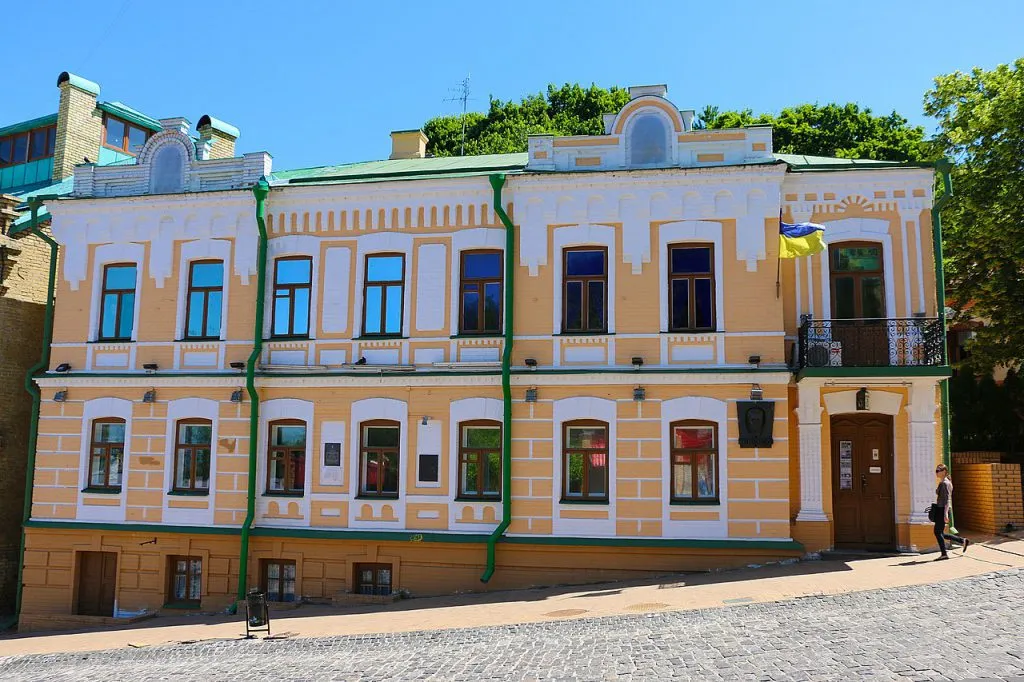
Photo: Lystovnychyi House at 13 Andriivskyi Descent, where the Bulgakovs lived from 1906. Also known as the Turbin house and the Bulgakov house (wikipedia.org)
The fans’ main argument is that Bulgakov was born in Kyiv, in Ukraine, so he deserves a monument and a museum here. Never mind that he was a Ukrainophobe and a monarchist, that he wrote exclusively in Russian and that 90% of his works are about Russia.
Here are a few quotations from the writer’s works that show his attitude to Ukrainians and the Ukrainian language.
before him lay a thin little book printed on cheap grey paper: “Ihnatii Perpillo – Ukrainian Grammar”.
Long live free Ukraina from Kyiv to Berlin! For half a year he mocked Russian officers, mocked all of us. Who forbade the formation of a Russian army? The Hetman. Who terrorised the Russian population with this vile language that does not even exist in the world? The Hetman. Who bred all this scum with tails on their heads? The Hetman”.
“The day before yesterday I asked that scoundrel, Doctor Kurytskyi – he, if you please, forgot how to speak Russian in November last year. He was Kuritsky, and became Kurytskyi… So I ask: how do you say “cat” in Ukrainian? He answers “kit”. I ask: “And how do you say whale?” And he stopped, goggled his eyes and fell silent. And now he does not bow. They cannot have the word “kit” for whale, because there are no whales in Ukraine, while in Russia there is everything. There are whales in the White Sea…”
Tour guides have “invented” Bulgakov places, made up where he liked to walk, to sit in the park, where he was baptised and married.
For example, it is known that Bulgakov was born in a house that belonged to the estate of the priest Matvii Butovskyi, but part of that estate was demolished as early as the 1920s, and the rest before the construction of the new Vozdvyzhenka.
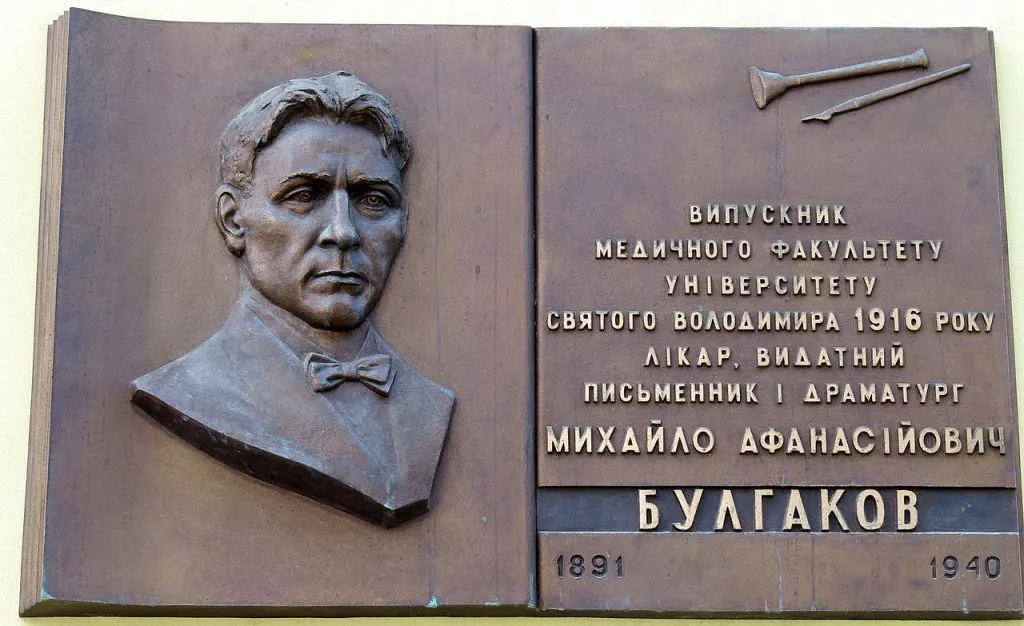
Photo: A memorial plaque dedicated to Bulgakov on the rectorate building of the O. O. Bohomolets National Medical University, Shevchenko Boulevard (wikipedia.org)
It is not known exactly where that estate stood, or in which of its buildings, or even in the annex, Mikhail was born. But guides bring tourists to 28 Vozdvyzhenska Street and say: “on this spot little Mikhailyk came into the world”. Not a single Ukrainian has been given such “detail” on tours as Bulgakov.
By the way, such tours were wildly popular among Russian tourists, who raised Bulgakov into a real cult and infected part of Kyiv’s residents with this cult. Bulgakov became a strong chain that held, and continues to hold, Kyiv shackled to the “Russian world”.
What the tours do not say about Bulgakov
In most cases guides are silent about the dark pages of Bulgakov’s biography. They only tell how he loved Kyiv and adored human values. So we need to say a little about some other twists of the writer’s life.
In April 1916 Bulgakov voluntarily went to work as a surgeon in the military hospitals of Kamianets-Podilskyi and Chernivtsi, but that work did not last long, since in September of the same year, as a person liable for military service, he was sent to work as a zemstvo doctor in the village of Nikolskoye (in the Smolensk region).
There he became addicted to morphine, from which Bulgakov was rescued by his wife, Tatiana Lappa. And in March 1917 Mikhail returned to Kyiv. Here he settled in an apartment on Andriivskyi Descent that his family rented. Today this house holds the writer’s museum.
On 3 February 1919 Bulgakov was drafted into the army of the Ukrainian People’s Republic, from which he deserted. Perhaps it was this episode of his flight that he described in the story “I Killed”. For some time he hid, and in August he was mobilised into the ranks of the Bolshevik army. He did not stay there long either, since in November 1919 Bulgakov was already working as head of a medical unit of the Terek Regiment of the Whites. From the end of September 1921 Bulgakov settled in Moscow.
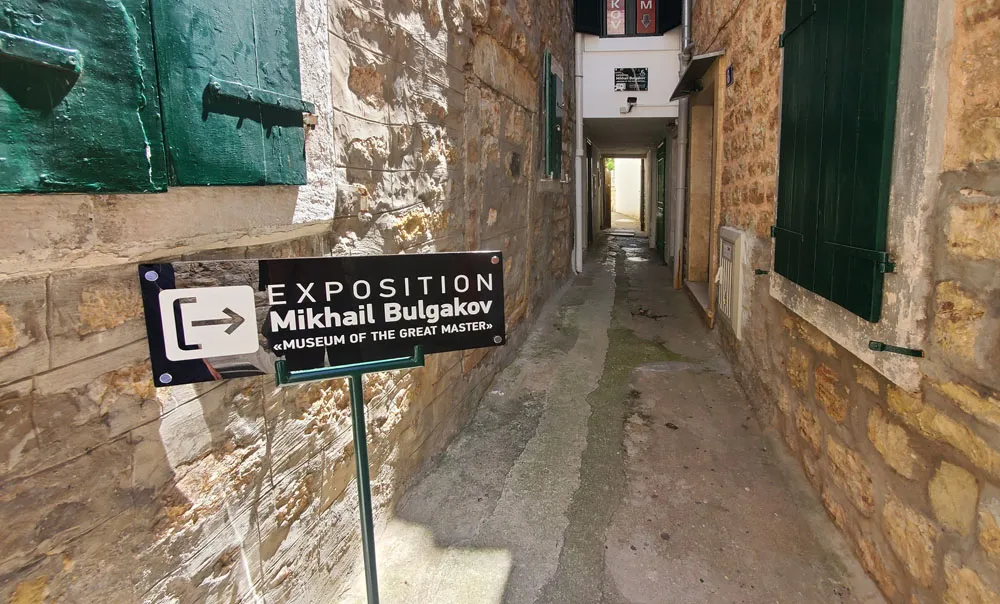
Photo: A sign pointing to the Bulgakov museum in the Montenegrin town of Herceg Novi
From Kyiv tour guides one can often hear how hard and hungry the writer’s Moscow life was. But the episode of outright poverty lasted a very short time: from the spring of 1922 he was already publishing regularly in various newspapers and receiving fees. And in the winter of 1924 he left his wife, Tatiana Lappa. He went to live with another woman, Liubov Belozerskaya.
Open sources say that Tatiana Lappa saved the writer from drug addiction and cured him of typhus, but Bulgakov treated her in an extremely inhumane way. While still married, in the street he pretended not to know Tatiana and turned away from her. And after “The White Guard” was printed – which he had promised to dedicate to Tatiana and which he wrote while living with her – he dedicated it to Belozerskaya, and came to visit Tatiana to show her the dedication – simply to mock a person to whom he owed his life twice over. That is what he was like, and nobody can deny it.
Should the writer’s museum remain in Kyiv
It is enough to read Bulgakov’s novels and stories to understand: in none of his works did he say a good word about Ukraine and Ukrainians. They are always grotesque and unsympathetic characters there. And Petliura he simply hated.
Numerous anti-Ukrainian quotations from the writer can be found on the internet. And such a person has a monument in Kyiv and a museum dedicated to him operating, while there are no monuments to great Ukrainians – almost none. And museums are few.
Now proposals are being voiced to turn the Bulgakov museum into some other museum. There are many options – among them even a museum of Ukrainophobia. But the fans of the Russian writer “stand like a wall” for their idol. We shall see what happens next. Perhaps, if Kyiv had many museums and monuments to outstanding Ukrainians, Bulgakov would not even be mentioned. As it is, he stands like a lone pine in the middle of a field, offending the eye with his Russophobia.
An undoubtedly talented writer, some of whose works can be broken down into quotations, he is associated in my mind with another incredibly talented Russian – Nikita Mikhalkov. An actor from God who could embody any image, positive, negative or neutral. His Henry Baskerville is brilliant, but he is a vile man.
P.S. In the Montenegrin town of Herceg Novi we once came across a Bulgakov museum. Quite a decent one. We asked why it was there. In reply we heard: perhaps the writer’s brother visited the house, so a wealthy Russian emigre set up a museum in this place.
And then I was told that Bulgakov is one of the favourite writers of Russian emigres, who promoted his works in different countries and funded numerous translations. That is, abroad Bulgakov is known precisely among such an audience, not among the broad masses.
Until the 1960s a considerable part of Bulgakov’s works was banned from publication. For this they made him into a sort of dissident. But remember the real dissidents of the 1930s. Is not Sandarmokh the grave of most of them? Bulgakov, however, was by no means in want, he celebrated in restaurants, had his wedding party in Koktebel, and had a conversation with Stalin himself. So there you have it.
Article by Roman Malenkov for RBC-Ukraine
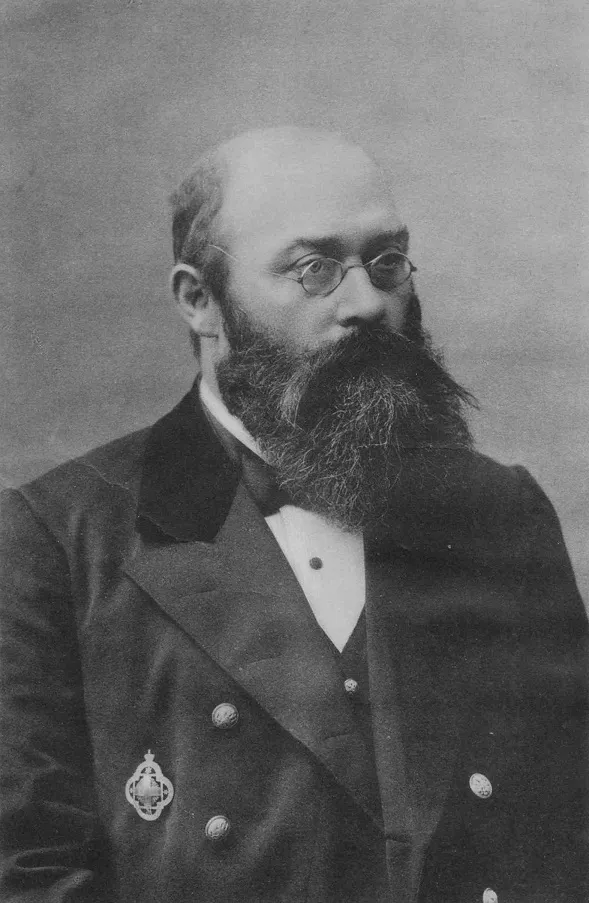
Photo: The writer’s father, Afanasii Bulgakov (wikipedia.org)


