Chervonohrad. Krystynopil. A Soviet city with an old centre

· 20 min read
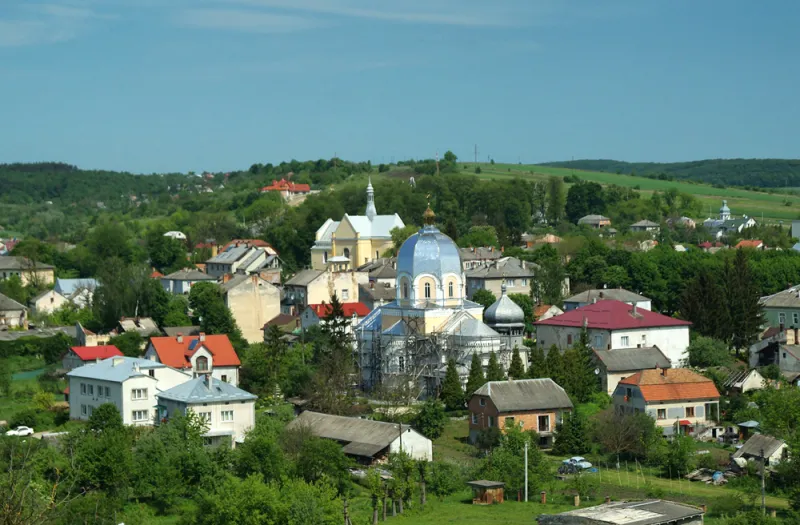
Chervonohrad, or Krystynopil, as this curious town was once called, looks at first glance like a slice of the East planted in the West, a colony of the Soviet Union among the half-European towns of Galicia. At least, that is the impression that strikes the traveller who, after elegant Zhovkva, peeling but proud Velyki Mosty and mysterious Belz, finds himself among Chervonohrad’s mines and barrack-like Khrushchev-era apartment blocks. Yet this is only a first impression, and in this case it is by no means a true one.
Once there was a settlement here called Novyi Dvir, owned by the Potocki family, a magnate dynasty that was half Polish and half Ukrainian and gave us a great number of generous patrons, wise and not-so-wise politicians, and capable and not-so-capable military commanders. Because of the Potockis’ wealth and influence they were called the mightiest of the kings of Rus, and they did everything to live up to the nickname. The Potockis founded countless towns, townships, temples and churches all over Ukraine, and one of them was Krystynopil, founded in 1692 by Hetman Feliks Kazimierz Potocki. Traditionally towns were named after their founders, but the father of our town, who after endless wars had glory enough already, decided to be original and named it in honour of his wife Krystyna.
The town had a castle, a wooden church and a wooden Greek Catholic church, built at Potocki’s expense, and in 1701 the owner began to build a masonry Roman Catholic Church of the Holy Spirit, cared for by the Bernardines. A year later Feliks Kazimierz died, and the construction was completed by his son Józef Potocki, while the founder’s grandson, Franciszek Salezy Potocki, built a Bernardine monastery beside the church. He also gradually rebuilt his father’s castle into a luxurious palace, which has survived in the town to this day.
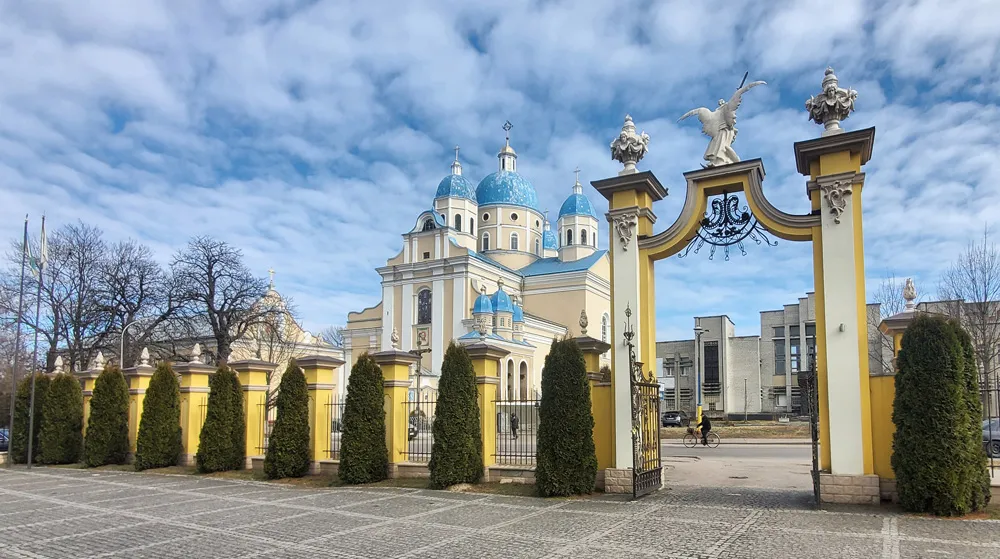
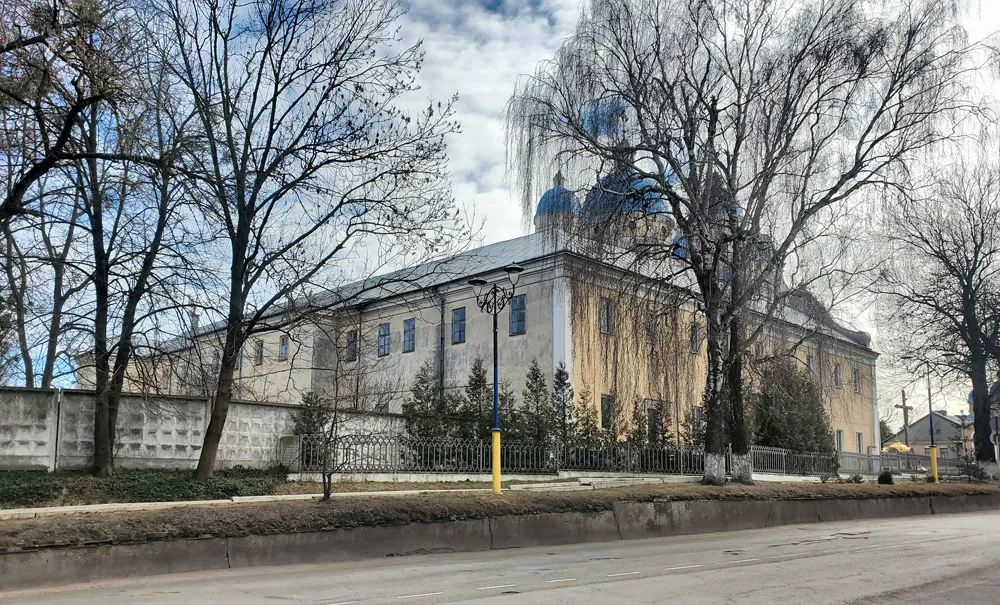
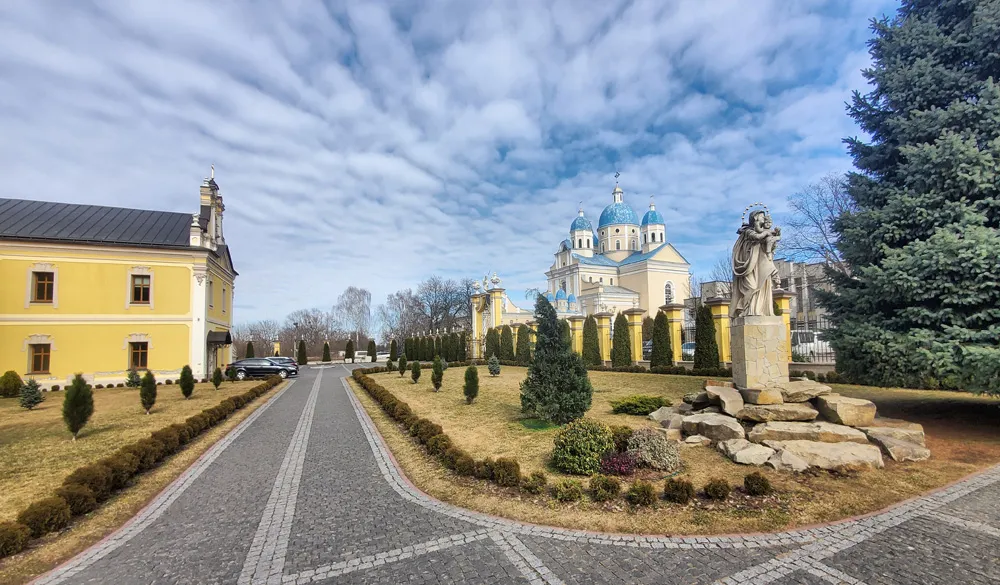
The same Potocki founded the Basilian Monastery of St. George in Krystynopil in 1763, on the site of an older Greek Catholic parish church. The reason the parish church was turned into a monastery one was simple: the residents of Krystynopil complained bitterly about the local priest Illia, who asked too much from parishioners for blessing Easter breads and performing rites. The complaints reached both the owner of the town and the Bishop of Belz, Maksymilian Ryłło. And so the two statesmen gathered and decided that Basilian monks would be better and less greedy pastors for the people of Krystynopil. Thus the magnate and the bishop, equally interested in their subjects being happy, decided to split the costs of building the monastery in half.
Franciszek Potocki, although a tolerant patron, still wanted the Basilians to be of use to his “own” Roman Catholics as well. So when founding the Basilian monastery he set the monks conditions: that they would assist the Catholic Bernardine monks during processions and help them as confessors. The Basilians did not like this and fought their benefactor for a long time to have the mandatory assistance to the Bernardines removed from the terms of the foundation. They settled on a compromise: during processions the Basilians do assist the Bernardines, but help them with confession only if they wish! In principle, neither Roman Catholics nor Greek Catholics had anything against joint processions, and gladly concelebrated with each other; it was only the “obligation” that oppressed both sides.
Actually, to be more precise, the Potockis brought the Basilians into the Krystynopil church only in 1765; apparently the magnate did not like to rush. Indeed, French architects spent a long time surveying the place where the future monastery was to stand, drawing plans and “fitting” the future shrine into the town’s layout. At first they planned to place the monastery church according to ancient tradition, with the altar to the east and the entrance to the west. But on reflection they decided to be guided not by tradition but by the streets of the town: the future church was turned with its main entrance to the main street, where the parish church already stood. According to medieval custom, temples of different denominations stood opposite each other, on different sides of the market square.
But for almost ten years all of this remained on paper. In the meantime the monks built themselves wooden cells, and for services they used the old wooden chapel that had stood here since at least 1717. When a fire broke out and the remains of the chapel were dismantled, Potocki still did not hurry with major construction, but merely built a temporary masonry chapel on the old site, using the surviving boards from the old church. And only in 1771 did the magnate “get round” to building the church and cells that we can see now.
The monastery was laid down with the grandeur typical of the Potockis: on 15 October 1771 a foundation stone, carved with figures of the Evangelists and the coats of arms of the Basilian Order and the Potocki family, was brought from the castle in Bilyi Kamin. In a special recess in the stone they placed a bottle in which, following the custom of the time, they put coins of every denomination then in existence (a ducat, a thaler, a bity, a rouble, a two-zloty piece, a zloty, a vosmachka, a troiak, a grosz, a half-grosz, a szeląg and a half-szeląg), as well as a parchment with the date of the foundation. Another similar bottle was walled into the wall behind the high altar of the future church at a height of three cubits.
Construction went quickly: Potocki allowed the monks to set up a brickworks in haste, and the old church was dismantled for building materials. A year later the church was ready, and the monks began to build the cells. On 26 December 1772 the ceremony of installing the Basilians in the new monastery took place, with music, a solemn procession and the participation of the Potocki family. And although construction continued for several more years, the monastery had by then begun its full existence.
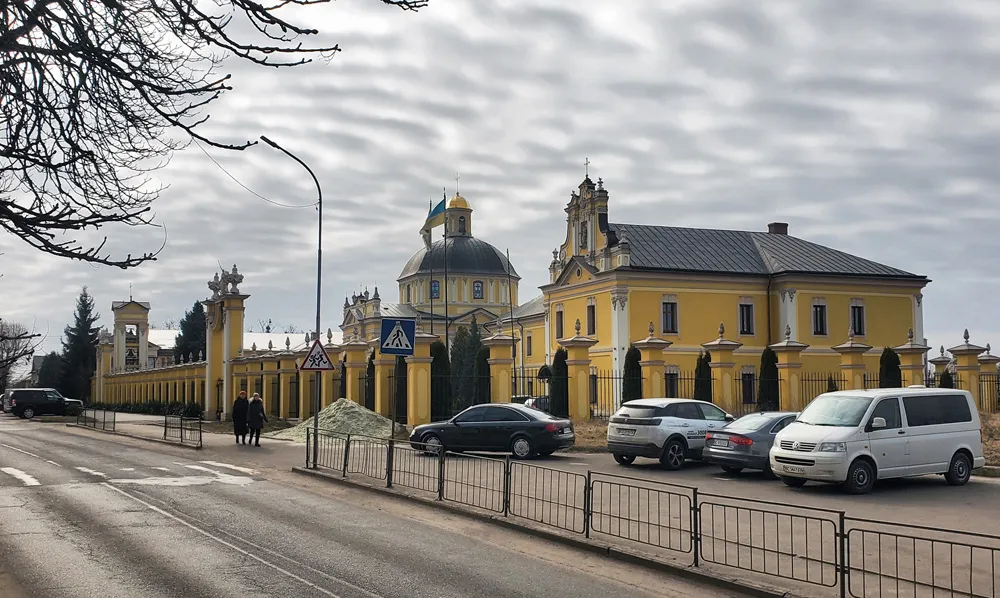
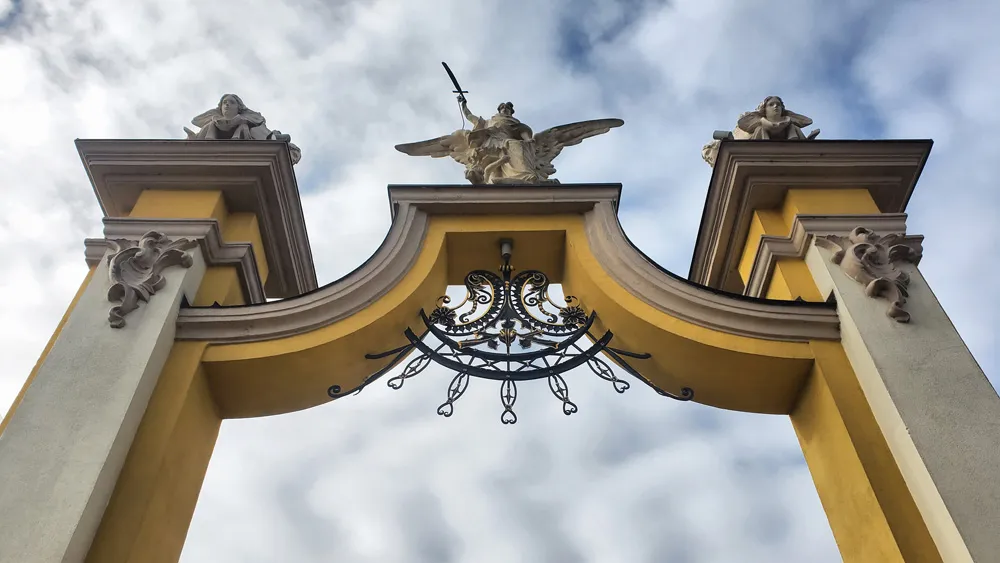
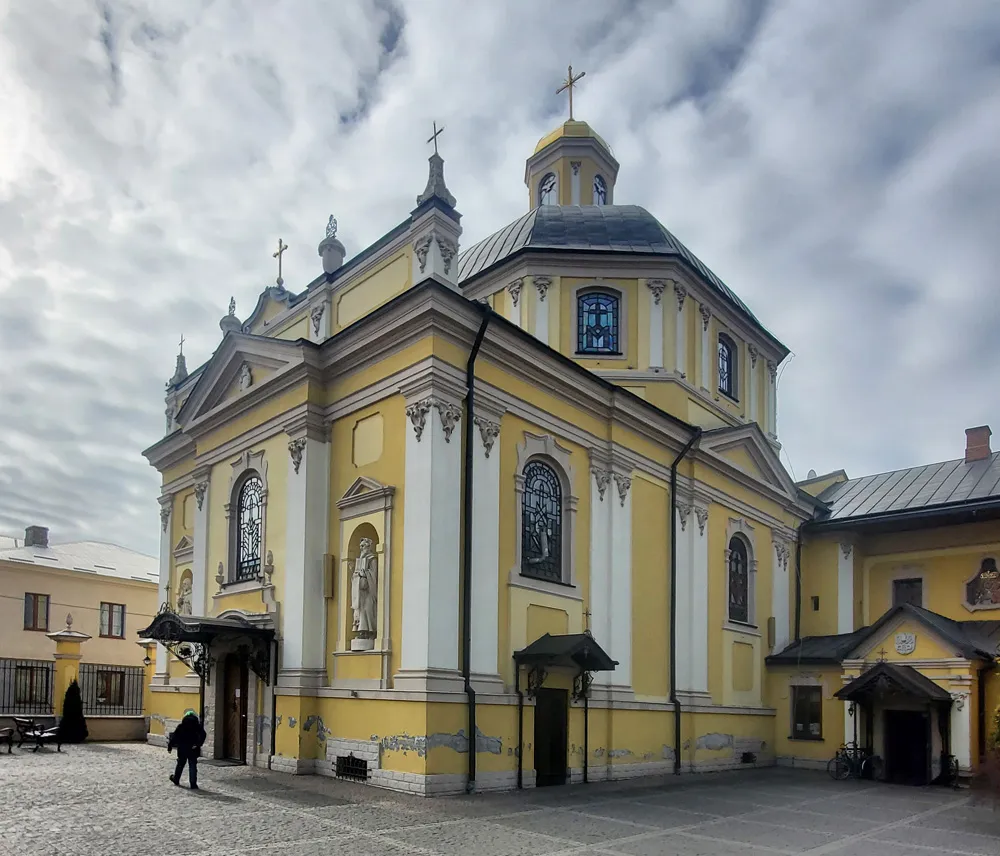
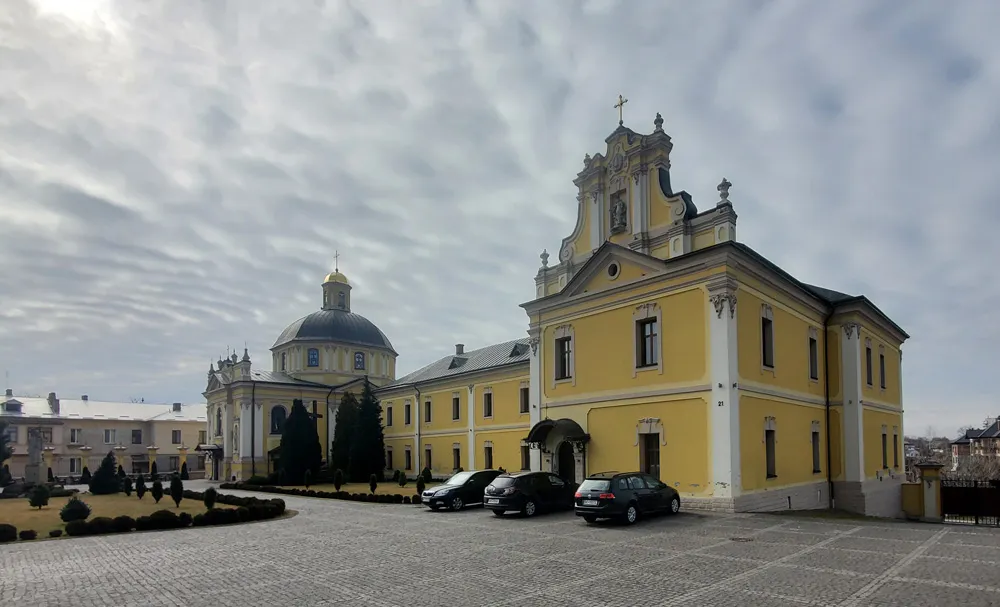
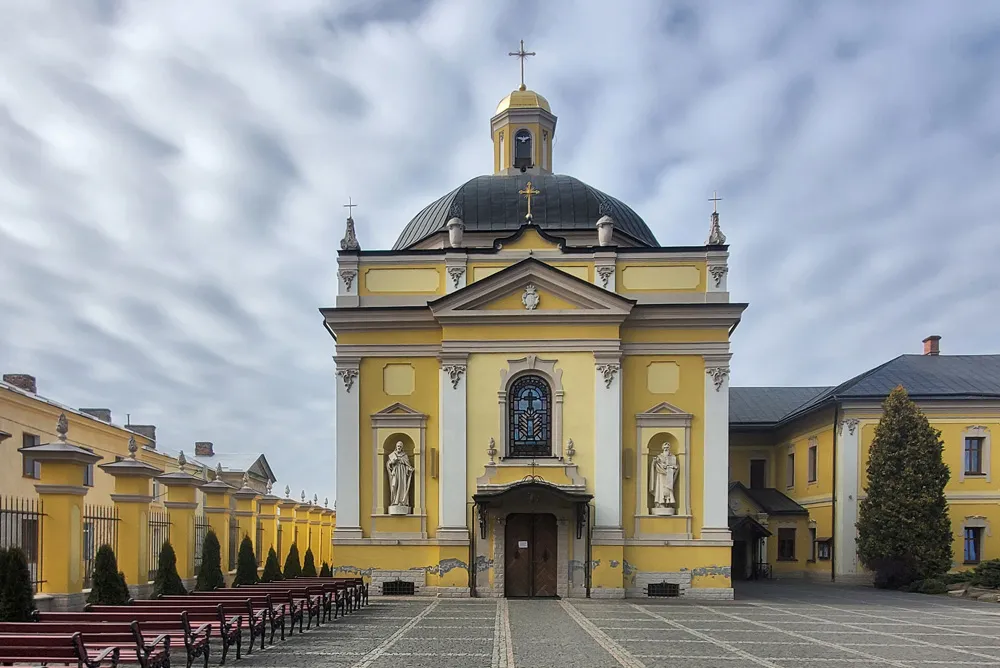
The Basilian monastery
Located in the magnates’ residence and benefiting from the generosity of the benevolent Franciszek Potocki, the monastery quickly increased its influence, and within a few years of the foundation of the shrine many monasteries and parishes in the surrounding towns and villages were under its care. In those years the Basilians were almost the only educated priests able to preach properly, and their vows of poverty and chastity allowed them not to fleece people for blessing Easter breads and to care for the church more than for themselves! On great feast days the bishop himself officiated in the monastery, and the Pope granted the Krystynopil convent a “great indulgence for all time”.
However, one rather unpleasant story is connected with Franciszek Potocki. His son Stanisław fell in love with an impoverished noblewoman, Gertruda Komorowska, and even married her in secret, incidentally in a Greek Catholic church. The elder Potockis, who had already betrothed their son to Józefina Mniszech, were outraged by his disobedience, hastily sent him off to Europe, and had Gertruda seized in order to take her to a convent pending a divorce. On the way Gertruda was killed, apparently through carelessness. Gertruda’s parents sued the Potockis. Of course, the rich magnates, who kept their own army, were used to ignoring court rulings, but after Krystynopil passed to Austria in 1772 the Potockis were forbidden to keep their own army. Moreover, Empress Maria Theresa decided to prove that everyone is equal before the court, and sentenced Franciszek Potocki to public execution (???). The magnate did not intend to wait for arrest and execution and took poison (the story of the suicide is no more than a legend, note by Yurii Hryniv). Soon his wife died too, and the young Stanisław Potocki, returning home, learned of the double tragedy and also inherited all his father’s estates. He did marry Józefina Mniszech, but their marriage was unhappy.
The young Potocki did not intend to live in Krystynopil after all these tragic events. Besides, in Austria, with its absolute monarchy and legal system, the all-powerful magnate felt uncomfortable. It is written that Stanisław was prompted to move to the Russian Empire by an incident involving a Galician Jew who had been arrested for some offence. Friends of the prisoner filed a complaint with Emperor Joseph, and the emperor ordered Stanisław Potocki to release the Jew with the words: “an equal among equals has no power”.
So Stanisław gradually inclined towards an alliance with Russia, moved to Right-Bank Ukraine, which had come under the rule of the Russian Empire, and later entered Russian service. Potocki built a luxurious palace in the town of Tulchyn. The palace has survived, and today it houses a school of culture. He also laid out a splendid arboretum in Uman, calling it Sofiivka after his third wife.
But Potocki did not forget Krystynopil either, as far as he could. He took up the support of the monastery and even made his own corrections to the construction. The last step in completing the shrine took place with his active participation. That step was made on 30 June 1774. At least, that is the date, when the lantern above the dome was completed, that marks the end of construction of the church.
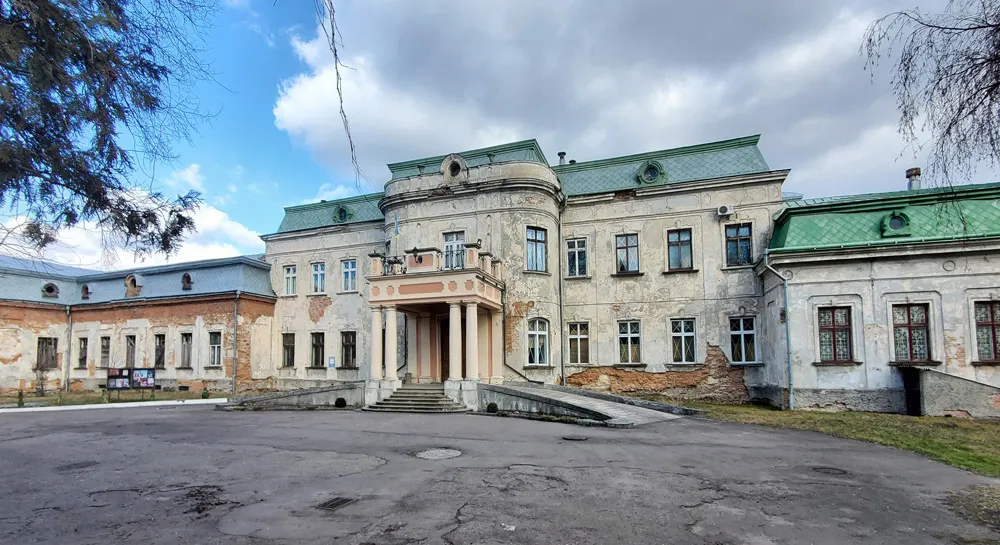
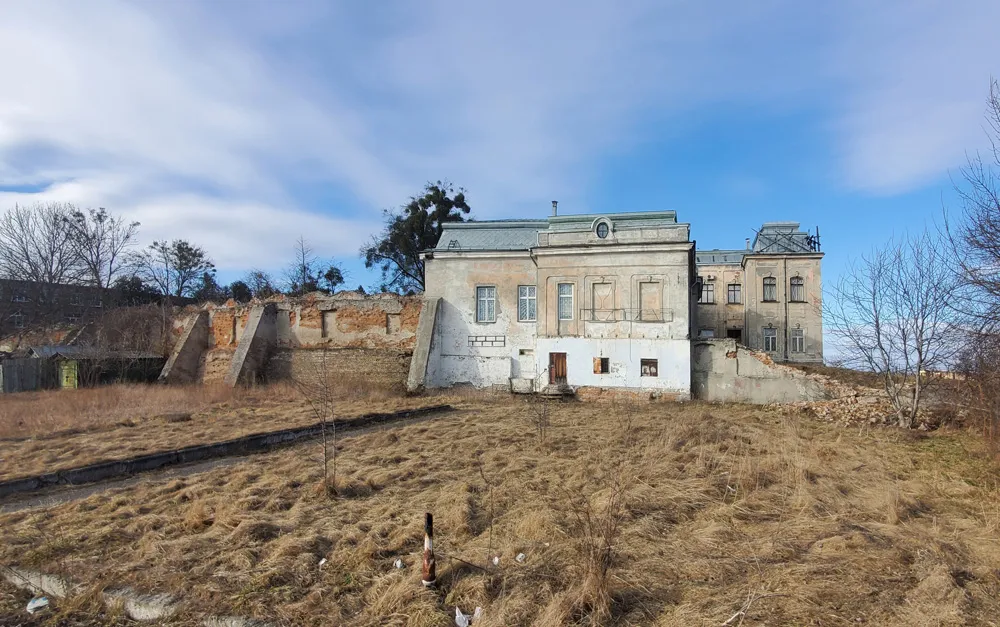
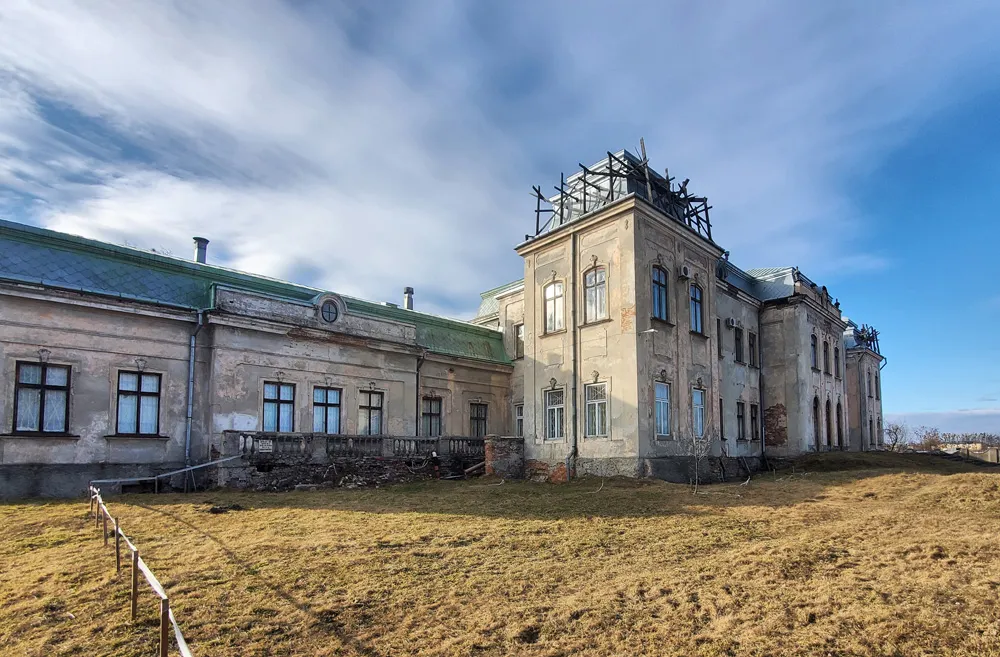
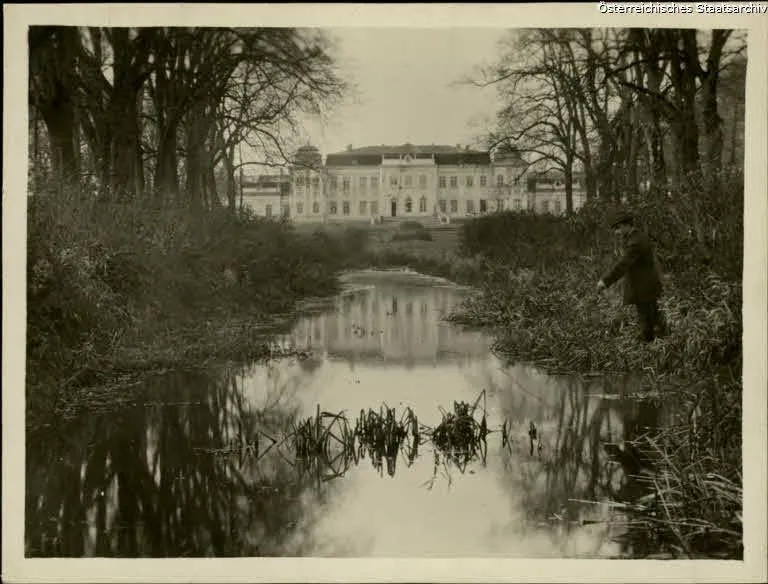
Potocki Palace. Archive photo from the website Krystynopol.Info
Together with the glory of the monastery its library grew too. This was not without the support of the old magnate, but the main initiator was Fr. Korneliy Srochynskyi, who was hegumen of the monastery from 1766 to 1776, took an active part in its development, won fame as a brilliant preacher and even began to write a chronicle! Numerous old printed books and manuscripts were brought here from closed monasteries, which only sped up the growth of the library. Many ancient folios of which the monastery librarians were proud vanished without trace, but Srochynskyi’s chronicle and the famous Krystynopil Apostle (a 12th-century manuscript) have survived to this day. Stanisław Potocki wanted to destroy the chronicle because of its mention of the story of the murder of Gertruda Komorowska, but then agreed only to have the pages describing this tragedy torn out.
The Basilian monastery is also known for housing the famous miraculous Krystynopil icon of the Mother of God. As to the origin of the image, the monastery chronicle says: “In 1764 Stanisław Kostka Sadowski, Marshal of the court of Franciszek Salezy Potocki, gave to the Basilian church an image of the Mother of God with Jesus Christ, painted on canvas, one cubit long and ? cubit wide.” In Soviet times the icon was, of course, taken from the monastery, and was returned only when the monastery was restored. Now the icon hangs in the altar part of the Basilian church and is opened for feast days.
The growth of the monastery’s influence did not stop even after the Austrian church reforms, when dozens of monasteries across Galicia were abolished. On the contrary, the Krystynopil convent, which became the only Basilian monastery in the Buh region, took under its wing a huge number of parishes in villages and towns, which from then on were filial churches of the monastery. The monastery hosted theological studies and retreats that covered several parishes. It was in Krystynopil that in 1892 the novice Roman Maria Sheptytskyi took his monastic vows and became Andrei Sheptytskyi.
In 1939 the Second World War began, and under the Molotov-Ribbentrop Pact Krystynopil was in Germany’s sphere of interest, so from September 1939 the occupation here was not Soviet but Nazi. And while the Communists destroyed everyone little by little, the Nazis specialised in Jews. The Jewish population of Krystynopil (more precisely, what remained of it, since the cleverest had fled in advance to the Soviet side) was sent to concentration camps, the synagogue was destroyed, and a road to the Soviet border was made from gravestones.
After the war Krystynopil passed to Poland, and in 1946, as part of Operation Vistula, all Ukrainians were expelled from the town. The Basilians were driven out too, but some remained in the town and continued to serve in secret those Ukrainians who had happened to stay. Then coal was found here, and in 1951 Stalin took Krystynopil, together with Belz and the surrounding villages, into the USSR, giving the Poles in exchange Nyzhni Ustryky and part of the Bieszczady. Now all the Poles were expelled from Krystynopil.
Having received as a “gift” an empty town without a local population, the Communist authorities decided to create a model Soviet city here: without churches, without “bourgeois” architecture, without history, without an indigenous population. Barely keeping up with the construction of mines, new residential districts, wide boulevards and parks were quickly built. The architects of the new town deserve credit: the new districts turned out quite habitable and relatively pleasant to the eye. But at the same time what remained of the old town was being destroyed: old townhouses with arcades, the castle park and the temples.
The castle was in fact turned into a school, and warehouses were set up in the monasteries of the eastern and western rites, which in no way helped preserve the beautiful interiors. In the Basilian monastery they later made a museum of atheism, which was better than a warehouse, but still did not help preserve the monastery and its cells. The Church of the Holy Spirit with its monastery cells was also turned into a complete ruin.
As a result of Soviet industrialisation old Krystynopil became one of the districts of a new city, which received the “ideological” name Chervonohrad (“Red Town”). Its population consisted of miners, builders and specialists from all corners of the Soviet Union: people with no attachment to this land, ideal Soviet people for whom, in Mayakovsky’s words, “our labour is our homeland”. As a result, Chervonohrad became one of the most criminal cities of Western Ukraine.
But if the Soviet Union always succeeded in destroying the old, building the new went somewhat worse. Green squares and typical high-rises came out quite well for the red authorities, but breeding a new kind of “homo sovieticus” stalled. Whether Banderites had seeped into the local party milieu, or the land itself passed its values on to the people who settled on it, or the crisis of the late Soviet economy played its part, Chervonohrad became the first city in Ukraine where a monument to Lenin was taken down, earlier than in Lviv!
At the end of 1989 the monastery was returned to believers, and since then restoration and reconstruction of the buildings have begun, continuing to this day. Today the monastery complex has survived in full and consists of the Church of St. George, a block of cells and a bell tower. All the buildings were erected during the second half of the 18th century and together form a unified architectural ensemble of the era of transition from late Baroque to early Classicism. The facade is decorated with new sculptures, the roof is made of copper, and the museum of atheism was moved to the Potocki Palace, as the school had by then been moved to new premises.
True, this is now a museum not so much of atheism as of sacred art. It is a branch of the Lviv Museum of the History of Religion, and holds old icons, priestly vestments, religious paintings and sculptures. The town also has a branch of another Lviv museum complex, the Sheptytskyi Museum. Folk embroidery is on display here, and from time to time works by outstanding Ukrainian artists, both old and modern, are brought from Lviv for an exhibition. In general, not every town has such sincere, welcoming museum workers devoted to their cause as Chervonohrad.
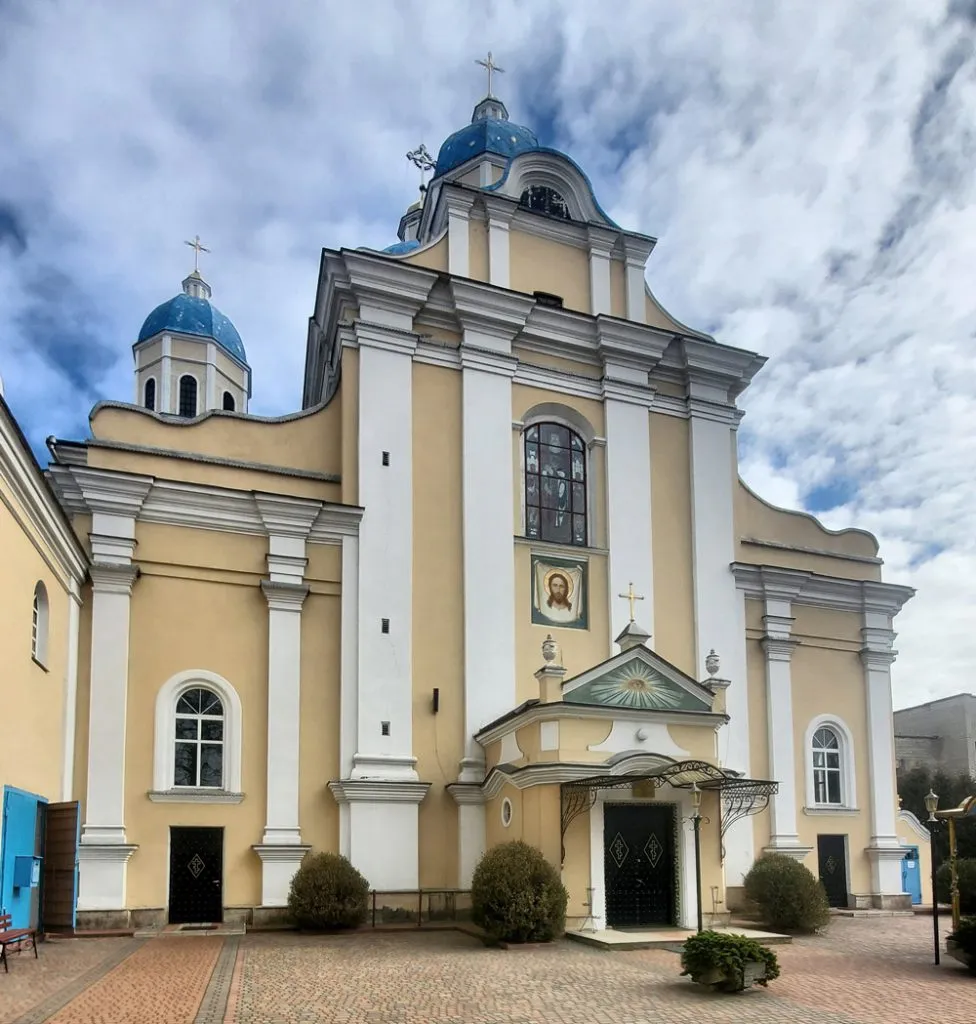
The church was a little less fortunate: only bare walls were left of the building, and they were handed to the Autocephalous Orthodox Church. Considering that nothing was left of the original interiors, the new owners painted the walls in the style of Russian Art Nouveau “in the manner of Vasnetsov”. In principle it looks quite decent, and only the five big blue domes spoil the Baroque composition of the former church.
The Roman Catholics who live in the town have for many years gathered in a small chapel and are building a new church. God grant that it is built soon.
There are many new churches in the town: in a completely modern style, built “in the old manner”, and even one beautiful modern wooden church. And here people treat with great care both the memorial to Soviet soldiers and the mass grave of soldiers of the Ukrainian Galician Army, who heroically defended themselves here against the Polish occupiers in 1919, and the graves of the UPA. People try not to paint history in black and white, to treat the problematic pages of the past with understanding, and to build a new future on its fragments, one shared by the children of Soviet soldiers and the children of those who carried food to Ukrainian insurgents, by Roman Catholics, Greek Catholics and Orthodox alike.
Text by Yurii Hryniv. Website Krystynopol.Info
Photos by Roman Malenkov
The former Bernardine monastery
The Bernardine monastery in Chervonohrad (then Krystynopil) was founded in 1695 (according to other sources, in 1692), when the founder of Krystynopil, Feliks Kazimierz Potocki, built in the town a wooden Church of the Holy Spirit with masonry underground crypts, intended to serve as a burial vault for the Potocki family and his descendants. Feliks Kazimierz also invited monks of the Bernardine order to settle at the church and gave them land for pasture, the right to fish in the Western Buh, and the right to use the mills and forests belonging to the nobleman. In 1701 the church burned down; Feliks Kazimierz began building a new masonry church in the Baroque style on its site, but died in 1702 and was buried in the church’s crypt. The rebuilding of the church was continued by his son, Józef Felicjan Potocki, who donated 30,900 zlotys to the building works. From 1710 a Confraternity of the Immaculate Conception of the Mother of God operated at the church.
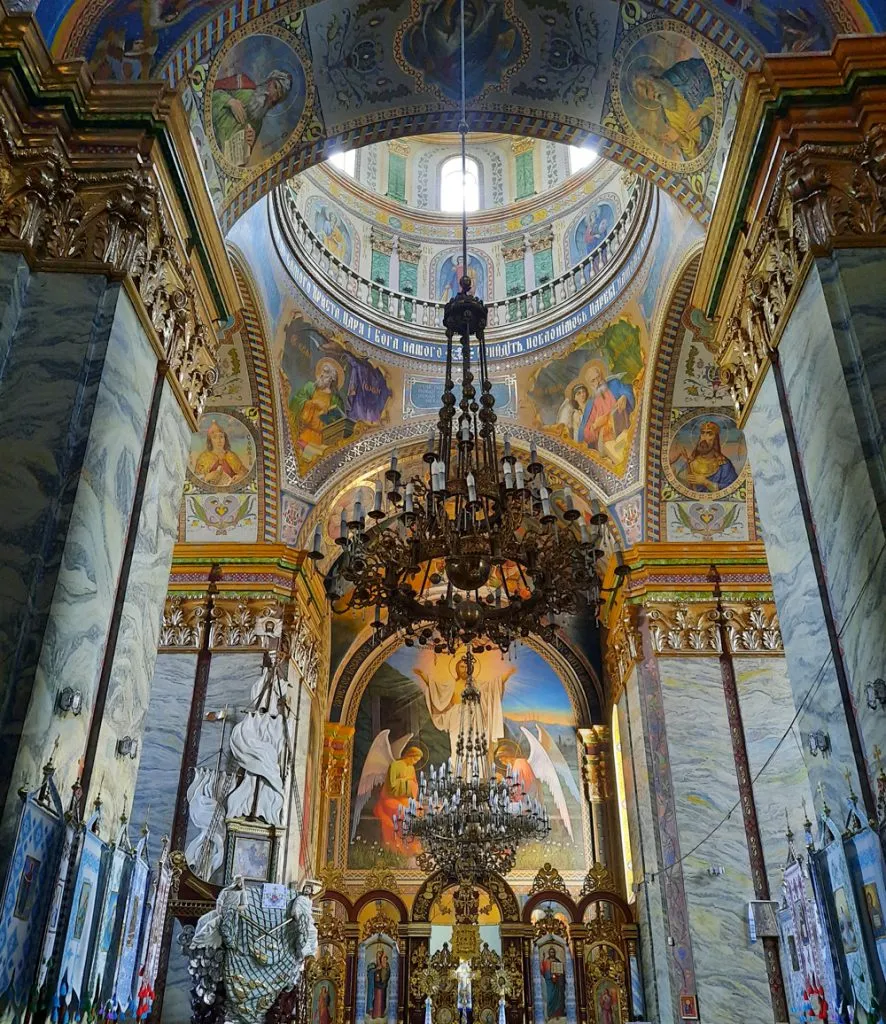
The modern interior of the cathedral. Photo by Oleh Tkachuk (Wikipedia)
In 1723 Józef Felicjan Potocki died and the construction of the Church of the Holy Spirit was continued by his son Franciszek Salezy Potocki. In 1733 he brought from Rome to the Krystynopil church a coffin with the relics of St. Clement. Another relic, a particle of the Holy Cross, was brought to the church in 1752.
The first buildings of the Bernardine monastery at the Church of the Holy Spirit were wooden, so in 1747 Franciszek Salezy began building a masonry monastery to a design by Franciszek Czajka. However, in 1749 a fire destroyed part of the monastery buildings and damaged the church. The restoration of the monastery and church was completed only in the 1760s. In 1767 a stone fence was added.
In 1755 an organ was installed in the church, and in 1758 a small chapel for the relics of St. Clement was added to the right of the altar part. For the interior painting of the church Franciszek Salezy Potocki invited the Lviv painter Stanisław Stroiński. The cost of the painting work, which continued from 1759 to 1759 [sic], was 16,016 zlotys. Stroiński painted the walls and vaults of the church with polychrome frescoes; the most prominent among them were frescoes on the theme of the Resurrection of Christ and the life of St. Francis in the main nave. A few paintings for the church were also made by the artist D. Balcani.
In 1772, after the First Partition of Poland, by which Krystynopil passed to the Habsburgs, and the death of Franciszek Salezy Potocki, the gradual decline of the monastery began. In 1772–1774 part of the premises housed Austrian army warehouses, so the monks gradually left the monastery, moving to Polish lands. In 1802 the Austrian authorities tried to close the monastery because of the small number of monks, but thanks to the patronage of the Lviv consistory member Eukarpiusz Wegel the monastery continued to exist.
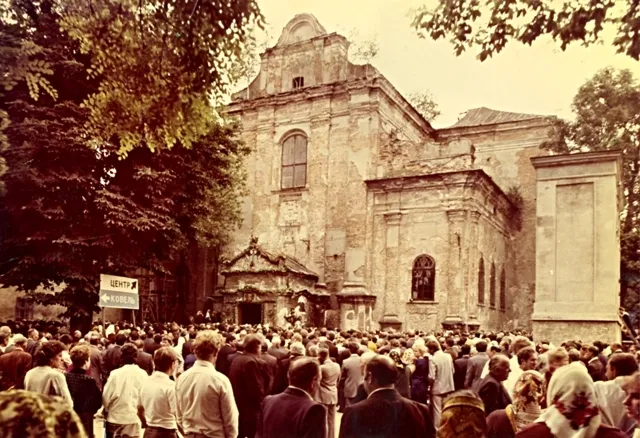
The Church of the Holy Spirit in 1988. Photo from the website Krystynopol.Info
In 1840–1843 a partial repair of the monastery was carried out; its superior then was Antoni Mikosz. In 1852 a great fire again destroyed the church and monastery, but within two years the buildings were fully restored. The restoration was led by the new superior of the monastery, Anzelm Pizuński, who held the post in 1848–1855; the money for restoring the shrine was given by numerous benefactors, among them Teresa Wiśniewska, the then owner of Krystynopil. Stanisław Stroiński’s frescoes were restored after the fire by the painter Stanisław Rodecki in 1854. In 1889 a new altar by the Polish master Majerski was installed in the church; the altar cost 4,000 zlotys. The Baroque altar was decorated with carved wooden figures: in the central part statues of St. Bernard and St. Francis, at the sides statues of the Roman popes Gregory and Urban. At the end of the 19th century the side chapels were also rebuilt.
In 1876, when the church crypts were opened, it turned out that the burials in them had been plundered and desecrated. They were put in order in 1898 by the wife of Count Adam Potocki, who restored two crypts at her own expense and reburied the bodies of the Potocki family in them.
It is known that in the second half of the 19th century a primary school operated at the monastery. As of 1885 the church parish numbered more than a thousand people.
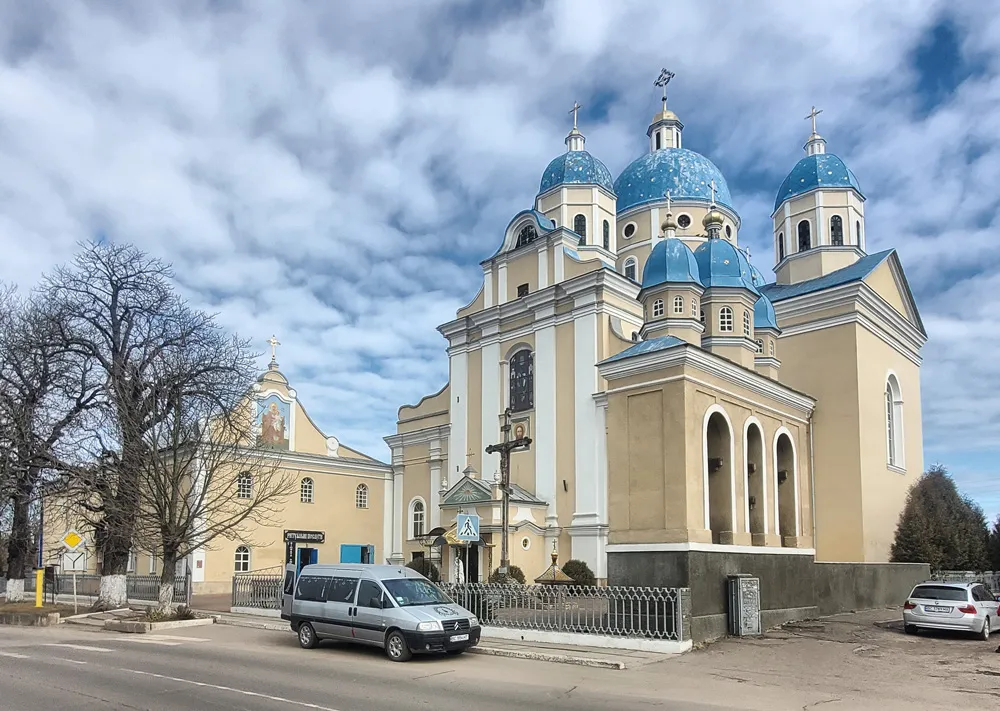
In 1927 the church was restored once again.
During the Second World War the church and monastery were almost undamaged; only in 1944 was the top of the dome damaged. The superior in those years was Jerzy Bielecki. The neighbouring Basilian monastery was taken by the Germans for a hospital, so with Fr. Bielecki’s consent the Basilians held their services in the Bernardine monastery. In 1944–1946 the monastery, abandoned by the monks, housed the Polish militia of Krystynopil. A torture chamber was set up in the monastery’s cellars, as evidenced by human remains found during the rebuilding of the church in the 1990s.
When in 1951, under the Soviet-Polish intergovernmental agreement, Krystynopil passed to the USSR, the Soviet authorities closed the church and monastery, and although in 1979 they received the status of “architectural monuments of the Ukrainian SSR under state protection”, the buildings gradually fell into ruin.
Only in 1988, by decision of the city council, was the Church of the Holy Spirit handed over to the Orthodox community, and it became the first working church in Chervonohrad. In 1988–1989 repair and restoration work was carried out, as a result of which four smaller domes were added to the main one, and the former church was reconsecrated as the Orthodox Church of St. Volodymyr, Equal-to-the-Apostles. The interior was decorated with paintings by artists from the town of Horokhiv under the direction of Oleksandr Koretskyi, the dome was painted by teachers of the Chervonohrad art school S. Ruzhytskyi and M. Levkun, and the iconostasis was made by the Lviv carver Ihor Kozak. Unfortunately, the 18th–19th-century interior paintings were destroyed during the restoration. In 2006 the domes of the church were painted blue and decorated with golden stars.
The church building is brick, in plan a cross with arms of equal length, the western arm of which is formed by a three-nave volume. The central nave, crowned with a dome, is considerably higher than the side aisles and the transept. The main facade, decorated in the Baroque style, is adorned with pilasters set on high plinths and crowned with a cornice and a curvilinear pediment. In the 19th century a small porch with a triangular pediment was added to the central entrance. The south facade of the church has no architectural decoration. To the north and east the church building is adjoined by two-storey monastery cells with a spacious rectangular inner courtyard.
The church houses the icon of the Mother of God “Vsetsaritsa” (the All-Queen). The church also holds icons with particles of the relics of the following saints: the Great Martyr Demetrius of Thessalonica, the Great Martyr and Healer Panteleimon, the Great Martyr Barbara, St. Spyridon, the wonderworker of Tremithous, and the Hieromartyr Cyprian.
Text from Wikipedia. Photos by Roman Malenkov