

Lithuanian customs officers detain a “Petro Mohyla bell” probably stolen by occupiers in Ukraine
On 16 March, Lithuanian customs officers at the Šalčininkai road checkpoint seized a bell smuggled through Lithuania, which was being secretly transported by a citizen of the Republic of Moldova. The press service of the Lithuanian Customs reported this.
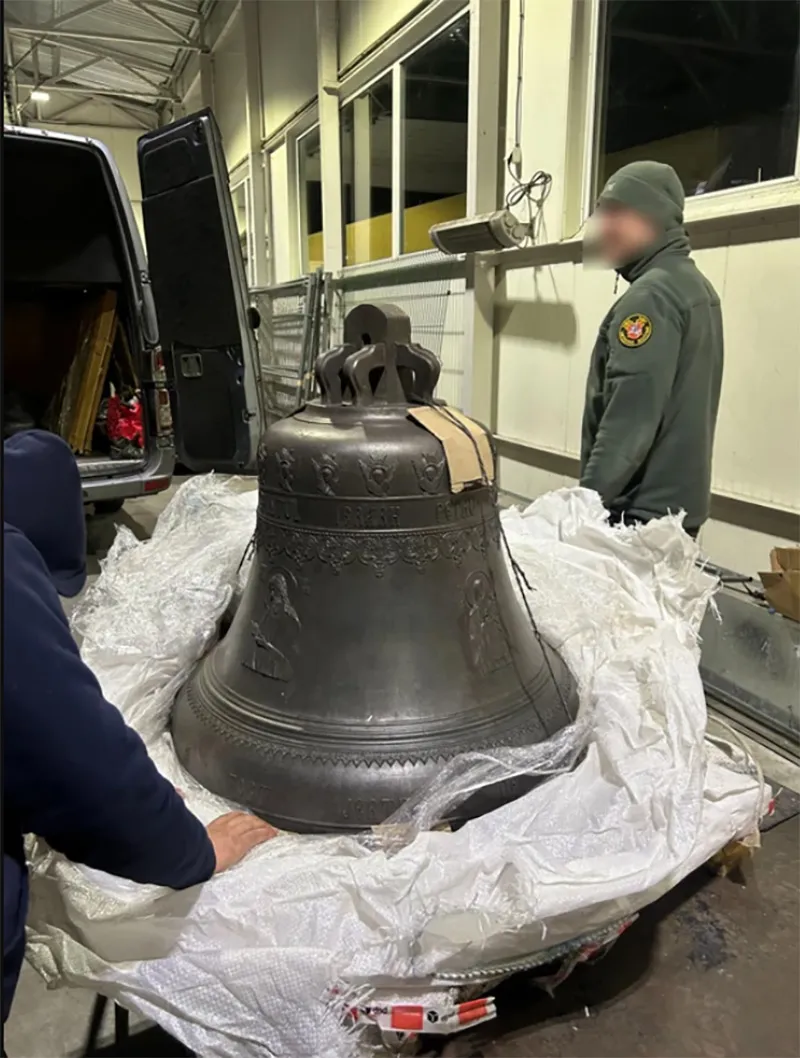
Specialists of the Department of Cultural Heritage Protection are currently determining whether the seized item is a cultural heritage object. Meanwhile, customs officers are finding out whether the bell could have been stolen in Ukraine.
On the night of 15 to 16 March, a few minutes after midnight, a citizen of the Republic of Moldova arrived at the Šalčininkai road checkpoint in a Mercedes Sprinter and told customs officers verbally that he was not carrying anything prohibited or subject to declaration. However, when they inspected the vehicle, the officers found an unexpected discovery inside – a church bell hidden under bags.
The driver could not provide any documents on the origin and ownership of the bell, saying he did not know such documents were needed.
Suspecting that it could be a cultural heritage object, probably stolen in Ukraine, as well as a violation of sanctions, customs officers seized the bell and drew up a seizure report.
The Moldovan citizen admitted that he intended to transport the bell from Russia (the city of Podolsk) through Belarus and Lithuania to Moldova at the request of Patriarchs Kirill and Nikolai.
Information about this 260-kilogram bell has now been passed to cultural heritage protection specialists for assessment.
Judging by the inscriptions on the bell, it may be dedicated to the veneration of the 17th-century Orthodox saint Metropolitan of Kyiv and All Rus’, St. Petro Mohyla.
Note from “Ukraine Incognita”: Petro Mohyla was canonised by the Ukrainian Orthodox Church (Moscow Patriarchate) and the Ukrainian Orthodox Church of the Kyiv Patriarchate (1996). But there was no canonisation at the level of the entire Russian Orthodox Church.
As the photos clearly show, the bell is modern. But given the above, it could previously have been in a church of the UOC (MP) or of the OCU. Yet there are no such churches in Russia. Accordingly, with a very high degree of probability it can be asserted that the bell was stolen from one of the churches in the Russian-occupied territories of Ukraine – most likely from one of the OCU churches. As is well known, the Russian invaders treat the Ukrainian Church extremely negatively: they persecute believers, arrest priests and plunder churches, handing them over to representatives of the Moscow Patriarchate.


