

The “plague cross” and the mystery of St. Magdalene (new discoveries, photos)

· 6 min read
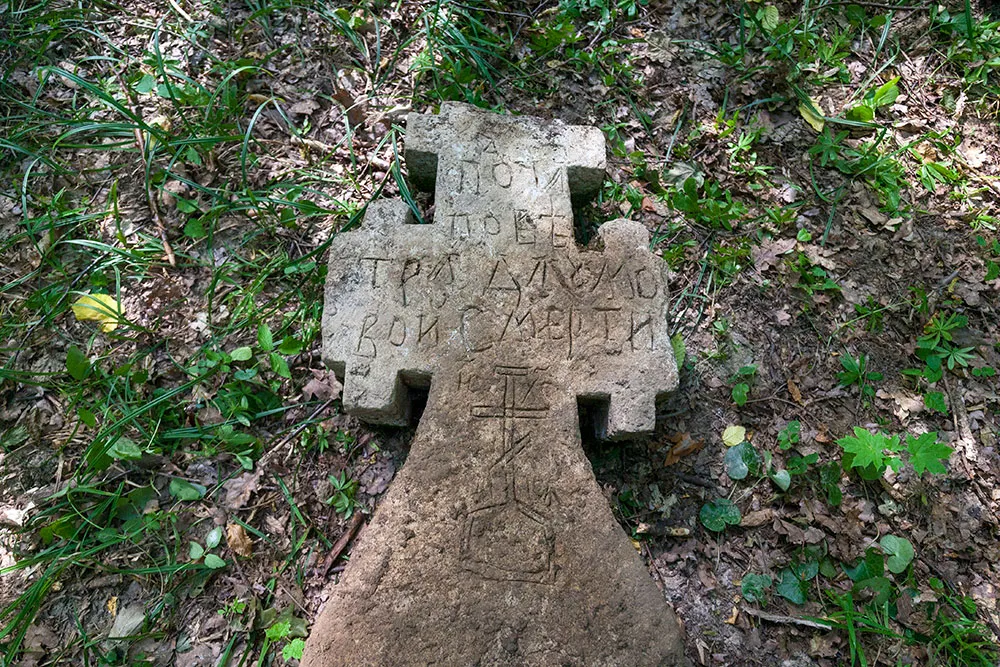
A mention of “plague death” on the cross of 1770
The news spread by “Ukraine Incognita” about the “plague cross” found by local historian Anatolii Kobiletskyi not far from Sataniv (Khmelnytskyi Oblast) had considerable resonance and was subsequently reprinted by a good dozen online publications. Before that, recall, quite a few people knew that an old cross lay in the forest in Sataniv itself, near the Holy Trinity Monastery, but nobody was interested in what kind of cross it was and from what time.
Not without the influence of the author of these lines, Mr Anatolii decided to find out at last what sort of cross lay in the forest. He combined historical research with his hobby, “quiet hunting” (mushroom picking).
The trip to the forest turned out successful in every respect: both mushrooms and the cross were found.
Having partly scraped the moss off the find, Mr Anatolii Kobiletskyi immediately sent photos to the editorial office of “Ukraine Incognita”, which was the first to report the news. Unfortunately, it had rained before, and it was not possible to clean the surface of the cross properly. From what was visible, it turned out that this cross too was connected with the plague epidemic that swept Eastern Europe in 1770–1771. This was vividly attested by an inscription saying that a “maiden ???ANNA” died in September of the year АΨО (that is, 1770).
The facts that this is an “extra-cemetery” burial and the date of 1770 clearly indicated that we have the grave of a victim of the plague epidemic. Recall that, to avoid spreading the disease, victims of the pestilence were buried right next to their houses, and in the place where the cross was found a farmstead once stood.
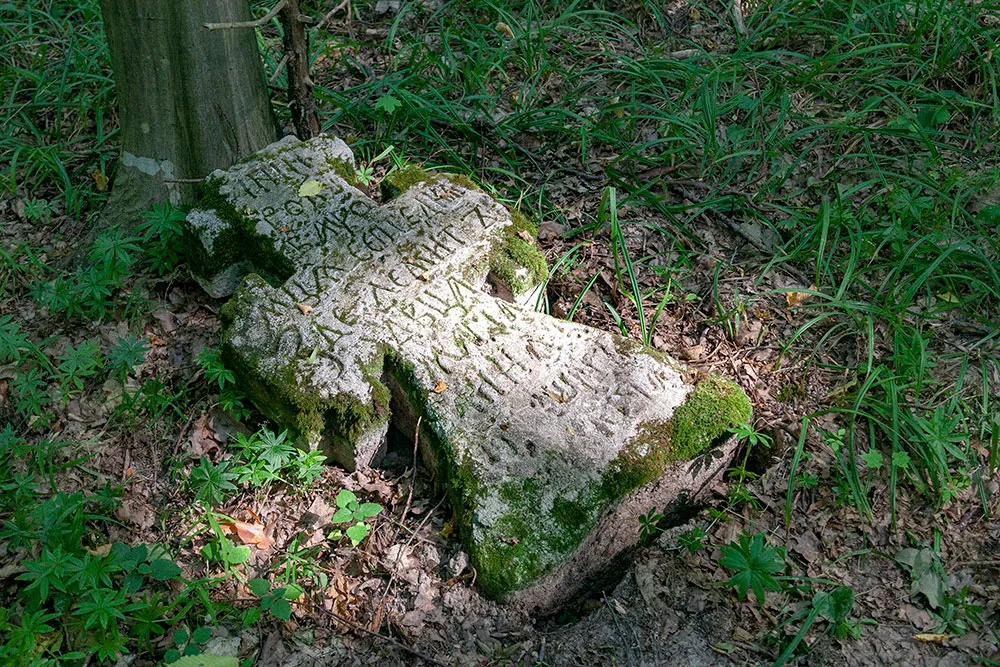
The cross after the moss was cleaned off
After some time Mr Anatolii returned to the find and cleaned the surface of the cross more thoroughly. It turned out that the person buried here was not “Anna” at all, as it first appeared, but Magdalene. And here we have an amazing and mystical coincidence.
As it turned out, the grave of the maiden Magdalene, who died of the plague, was found on the eve of the commemoration day of St. Magdalene, whose miracle-working icon (19th century), kept in the Church of the Resurrection of Christ, is greatly revered in Sataniv because it once saved the town from a cholera epidemic.
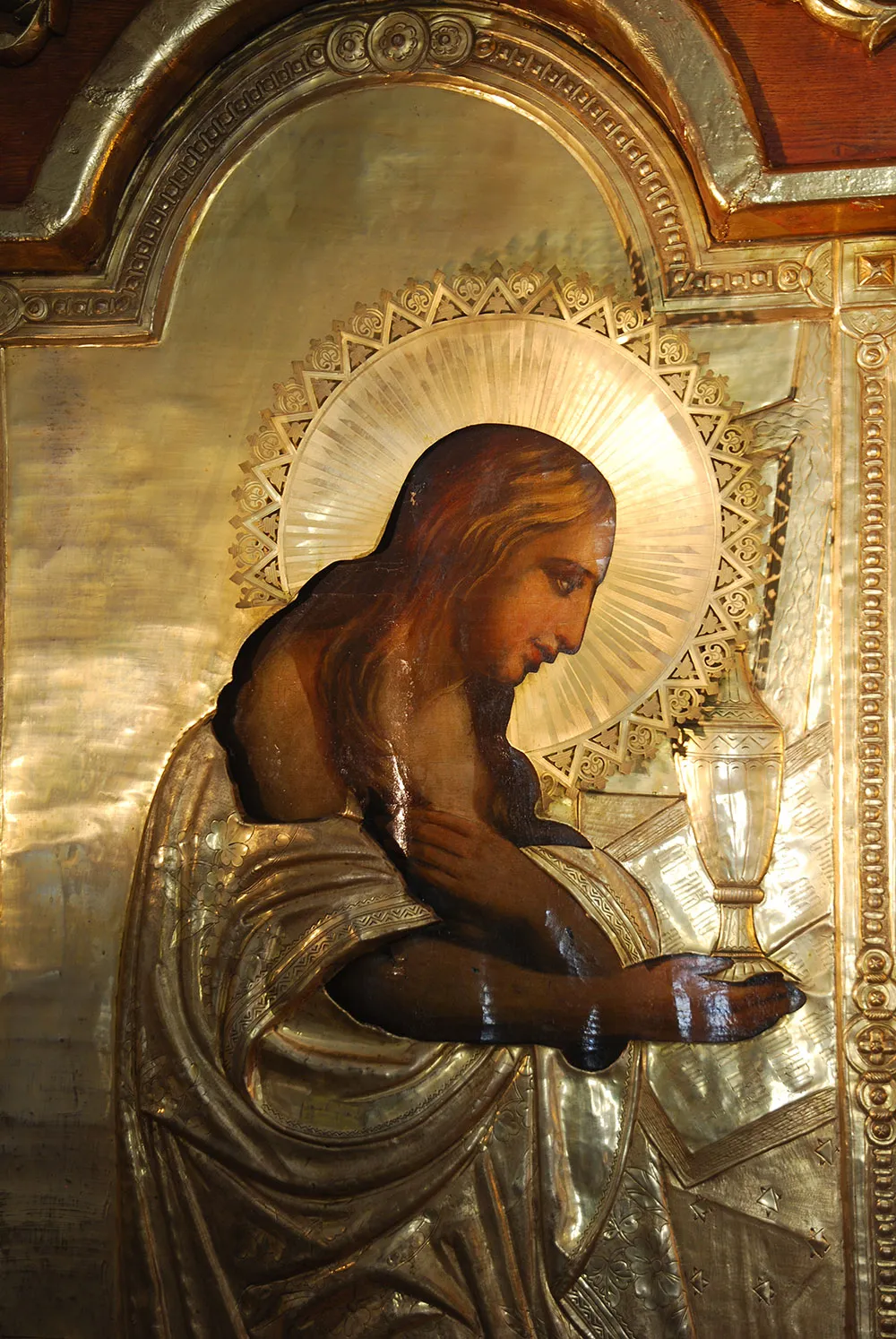
Icon of St. Magdalene. Sataniv
Old people still recall the stories of how cholera raged in the town in 1918. The epidemic, according to tradition, stopped only after the image of St. Mary Magdalene was carried in a procession around Sataniv. They say that this sizeable and rather heavy icon was carried by four widows; when some grew tired, another pair replaced them.
According to tradition, when the procession moved through the streets of the town, not only Orthodox Ukrainians came out to the road, but also Polish Catholics and even Jews. As for the latter, the stories differ slightly. Some say that the Jews, too, prayed (in their own way, of course) as the icon passed; others say they greeted it in silence, but respectfully. According to local legend, the epidemic stopped as soon as the image was carried to the middle of the bridge over the Zbruch (the border guards would not let it go any further).
In addition, when the icon was returned to the church, according to eyewitnesses, it was found to have been miraculously renewed, and the old dull paints shone like new. St. Mary Magdalene herself in the image was “as if alive and, it seemed, breathing”.
It is indeed an amazing coincidence: the cross on the grave of the girl Magdalene, who died of the pestilence, was found on the eve of the day of St. Magdalene, who saved Sataniv from the epidemic.
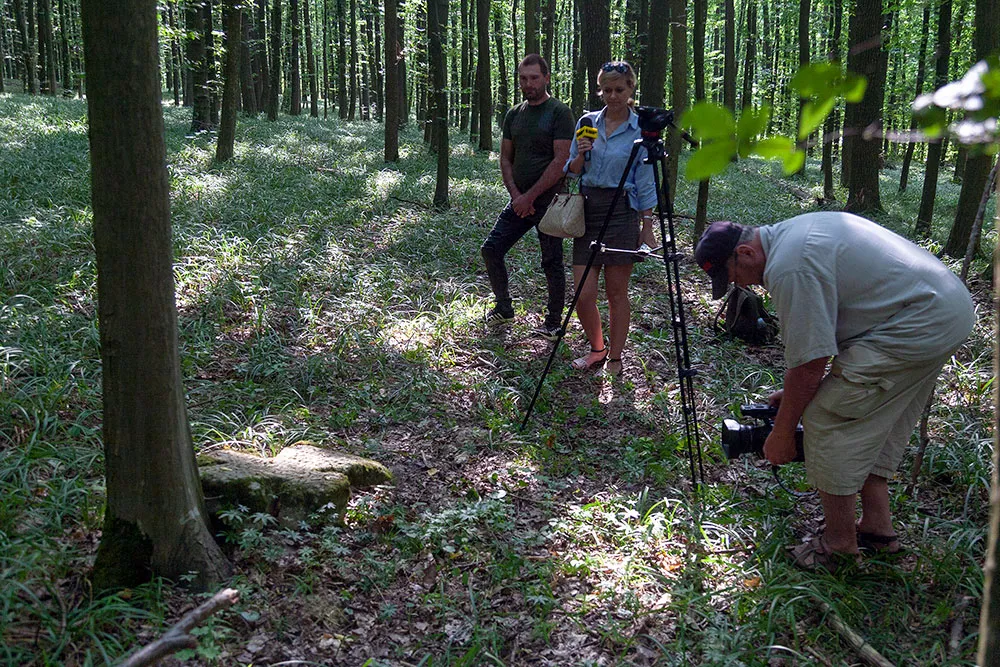
Journalists of Suspilne also became interested in the find
Together with the discoverer of the monument, Anatolii Kobiletskyi, and a film crew from “Suspilne Khmelnytskyi”, the author, who had already studied many “plague” and “cholera” burials of the Zbruch region, examined the find more thoroughly, which resulted in one more discovery.
After photographing the find, it was decided, at the suggestion of the author of these lines, to examine the opposite side of the stone cross, all the more so since its dimensions allowed it. For example, another “lying” cross, on the grave of the “Младєніци Марії із вєски Кринцилов” (“the maiden Maria from the village of Krynchyliv”), near the village of Krynchyliv (about a kilometre from Magdalene’s grave), can be turned over only with the help of machinery or a good team of loaders.
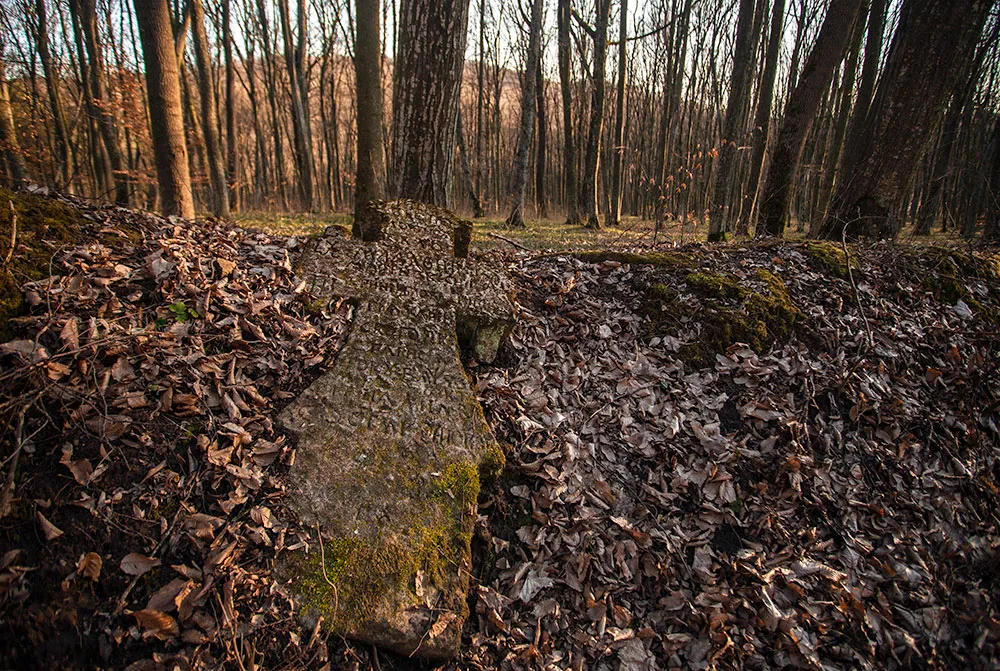
The “plague cross” near the village of Krynchyliv.
It was expected that the opposite side would show the image, traditional for tombstones of that time, of the Calvary cross and the “Adam’s head”. These images were indeed found, but as a secondary element. The main discovery was the continuation of the epitaph.
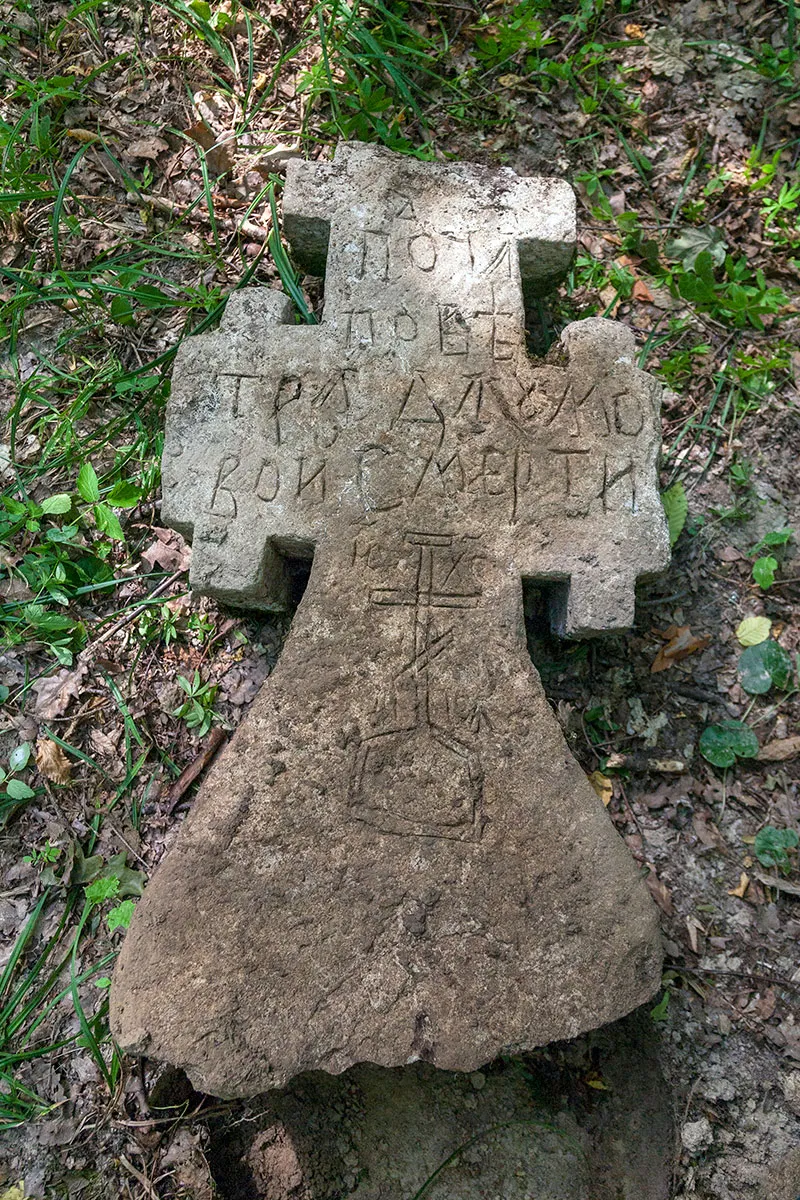
The previously hidden side of the cross.
Whereas before, the conclusion that this was precisely a “plague cross” was built on assumptions (its location outside a cemetery and the date of 1770), on the reverse side the cause of death of the “maiden Magdalene” is stated directly: “повєтріє джумовой смєрті” (“the pestilence of dzhuma death”). “Dzhumovoi” means “plague”. In Bukovyna the plague is still called “dzhuma”. A direct reference to the plague-dzhuma, by the way, is not typical of the epitaphs of plague victims found in this area.
One may assume, especially considering that the burial is located about half a kilometre from the Holy Trinity Monastery, which at that time belonged to the Basilians, that the “maiden Magdalene” belonged to the monastery’s peasants.
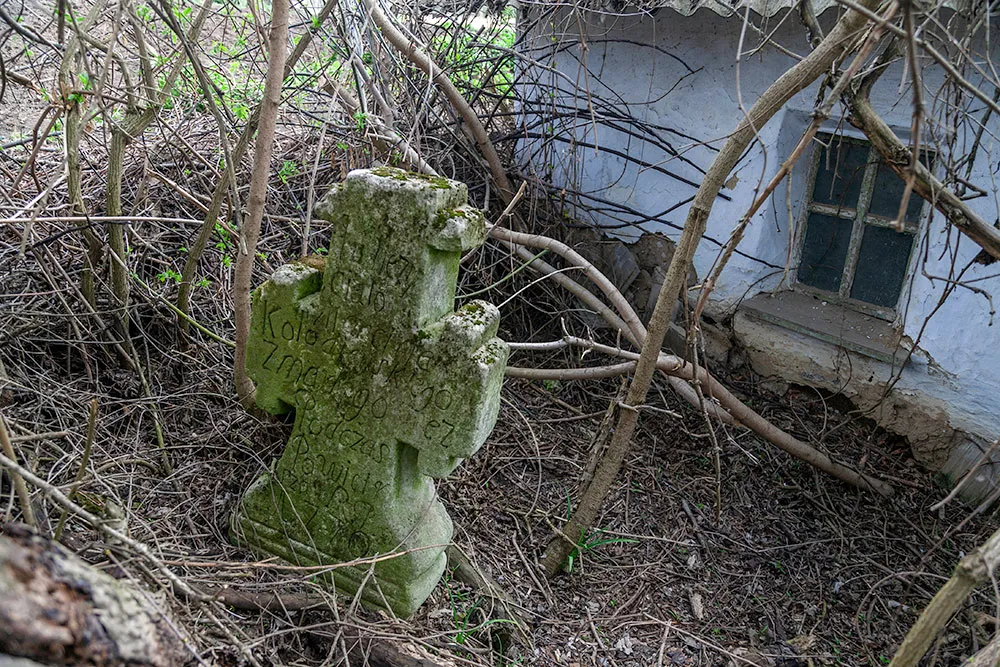
A plague cross in the village of Kamianka, a hamlet of the settlement of Sataniv
The monastery’s chronicle contains an entry left by its hegumen Modest Silnytskyi. In particular, it says that in the plague of 1770, 6 monks and 150 peasants belonging to the monastery died. Among the latter, probably, was the maiden Magdalene.
It is worth noting that “plague” extra-cemetery crosses of the 18th century are extremely unique and rare monuments of the past. Throughout Podillia there would hardly be even a couple of dozen of them.
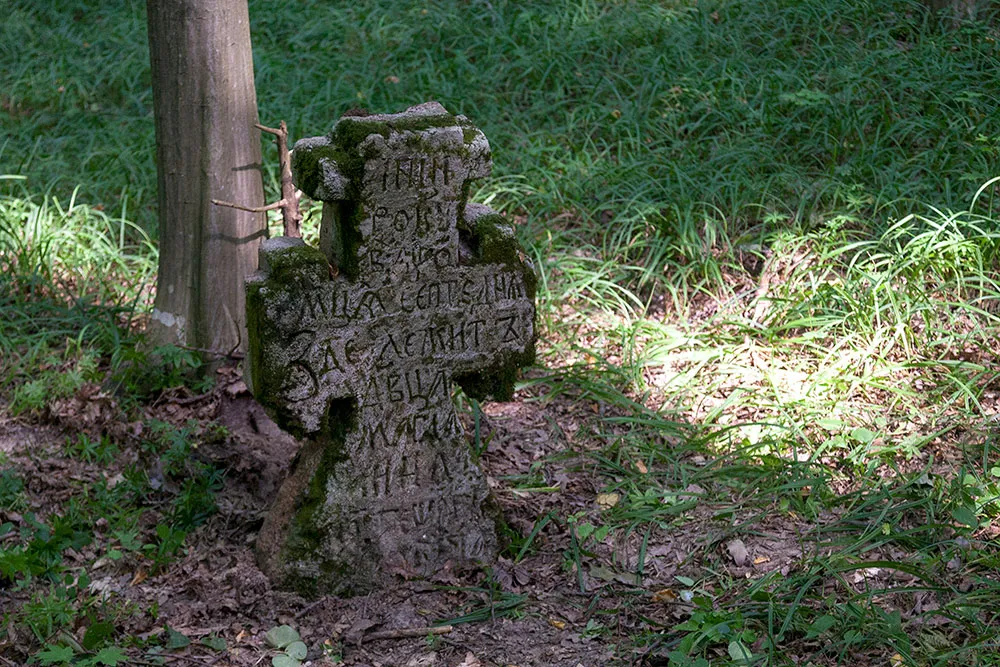
After the photo session the cross was carefully laid back on the ground: it is unstable (the “tongue” that is dug into the ground is missing) and might be damaged if it fell.
Dmytro Poliukhovych (“Virtual Vytrishky”)
If you liked it, you can thank the author for his work and help the “Virtual Vytrishky” project by transferring a few hryvnias to the PrivatBank card 5168 7554 6511 0969 (Dmytro Poliukhovych).


