

Not stealing but rescuing! The Museum of the History of Jews responds to the publication about the Ternopil region synagogue relics that ended up in Moscow

· 10 min read
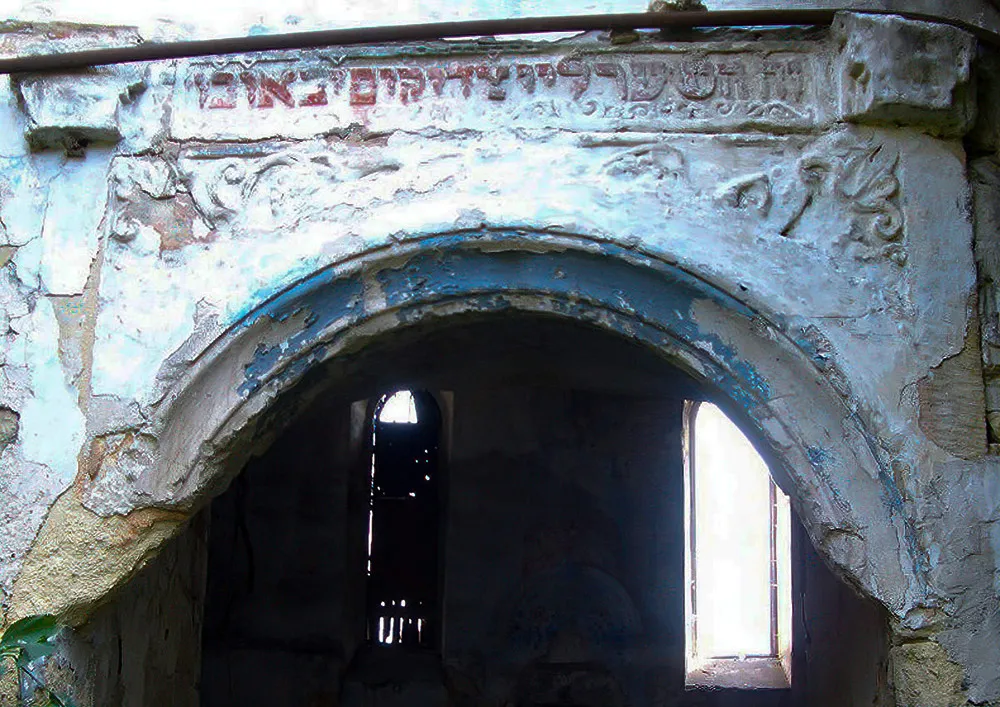
The tablet and the plant decoration still in place. Synagogue in Pidhaitsi
Our small investigation, which appeared as a logical continuation of the publication by the journalists of chortkiv.city, “Carved doors, three hundred years old, stolen from the old synagogue in Chortkiv have ‘surfaced’ in Moscow”, caused quite a stir.
As a reminder, “Ukraine Incognita” closely tracks everything concerning the preservation of cultural heritage in Ukraine. Accordingly, we could not miss the news that the ancient carved doors of the Chortkiv synagogue of the 18th century, after mysteriously disappearing, had suddenly appeared in the exhibition of one of the museums in Moscow. We could simply have reprinted the report of our Chortkiv colleagues, as a good dozen outlets did. But the “Ukraine Incognita” team decided to find out whether those doors were the only relic taken out of Ukraine or not. Unfortunately, it turned out that the same museum also displays a stone tablet inscribed “This is the gate of the Lord — the righteous shall enter through it”, which until recently adorned the entrance to the synagogue in Pidhaitsi (17th century). The tablet and a number of other decorative elements carved from limestone were illegally dismantled from the masonry of this architectural monument of national significance at about the same time as the doors in Chortkiv disappeared. The “Ukraine Incognita” publication about the relics of the synagogues of the Ternopil region displayed in the museum’s exhibition in Moscow had a considerable resonance in the media. And yesterday we also received a letter from the curators of the museum in which these relics are exhibited.
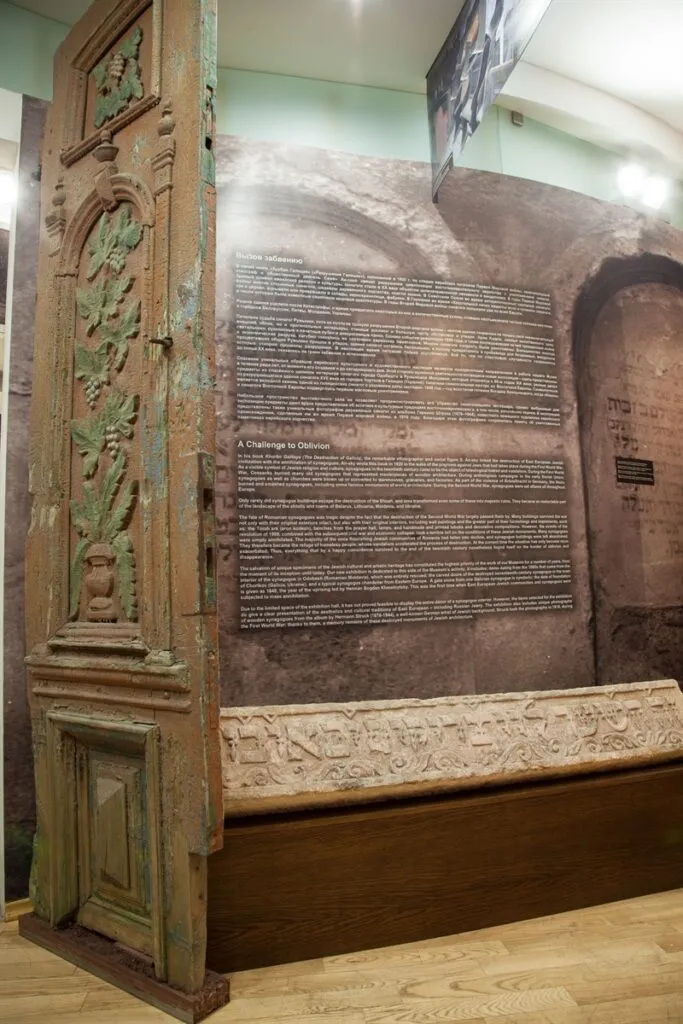
The door from Chortkiv and the inscribed tablet from Pidhaitsi in the exhibition of the Museum of the History of Jews in Russia. Photo from the museum’s website
Given that it was signed by a highly authoritative specialist in Jewish cultural heritage, an expert in traditional Jewish art, a doctor of art history from the Hebrew University of Jerusalem, Boris Khaimovich, whom the “Ukraine Incognita” team knows as a very professional and decent person who has done a great deal for the study and preservation of the cultural heritage of Ukraine’s Jews, at his request we publish this letter in full and without any changes. However, we reserve the right to a number of comments after the fact. The letter is published in the original language (Russian), here translated into English.
***
Dear sirs,
Our letter is a response to the publication about “objects stolen from Ukrainian synagogues”. Let us clarify: this concerns the wooden doors from the synagogue in Chortkiv and a foundation stone from the synagogue in Pidhaitsi. Both of these objects, from synagogue buildings on the verge of complete destruction, were acquired, not stolen, by the private “Museum of the History of Jews in the Territory of the Former Russian Empire and the USSR”. This was done many years before Russia’s military attack on sovereign Ukraine. Thus these objects were saved from destruction, but restoring and exhibiting them required lengthy and painstaking restoration by highly qualified specialists. The door was cleaned of fungus and rot for months, and the stone, which had fallen apart, was glued back together and its inscription restored. After restoration these objects were put on public display in the exhibition “On the Verge of Oblivion”, devoted to the rescue of Jewish monuments, which is, in fact, the museum’s main task.
Owing to the openness of information about our museum’s collections, in 2018 an initiative group from Ukraine approached us, which considered it unacceptable to exhibit monuments from the territory of Ukraine in Moscow. The museum’s staff decided to meet these statements halfway and agreed to return its exhibits to Ukraine, on condition that the “initiative group” pay part of the sum spent on their restoration and take on their delivery back. The “initiative group” did not react to our proposal and broke off contact with the museum. Since among those who are now commenting on “this theft” there is one of the initiators of that process, I hope he can confirm my words (the corresponding correspondence has been preserved).
A few words about the dramatic context of the discussion that has unfolded around the museum’s exhibits originating from the territory of Ukraine. First, the conspiratorial speculation and the spontaneous throwing about of names, including the names of rabbis who have nothing to do with this activity, should stop. Second, and this is the main thing, it is not by chance that our museum set itself the task of rescuing Jewish monuments in the territory of the former Soviet Union. Many years of expeditions to various regions of the former Soviet republics have convinced us that Jewish monuments are still being destroyed, as in the years of Soviet rule, and that local authorities at best treat them with complete indifference. So we saw our task as rescuing monuments of the material culture of East European Jewry that had miraculously survived or were on the verge of disappearing.
The list of such monuments, which survived two world wars, destroyed in independent Ukraine literally before my eyes is enormous. Let us list only some of them here: the synagogue in Buchach, built in the 17th century by Italian masters, was demolished; the Baroque synagogue with carved doors and a suspended vault in Berezhany collapsed; the famous 17th-century synagogue in Husiatyn is being destroyed and has been turned into a latrine; the synagogue of the first half of the 18th century in Brody has become a ruin; the synagogue of the 18th–19th centuries in Bolekhiv is in disrepair; the buildings of the synagogues mentioned above in Pidhaitsi (17th century) and Chortkiv (18th century) are collapsing. The same fate threatens the famous 17th-century Sharhorod synagogue.
It is not only synagogues that are vanishing from the face of the earth. Over three decades the last traces of unique Jewish vernacular buildings in the Ukrainian towns of Sharhorod, Chernivtsi, Tomashpil, Trostianets, Kopaihorod and many others, which as late as the 1990s were a kind of open-air museums, have been completely erased. As an example of the museum’s “thieving activity” we could tell how in that same Sharhorod we literally pulled unique furniture and tableware made by Jewish craftsmen out of the snow. The new owner, who bought the premises of the former local Jewish museum, whose collection had been put together by one single enthusiast, threw all the objects onto the rubbish heap. And in Ukraine there was no person or organization to support that museum, despite all our appeals to various cultural figures and institutions.
No less radical an example is the “restoration” by a private individual, in essence a rebuilding, of an outstanding architectural monument, the 16th-century synagogue in Sataniv, which has completely lost its historical appearance, turning into a replica of glaring tastelessness. A similarly catastrophic fate befell one of the most beautiful Jewish cemeteries in Europe, in the same Sataniv, which has been “restored” in an absolutely barbaric manner. These examples can be multiplied.
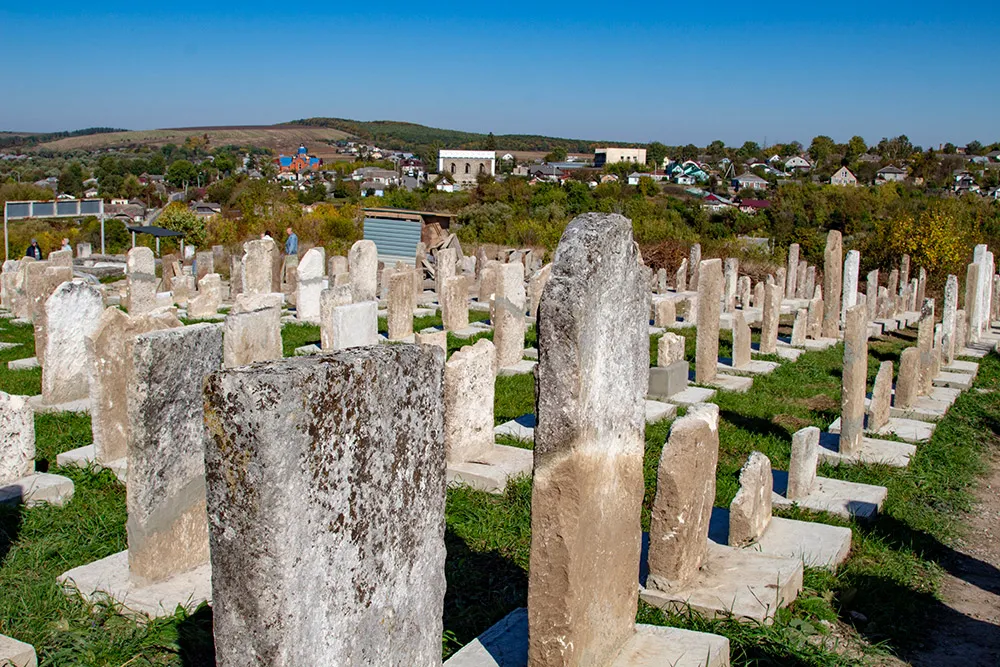
Vandalistic “restoration” in Sataniv
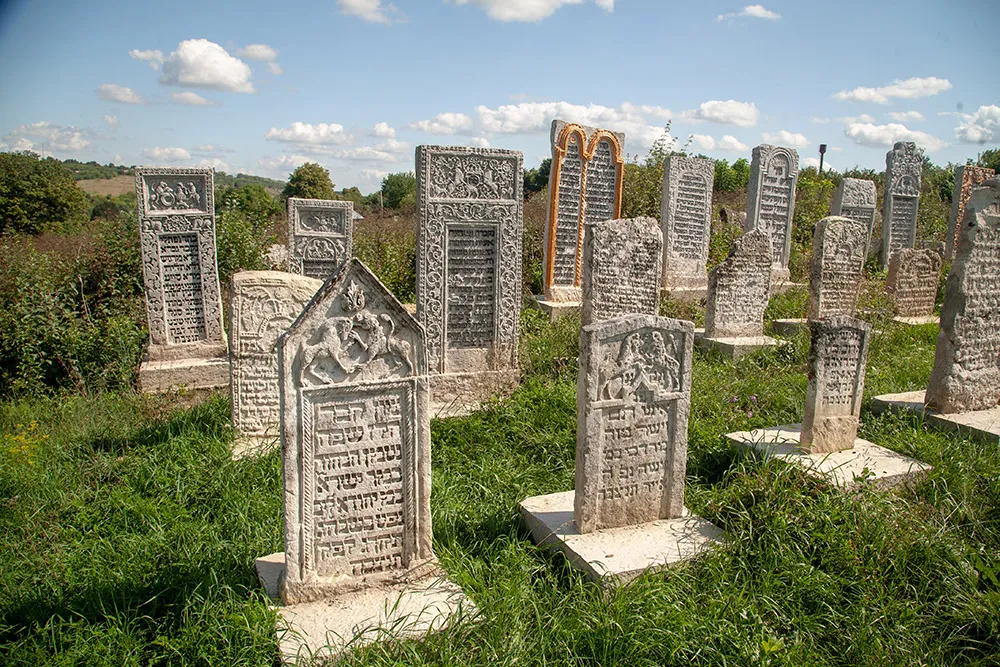
“Gold” paint and indelible black paint on tombstones of the mid-18th century. Moreover, the structure of the cemetery has been utterly destroyed.
All this is the result of the fact that neither the Ukrainian authorities nor Jewish organizations cared about the monuments of Jewish culture. However hard we tried, we could not get through to either of them in order to create in Ukraine, if not a museum, then at least a centre for the rescue of Jewish monuments. Finally, a museum appeared, unfortunately not in Ukraine, that took this task upon itself.
We are proud to be its staff members and not to have played the shameful role of a silent extra and an “objective” scholarly observer, indifferent to the destruction in Ukraine of the last surviving monuments of Jewish culture.
Russia’s attack on Ukraine and the bloody war have skewed in many minds the intention of our work to rescue Jewish monuments. I very much hope that the people of victorious Ukraine will come to realize that the cultures of all the peoples who inhabited Ukraine are an integral part of Ukrainian culture, and that this realization will finally take an active form.
A hundred years ago similar thoughts were expressed by the Ukrainian ethnographer, historian, archivist and museum worker Yurii (Heorhii) Semenovych Oleksandrovych (1884 – after 1942): “The collecting and study of Jewish monuments and the acquainting of the population with them would educate its consciousness in the direction that much of value has been contributed to the treasury of the cultural acquisitions of the Ukrainian people by Jews as well. All this would, of course, influence the orientation and upbringing of the local population in the spirit of a community of its vital interests and would draw both Jews and Ukrainians to the realization of this idea.”
Dr. Boris Khaimovich, Jerusalem
Hillel (Grigory) Kazovsky, Jerusalem, curators of the “Museum of the History of Jews in the Territory of the Former Russian Empire and the USSR”
***
The first thing we note here is that the museum really did buy those artifacts and not steal them. Yes, let us agree that it was done with the best of intentions. But in all the criminal codes of the world there is an article stating that buying knowingly stolen goods is a crime. All the more so when the stolen goods were brought into Russia by smuggling.
As to the thesis of rescuing the relics, we note that in the process of the illegal and vandalistic dismantling of the tablet from the synagogue in Pidhaitsi, the carved plant ornament that decorated the doorframe was completely destroyed. It was located right under the tablet, and the fragile limestone simply crumbled. The arched frame of the doorway was also destroyed at that time.
As to the time of the doors’ removal: in an interview with chortkiv.city, the head of the Jewish community of Chortkiv, Yakiv Baranov, gives 2014. He also mentions the involvement in this event of the chief rabbi of Russia (at least that is how it appears from his words). As for the artifacts of the Pidhaitsi synagogue, there is information that as of summer 2013 they were still in their places.
As for the problems of preserving Jewish cultural heritage, of which the esteemed Boris Khaimovich spoke with sincere pain, here we subscribe to every word. It is truly an enormous problem and a calamity. However, this situation with the preservation of cultural heritage is observed with all monuments: Ukrainian, Polish, Jewish, Armenian, German (the heritage of the colonists of the south) and so on. Here we see indifference, ignorance and greed (when for the sake of money historic buildings are destroyed in order to put another shopping centre or residential complex on the cleared site). For example, those same unique doors rotted for years in the rain. Why were they not removed to one of the Ukrainian museums, or restored and conserved?
The artifacts taken to Russia have highlighted one more important problem. Ukraine was the centre of the emergence and development of a very interesting culture of shtetl Jews, which, moreover, was closely intertwined with the culture and history of the Ukrainian people. In particular, it was in Ukraine that Hasidism was born and developed, today the most powerful current in Judaism. The names of hundreds of outstanding figures of world Jewry are connected with Ukraine, and so on. Despite this, Ukraine has no nationwide museum devoted to the history and culture of Ukrainian Jews as a whole (though there are about half a dozen regional ones). And this although we have quite a few fairly wealthy and influential Jews for whom organizing and financing such a museum would present no particular difficulty. The scandal over the artifacts taken to Russia must become a trigger for starting the creation of such a museum.
As for the question raised by the esteemed Mr. Khaimovich about the disappearance of typical shtetl buildings: unfortunately this is a natural process, like the disappearance of traditional Ukrainian thatched houses. But here too there is a way out. In the Museum of Folk Architecture in Pyrohiv there is enough room to set up a little street of a typical Jewish shtetl as well. Part of the traditional Jewish houses could quite realistically be moved to Pyrohiv. Especially the adobe ones on a timber frame. Jewish businessmen could quite well finance such a project.


