

What links the Ukrainian tales of Ryaba the Hen and “Yaitse-Raitse” with a Jewish matzevah in Sataniv?
Many cultures and religions share a very touching image of God as a mother hen, sacrificially protecting her creation and warming the eggs with her body. The eggs are a metaphor for the World, God’s creation. This image is more characteristic of the popular perception of the Lord. In Ukraine we find a deep echo of it in the tales of Ryaba the Hen and “Yaitse-Raitse”. The hidden sacred and philosophical metaphors of these seemingly simple children’s tales have long since been sorted onto shelves and taken apart stone by stone. It has long been known that metaphor is the only possible language in any religion, for how else can one explain to a mortal what the Great Divine Mystery is?
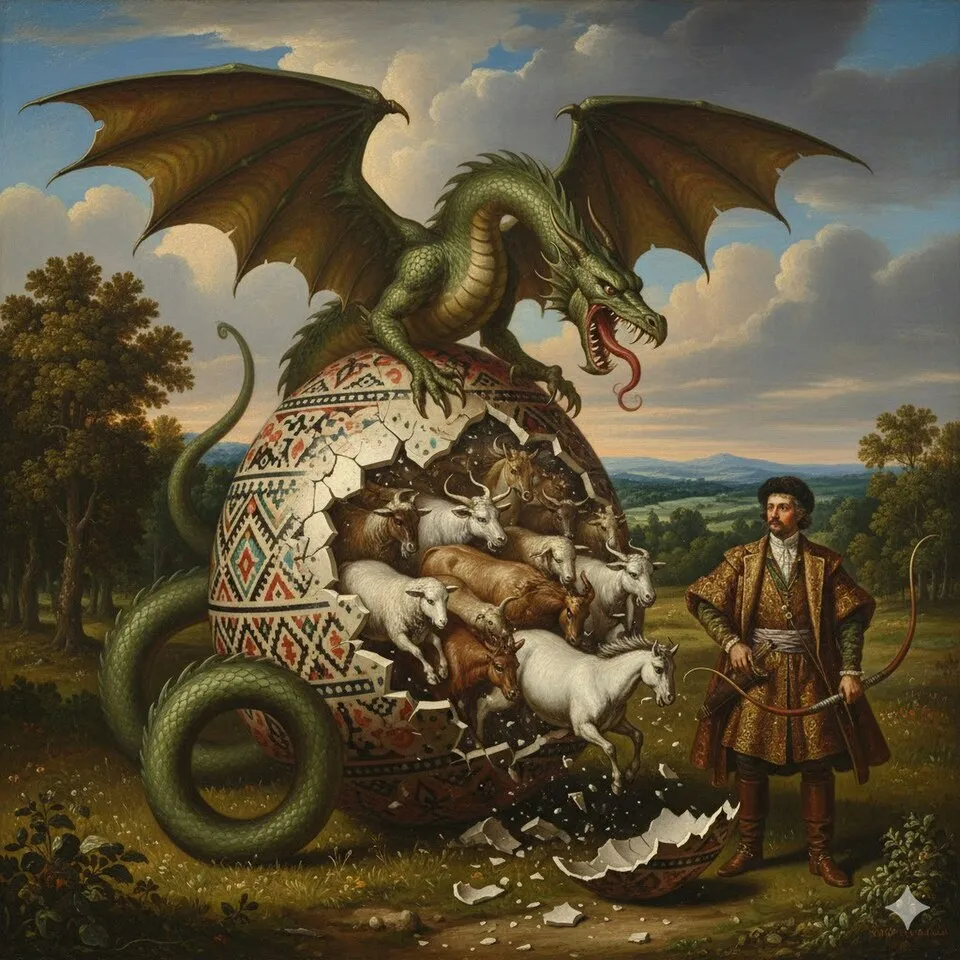
Yaitse-Raitse
The popular archetype of a caring and tender God-hen stands opposed to the official religious archetype of God-the-Eagle, fearsome and punishing. Incidentally, in Jewish sacred art it is precisely the eagle (two-headed or single-headed) that is a metaphor for the Lord. I examined this in detail in my book “The Jewish Cemetery of Sataniv. Stone Beasts and Mystical Rites”.
We see this archetype of a bird on an egg in the Bible. In particular, in the Book of Genesis (1:2) we read: “And the earth was without form and void, and darkness was over the deep, and the Spirit of God hovered over the face of the waters”.

“The Creation of the World”, artist Alina Prytula
This is Ohiienko’s translation. Other translations say roughly the same.
In fact, the original text has a small nuance. In the original, the word that Ohiienko translated as “hovered” is “merachefet” (מְרַחֶפֶת). This verb describes not the majestic soaring of an eagle or golden eagle but the gentle fluttering of a bird over its little nest. “Merachefet” can also be translated literally as “warming with wings” (brooding). In the Talmud (tractate Chagigah) this is explained thus: “The Spirit of God fluttered over the waters like a dove that flutters over its nest, touching and not touching it.”
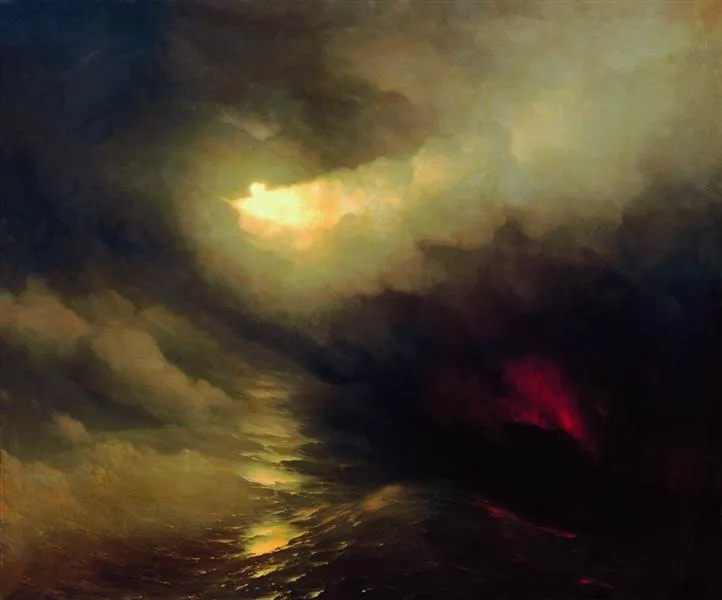
The Creation of the World, 1864, by Ivan Aivazovsky
Here we see a hidden epic metaphor, vividly described in our Ukrainian “Yaitse-Raitse”: the metaphor of the Great Cosmic Egg from which the World hatched. That is, at the beginning, a dead and cold egg of primordial chaos (“the earth was without form and void, and darkness was over the deep”). But the Spirit of God “merachefet” (broods, warms with wings) this dead, primeval, cold, primordial egg, and with its warmth, love and tenderness breathes life into it and creates the world…
In the Book of Psalms the metaphor of shelter under God’s wings is repeated as a symbol of absolute safety in times of trouble and persecution:
Psalm 91:4: “He will cover you with His feathers, and under His wings you will be safe; His truth is a shield and a fortress”.
Psalm 17:8: “Keep me as the apple of the eye; hide me in the shadow of Your wings.”
Psalm 57:1: “Have mercy on me, O God… for my soul trusts in You, and in the shadow of Your wings I will take refuge until the troubles pass”.
Psalm 63:7: “…because You have been my help, and in the shadow of Your wings I will rejoice”.
In the apocryphal Third Book of Esdras (1:30) of the Old Testament, which the Orthodox tradition regards as non-canonical but useful for reading, it is recorded how God addresses His people:
“I gathered you, as a hen her chicks under her wings: what shall I do to you now? I will cast you away from my face” (“I gathered you as a hen gathers her chicks under her wings; what shall I do to you now? I will cast you away from My face”).
This Old Testament prophecy describes God’s care for His people and a warning about the consequences of apostasy.
In the Gospel of Matthew (23:37) we see Jesus almost repeating the words of Ezra:
“Jerusalem, Jerusalem, you who kill the prophets and stone those sent to you! How often I have longed to gather your children together, as a hen gathers her chicks under her wings, and you were not willing!”
The same words are given in the Gospel of Luke (13:34).
It might seem strange why the Saviour compares Himself to a hen rather than to a more imposing and majestic eagle. All the more so since in the Old Testament this regal bird repeatedly serves as a metaphor for the Lord?
The eagle builds its nest either high in a tree or on a cliff and defends it with strength and might.
In the Old Testament (the Torah), in the Book of Deuteronomy (chapter 32, verses 11–12), in the famous farewell song of the prophet Moses before his death we read: “As an eagle stirs up its nest, hovers over its young, spreads out its wings, takes them, bears them on its pinions, so the Lord alone led him…”
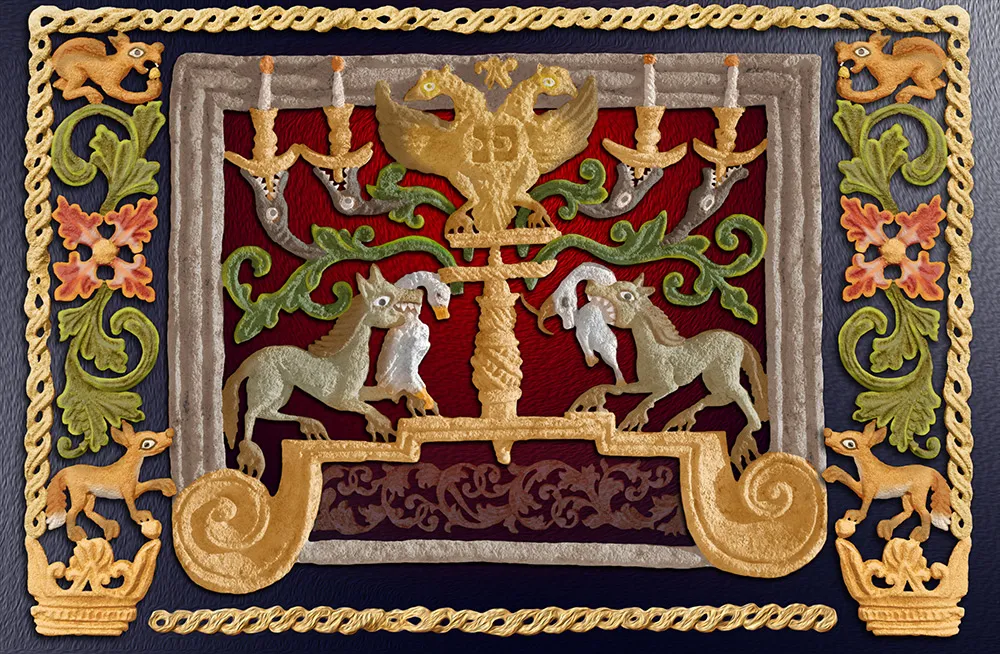
An eagle as a symbol of God on the gravestone of an unknown woman, 1799. Wolves with their prey are a metaphor for death
The eagle as protector, by the way, is also represented in traditional Jewish art. In my book I examine in great detail, over several pages, the motif of the two-headed eagle-protector that shields hares with its talons (a metaphor for the Jewish people and, at the same time, for the righteous man who has surrendered to the will of the Lord).
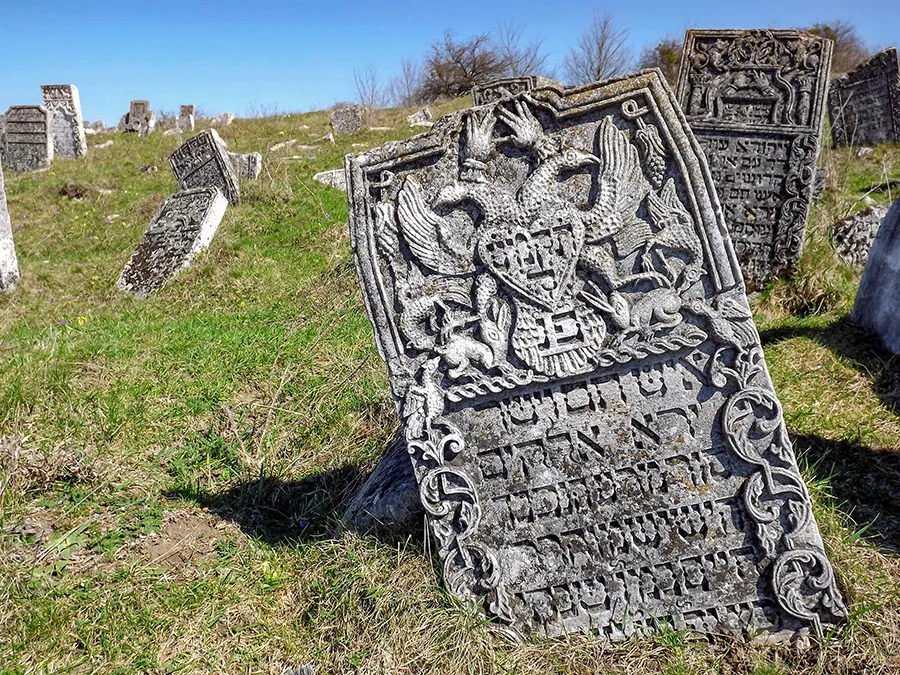
The gravestone under which rests “the elder, our teacher, rav” named Chaim, who died in 1788.
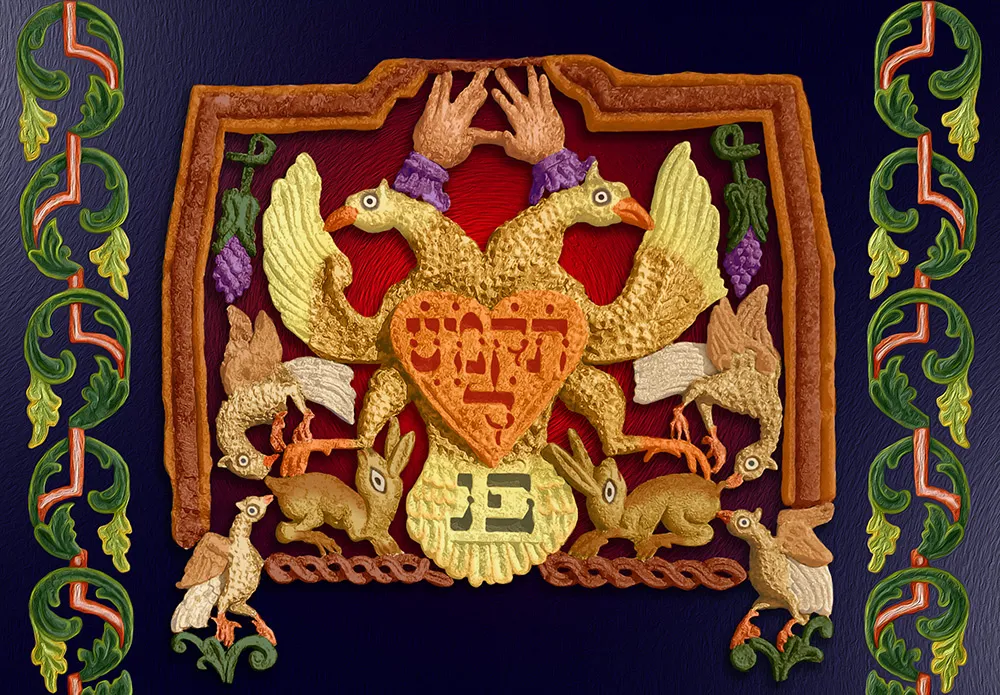
An artwork in the style of folk art
Jesus, however, for some reason compares Himself to a hen. She nests on the ground, among people. She hardly flies at all, and her claws are good for little more than scratching up grains and worms. But in case of danger, whether the attack of a hawk or a fire, she turns into a living shield, covering her chicks with her wings and sacrificing herself. How many times, after a fire, have live and healthy chicks been found under the dead, charred body of their mother!
On Golgotha Jesus could have acted like an eagle and summoned the heavenly host led by the Archangel Michael and ground His tormentors to dust. But He acts like a hen, spreading His arms-wings on the Cross, taking upon Himself the fire of human sin and death and becoming a shield for all humanity.
The imagery of the primordial egg and the God-hen in our “Ryaba the Hen” is intriguing. At first glance it is a simple children’s tale, but in fact we see here a code of deep cosmogonic and theological meanings. Let us stress that the original (folk) version of this tale, recorded by the folklorist, ethnographer and author of the Ukrainian anthem “Ukraine Has Not Yet Perished”, differs quite strongly from later, primitivized and abridged adaptations.
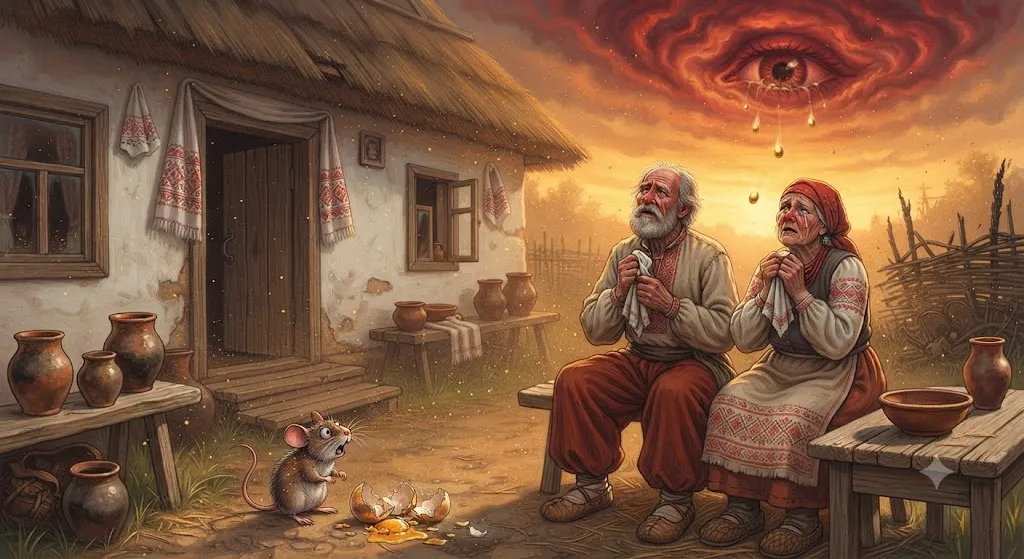
As is well known, the golden egg is broken by a mouse. It lives in a burrow deep in the earth and is a metaphor for Nav, the underworld of death and chaos.
This event sets off a whole chain of catastrophes: the gate flies off its hinges, the magpie loses her tail, the priest’s daughter smashes the buckets, and the priest tears the sacred books in the church.
And over it all, the weeping of the old man and the old woman…
This is a classic description of how sin destroys the cosmos and harmony.
But Ryaba the Hen (God-the-hen) brings salvation. She comforts humanity in the image of the old man and woman and promises to lay “an egg that is not golden (a metaphor for death and pride/sin) but plain (living and warm)”.
The plain egg is a symbol of the Church and the New Testament and of renewed life, where the dead shell will eventually be overcome by the Resurrection and new life.
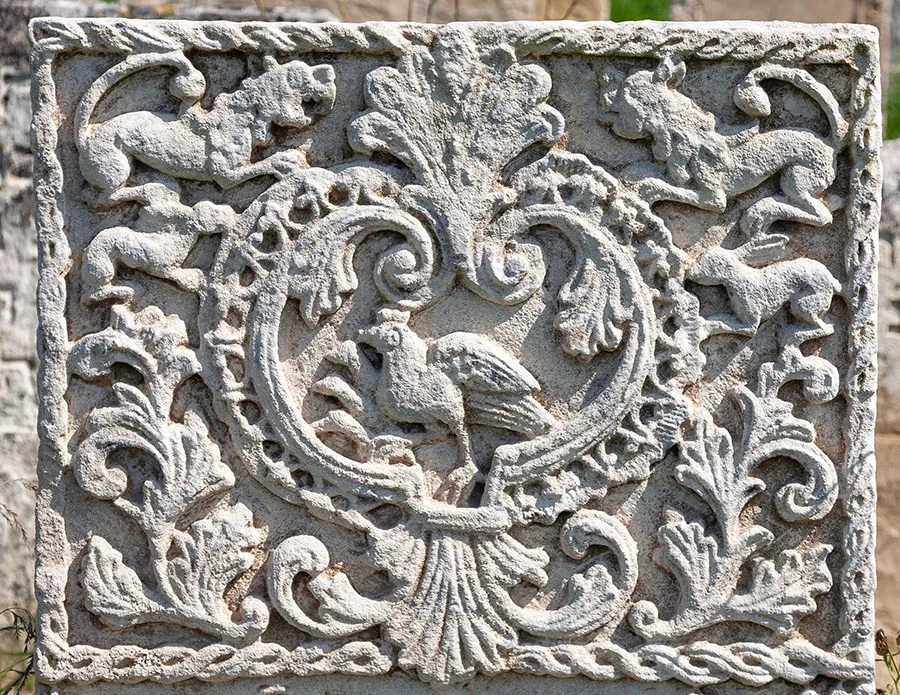
In the town of Sataniv, on a matzevah placed on the grave of a woman named Rivka, who died in 1789, we see a remarkable decoration with a rare motif: a bird of indeterminate species. The latter is quite common in such cases: “I’m the artist, this is how I see it.” Pelicans, for example, can be identified solely by their specific poses, while outwardly there is nothing pelican-like about those birds. Where, after all, could a master who had spent his whole life in Podillia have known what a pelican looked like? All the more so since in the 18th or early 19th century a National Geographic subscription was hard to come by in these parts.
Because of the crown on its head, there was a version that this is an eagle, a metaphor for God, and the above-quoted passage about the eagle and the nest was carved in stone.
There was a version that it is a pelican, all the more so as such iconography (a pelican and three chicks) is quite common in traditional Jewish art and, interestingly, on Christian icons!
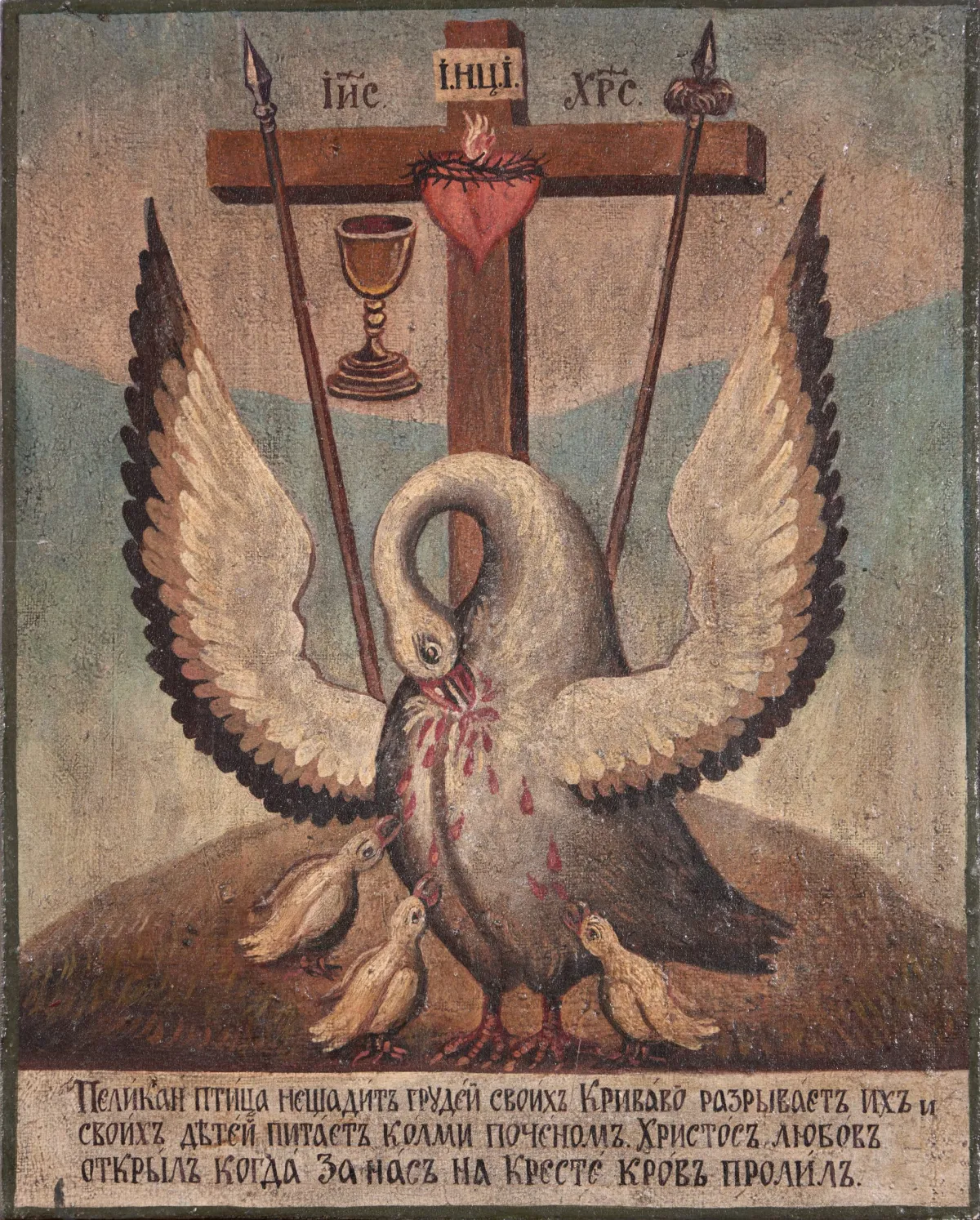
But the crown on the bird’s head here also rather resembles the comb of a hen (perhaps Ryaba). It is not impossible that we have here an image of the God-hen, rare in Jewish funerary art…
Text, photos and artworks: Dmytro Poliukhovych


