Stara Talalaivka. A wooden masterpiece

· 7 min read
Stara Talalaivka (until 1921 Talalaivka, in 1921-2016 Sylchenkove). Population: 805.
Before the revolution this village was called Talalaivka; then its name was taken for a neighbouring village, which was made a district centre, while the new name was formed from the surname of the revolutionary Sylchenko.
The village was founded at the beginning of the 17th century, when the Wiśniowieckis owned the Pryluky region. It is first mentioned in 1629.
Talalaivka is an old Cossack village that arose in the Wiśniowiecki lands (a territory of the Commonwealth on the Left Bank of the Dnipro with a special legal, military and confessional regime, centred on the town of Lubny, in the early 17th century). The noted researcher V. V. Kryvosheia claims that many Cossacks came from Belarus. It is among Belarusians that the surnames Drozd, Sylchenko and Roi are widespread, and they are still found in the village. In Mahilyou there was a well-known Talalai family.
The village of Talalaivka was a rank estate for the maintenance of the regimental esauls of the Pryluky Regiment. In 1648 the village became part of the Talalaivka kurin of the Krasnyi Kolyadyn company of the Pryluky Regiment. And no later than 1687 the village was granted by Hetman Mazepa to the Krasnyi Kolyadyn captain Tymofii Andrienko, after whose death the village was held by his sons.
In 1711, by a universal of Hetman Skoropadskyi, the village of Talalaivka was transferred to the regimental esaul of the Pryluky Regiment, Mykhailo Fedorovych Movchan.
After the death of M. Movchan in 1742 the village passed to his widow Paraskeva, and later to the children of his daughter Kateryna, who was married to the distinguished military companion Demian Mazaraka.
In 1780 the owners were: the bunchuk companion Andrii Mazaraka, the bunchuk companion Ivan Mazaraka, the family of the late regimental esaul Hryhorii Mazaraka, and the Lubny colonel Maksymovych.
In 1782-1796 the village was part of Romny povit of the Chernihiv Viceroyalty; from 1797 it belonged to Pryluky povit.
From 1802 the village passed to Romny povit of the Poltava Governorate.
In 1897 there were 742 households, a zemstvo school and a library, and two fairs a year were held.
In April 1921 the village was taken under the control of Nestor Makhno’s detachment, which liquidated the first head of the volost revolutionary committee, Sevastiian Mytrofanovych Sylchenko (1880-1921), in whose honour the village was renamed.
Ivan Petrovych Kavaleridze, a Ukrainian sculptor, film director, playwright, screenwriter and film artist, spent his childhood in the village.
HISTORY OF THE CHURCH (given with partial use of information from Olena Krushynska’s website “Wooden churches of Ukraine”)
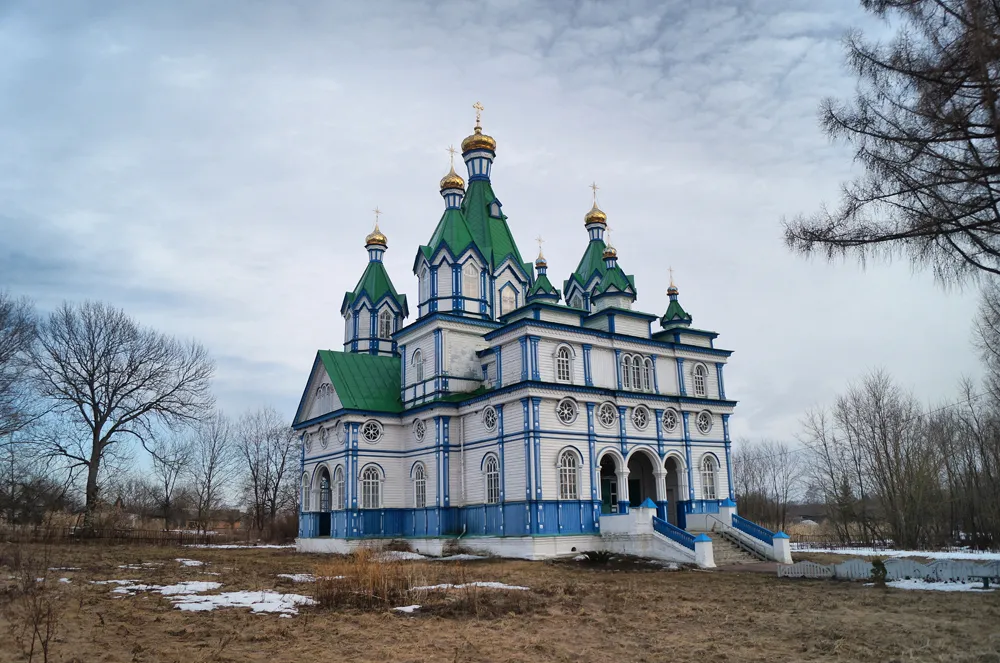
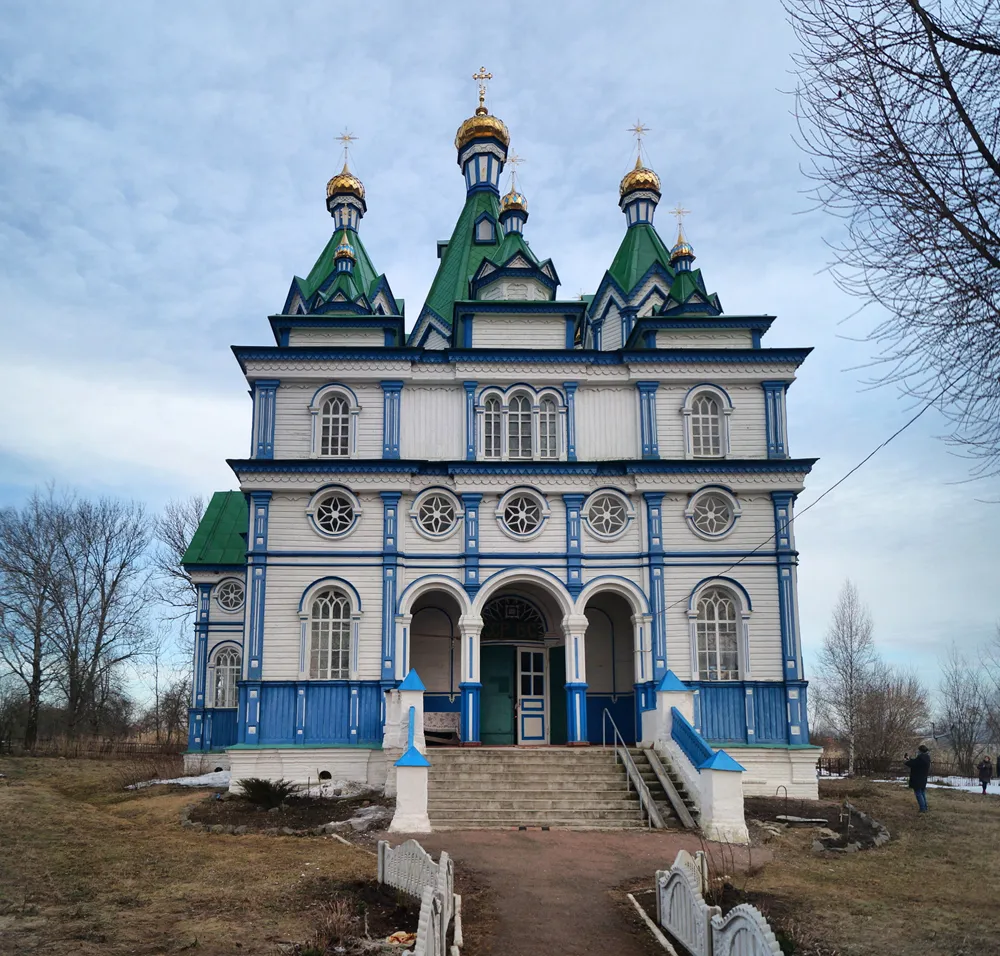
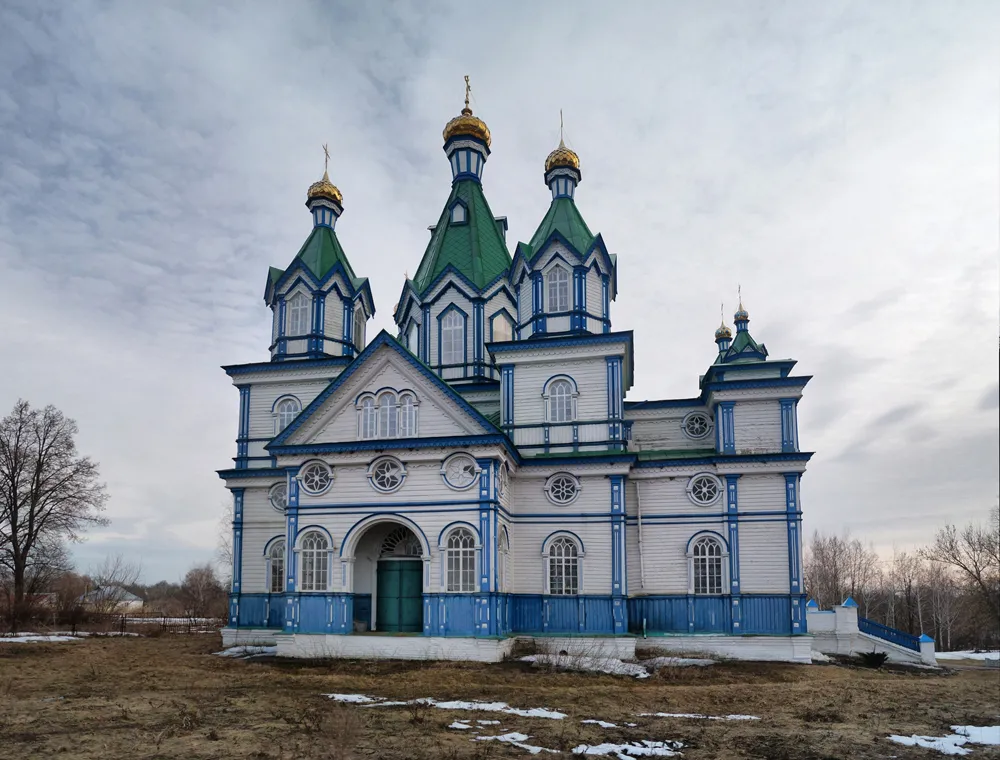
An architectural monument has survived in the village: the Holy Dormition Church (it belongs to the UOC-MP). It is a monument of local significance.
There are two versions of the construction date of this particular church: 1775, by the Mazaraka brothers, with a radical rebuilding by Buzovskyi in the 1890s. According to other data, Buzovskyi then built the church on the site of the previous one.
The first church building, 1711-1771
In 1711, by a universal of Hetman Skoropadskyi, the village of Talalaivka was transferred to the regimental esaul of the Pryluky Regiment, Mykhailo Fedorovych Movchan. It was possibly under Mykhailo Fedorovych that the first church was built. The date of construction is approximately 1711 or earlier; its location is unknown. The village had two churches; the second was dismantled and sold to the village of Molky (Milky) (1677). Mykhailo Fedorovych also granted land to the archpriest Andrii Nekyslovych, of the Polish nobility. Father Andrii came from Stary Ostroh after the strengthening of the Uniate church. For 100 years the church’s rectors were his sons and grandsons.
The second building, 1775-1890
After the death of Mykhailo Fedorovych Movchan in 1742 the village passed by inheritance to his grandsons Andrii and Ivan Mazaraka, because their parents Kateryna Mykhailivna Movchan and Demian Ivanovych Mazaraka had died in 1722 (24) and 1734 (36). Demian Ivanovych Mazaraka was born in Lviv and died in 1722 (24) in the North Caucasus; he was a military companion of the Pryluky Regiment. His sons: Andrii Demianovych Mazaraka (1717 – after 1787), a military clerk of the General Military Chancellery and bunchuk companion of the Pryluky Regiment, and Ivan Demianovych Mazaraka (born 1717), a military companion of the Pryluky Regiment. It was Andrii and Ivan Mazaraka who decided to build a new church in a new place in 1771, and in 1775 the church was built. The site for the construction of the church was allotted in Demianivka. (Demian Ivanovych Mazaraka was already married to Movchan’s daughter Kateryna Mykhailivna in 1717. That year he bought from one of the Cossacks in Talalaivka “a plot, a house, with a yard, a garden, a dam and a grove for 200 zlotys of Lithuanian reckoning”, and obtained from Hetman Skoropadskyi the confirmation of this purchase by a universal of 21 January 1719.)
In 1771 Andrii Mazaraka mentions the site for the new church: “On 14 February 1771, my own nephew Hryhorii Ivanovych Mazarakii, regimental Pryluky esaul, by the will of God fell ill in 1770, in the last days of December, and died on the above-written year and day, on a Monday, and his body was buried according to the Christian custom, in an oak vault, at the place chosen for the newly built church, in the village of Talalaivka.” And in 1783 Andrii Mazaraka speaks of the church as in use: “My dear grandson Stepan Semenovych Mazarakii passed away on 27 July 1783, and Marfa Semenovna Mazarakievna passed away on 17 January 1787, whose bodies are buried in the church porch, on the right side, in oak vaults.” The tomb and gravestones of the Mazarakas are still located beside the church.
The church has one dome, with a churchyard and a one-tier bell tower beside it. The bell tower has 13 bells, one of them weighing 26 poods.
From 1768 the rector of the church was Vasyl, as he wrote in a receipt: “son of the deceased priest of the Talalaivka Holy Dormition Church Petro Andreiev, Vasyl Petrov Andreievskyi”.
Until 1827 the priest of the church was Kyrylo, son of Oleksandr Andreiev. In 1827, by decree of Gregory, Bishop of Poltava and Pereiaslav, an inspection of the church was carried out and a document was issued in which the history of this church has been preserved.
The third building, from 1890 to the present
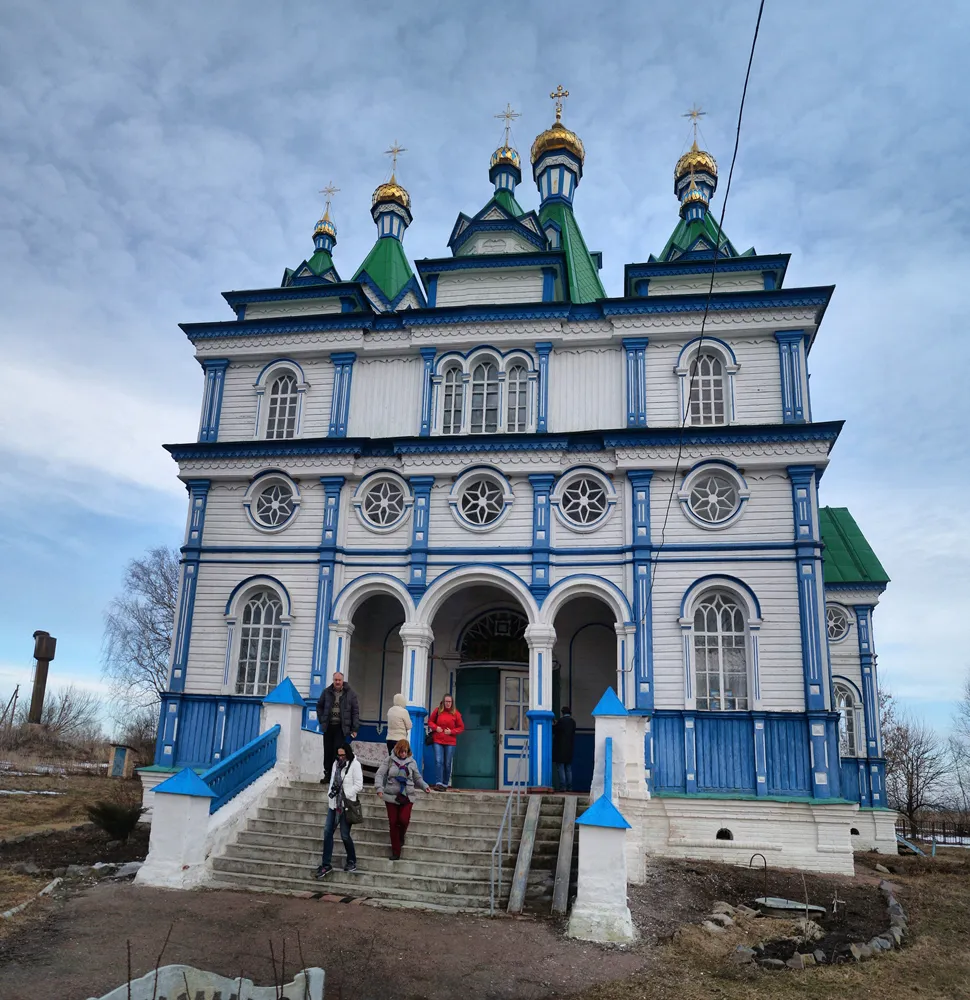
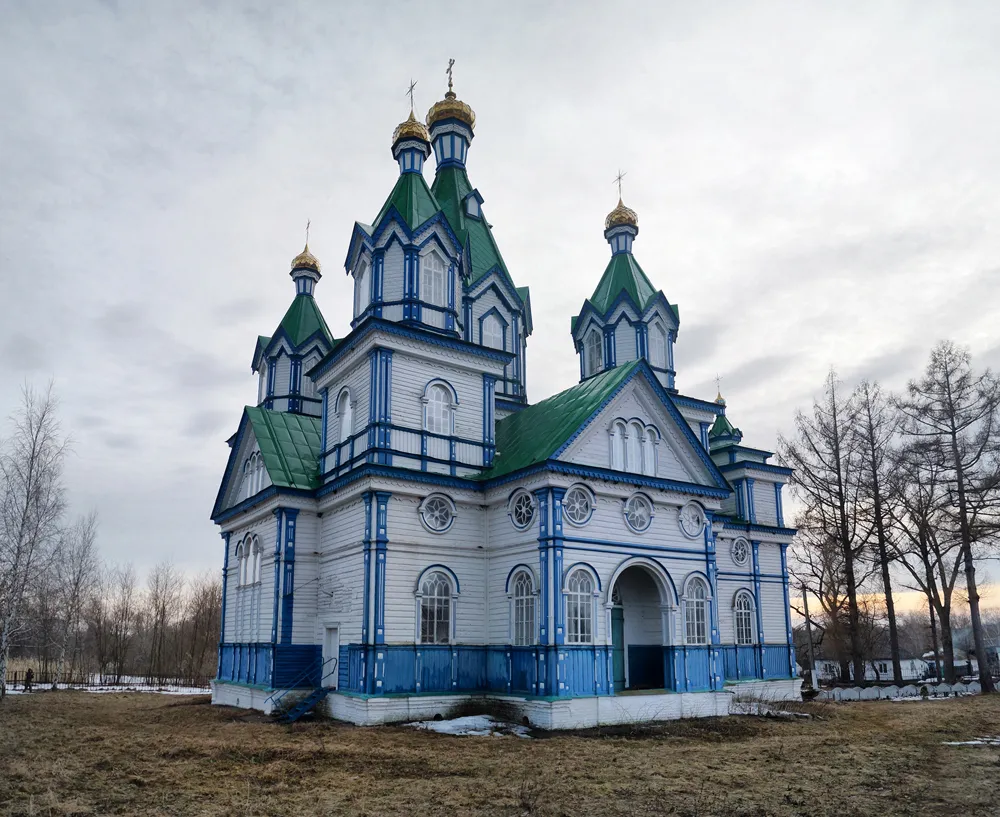
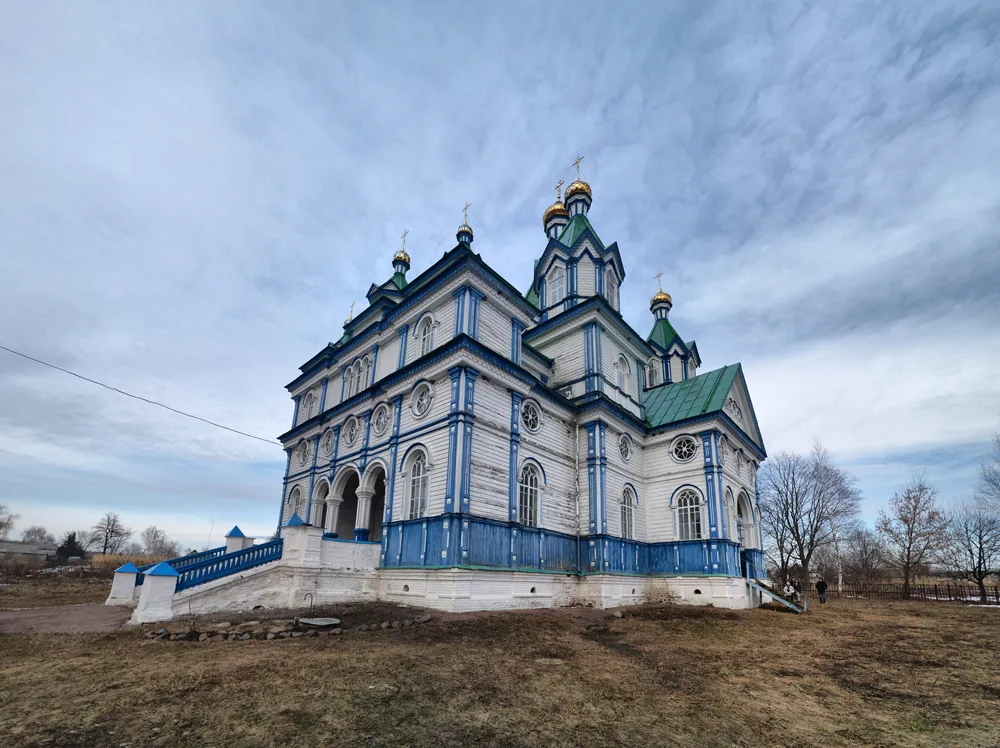
Having stood for more than 100 years, the church began to decay, and a wealthy peasant, Vasyl Fedorovych Buzovskyi, began raising funds for the construction of a new church. The church was built on the same site as the previous one. Construction went on from 1890 to 1893. Vasyl Fedorovych Buzovskyi controlled the construction, watching over it through a spyglass. The workers were paid in timber. For some reason Vasyl Slobodian states in his research that Buzovskyi was a master builder. One of the builders of the church was Serhii Roi.
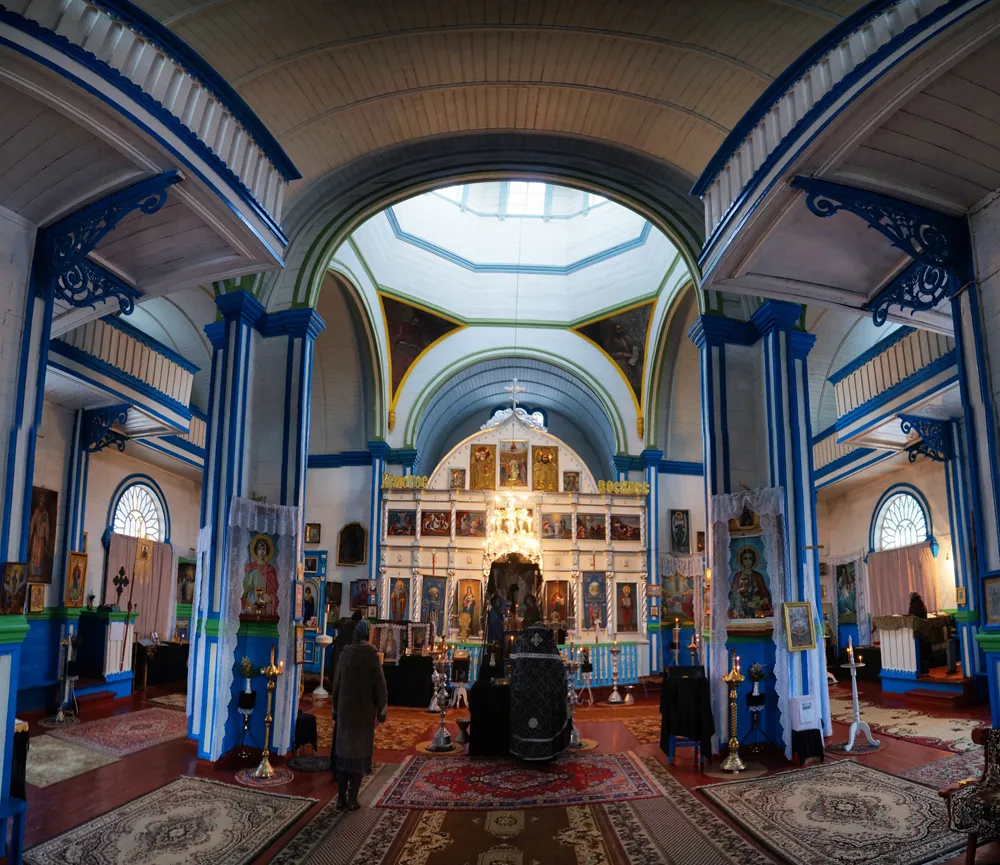
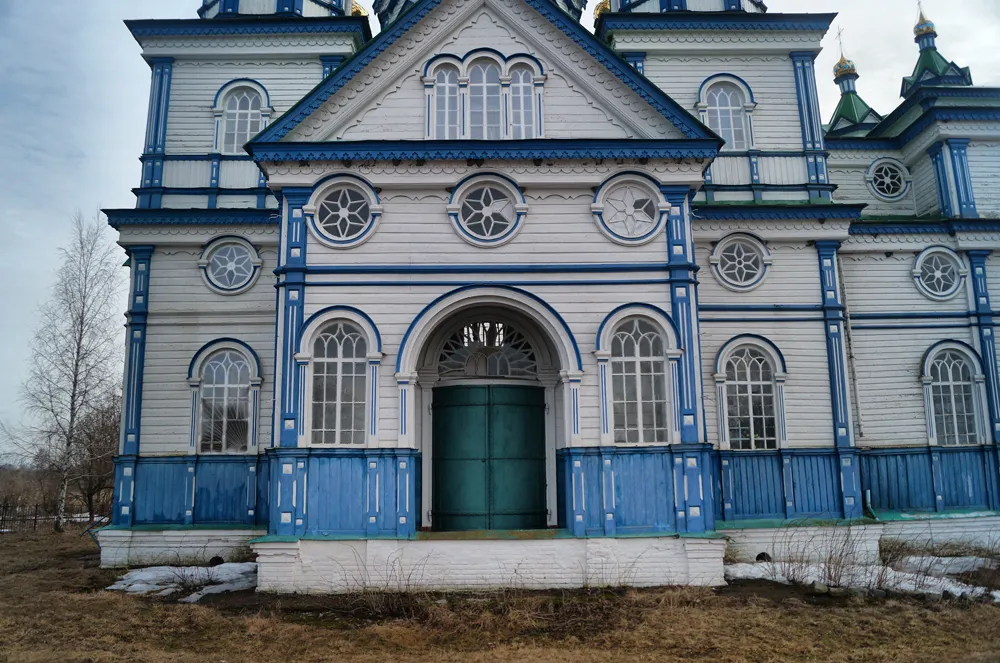
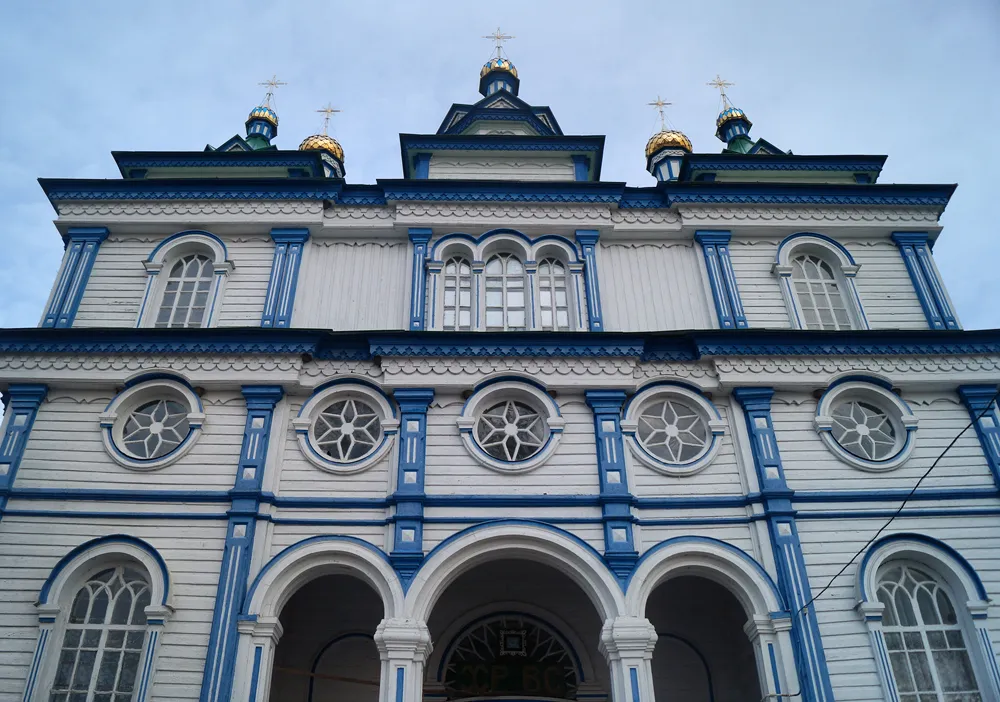
It is a wooden, nine-part structure with a vestibule on the west and an arcade above the entrance, to which steps lead. On either side are two octagonal towers (in the southern one are the bell tower and the stairs leading to the choir gallery). The church is crowned with five tent roofs on octagons and three small tents above the towers and the main entrance. In the interior the choir gallery (in the form of a balcony on wrought brackets) runs along the west, south and north walls almost up to the line of the iconostasis, which was installed in 1941-1943. Icons of the 18th-19th centuries, oil paintings of the early 20th century and bells have survived, among them one made at the Usachev Brothers factory in Valdai. Artistic carving in wood and metal was used in the decoration of the interior and facades.
In 1902 the parish had a zemstvo people’s school, two mixed literacy schools, one girls’ literacy school and a church-parish guardianship.
In 1910 the church had: a library, a girls’ one-class school, a literacy school, a priest’s apartment of 4 rooms and a room for the psalm-reader. The parish included: 11 nobles, 13 townspeople, 634 Cossacks and 2,071 peasants.
Although some sources report that in those years it was only rebuilt, and the date of its origin is still considered to be 1775. One way or another, it owes its fine architecture to the master Buzovskyi.
Icons of the 18th-19th centuries, oil paintings of the early 20th century and bells have survived,
The Dormition Church never ceased its services, even when in the 1940s grain was stored in its premises. In Soviet times, the church in Stara Talalaivka was the only church within a radius of fifty kilometres that did not stop working.
In the summer of 2019 repairs were under way inside the church.
The author of the text on the Dormition Church is Serhii Kozlov.
Material prepared by Ihor Dorozhko, photos by Roman Malenkov.