

A neglected relic of a church destroyed by the communists in 1732 found in Horodok, Khmelnytskyi Oblast
Epigraph: “The stone which the builders rejected has become the chief cornerstone”
(Psalm 117:22)
The story of how this relic was found is, to a certain extent, mystical and full of amazing and symbolic coincidences. In 2017, when the construction of the new building for the Horodok Local History Museum (G-MUSEUM) was almost complete and the area in front of it was being landscaped, a great miracle happened!
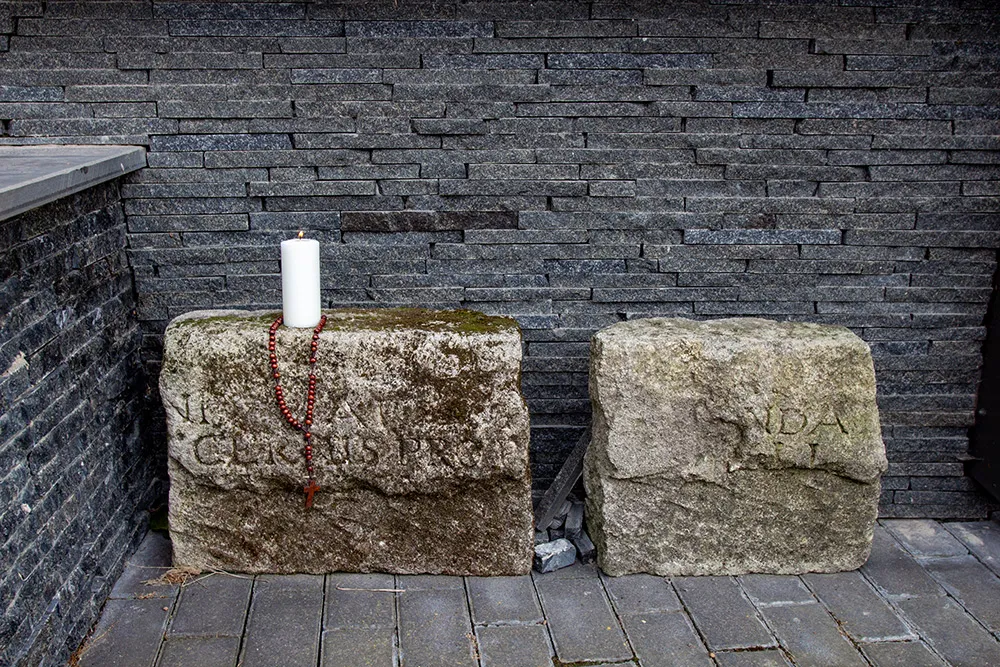
As it turned out, these stones are far from simple!
The event, it seems, was no accident. For the modern museum in Horodok is itself a Great Miracle! In which other district centre (well, now a former one) is there a museum building erected from the start precisely as a MUSEUM, with such modern museum equipment inside? Let us recall that even in the capital the last building constructed as a museum was opened only in 1982: the Lenin Museum, today the Ukrainian House. The Museum of the History of Kyiv, let us recall, is based in a building that was designed and built from the start as a commercial and office centre. Horodok owes this amazing gift to its patrons, the family of scholars and businesspeople Mykola and Halyna Humeniuk. Mykola Ivanovych, let us recall, hails from the Horodok area.
Perhaps the land of Podillia itself decided to complement this Museum Miracle and made a generous gift both to the renewed museum and to its patrons (as thanks for their generosity). Perhaps Divine providence played a part too. For it really is a very strange coincidence…
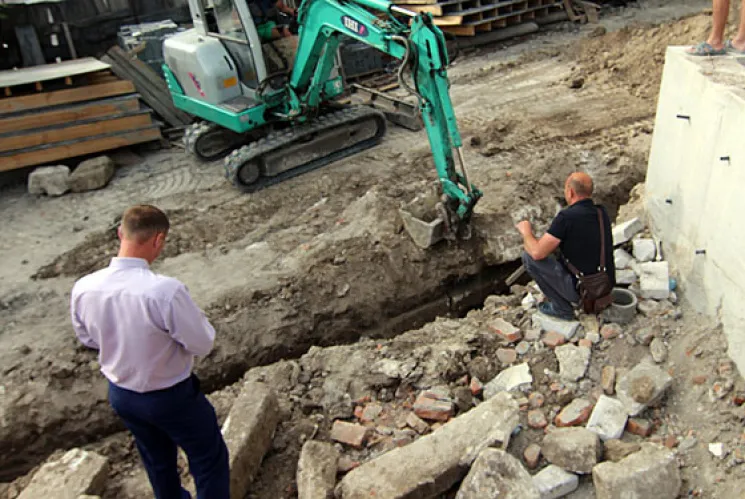
During the earthworks, the remains of an old road were uncovered, which had been filled in around the 1960s. Kerbstones were found beside the road. On one of them a Latin inscription was discovered. That is, for a kerbstone the communists had once used blocks from one of the churches they had destroyed.
Let us recall that on one night in 1936 the communist authorities blew up all the sacred buildings of the town (except for two cemetery chapels). The explosions shattered the churches of St. Anne and St. Stanislaus (from the beginning and the end of the 18th century respectively) and the St. Alexander Nevsky Church (first half of the 19th century). The wooden 18th-century synagogue was simply burned down.
Unfortunately, the only words that can be read, “Cernis pro…” (translated from Latin as “You can see / you see”), said little. There were also some illegible letters.
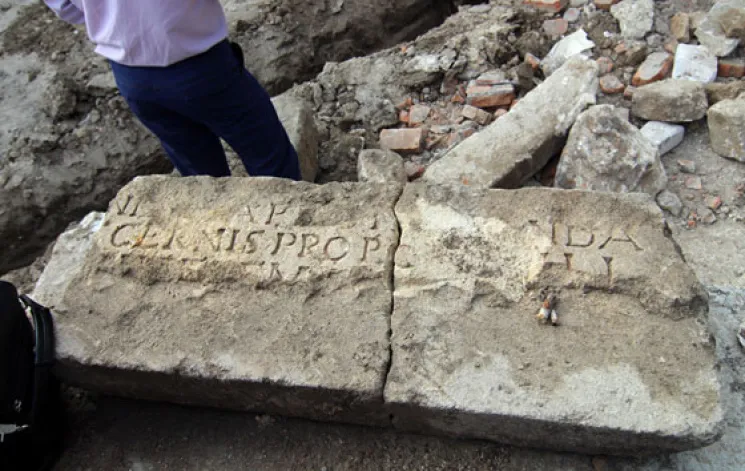
From the start a version arose that the block with the inscription came from the Church of St. Stanislaus. Given that it stood right across the road from the museum and the find spot, this was a fairly logical assumption.
The find itself carried a whole series of meanings at once:
- The relic was given to the Horodok Local History Museum by the land of Podillia itself during the construction of a new building for it.
- This relic was clearly connected with one of the destroyed Roman Catholic churches. This is especially important considering that a third of Horodok’s residents are Poles and Roman Catholics. Until now only photographs reminded people of the destroyed churches.
- It would be an exhibit that visually demonstrated the vandalism and barbarism of the Russian Bolshevik regime. A destroyed church was turned into a road kerb. This too is very important as a vivid example, especially for schoolchildren!
The find was washed, cleaned and, not without the participation of the author of these lines, solemnly carried into the almost completed new museum building…
Less than a week later it was thrown out into the street as rubbish, and the block with the inscriptions lay for more than a year by the side entrance of G-MUSEUM. Drivers of trucks delivering building materials for the interior works and the latest equipment for the institution propped their wheels with the historic stones.
Later, before the opening of G-MUSEUM, the relic was nevertheless removed from the doors (because it looked untidy). Fortunately it was not thrown on the rubbish heap, but dumped beside the museum’s side wall, where it stands to this day and has already become overgrown with moss. In the photo, note, you can clearly see how the relic looked in 2017, when it had just come into the museum staff’s hands, and how it looks today…
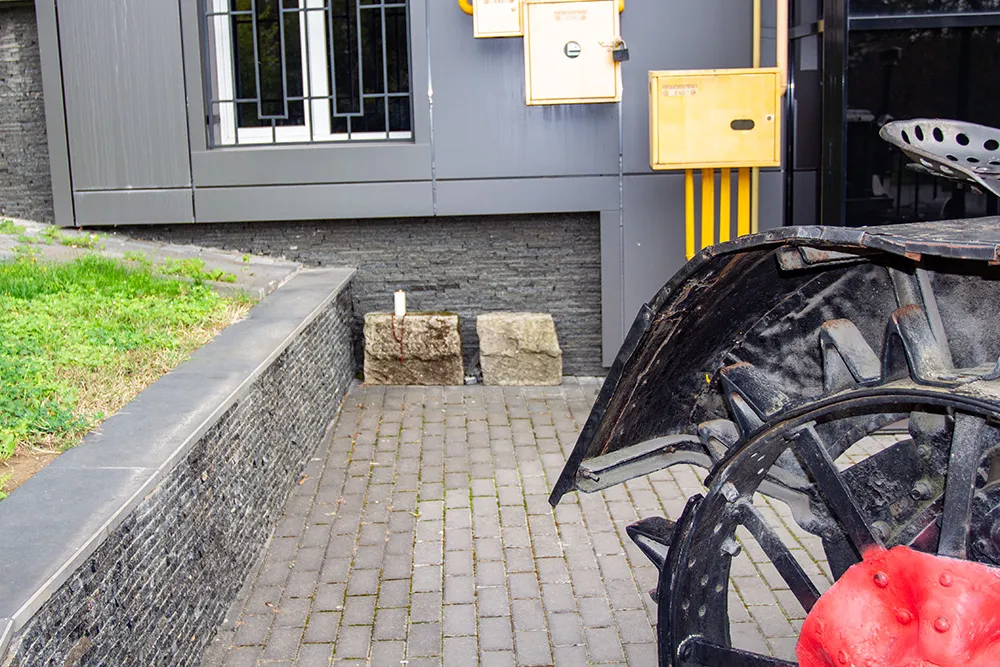
The author of these lines repeatedly told G-MUSEUM staff that an artefact of the past does not belong there, but they took it as yet another instance of “bullying” by an ignoramus of professional museum specialists.
Meanwhile the mysterious stone gave the author no peace. It was interesting to find out what the land of Podillia had really given G-MUSEUM, and what exactly the museum staff had deemed unworthy of the display of this “innovative” institution that has no analogues.
About having no analogues, that is true. The premises and museum equipment donated by the patrons, the Humeniuks, are truly an incredible tool. But one still has to know how to use it!
And what this relic is, I did manage to find out!
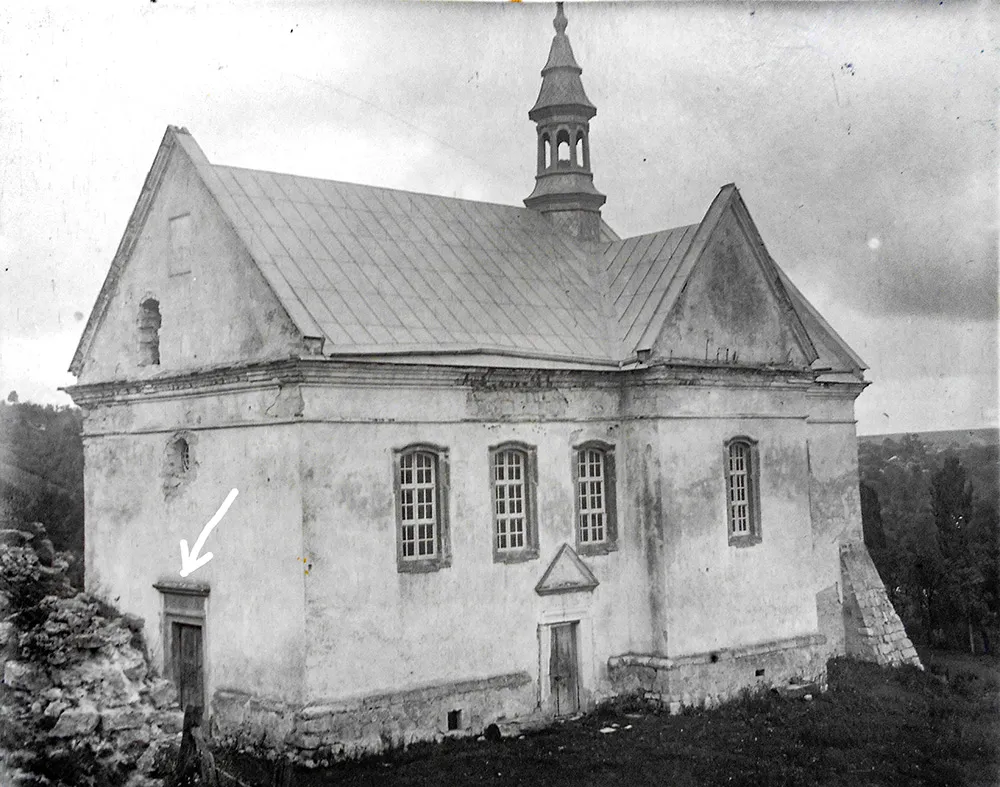
The Church of St. Anne. The arrow points to the memorial plaque
The artefact really is connected with one of Horodok’s destroyed churches. But not with the Church of St. Stanislaus, which stood next to the museum (and the find spot). This relic, and no ordinary one but a landmark, comes from the much older Church of St. Anne, built back in 1732!
Until now that church was recalled only by photographs by Stefan Taranushenko and Pavlo Zholtovskyi from the expedition of the Kharkiv Museum of Ukrainian Art in 1930, and by the foundations of the destroyed bell tower of this church.
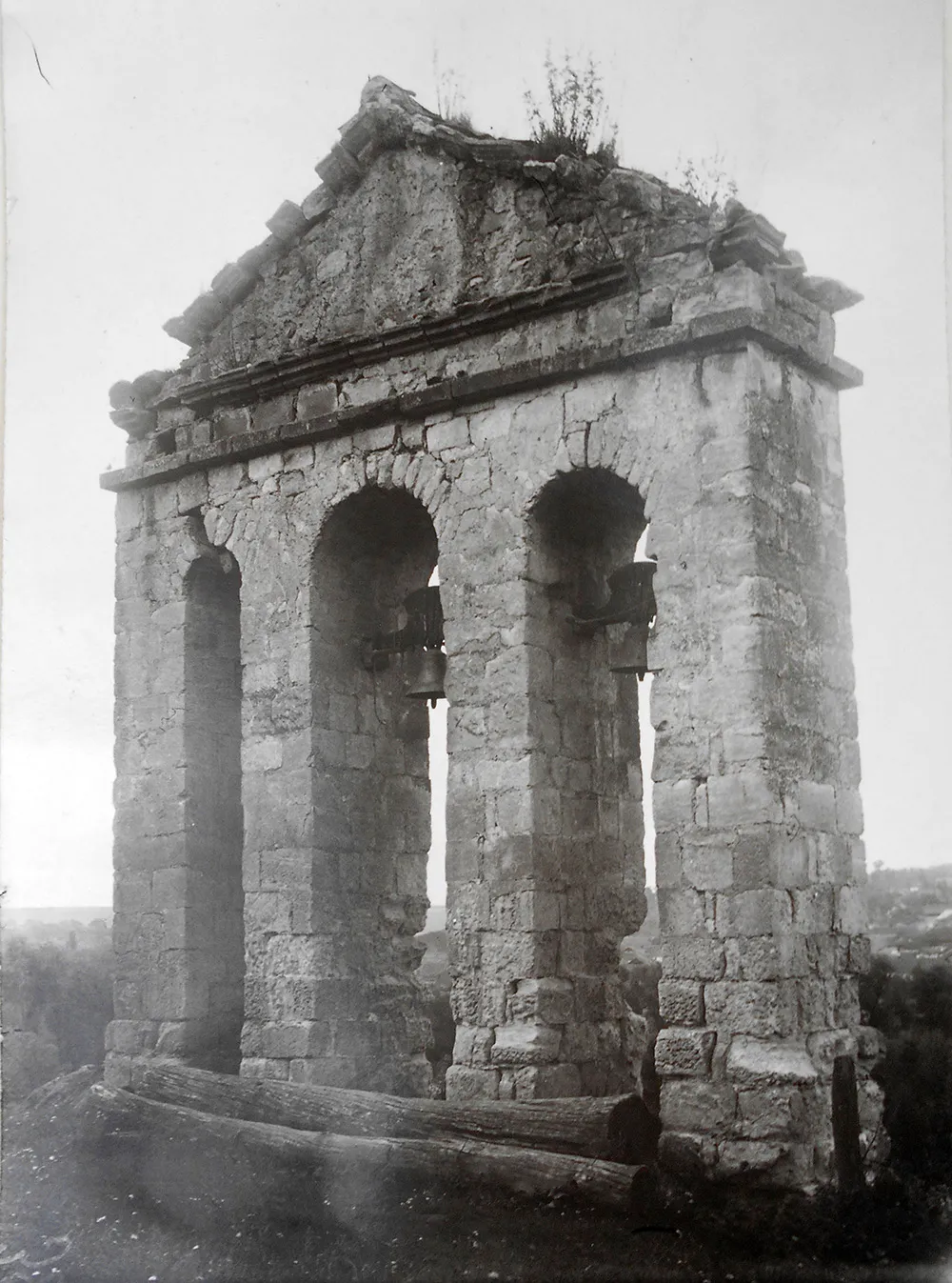
It was these photographs that shed light on the mystery of the relic found in astonishing circumstances during the construction of the new G-MUSEUM building.
In particular, one of the photographs captured the view of the main entrance of the destroyed church with a memorial plaque placed above it.
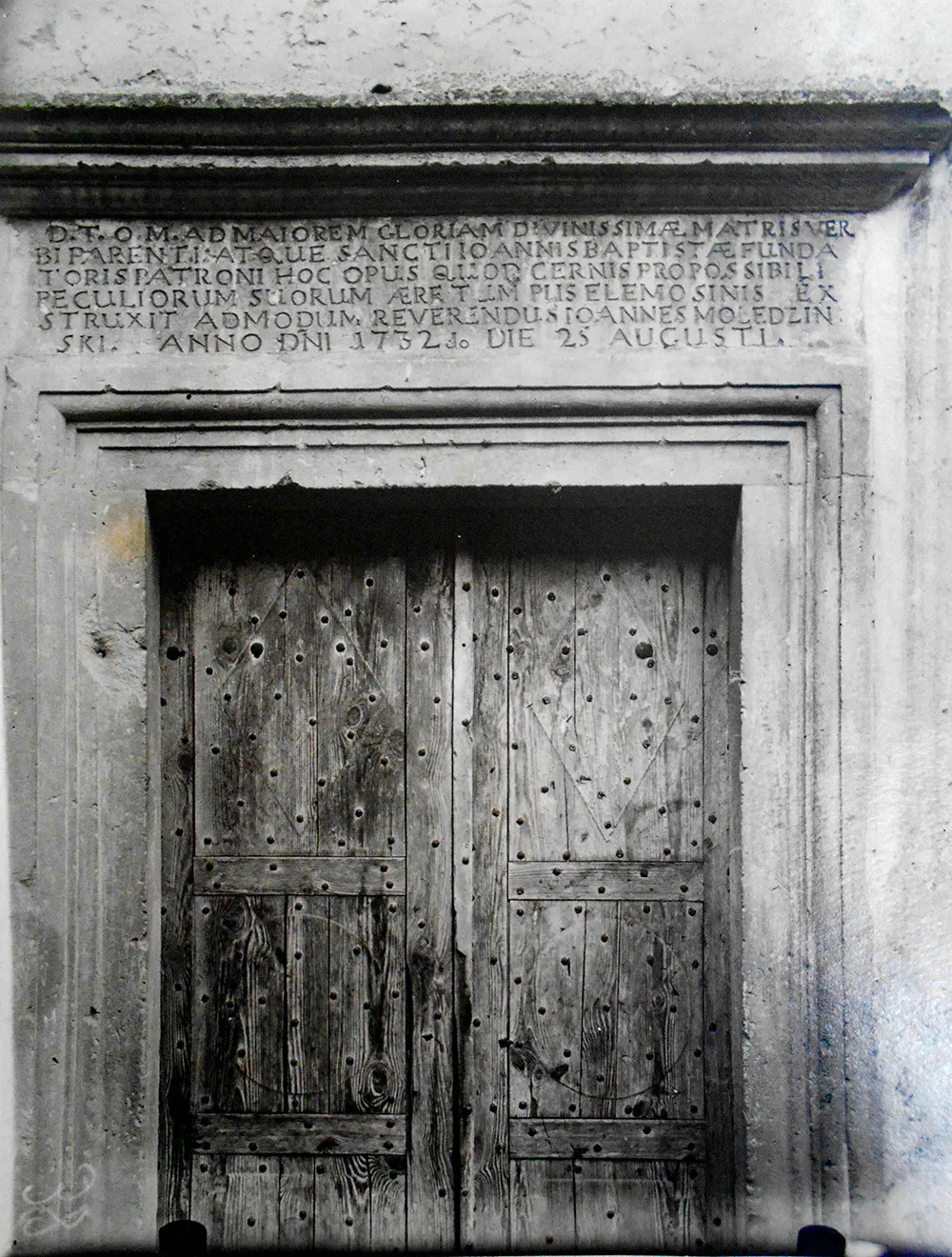
The Latin text reads:
“D. T. O. M. Ad majorem gloriam divinissimae matris verbi parenti atque sancti Ioannis Baptistae fundatoris patroni hoc opus quod cernis propos sibili peculiorum suorum aere t[e?]mplis elemo sinis ex struxit admodum reverendus Ioannes Moledlinski Anno d[omi]ni 1732 do die 25 augusti.”
In translation:
“To God, the best and greatest, in the Trinity. For the greater honour of the Most Holy Mother of God, Mother of the Word, and of St. John the Baptist, patron of the founder, this work that you see, built according to the means at his disposal and by generous foundation, was erected by the Very Reverend Father Jan Molendziński. In the year of Our Lord 1732, on the 25th day of August.”.
It was precisely this foundation plaque, dedicated to the construction of the Church of St. Anne, that the communists turned into a road kerb, and the remains of the relic, mutilated by the Bolsheviks, were later thrown out of the “innovative” museum as rubbish by its staff.
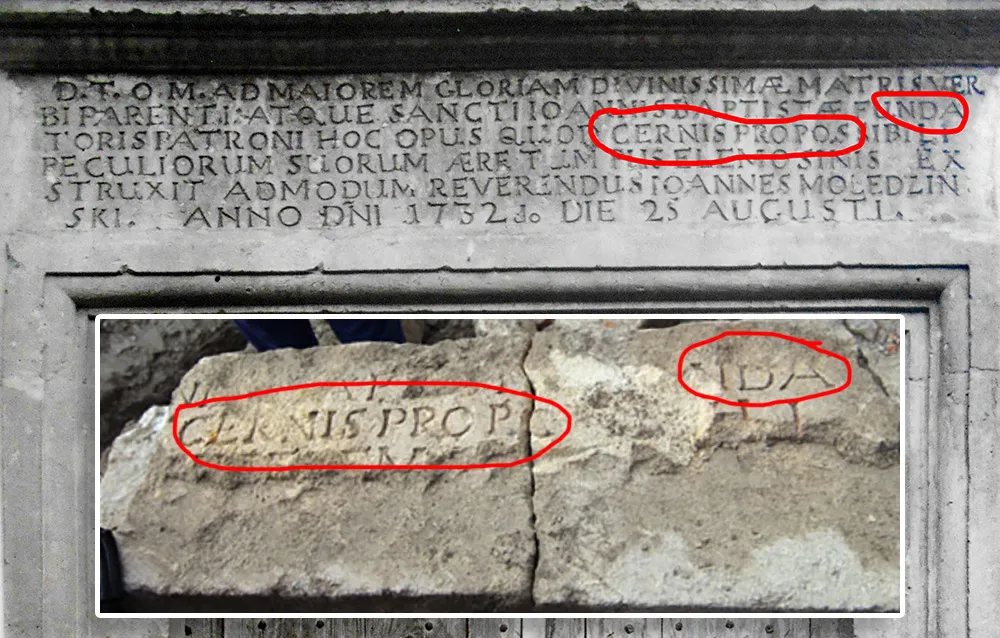
It is worth noting that identifying this relic is significant for preserving the history of Horodok. The Church of St. Anne was once not only the oldest (as of the 20th century) masonry church in the town. It was to this church that the miraculous icon of St. Anthony of Padua, famous throughout Podillia and regarded as the heavenly patron of Horodok, was once brought from Kamianets-Podilskyi. It was kept here for a long time, until it was moved to the Church of St. Stanislaus and later, after the churches were destroyed, to the Roman Catholic cemetery chapel, on whose site the new church of St. Stanislaus the Bishop and Martyr now stands. Let us recall that it is thanks to this famous icon that the church was recently raised to the honourable status of a Sanctuary. And the path to this Sanctuary began at the doors of the Church of St. Anne. Doors that were once adorned by the memorial plaque, whose remains, mutilated by the Bolsheviks, still lie beneath the walls of G-MUSEUM.
The author nevertheless hopes that, now that the origin and significance of the relic have finally been established, the artefact will find its place in the display. If, however, G-MUSEUM has no use for such “non-innovative” things, perhaps it would be worth handing it over to the Sanctuary of St. Anthony, where the relic would undoubtedly take the most honourable place beside the famous icon. All the more so since the artefact is hardly officially registered in the museum.
P.S. Why this discovery was made by an “amateur” and not by the professional staff of G-MUSEUM headed by the institution’s curator, Candidate of Historical Sciences Serhii Shchur, remains an open question. The question of why a museum which, thanks to the patrons the Humeniuks, has the potential to become a museum known across Ukraine and even Europe is still practically unknown beyond Khmelnytskyi Oblast is rhetorical….
Text and modern photos: Dmytro Poliukhovych
Historical photos: Stefan Taranushenko and Pavlo Zholtovskyi. Expeditions of the Kharkiv Museum of Ukrainian Art. 1930.


