

A unique “plague cross” found in Podillia with the participation of the Ukraina Inkognita team
Reading the headline, a sceptical reader will probably mutter: “We know, we know: every guide or provincial local historian will certainly use the word ‘unique’ for any object in their own patch, even when that is not the case at all.”
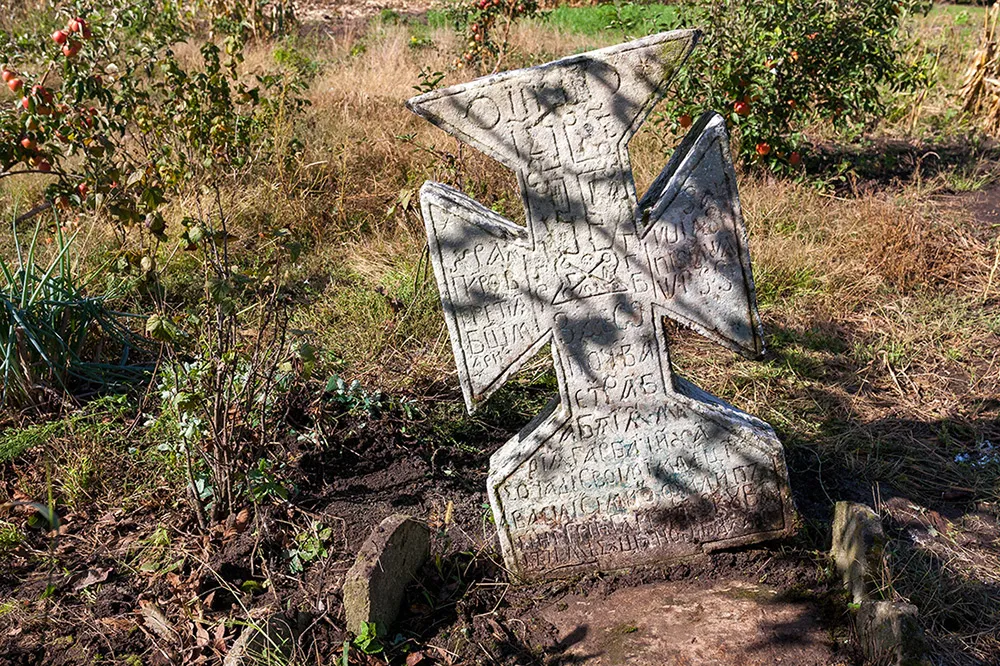
The “plague cross” in Lisovody.
Despite the understandable scepticism, the cross we are about to discuss truly has every right to this respectable and proud epithet.
Our website has repeatedly told about the partner project of the NGO Ukraina Inkognita and the Department of Culture, Nationalities, Religions and Tourism of the Horodok City Council (Khmelnytskyi Oblast), called “Graves of the Ancestors”. The project is implemented with the support of the mayor of Horodok, Neonila Andriichuk.
Within the project, the old necropolises of the former Horodok district (Ukrainian, Polish and Jewish) are surveyed, both to reveal the multinational and multi-confessional heritage of Podillia and, in the longer term, to create tourist routes.
When information arrived that on one of the peasant farmsteads in the village of Lisovody there is an old grave with a stone cross, this news naturally interested the project participants. After all, crosses used as gravestones outside cemeteries are an enormous rarity, and every such monument deserves the description “unique”. The author of these lines, for one, knows of only 8 such crosses (9 with the newly discovered one). These are crosses on the graves of victims of the plague epidemics (“morovytsia”) of 1770–1771 and 1797. All of them are concentrated in the vicinity of the urban-type settlement of Sataniv in the same Khmelnytskyi Oblast.
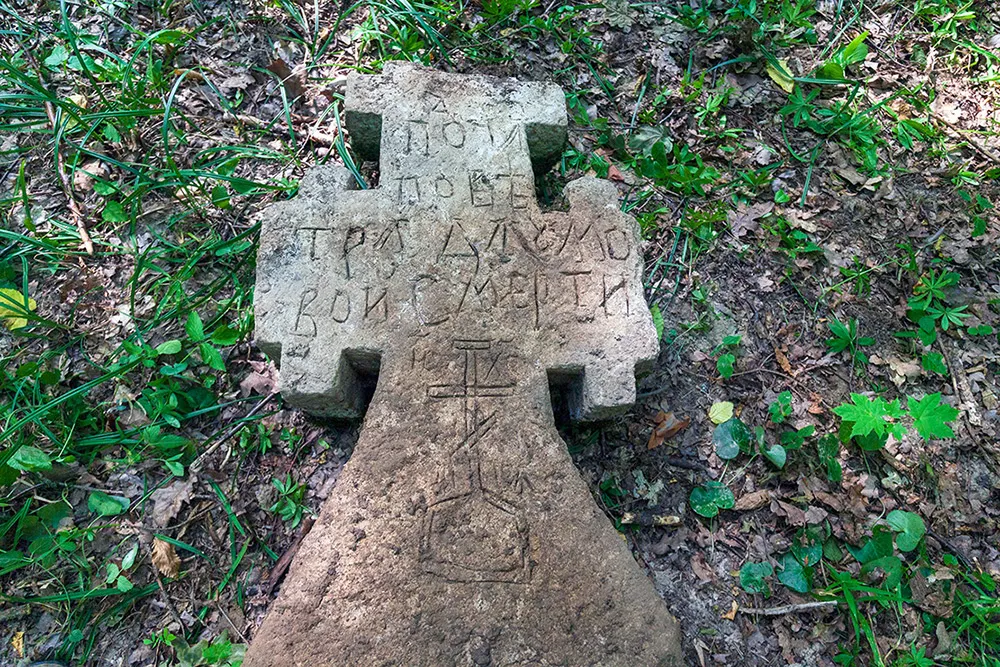
A “plague cross” from the vicinity of Sataniv, on the grave of “дєвіци Магдалени” (the maiden Magdalena), who “почіла от поветрія джумовой смерті” (passed away from the pestilence of plague death)
As Volodymyr Liubchenko, a researcher at the Institute of Ukrainian History of the National Academy of Sciences of Ukraine, whose scholarly interests include studying the evidence of the 1770–1771 plague, said in his comment, “plague crosses” are an enormous rarity today. Besides those known to the author, he could name only one such monument, located within the city of Ternopil. He also noted that there is evidence of similar crosses in other parts of Podillia, but all of them were lost during the anti-religious frenzy of Soviet times. According to oral tradition, there were more of them in Lisovody too, but they were destroyed by Komsomol members and party activists.
The villagers themselves revered these graves. It is believed that damaging or destroying one causes various misfortunes. Indeed, they are still looked after. In particular, they are periodically whitewashed and cleaned. The latter has quite a bad effect on their preservation. The soft Podillian limestone wears away quite easily. That is why, for example, on the crosses in the villages of Kamianka and Spasivka beyond the Zbruch, considerable epitaphs have been erased. You can see there was once a large, extensive text, but reading it is out of the question. Only the dates survive.
It is good that in Lisovody it was only whitewashed and, at least once, painted with oil paint. Fortunately for researchers, the cross stood slightly tilted, and on the front side the oil paint had peeled off under the action of rain. But to clean the relic of its thick layer of lime still took more than an hour of work. Of course, a wire brush could have helped to cope quickly and radically, but out of respect for its age we had to work with sharp wooden scrapers prepared in advance (they have repeatedly helped on the “Graves of the Ancestors” expeditions) and a soft brush. The opposite side was harder: there the oil paint was set hard. Besides, the supply of scrapers we had brought ran out, and we did not want to use a nail or anything of the kind.
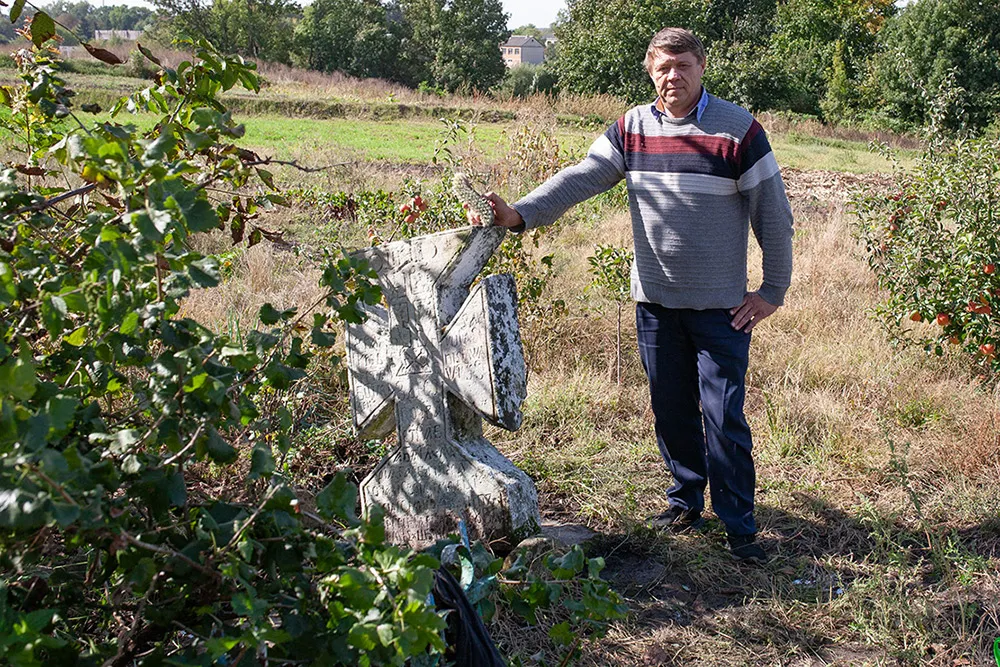
One of the most active participants of the “Graves of the Ancestors” project, ATO veteran Valentyn Nyshchyi, shows what the cleaned cross looks like. Unfortunately, the author forgot to take a “before” photo.
The cross standing on the farmstead of the village’s long-time resident Nina Probyta differed radically from all the “plague crosses” seen before. First, all the others were of the “cross-ended” type traditional for this part of Podillia, on the graves of Ukrainians and on those of Poles alike. The cross in Lisovody, by contrast, belongs to one of the varieties of the so-called “Cossack” crosses. Besides, all the previous crosses were simply set in the ground by means of a “tongue”. The cross surveyed here, by contrast, was also propped up by flat slabs laid on the ground. During the survey the latter were cleared of soil, but unfortunately they bore no inscriptions or images.
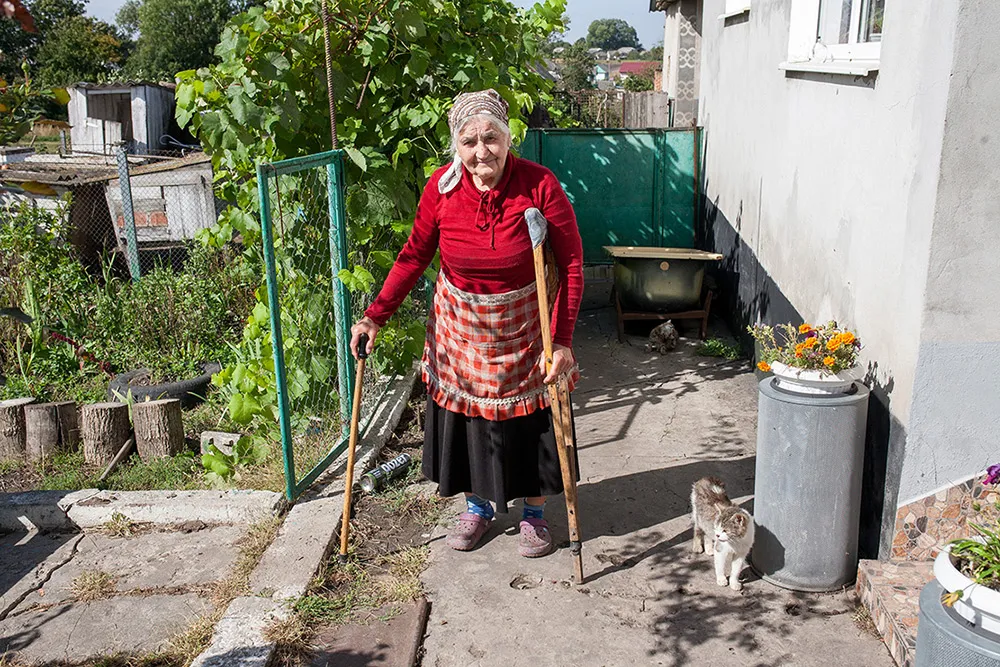
Nina Probyta and her cat
Even before the cleaning of the monument began, Mrs Nina told the sad story of this grave. Once, she said, a house stood on the site of her farmstead where a woman lived with three small children. The woman and her children felt fine. In the daytime they were still alive and well, but the next morning the woman’s brother, who lived “across the river” (Bila Krynytsia), came to visit and found them all dead. As with all victims of the plague, so as not to spread the disease through the village, he buried them all beside the house. She also said that in the 1930s “activists” wanted to topple the cross, but the people would not allow it.
As it turned out, once the layers of lime were cleared away, the most interesting thing about this gravestone was its decoration and inscriptions. The latter make this “plague cross” unique twice over! Recall that each example of monuments of this type is extraordinarily rare and in itself deserves this proud epithet.
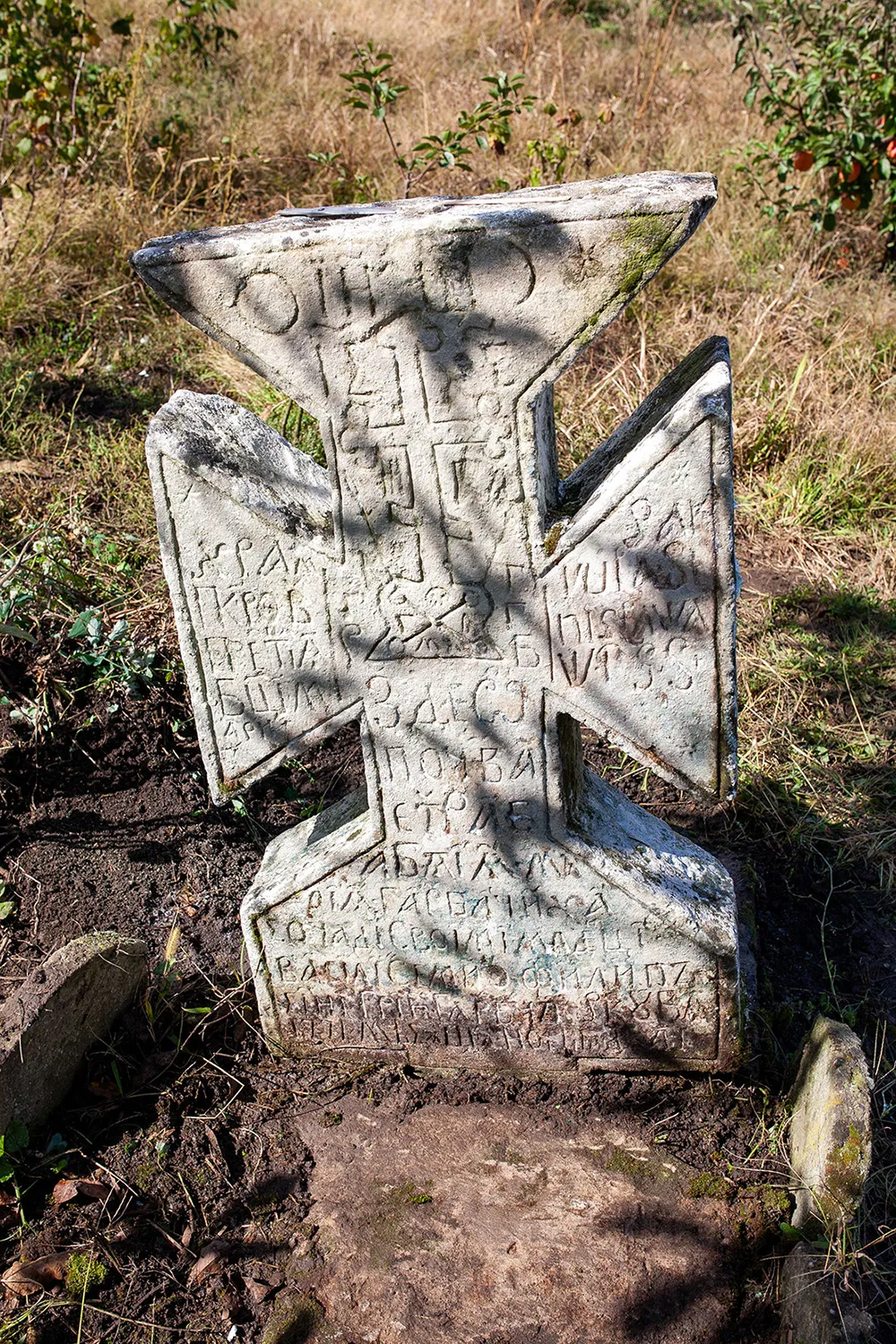
The “plague cross”
It is precisely these inscriptions that make this gravestone unique against the background of all other crosses of the 18th and early 19th centuries!
Its upper and central parts, note, are quite standard. These are the typical inscriptions and images for such gravestones in the Eastern tradition. At the very top we see a circle-Sun (a symbol of Christ), IC XC NIKA (Jesus Christ Conquers) and a moon, looking more like the letter “C” (a symbol of the Mother of God).
In the centre is carved a six-armed cross on Golgotha with a small cave beneath it in which lies the skull of Adam. Around it are abbreviations meaning Jesus Christ the King of Glory, the Place of the Skull, was crucified, the sponge and reed, Mount Golgotha, the head of Adam. A fairly standard set.
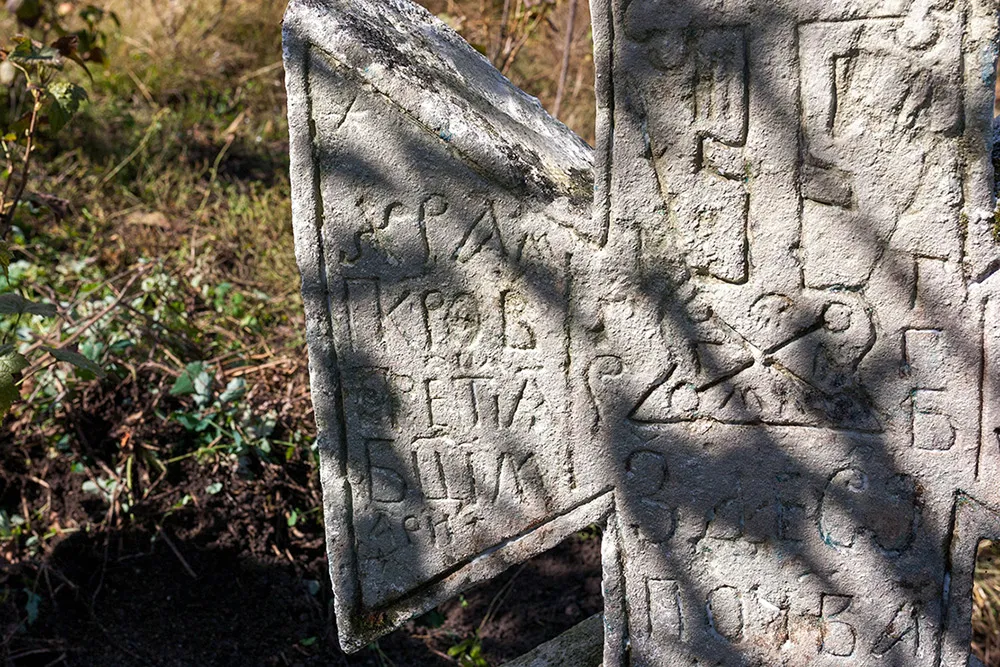
The mention of the Church of the Intercession.
The non-standard part begins on the right arm of the cross. It bears the inscription: “Храм Покрова Пресвятої Богородиці Марії” (the Church of the Intercession of the Most Holy Mother of God Mary). A mention of the church to whose parish the deceased belonged is probably a very rare phenomenon. At least the author, despite considerable experience, saw such a thing for the first time.
The Church of the Intercession parish in Lisovody exists to this day.
There was a church in the village by at least the 16th century: a local priest is already mentioned in the lists of 1583. The Church of the Intercession is known from the 18th century. It was built in 1704. Just before the plague epidemic the church burned down, and in 1768–1773 a new one, also wooden, was built on its site. In 1869 it was replaced by a masonry one. In 1933 the church was closed and turned into a club, and the priest Volodymyr Furman was arrested and most likely shot. In 1964 the church was demolished completely. The present Church of the Intercession was built in 1990, but no longer in the centre of the village, rather on its outskirts.
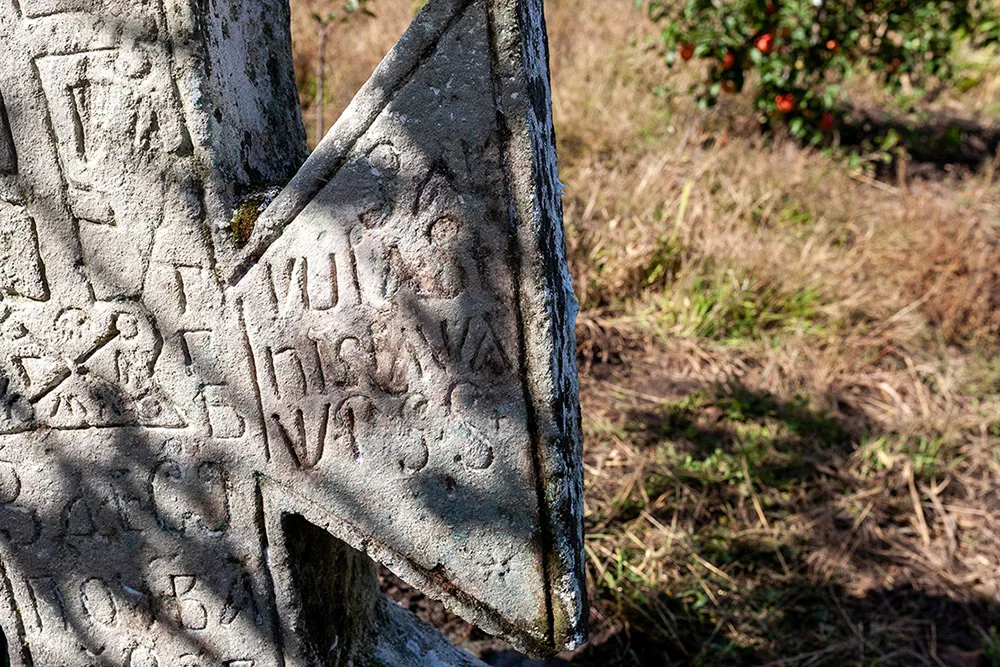
The inscription in Latin.
An amazing inscription can be seen on the right arm. Here we probably see the Latin version of some prayer or saying. What could be made out is “Sak(h?) vuia St nissawa WP S+S+” (the “+” signs are small crosses). It is hard to say what exactly lies behind it. The author is frankly out of his depth on this subject. What can be said with certainty is that the abbreviation “S+S+” is most likely “Spiritus Sancti” (Holy Spirit), as the small crosses beside the letters clearly indicate.
The epitaph announces: “Здесь отпочивает раба Божия Марія Горбачиха со чадами своими і младенцы Васілій, Семион, Филип, сины Григорія Горбача. Року БОЖИЯ 1771 месяця новембрия 14 день” (Here rests the servant of God Maria Horbachykha with her children and the infants Vasyl, Semion and Pylyp, sons of Hryhorii Horbach. In the year of GOD 1771, month of November, 14th day).
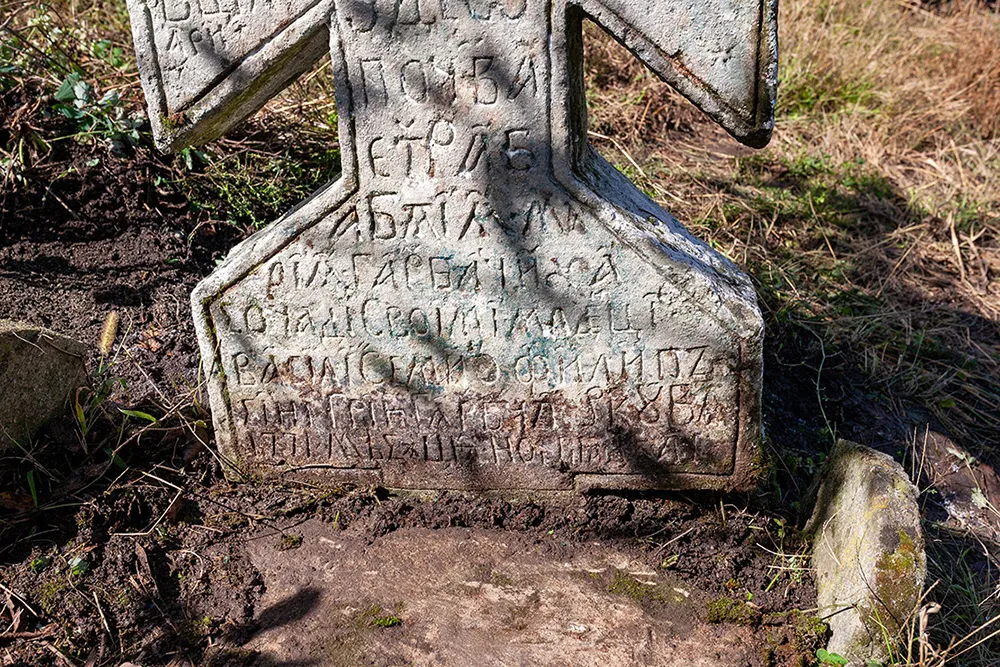
The epitaph itself
On this part of the gravestone there is not a word about the plague, unlike on some gravestones in the vicinity of neighbouring Sataniv, but the date 1771 explains everything.
The decoration of the opposite side is almost completely identical to the front. Here too we see a cross on Golgotha, though without the schematic depiction of the Sun and Moon. Because of layers of blue oil paint, the inscriptions on the side arms are illegible. We will need to visit again and finish the cleaning. Perhaps there will be something about the plague there.
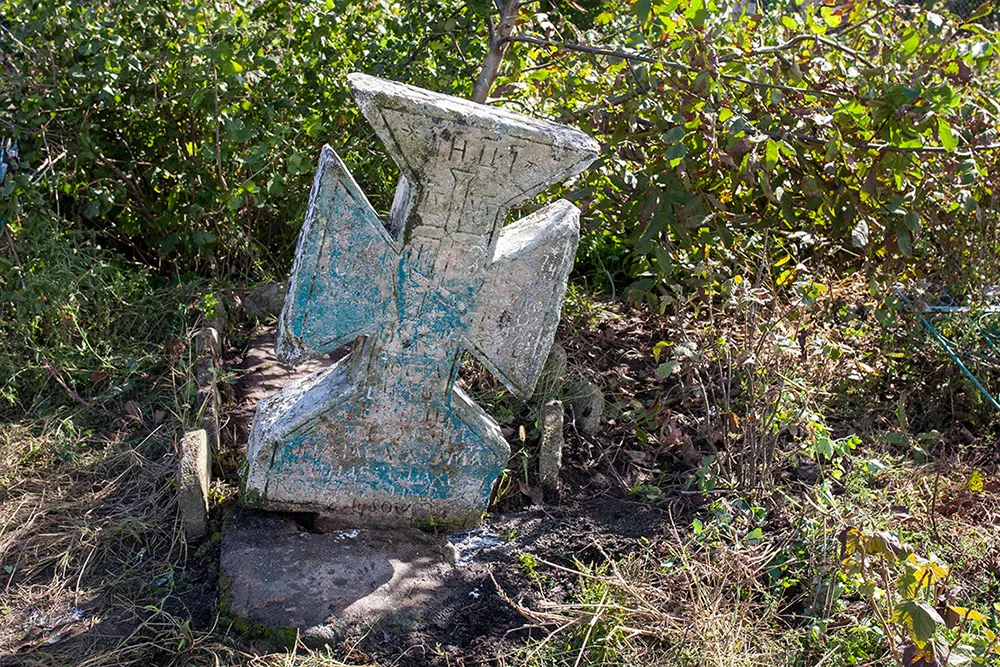
There were difficulties with cleaning the reverse side
We managed to make out a little of the text at the bottom: “Поставил сей крестъ … RОКУ 1772 … раб Божий Гаврило Гарбач…” (This cross was set up … in the year 1772 … servant of God Havrylo Harbach…)
Havrylo Horbach was probably the brother of the plague victim’s husband. Possibly, however, her father-in-law. Accordingly, the story told by the farmstead’s owner, Mrs Nina, probably spoke from the start of the husband’s brother rather than the wife’s brother. But that is not essential.
It is interesting that in the word RОКУ (“year”) the Latin “R” is used rather than the Cyrillic one.
At the very bottom, also in Latin letters, is “Lysowody”.
The simultaneous use of Cyrillic and Latin texts clearly testifies to the Uniate tradition, and confirms once again that before the seizure of Podillia by the Russian Empire the Greek Catholic Church dominated here.
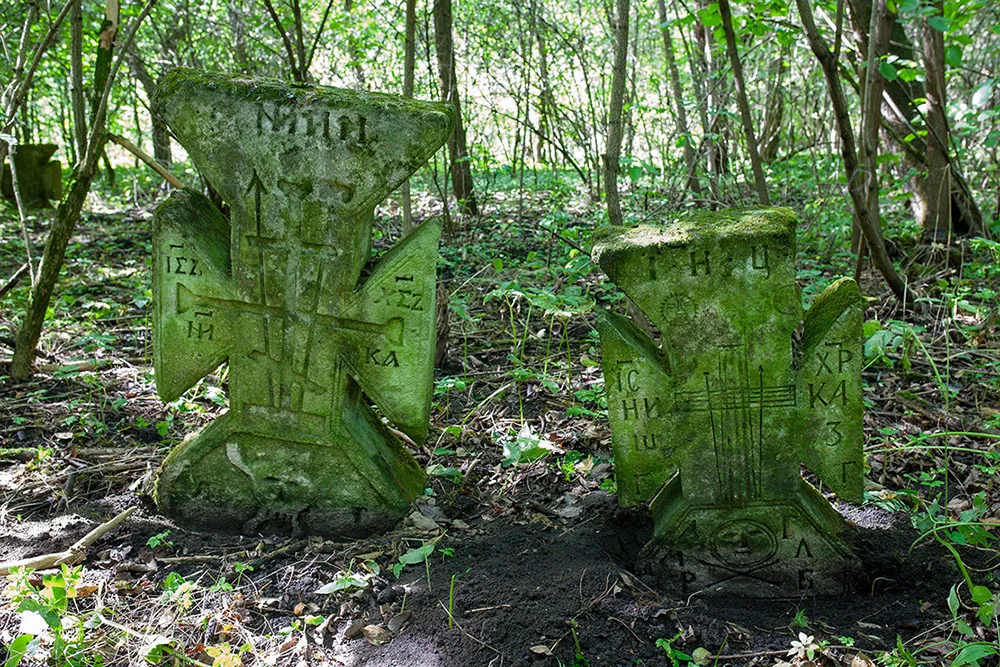
Crosses of the same form in the cemetery in Lisovody. The larger one is of 1810, the smaller of 1808. The smaller one bears the Sun and Moon
In Lisovody, crosses of the same form as the one on the plague victims’ grave under discussion were used for at least another forty years. In particular, in the old part of this village’s cemetery one can see two quite interesting and beautiful gravestones of similar outline dating from the first decade of the 19th century. One of them is also decorated with an image of the Sun and Moon. True, the Sun there is more elaborate, with rays and a human face, not just a schematic circle.
We drew attention to this because, although the Sun and Moon is a fairly common image in the Christian tradition, in this part of Podillia it is an enormous rarity on gravestones. In addition, they use a rather non-trivial form of epitaph: “Крєст сєй поставлєн на рабє Божій…” (This cross was set up for the servant of God…)
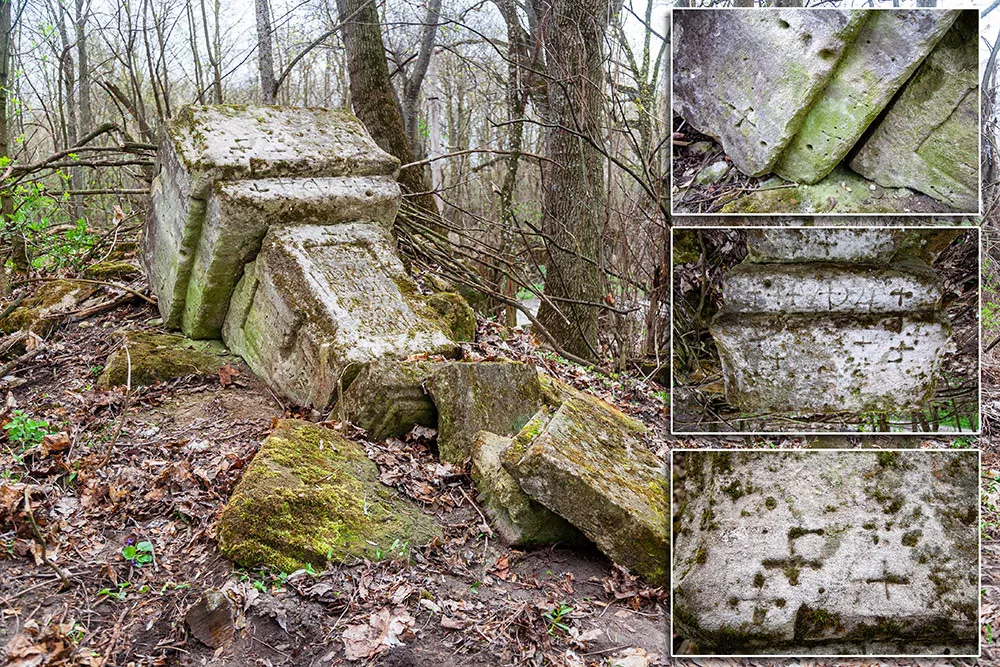
Graffiti in Andriivka (Kumaniv)
Recall that this is not the first resonant find made in the course of the “Graves of the Ancestors” project. Among others, it is worth singling out the very interesting and touching monument “To a Lost Love” in Kupyn, the graves of descendants and relatives of the famous mystic and “King of the Illuminati” Tadeusz Grabianka, and a 17th-century matzevah with unique decoration in the Jewish cemetery in Sataniv, which has the oldest depiction of the Western Wall in Jerusalem in Ukraine and, quite possibly, in Europe. Another interesting monument with graffiti has also been found. It is the pedestal of an unidentified sacred figure of 1704 in the village of Andriivka (Kumaniv). Specialists had not previously known of such graffiti on Roman Catholic monuments of this type in Ukraine.
Text and photos by Dmytro Poliukhovych
An extended version of this article, with a story about another unique cross in Lisovody, can be read on the RISU website


