

Rymarivka. The church and the Holodomor

· 11 min read
Not far from Plishyvets, with its phenomenal church, lies the village of Rymarivka, which also has a handsome brick church — the Church of the Intercession, laid down in 1906. The style of the church is called Neo-Byzantine. Personally, I have my doubts about this: having seen a great many Byzantine churches, I somehow do not identify the Rymarivka church with the Byzantine tradition. There are elements of it, but that is hardly enough to call it a style. Today it would rather be described as brick Art Nouveau leaning towards Neo-Russian historicism (with its kokoshnyk gables).
Musings about style do not deny the fact that the Church of the Intercession is beautiful. A large dome on a tall drum, five small cupolas, a bell tower. It is a fine example of brick Art Nouveau — it is clear that the architect was a good one and that the masons laid the brick well. I found a decent account of the church on the website of the village of Rymarivka:
Church life in Rymarivka reaches back to the very beginnings of the village, reflecting the centuries-long presence of Christianity in our lands.
The churches changed their outlines, were rebuilt, and new ones were erected in place of the old. Today we can only try to make out, in the twilight, vanishing figures, events and names. In Rymarivka there are tales that somewhere there are handwritten prayers taken out of the village that date back to the 11th century. Information about a wooden church in Rymarivka goes back to the Cossack times of the late 16th century, or even earlier. In 1783 the collegiate assessor H. Ye. Stanislavskyi built a new church in place of the old Church of the Intercession. And in 1903, after a fire (according to eyewitnesses), a new brick church in the Byzantine style was laid down, which has survived to this day. The church is 35 metres high. A fence with a chapel was built around the church, and it was destroyed under Soviet rule.
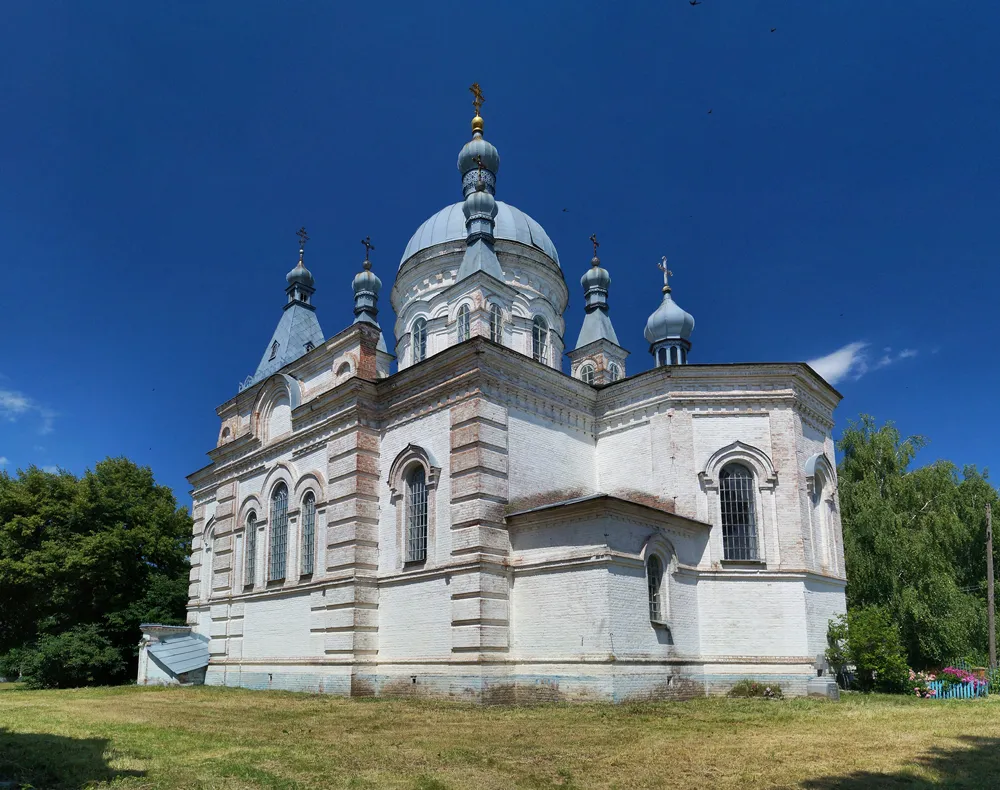
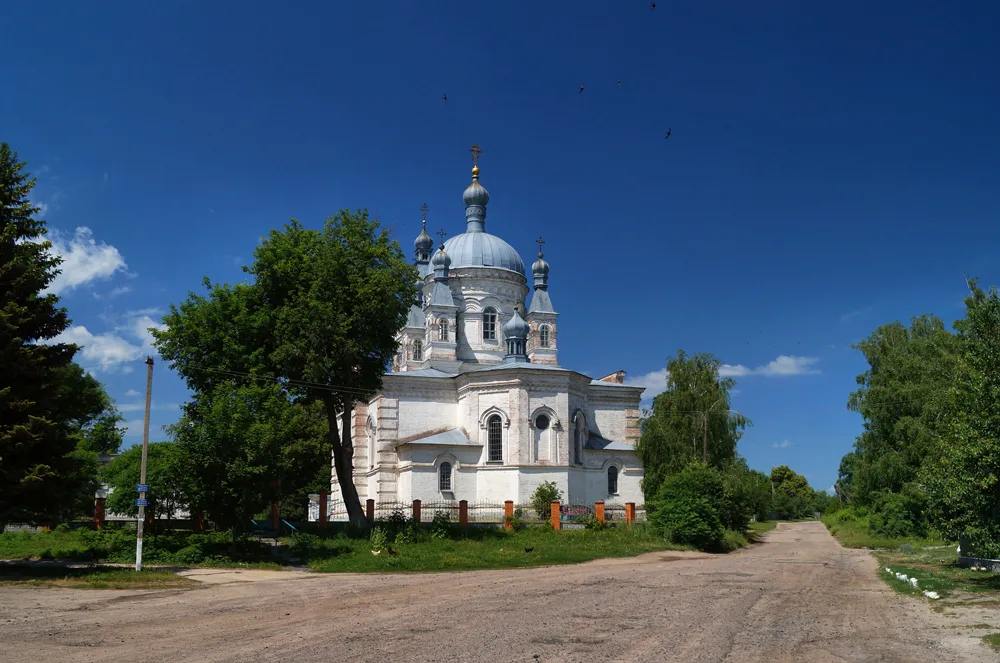
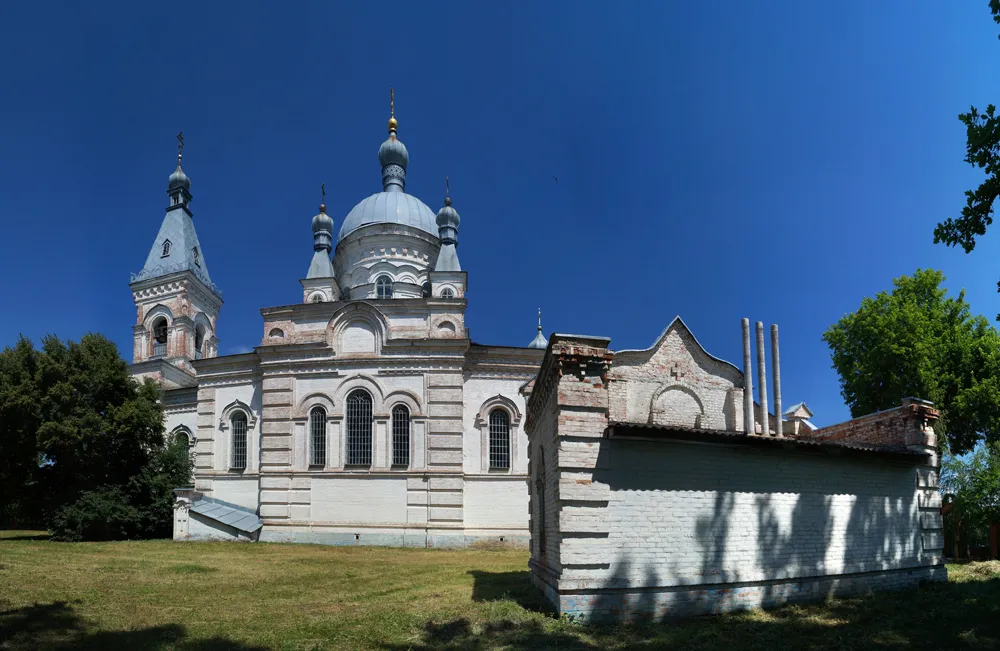
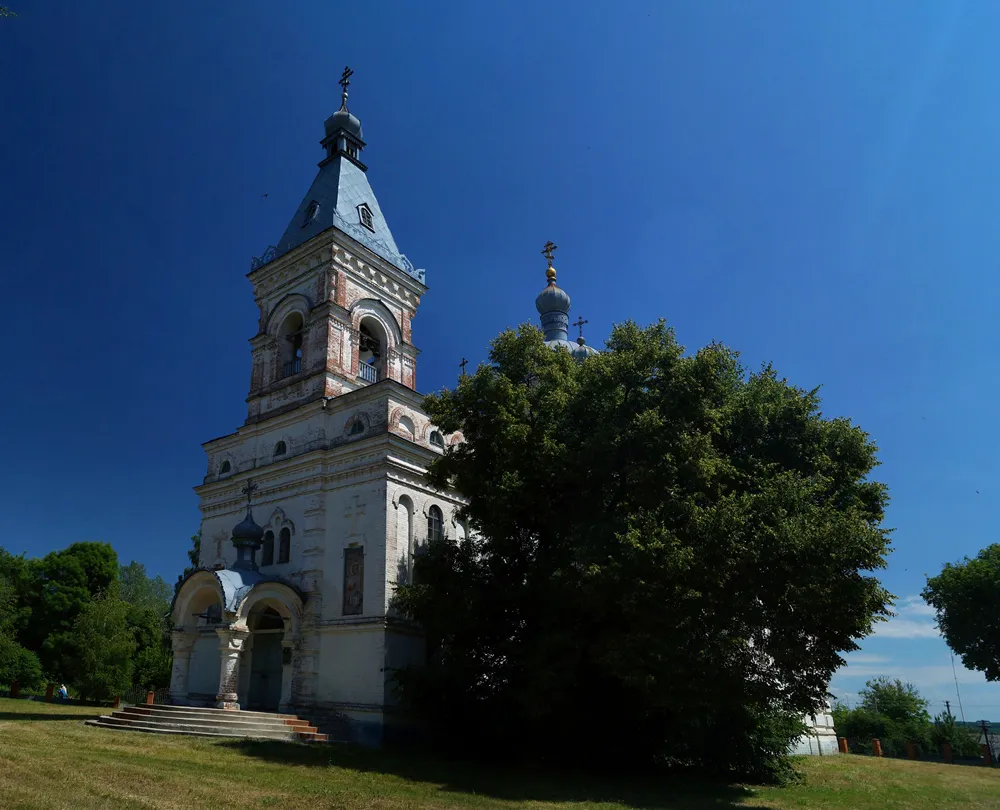
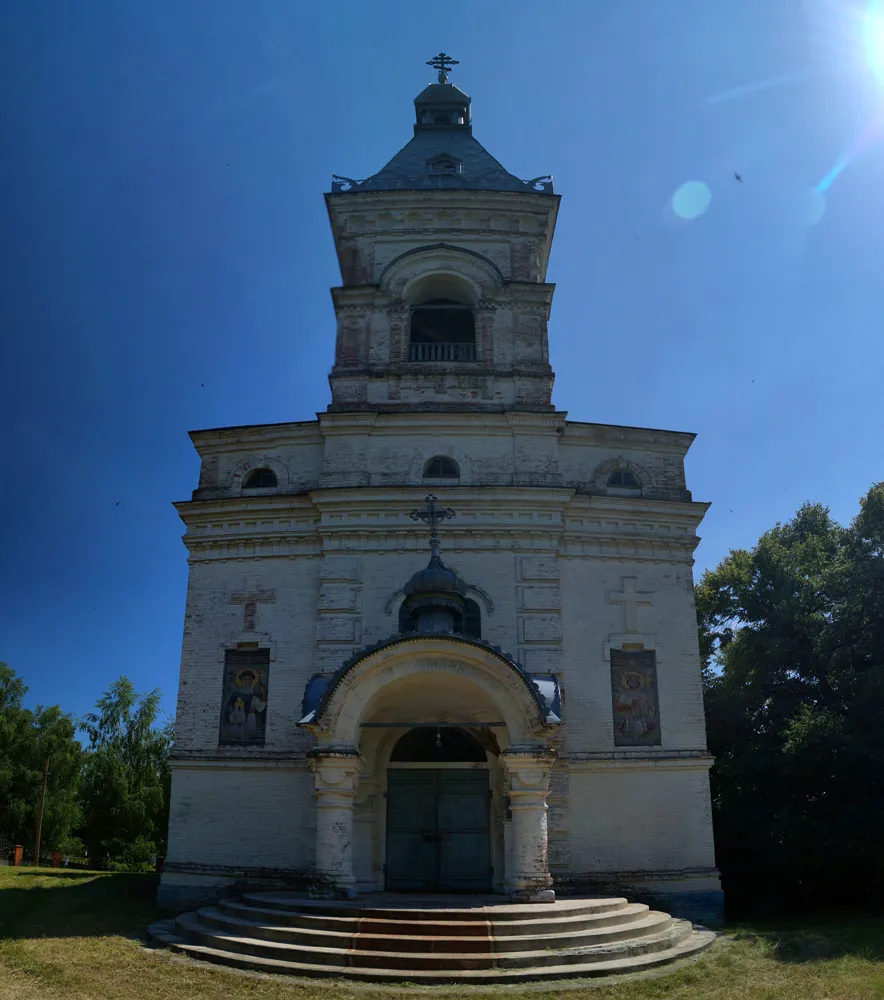
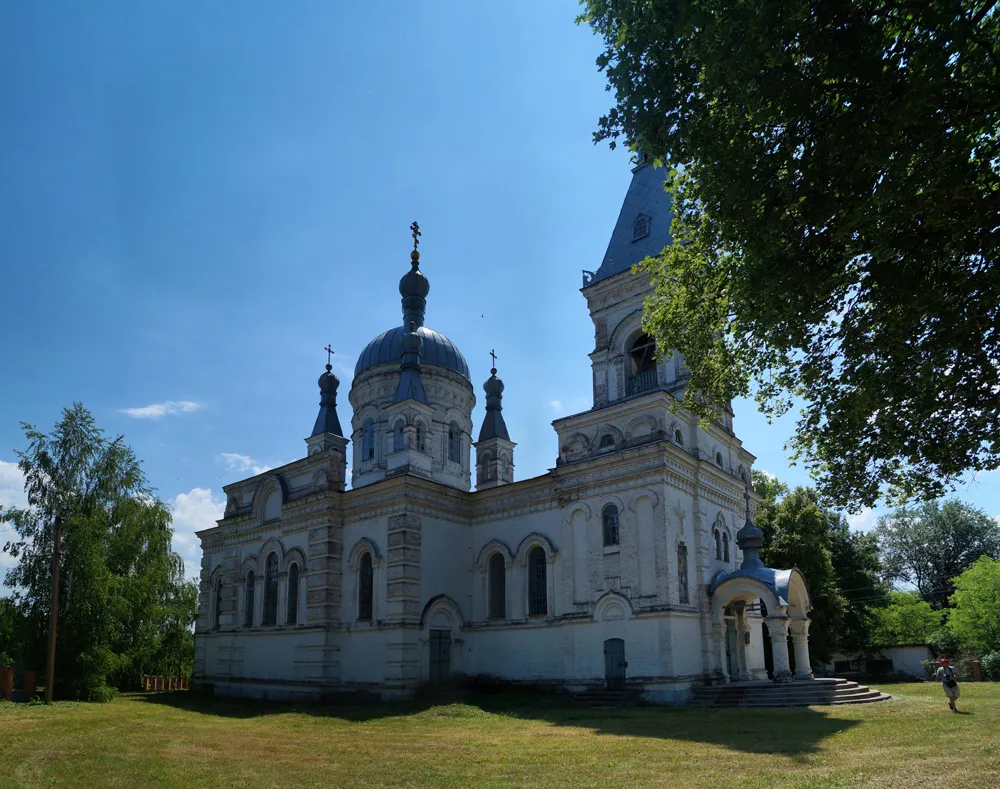
The church, unusual for a village, is wrapped in legends. It was built with funds from Major Viktor Serhiiovych Yuriev, who owned these lands. According to the old-timers, the story of the church’s creation is as follows. Major Yuriev, on military business in St. Petersburg, met Anna Danylivna there, who came from a rather wealthy noble family. The major’s age was already turning towards the second half of life and it was time to marry. Here the young, pretty noblewoman took his fancy, though she, it seems, did not much like the balding landowner who had an estate in faraway Ukraine, in the village of Rymarivka in the Hadiach county of Poltava Governorate. Turning up her nose with confidence, she nevertheless set one condition (perhaps hoping that he would not be able to fulfil it, or simply to buy time, as she was still quite young). The condition was this: to build in his village a church exactly like the one she attended every Sunday service in St. Petersburg.
Viktor Serhiiovych returned home gloomy, because although he had a large estate, rich lands and sufficient funds, building a church — one of the largest, if not the largest, in the whole Hadiach county — was nevertheless a very difficult undertaking. Whether he had taken that much of a liking to the fair-faced noblewoman, or for some other reasons, the major firmly resolved to keep his promise. The church took no less than ten years to build; Anna Danylivna did marry Yuriev in the end.
It is documented, however, that according to the entries in the travel journal of the Poltava bishop Hilarion (Yushenov), the wooden church at the end of the 19th and the beginning of the 20th century was in such a state that a new one had to be built. Ancient handwritten books were kept here: a Gospel and a Euchologion of the 16th century, and a Nomocanon printed in 1624. It was from Bishop Hilarion that the wider public learned of this rare find. The founder of the brick church was the tsarist minister, retired Major Yuriev, who built the majestic Cathedral of the Intercession at his own expense. The grave with an inscription about Yuriev’s burial is one of the few that have survived next to the church. Besides it, beneath the altar wall lies the grave with the remains of the parish priest Viktor Viktorovych Nazarevskyi; his father, Fr. Viktor Nazarevskyi, served as a priest in Rymarivka at the beginning of the 20th century. In his notes he attests that a church in the village already existed at the end of the 16th century, or perhaps even earlier; the probability of this version is indicated by the Universal of Hetman Ivan Mazepa of 1688, the Nomocanon printed in 1624, as well as the ancient handwritten Euchologion and Gospel. This is also confirmed by a find of our own time, a liturgical book, the Euchologion printed in 1763, made during the rebuilding by the church’s rector, Archpriest Leonid Vasylenko.
In the mid-20th century, during another anti-religious campaign, the church was closed. The last service before its destruction was conducted by Father Tsyhanenko in 1958.
1962 saw tractors pull the holy crosses down from the domes of the Church of the Intercession, and the first attempt was made to blow up the church. Demolition men arrived with explosives, but it turned out that in order to blow up the majestic church the people had to be moved out of the surrounding buildings, and there was a danger of destroying the newly built two-storey collective farm office and the three blocks of the newly built two-storey secondary school. That is why the demolition men were afraid to destroy the church then. Under Soviet rule the church was attacked three times, but it stood firm thanks to its strong walls and God’s protection. Only the crosses from the small domes were pulled down by tractors. When they pulled at the main dome, the cable could not hold and snapped, maiming the man in charge of the work — as people say, ripping open the stomach of the destroyer. The church fence was destroyed and the chapel dismantled, and an office was built in its place. The chapel had held the burials of the Mazarak family.
When the mutilated church was handed over to the religious community, birches with trunks as thick as a bucket were growing on the second tier of the bell tower, and the domes of the bell tower had been pulled down. The church was restored by the efforts of the community of believers headed by the rector, Father Leonid Vasylenko. In 1992, at the request of his fellow villagers, Fr. Leonid returned to his native village and began to serve in the parish, while his wife Maria took charge of the church choir. Before Easter 1992 the community moved from the Moscow jurisdiction to the UAOC (Ukrainian Autocephalous Orthodox Church), and later to the Kyiv Patriarchate when it was formed. People wept on hearing the Word of God in their native language. Thanks to the first choir director after the restoration of services, O. Ya. Pererva, who had sung in the church back in the 1920s, it was possible to revive the traditional local church chants; in particular, the melodies of church services in Ukrainian were preserved.
The community was helped with the restoration work by the agricultural enterprises of Rymarivka and the surrounding villages. Among the donors Fr. Leonid names Professor Petro Vasylovych Odarchenko, a literary scholar and ethnographer, a former Rymarivka resident who lived in the USA; the Spivak family from Canada; and the Matviiko and Patsir families from Chicago. During the church’s restoration, a mine was found in the wall of the bell tower, which is one whole with the church. The mine had reached the middle of the wall, destroyed its own explosive device and did not explode. And when rubbish was being carried out of the cellar, they found the arms of a human skeleton, shackled in chains. The church has many icons and a wonderful iconostasis by the masters Petro Mykhailovych Halak and Vasyl Petrovych Yaremenko, made with the participation and under the guidance of Fr. Leonid, who is a painter by training. Through the efforts of the rector and the community, donors and sponsors, the exterior of the church has been restored and a new fence built. The church was adorned with icons by students of the Academy of Arts under the guidance of Vira Barynova-Kuleba, and decorated with embroidered towels (rushnyky) made by fellow villagers.
I was also interested in the article about Rymarivka on Wikipedia, especially the shocking list of Holodomor victims, which shows that the village was almost wiped out.
• Barabytskyi Yakiv — family of 9
• Blakytnyi F. — family of 5
• Bondarenko Vasyl — family of 7
• Bortnyk O. — family of 6
• Bortnyk Mykola — family of 4
• Bortnyk F. — family of 2
• Vasetskyi F. — family of 7
• Vlasenko V. — family of 7
• Vlasenko I. — family of 5
• Vlasenko M. — family of 7
• Vlasenko O. — family of 6
• Vlasenko T. — family of 5
• Vlasenko Yukhym — family of 3
• Havrylko Ovram — family of 9
• Hakh T. — family of 3
• Horpynko Mariia, 1 child
• Hrytsan S. — family of 5
• Divak M. — family of 9
• Dolynnyi V. — family of 11
• Zharko T — family of 6
• Zhydivka M. — family of 9
• Zaiets M. — family of 2
• Zaiarskyi K. — family of 6
• Kanivets A. — family of 8
• Karmaza M. — family of 4
• Kobzar S. — family of 6
• Kovinko Vasyl — family of 11
• Kovinko H.
• Kovinko Ivan — family of 6
• Kovinko Petro — family of 3
• Kovinko S. — family of 7
• Kovinko F. — family of 7
• Kovinko F. — family of 4
• Kovtun H. — family of 5
• Kovtun D., 1 child
• Kovtun Ivan — family of 4
• Kovtun K. — family of 6
• Kovtun S. — family of 2
• Kovtun T. Kovtun F. — family of 8
• Kovtun F. — family of 7
• Kovtun Yakiv — family of 7
• Kozachenko A. — family of 4
• Kozin A. — family of 5
• Kozin K. — family of 5
• Koshman Vasyl — family of 11
• Koshman S. — family of 9
• Kravchenko V. — family of 5
• Kravchenko H. — family of 4
• Kravchenko Ivan Mykolaiovych
• Kravchenko Ivan P.
• Kravchenko K. — family of 6
• Kravchenko S.
• Kravchenko F. — family of 6
• Kramar S. — family of 10
• Krasiuk D. — family of 3
• Karmaza V. — family of 8
• Kuleba H. — family of 6
• Kucherenko P.
• Levun D. — family of 6
• Lepskyi I. — family of 4
• Lytvyn F. — family of 7
• Lymonia Petro — family of 5
• Lytovka Ivan — family of 5
• Lytovka P. — family of 3
• Lytovka S. — family of 7
• Liashenko A. — family of 6
• Marunych H. — family of 5
• Melezhyk Ivan — family of 2
• Melnyk H. — family of 5
• Mykytenko V. — family of 9
• Myroshnychenko O. — family of 7
• Miniailo O. — family of 8
• Mishchenko S. — family of 2
• Nehodykha Aniuta
• Oksom A. — family of 2
• Perepelytsia S. — family of 4
• Perepelytsia Ya. — family of 6
• Pererva O. — family of 8
• Pererva P. — family of 5
• Petrenko P — family of 2
• Pysarenko Ivan — 2 children
• Plutenko K.
• Plutenko T. — family of 7
• Plutenko Trokhym — family of 4
• Pohorilyi K — family of 7
• Poltavets O. — family of 9
• Polianyn Ivan — family of 8
• Pravdiuk Ivan
• Riznechok M. — family of 7
• Riznechok Petro — family of 4
• Roskolupa V. — family of 6
• Serba O. — family of 6
• Sereda H. — family of 7
• Sereda Petro — family of 6
• Svatkovska Uliana — family of 5
• Sukhonis H.
• Sukhonis D. — family of 2
• Tykhonovych Taras — family of 4
• Tychyna M. — family of 7
• Fyl H. — family of 6
• Kholod Ivan — family of 6
• Khropko S. — family of 7
• Khropko S. — family of 6
• Cherepovskyi F.
• Shvets F. — family of 3
• Shvydkyi K. — family of 7
• Shostak F. — family of 7
• Yashchenko A. — family of 7
• Yatsun M.


