

Sochaczew (Poland) receives a photo exhibition as a gift, created with the participation of the NGO “Ukraine Incognita”
We have repeatedly reported on the “Graves of Ancestors” project, initiated by the city authorities of Horodok (Khmelnytskyi Oblast), the Department of Culture, Nationalities, Religions and Tourism, and the NGO “Ukraine Incognita”. We recall that under the project, which has been running for almost a year, all old necropolises (Ukrainian, Polish and Jewish) on the territory of the former Horodok district are being surveyed. Both the “Ukraine Incognita” website and national and foreign media have repeatedly reported on the finds and discoveries made during the expeditions.
The first “tangible” result of the project was a photo exhibition devoted to the Roman Catholic (Polish) necropolises.
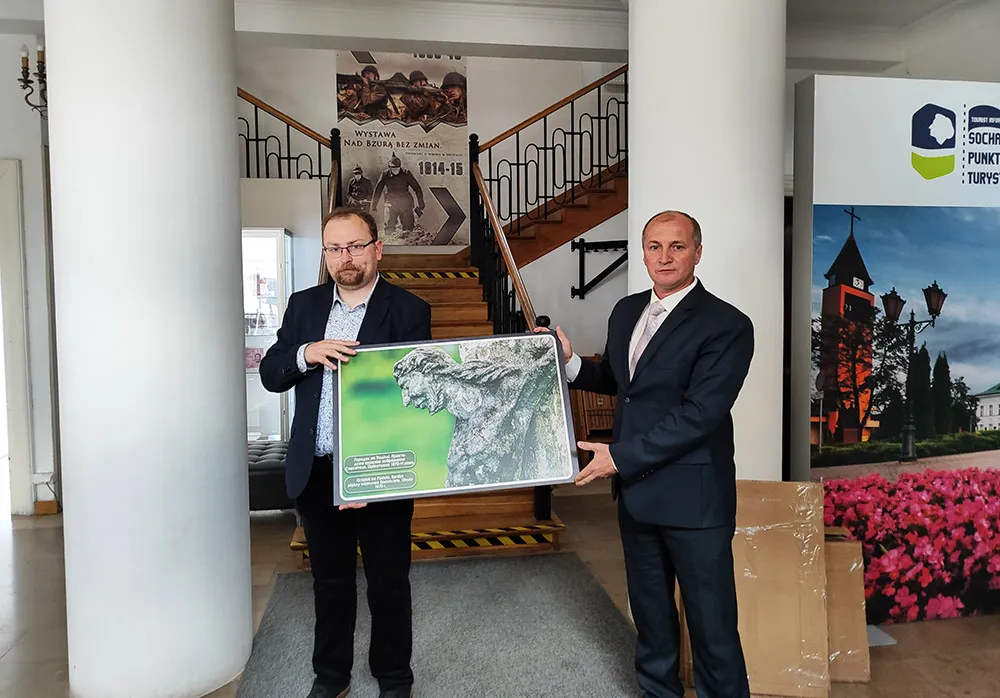
Director of the Sochaczew museum Dr Michał Górny and exhibition co-author Oleh Fedorov
Why the project participants decided to start with Roman Catholic cemeteries was explained by the head of the culture department, Oleh Fedorov:
- First, we have almost finished surveying the Polish cemeteries, says the local historian. There are far fewer of them in the Horodok area than Ukrainian ones. Of the latter we have surveyed only about half. Second, Horodok has a twin town in Poland, Sochaczew, to which we decided to give a gift for the city’s day. We have 31 years of twinning. Accordingly, we made 31 exhibition panels.
The research, we recall, is conducted solely on a volunteer basis and out of enthusiasm. The city hall only paid for fuel for the trips. The production of the exhibition panels, on the initiative of Horodok mayor Neonila Andriichuk, was taken on by the community.
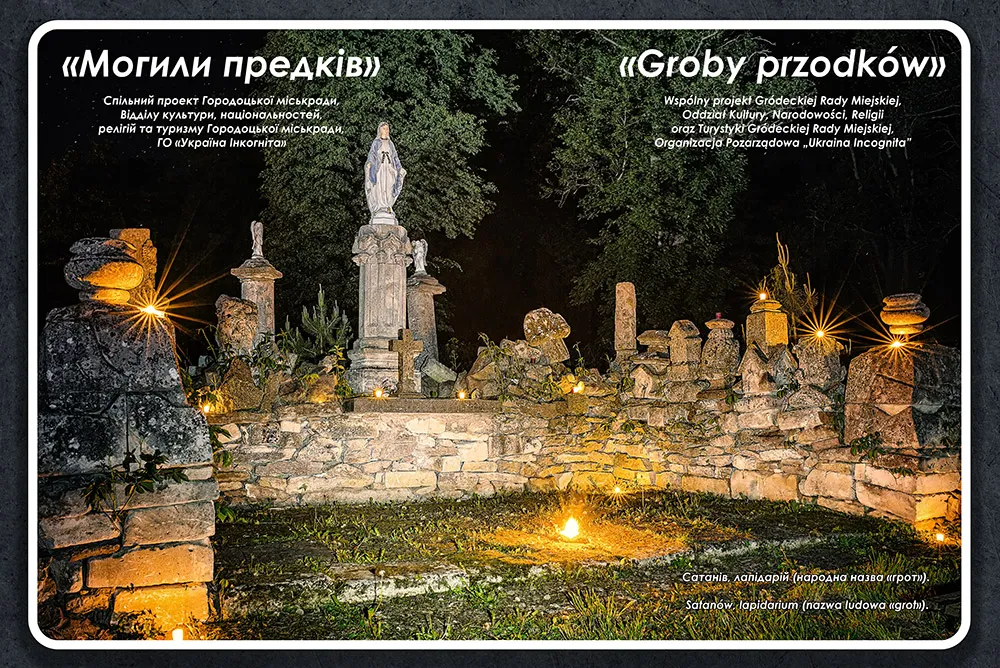
Before going to Poland, the exhibition was on display for two days in Horodok at the Institute of Theological Sciences of the Immaculate Virgin Mary.
- We hoped that our gift would please our twin-town friends in Sochaczew, says Olha Bystrytska, manager of affairs (secretary) of the executive committee of the Horodok city council, who headed the Podillia delegation at the Sochaczew City Day celebrations. But the reaction exceeded all expectations. Sochaczew highly appreciated both the scale of the work done and the artistic quality of the photos and, of course, the fact that the Horodok community respects and studies Polish heritage.
Before the start of Russian aggression (2014), mutual visits on city days were a tradition. Now the movement is one-way. Instead, our Polish twin-town friends regularly and generously help materially, providing considerable humanitarian aid. After all, the Horodok area has become home to thousands of Ukrainians whom the Russians forced to leave their homes, sometimes with only the clothes they were wearing.
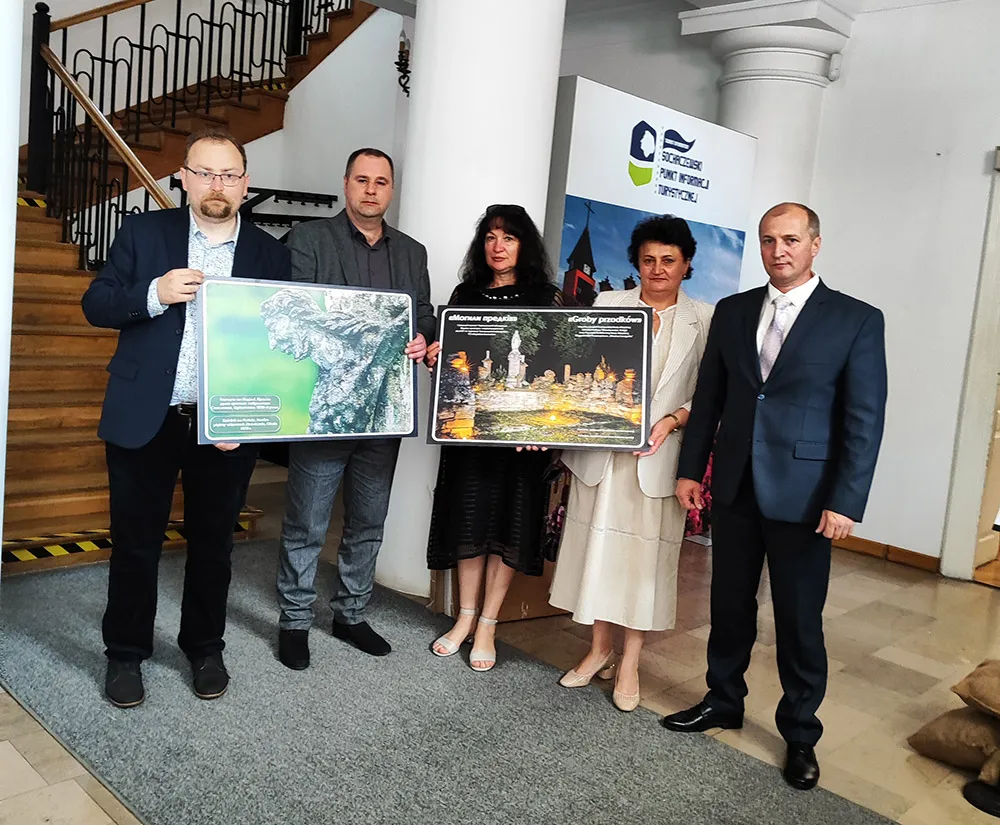
As for the photo exhibition, let us give the floor to Radosław Jarosiński, head of the scientific department of the Sochaczew Museum and Battlefield of the Bzura:
The Sochaczew Museum has received an extraordinary exhibition from Horodok, which is the culmination of the “Polish part” of the “Graves of Ancestors” project. Graves overgrown and damaged by time and human negligence are quite picturesque. They are captured in several dozen amazing photographs which, besides their educational and informative value, also have considerable artistic merit. The “Graves of Ancestors” exhibition is also extremely important because of its message – it illustrates a meeting place of the cultures of three neighbouring peoples. It has already been included in the Sochaczew museum’s exhibition plans.”.


