

Ukraine is reclaiming scholars appropriated by Russians

· 4 min read
Our heritage is not only the tangible (castles, churches, monasteries, palaces and so on) and the intangible (the hopak, songs, customs and borshch), but also the people who left a mark on history, culture and science. Accordingly, the Russians want to appropriate all of this too and say: “this is ours!”
Among our heritage long appropriated by Russia is the outstanding Ukrainian Professor Serhii Vynohradskyi. He became famous as a renowned microbiologist. Alongside Pasteur, Koch and Mechnikov, he is one of the four pillars on which microbiology developed as a science. Vynohradskyi’s fundamental discoveries are the process of bacterial chemosynthesis and nitrogen-fixing bacteria. While chemosynthesis is still mostly a purely academic discovery, the second underpins all of modern soil science and, accordingly, all organic crop farming.
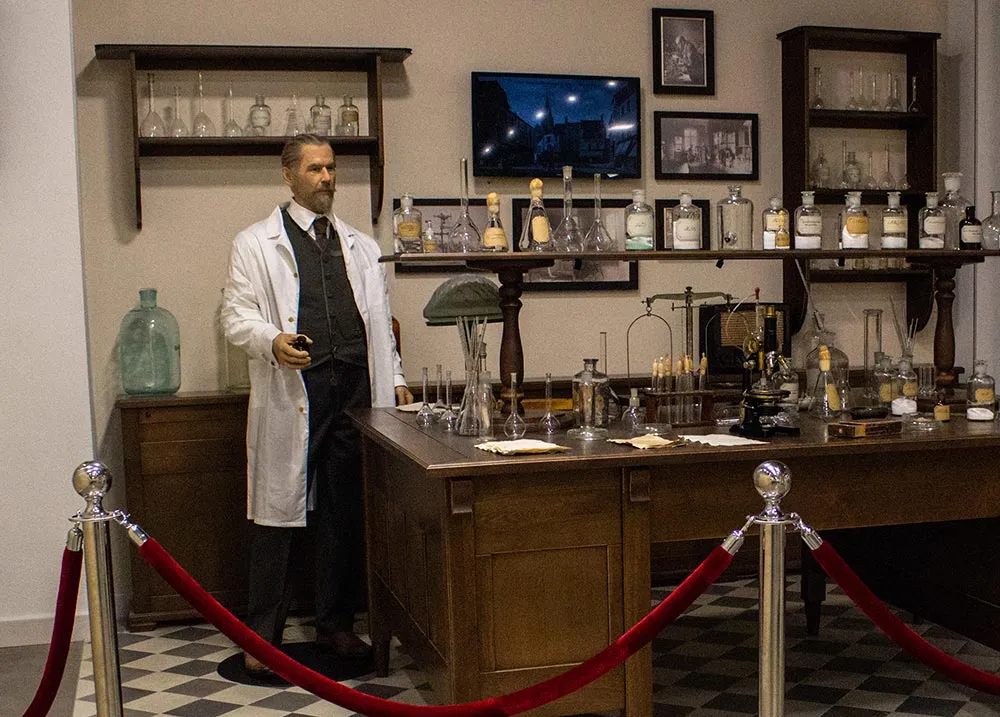
The recreated laboratory of S. Vynohradskyi at the Pasteur Institute and his wax figure. “G-museum”, Horodok
For those who have forgotten their school botany, a reminder. Nitrogen compounds are necessary for the life of all living things. There is more than enough nitrogen in the surrounding environment – it makes up 78% of the atmosphere. But the nitrogen molecule (N2) is extremely stable, so plants can only take up its compounds. Oxidation of atmospheric nitrogen occurs naturally only in the channel of lightning bolts. Nitrogen-fixing bacteria have also learned to bind nitrogen: they absorb atmospheric nitrogen and convert it into a form more convenient for other organisms.
Serhii Vynohradskyi did not become a Nobel laureate only because he made his greatest discovery (chemosynthesis) before the most prestigious of the prizes was established.
Understandably, a figure of such world stature – despite being a Ukrainian (indeed, even a relative of Hetman Pavlo Skoropadskyi) – was gladly written down by the Russians among the “great Russian scientists”.
A great deal is being done to return Vynohradskyi’s name to the fold of Ukraine by the Serhii Vynohradskyi Club, which operates in the town of Horodok in Khmelnytskyi Oblast. Professor Vynohradskyi had a close connection with this town. His family estate was here, where he lived from 1905 to 1917. While in emigration in France, where he worked as head of a department at the Pasteur Institute, the scientist always recalled Horodok as his “lost paradise”.
One of the Club’s initiatives was a successful vote in the “Kyiv Digital” app on renaming one of the streets in Kyiv’s Solomianskyi district after Serhii Vynohradskyi. After approval by the relevant commission of the Kyiv City Council, the renaming of the street will be put to a vote of the City Council.
As the Communications Centre of Taras Shevchenko National University reports, a portrait of Serhii Vynohradskyi will soon also adorn the walls of his alma mater and join the Gallery of outstanding scientists associated with the University.
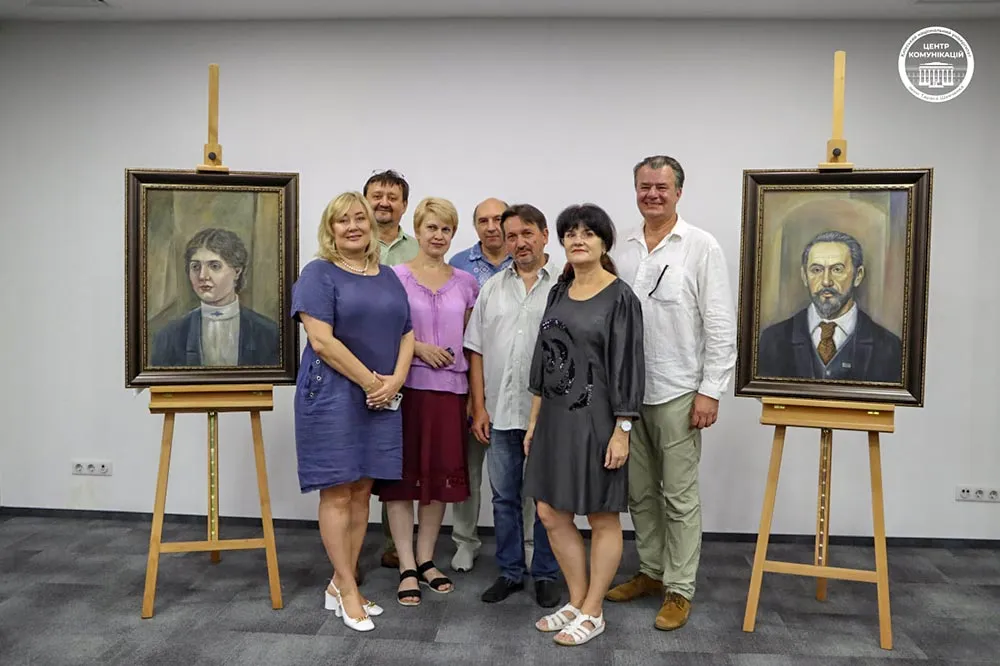
These portraits will soon adorn the walls of the University
The initiators of the project were the public association UpToFuture, which founded the above-mentioned Serhii Vynohradskyi Club, and the Ukrainian company with strong social responsibility, Yuriia-Pharm.
At the same time, on the initiative of these organizations, the Gallery will also be joined by a portrait of the well-known historian and archaeologist Natalia Polonska-Vasylenko – the first woman elected a privatdozent of the Kyiv University of St. Vladimir (1916). Incidentally, the image of the founder of the Ukrainian Archaeological Institute in Kyiv will also be the first portrait of a woman in the Gallery.
The author of both portraits is the artist Roman Dmytryshyn.
Presenting the portraits of outstanding Ukrainian scientists, the president of the Yuriia-Pharm corporation Mykola Humeniuk noted: “Everyone knows Taras Shevchenko National University of Kyiv, but our corporation not yet. We are a domestic pharmaceutical company built from scratch in 1990, which develops and produces medicines, mainly intravenous and injectable. We are a socially responsible company, so we take part in such important things as the creation of the Public Association and the Vynohradskyi Club, which has already become international. After all, we are scientists ourselves, and therefore it is important for us to support the glorious history of Ukrainian science and tell Ukrainians about it.”
Olena Dobrzhanska, Vice-Rector of the university for academic and pedagogical work, thanked the Yuriia-Pharm corporation and the Serhii Vynohradskyi Club on behalf of the University for their active participation in popularizing glorious names little known to Ukrainians: “We must reveal Ukrainians to Ukraine. Business and scientists have united to promote such projects – and this is extremely important. I am very glad and happy that our University is at the centre of this process.”


