

In Ostroh, the legality of large-scale earthworks on the territory of an archaeological site is being investigated
Law enforcement officers are establishing the circumstances and grounds for large-scale construction works in the historic part of ancient Ostroh (Rivne Oblast). This was reported by the press service of the Rivne Regional Prosecutor’s Office, based on materials of the Zdolbuniv District Prosecutor’s Office.
Here and below, photos by Mykola Bendiuk
According to the report, the Zdolbuniv District Prosecutor’s Office has opened a pre-trial investigation into the deliberate unlawful destruction, demolition or damage of cultural heritage sites or their parts (Part 2 of Article 298 of the Criminal Code of Ukraine).
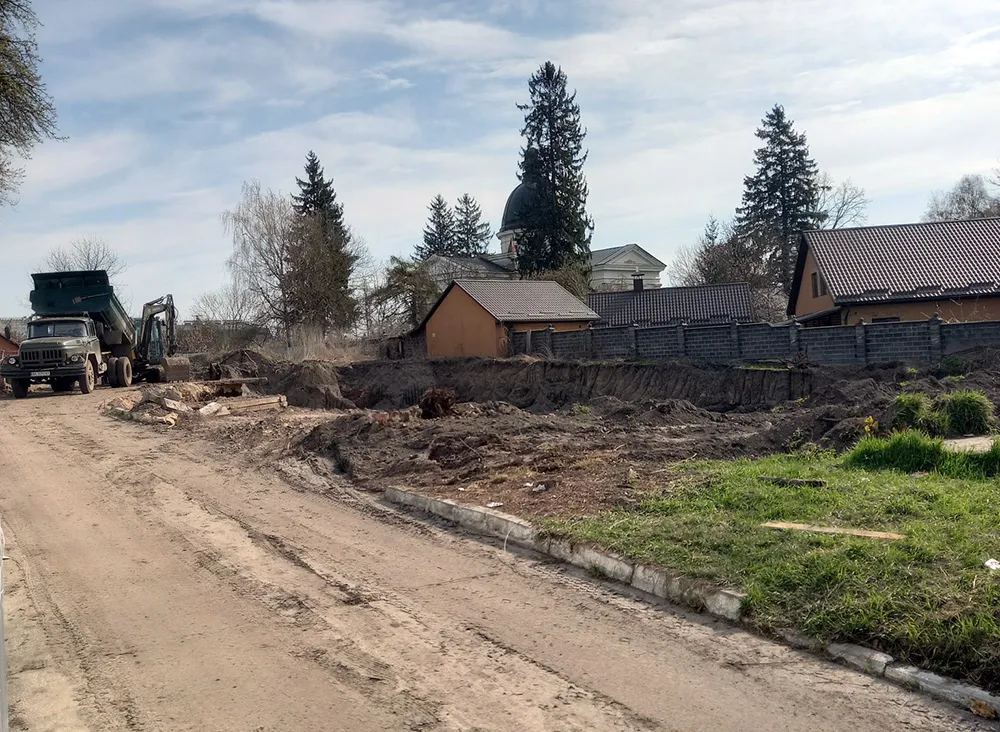
According to the investigation, on Akademichna Street in Ostroh a developer began earthworks, which may lead to the destruction of underground cultural heritage sites.
In particular, the works are being carried out in the central part of the historic settlement, where an archaeological site of local significance is located: the hillfort of the chronicle town of Ostroh.
At present, the necessary priority investigative actions are being carried out in the criminal proceedings.
The pre-trial investigation is being conducted by a group of investigators of the Investigation Division of Police Department No. 3 of the Rivne District Police Department of the National Police Main Directorate in Rivne Oblast (Ostroh).
The first to draw attention to this crime against the historical heritage was Mykola Bendiuk, head of the Art Cluster of the Ostroh Academy, a well-known historian and art historian. On his Facebook page he left the following post:
– Yet another monument is being destroyed by developers in Ostroh!!!
On the territory of the lower castle of the Princes of Ostroh, without any permits, developers destroyed the archaeological layer and, evidently, the burial vault of Jan Wilhelm Rottarius, who was the starosta of Ostroh and a colonel of His Royal Majesty’s army and died in 1728.
Although we do not know exactly to whom this burial vault belonged. It is located about 10 metres from the church. We know that in the church, or perhaps in a separate burial vault, Princess Halshka Ostrozka, the founder of the Ostroh Academy, and her cousin Kostiantyn Kostiantynovych Ostrozkyi were also buried. But I believe that they were laid in the church itself, while Colonel Rottarius was nevertheless buried in a separate crypt.
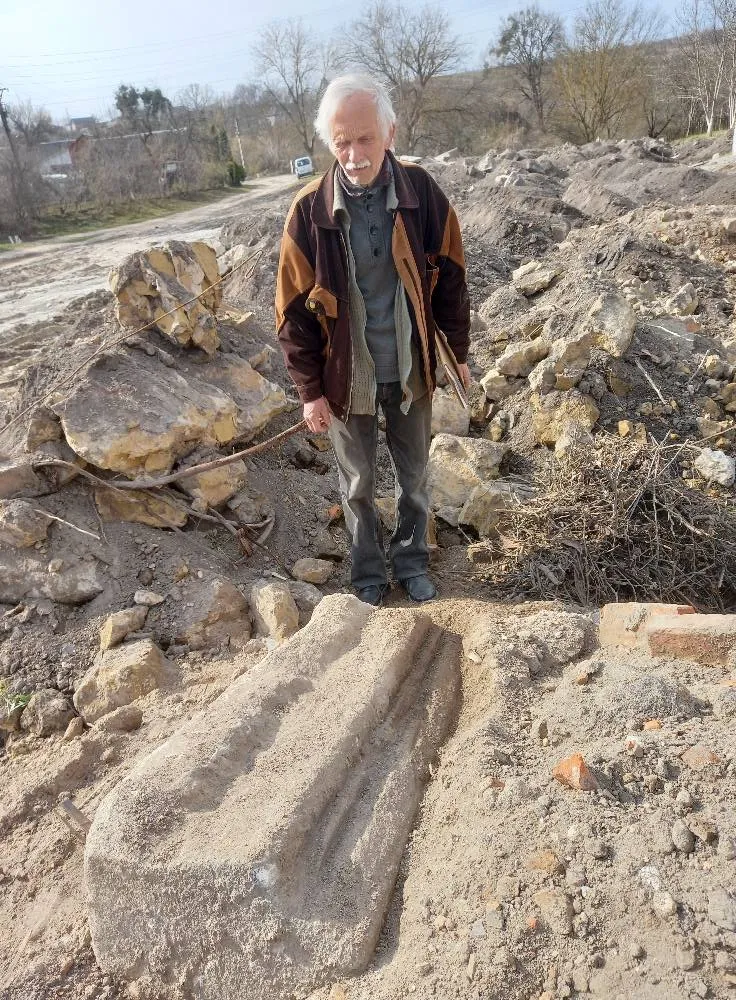
A fragment of the crypt’s cornice
The Ostroh State Historical and Cultural Reserve still keeps a funeral portrait of the colonel who governed the town at the beginning of the 18th century. In any case, whose crypt it was we will no longer learn. The developers used a trick that is applied in practically all towns of Ukraine. They partially fund archaeological research of a small plot of land on their building site, and when the archaeologists conclude that construction can be carried out on the studied territory, but that on all the rest of the unstudied plot works are prohibited until a complete archaeological study,
the developers usually see only the first part of the archaeologists’ report and “do not notice” the second. That is what happened in this case, too.
The developers enclosed the building site with a high fence and within three days, letting no one onto the territory, destroyed the entire cultural layer with a bulldozer, including the burial vault. And all of this across the road from the administration of the State Historical and Cultural Reserve of the town of OSTROH. This raises suspicion of collusion with the developers. The museum’s archaeologist, Oleksandr Ananiiovych Bondarchuk, was not allowed onto the territory by the security guards. Yet under the conditions of work on such a plot, supervision by archaeologists of any action involving the ground is mandatory.
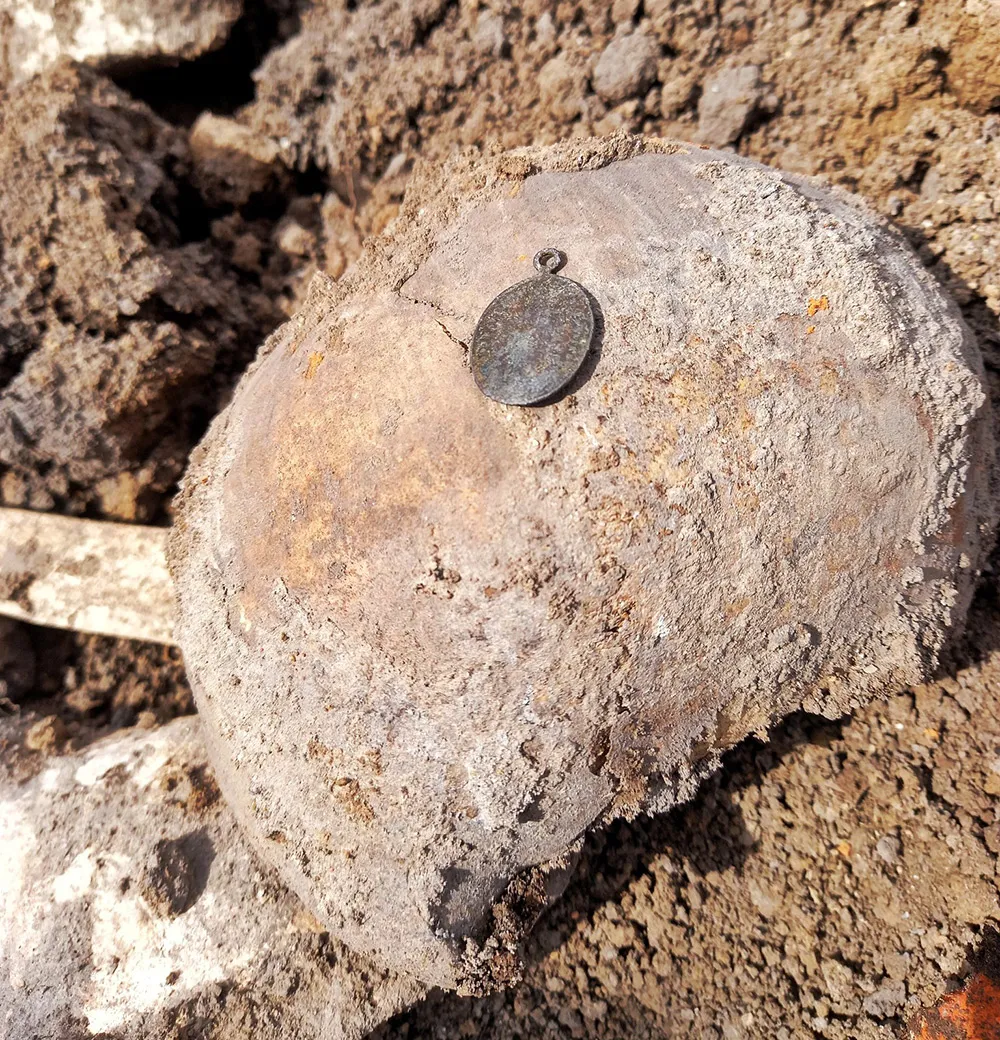
I wrote and phoned the regional department of culture of Rivne Oblast, and was assured that no works were being carried out at the site. And this at the very time when soil with human bones and remains of the burial vault was being carted off to the outskirts of the town. Together with an archaeologist I went to the place where the soil was dumped and saw the remnants of Ostroh’s history there, on heaps of rubbish. There were human skulls, and a hewn stone cornice of the burial vault, fragments of pottery from the Old Rus’ period and from the time of the Princes of Ostroh; and we even found an 18th-century pectoral icon with an image of the Mother of God and St. Francis.
We hope that law enforcement will give this crime against culture a proper assessment and that all those guilty will be punished.


