

Scythian gold stolen from Ukraine “surfaced” in Spain. Was the UOC-MP involved in the brazen smuggling?

· 4 min read
As BBC Ukraine reports, the Spanish authorities have seized ancient Scythian jewellery worth 60 million euros which, according to them, was stolen from Ukraine. The operation was carried out with the participation of the Security Service of Ukraine, Spanish police said.
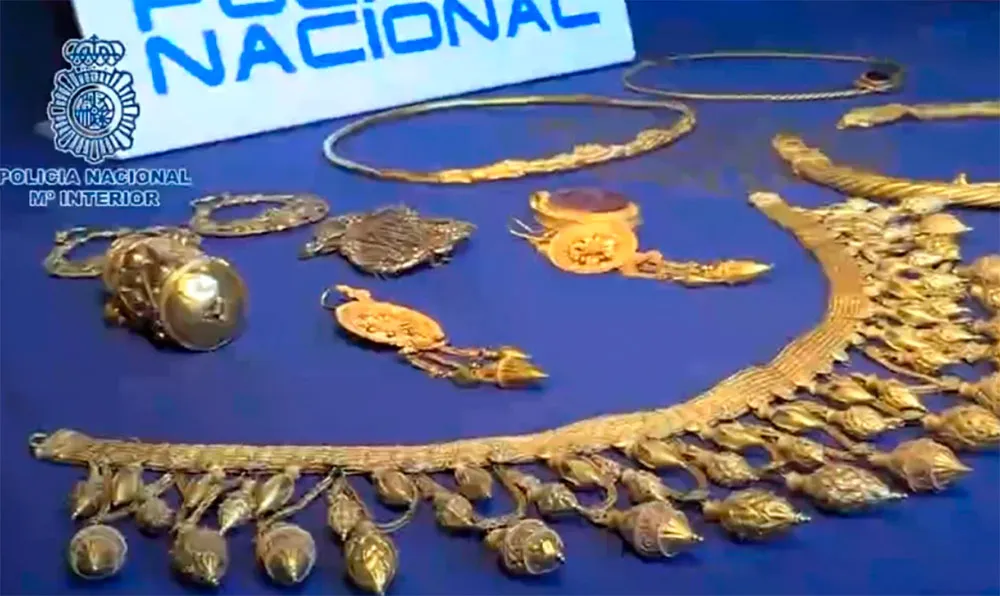
Scythian gold seized in Spain
Police said that 11 ancient gold items were taken out of Ukraine in 2016 for resale in Spain. The bracelets, necklaces and earrings of the 8th–4th centuries BC had forged documents of ownership by the Ukrainian Orthodox Church (in fact, the ROC in Ukraine).
Spanish agents arrested five people (three Spanish citizens and two Ukrainian citizens), thereby dismantling a criminal network aimed at taking cultural valuables out of Ukraine.
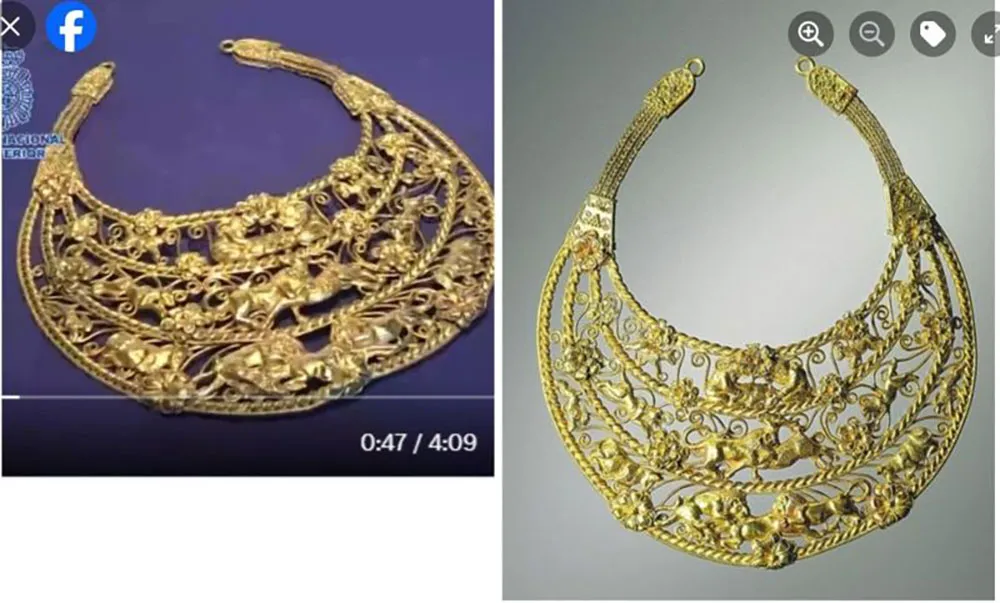
A large openwork pectoral, in the police video and in a museum in Kyiv in 2013
The seized items, gold jewellery of great historical and economic value, were stolen and illegally exported, and were intended to be sold in Madrid.
The first investigations began when agents learned that a series of gold jewellery items of great historical and economic value in Ukraine was being sold by a citizen of that country living in Madrid.
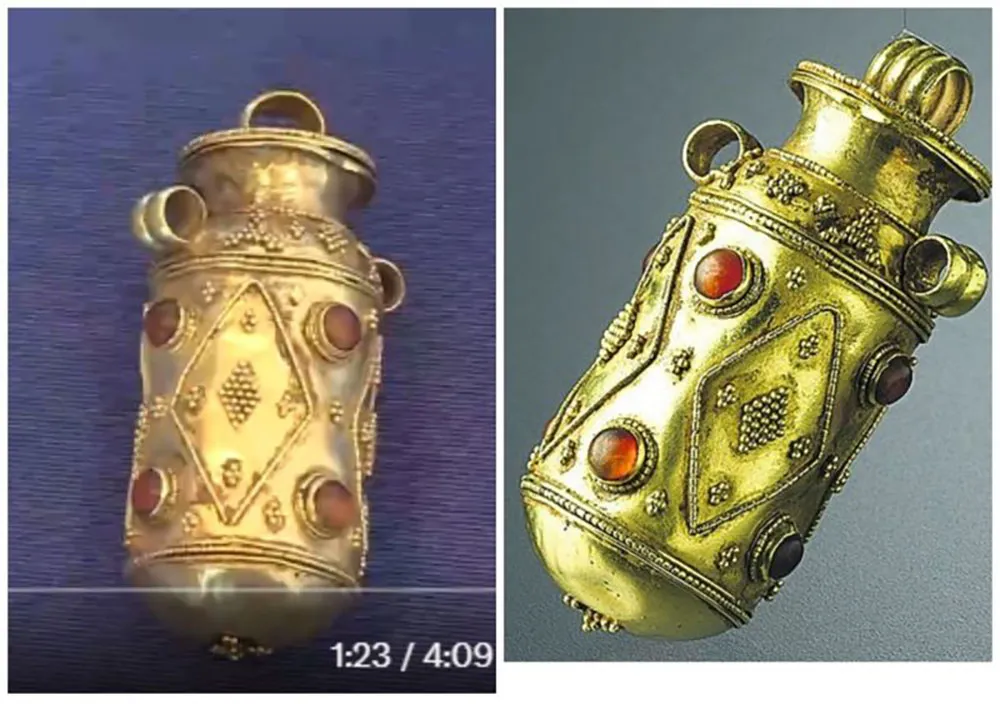
A flask. A gold container for storing aromatic oils. Police video and a photo from an exhibition in Kyiv in 2013
“These are items that cannot be sold through ordinary legal channels, for example through auction rooms. For this reason the jewels were included in the capital of various commercial companies created specially to give them a legal appearance and thus make it easier for a group of investors to market them,” says the police statement.
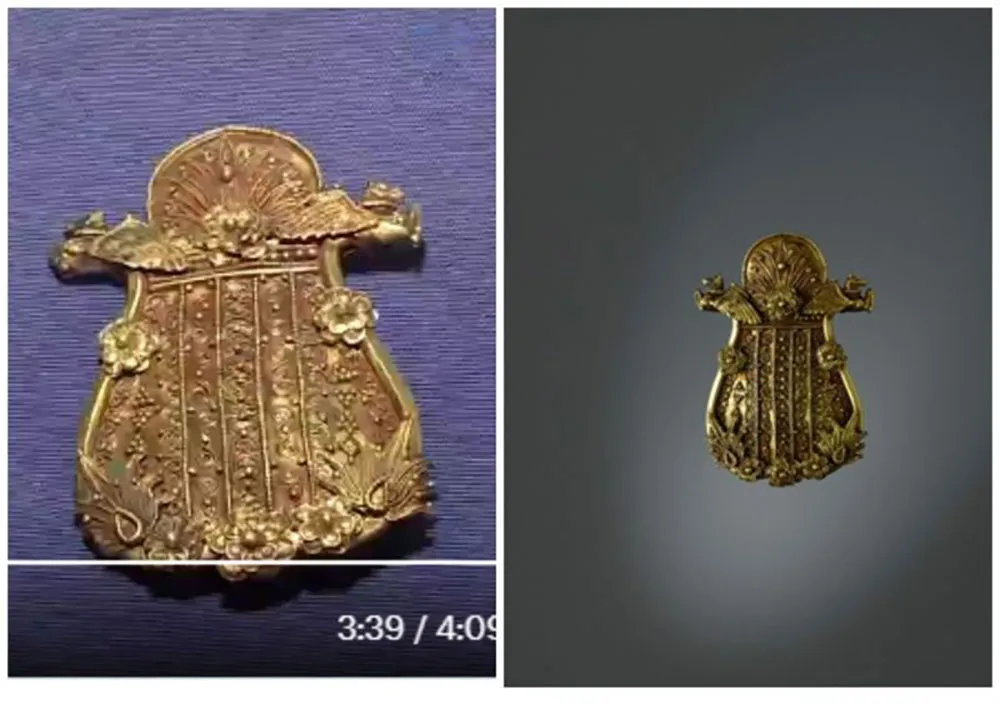
A gold brooch. Police video and a photo from an exhibition in Kyiv
To launder the origin of the jewellery, documents in Ukrainian, English and Spanish were attached to it, confirming that it belonged to the Ukrainian Orthodox Church (Moscow Patriarchate). The perpetrators also transferred the right to dispose of the jewellery to the main suspect in the case, an Orthodox priest living in Madrid.
In a comment to BBC Ukraine, Metropolitan Clement, head of the synodal information department of the UOC (Moscow Patriarchate), assured that the UOC has no parish in Madrid and that no UOC priests live there.
“UOC priests are not assigned to serve in Madrid and do not live there. There is only one parish of ours in Spain, but in another city. Since the police report contains no names or photos, it is impossible to provide any other information,” Clement said.
He suggests that the priests in question may belong to other jurisdictions. However, the Ecumenical Patriarchate, which has Ukrainian priests in Madrid, told BBC Ukraine in a comment that its clergy are not involved in this criminal case.
BBC Ukraine’s sources in church circles indicate that the main suspect in the case is a figure who was quite well known in the UOC in past years. We cannot name him yet, but he had serious connections in Ukrainian business and, in 2016, in the leadership of the UOC-MP.
The Security Service of Ukraine said that the detainee is a representative of the UOC-MP from Ukraine. But they refused to disclose the name.
Meanwhile, on social media the name of the owner of the Scythian gold is given quite confidently.
It turned out that all these artifacts were previously known as the property of the “Rodovid Museum”, which showed them at exhibitions.
In particular, in 2009 there was an exhibition at the Mystetskyi Arsenal, and in 2013 the gold was exhibited at the International Investment and Innovation Forum.
Rodovid Museum LLC is, to this day, 100 percent owned by Ihor Didkovskyi, according to youcontrol.com.ua.
Didkovskyi headed the Mystetskyi Arsenal in 2007–2010. According to bloggers, he was involved in embezzlement of budget funds during the construction of the Arsenal.
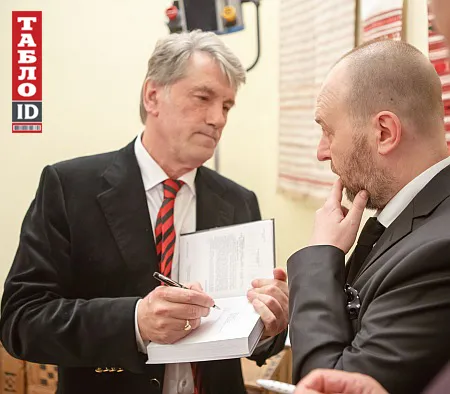
Famous collectors of antiquities Viktor Yushchenko and Ihor Didkovskyi
He is a great friend of Petro and Viktor Yushchenko, well-known collectors, including of artifacts of knowingly criminal origin from illegal looting excavations.
In 2012, in an interview with Katia Osadcha, Didkovskyi said that he owns the largest collection of Scythian gold, which is his property, acquired personally. It consists of “21 items, 4 pectorals, the only belt of a Scythian queen in the world. Valued by the National Bank of Ukraine at 2.7 billion dollars, and by Deutsche Bank at 18 billion euros. It is priceless,” Didkovskyi said.
Archaeologists are sure that Didkovskyi’s collection is mostly “junk”, forgeries. But among the jewellery there are also genuine artifacts, which by law he could not legally have bought or found, because all such items are the heritage of the people of Ukraine and must be handed over to a museum; private expeditions are prohibited.
What has now been found in Madrid needs to be studied. Something there is valuable, something is only modern gold products. Which is which, none of the archaeologists will point a finger until it has been studied. There are only assumptions, which are kept quiet. There is no suggestion that the gold could have been stolen from museums.


