

Exhibition devoted to the art of ancient Jewish stonecarvers comes to Horodok
The NGO “Ukraine Incognita” is the only organization that comprehensively studies all of Ukraine’s old necropolises: Ukrainian, Polish and Jewish. One result of this work is the information guide “Old Cemeteries. Jewish Necropolises of Ukraine”, created in partnership with the Babyn Yar National Historical Memorial Reserve and the Charitable Foundation of the Historical and Cultural Centre of Uman (HCCU).
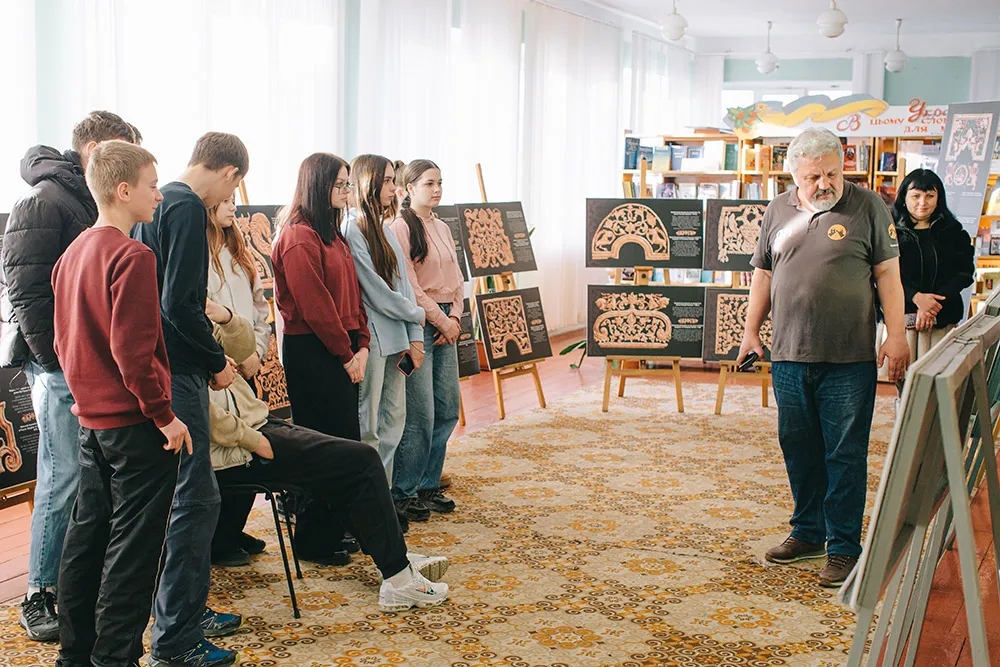
The exhibition in Horodok. Here and below, photos by Ihor Motsnyi
An interesting “Jewish” project in which the NGO “Ukraine Incognita” is also involved is the exhibition “Sataniv: The Lost World of the Ancient Jewish Cemetery”. It became possible thanks to the active participation and funding of the United Jewish Community of Ukraine. Special thanks here go to the UJCU Chief Operating Officer Vitalii Kamozin.
The author of the exhibition is Dmytro Poliukhovych, a member of the “Ukraine Incognita” team, local historian, historian and journalist.
The essence of this project was perhaps best expressed by Yevhen Kotliar (Kharkiv), Candidate of Art History, professor and Chair of the Academic Council of the Ukrainian Association of Judaica:
“The art of the carved stone stele in the Jewish artistic tradition goes back to biblical times. This tradition was never interrupted and reached its apogee in Eastern Europe in the 17th–18th centuries. Then the epitaph merged with the rich symbolic language of numerous images, and each gravestone became a unique work of art. Among the hundreds of Jewish cemeteries that recall Ukraine’s long Jewish history are genuine gems, such as the one in Sataniv. Scattered on a high hill, covered with moss and eaten away by time, these gravestones preserved the spirit of the life and faith of Jews who awaited the Messiah and believed in the resurrection of the dead and the return to the Promised Land. Each stele symbolically expressed the merits and status of the Jew who rested beneath this or that stone, so that the Almighty would grant him a better portion in the world to come.
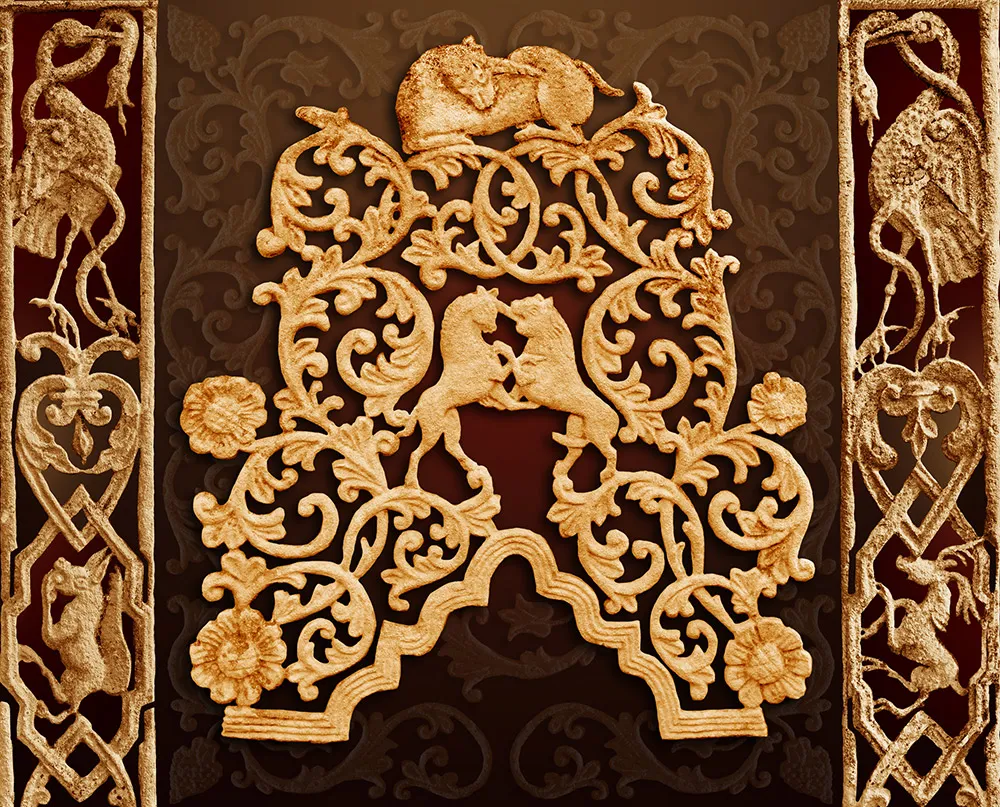
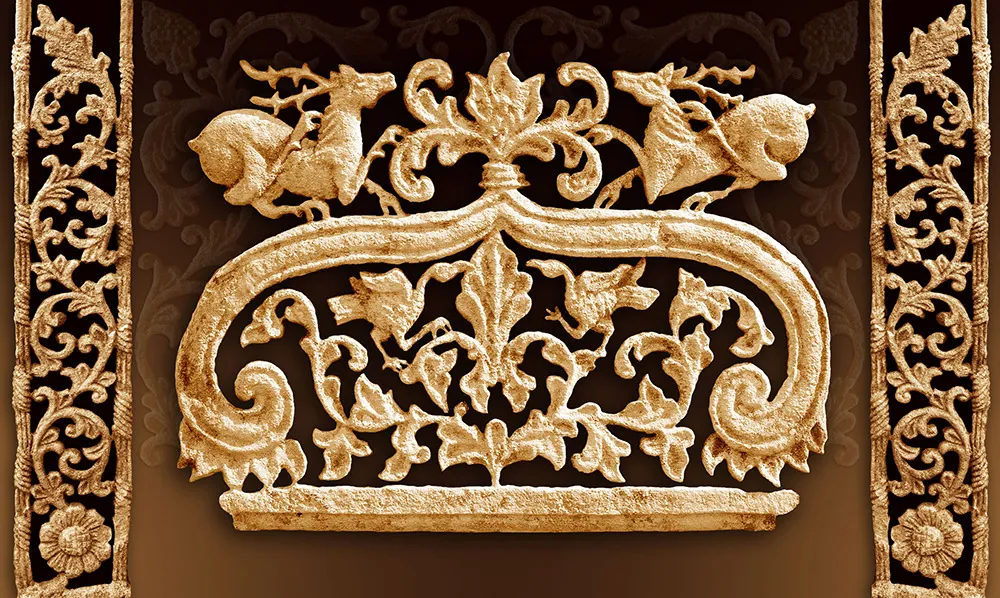
The sculptural quality and poetry of these gravestones inspired many artists of the last century, who sought in the intricacies of ornament and animals the sources of their own national style. Solomon Yudovin, Nathan Altman, Issachar Ber Ryback and others saw in the flat, archaic style of carving the archetypes of Jewish folk culture. The countless images of double-headed eagles (let us note that the Jewish double-headed eagle has nothing to do with Russia; in Judaism it embodies God, and the two heads symbolize the two lines of His governance of the world: punishment and forgiveness, severity and love, and so on – note by “UI”), lions, deer, bears, hares, vases, candlesticks, flowers and architectural and ornamental motifs of these symbolic portals were an allegorical expression of the language of the Torah and the spiritual tradition. This tradition bound together, in a “knot of eternal life”, the Jews of all preceding generations, while the carved tracery of the gravestones made this bond visible.
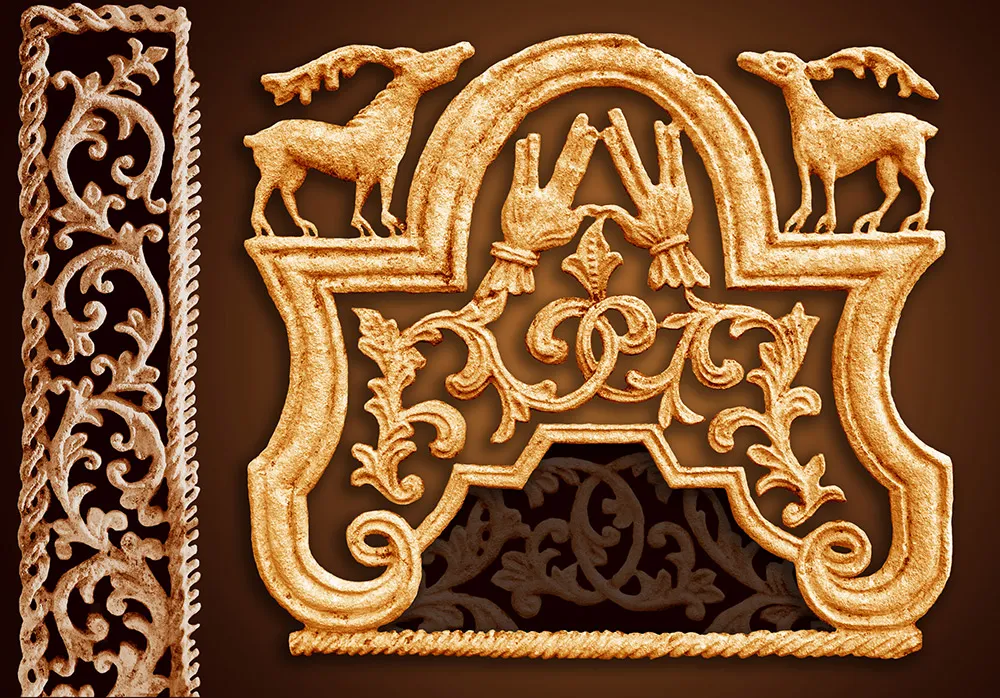
Time slowly destroys these majestic matzevot, and the ruinous approaches of the antiquities’ “custodians” speed up this process. The beautiful and original works of Dmytro Poliukhovych, like a kind of rubbings, preserve and return to us the generous wealth of Renaissance and Baroque forms of these masterpieces of traditional Jewish art. The author tenderly preserves their warmth, texture and play of light and shadow. The eye slowly glides over these fragile ochre patterns, which evoke associations with the delicate shortbread for the holiday of Purim that Jews baked in the former small towns, the shtetls. For this they used carved wooden Purim moulds (purim-bretl) with similar emblems. In his works, Mr Dmytro carefully detaches the openwork carving from the stone plane and lays it as a silhouette on a dark background, like a three-dimensional paper cutout, a reyzele. Freed from its base, the gravestone’s design heightens the expressiveness of the images and, in some mystical way, gives the image a voice. It is this voice that preserves a direct connection between a contemporary and a vanished artistic culture and a tradition that is still alive and flourishing.”
The creation of the exhibition was also greatly helped by the partner project of the NGO “Ukraine Incognita” and the Department of Culture, Nationalities, Religions and Tourism of the Horodok City Council (Khmelnytskyi Oblast), “Graves of the Ancestors”, which is carried out under the patronage of the leadership of the Horodok community. Within this initiative, the old necropolises of historical Horodok area (the former Horodok district) are being studied. The “Ukraine Incognita” website has repeatedly reported on the achievements and interesting discoveries made by Podillia researchers.
In particular, a number of previously unknown but very interesting matzevot were found during the “Graves of the Ancestors” expeditions to Sataniv. Their decoration is presented at the exhibition. The Sataniv Jewish necropolis, let us note, is one of the largest. The decoration often hides under a cap of moss, so one can find something new there every time.
The exhibition was first seen at the largest Jewish museum in Ukraine and one of the largest such museums in Europe, “Memorial Center of the Jewish People and the Holocaust in Ukraine” (Dnipro). Later it was shown at the Babyn Yar National Historical Memorial Reserve (Kyiv), the Museum of Genocides (Odesa) and the Khmelnytskyi Regional Scientific and Methodological Centre of Culture and Art… From 1 to 20 December the exhibition can be seen in Kharkiv.
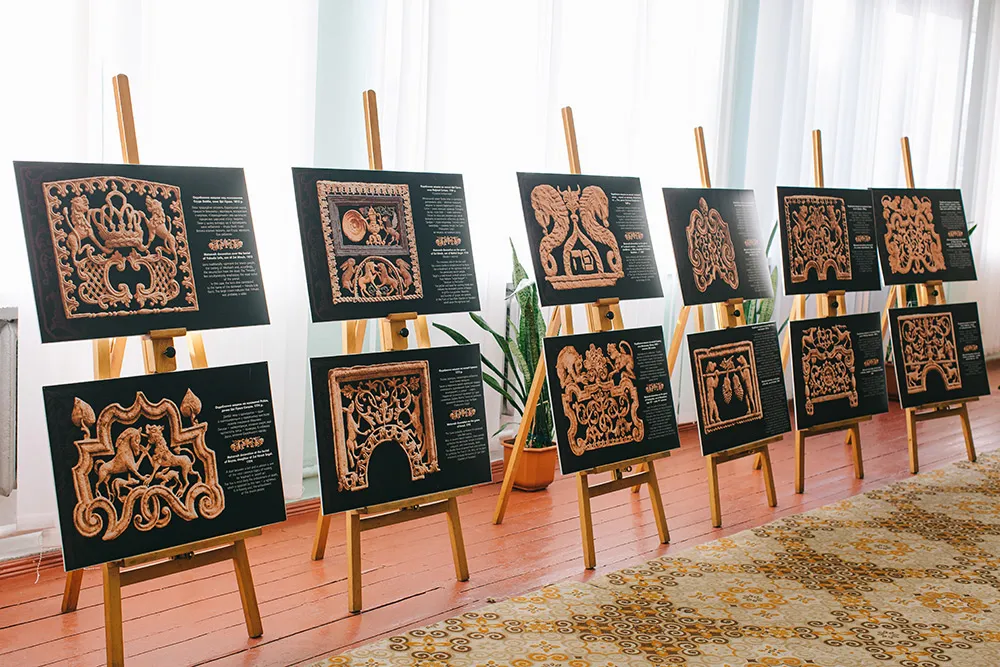
On its way from Khmelnytskyi to Kharkiv, the exhibition stopped in Horodok, where it was, in fact, “born”. It can be seen on the premises of the Horodok Public Central Library (3rd floor). It will be on display until 24 November.
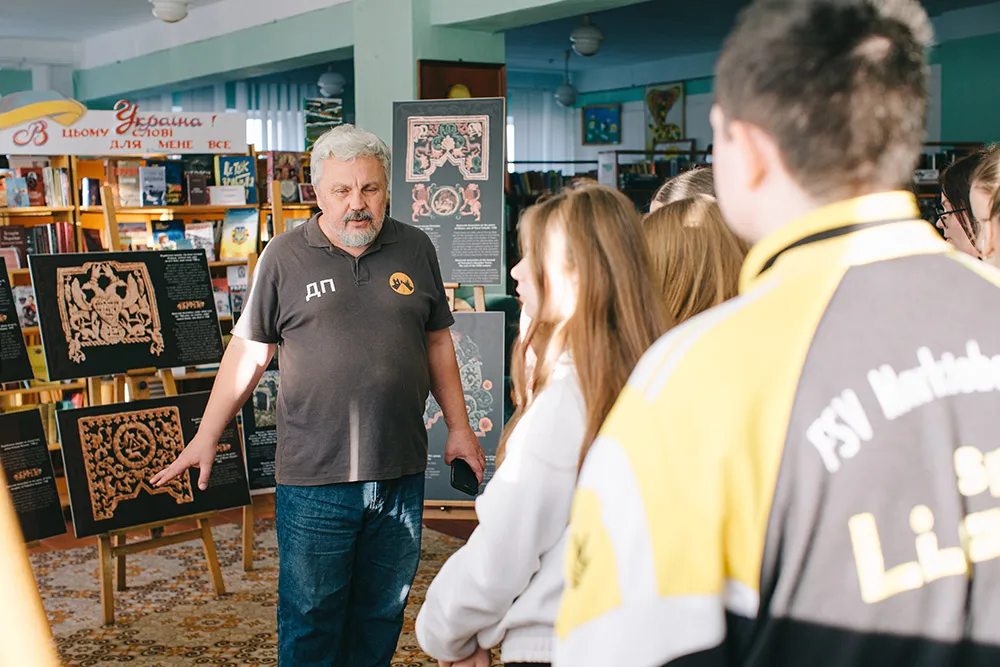
“We are very glad of the opportunity to show our fellow countrymen the exhibition that was seen in Kyiv and the largest cities of Ukraine, – says library director Nadiia Butelska. – The works on show are very beautiful, vivid, interesting and original. Above all, it tells about the culture, history and art of our region. Although the exhibition will be on display for only a week, we hope that many of our fellow countrymen will see it.”
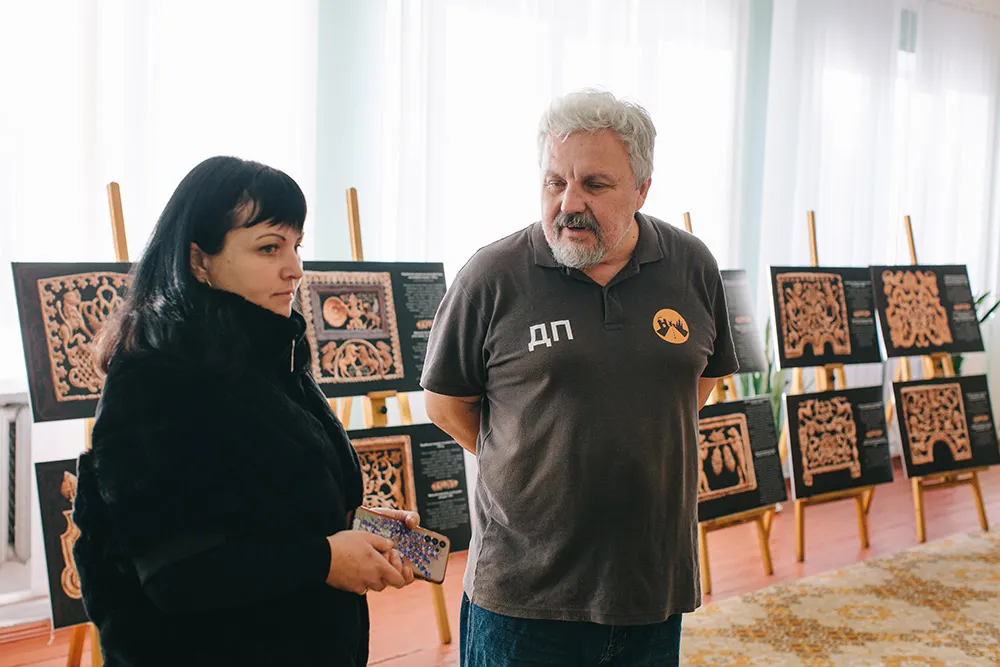
Olena Hrikh and the exhibition’s author Dmytro Poliukhovych
Olena Hrikh, Secretary of the Horodok City Council, believes that such an event is important politically and ideologically as well: “The culture, art, customs, beliefs and worldview of the Jews, who lived for centuries alongside Ukrainians, are for most people a true ‘Terra Incognita’,” says Ms Olena. “So it is very important to tell the community about our neighbours. All the more so since before the Second World War Jews made up the majority of the population of our town. Such events contribute to achieving interethnic peace and harmony, which is important for the unity of our society in standing up to Russian aggression. It also once again refutes the thesis of Russian propaganda about the supposed flourishing of Nazism in Ukraine.”
The first visitors to the exhibition were pupils of Horodok Lyceum No. 1.


