

Göbekli Tepe. The zero point of civilisation?

· 6 min read
The hair on your head begins to stir when you realise that next to you is a temple complex almost 12,000 years old. A developed civilisation existed here when in our Dnipro region people were hunting mammoths. Incredible. Who built this complex? Scientists do not know, and do not even have clear hypotheses. Is it the zero point of civilisation? For a long time it was considered so, until quite recently, near Mardin, the settlement of Boncuklu Tarla was found, which is half a millennium older than Göbekli Tepe, but almost no research has been done there yet, and tourists are not admitted.
Göbekli Tepe has been excavated only about 5%, so there is still much to research, but for now, among the hypotheses of the origin of the temple complex there is even something about representatives of other planets. I am not an archaeologist at all, so below I give the text from Wikipedia, where a great deal is written about Göbekli Tepe.
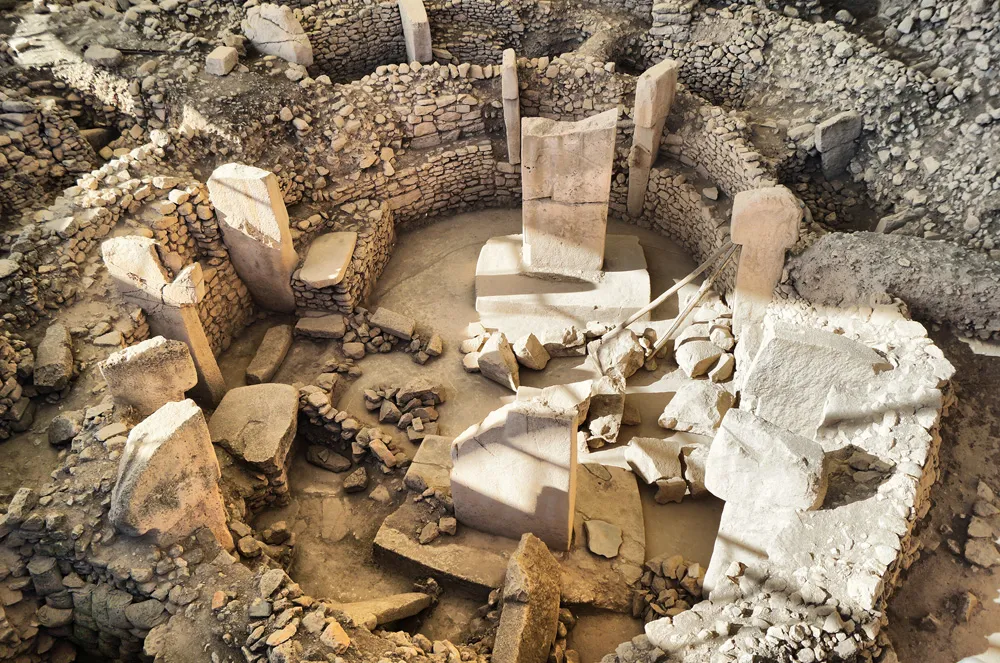
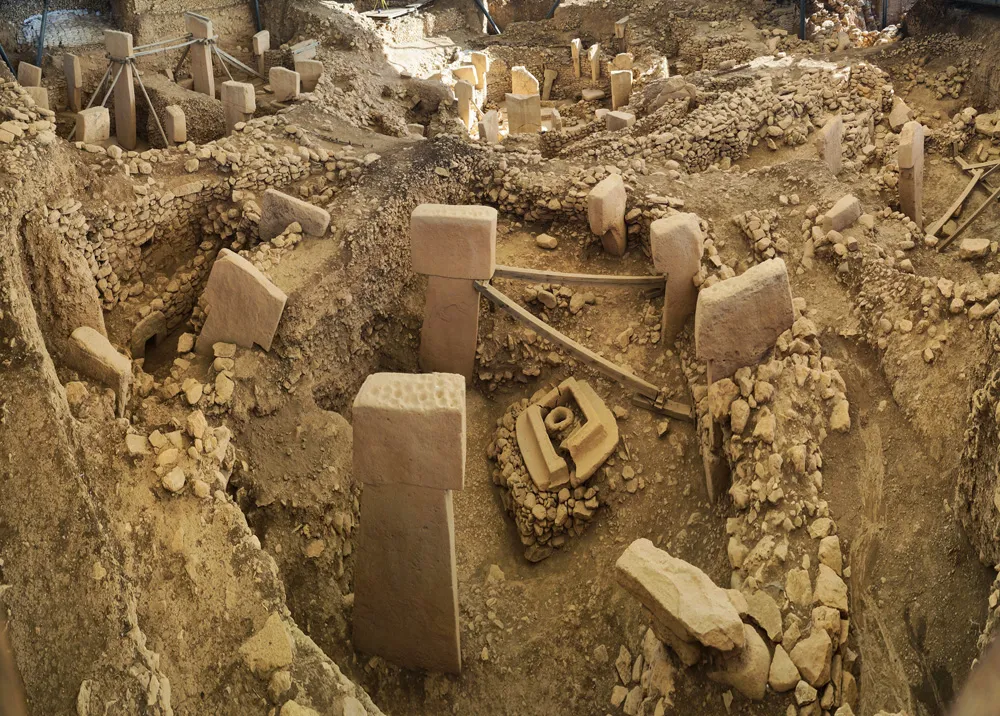
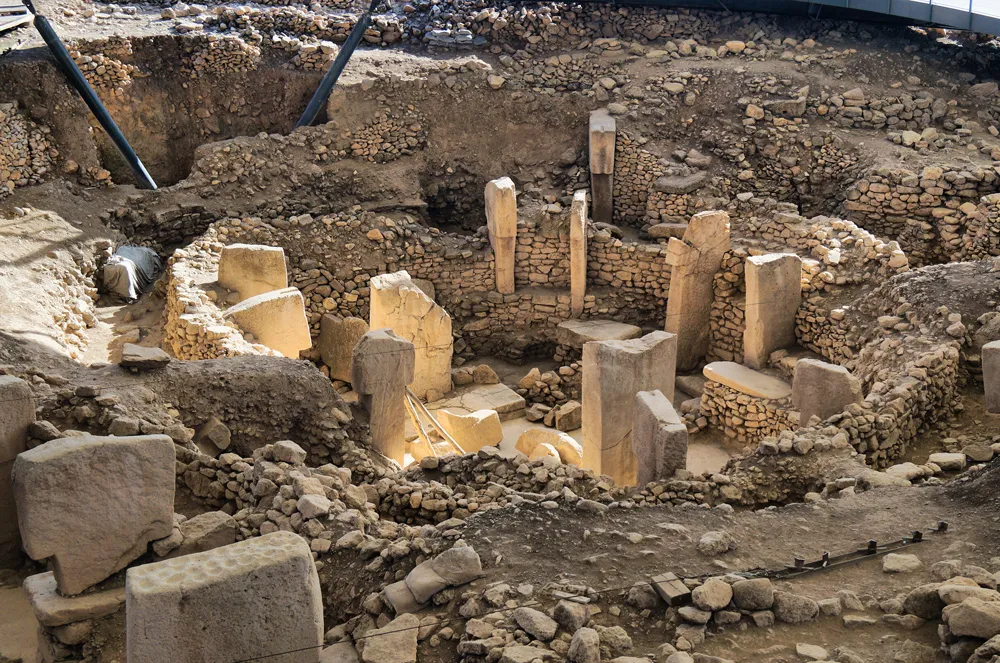
Göbekli Tepe (Turkish: Göbekli Tepe – “Potbelly Hill”, also known as “Navel Hill” or “Navel Mountain”) is one of the oldest and best-known temple complexes of Northern Mesopotamia. It is located 12 kilometres northeast of the city of Şanlıurfa and 2.5 kilometres from the village of Örencik (now in southeastern Turkey). The complex is considered the oldest megalithic structure in the world known today. Its age is at least 12,000 years, tentatively dated to at least the 9th millennium BC. It consists of round structures (concentric circles), the number of which reaches 20, according to geomagnetic surveys conducted in 2003.[6]. The surface of some of the pillars is covered with reliefs. The complex was deliberately buried under sand in the 8th millennium BC. For a long time (9,500 years) it was hidden under the Göbekli Tepe mound, about 15 metres high and about 300 metres in diameter. Archaeological finds at Göbekli Tepe and Nevalı Çori have revolutionised ideas about the Early Neolithic in the Near East and in Eurasia as a whole.
Göbekli Tepe was known to archaeologists as early as the beginning of the 1960s, but its true significance long remained unclear. The American archaeologist Peter Benedict supposed that a Byzantine-era cemetery lay beneath it. Since 1994 excavations and research have been carried out by the Istanbul branch of the German Archaeological Institute (Deutsche Archäologische Institut, DAI) in cooperation with the Şanlıurfa Museum under the direction of Klaus Schmidt. Schmidt recognised from the very look of the stones found on the surface that this was a Stone Age site. Long before the excavations began, the mound was used by local farmers, who piled up the stone blocks that got in their way or covered them with layers of earth. Archaeologists established that the famous mound could not have formed naturally, and soon discovered among the stones T-shaped pillars bearing traces of carved designs.
Today the temples of Göbekli Tepe are the oldest cult structures. Their construction began as early as the Mesolithic and lasted several thousand years.
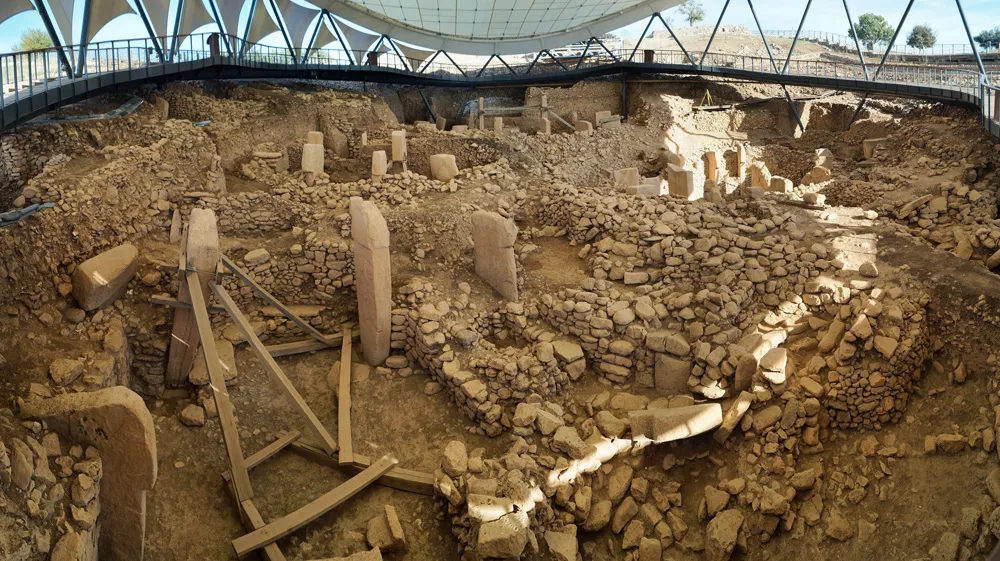
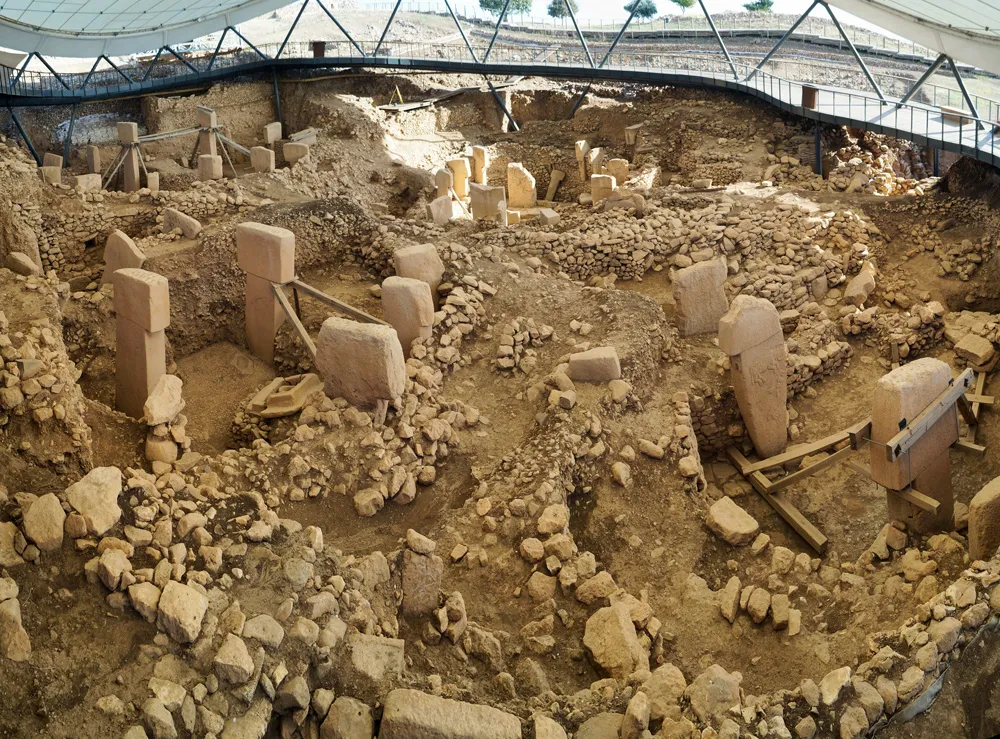
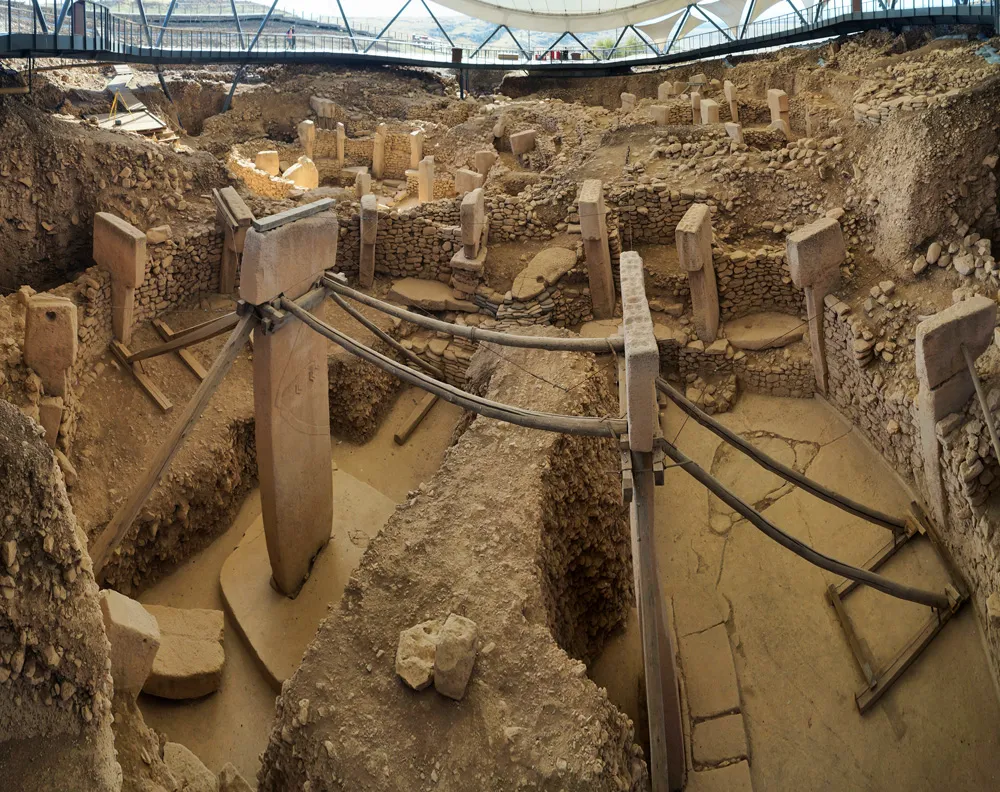
The archaeological complex consists of three main layers belonging to the Neolithic era.
The oldest is layer III, belonging to the Pre-Pottery Neolithic culture[8]. In this layer monolithic pillars up to 3 m high were found (individual boulders weigh up to 16 tonnes), joined by walls of rough stone into a round or oval structure. Similar pillars were set in the centre of the structure. The floors are made of burnt limestone with low stone benches along the walls. In addition, sculptures of boars and foxes were placed in the temple. In all, four such structures with a diameter of 10 to 30 m have been uncovered. According to geophysical surveys, another 16 such structures are hidden in the depths of the mound. The stone was quarried nearby, broken out with stone wedges. Several unfinished pillars up to 9 m long have been found in the quarries. There are also several stone basins, the largest with a volume of 150 litres. Remains of oxalate, formed by the synthesis of barley and water, resulting in a beer-fermenting process, were found in the basins.
Layer II corresponds to the PPNB period (7500–6000 BC). In this era, rectangular halls with polished limestone floors were built over the buried oldest structures. The upper layers have been damaged by weathering and later farming.
The temple pillars are decorated with stone carvings in the form of animals and abstract pictograms. They cannot be writing, but reflect commonly used sacred symbols of their culture, known from other Neolithic cultures as well. Among the known images are lions, bulls, boars, foxes, gazelles, snakes and other reptiles, insects, arachnids, and birds, most often vultures and waterfowl. The images of vultures are linked to a peculiarity of the local cult; it is assumed that the dead were not buried but left as food for vultures (later this was adopted by the Zoroastrians), and their heads were separated from the body and kept as an object of ancestor cult (as in the preceding Natufian culture). Human images are few; among them is a depiction of a headless body surrounded by vultures. On the T-shaped pillars there are also images of hands, possibly denoting people.
Numerous flint artefacts (mostly arrowheads and scrapers) as well as animal bones have been found in the temples. It is assumed that the temple complex was a place of pilgrimage for people living hundreds of kilometres away. Ritual feasts and, possibly, sacrifices took place here. Nevertheless, several cult attendants lived permanently at the temple.
Although the complex formally belongs to the PPNA culture, no traces of domesticated animals or plants have been found in it. At the same time, according to genetic studies, domesticated wheat descends from a wild subspecies growing on Mount Karacadağ, 30 km from Göbekli Tepe. The cult of Göbekli Tepe is believed to have played a key role in the emergence of agriculture.
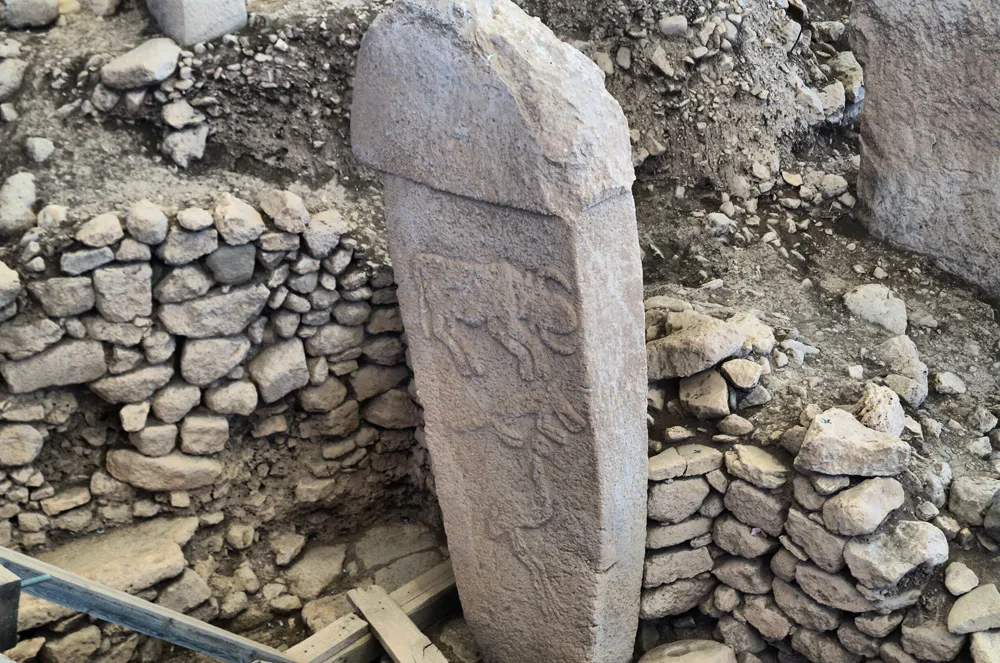
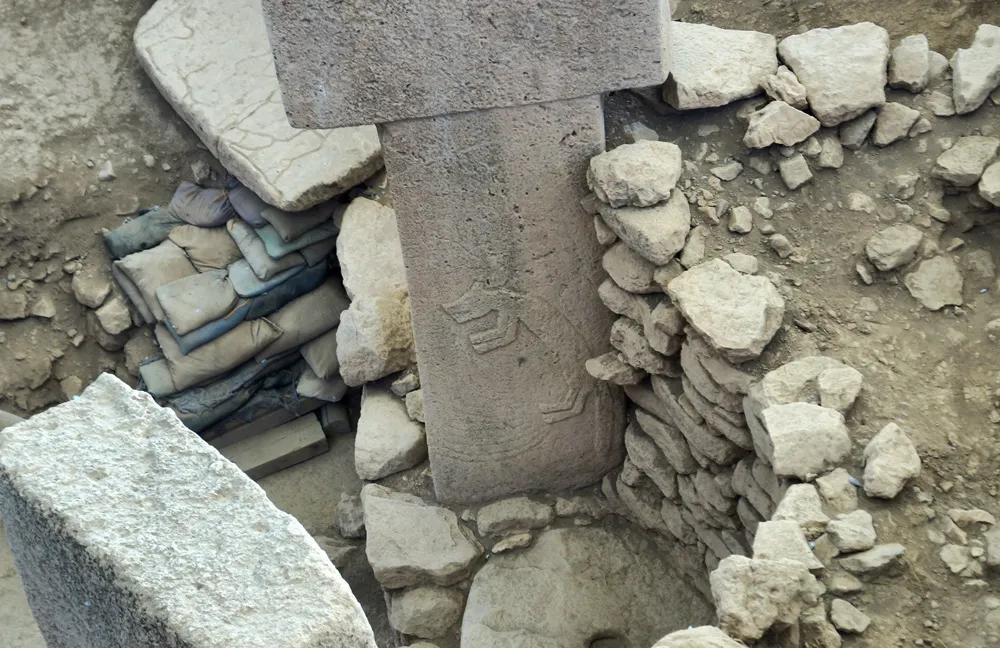
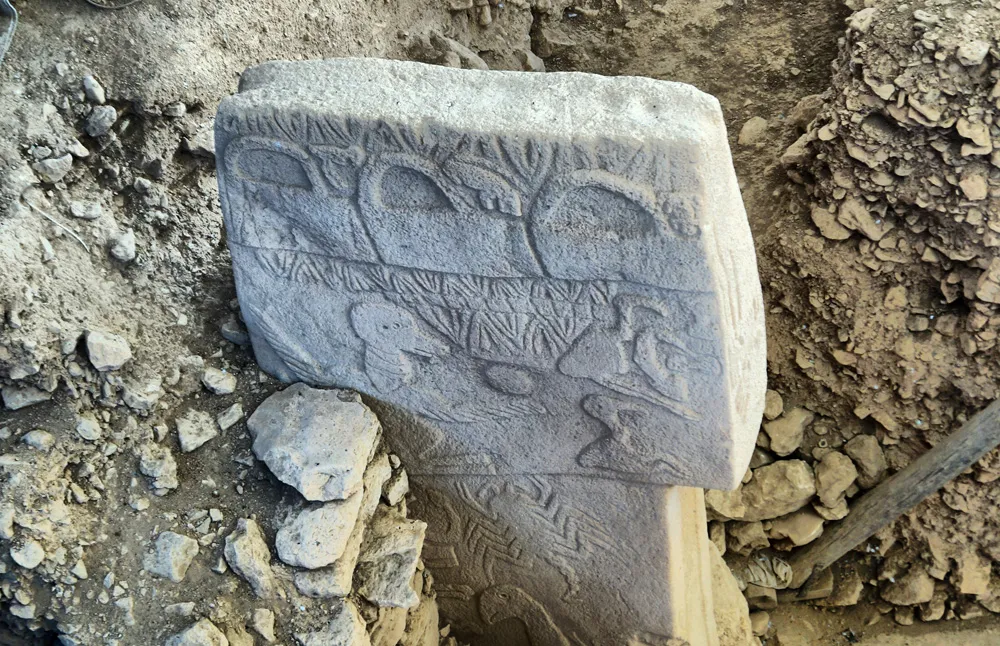
All conclusions regarding the Göbekli Tepe temple complex are so far preliminary, since excavations are conducted on only 5% of its territory. Archaeologists believe that research will continue for about another 50 years. The dating of the studied part places the end of layer III in the 9th millennium BC, and its beginning in the 11th millennium BC or earlier. Layer II belongs to the 8th–9th millennium BC.
Since the complex appeared even before the Neolithic revolution, the origin of agriculture and cattle breeding in this region should probably be assigned to the era after 9000 BC. At the same time, building such a grandiose structure required the efforts of a large number of people and a certain social organisation. This is uncharacteristic of the Mesolithic. By rough estimates, making and delivering pillars weighing 10–20 tonnes from the quarry to the building, up to 500 m apart, in the absence of draught animals, required the efforts of up to 500 people. Moreover, some pillars weigh up to 50 tonnes, so even more people were needed. It is even suggested that slave labour was used for such work, which is uncharacteristic of communities of hunter-gatherers. Such work required systematic effort and a social hierarchy in which many people were subordinate to one religious or military leader, and the religious leader then had to oversee the performance of rituals. In that case, the very existence of a temple complex in such a remote historical era testifies to social stratification at a very early stage of Neolithic culture.
At the beginning of the 8th millennium BC the Göbekli Tepe temple complex lost its former significance. But it was not simply abandoned and forgotten to decay gradually through natural weathering. It was deliberately buried under 300–500 cubic metres of earth. By whom and why this was done is unknown.
Text from Wikipedia, photos by Roman Malenkov.


