

Didivtsi and Kostomarov

· 8 min read
Didivtsi is first mentioned in 1629. It belonged to the regimental lands, and from 1757 to the Perevolochna company of the Pryluky Regiment; after the Cossack system was abolished, to Pryluky county (1782–1923).
At first it was a free military village. In 1690 Hetman Ivan Mazepa granted Didivtsi to the regimental captain Ostap Matsenko. After his death Hetman Ivan Skoropadskyi left Didivtsi to the captain’s widow Yefymiia Ostapivna and his son Anton Matsenko. Didivtsi was recorded as belonging to the latter in 1737, when he was second regimental standard-bearer. In 1753 the village’s population belonged to 7 owners, of whom the Pryluky archpriest M. Lysanevych held 7 households, while the widow of Anton Matsenko owned only 3 farmsteads. In 1797 there was a wooden Church of St Paraskeva, built in 1750 (the first church had been built before 1666).
In the second half of the 18th century the bunchuk comrade Petro Yakymovych Horlenko began buying up peasant farmsteads in Didivtsi (in 1780 he owned 6 souls, and in 1782 already 28 souls). His grandson Yehor Ivanovych Horlenko owned 27 souls in the 1840s.
Besides Horlenko, the Kysil family were also landowners of Didivtsi. Thus in 1861 Mark Dmytrovych Kysil was recorded as holding 39 peasant souls and 5 house serfs in Didivtsi and the hamlet of Kyselivshchyna.
The last owner of the Didivtsi manor was Oleksandr Markovych Kysil, to whom his mother passed it by inheritance in 1885, after his father’s death.
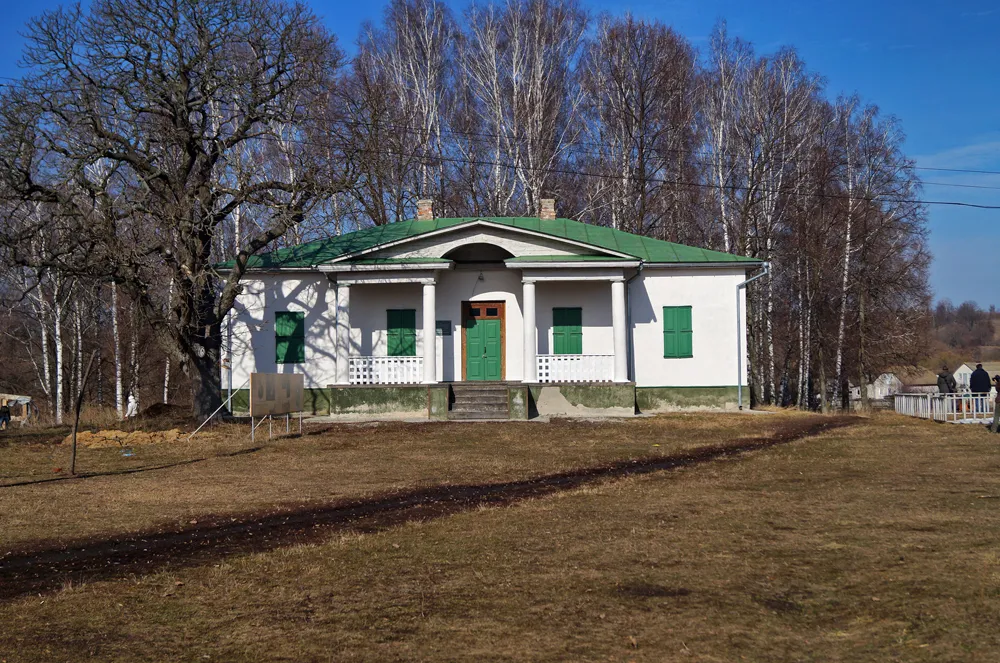
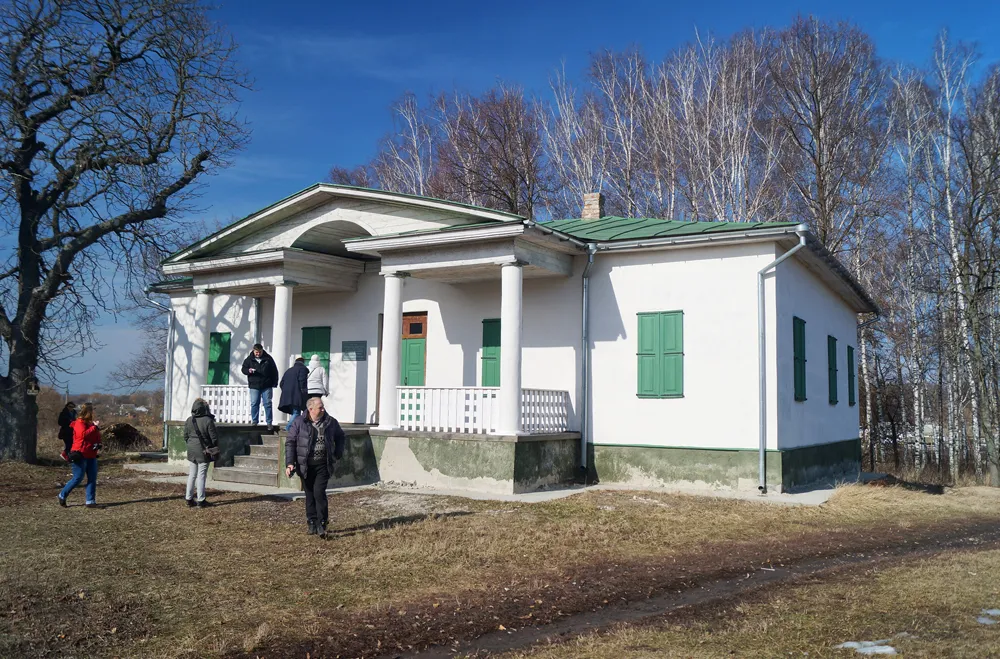
In 1886 the village had a new wooden church (1839), with a literacy school attached, a tavern and a windmill; in 1910 it had the wooden Church of St Paraskeva (burnt down in 1920), a zemstvo primary school (1906) with workshops where carpentry and lace-making were taught (in 1905 O. M. Kysil donated one desiatina of land for this school), and a mixed parish school.
In 1874–84 Mykola Ivanovych Kostomarov came every summer to rest at the Kysils’ manor in Didivtsi. The writers V. P. Horlenko and D. L. Mordovets, the artist K. Junge and the kobzar O. Veresai also visited this manor.
The significance of Kostomarov and his work for Ukraine is inestimable. We will not retell Mykola Ivanovych’s whole biography, which is set out quite fully on Wikipedia; we will note only the main defining moments and Kostomarov’s connection with Didivtsi and the Kysil manor.
Mykola Ivanovych Kostomarov (1817–1885) was an outstanding historian, ethnographer, prose writer, thinker and public figure. He was a co-founder and active member of the Slavophile-Ukrainian Kyiv association, the “Cyril and Methodius Brotherhood”, for his participation in which he was arrested in 1847 and taken from Kyiv to St Petersburg.
Already in his student years Kostomarov was fascinated by history and folklore, and by Ukraine’s Cossack past.
After finishing his studies Kostomarov came to lean towards the view that among the Slavic peoples it was precisely the Ukrainians who had a special mission in freeing all Slavs from imperial despotism and serfdom.
In 1845–46 Kostomarov, together with Vasyl Bilozerskyi, Mykola Hulak, Panteleimon Kulish and Opanas Markovych, founded the Slavophile-Ukrainian Cyril and Methodius Brotherhood, which Taras Shevchenko soon joined. Most members of the Brotherhood (Kostomarov among them) were deeply religious people, and their populist pathos took on the character of an almost religious faith. But while Kostomarov, Hulak and Bilozerskyi were rather Slavophiles than Ukrainophiles, Kulish and Shevchenko formed the patriotic Ukrainian wing.
Having taken shape ideologically, the members of the Brotherhood intended to move on to practical activity, propagating their convictions among the population. Hulak, who was close to the Decembrist radicalism of Pavel Pestel, did not rule out violent methods of struggle, and Shevchenko even dreamed of a popular uprising. Following a denunciation, in 1847 Mykola Ivanovych was arrested and sent to the Peter and Paul Fortress, and a year later he was already in exile in Saratov. In 1856 Alexander II released Kostomarov from police supervision, after which he went abroad, visiting Sweden, Germany, Switzerland, France and Italy; a year later he returned to St Petersburg and continued his scholarly work, and in 1859 he headed the Department of Russian History at St Petersburg University. In this post he enjoyed enormous authority among students and lecturers.
Kostomarov did not change his views on Ukraine; in St Petersburg he met his old friends Panteleimon Kulish and Vasyl Bilozerskyi, and together they founded and led the St Petersburg Ukrainian “Hromada”. Mykola Ivanovych stood unshakably on national positions, as shown by his slogan proclaimed in 1860:
Let neither Great Russians nor Poles call the lands settled by our people their own!
In these years Kostomarov published the historical and publicistic articles “The Truth to the Muscovites about Rus” and “The Truth to the Poles about Rus”.
Harassment rained down in response from the lecturers; in protest Kostomarov resigned in 1862 and never returned to teaching, concentrating on research.
In 1881–1882 Kostomarov was twice knocked down by a carriage. This, and incredible overexertion, undermined his health, and in 1885 Mykola Ivanovych died in his flat in St Petersburg.
In his works, especially in “Bohdan Khmelnytskyi”, published in 1857, Kostomarov stresses the main credo of all his future historical works: the Ukrainian people is the chief heir to the statehood of Kyivan Rus, having preserved all the democratic traditions of its ancient Kyivan state. Kostomarov also stresses the principle of the unity (sobornist) of all those lands where the Ukrainian people lives.
To the end of his days Kostomarov defended the idea of the difference between “the two Russian nationalities”, as he called them: Ukrainians (heirs to the democratic traditions of Kyivan Rus) and Russians (creators of the despotic Muscovite tsardom and the Russian Empire).
But what links Kostomarov with Didivtsi and the Kysils’ manor? A fateful love.
While still working in 1845 as a teacher at the 1st Gymnasium in Kyiv, Kostomarov at the same time taught history at the private boarding school of Laura Yosypivna de Caillant. There he met a pupil, Alina Kraghelska, who was then 15 years old and who became his only love for life. Kostomarov himself was 28. A year later, in 1846, already a professor at Kyiv University, Mykola Ivanovych met Alina by chance in Odesa, where she, like him, was on holiday with her mother. Back in Kyiv, Kostomarov often visited the Kraghelskis, and a year later, in February 1847, he became betrothed to Alina. The wedding was set for 30 March, and Taras Shevchenko was invited as the groom’s best man.
But on the night before the wedding, all the members of the “Cyril and Methodius Brotherhood” were arrested. The only thing they were allowed to do was say goodbye; they were not even told where the prisoners would be taken. After some time Alina herself found her beloved in St Petersburg and travelled to visit him, and then corresponded secretly with Kostomarov for almost 2.5 years. Kostomarov, punishing himself and considering himself ruined, did not want a bad fate for Alina, and the girl’s mother also opposed the marriage, so she married her daughter off to Colonel Mark Dmytrovych Kysil, owner of Didivtsi, with whom she lived for 19 years and had three children.
Credit must be given to Mark Kysil: he respected his wife’s feelings for Kostomarov and did not reproach her; on the contrary, he even gave Alina a book by Mykola Ivanovych with the author’s dedication “Dedicated to the unforgettable A.L.K. in memory of 14 June 1847″. In 1865 the Kysil family moved from Kyiv to Didivtsi. By then Mark Dmytrovych was already very ill, and in 1870 he departed this world. Alina Leontiivna was left with three children: 15-year-old Oleksandr, 13-year-old Yulia and 7-year-old Sofiika.
By then Kostomarov was already a world-famous scholar and writer. But family life had never worked out for him; his first love had not let him go all those years. And so in 1873 the 17-year-old Oleksandr Kysil passed to Kostomarov, through Professor Volodymyr Antonovych, a letter from his beloved Alina with an invitation “to come for evening tea”. So the meeting took place, after 26 years, of two people, no longer young, who had been parted by fate. After 2 years of letters and meetings, on 9 May 1875, Mykola Ivanovych and Alina Leontiivna were married in the Church of St Paraskeva in the village of Didivtsi. For the next 10 years the Kostomarovs came to Didivtsi every summer both to rest and to work. This period of Mykola Ivanovych’s work is considered the most fruitful. And Kostomarov had full understanding and trust with Alina Leontiivna’s children.
Unfortunately, the scholar died after 10 years of married life. His library of almost one and a half thousand books and manuscripts was donated by his wife to Kyiv University. Alina Leontiivna herself outlived her beloved by 23 years and died on 4 February 1908. She was buried in Kyiv.
From 1885 the owner of the estate in Didivtsi was Alina Leontiivna’s eldest son, Oleksandr Markovych Kysil, a deputy of the Pryluky county zemstvo from 1895.
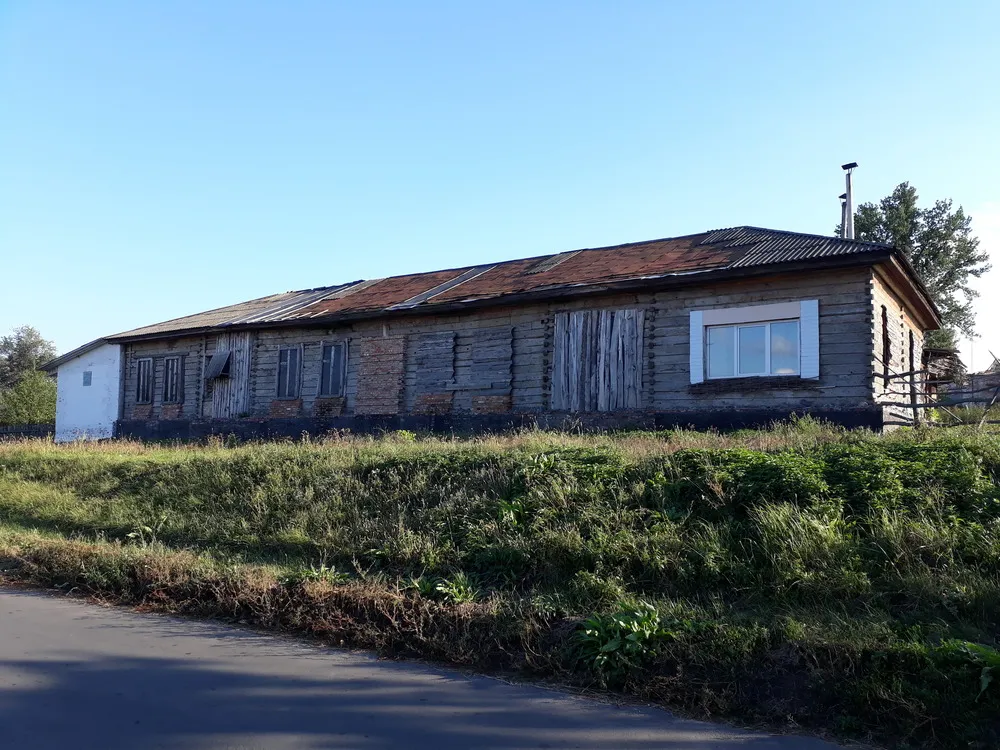
P.S. Opposite the Kysils’ manor in Didivtsi, across the road and a little to the side, outbuildings of the Kysils’ estate from the early 20th century have also survived.
Text by Ihor Dorozhok, photos by Roman Malenkov.


