

Hero of Ukraine. Little-known facts about Nechui-Levytskyi that will surprise you

· 11 min read
The article was published on the RBC-Ukraine portal
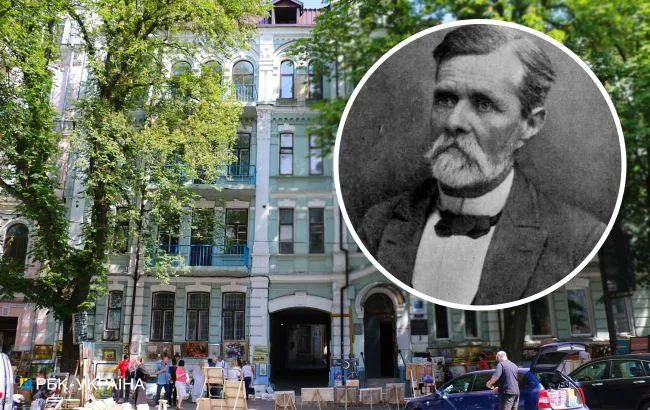
Photo: Nechui-Levytskyi’s legacy in Kyiv (collage by RBC-Ukraine)
Kyiv has almost forgotten the legacy of the outstanding writer, says local historian Roman Malenkov
The renaming of streets in the capital and other Ukrainian cities is being actively discussed now. A record number of Kyivans voted on the new names. The traveller and local historian Roman Malenkov believes that several important historical figures have been left out of the discussion. In particular, few people talk about the outstanding writer Ivan Nechui-Levytskyi. Yet he is a star and legend of Ukrainian literature. His name was scrubbed from history back in the USSR.
In a column for TRAVEL RBC-Ukraine, Roman Malenkov reflects on why more attention should be paid to this historical figure, and why it is worth knowing as much as possible about him — both for travellers and for the residents of Kyiv.
The creator of the literary language. Why the writer was forgotten for so long
In recent days I have been reading many comments and proposals about renaming streets. And I do not see anyone mentioning the name of one of the greatest Ukrainian writers — Ivan Semenovych Nechui-Levytskyi. He is a legend of Ukrainian literature. And one of the creators of the language in which almost all Ukrainian writers of the 20th century wrote.
Ivan Nechui-Levytskyi is a hero of Ukraine. After all, in the last quarter of the 19th century, under Russian circulars on a total ban of the Ukrainian language, he was almost the only one who truly defended the language. And, in effect, defended Ukraine. That is why the Russian propaganda machine almost erased his name from Ukrainian history and from the memory of Ukrainians. Now we have to do the reverse work — to restore justice regarding one of the greatest figures in Ukrainian culture.
- “Ivan Levytskyi is a great artist of vision, the colossal, all-embracing eye of Ukraine” (Ivan Franko);
- “What a beautiful language! Reading it was like drinking clear water in the heat. What knowledge of folk customs, of folk life!” (Mykhailo Kotsiubynskyi)
- “No literature in the world has such a truthful, witty, humane, sunny work, though somewhat clouded by longing for a better life… as Nechui’s The Kaidash Family” (Maksym Rylskyi)
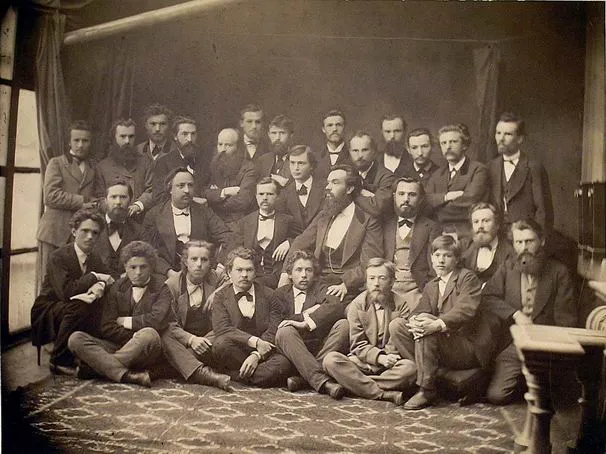
Photo: Ivan Nechui-Levytskyi with members of the “Kyiv Hromada”, 1873 (wikipedia.org)
Ivan Nechui-Levytskyi was the first to extend the boundaries of Ukrainian literature to the “standards” of world literature, and it is to him that Ukrainian writers of the 20th century owe their literary language — most of them wrote precisely in Nechui’s language. Ivan Semenovych was the first to show in his realistic works all strata of Ukrainian society: the intelligentsia and clergy, landowners and merchants, peasants and workers — all of them are on the pages of his works.
Nechui-Levytskyi expanded the genre boundaries of Ukrainian literature: short stories, novellas, novels, tales, plays, sketches, essays, critical journalism, ethnographic articles — there was hardly anything the writer did not take up. He wrote about the westernmost Ukrainian villages in distant Lesser Poland, and about the towns of the former principality of Danylo of Galicia, for example Drohiczyn, where Danylo was crowned king; he wrote about the Ukrainian Black Sea coast, and most of all about his native Nadrosia and about Kyiv.
He was the first to write about total Russification in Ukraine
Nechui-Levytskyi was the first to write about the policy of total Russification in Ukraine. In many works he covered the process of Russification in education (Clouds, Prychepa, On the Black Sea). Ivan Semenovych set out his own detailed observations and analysis of Russification in education in the following works: “The Russian Folk School in Ukraine”, “Pedagogical Manifestation in the Russian Folk School”, “The School Must Be National”.
Another personal achievement of Nechui is that he was the first to address the problem of the Russification of literature. As a teacher of Russian language and literature, Ivan Semenovych relentlessly criticized the authorities for the ubiquitous mass imposition of Russian literature on non-Russians.
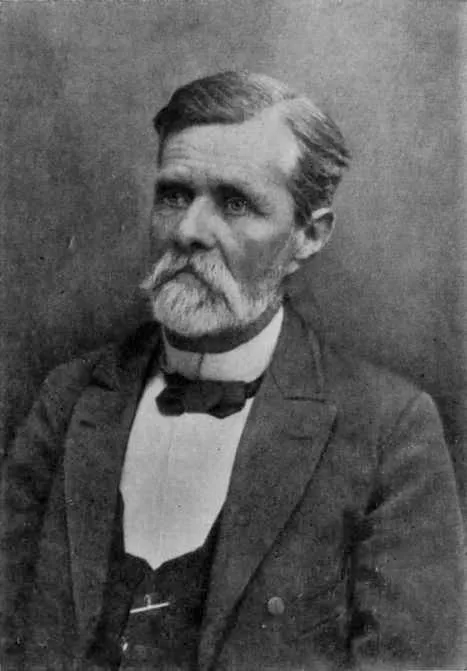
Photo: The writer was the first to speak about the problem of the Russification of literature (istpravda.com.ua)
“On the Uselessness of Great Russian Literature for Ukraine and the Slavic World”, “Ukraine in Literary Litigation with Muscovy” — these works were not published in the USSR, because they were considered nationalist, as was the work “The Worldview of the Ukrainian People” — there can be no separate worldview of Ukrainians. For this Nechui fell out of favour with the Russians, and they did everything to make descendants forget the great classic.
Nechui-Levytskyi considered the greatest flaw of the Ukrainian intelligentsia to be that Russian literature had replaced their own national literature. By the way, for many regions of Ukraine this problem is still relevant today.
Nechui-Levytskyi’s works are the best about the Ukrainian village
It is believed that Nechui’s work significantly accelerated the development of Ukrainian literature, extending its boundaries in every possible direction. And Ivan Semenovych, together with Panteleimon Kulish and Ivan Puluj, became a translator of the first Ukrainian-language Bible, which was printed in Vienna in 1903.
Nechui-Levytskyi’s works are the best about the Ukrainian village, the most detailed and the most poetic, though in prose. But the master did not write only about the village. He lived in Kyiv for 33 years and wrote quite a few incredible works about our capital. Kyiv Petitioners, The Athos Rogue, Clouds, An Apocalyptic Picture of Kyiv, An Evening on Volodymyrska Hill — I highly recommend them. And he also wrote a work that all Kyivans know and adore.
Ivan Semenovych had a play about life in Podil — it is called On the Kozhumiaky. Another of our great classics, Mykhailo Starytskyi, read it and was impressed. But he immediately understood that for the stage the play was too long — as many as six acts. And he turned to Nechui-Levytskyi.
Starytskyi wrote in a letter of 17 March 1883:“Dear and most esteemed Ivan Semenovych! The Dramatic Committee has instructed me to review your Kozhumiaky and to work out a plan for how to adapt it for the stage. I have done so and read out my plan, and it was highly praised: so now I am sending it to you for your sanction. Please, once you have read it, return it with your answer as soon as possible.”
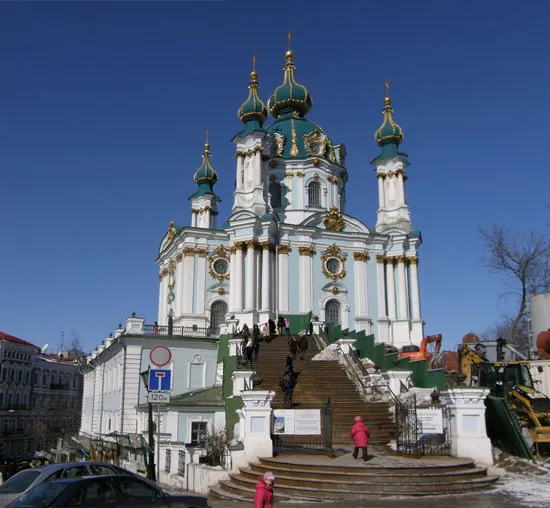
Photo: Nechui-Levytskyi was very fond of St. Andrew’s Church
Starytskyi also asked that his surname be added as a co-author: “So that it would say: ‘A comedy by Levytskyi-Starytskyi’. If you agree, look over the plan, make your remarks and send it to me at once, and then I will quickly get down to work.” Nechui-Levytskyi gave his consent, and the play with the double title “The Gentry’s Lip and No Teeth (Chasing Two Hares)” was first published in 1890 in the collection Malorossiiskii teatr under two signatures: Levytskyi-Starytskyi — such was the agreement and will of the writers.
In the Soviet period his name was “wiped” from history
In the Soviet period Nechui-Levytskyi was “wiped” from history — from a family of priests and, on top of that, a nationalist — such authors were not needed by the Soviet authorities. Ivan Semenovych was thrown out of the authors of the popular play “Chasing Two Hares”, leaving only Starytskyi. And even Wikipedia names Starytskyi as the author.
Nechui-Levytskyi was forgotten — an incredible injustice. On Andriivskyi Descent there stands a monument to the characters of a work invented precisely by Nechui-Levytskyi, but as for the author…
Who gave the best tours about the writer
Ivan Semenovych was a member of the Imperial Geographical Society and wrote sections for the Brockhaus and Efron encyclopedia. Nechui’s social and everyday stories and novellas are masterpieces of Ukrainian literature.
There is nothing more interesting and detailed about the life of the Ukrainian village. In Nechui’s time 80% of Ukraine’s population lived in villages, so the importance of conveying details of their life is hard to overestimate. Almost everyone enjoyed the series about the Kaidashes — The Kaidash Family — one of the most widely read works in all of Ukrainian literature, immortal for all ages.
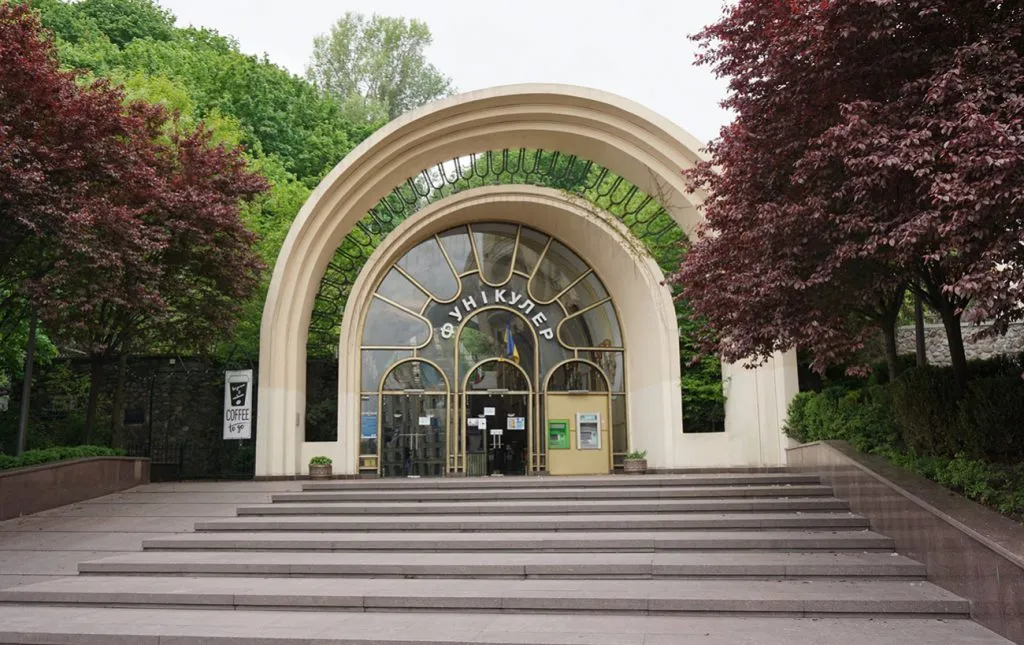
Photo: In Kyiv the writer also liked to go down and up by the funicular (facebook.com/Kyivpastrans)
The collected works of Nechui-Levytskyi, published in the 1930s, before the writer was forgotten, comprise 10 volumes. The late Serhii Khavrus, director of the Nechui-Levytskyi Museum-Estate in Stebliv, was the best expert on and researcher of the writer’s life and work.
With his tours and books he revealed Ivan Semenovych in a completely different light: after his stories no one had any doubts: Nechui as a prose author is on the level of Franko and a star of Ukrainian literature. Dozens, and perhaps hundreds, of 20th-century Ukrainian authors took their cue from his works, yet the Ukrainian people hardly honour their heroes. Two monuments and a few streets.
Nechui-Levytskyi’s addresses in Kyiv. Where to go for a walk
In Kyiv there is a Nechui-Levytskyi Street — a small one, in the private-house sector in Solomianka, near Baikove Cemetery. Is that really where the street named after one of the country’s main classics should be?
“Ukraine Incognita” has begun conducting a tour called “Kyiv of the Great Nechui”. The tour offers a walk along the route that Nechui-Levytskyi walked for 21 years while living on Pushkinska Street. These are today’s streets: Pushkinska (they simply cannot rename it, and the authorities ignored the fact that Nechui lived here for 21 years), Bohdana Khmelnytskoho and Volodymyrska, then Mykhailivska Square and Volodymyrska Hill.
In Kyiv there are eight addresses where Ivan Semenovych lived at various times. Two addresses are connected with his studies at the Kyiv Theological Seminary and the Theological Academy, five are apartments the writer rented from 1885 to 1917. The last address is the Dehtiarivska almshouse, where Nechui died, already in the time of the Ukrainian People’s Republic, in poverty, with a broken leg.
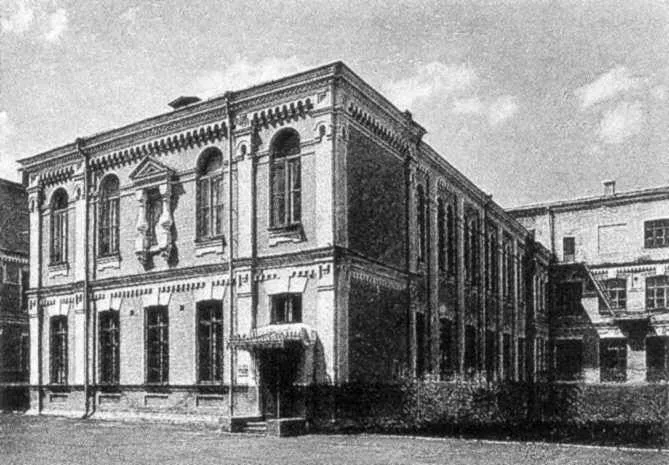
Photo: Kyiv, 17 Dehtiarivska Street. Nechui-Levytskyi died here after several days of illness (myslenedrevo.com.ua)
Interestingly, of the residential buildings in which he rented rooms, only one has survived. It is at 7 Volodymyrska Street. It does not even have a memorial plaque. As, by the way, none of the buildings connected with Nechui do. There is a plaque only on the building at 17 Pushkinska Street. True, it is very unprepossessing and barely noticeable, and it is also written in black on black — from five metres away it is almost impossible to make out the inscription.
The building that housed Ivan Semenovych’s last apartment, the Zelenska apartment house, collapsed back in the 1990s. Only a corner fragment of it remains — also quite an interesting attraction, with decorative elements and a doorway. There is no memorial plaque on this wall either, and almost nobody knows about its existence.
Nechui-Levytskyi was very fond of St. Andrew’s Church and St. Sophia’s Cathedral in Kyiv, and liked to go down and up by the funicular.
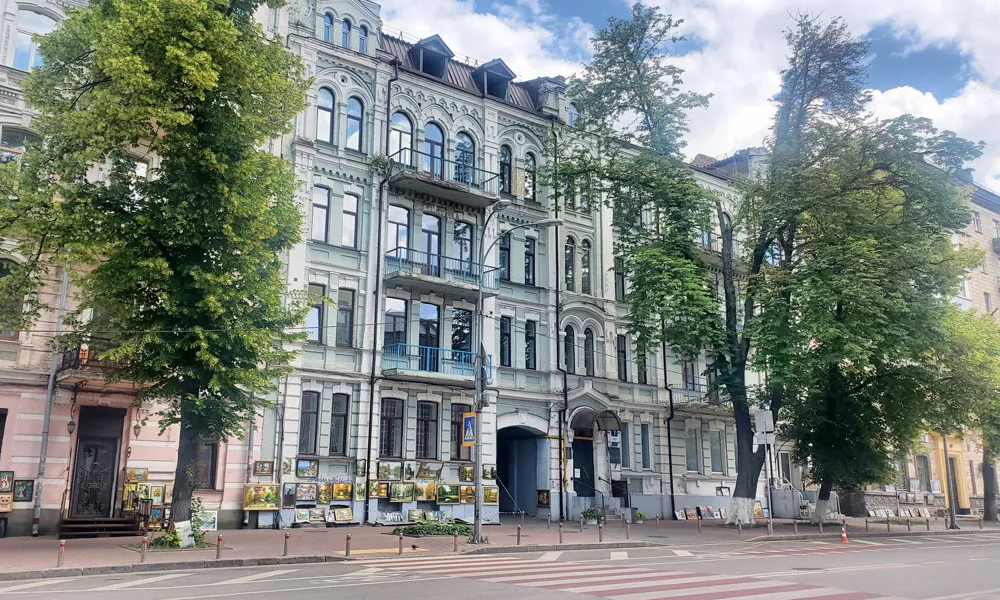
Photo: 7 Volodymyrska Street — the only residential building in Kyiv that has survived of those where the writer lived
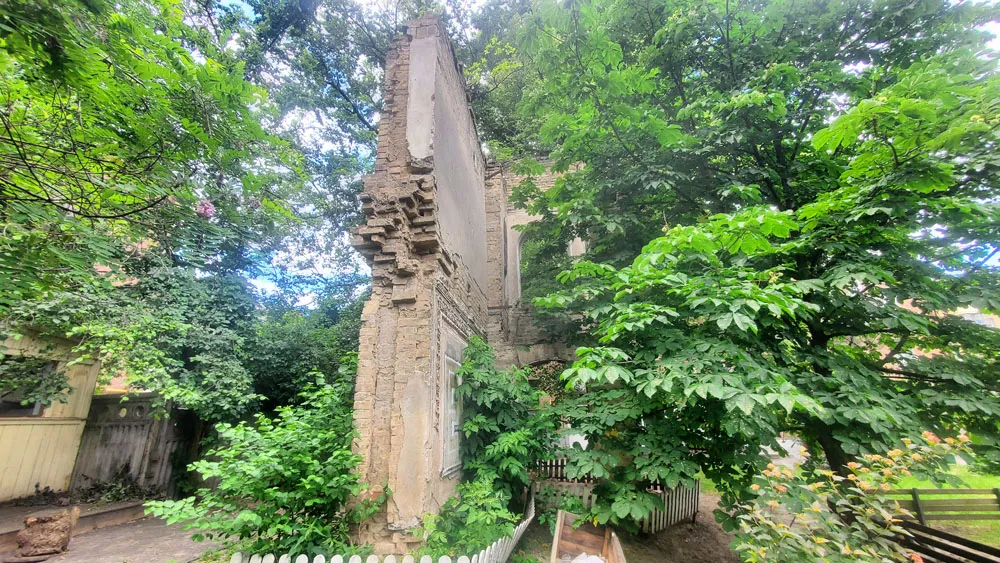
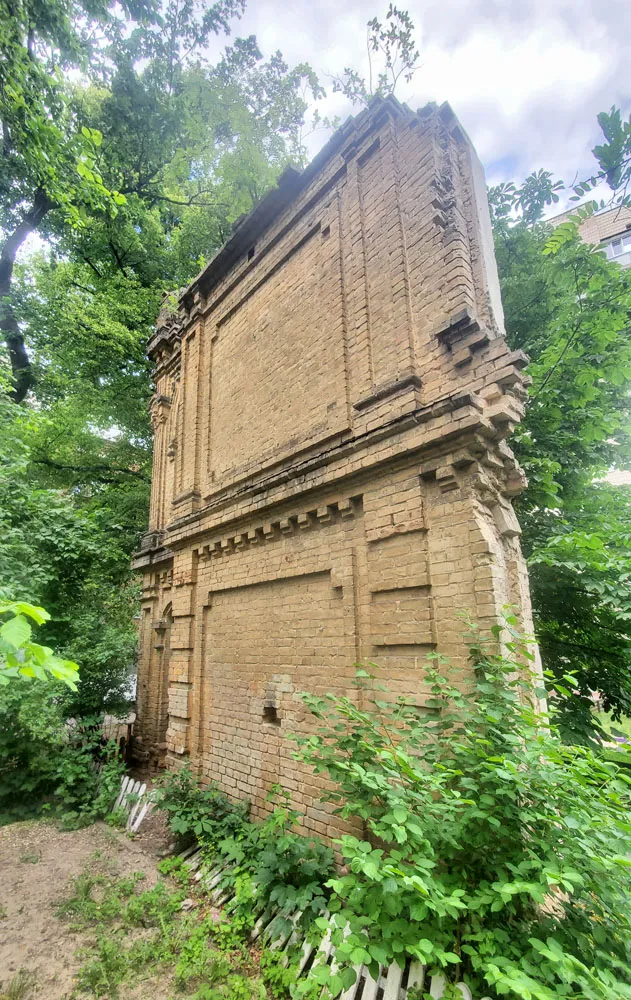
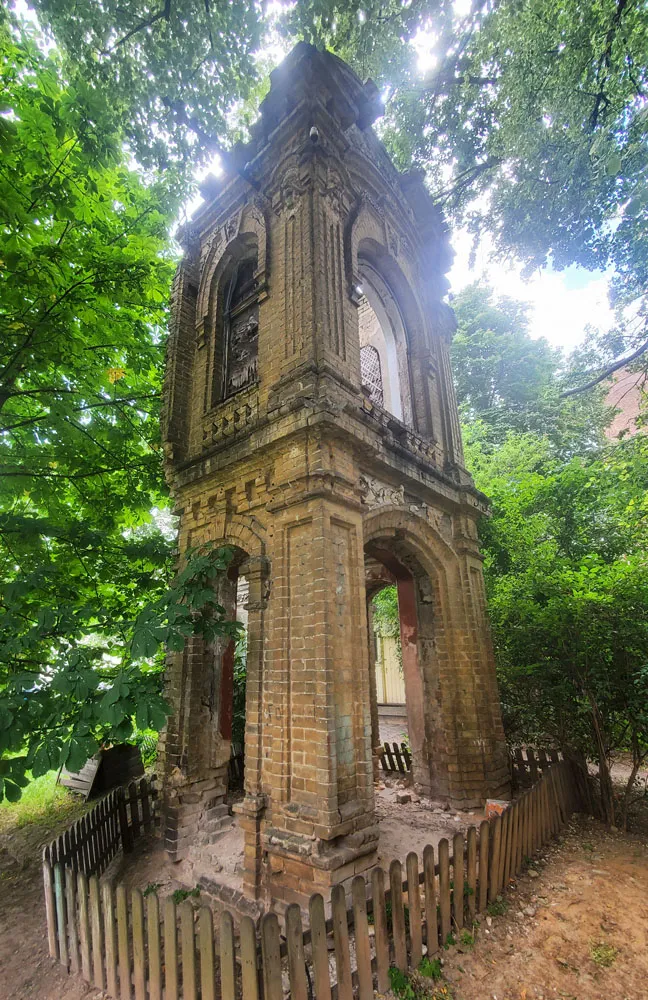
Photo: The remains of the building on Bekhterevskyi Lane. Nechui’s last apartment was here
The Russification of Kyiv began after the 19th century
P.S. Kyiv was not Russian-speaking in the middle of the 19th century. Russification began later, and it began with educational institutions. Ivan Nechui-Levytskyi, who studied at the Kyiv-Mohyla Academy, wrote about this very clearly and meaningfully.
He describes the process of total Russification in the novel Clouds. There, by the way, are countless descriptions of the Kyiv of that time, as in Nechui’s other works. And it is he who is the main singer of the City at the turn of the centuries, not Bulgakov at all, whose father was a typical Russifier of Kyiv. Below I give an excerpt from the novel Clouds. An incredible piece of truth about old Kyiv.
- “…at the academy they met students from all over Russia. The Great Russian synod, ahead of the government, noticed the idea of Russification, and for that it ordered the academies to mix Ukrainians with Russian students. That is why seminarians from Kostroma, Arkhangelsk, the Volga and Siberia were being pushed into the Kyiv Academy, mixing them with Kyivans, Poltavans, Odesans and others, and Ukrainian seminarians were sent to Moscow and Petersburg, though they had no desire to go there.
- “…All the students spoke the Muscovite tongue, and it was rare to hear the melodious, soft Ukrainian speech. In the very middle of the monastery stood a large, beautiful Epiphany Church. On the south wall of the church was an iron plaque with an inscription over the grave of Hetman Konashevych-Sahaidachnyi. The monastery itself with the academy stood on Mazepa’s yard. And despite that, in the academy of Petro Mohyla, St. Dimitry of Rostov (Tuptalo) and others there was not a trace of the spirit, not a trace of those ancient figures of Ukraine, those Sahaidachnyis, Mohylas…”
- “In the Brotherhood Monastery, in the ancient famous academy, an alien Great Russian spirit reigned, an alien learning, an alien language, even alien people… Everything ancient Ukrainian lay somewhere deep underground, next to the grave of Sahaidachnyi, and above the ground, like a swarm, alien people from an alien distant land buzzed about under the tree, with an alien language, with an alien spirit, driven God knows from where, to drive our antiquity and our modernity still deeper into the earth and bury it forever.”
In Nechui’s time Sahaidachnyi’s grave still existed, but the Russians destroyed it. Together with the academy and the monastery.
Author: Roman Malenkov


