

The National Chornobyl Museum, which is no more…
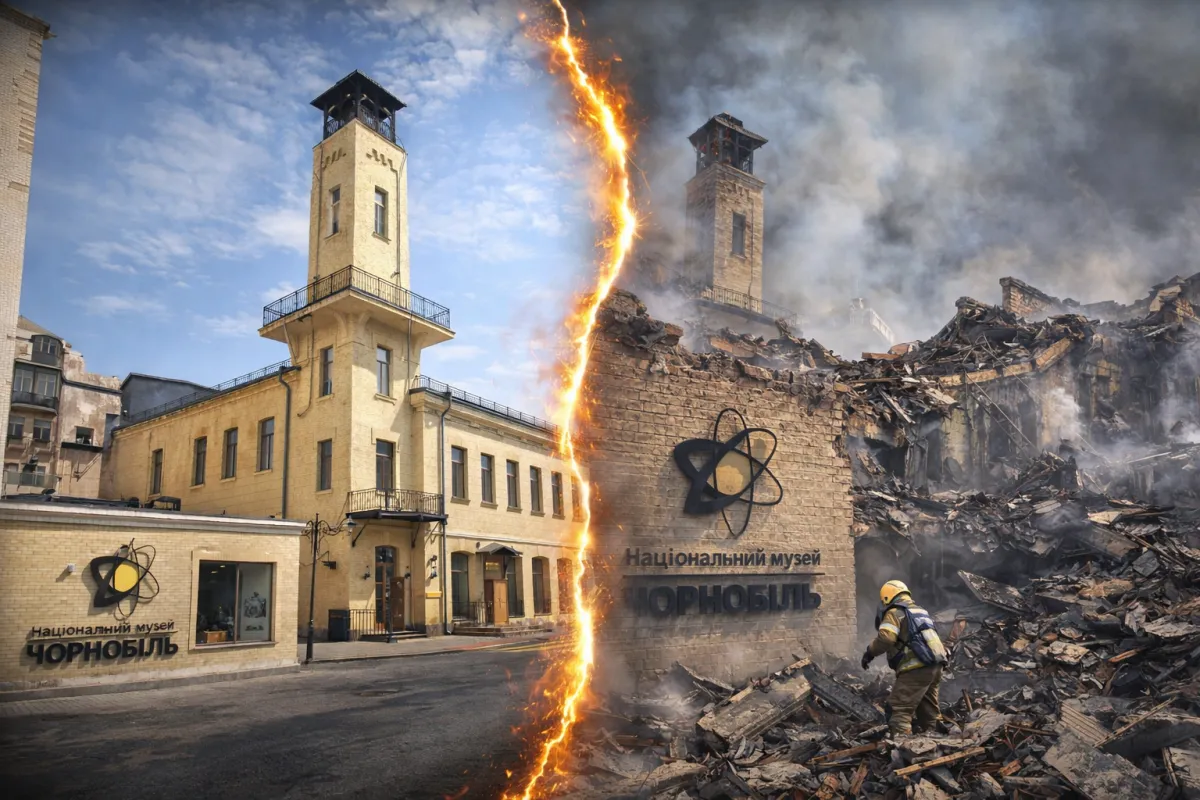

All that is left of the museum. Photo: open sources
If this had been some “ideological” museum that, by the twisted logic of the Russians, could be labelled “Banderite”, “fascist” or “Nazi” and therefore “denazified as part of the special military operation”… It would be barbaric, but such a strike could at least be given some kind of explanation. But this is a museum about the feat of the people who saved the world from a nuclear catastrophe, including significant territories of Russia itself.
Even the most fervent Kremlin propagandists will not be able to justify the destruction of this museum with the word “denazification”. It is simply barbarism. Ordinary Russian barbarism… And it is precisely this that delights the Russian people. And it is precisely to please the Russian people that Moscow did all this… Because such a strike has no military significance whatsoever… Only to please the population of the Russian Federation…
(24.05.2026)


Photo: Maksym Nazarenko, “Ukraine Incognita”
*****
Let us remember what it was like!
The National Chornobyl Museum opened on 25 April 1992 on the initiative of the Ministry of Internal Affairs of Ukraine in a specially reconstructed historic building, the Fire Watchtower, an architectural landmark of the early 20th century that had previously housed the Podil fire station. Importantly, it was here and in the neighbouring building that in the 1980s the Kyiv Oblast Fire Protection Department was based, which bore the brunt of fighting the fire at the Chornobyl Nuclear Power Plant. In 1996 the museum was granted national status.

The museum’s exhibition comprises about seven thousand items: declassified documents, maps, photographs, personal belongings of the liquidators, and examples of Polissia folk architecture collected by expeditions in the exclusion zone. It tells of the heroic work of civilians and military personnel who dealt with the consequences of the largest man-made disaster of modern times, and also covers the post-Chornobyl environmental situation and international cooperation in overcoming the consequences of the accident.


In October 2024 restoration work began: hazardous areas of the roof and of the watchtower were found, and archaeological research was carried out, with the artefacts added to the museum’s collections. On 26 April 2025, on Chornobyl Remembrance Day, the museum closed temporarily to visitors. Major renovation and the renewal of the exhibition lasted two and a half years. On 27 April 2026, for the 40th anniversary of the accident, the museum opened its doors again.


As stated on the official website: “The museum rejects outdated approaches to perceiving Chornobyl that were based on fear, silence and stigmatisation. Instead, it shapes a new narrative, about strength, responsibility and an experience that unites society.”

Today the National Chornobyl Museum is a place of remembrance of the heroism and self-sacrifice of the Chornobyl accident liquidators; a repository of unique relics of the Chornobyl Polissia; a modern museum space with interactive displays and storytelling; a laboratory of contemporary research; an educational venue with a library and learning spaces; an open platform for discussion and partnership initiatives; and a starting point for large-scale projects related to the theme of Chornobyl.

The renewed exhibition also reflects the events following Russia’s full-scale invasion in February 2022: the seizure of the plant, its liberation by the Defence Forces of Ukraine and the subsequent systematic drone and missile attacks. The authors sought to make the museum understandable both to the liquidators, who can see their feat in a new light, and to children, so that new generations can learn in a modern form what happened in 1986.


The museum has an educational space for children, including programmes for children with special needs. A separate installation is devoted to the history of the town of Chornobyl before the construction of the nuclear power plant, since it has been known since the times of Kyivan Rus.

Besides the main exhibition, visitors to the National Chornobyl Museum have one more interesting opportunity: to climb the fire watchtower, from which an amazing panorama of Podil opens up. From here you can see the ancient quarters of Kyiv, their churches and streets unfolding before your eyes in all their beauty.

The watchtower also features the “What do I see?” project, first initiated by the Ancient Kyiv National Historical Reserve in the bell tower of St. Michael’s Golden-Domed Monastery. These are information panels graphically depicting the views that open up from the height, from the corresponding vantage points. Why, one might ask, duplicate with a drawing what is already clearly visible? But the point is that even when there is no fog, not every visitor can immediately recognise which landmarks are hidden in this incredible view.

The stands were made so that everyone could clearly understand what exactly they are looking at. After all, from the watchtower one sees not only the general panorama of Kyiv and Podil but a whole “open-air museum”: dozens of historic buildings, churches and architectural monuments. The information panels help to make sense of what is located where, and thus combine the living view with a popular-science explanation.

This additional space makes a visit to the museum even more interactive: it allows you not only to immerse yourself in the theme of Chornobyl but also to feel historic Kyiv…
***
Now this is yet another testimony to the criminal nature of bloody Russia….


