

The Tree of Life and a lament for beauty that will rot in the earth: a Baroque masterpiece of Sataniv
The Jewish cemetery in Sataniv is interesting above all for its venerable age (it was in use from the mid-16th to the mid-20th century). But it caught this author’s attention first of all as a place with an enormous concentration of Renaissance and Baroque stone carving. Here we see ornaments, patterns and artistic compositions that are reference examples for all East European Baroque, including the Ukrainian.
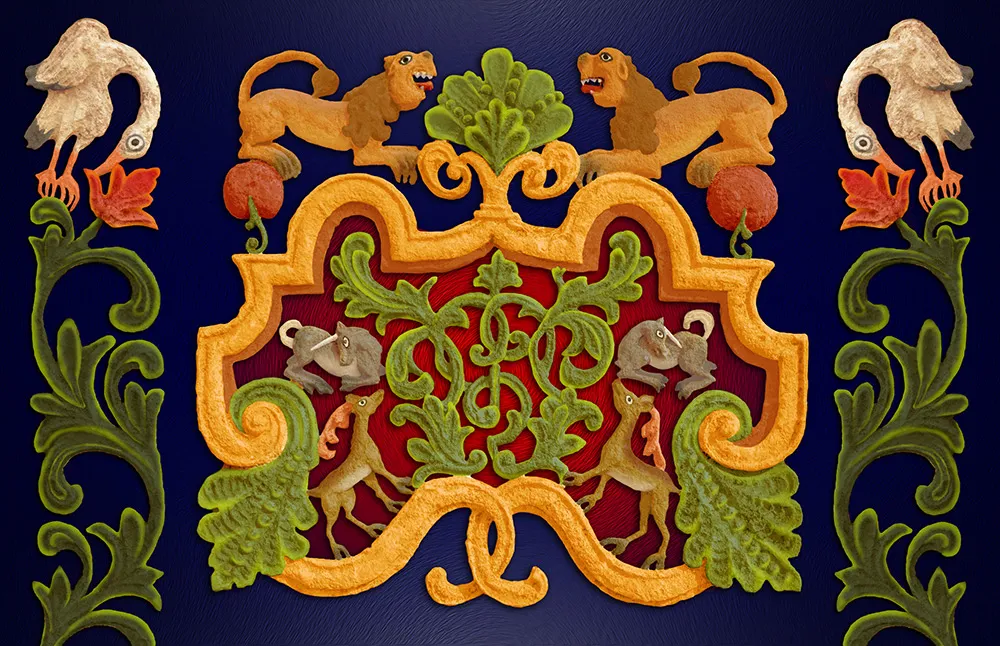
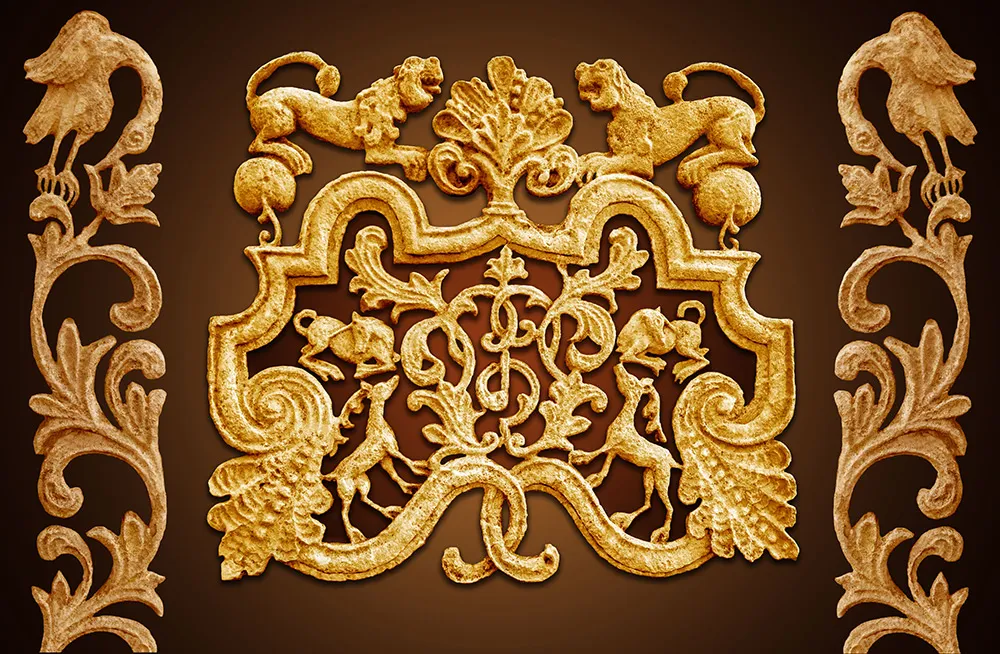
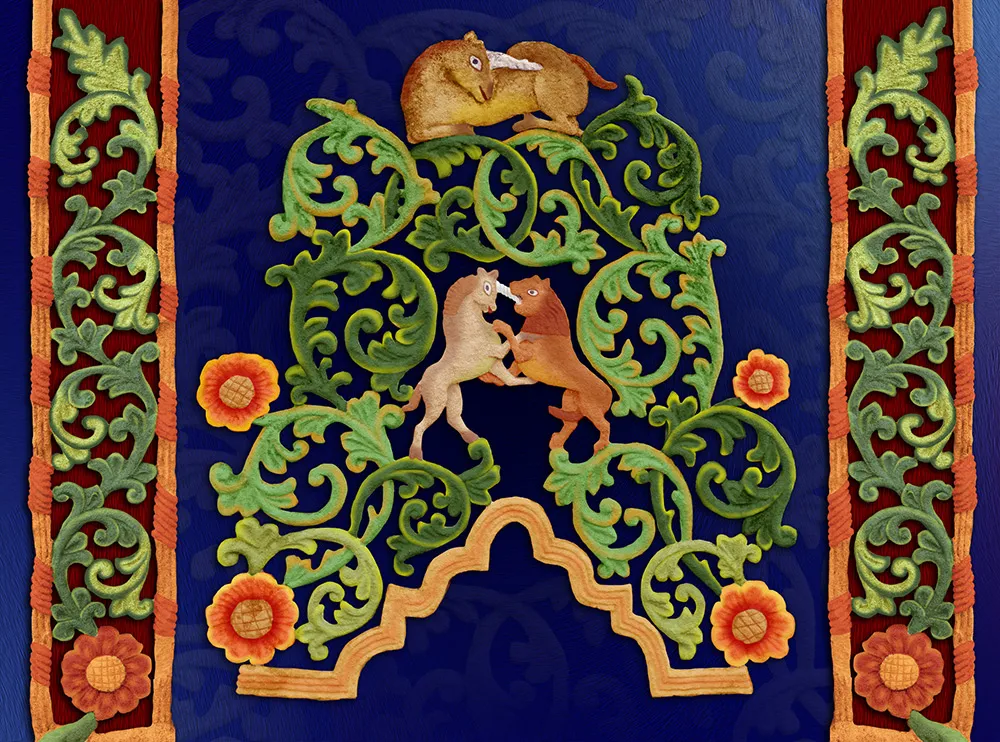
An artwork created on the basis of the decoration of the matzevah on Sarah’s grave
In this article we will examine only one gravestone in detail.
This lavishly decorated Baroque matzevah is perhaps the most artistic and refined in the whole sizeable cemetery of Sataniv. As it turned out, it is also interesting for the person of the deceased woman and the romantic love story hidden by this ancient stone.
It was in fact with this matzevah that the author’s detailed study of the Sataniv necropolis began. It was so enchanting that I wanted to learn more about it. Its photo was sent to the well-known Judaica specialist Anatolii Kerzhner so that he could read the epitaph.
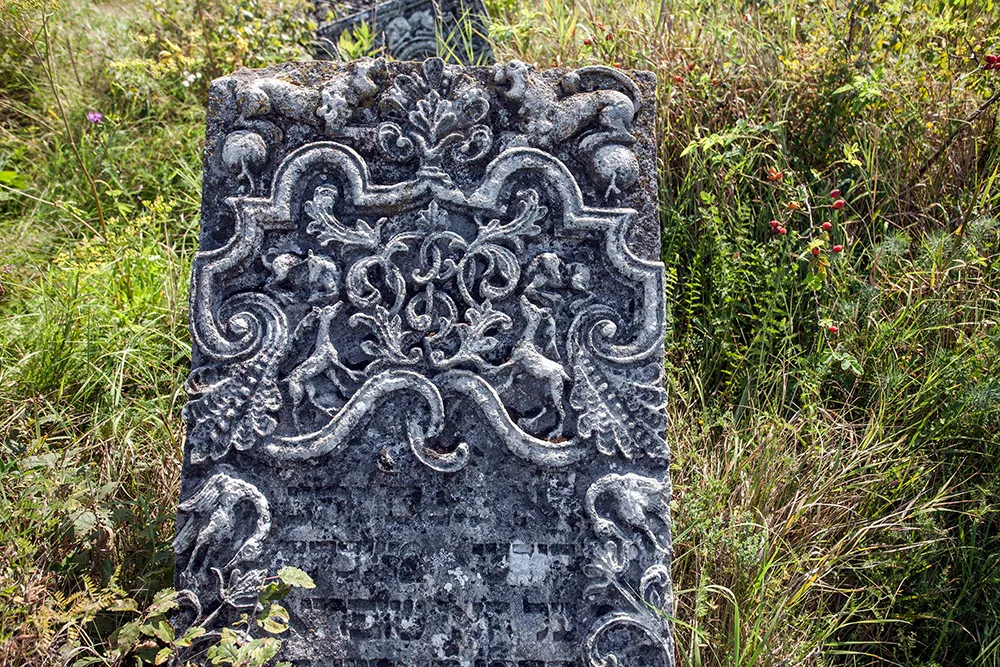
The task was not a simple one, because the inscription, as it turned out, had been made in a mixture of Hebrew and Aramaic.
The epitaph, executed in an elaborate script that seems to have come straight from the pages of medieval manuscripts, announced:
“Behold: the seed of the holy, a monument (a monument to a descendant of holy people – author’s note)
For this beauty that will rot in the earth I weep (a saying from the Talmud).
Tender and delicate (a paraphrase of Deuteronomy 28:56),
modest [in regard to] her good deeds,
Mrs Sarah,
daughter of the renowned rabbi Meir of Lviv…”
Given that the gravestone had sunk almost a third of the way into the ground, what is written further remained unknown at the time. As did the date of burial. However, the latter was found on the website of the Center for Jewish Art, a research institute of the Hebrew University of Jerusalem that documents and studies Jewish visual culture. Among other things, that site held a huge archive of photographs from Sataniv, made by the Center’s expedition as early as 1992.
Evidently they, too, noticed this very beautiful gravestone, because the site had as many as four photographs of it (whereas of other matzevot there were one or two). Everywhere the year 1800 was given.
About the decoration
At the very top we see a pair of lions. These animals are quite traditional in Jewish funerary art and in art generally.
To understand such popularity of the “king of beasts”, it is worth recalling the passage of the Torah (the Old Testament) where the patriarch Jacob on his deathbed blesses his sons:
“Judah is a young lion! From the prey, my son, you have gone up: he stooped down, he crouched as a lion and as a lioness; who shall rouse him up? The sceptre shall not depart from Judah, nor the lawgiver from between his feet, until the Peacemaker comes, to whom the peoples will give obedience”.
That is, Yehuda is compared here to a lion. In this way the lion became a kind of “totemic” symbol of the tribe of Yehuda (Judah). We also see a prophecy of the coming of the Peacemaker — that is, the Mashiach/Messiah, who will likewise be a descendant of Yehuda/Judah.
Given that almost all modern Jews descend from the tribe of Judah, the lion became the embodiment of the whole Jewish people, as well as a metaphor for the expectation of the Mashiach/Messiah and, accordingly, of the resurrection of the dead.
Unicorns.
The Torah mentions an animal called “re’em”, behind which, supposedly, hides the elusive unicorn. But most likely the biblical “re’em” is an entirely real oryx (the scimitar oryx). Oryxes have distinctly cloven hooves (one of the signs of being kosher). For this reason, as scholars of biblical texts believe, the animal could have become a symbol of purity (kashrut) among the Jews.
Accordingly, the unicorns (re’em) depicted here hint at the purity and sinlessness of the deceased.
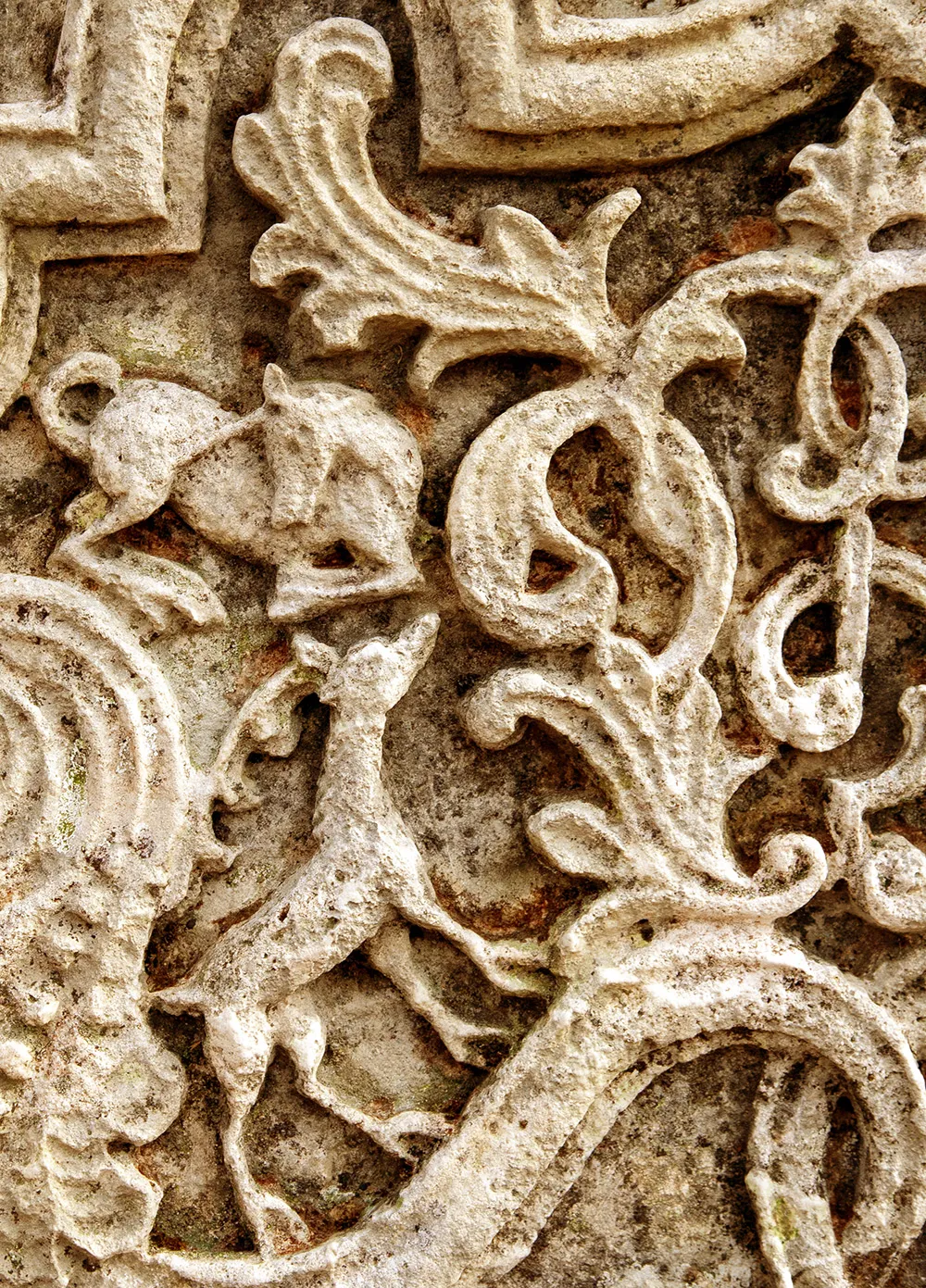
Resting unicorns were usually depicted on the graves of young women and unmarried girls.
The well-known researcher of the traditional art of the Jews of Eastern Europe, Boris Khaimovych, believes that a unicorn that is resting (sleeping) can at the same time serve as a metaphor for death, while the fabulous animal itself in this case embodies the deceased.
One more meaning hidden behind the image of the unicorn is worth mentioning. Among the so-called “biblical fauna”, that is, animals mentioned in the Torah/Bible, there are several species that are still unidentified. Among them is a certain “tachash”, which had very beautiful, multicoloured fur, and whose skins covered the famous Ark of the Covenant (the portable Temple).
Many commentators on the sacred texts believe that the word “tachash” in the Bible refers to unicorns. In this sense the legendary animals serve as a symbol of the Temple, and the image itself points to the righteousness and sinlessness of the deceased.
Does
Beneath the unicorns we see a pair of does. The latter are traditional for the gravestones of young women and girls.
However, quite often it is also simply a symbol of purity, righteousness and a metaphor for death.
In the Psalms/Tehillim we read: “As the hart pants after the water brooks, so pants my soul after You, O God”. (Psalms 41:1-2)
As we see, the stag or doe here symbolises devotion to God. It can also be a metaphor for death — the soul yearns for God in order to be near Him in the Garden of Eden.
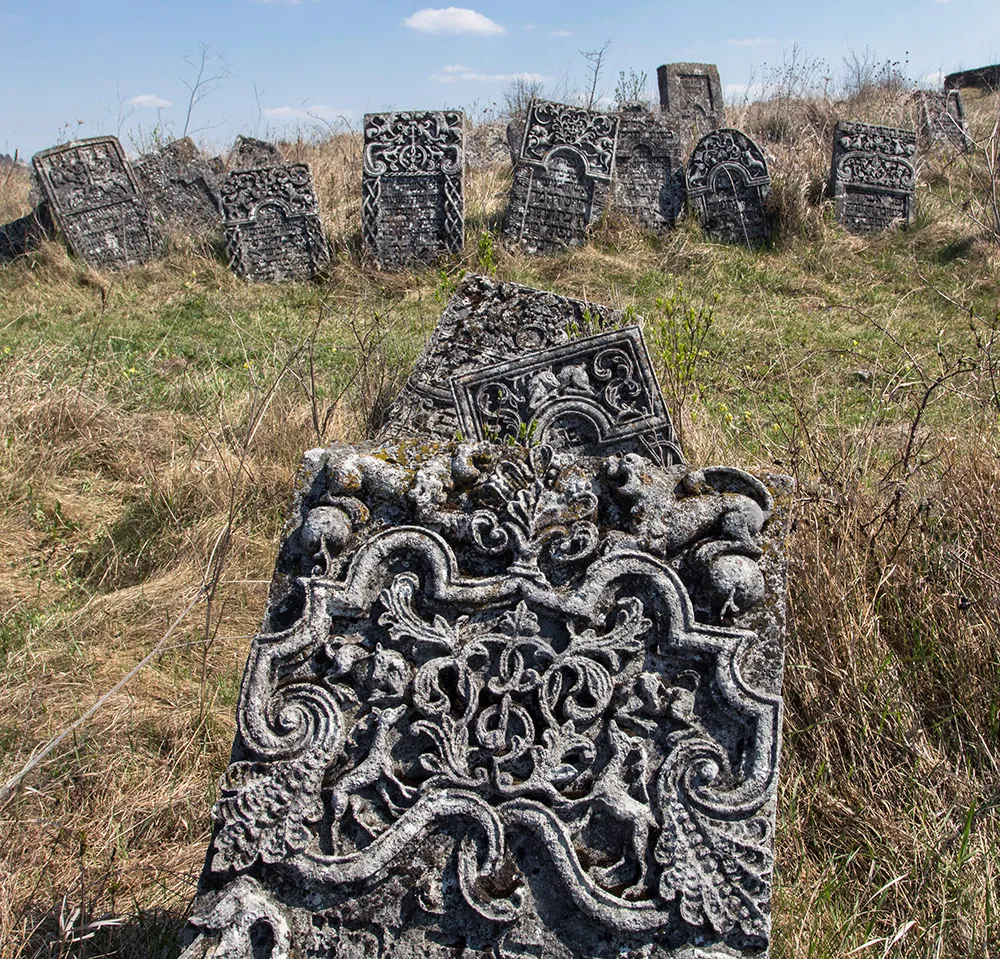
A stag or doe on women’s graves can also symbolically embody death. In the biblical book of the prophet Jeremiah/Yirmiyahu, in a prayer during a drought, we read: “Even the doe in the field gives birth to a fawn and abandons it, because there is no grass”.
Here we see a poetic depiction of the coming of death (drought), as a result of which the mother leaves her little ones to their fate and can no longer care for them.
The plant ornament in the centre of the Baroque cartouche is a metaphorical Tree of Life and, at the same time, the Garden Thickets of Paradise, among which the righteous souls (unicorns and does) rest.
The Tree of Life is also a metaphor for the hope of resurrection from the dead.
On the frame of the epitaph we see a pair of sorrowful storks. In ancient Hebrew (that is, Hebrew), the stork is “chasida”, which shares a root (ch-s-d) with “chasidut” — righteousness, piety. Such bas-reliefs hint that the deceased was a righteous person.
The image of pomegranate fruits, on which the lions stand, has an interesting hidden subtext. According to rabbinic legends, each pomegranate contains exactly 613 seeds — the same number as the commandments in Judaism (taryag mitzvot). The image of the pomegranate indicates that the woman buried here observed all the laws set out in the Torah. The latter, I would note, is very difficult — after all, few people keep even the ten main commandments.
From the start there was a version concerning this grave that a young girl was buried here. This was indicated both by the decoration (unicorns and does) and by the epitaph:
“For this beauty that will rot in the earth I weep…
Tender and delicate…”
That is how they write exclusively about young women!
The most eminent Judaica scholars fully agreed with this version, and its author voiced it more than once in his publications.
But this, as it turned out, was a mistake!
The vandalous and criminal “tidying-up” being carried out at the Sataniv necropolis by an organised group of the notorious French-Israeli rabbi Israel Meir Gabbai is, from the point of view of studying the site, rather interesting. In particular, in the course of the “tidying-up” almost a hundred gravestones were dug out that had long ago fallen and sunk into the ground and were therefore unnoticed by researchers. Pulling gravestones out of their ancient places and setting them on concrete pedestals, although it contradicts heritage-protection legislation and the religious precepts of Judaism, is also interesting from a research point of view. Because it reveals the parts of epitaphs hidden in the ground.
That is what happened with the gravestone to which this article is devoted.
The continuation of the epitaph, which was hidden in the earth, is as follows:
“…Modest [in good deeds] Sarah, daughter of the renowned rabbi Rabbi Meir of Lviv, who died with a good name, in old age, on the eve of the holy Sabbath, 2 Nisan 1783.”
First, here we have a completely different year of death from the accepted one, 1783, whereas the researchers from the Hebrew University for some reason saw 1800.
Moreover, the “girl’s grave” turned out in fact to be the burial of a grandmother of venerable age.
And the gravestone, as is clear from the full translation of the epitaph, was set up not by her parents but by her husband and children.
This adds new meanings and a romantic aura to this burial. Especially this line:
“For this beauty that will rot in the earth I weep…”
Usually the epitaphs on the graves of women who died of old age state that she was a “woman of respect”. A mention of virtue, intelligence and so on is also traditional. But not of beauty.
Decoration of a woman’s gravestone, 18th century. Sataniv
One can only envy this love, when even in an elderly grandmother her husband still saw the young and beautiful Sarah.
And Rabbi Meir of Lviv, as it turned out, was one of the most authoritative rabbis of his time and even a favourite of King Stanisław August Poniatowski. At one time, when still a boy, little Meir prophesied to the young Poniatowski that he would soon receive the crown of the Polish-Lithuanian Commonwealth.
Text, photos and artistic compositions: Dmytro Poliukhovych


