

Khorol. The Khorol Pit, a terrible death camp

· 15 min read
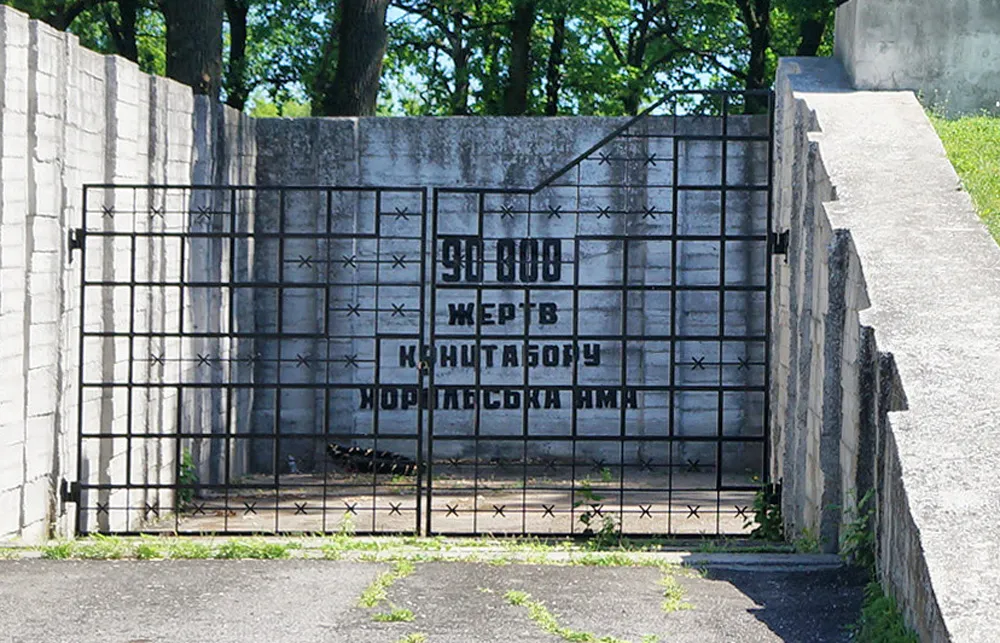
The town of Khorol is very old: it first appears in chronicles under the year 1083. For almost all of its 938 years of history Khorol was a small fortified settlement that was constantly destroyed in wars and not allowed to develop. It never rose above the level of a company-district town, but never sank to the level of a village either. Even now about 13 thousand people live here: a small town, but a town.
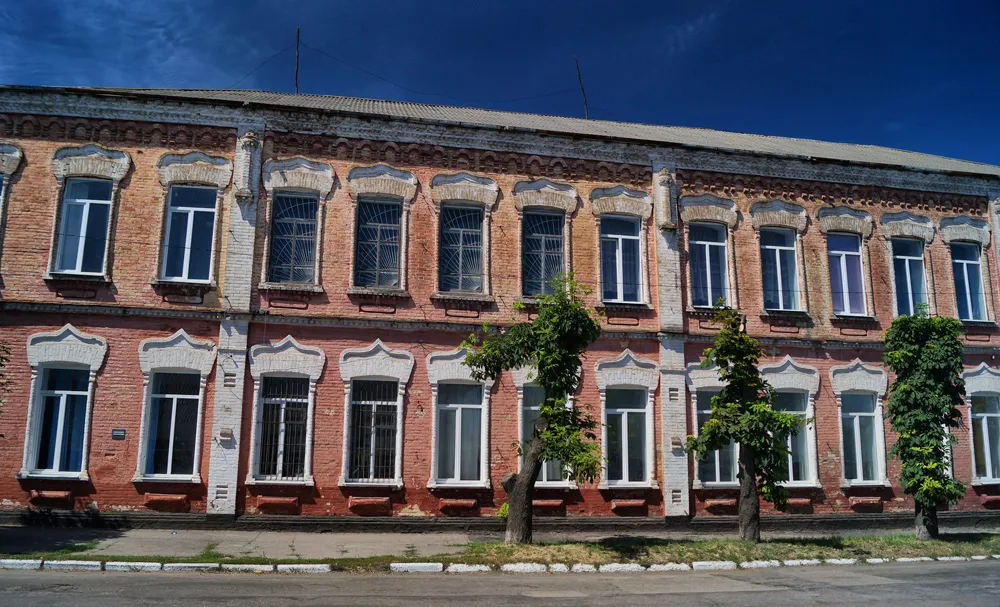
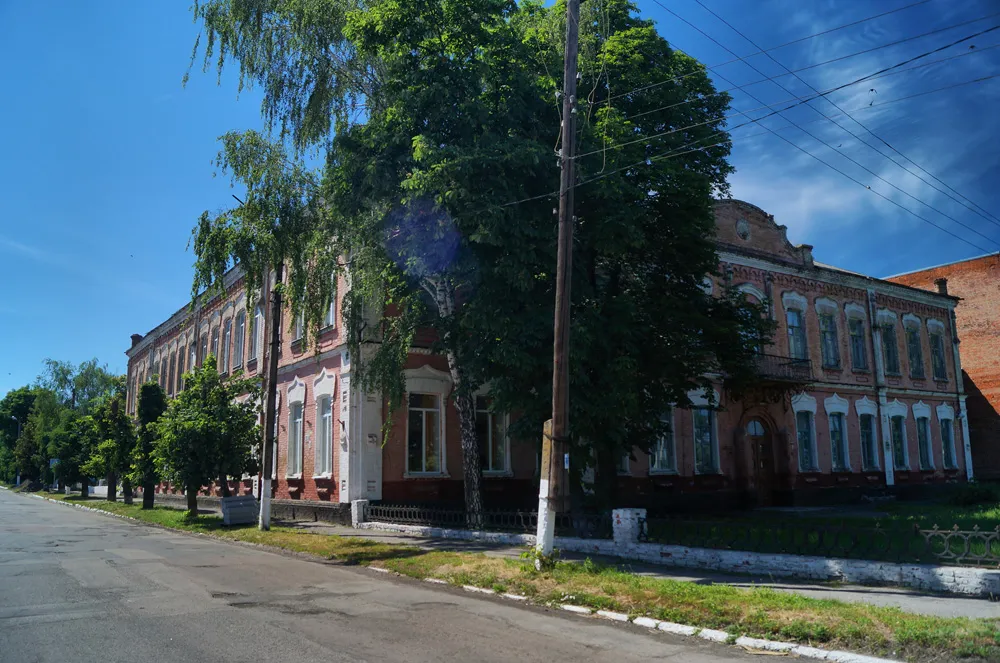
There are very few tourist sites in Khorol, if not to say none at all. The few buildings of the late 19th century amid Soviet-era construction, mostly private housing, I would not call tourist sites. But Khorol has something that could turn the town into a tourism centre, even an international one. Potentially Khorol is a powerful tourist hub, but when that potential will be realised is hard to say. No effort from the local authorities to actually realise it is visible… What am I talking about? About the Khorol Pit, a terrible Nazi death camp in which between 95 and 110 thousand people were killed.
Have you heard of the Khorol Pit? Most say no. How can that be? Why is there almost no information about this terrible place? Tourists from all over the world travel to the former death camps in Poland. To see, to learn, because tourism is not only fun on the beach. With proper promotion and the appearance of infrastructure, people would certainly start coming here. First Jewish groups, and then any others. But there is not even advertising, let alone more: the general information online is very scanty. Here is what Wikipedia says:
“The Khorol Pit” (Dulag No. 160) was a Nazi camp for prisoners of war of the Red Army in the town of Khorol, which existed from 20 September 1941 to 15 September 1943.
In six of the known mass graves rest the remains of between 91,500 and 100,000 Soviet citizens: men and women, Communists and non-party people, natives of various cities and villages of the USSR. The Act of the commission investigating war crimes of 1 October 1943 states that those directly guilty of the destruction of people in the “Khorol Pit” were Gebietskommissar Eisenach, Gestapo chief Dietmann, commandant Singer, Lance Corporal Niederein (awarded the Iron Cross in 1942), doctors Früchte and Schröder and others.
There is also something there about Soviet patriots, but that is rather poor information. 100 thousand human lives, and now, in the 21st century, we can find out almost nothing about it. Just as, incidentally, about most other death camps on the territory of Ukraine, such as Bohdanivka, where 55 thousand people were burned alive. Strange. It seems that someone is deliberately working to keep this terrible information from spreading on the Internet. Or simply everyone is indifferent. What do you think?
Text and photos by Roman Malenkov.
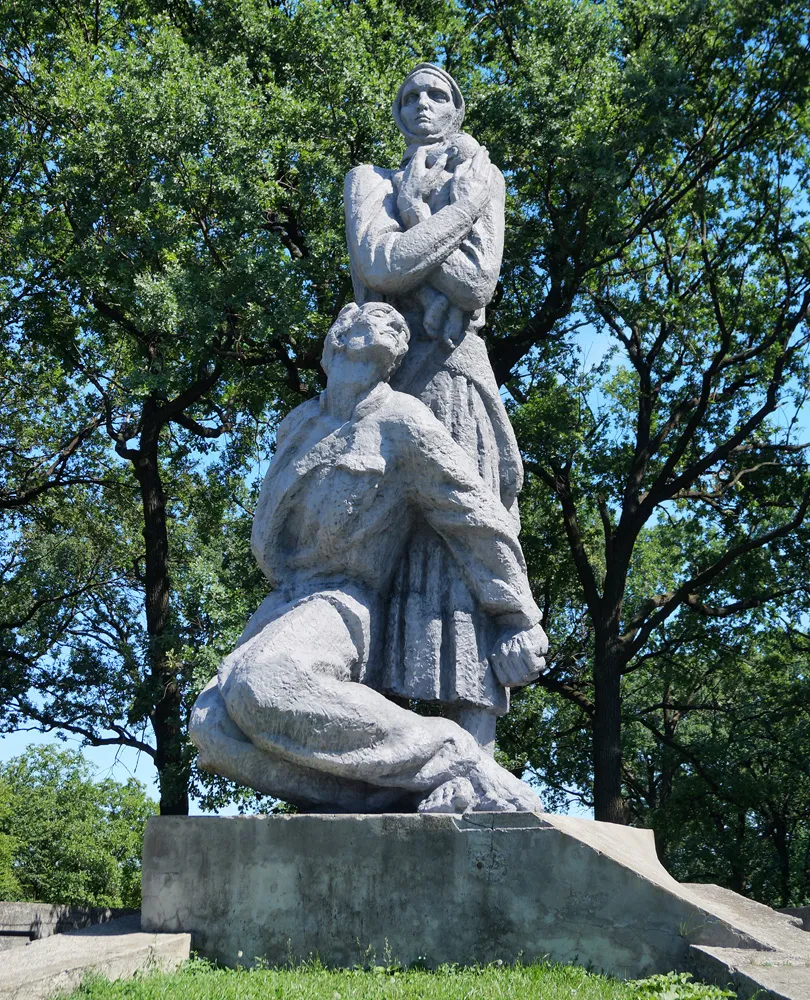
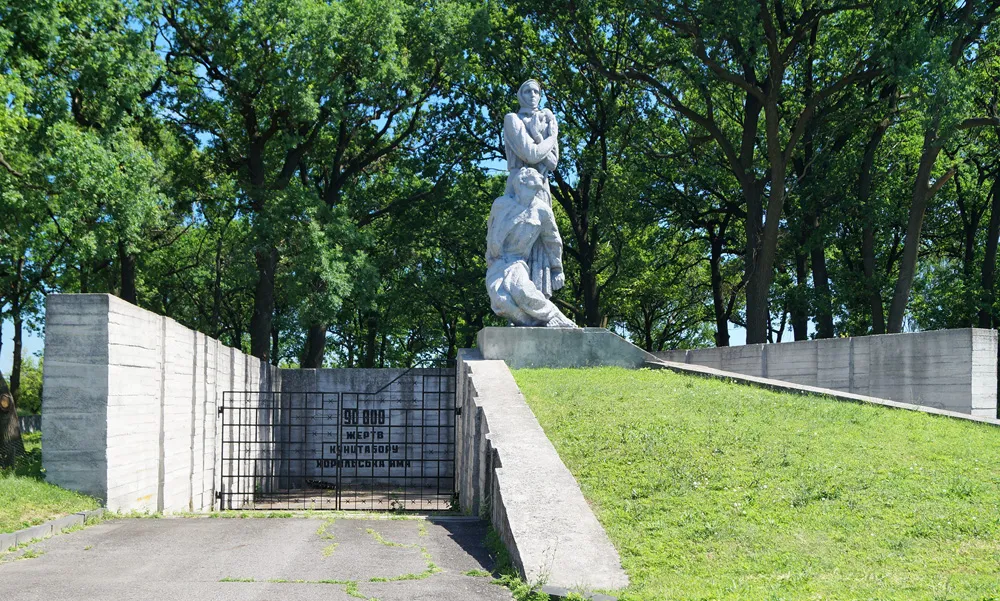
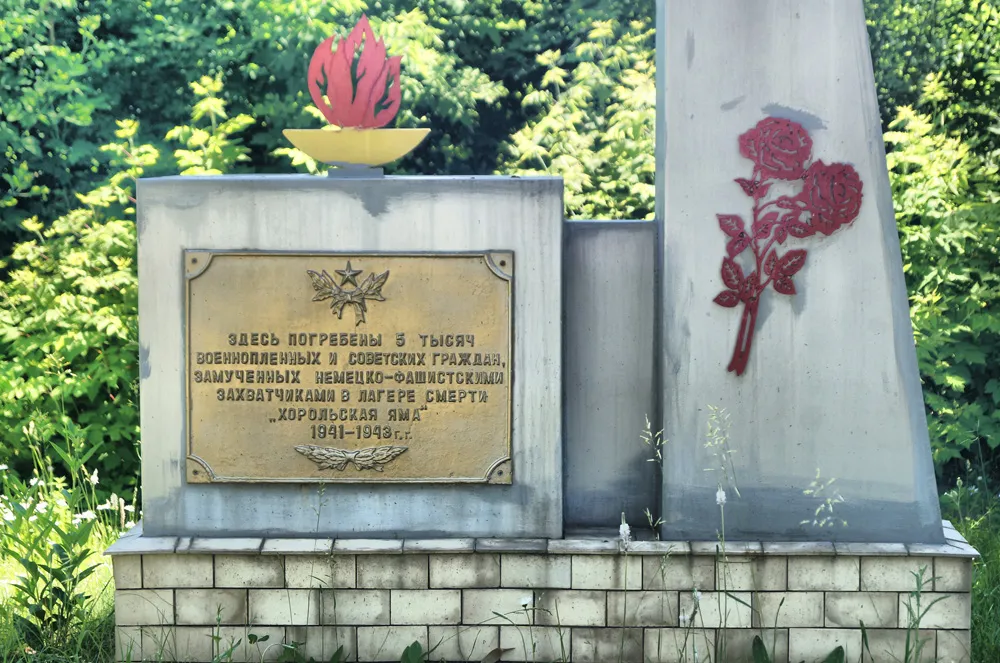
Next is an article from the website “Novyny Poltavshchyny”. Author: Oleh Dubyna
“The Khorol Pit”: memories of those who went through hell
For almost two years, in one of the most terrible German death camps, located in the town of Khorol (Poltava region), by approximate estimates about 100 thousand people died.
The legendary Prime Minister of Great Britain (1940–1945, 1951–1955) Winston Churchill is the author of the phrase:
“War is when absolutely innocent people die for the interests of others.”
Because of Adolf Hitler’s fantastic and horrific dreams of a Greater Germany, Ukraine lost millions of people. In practically every settlement the Germans and their allies created death camps where hundreds of people died every day.
One of the largest was in the town of Khorol, where the cruelty of the German occupiers knew practically no bounds. The camp entered history under the name “the Khorol Pit”.
The front
After the catastrophe of the South-Western Front of the Red Army, which practically ceased to exist after the lost defensive battle for Kyiv (there were more than 600 thousand Soviet soldiers taken prisoner alone – the author’s note), the German-Soviet front turned sharply east. On 12 September 1941 the 1st Panzer Group and the 17th Army of the Wehrmacht struck from the Kremenchuk bridgehead northward to meet the troops of the 2nd Panzer Group in the direction of Lokhvytsia, capturing Khorol and Lubny on the way.
The horror of the first day
According to archive files now kept in the Sectoral Department of the Security Service of Ukraine, on the first day of the occupation of the town (11 September 1941) the Germans seized a local resident, Vasyl Kornienko, on one of the streets. He was accused of having served in the Red Army. The man was beaten and led out of town to be shot. Kornienko managed to break free from the guards, after which he attacked a German officer and beat him. Then the Nazis cut off the man’s hands. He managed to escape, but on the second day the Germans found him and, already half-dead, shot him.
The destruction of the Jews of Khorol
In October the German commandant of Khorol, Brenecke, issued an order proposing that the entire Jewish population of the town appear on the Bazaar Square. The same document ordered the Jews to take with them valuables, warm clothing and food for two days. They were promised to be sent to Dubno to work.
The people were led under escort along the Lubny highway. When they came to a ravine beyond the town limits, the Germans ordered them to turn off the road. Then the locals understood what would really happen to them. They threw down their belongings, begged for mercy, many rushed to run in different directions, but when the German officer gave the command, bursts of submachine-gun fire…
Before this the children had been led aside and each had poison smeared under the nose (perhaps it was morphine), because of which they soon died. In total about 500 people lost their lives that day.
The camp
On the territory of the brick factory and the grain elevator it is now relatively quiet, unlike September 1941, when the occupation authorities decided to set up a transit camp for prisoners of war there. In the German register it was called Dulag No. 260.
“There was a huge pit here from which clay had been taken for various processes for many years. Now entry to the territory of the factory itself is closed because it is private property, but this part of it is partly visible from the side of one of the monuments to the dead,” said Nelia Petlovana, a representative of the Khorol Local History Museum.
The pit itself was from 3 to 5.5 metres deep and was fenced with rows of barbed wire. Guards walked around, ready to shoot anyone who came near the wire.
“…we feared the wire like fire. If a person was pushed or fell less than a metre from the wire, a shot immediately rang out from the tower…”, said Anatolii Overchuk of Lviv during interrogation on 16 November 1974.
Three machine guns and two cannons were also located at this place.
In 1974 the artist Oleksandr Zaitsev recounted:
“The pit was surrounded by barbed wire with four towers at the corners with searchlights and machine guns; soldiers armed with submachine guns, dressed in the uniform of the German Nazi army, walked along the wire.
The bottom of the pit was constantly covered with such a thick layer of mud that it was hard to pull your feet out when walking. The wall of the pit was 10 metres high. In this “pit” under the open sky there were, I think, about 40 thousand prisoners of war.
The conditions for holding the prisoners were very hard: I saw that every morning no fewer than ten prisoners’ corpses were carried out to the exit of the “pit”. There was no medical care.
During the day about 700 grams of thin soup was issued, that is, potato or beet peelings boiled in water, and also a two-hundred-gram piece of black bread baked with some admixtures. Huge queues formed for this food, people crowded, and once, at the end of September 1941, the camp guards began to shoot into this queue. After the shots two or three people were left lying on the ground…
We slept right on the ground; there was nothing to lay under us. Some prisoners dug niches in the walls of the pit with their bare hands and hid there from the rain, but most people got soaked.”
As eyewitnesses recounted, the day in the camp began at 4 a.m. Policemen burst into the barracks where the prisoners were and in hysterical voices ordered them to get up. The Nazis beat with whips the wounded who were no longer able to do so. The Germans drove all the prisoners of war out into the camp yard. There they were soaked by the rain and died of hunger and cold.
Fata Faizov (Red Army soldier, interrogation of 31 March 1942):
“On the evening of 28 September 1941 I arrived at the Poltava camp among the prisoners of war. At that time there were 15 thousand of us prisoners. On the morning of the 29th, two thousand of us who were in Barrack No. 10 were lined up in the camp yard. Soon a German interpreter arrived here in the uniform of a German sergeant-major, who understood Russian well. He introduced himself as a German interpreter, said he had been sent by the German commandant’s office and asked the middle and senior command staff to step out of the line. He assured us that if they did not step out they would be shot, while those who stepped out themselves would be considered to have surrendered voluntarily and special conditions would be created for them.
Ten to twelve people stepped out of the line of prisoners and were instantly taken away to a place unknown to me. After that the same interpreter, addressing the formation again, said rudely: ‘Yids, step out of the line.’ Ten to fifteen Jews stepped out and were instantly taken away, where exactly, I do not know…”
It was towards representatives of the Jewish people that the Germans behaved most cruelly. Anyone who looked like a Jew was smeared with paint, a star was drawn on his back, his head was smeared with tar and he was tortured until he died. They stripped the prisoner naked, tied his head and legs to a wooden log and left him for several days; the person died.
Food
For the first two weeks the prisoners were starved: they were given half a litre of foul liquid made from rotten potatoes and, per 100–150 people, a two-kilogram loaf of bread.
“…I asked a soldier in German to give me bread, and the German threw me a piece. I do not remember how I broke free from the crowd…”, the actor Ihor Luzanov recounted after the war.
Almost nobody had mess tins, so the prisoners of war were forced to receive the thin soup in the hems of their tunics, in forage caps, in peaked caps, and many simply in cupped hands. The starving people threw themselves at the barrel where food was handed out and knocked the policemen over.
Days of shootings
The deputy commandant, Non-Commissioned Officer Müller, and Senior Lance Corporal Hans had a sort of bloody amusement that cost the lives of more than a dozen prisoners: from time to time they climbed the tower and from there fired submachine guns into the crowd.
Oleksandr Okinenko (former prisoner):
“The camp commandant himself (Singer) was a captain, about 45–50 years old, without his right arm (a prosthesis), his shoulder boards were solid fringe, he wore a khaki tunic and trousers and no stripes. He lived in the officers’ barrack of the camp…
In the camp all the work was done by prisoners of war. But women worked in the kitchen and laundry for the Germans: one from Kharkiv named Nadia, about 30, who had supposedly come from Kharkiv; the second, Halia Zdor, about 20, from Shtompelivka; the third, Lilia, about 18, a German colonist, who fled with the Germans when they retreated….
During the frosts the half-naked prisoners stayed in plank barracks, and in the morning dozens of frozen people were carried out of there. The wounded and those who had caught cold stayed with everyone else; sometimes they were thrown into an open barrack, the so-called “sanitary unit”. Doctors among the prisoners of war could not give them real help, since no medicines or dressing materials were provided.
…a German doctor, Früchte, came to the camp. On his orders many of the wounded were selected and moved to the “infirmary”. There the German executioner engaged in bloody business: he “performed operations” on the wounded and sick, but almost nobody returned to the ward. Torn to pieces, with arms and legs cut off, they died. They were thrown into the pit.”
In the camp people were hit on the head with a stick everywhere, anyone and for no reason, regardless of age and physical condition. On 28 and 29 September thousands of prisoners received no food at all and saw no water for 5–10 days; death from hunger was a common occurrence. Every day several dozen who had died of hunger or been killed and shot were carried out of the camp.
According to eyewitnesses, one day an elderly collective-farm woman came up to the camp and threw a parcel for her son over the wire. Before he could touch it, a sentry fired and killed the man before his mother’s eyes.
On 24 September 30 prisoners were shot for no reason at all. When the Germans discovered a Jew who was trying to hide his nationality, they beat him mercilessly and then shot him…
As the prisoner of war Kovalenko recounted, on 3 October 1941 the Germans got drunk and, armed with sticks, began beating the prisoners. Ten people were carried out half-dead. The morning of 5 October began with the Germans killing a 50-year-old man at point-blank range and severely wounding a captured Red Army soldier. The latter was later finished off.
“On 7 October the prisoners got a chance to swallow a few drops of water. A crush began. For “order” a sentry opened machine-gun fire and with the very first burst killed 8 people.
On 9 October the corpse of a prisoner of war who had died of hunger lay all day. The same day a man driven to despair hanged himself. His body dangled near the entrance.”
Mortality in the infirmaries reached 600 people a month. According to German statistics, from 22 September 1941 to 1 May 1942 alone, 37,600 people died in the camp. But this is far from complete data.
Memories of the camp’s famous prisoners
Oleksandr Malynovsky (architect, one of the authors of the general plan for the reconstruction of Khreshchatyk, interrogation of 3 October 1975):
“During my time in the ‘Khorol Pit’, the Germans from the camp commandant’s office carried out punitive operations several times. They consisted of German soldiers entering the territory of the ‘Khorol Pit’ itself and selecting from among the Soviet prisoners of war persons of Jewish nationality and party workers. The Germans herded all those selected into a large barrack without walls that had previously been used for drying bricks, and then led them out of the camp zone. After that these people were sent away from the camp, and soon the sound of shots was heard… Each time the Germans selected several hundred people…”
Mykhailo Hrechyna (in 1936–1941 chief architect of the construction of the Khrushchev Stadium, now called the Olimpiyskiy National Sports Complex, interrogation of 11 October 1974):
“I was held in the ‘Khorol Pit’ for 10 days, after which I was moved to a prisoner-of-war camp located 4 kilometres from the ‘pit’, near the Khorol railway station on the territory of the former elevator. This camp was called ‘Dulag’ with numbers that I cannot remember now.
This camp consisted of two barracks that had previously served as granaries, with earth floors, completely unsuited for sleeping. Several thousand prisoners of war, approximately 6–10, were held in the ‘Dulag’ at one time.
The camp zone, like the ‘Khorol Pit’, was also divided into two sectors: in one the prisoners spent the night, and into the other, where there were no buildings at all, the prisoners were driven during the day. When moving from one sector to the other, the prisoners were given food once a day in the same quantity and quality as in the ‘pit’, though the bread was even worse.
Not all the prisoners fitted into the barracks for the night; some stayed outside and slept on the ground. In the barrack they slept on the floor in a sitting position; some tied themselves to the rafters with a rain cape. In addition, almost daily German officers and soldiers fired at the barrack where the prisoners slept, killing many…Every day no fewer than 200 died.”
After the occupation
After the Red Army arrived, an investigation of the Germans’ atrocities began, which for various reasons dragged on for months. Only on 27 February 1944 was the final Act drawn up, signed by the chairman of the special commission Klyment Mysak, as well as by some local residents who were witnesses to the existence of the camp.
For a long time not so much was known about the events in Khorol, although the people who had lived through the German occupation did not intend to stay silent. For example, thanks to the works of the writer Dmytro Bedzyk, the artist Yevhenii Kobytiev and Abram Rieznichenko, as well as many other former prisoners of the camp, memories of the terrible period were preserved.
At present the events in Khorol are recalled by six mass graves, in which, according to various data, up to 100 thousand people are buried, and by a memorial complex that was built and opened only in the last months of the existence of the Soviet Union.
—-
The materials used data from files kept in the archives of the Security Service of Ukraine.
The author expresses gratitude to Olena Yevdokimova, administrator of the information and reference hall of the archive support sector of the SBU in Poltava region, for help in creating the material.
Oleh Dubyna, “Novyny Poltavshchyny”


