Who lived in the “terem”? (Andriivskyi Descent, 34). The Stoliarenko house
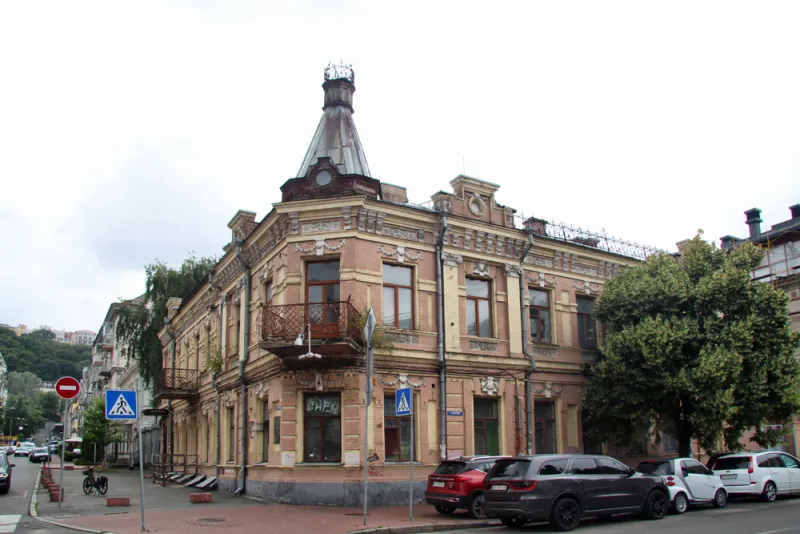
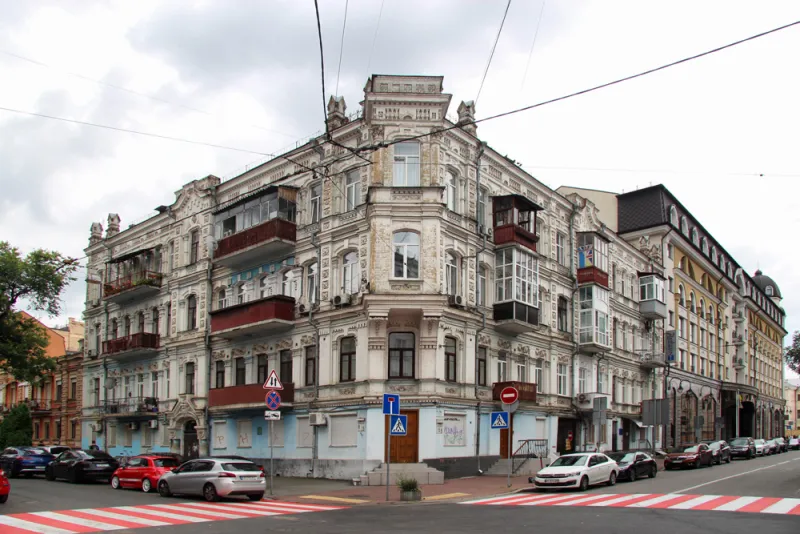
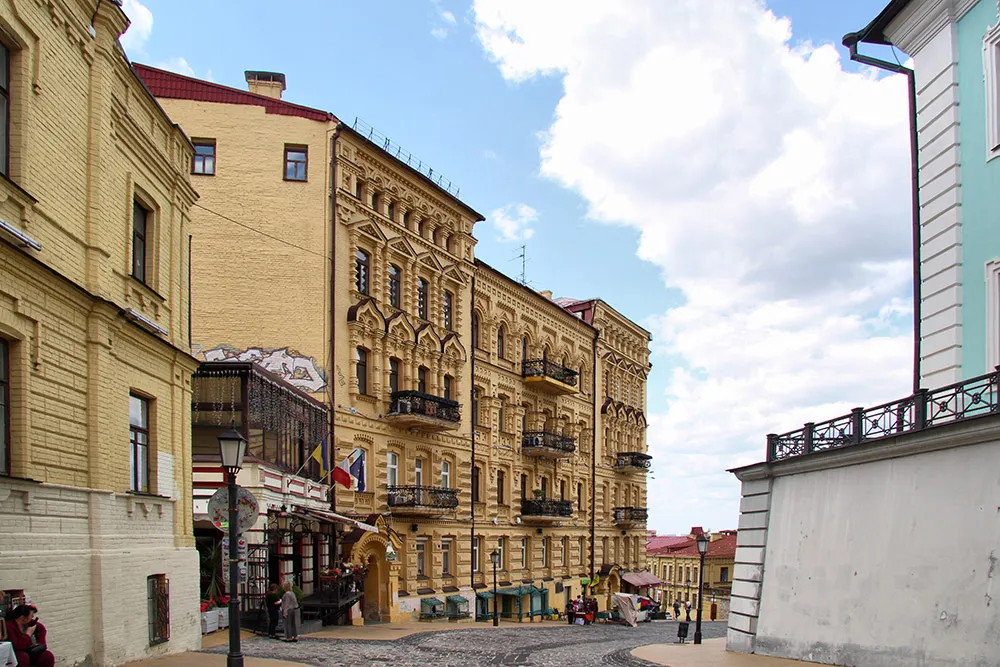
House No. 34 is one of the most beautiful on Andriivskyi Descent. It stands directly opposite the famous church that gave the street its name.
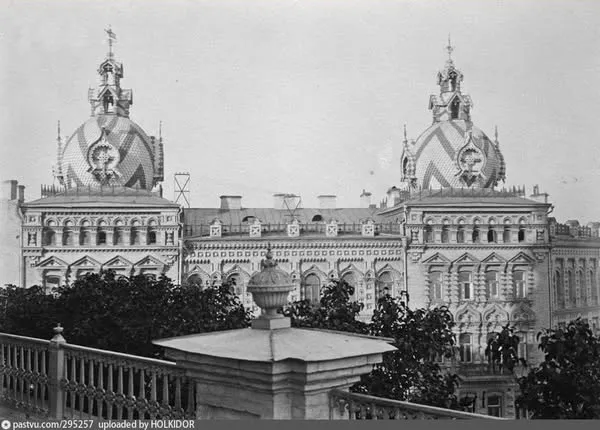
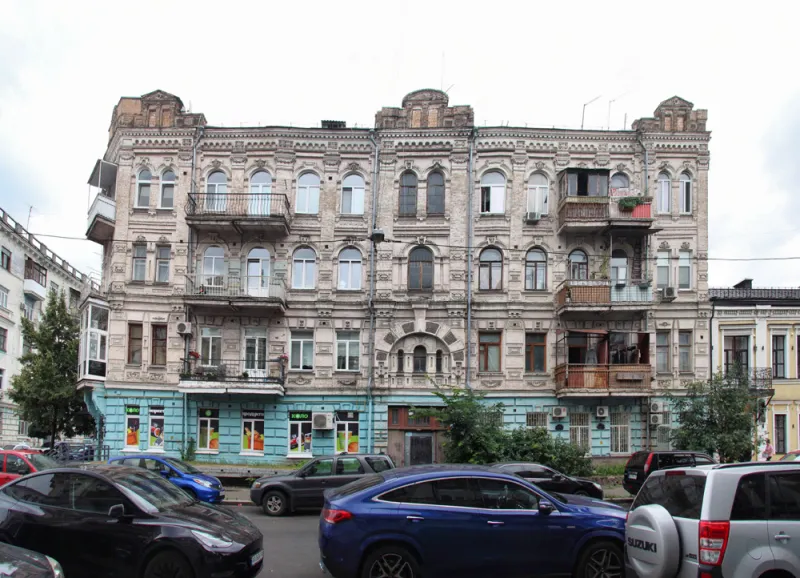
The house was built in the so-called “Muscovite terem” style, commissioned by Yefrosynia Stoliarenko in 1900–1901 as an income-generating building. It was erected to a design by the architect Oleksandr Khoinatskyi. The work was carried out under the supervision of the civil engineer Mykola Vyshnevskyi. Because of the considerable slope of the terrain, the wings of the building have different numbers of storeys.
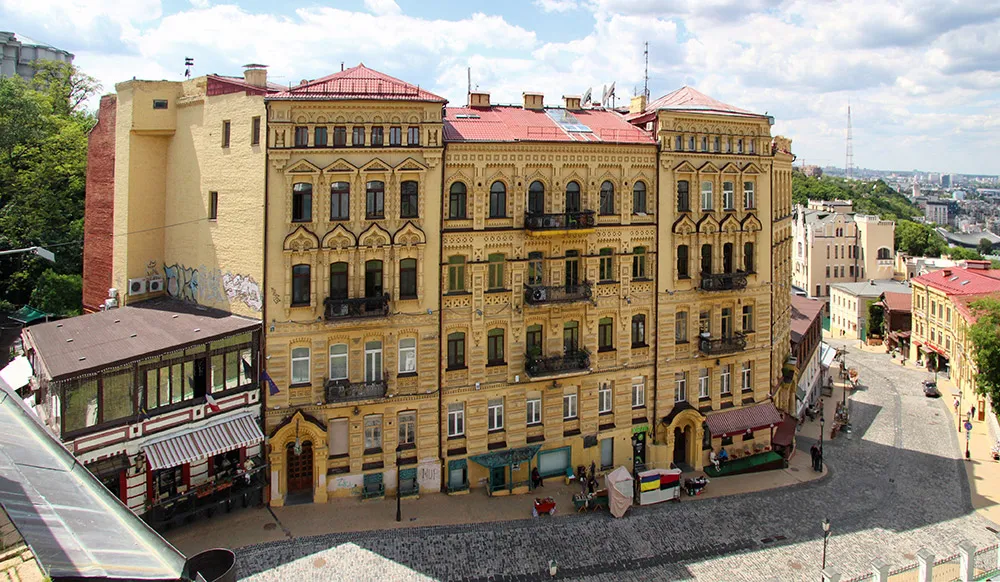
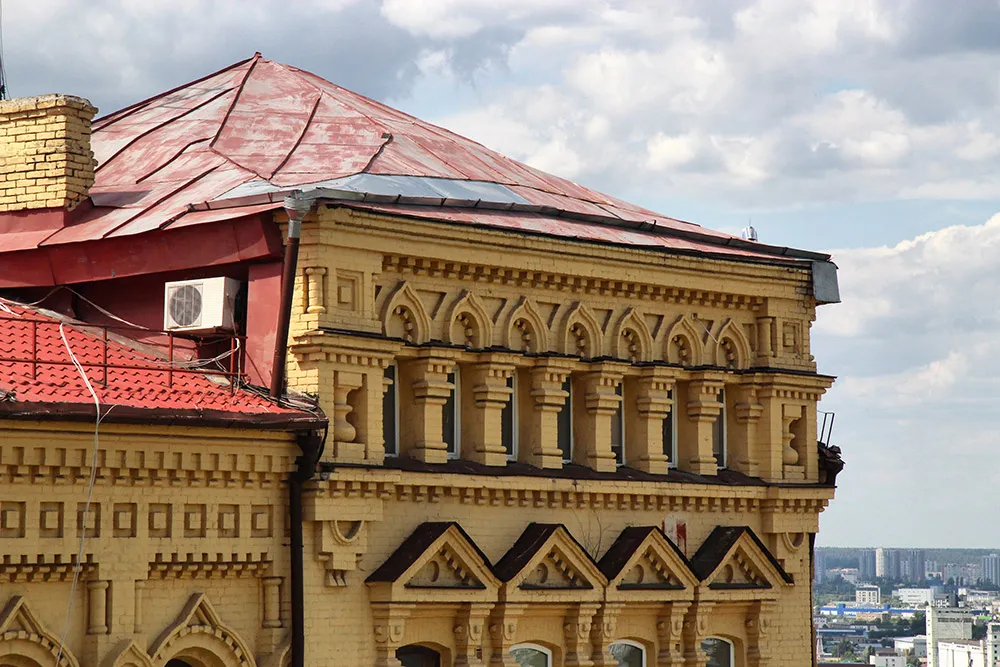
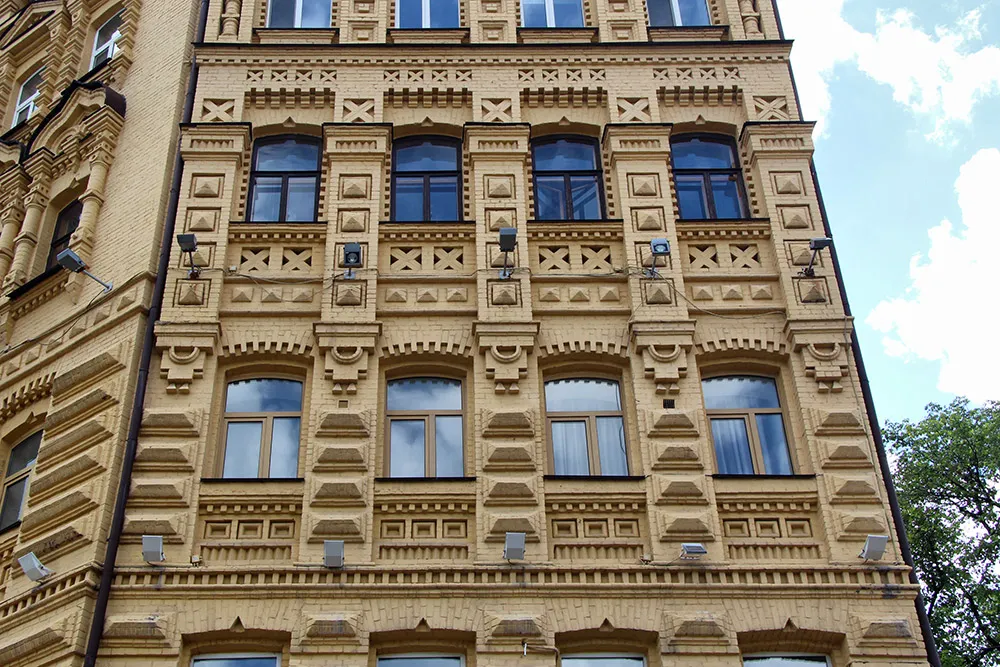
Owing to the features of the plot, the composition of the main facade is asymmetrical. The upper corner part and the curve of the facades are emphasized by vertical projections that turn into raised volumes of attic rooms. Originally the projections were crowned with large onion-shaped domes with lanterns, decorative kokoshniks and an ornamented scale-like covering (lost). Urban legends claim that the domes were clad in sheet silver, but that is hardly so…
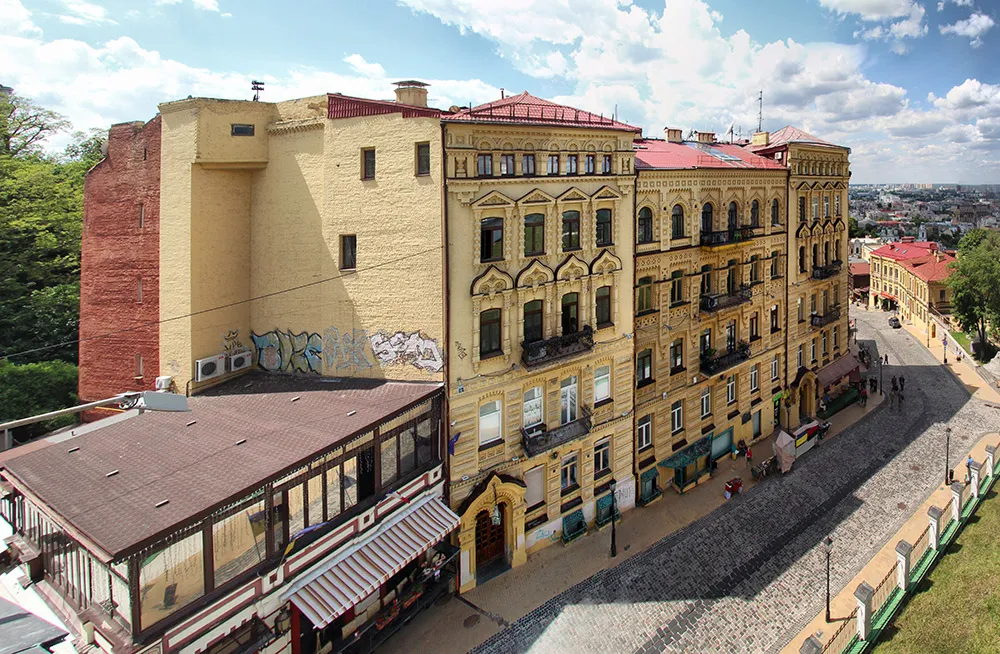
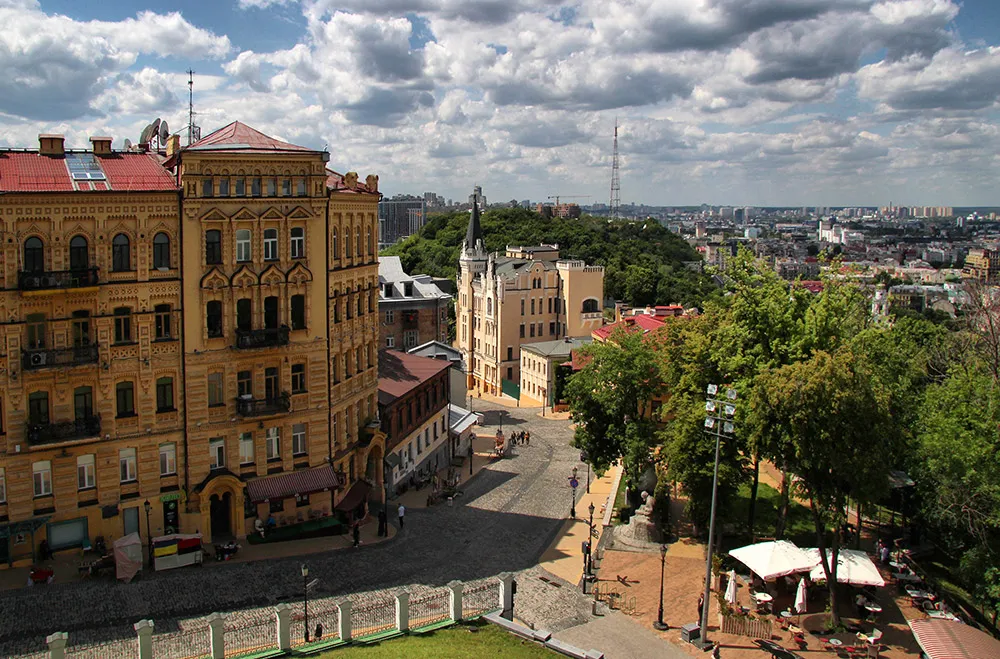
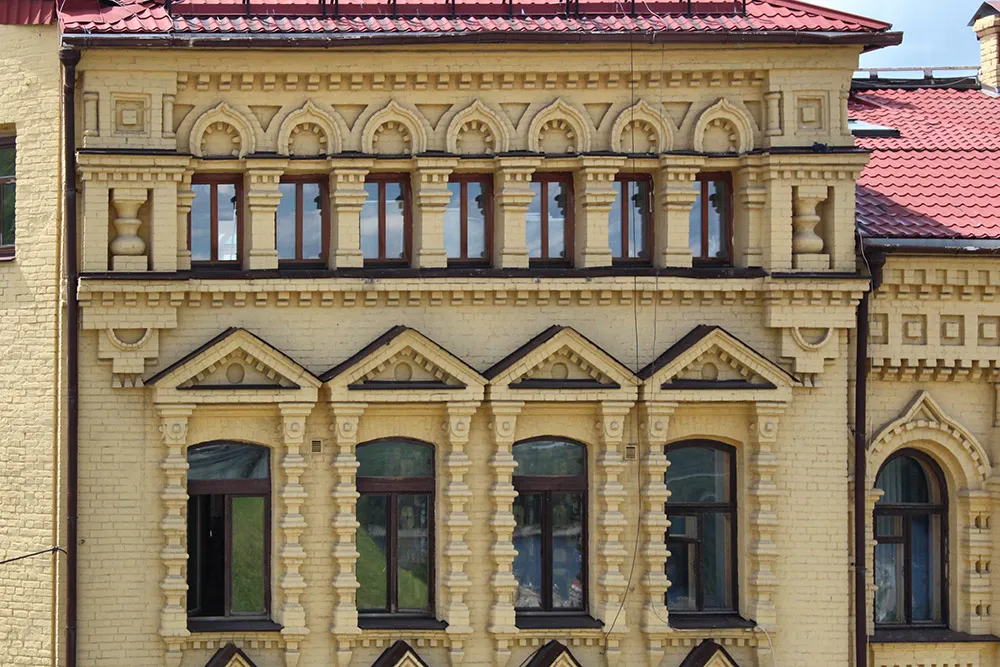
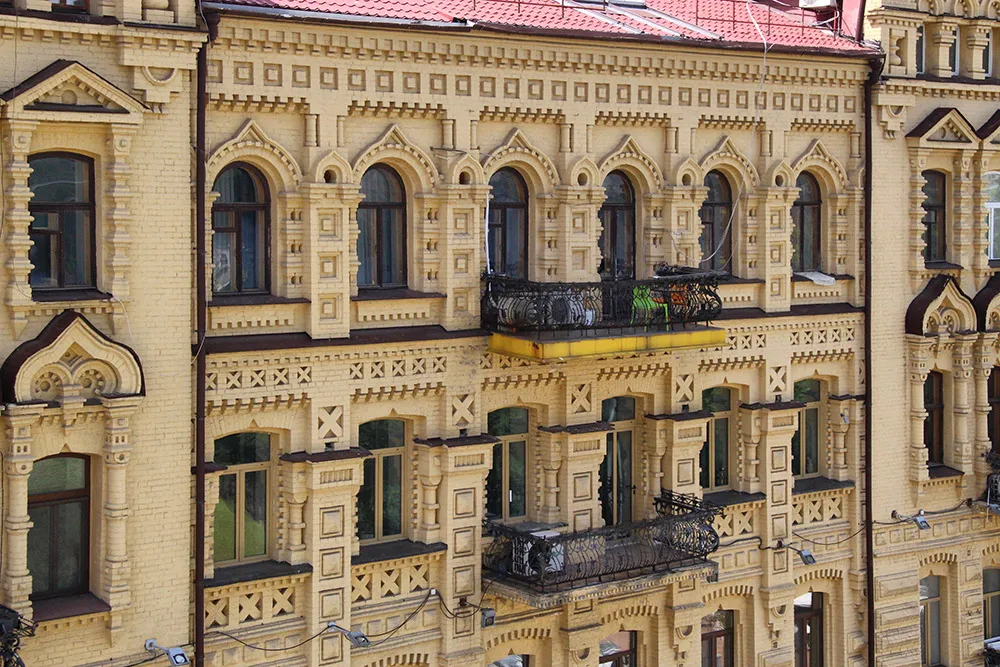
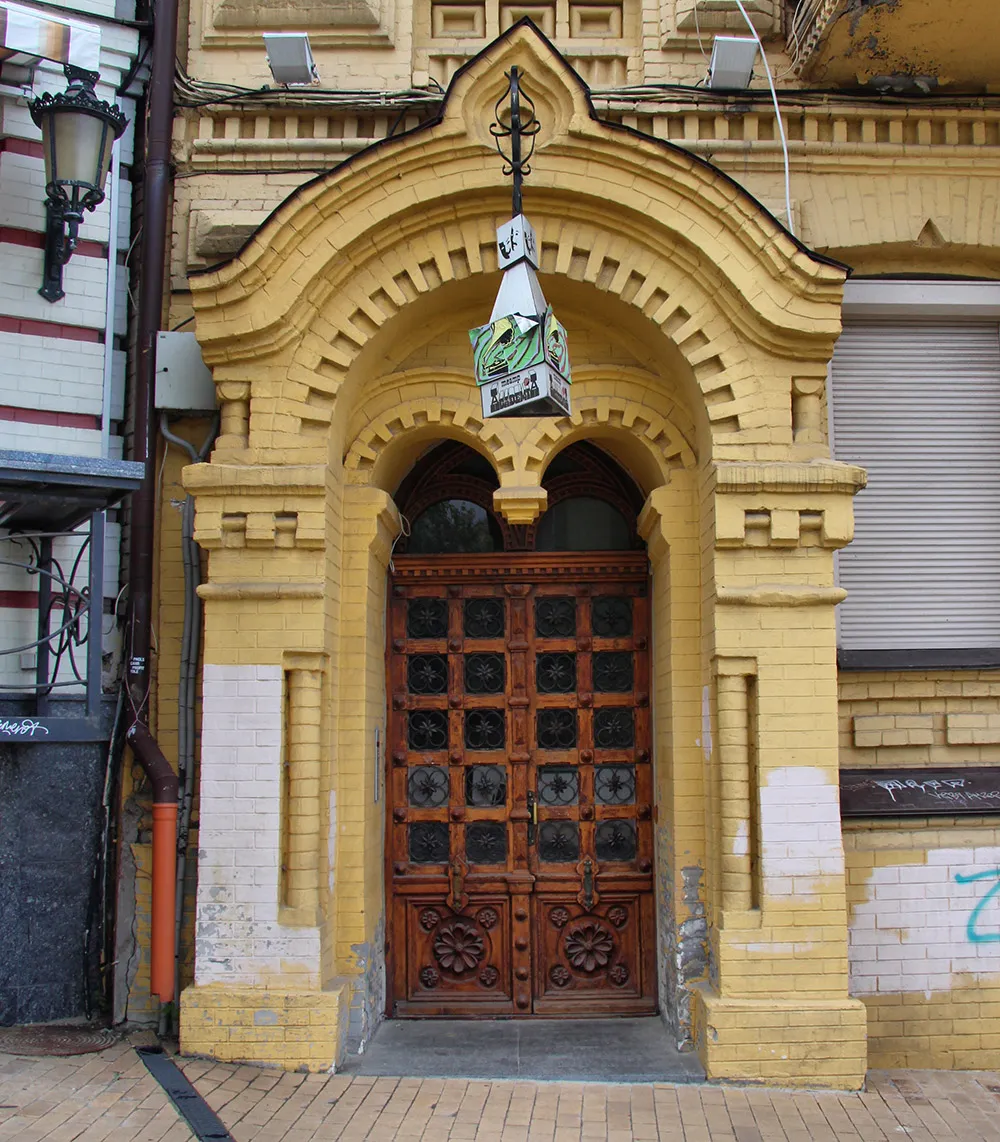
The sculptural decoration of the facade, made of brick, is kept in the forms of 17th-century Muscovite architecture, stylized as a “terem” (there was such a “native” fashion in the early 20th century in the Russian Empire). The lower floors are finished as rustication. The entrances are marked by massive arched portals with voussoirs. The lavish decor of the two upper floors consists of window frames with keel-shaped and triangular pediments, panels, a dog-tooth frieze, keel-shaped kokoshniks and niches. The doors in the stairwell vestibules, decorated with applied carving and shaped glazing, have survived, as has the original interior finishing (stucco, parquet, tiled stoves, granite stairs with wrought-metal railings).
Who lived in that “terem”?
From 1907 to 1911 apartment No. 29 in this house was home to Pavlo Zhytetskyi (1837–1911) – a philologist and researcher of the Ukrainian language and literature; an educator, corresponding member of the St. Petersburg Academy of Sciences (from 1898), member of the Kyiv Old Hromada and of the South-Western Branch of the Russian Geographical Society, full member of the Shevchenko Scientific Society, contributor to “Kievskaya Starina”, where he supervised the compilation of a dictionary of the Ukrainian language. In 1907 he was elected the first honorary member of the Ukrainian Scientific Society in Kyiv. On 30 May 1908 he was awarded the academic degree of Doctor of Sciences.
In 1908 he began work on the “Encyclopedia of Slavic Studies”, which was published after his death, in 1914, in the journal “Ukraina”.
From 1908 to 1958 apartment No. 9 on the second floor was home to Taufik Kezma (1882–1958) – an orientalist. After graduating from the Kyiv Theological Academy in 1906 he taught Arabic and Turkish at Kyiv higher education institutions; from 1920 he was a senior lecturer at the Faculty of International Relations, and from 1948 a professor at Taras Shevchenko Kyiv State University. He headed the Arabic-Iranian philology sector of the Academy of Sciences of the Ukrainian SSR. In 1928 T. Kezma created the textbook “Elementary Foundations of Arabic Grammar in a Popular Presentation”, which won the recognition of many Ukrainian and foreign scholars. T. Kezma promoted Ukrainian literature in Arabic-speaking countries, in particular in Egypt, Syria and Iraq, and collaborated with the journal “Al-Ikha” (“Brotherhood”, Egypt). He published many materials about T. Shevchenko, I. Franko and Lesia Ukrainka, and translated into Ukrainian works by Arab writers: Jalal Khalid, Muhammad Taymur and others.
In 1919–1920s apartment No. 1 was home to Mykola Saharda (1870–1943) – a bibliographer. He graduated from the Kyiv Theological Academy and taught at the Poltava Theological Seminary. From 1919 to 1934 he worked at the All-People’s Library of Ukraine, as head of the periodicals department and editor of the “Journal of Library Science and Bibliography” (1927–30). He was repressed..
From 1963 to 1967 apartment No. 17 was home to Hryhir (Hryhorii) Tiutiunnyk (1931–1980) – a prose writer, laureate of the Lesia Ukrainka Prize (1980, posthumously, for the novellas “Klymko” and “A Light Far Away in the Steppe”). In 1991 a bronze memorial plaque with a bas-relief portrait of the writer was installed on the facade of the building.
Today the ground floor of the building houses the “Akademiia” studio theatre, the “Tryptykh” art gallery and a cafe.
(Materials from “Captivating Kyiv” were used in preparing this text)