

Kryvchyk: the Ottoman riddle of a “secret” palace

· 12 min read
The Krupenskyi Palace in Kryvchyk, near the former district centre of Dunaivtsi, a monument of architecture of local significance, fully deserves the title of the most unknown and mysterious palace in Khmelnytskyi Oblast. The main reason is that the former palace houses a psychoneurological residential care home. Such institutions are rather closed everywhere in the world, and it is extremely difficult for outsiders to get into them, let alone tourists.
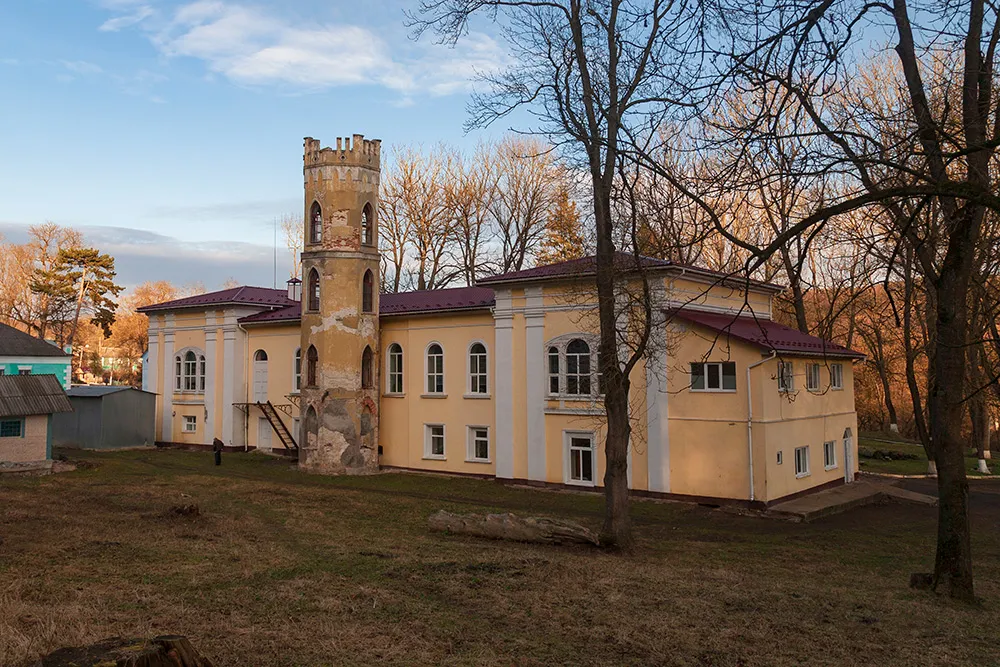
The palace in Kryvchyk
The ancestors of the Krupenskyis, of the Poraj coat of arms, moved from Poland to Moldavia as early as the 17th century. In particular, the “exiled” Moldavian prince Dimitrie Cantemir, who was forced to flee to St. Petersburg after joining the failed Pruth campaign of Tsar Peter I, mentions the Krupenskyis of his time in his “Description of Moldavia” and stresses their Polish origin. We know, for example, that in 1669 a certain Adronakii Krupenskyi is mentioned in the court rank of “vel ushier” (great doorkeeper).
After Bessarabia was annexed to Russia, the Krupenskyis hastened to serve their new masters. Matvii Krupenskyi, for example, soon became vice-governor of the region. In 1845 the Krupenskyis were finally recognised as Russian nobles, though a previous decision to that effect dates from as early as 1821.
The time when the palace appeared is not known for certain, but it is generally accepted that it happened sometime in the second half of the 19th century. It is believed to have been built at the expense of Mykhailo Heorhiiovych (Yehorovych) Krupenskyi. Unfortunately, after the notorious fire at the Kamianets-Podilskyi archive a large body of documents was lost, and here one can only guess.
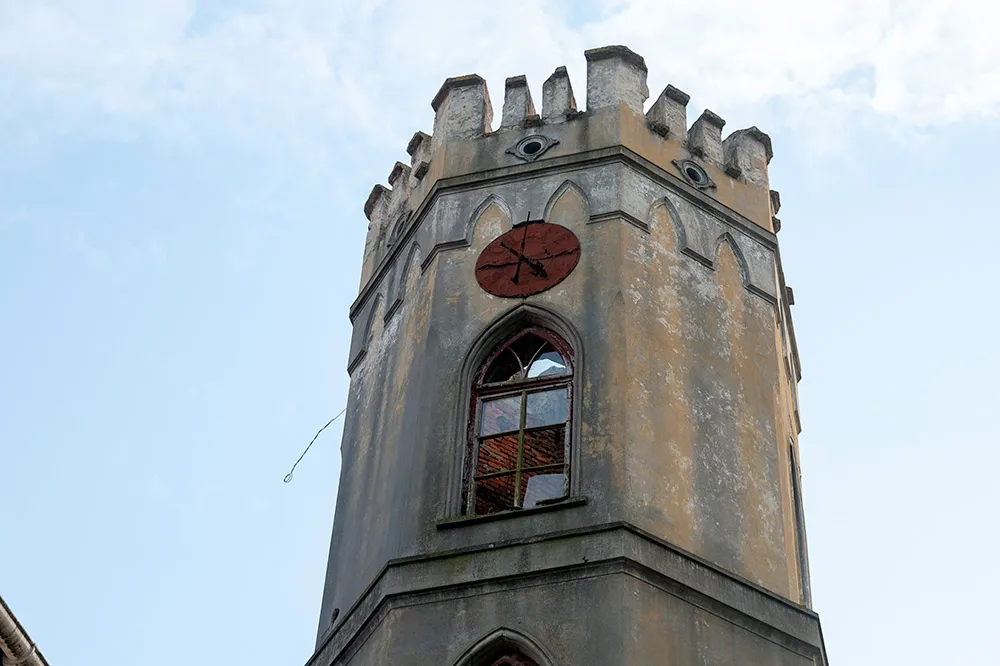
Time has stopped…
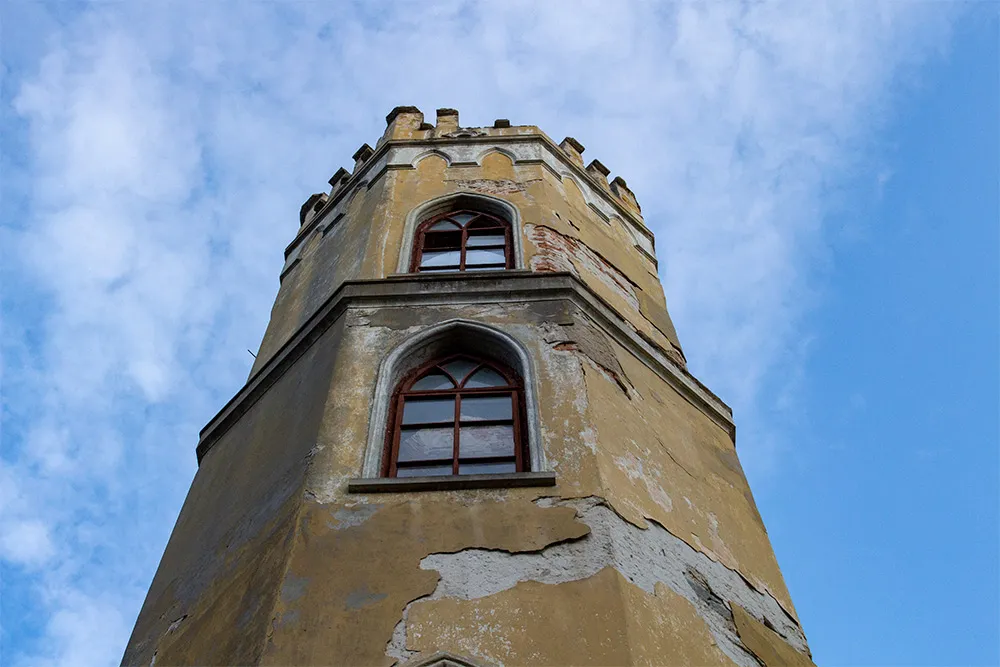
Given the established tradition of linking palaces and manors exclusively with their last pre-revolutionary owners, one can assume that the palace was built earlier, and not by the Krupenskyis but by one of the previous owners of Kryvchyk. In particular, the well-known researcher of Podillia’s history Viktor Huldman, in his “Reference Book of Podillia Governorate” published in 1888, names the once well-known banker Mark Rafalovych as the owner of Kryvchyk. Such a man could easily afford to build even more than this. But one should not rule out that the palace appeared even earlier. In particular, its adornment is a four-tier octagonal tower. We see a practically identical one in the palace in the village of Opinogóra Górna, Ciechanów County, Masovian Voivodeship (Poland). The time when that palace was built is more or less known: the 1840s. That is, one should not exclude that Mykhailo Krupenskyi merely rebuilt an older palace somewhat, put outbuildings next to it, expanded the park, and so on.
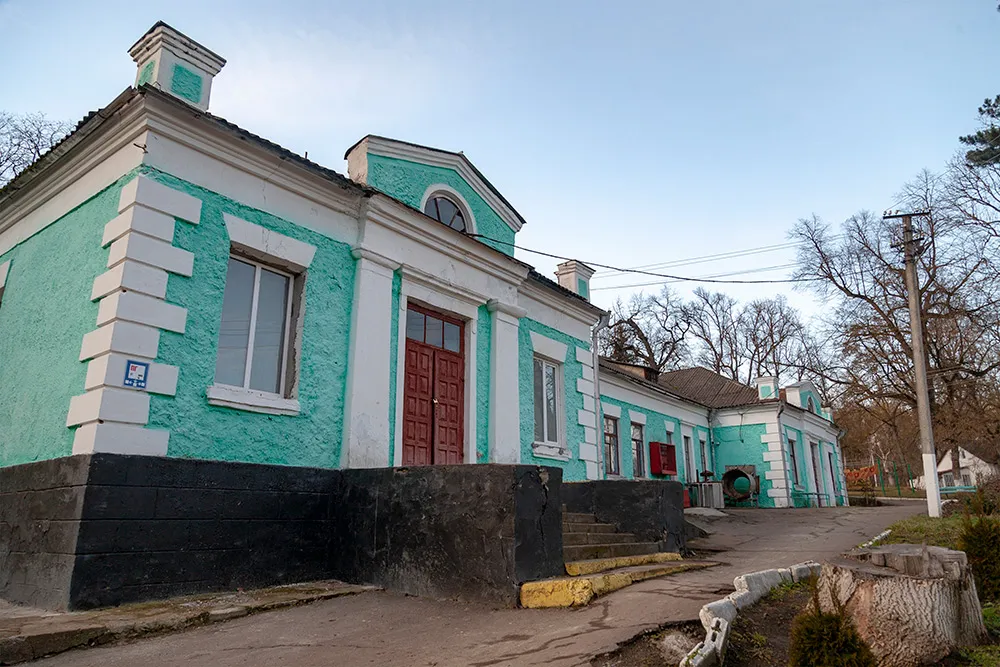
The servants’ house
The date of construction is, in fact, not the only riddle and confusion surrounding this palace, which, by the way, is one of the most beautiful in Khmelnytskyi Oblast. In the vast majority of local history publications, the last pre-revolutionary owner of Kryvchyk is called a general and, every other time, also titled a count. But he was never either.
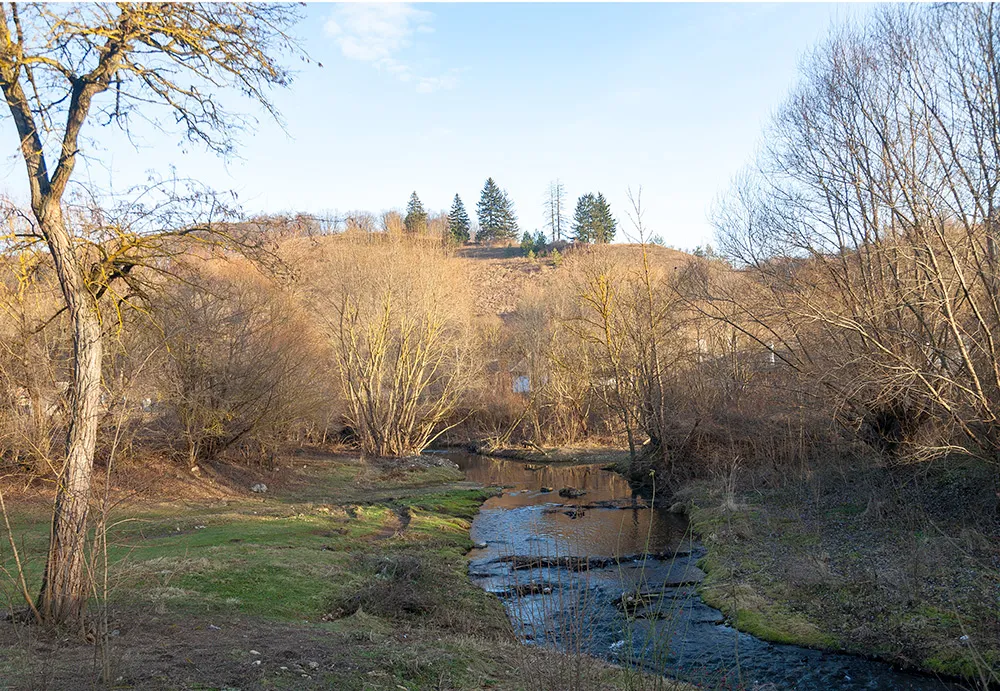
The Ternava river near the palace
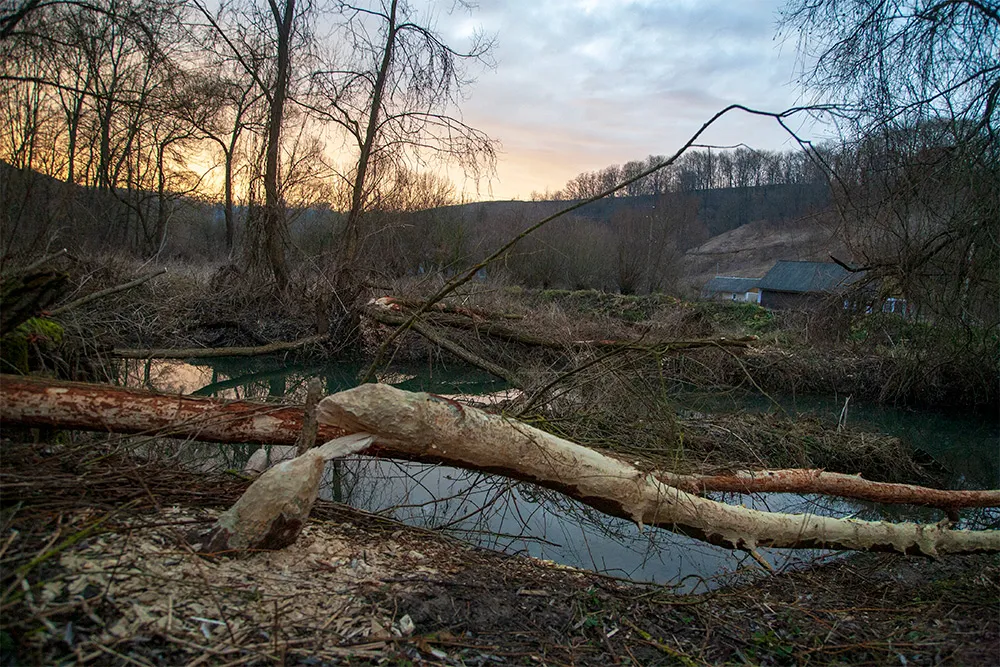
Traces of beaver activity
Whoever built the palace on the high bank of the Ternava, he chose a remarkably successful and picturesque spot. Already on the approach to Kryvchyk you get the impression that you have entered some very distinguished landscape park on the level of “Sofiivka”. But whereas in Uman all that beauty is the work of human hands, here nature itself has done the work.
The Ottoman riddle
Who built the palace and when is of interest only to local historians. All of this is purely local historical riddles. But Kryvchyk has something that no other palace in Ukraine can boast. Indeed, even for Ukraine as a whole it is a rather unusual and rare artefact.
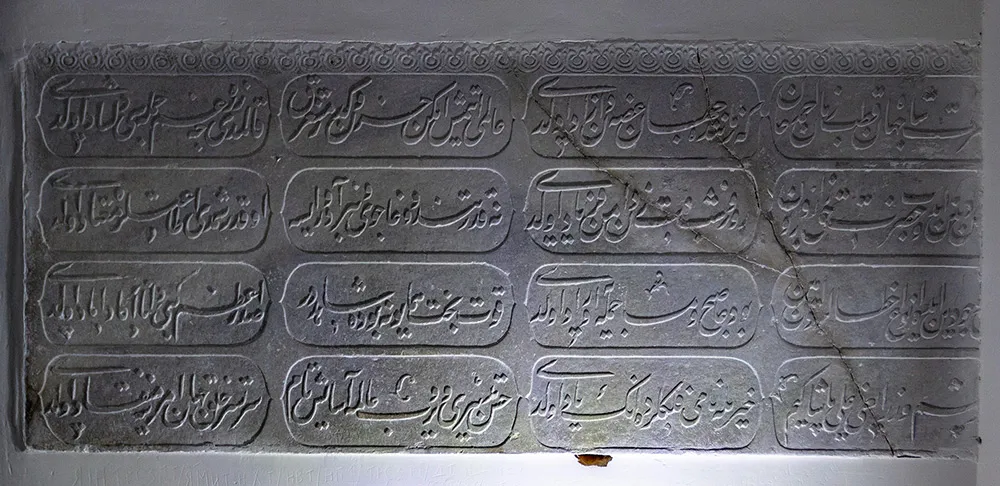
The author first heard about the arabesques in the former Krupenskyi palace some two years ago from Doctor of Historical Sciences Stefaniia Bazhenova, but, unfortunately, did not attach any importance to it. For some reason he thought it was a matter of 19th-century decorative elements such as the paintings of the “Japanese Room” in the Checheli palace in Samchyky.
In the autumn of last year, Anastasiia Donets, director of the Maliievtsi Regional Museum of History and Culture, provided a photograph of that inscription, and it turned out that this is something not merely ancient but very mysterious. Unfortunately, she photographed only a small part of a large limestone slab. The specialists to whom the photograph was shown could draw only one conclusion: these are some Sufi rubaiyat verses, most probably dated to the turn of the 17th–18th centuries.
As already mentioned, it is not so easy even to get onto the grounds of the care home. Getting into the palace itself is altogether problematic. But Ms Anastasiia, as the owner of the Orłowski palace in Maliievtsi, managed to arrange a visit with the head of the palace in Kryvchyk. All the more so since the head of the care home, Andrii Artsabliuk, is himself interested in history and local lore.
Given the specifics of the institution, the understandable wish of a journalist and local historian to take the maximum number of photographs had to be put aside. In particular, the author did not photograph the main façade of the palace, although he was very tempted to. At that time a dozen and a half patients were strolling in front of it, and photographing people in such a condition would have been unethical towards them and their families. And it is unknown how they would have reacted.
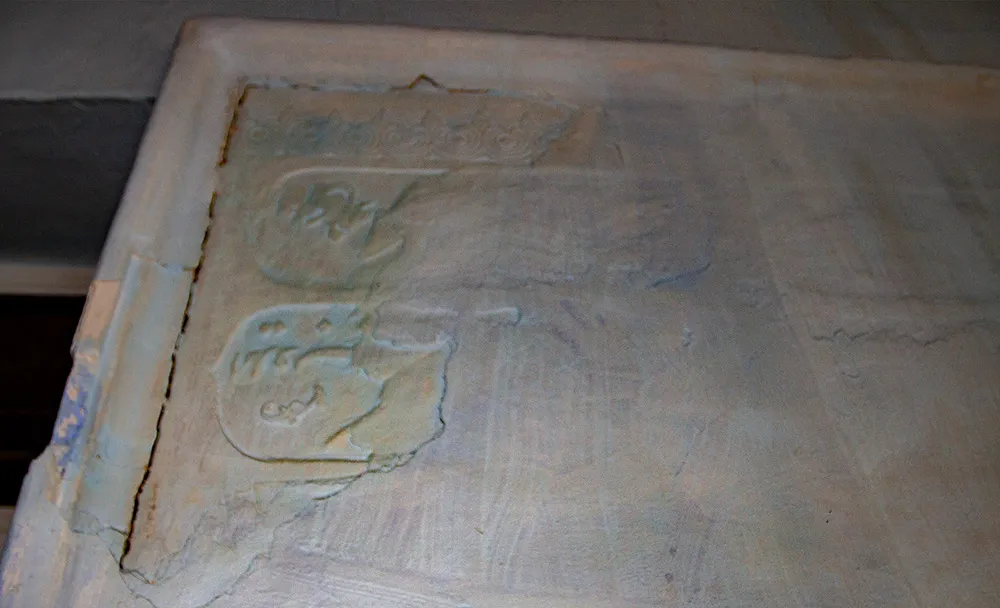
The slabs with the arabesques are in an annexe of the left wing. Over time the ancient arabesques ended up under a thick layer of numerous whitewashings and became practically invisible. To see them one had not only to look closely but also to know where to look. One of the two limestone slabs was uncovered during repairs thanks to the director of the care home, who cleaned it of the layers. The other is still “disguised”.
Knowing the Krupenskyi genealogy, it is not hard to conclude that these artefacts come from Khotyn, with which this family was closely connected. In particular, the father of the last owner of Kryvchyk, Yehor Krupenskyi, was in 1861–1863 the Khotyn marshal of nobility.
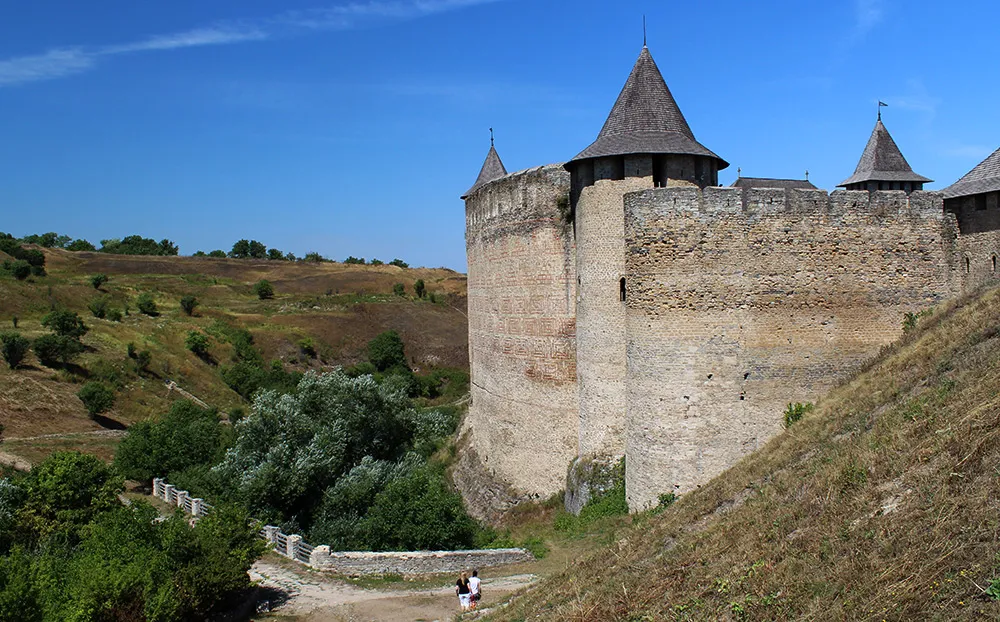
As regards Khotyn itself, we have several mentions of stone slabs with Ottoman verse inscriptions. In particular, on the official website of the State Historical and Architectural Reserve “Khotyn Fortress” we read that the façades of all the entrance gates were adorned with chronograms (memorial plaques) of gold on azure, executed in ta‘liq letters (a variety of Arabic script). Of course, this does not mean precious materials, but azure paint and gilding.
From other sources it is known that the inscriptions mentioned above glorified the deeds of the fortress commandant Abdi Pasha.
The carved sarcophagus of Abdi Pasha, later destroyed by the Russians, is also mentioned. Ottoman sarcophagi, traditionally, were also adorned with inscriptions.
So who was this Abdi Pasha?
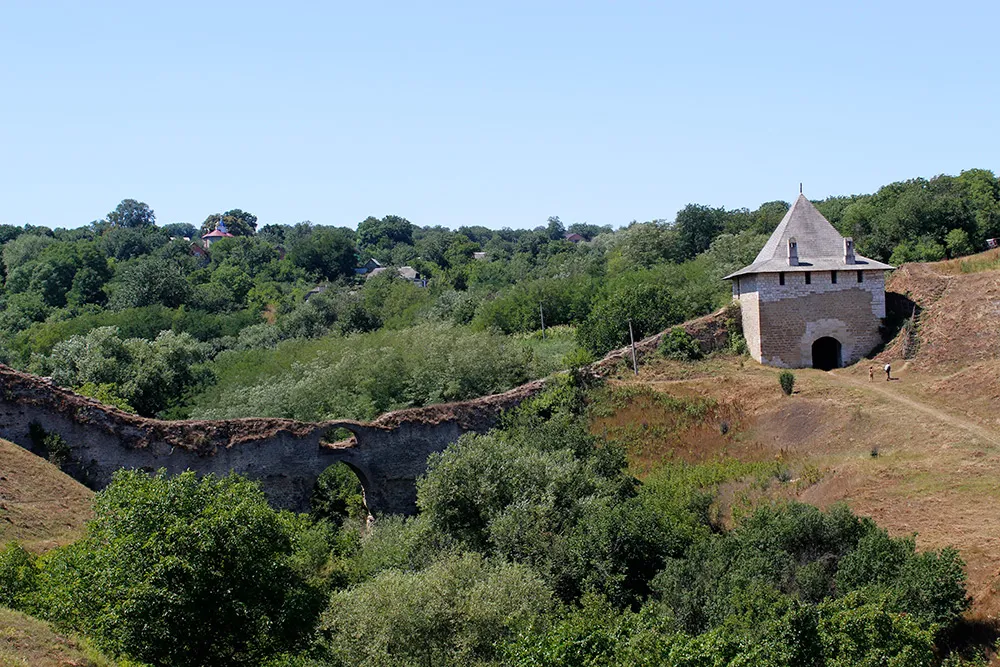
In 1713, by a firman of Sultan Ahmed III, the Khotyn tsynut (district) was separated from the vassal Principality of Moldavia, and direct sultanic administration was extended to it. The Khotyn nahiye was formed on its territory.
In 1713 Abdi Pasha, the commander-in-chief of the Akkerman fortress (now Bilhorod-Dnistrovskyi), arrived in Khotyn and headed the administration of the newly formed nahiye. It was he who rebuilt the fortress and the town, which had suffered considerable destruction during a series of wars in the 17th century. At that time, by order of Sultan Ahmed III, numerous skilled specialists were sent to Khotyn from Istanbul: architects, stonemasons, blacksmiths, masters of building water supply and sewerage systems, and so on.
The Ottomans, under Abdi Pasha’s leadership, fundamentally expanded and rebuilt the fortress and the settlement next to it, turning Khotyn into one of the most beautiful and comfortable cities of Europe. It was then that the slabs with inscriptions mentioned above appeared.
It was already noted above that the chronograms were originally executed in gold on azure. No traces of gilding could be found during the inspection, but barely noticeable remnants of the azure paint have survived here and there to this day.
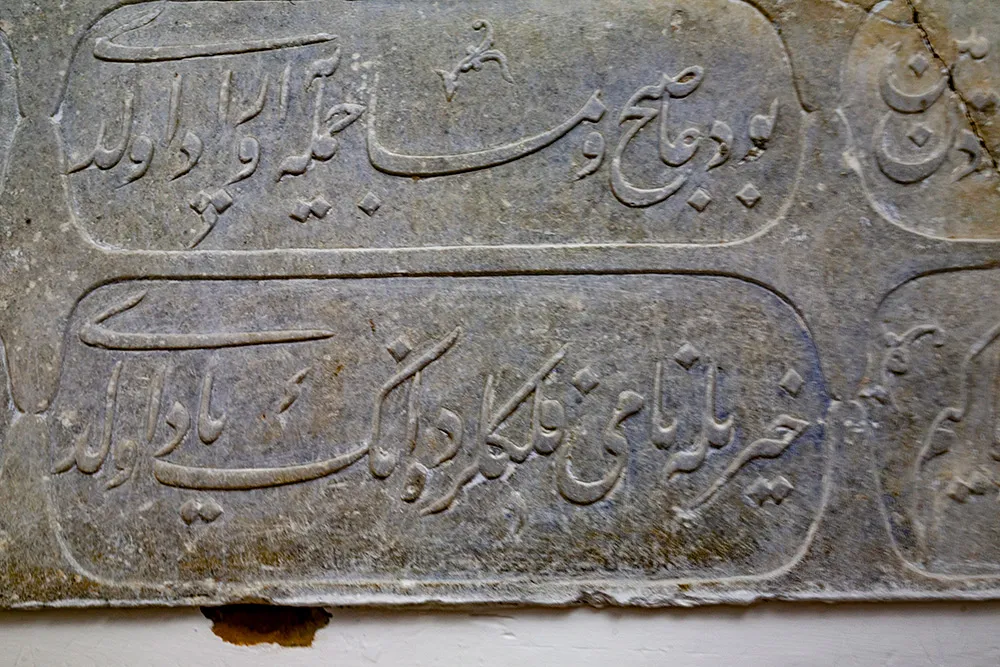
Of course, one was very eager to find out what was actually written there.
The photograph with the arabesques was sent to the well-known orientalist, Candidate of Historical Sciences Mykhailo Yakubovych, who now works at the University of Freiburg (Germany).
According to the scholar, what we see here are rubai verses (plural “rubaiyat”) written in the ta‘liq script.
A rubai is a quatrain, usually of philosophical content. In Europe the best known are the rubaiyat of Omar Khayyam. In Ukraine, for example, Dmytro Pavlychko wrote poems in the rubai form, and in Poland, Maria Pawlikowska-Jasnorzewska.
We stress that the “palace” slabs are executed in the ta‘liq script, the same as, according to old documents, the inscriptions on the gates of Khotyn were made.
Mr Yakubovych made an approximate translation of the text, noting certain difficulties: part of the inscription is hidden behind a later wall, and the text itself uses not only Turkish words. From what he managed to make out he drew this conclusion: “This is evidently about a secular person; the mention of military affairs may correspond to the profile of Abdi Pasha, the seraskier, the head of the Ottoman administration of Khotyn. The monument is of a lapidary character. Quite probably it comes from a mausoleum, as the rather tragic and sad content of the text suggests.”
The scholar recalled that Abdi Pasha was buried in the Khotyn cemetery not far from the mosque and added:
“Unlike most monuments of this type, here there was rather a whole mausoleum (türbe) than just a gravestone (baş taş). The style corresponds to the 18th century. However, one may suppose that these are plaques that once adorned the fortress gates.”
The scholar also did not rule out that the slabs from Kryvchyk may be the side walls of the carved sarcophagus of Abdi Pasha mentioned in old records. All the more so since the dimensions of the slab, over 2.0 × 0.9 m, correspond to similar cemetery artefacts.
Moreover, there is a mention that in 1735, when the Russians captured the fortress, they smashed the pasha’s sarcophagus. In Kryvchyk it is clearly visible that the slab is assembled from fragments.
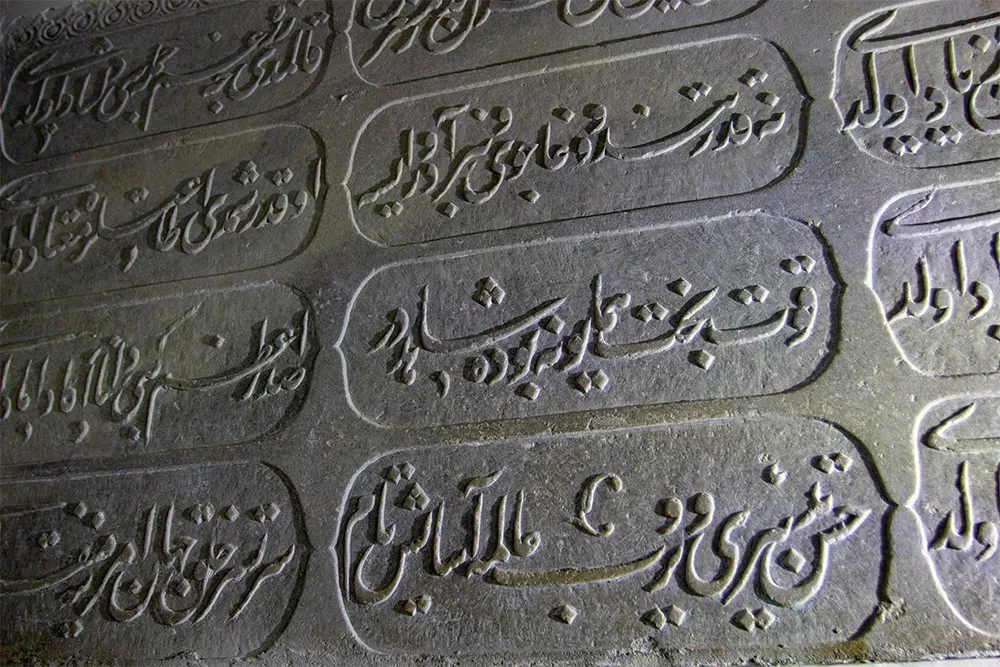
Mr Yakubovych also stressed that one can speak about the monument with any confidence only after its detailed study. It is necessary to establish the thickness of the slab with the inscription, and to investigate whether it is simply a flat slab or a fragment of a sarcophagus. It would not be bad to dismantle the partition wall to reveal the inscription fully.
It is clear that no one will do this in the near future: it is not cheap, and after all this a renovation would also have to be done. As the scholar noted, for more accurate conclusions it would be worth at least clearing the second slab of later layers.
The author of these lines was already swelling with pride and feeling like the discoverer of a sensational find at least on the national level, but, as it turned out, in vain. Scholars of the Kamianets-Podilskyi State Historical Museum-Reserve, who also heard from Ms Bazhenova about the Kryvchyk arabesques (this happened practically at the same time), worked faster. Indeed, they were lucky to obtain a more accurate translation of the ancient rubaiyat. A whole “consilium” worked on the decipherment, consisting of Professor Mehmet Çelenk of Uludağ University in Bursa, Turkey, and Professor Mehmet Hakkı Suçin of Gazi University in Ankara. The latter made the final translation into English, which is included in the scholarly report prepared by the museum-reserve’s researcher Yevhenii Levinzon.
In Ukrainian we have:
The precious sultan of the world, the Pole of the age, Ahmed Khan,
who was freed from the world of sorrow of his time
While the world is filled with sadness and grief,
not a grain of grief remained, all were full of joy.
[missing] Eternal and precious Right
Day and night my hands and tongue lamented
As many as there were hardships, fights and battles
Now obedience and peace have prevailed.
[missing] Far from any error
This prayer is on everyone’s tongue morning and evening.
The power of the Kingdom’s fate bears witness to this
Such a declared man, as the grand vizier, was his betrothed
[missing] and his vizier Ali Pasha
His name is remembered with kindness in all worlds.
By his virtuous measures he made peace in the world,
[missing] all the creatures of the world were subject to him.
“The Pole of the age Ahmed Khan” is an indication that this refers to the reign of Sultan Ahmed III (1703–1730), that is, precisely the time when Abdi Pasha governed in Khotyn.
From the content it seems to be about the death of Ali Pasha (Damat Silahdar Ali Pasha). He was betrothed to Ahmed III’s daughter Fatima, receiving the title Damat (bridegroom). In 1716, near the Serbian city of Petrovaradin, the Ottomans under Ali Pasha were defeated by the Austrians. Ali Pasha fought a battle in which the Turkish army suffered a crushing defeat. Damat Silahdar Ali Pasha was wounded and soon died. After his death he was called Şehit Ali Pasha (Turkish: the martyr).
If we accept the hypothesis that the slabs are somehow connected with the burial of Khotyn’s builder Abdi Pasha, then the mention of the death of Grand Vizier Ali Pasha may well be in the vein of comparing the latter with the deceased. All the more so since it was under his patronage and leadership (the grand vizier being the first minister) that Abdi Pasha developed the Khotyn entrusted to him.
Something more precise can be said after the second Kryvchyk slab is cleared and its content translated. Perhaps we shall soon learn its content. As Master of Archaeology Yevhenii Levinzon, junior researcher at the Kamianets-Podilskyi State Historical Museum-Reserve, reported, scholars have planned one more expedition to Kryvchyk for approximately March, during which the other slab will be cleaned of later layers.
Mr Yevhenii also reported that in the future it is planned to make casts of the slabs to display them in the museum.
Dmytro Poliukhovych
First published in Polish in “Kurier Galicyjski”


