

Mylushi

· 3 min read
Mylushi (Polish: Miłusze, English: Mylushi, Czech: Milushi) is a village of the Lutsk urban community, Lutsk district, Volyn Oblast. It is located in the extreme south of the Polissia Lowland, on the left bank of the Styr River, 5 km from the regional centre, the city of Lutsk.
In the past the village and its surroundings were covered with forests. From the earliest times the inhabitants engaged in farming, cattle breeding, forest trades and fishing. According to archaeological data, monuments of the Pomeranian–Globular Amphora culture were found in its northern part: a stone thin-butted axe, as well as cultural artifacts such as ceramic items decorated with cord impressions.
An interesting legend about the founding of the village of Mylushi has come down to us from the times of Kyivan Rus. In the past the territory of the village served as an outpost on the approaches to the town of Luchesk, which was held by Prince Svydrygailo. During the 1440s he issued grants for villages and estates to his servants. The territory was settled by people from the tribes of the Dulibs, Polianians and Drevlianians. One of them, Mal, was raising his daughter Malusha. During a military clash she was taken prisoner, and a brave princely warrior, Khodko, fell in love with her. For his military valour he received from Svydrygailo a territory near the town, freed Malusha and married her, and named the settlement in honour of his wife. Over time the name changed: the settlement of Malushy became Mylushi.
The first written mentions of the village date to the mid-15th century. Thus, there is mention of the flight, in early April 1642, of subjects of Jan Czapliński from the village of Miłowsze to the estate of the Mozyr marshal Jan Babiński, to the Cossack units in the village of Olshany.
Under the Union of Lublin of 1569, Mylushi, as part of Volhynia, became part of the Kingdom of Poland and the Grand Duchy of Lithuania until 1793. After the Second Partition of Poland between the Russian and Austrian empires, the area came under Russian rule.
An entry in the clerical records dated 1 January 1800 reports on changes in the village, from the priest Mykola Teodorovych: “To this church belong 22 days’ worth of arable land, hayfields for 6 mowers, forests for pastures, and a kitchen garden of 7 days’ ploughing, on which stands the priest’s house.” It is also known that the Mylushi Church of St. Paraskeva the Friday was for some time subordinate to the neighbouring church in the village of Syrnyky and was attached to it. According to a document, in 1880 the church was painted with oil paints outside and inside and was very poor. All those who were born or married were registered in the registers of the Church of the Intercession in the village of Syrnyky, and church reports were submitted there as well. A parish school also operated in Mylushi.
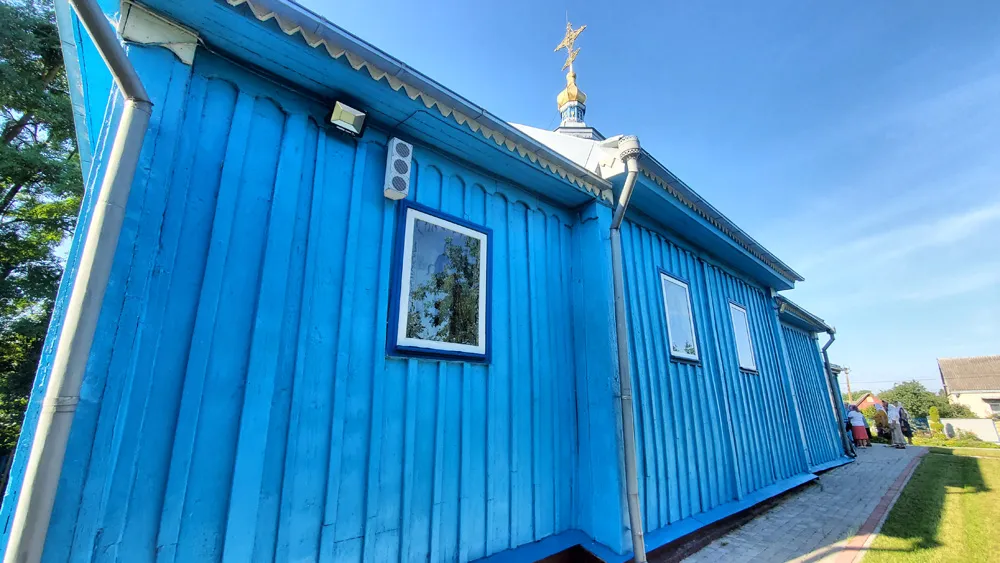
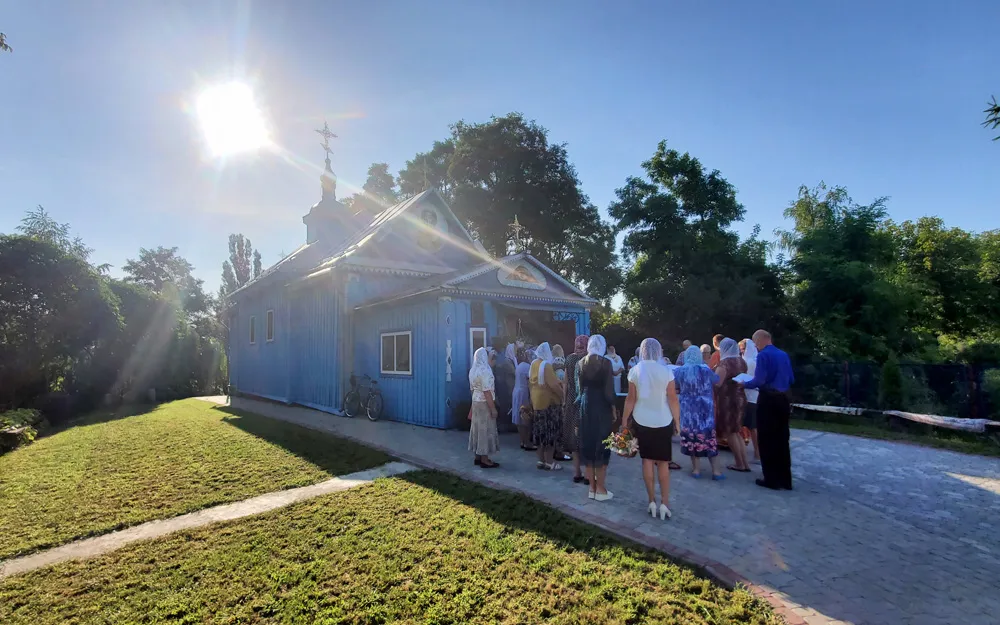
Church of St. Paraskeva
The existing wooden church in Mylushi is dated to the late (according to other data, early) 17th century. One may assume that the shrine was actually built in the interwar period; otherwise it would have had to be rebuilt to a standard diocesan design.
It is not known whether services were held in it during the Soviet period. In 2013 a new altar table was consecrated. Today it is used by the community of the UOC-KP. It is an architectural monument of local significance.
A small three-log church without a dome, with a large vestibule attached to the narthex, it has survived in the eastern part of the village, between the road and the left bank of the Styr River, near the houses. The nave is barely wider than the narthex and the sanctuary. As of 2008 the church had been repaired on the outside.
Source: Wooden churches of Western Ukraine
Photos by Roman Malenkov


