

Pereiaslav. Stone crosses of the Fair Cemetery

· 31 min read
The custom of marking a person’s last resting place has been known since ancient times. In Christian cemeteries, to honour the memory of the deceased, gravestones and crosses were placed on graves and crypts were built. The cross as a grave marker appeared in the funeral rite in the 4th century, when Constantine the Great established the Christian type of burial. Christian norms of attributes were introduced into the ritual system slowly, so the cross became a grave marker obligatory for a Christian only probably in the 14th–15th centuries. Before that, gravestones with a relief image of a cross were used.
Scholars have long realised the importance of studying and describing cemeteries together with their grave markers, since they are monuments that carry a cultural code and human memory. Grave markers are an integral part of the historical development of society, a distinctive biographical and genealogical source for the study of history. They not only perpetuate the memory of people but also leave a kind of cross-section of biographical information about the fates of various strata of the population: from outstanding figures to ordinary townspeople or peasants.
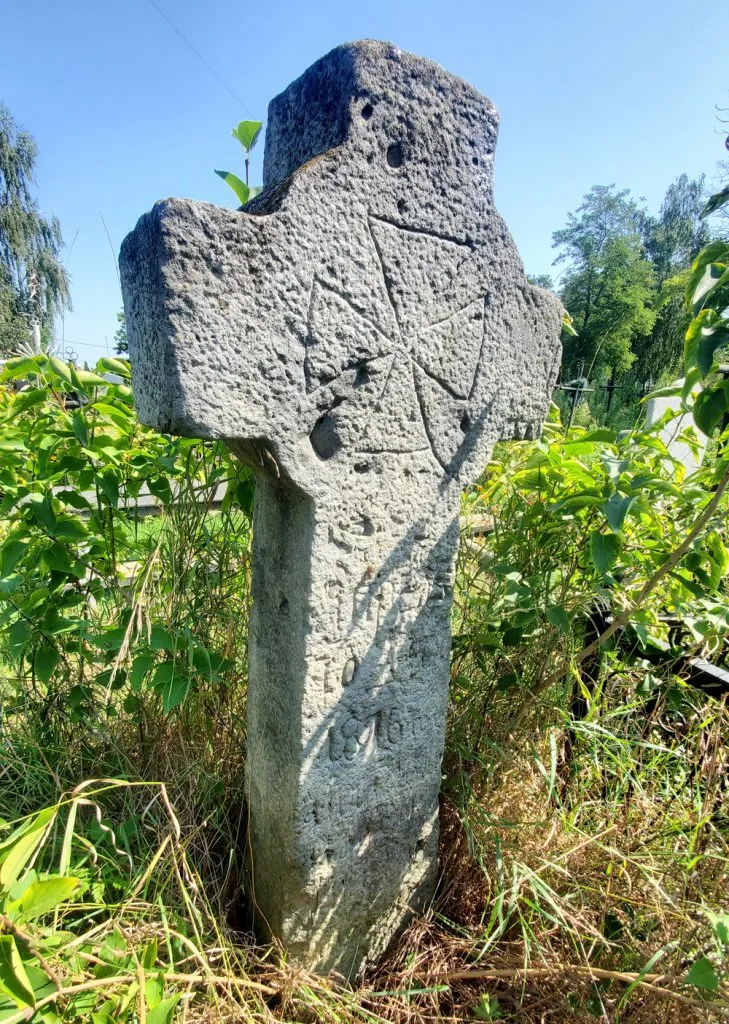
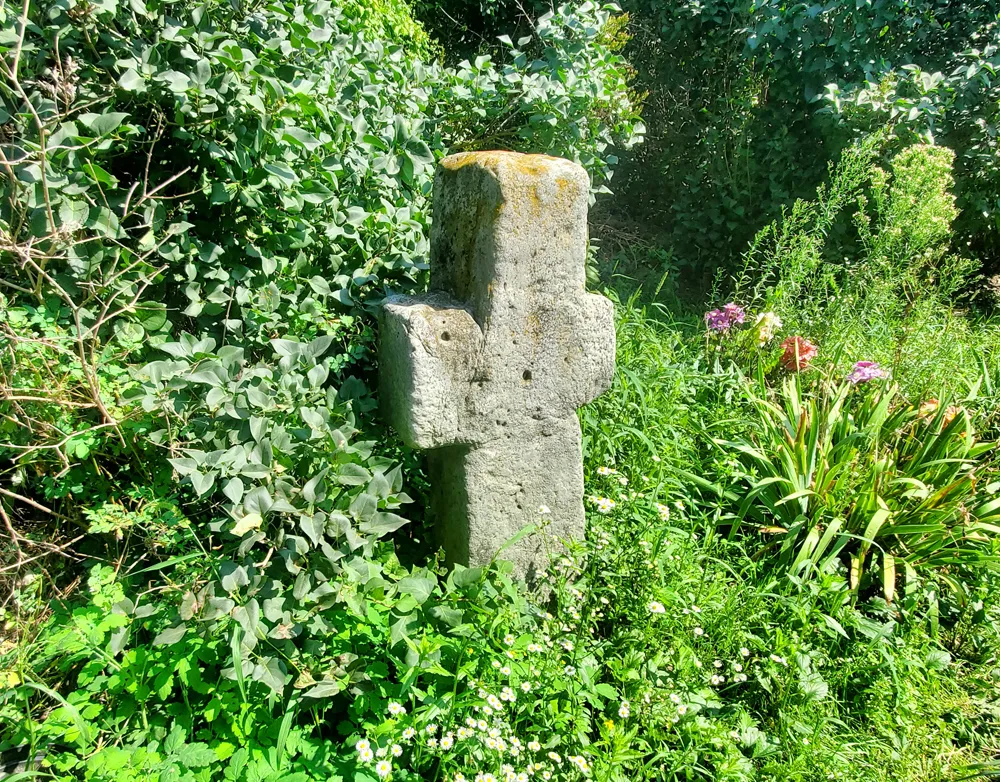
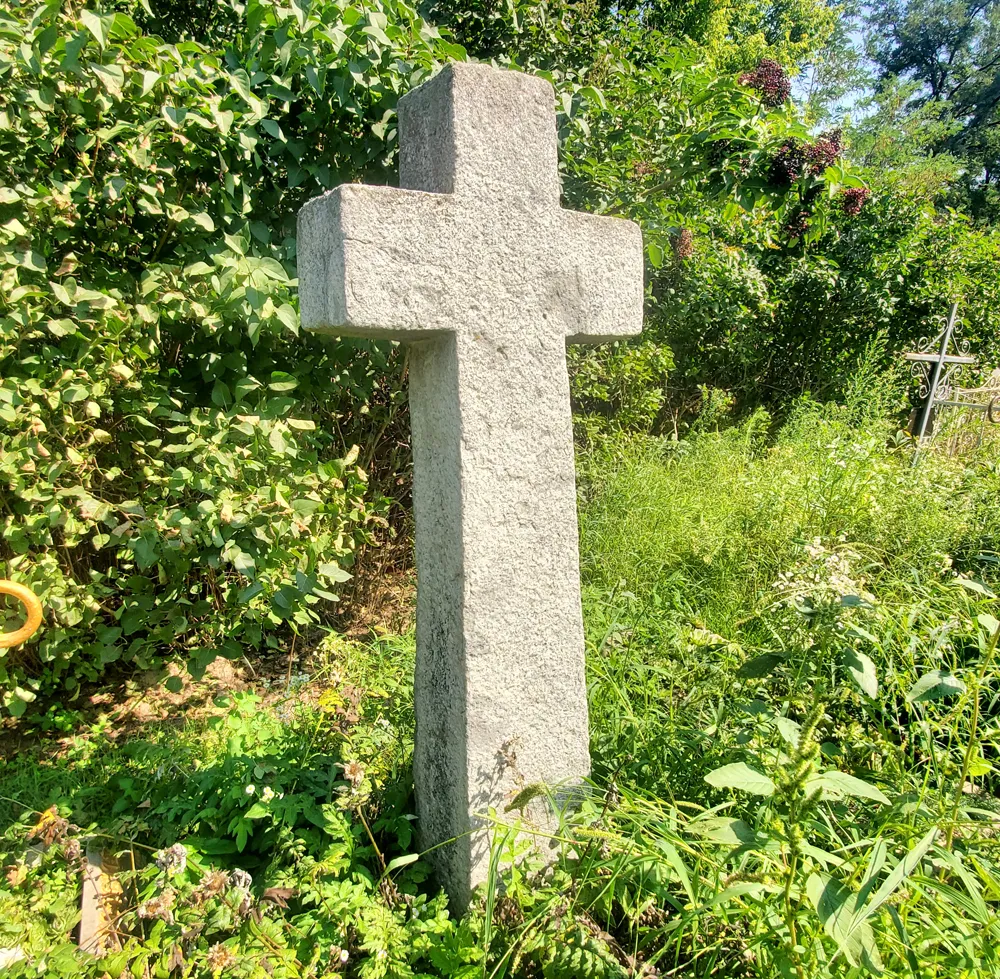
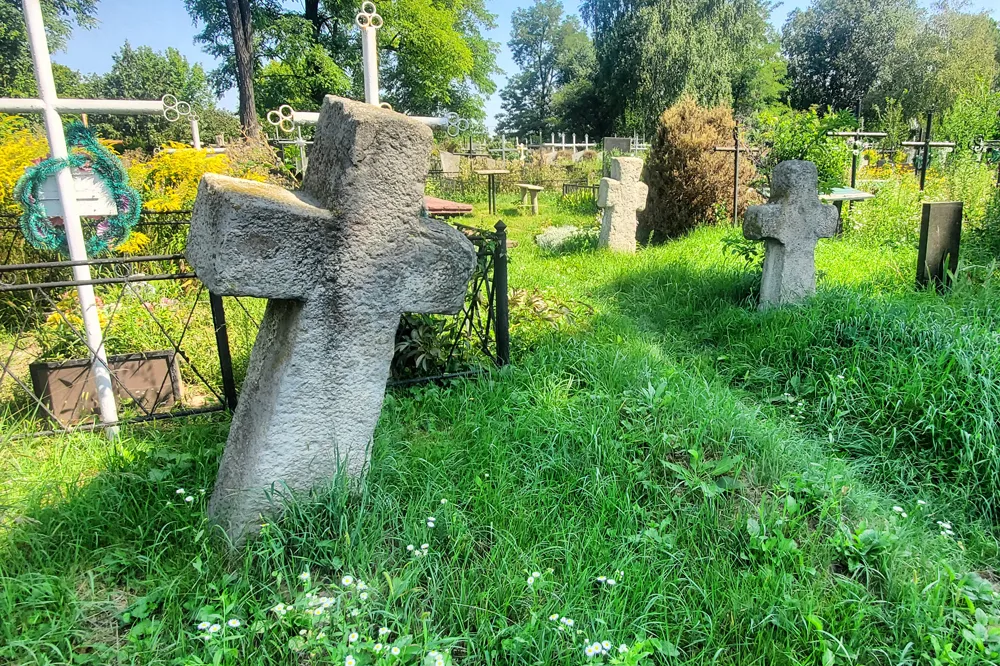
In the territory of Pereiaslav-Khmelnytskyi, the largest number of old grave markers, and in particular stone crosses, is found in the oldest citywide cemetery, the Fair Cemetery (there are also the Altytske, Pidvarske and Karanske cemeteries). The cemetery is located in a natural setting, on an isolated elevation in the Yarmarkivshchyna tract, on a rounded plot with gently sloping terrain, on the site of an Old Rus burial ground. It was actively used in the 18th–19th centuries and continues to be used to this day. In the 17th–18th centuries it was located separately from the city at some distance. Today it lies within the city limits, bounded by Paryzkoi Komuny, Polova and Shkilna streets. From topographic descriptions of Little Russia Governorate from the late 18th century it is known that a wooden Church of the Last Judgement stood in this cemetery, which in 1842 was evidently replaced by a wooden Church of St. Thomas that belonged to the clergy of the city’s Dormition Church [7, p. 84]. The late medieval grave markers of this cemetery were for the most part wooden, so they have not survived to our time (only one has been identified so far). The old stone crosses that can still be seen today are dated by their inscriptions and form to the 19th – first half of the 20th century.
The stone grave crosses of the necropolises of Pereiaslav-Khmelnytskyi have not yet been the subject of special research. Their dating and location have not been determined, their types and the place where the material was extracted have not been clarified, and the persons on whose graves the gravestones stand have not been identified. Only a few publications touched on this subject in passing, mostly in the part concerning the history of the origin of the Fair Cemetery. In particular, these are the works of O. Yurchenko and O. Kolomiiets. General information about relict grave markers of the Middle Dnipro region can be found in the works of M. Tovkailo.
This study aims to continue the study of gravestones in the necropolises of Pereiaslav-Khmelnytskyi. The author’s main goal is to draw researchers’ attention to old stone grave crosses as an important source for studying the history of the city. The desire to leave information about them is driven by the tendency of these monuments to rapidly deteriorate under the influence of natural and anthropogenic factors. Thus, the aim of this work is to give a description and generalised characterisation of the grave crosses of the Fair Cemetery.
In the course of the study, the author carried out field surveys of the cemetery and made detailed descriptions, measurements and photographic records of the graves with sandstone crosses that have survived in this cemetery. Unfortunately, not all burials can be attributed; the inscriptions on most graves cannot be identified, and some crosses have survived only in fragments.
In total, 169 sandstone stone crosses were found, surveyed, recorded on a schematic map and systematised on the basis of the relevant typological schemes.
The absolute majority of the old stone crosses that have survived in the Fair Cemetery are undoubtedly Christian in character. They are uniform in their functional purpose – they are grave markers. Their form is always perceived as a reflection of the Christian symbol – the cross.
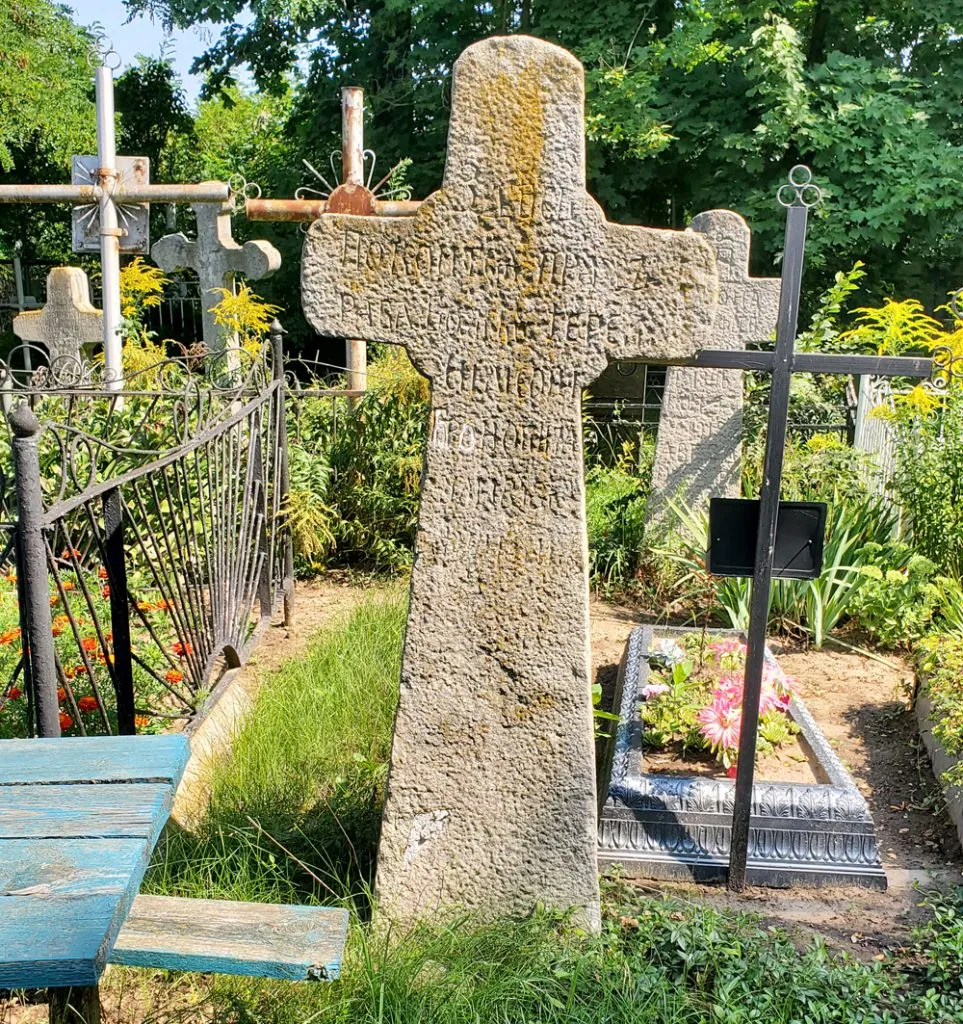
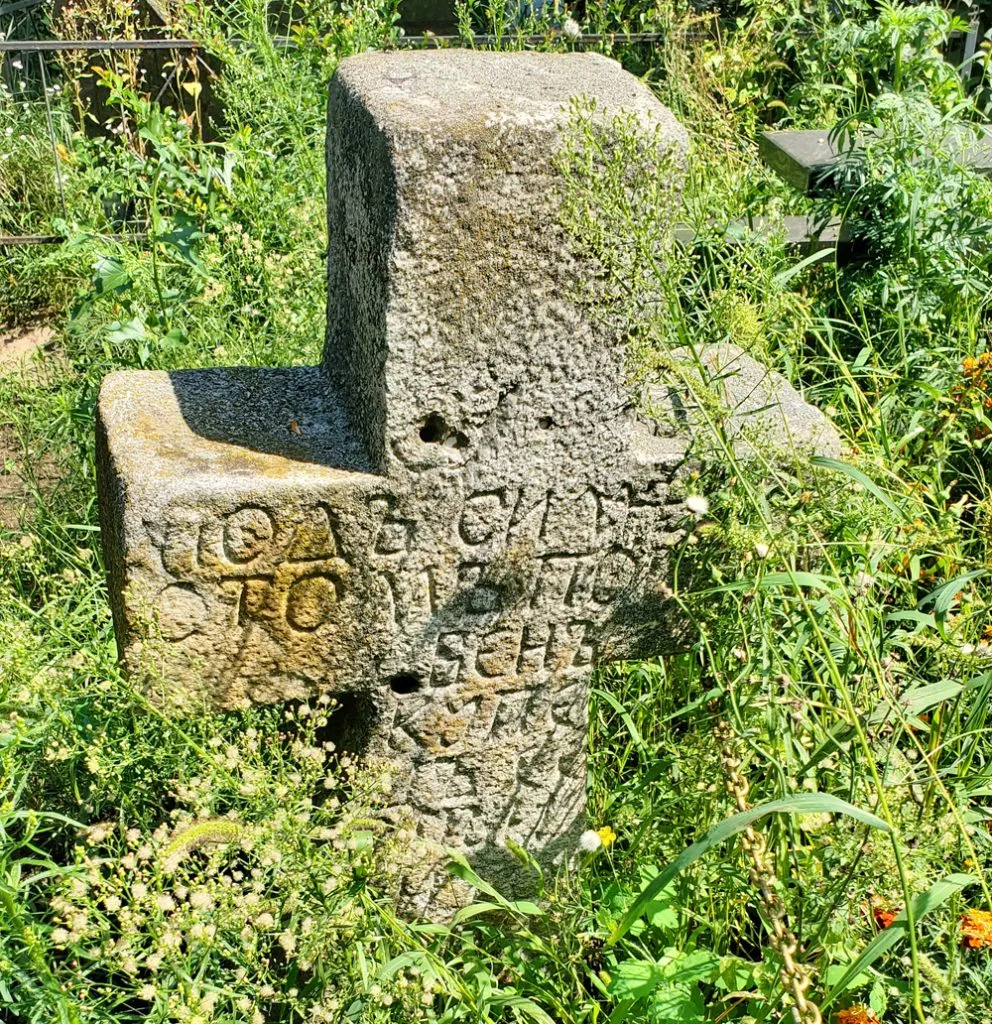
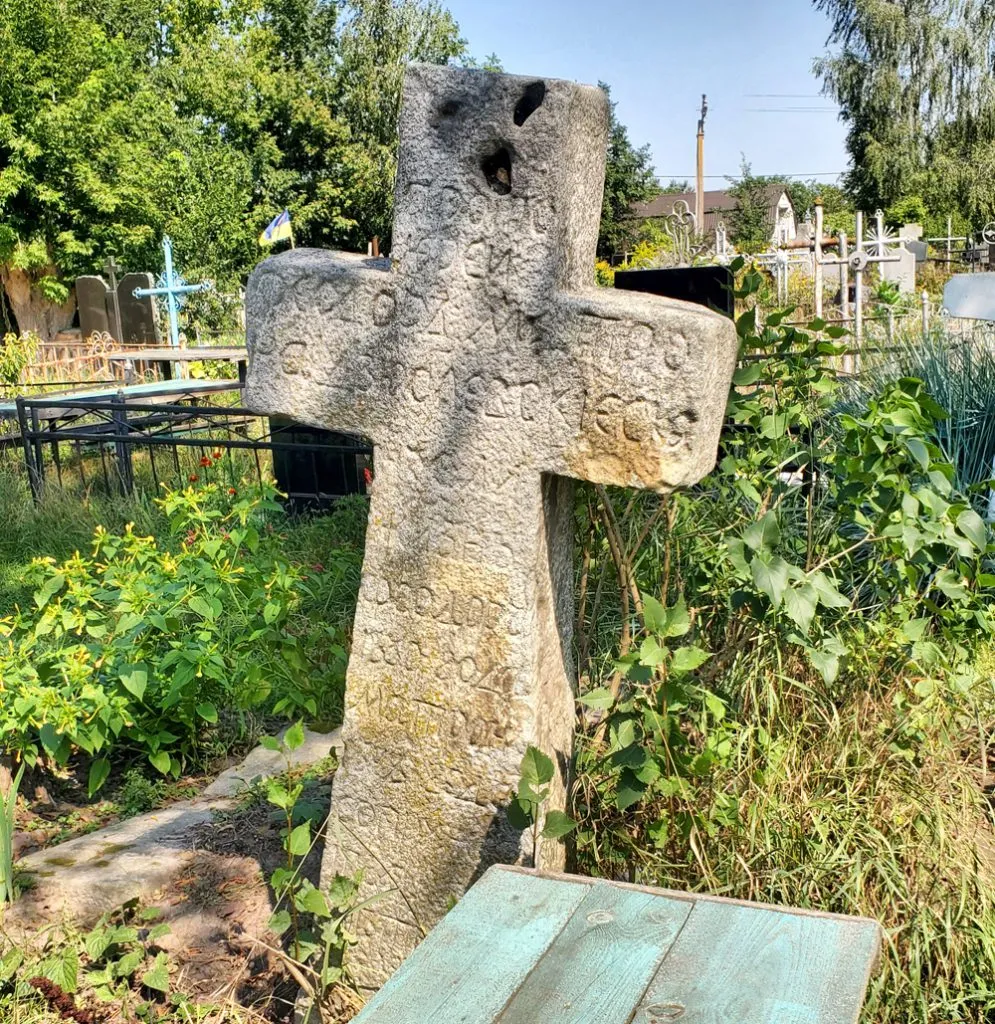
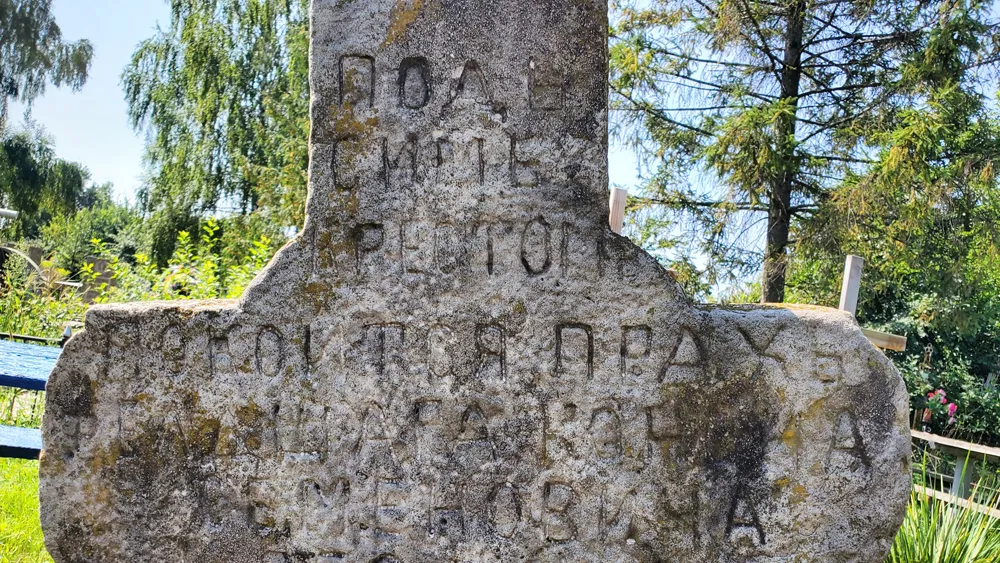
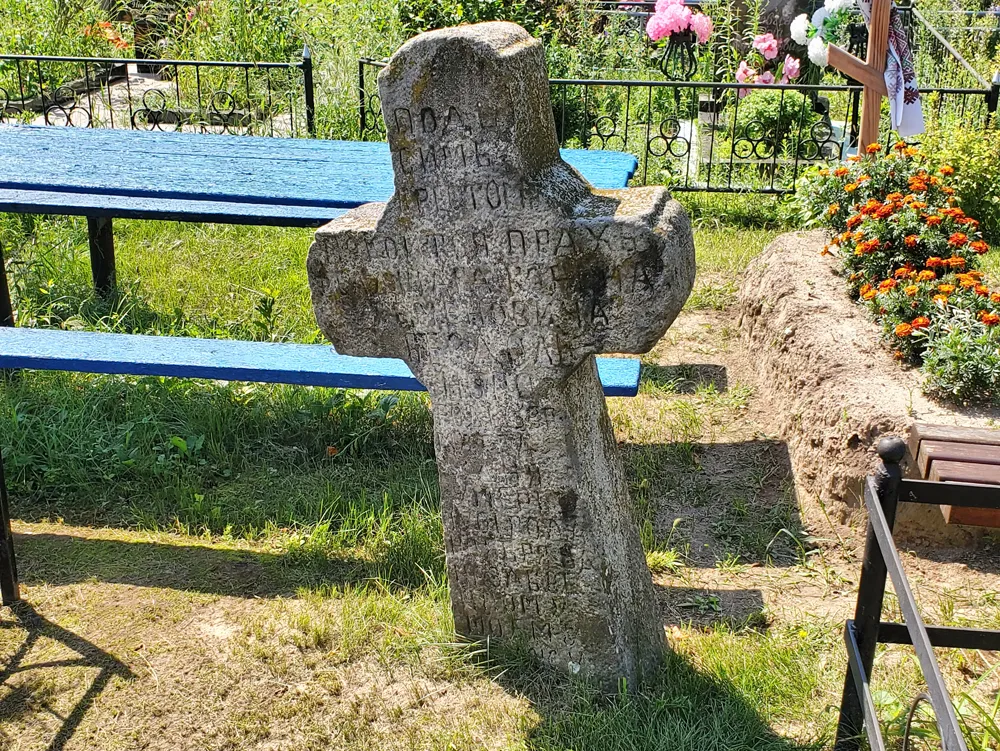
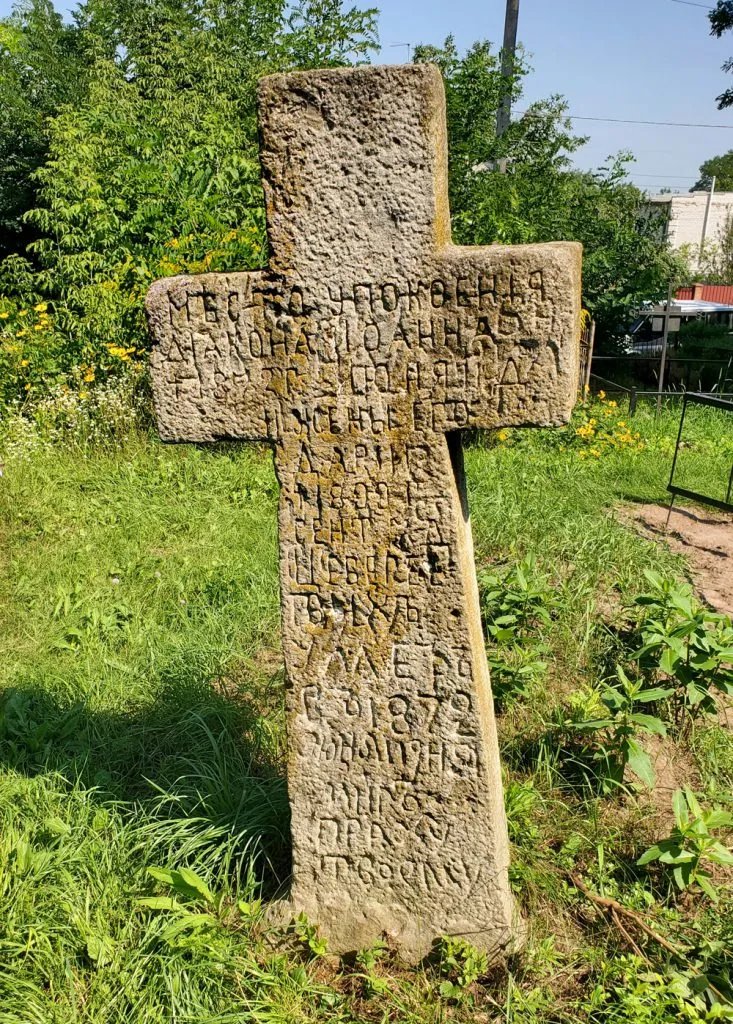
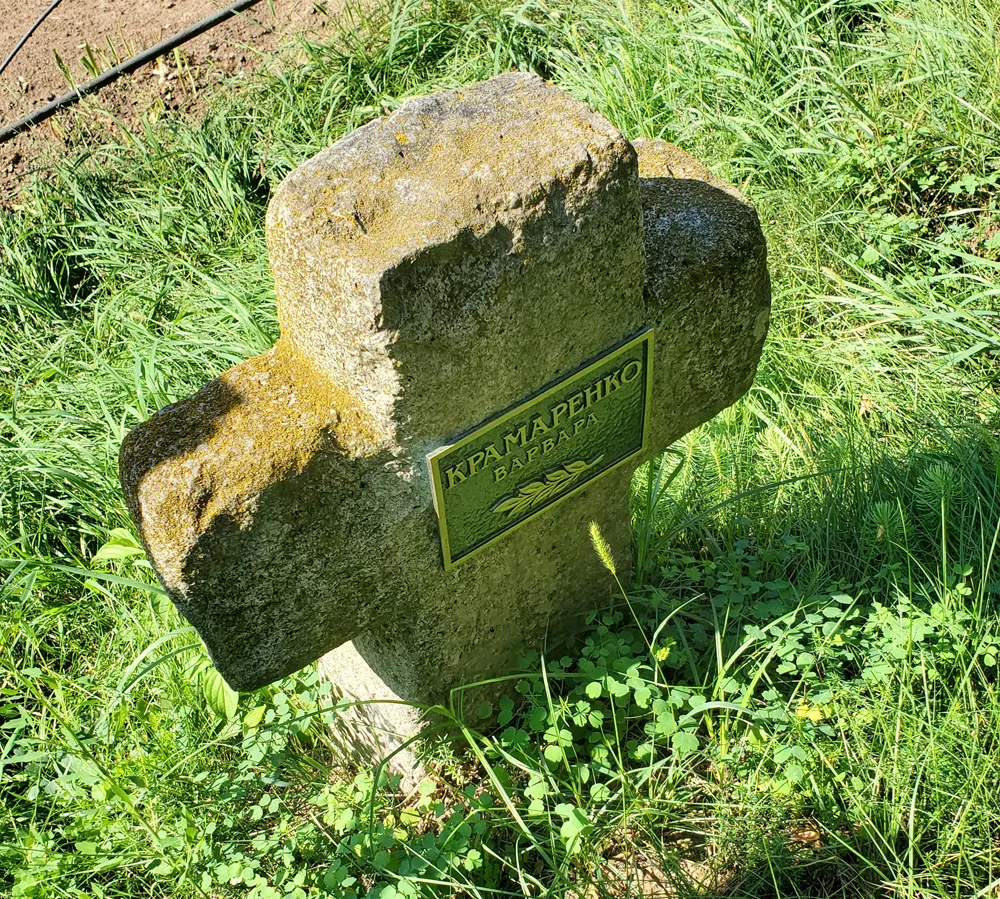
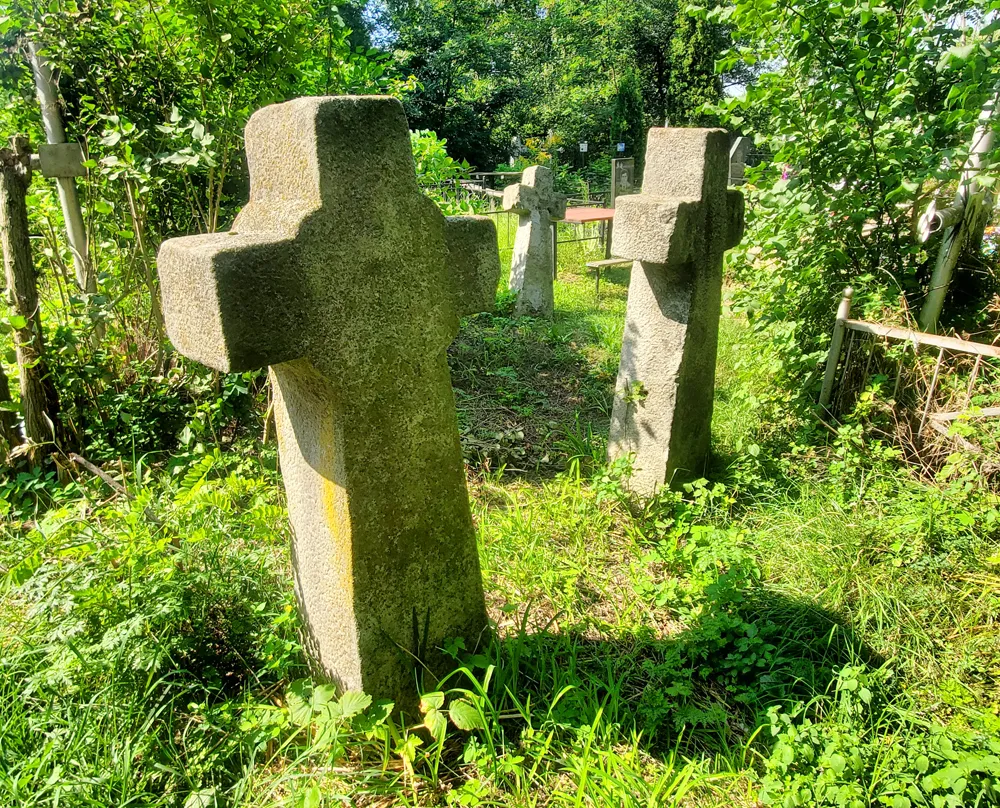
The arrangement of the graves with crosses follows no particular system. The largest number of crosses has survived in the central part, located on either side of the main path of the Fair Necropolis leading from the central entrance, and to the right of it. It is known that the Church of St. Thomas stood precisely in this part of the cemetery. To this day a wooden marker cross stands on the probable site of the church, and the construction of a chapel is planned. Running ahead, we note that the largest number of burials of clergymen has been found precisely near this spot.
The vast majority of grave crosses are individual – they commemorate one person. Eight collective burials marked by crosses have been found: “Makar Alekseevich Shidlovsky. 1866–1926 and wife Elizaveta 1870–1956.”, “Karpenko Akim Dmitrievich 1870–1918. Olga Stanislavovna 1880–1955…”, “Repose of Deacon John, 1872, June 11, and of his wife Daria, 1889, September 17..”, “Under this cross rest the remains of the servants of God Trofim Lyubchenko and his wife Irina. Born 1847. Wife born 1855. Died 1903.”, “Here rest Nikolai Filipovich Kucher. Died in his 42nd year and Anna Arsenievna died in her 84th year.”, “V.D. the remains of Priest John Prokhorovich and his wife Agrofena”, “Here rests the remains of the servant of God Mikhail Gavrilovich Biletsky. Born 1872 died 1862 and his wife Marfa Ivanovna. Born 1841 died 1896.”, “Archpriest Feodor and Matrona Dziubledskiesko…”. There may be more collective burials in the cemetery, but it is hard to establish. Only 81 of the 169 grave crosses can be found to bear inscriptions (9 of them are completely illegible). It is rarely possible to read the whole text – the stone has crumbled. The surviving epitaphs date from the second half of the 19th to the first half of the 20th century.
According to the epitaphs, of the 81 crosses with inscriptions, 24 are placed on women’s burials, 48 on men’s, 8, as noted above, on collective ones, and 1 on a child’s (the merchant’s son Stepan Stepanovych Anisimov, 10.12.1890–12.02.1898).
A large group of stone crosses consists of gravestones over the graves of clergymen – 6 items: priest Ioan Kudelia (1884–1965), priest Ioan Prokhorovych with his wife Agrofena, priest Petro Kalinovych, deacon Ioan (died 11.06.1872) with his wife Daria, archpriest Feodor Dziubledskiesko with his wife Matrona, the priest’s wife Yefrosyniia Horonovych (died 30.07.1856), and the wife of priest Ioan (died 18.09.1838).
There are also group burials of relatives in one place, for example the Kostenkos, Kononenkos, Karpenkos, Pokotylos, Palatnis, Anisimovs, and Lebedevych-Draievskis. The largest number of grave crosses belongs to the Kholodnyi family: Ivan Makarovych Kholodnyi (1899–1912), Mykhail Kholodnyi (1840–11.02.1859), Olha Kholodna (died 15.05.1849), Vasilii and Yefrosyniia Kholodni (1903). One senses that the first three Kholodnyi crosses were made by one craftsman: they have the same shape, dimensions, lettering and graphic design (a schematic image of a single-domed church with a cross). The local historian O. R. Kolomiiets suggests that these crosses could have been made by Ivan Makarovych Kholodnyi [9].
The inscriptions are made in a mixed language (Church Slavonic and Ukrainian), are often illiterate, placed asymmetrically, mostly on the front side, less often on both front and back, on one cross on the side face, with frequent word breaks and carry-overs to the next line. The letters are cursive, rarely in ustav script. The cryptogram “ZP” (“here is buried”) is often encountered, rarely “UNA” (“died in the .. year of life”), and once “V.D.” on the grave of the priest Ioan Prokhorovych. An interesting but incomprehensible cryptogram appears on the grave cross of Matrona Prokofievna Kostenko (died 1912) – “AVGZD”. Most inscriptions begin with the words: “Here is buried the body of…”, “Here rest the remains…”, “In this place rest…”, “Under this cross the remains…”. The inscriptions on …. crosses begin straight away with the surname. The endings of the epitaphs are typical: “Peace to your ashes.”, “May there be eternal memory.”. Very rarely do the inscriptions on crosses, besides the name and date of death, carry additional information about occupation, status, age and so on. For example, according to the epitaphs on grave crosses, the following found their last refuge in the Fair Cemetery: the townsman Fedir Ivanovych Krepenko (died 1877 in his 78th year), the merchant Serhii Antonovych Leontovych, the feldsher Konon Semenovych Bezdolnyi (18 March 1853 – 4 March 1901), the wife of the merchant Anisimov, Iryna Mykhailivna, the merchant’s son Stepan Stepanovych Anisimov, the provincial secretary Petro Yakovlevych Kondratiev (1808–1889), the wife of a provincial secretary, Mariia Astrovna Polipenkova (1832–1896), the wife of a provincial secretary, Mariia Akymivna Kondratieva (1813–1884), and Captain Andrii Datsenko (1821–1886). The cross for Petro Kalinovych, priest of the Church of the Transfiguration, who died in 1870 in his 49th year, was erected in 1895 (25 years after his death) by Lieutenant Colonel and police chief Oleksandr Kalinovych. The occupations of several of the buried have been established not from inscriptions but from documentary sources. For example, it is known that Yurii Ivanovych Mishchenko (1866–1940), buried at the central entrance to the cemetery, was one of Pereiaslav’s respected gymnasium teachers, who taught Ukrainian and Russian language and literature [3, p. 3]. The stone cross on the grave of Ivan Makarovych Kholodnyi (1899–1912) was personally made and erected by his son Petro Ivanovych Kholodnyi – the well-known Ukrainian artist, public figure and minister of education of the Ukrainian People’s Republic [9].
Some epitaphs stand out for the originality and drama of their inscriptions. For example: “Here is buried the body of the servant of God Natalia Vasilievna Butnikova. Died 23 March 1911 in her 39th year. Remember, O Lord, her soul in Thy heavenly kingdom. Sleep and rest in quiet slumber until the trumpet’s voice wakes us.” Two similar epitaphs have been recorded on crosses in different parts of the cemetery: “Passer-by, stop. I was what you are, and you will be what I am now.” One cross is placed on the grave of a woman, the other of a man (the surname is illegible). Interestingly, the descendants who erected the cross to the said man so wanted to draw attention to the inscription that they placed it on the front face, while the name of the deceased was carved on the narrow side face. Incidentally, this is the only cross in the cemetery with inscriptions on the side of a grave cross. It is impossible to identify the inscriptions on the crosses in more detail without meticulous cleaning and excavation of the lower part, where there are also inscriptions.
As for the ornamentation of the grave crosses of the Fair Cemetery, it is extremely modest or entirely absent, which is a characteristic feature of stone gravestones of the Dnipro region. The decor is geometric – symbols of a cross, a sun, a sun or cross in a circle. The simple Greek cross is the most common. Among the graphic motifs, the relief image of a church on the Kholodnyi grave crosses attracts attention. Memorial scholars regard such an image as an atypical figurative symbol of grave markers. Its appearance here is probably due to a person’s desire to visibly attest that the church is the place where they fulfil their spiritual need for union with God. The image of a church among the people is above all a symbol of God’s House, without which the earthly and the afterlife of a Christian are impossible [11, p. 249]. The image of a spiral is among the rare grave symbols. In the Fair Cemetery there is one stone cross with such an image – on the grave of Motrona Prokofievna Kostenko. The ends of the spiral have the form of oval projections, on the middle one of which is a likeness of an angel’s head, and on the side ones relief spirals. They are placed mirror-fashion, and their curls break off in the lower part. In symbolism the spiral is associated with the sign of the cross as a symbol of the sun and the ceaselessness of time (Matt. 27:45, Luke 23:44) [11, p. 223]. The image of a four-petalled rosette enclosed in a circle is also infrequently used. The well-known early 20th-century researcher of Ukrainian grave markers K. Shyrotskyi believed this was an image of heavenly paradise. In pre-Christian beliefs the rosette is a symbol of the sun. And in the Christian religion the image of the sun is connected with the crucifixion of Jesus Christ – before his death on the cross the sun was darkened for several hours [11, p. 211]. There is one cross with such an image in the cemetery. Unfortunately, the cross could not be attributed – the inscriptions cannot be read. One grave cross bears the image of a sub-Maltese cross pattée, dated 10 April 1876; the rest of the text could not be read. The most frequently used images (5 pieces) on the stone crosses of the Fair Cemetery are the simple outline cross and the outline cross on an elevation (the symbol of Golgotha) of triangular, rectangular and dome-like shape. The general meaning of the cross motif in Christian art is well known. In the early period (3rd–4th centuries) it was a sign of salvation, but later, in the 5th century, under the influence of liturgical practice, the cross appears as a symbol of hope for the future resurrection of all the faithful [5, p. 53]. According to ancient beliefs, at the Second Coming of the Saviour a cross will shine with a wondrous light above every grave. This light will be a miraculous sign of resurrection and transfiguration for the departed. Therefore the deprivation of a person of a cross was understood as deprivation of the future resurrection. The average size of such an image is 20 by 15 cm, with a width of 2–3 cm. It is often placed in the centre of the grave marker so that the text of the epitaph flows around it. The image is made by simple incision to a depth of 1–1.5 cm. The most numerous among the graphic images are crosses made with a very narrow relief line or simply painted. Such images are found exclusively at the beginning of the epitaph. On three crosses, rectangles are incised in the centre, two of which are divided into four vertical sectors. The author, unfortunately, has not managed to establish the origin of this image.
Turning to the question of typologising the crosses of the Fair Cemetery, its complexity should be noted. In modern staurography (a special historical discipline that studies the history and symbolism of the cross) there is no universal classification of crosses. Individual scholars have attempted to develop classifications of princely crosses, Cossack crosses, or those of a particular region or necropolis. The present state of the problem is that every scholar names a given type of cross as he sees fit, which deepens the chaos in the typology of crosses. The first to try to systematise Ukrainian crosses, in 1908, was K. Shyrotskyi in the work “Grave Crosses in Ukraine”. His classification is still considered basic, although it is built on data collected mostly in Podillia. The researcher distinguishes 4 main kinds of crosses: three-ended, straight four-ended, oblique, and six- to eight-ended. The crosses of the Fair Cemetery are characterised by the first two kinds: the straight four-ended, formed by the crossing of two crossbars at a right angle, and the three-ended (St. Anthony’s) – one consisting of two crossbars that intersect not in the middle but at the top. In 1995 the scholars R. Shuvalov and I. Sapozhnikov developed a universal typology of the stone crosses of Ukraine. The scholars distinguished 176 kinds of crosses and steles and divided them into 12 groups. The classification is based on the shape of the bases, the proportions of the arms, and the presence of structural details. According to this classification, the following 5 forms of crosses are characteristic of the Fair Necropolis:
The “Greek” cross (19 pieces). It is formed by the crossing of rectangular or square arms that intersect at a right angle. The main feature of the cross is the equality of its arms. Dogmatically this means an appeal to Christ from all four corners of the world. Among crosses of the Greek type there are more complex ones – four-ended with a pointed top (2 pieces), with rounded arms, with a circle in the centre of the cross.
The “flared” cross (72 pieces). It arises from a slight widening of the arms of the “Greek” cross in different directions. Subtypes are distinguished: with a slight widening, with a large widening, with uneven widening, and flared with a trapezoid or triangle at the end. It is known that curvilinear surfaces are the most difficult to work in stone.
The “trefoil” cross (2 pieces). The arms of this cross end in three leaf-shaped branches.
The “round” cross (53 pieces). It is characterised by rounded arms.
The “double” cross (22 pieces). This cross results from superimposing crosses of different types on one another (most often flared and Greek).
In addition, all grave crosses can be divided into two kinds: crosses with a circle and without a circle. In the Fair Cemetery most grave crosses (82 of 169 pieces) have a circle of various diameters at the crossing. It is well known that the cross itself as a sacred symbol appeared long before the emergence of Christianity and was at first associated with the idea of the four directions and the point that unites them – the centre. Later the centre came to be associated with the symbol of the sun, which signified eternal life (in later crosses rays are seen diverging from the centre).
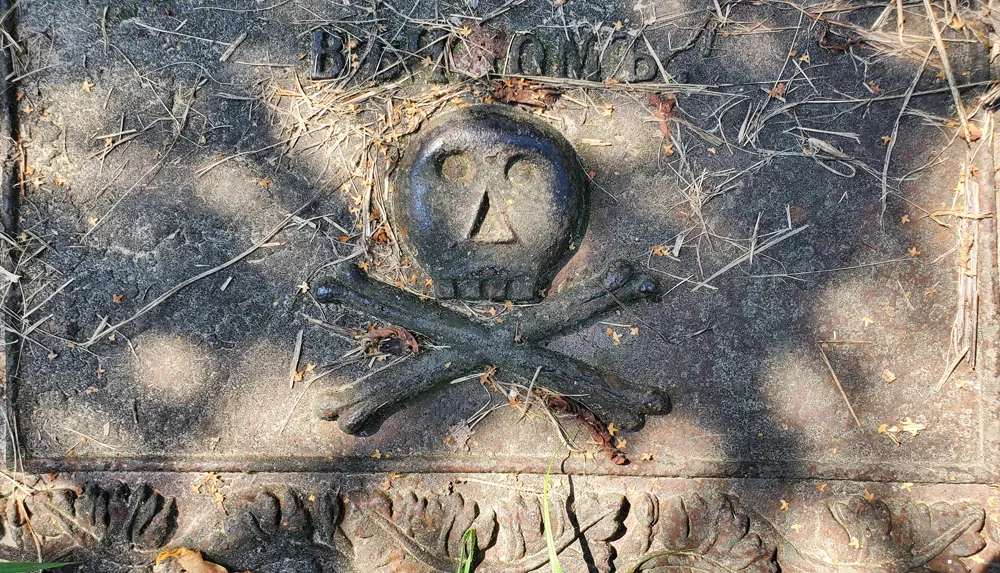
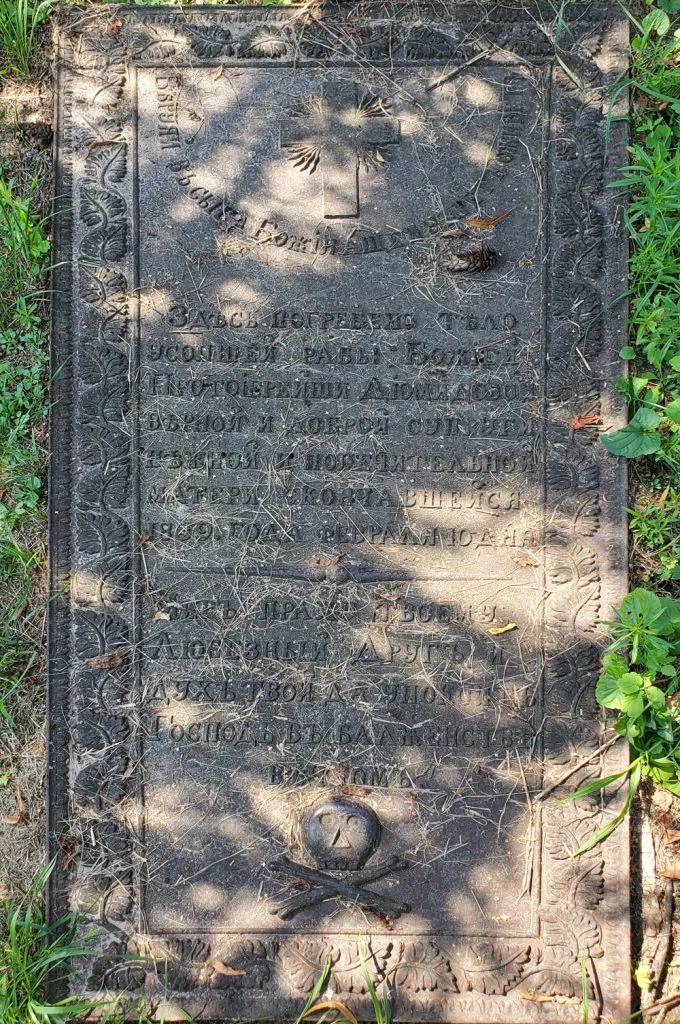
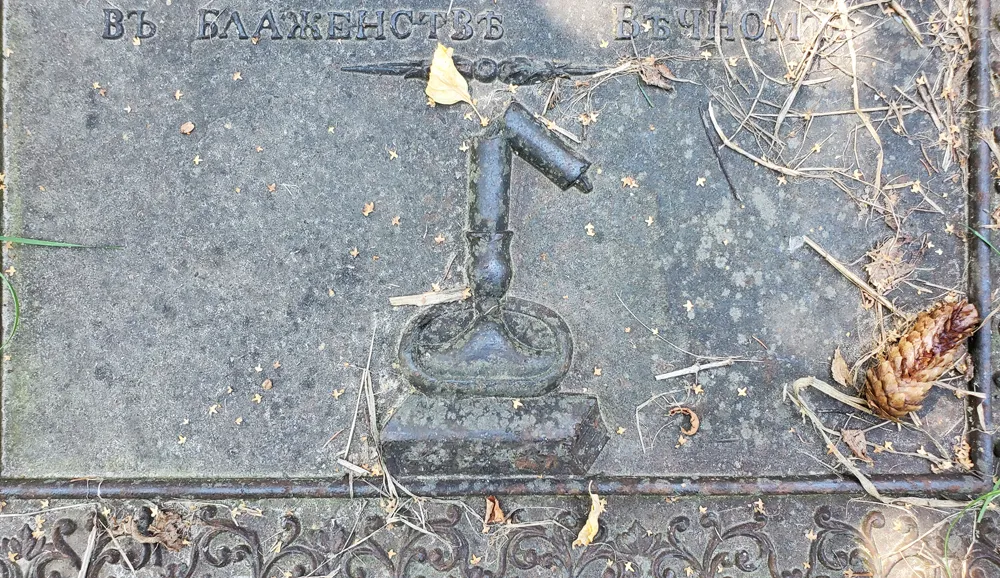
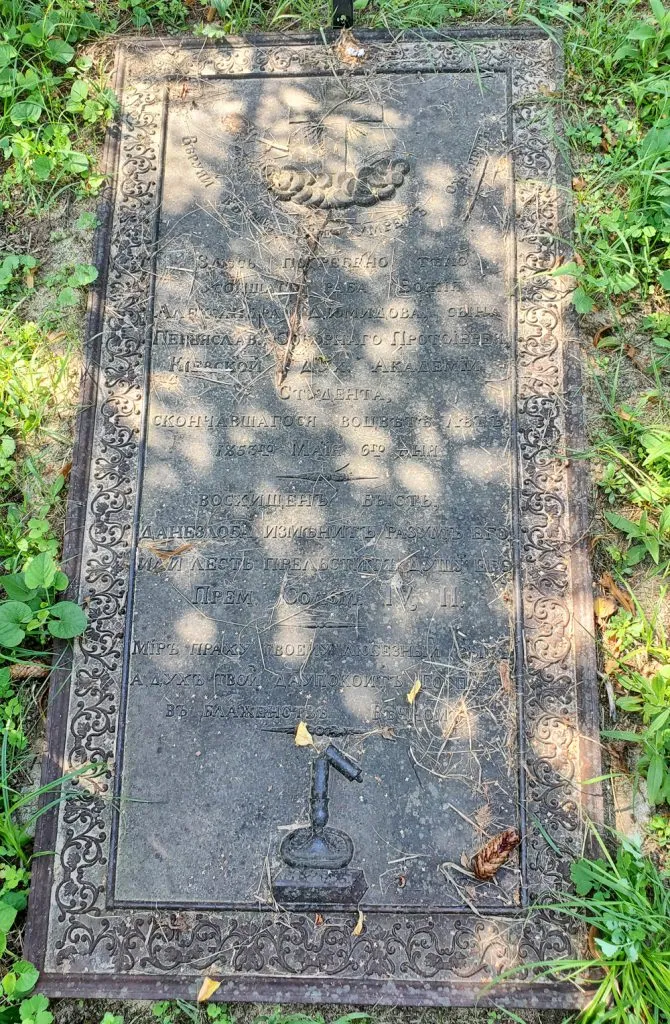
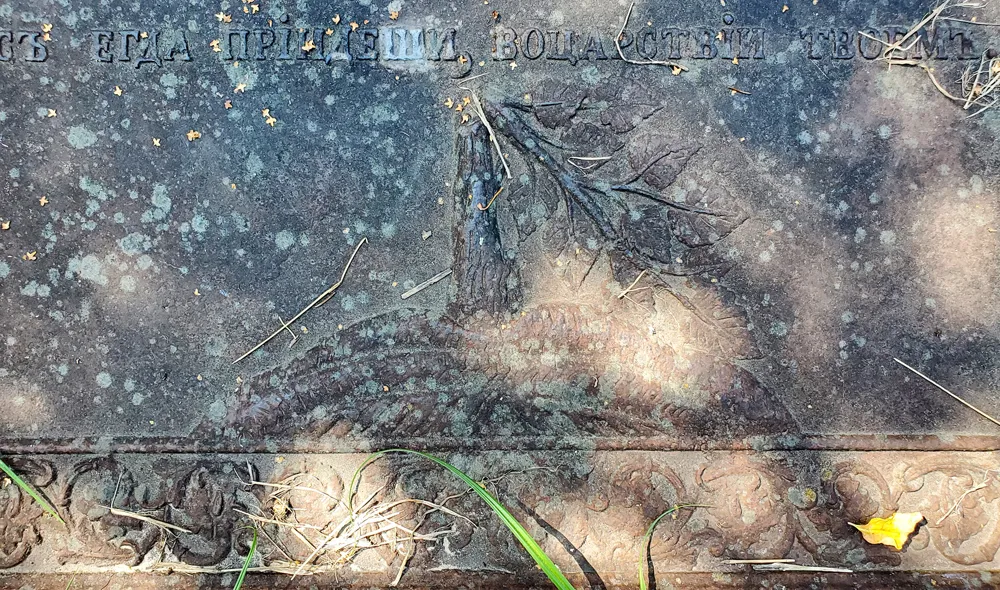
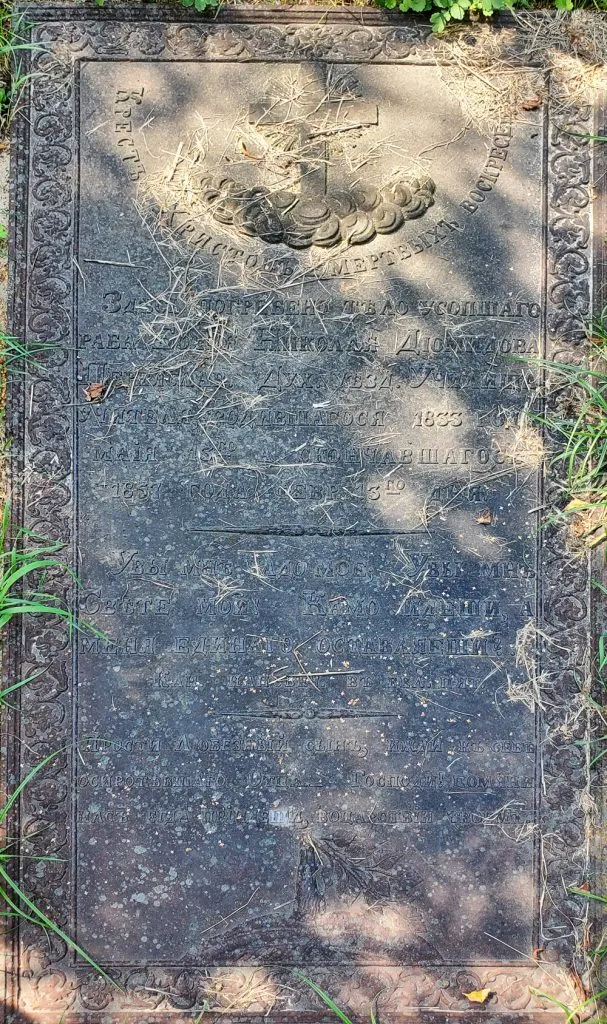
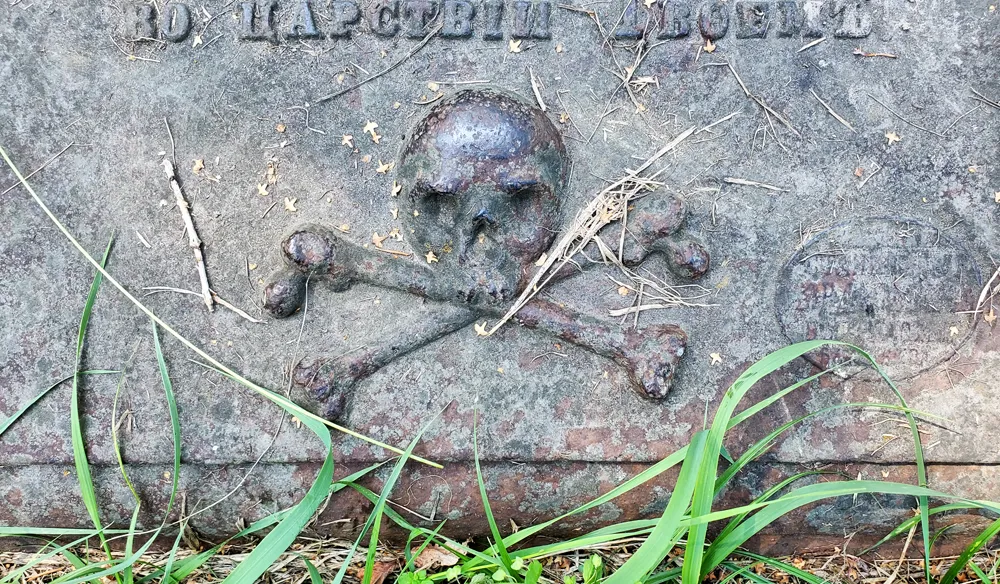
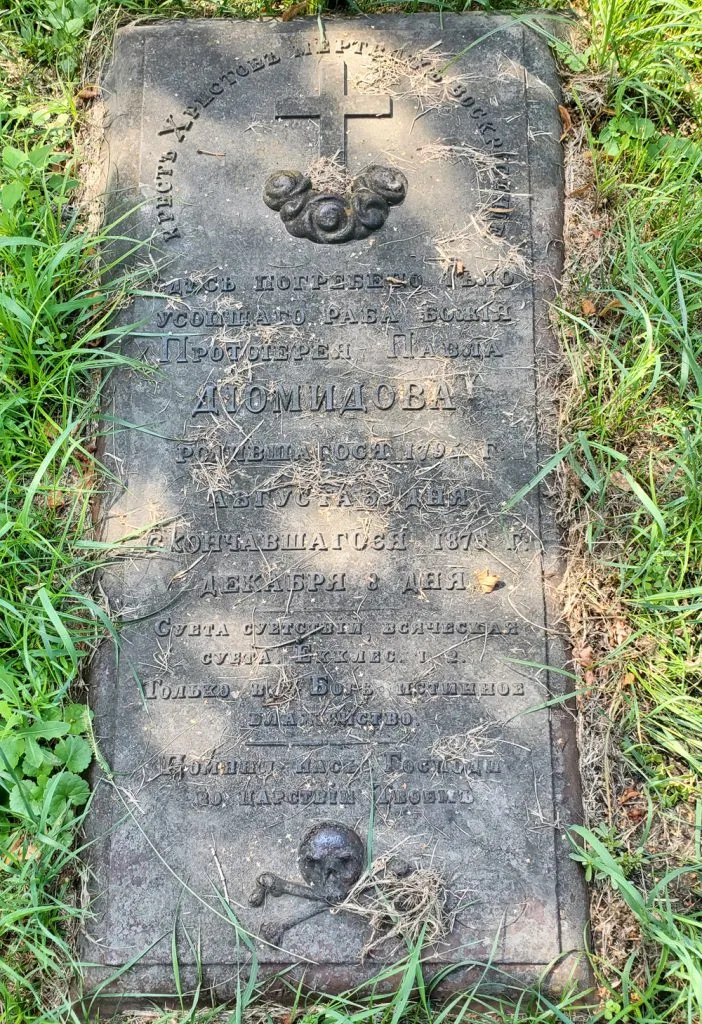
The absolute majority of the crosses in the studied necropolis are of medium size: 94 crosses are 1 to 1.5 m tall, 53 crosses 1.5 to 2 m, and 17 crosses within 0.5–1 m. There are only 5 crosses taller than 2 m (the tallest of them is 2.08 m above ground). In form the crosses are simple – differing only in the shape of their ends – four-armed, with equal, flared, slightly bevelled corners, fully rounded or trapezoidal ends. All are four-armed and lack additional sculptural elements. Only two have plaques with epitaphs of a later date. On some crosses there are four holes at the crossing – probably places for fastening plaques. It is hard to find two crosses of absolutely identical form. Similar crosses occur only occasionally. One can be sure that they were created at about the same time, by one craftsman, belong to relatives, and are mostly placed side by side.
The rather massive proportions of the grave crosses are striking. Most of the monuments above ground are a slab 10–24 cm thick that widens towards the bottom to as much as 40 cm. The widening in the lower part had a practical purpose – it gave the monument greater stability, since the cross was buried directly in the ground without special slabs (some crosses have a distinct projection with a rounded corner before the transition to the underground part). Incidentally, not a single cross with a widened lower part that had tilted badly or fallen was found. Only one was lying down, and it had evidently been deliberately dug out. It was from it, more precisely from its darker lower part, that it was possible to establish the approximate depth to which a cross was buried – 28 cm (the dimensions of this cross: height 1.12 m, width 0.66 m, thickness 0.21 m). We did not dare to excavate the lower part of the other grave crosses to establish how deep they are buried.
As for the characteristics of the material from which the stone grave crosses of the Fair Cemetery are made, they are as follows. The crosses are made quite professionally from a solid block of sandstone, most probably of local origin.
Sandstone is a natural stone, a rock of sedimentary origin, consisting of quartz particles bound together by other minerals such as silica and carbonate. In mineral composition and physical and mechanical properties it is somewhat inferior to granite and quartzite. It is a stone of medium hardness, although there are also dense varieties that are not inferior in hardness to granites. By grain size, sandstone is divided into fine-grained (0.1–0.25 mm), medium-grained (0.25–0.5 mm) and coarse-grained (0.5 mm). Unworked sandstone is called “dykun”, “plytniak”, “plashka”, “plastun”. By type of processing, it is divided into sawn and fired sandstone. By composition it is divided into: quartz, quartz-feldspar, quartz-glauconite, clayey, calcareous and gypsum-bearing. It can be of various colours, but grey, yellowish-grey or white predominate, more rarely reddish. The crosses in the cemetery under study are in various shades of grey. It has a fire resistance of 1700 °C. The largest sandstone deposits in Ukraine are concentrated in the zones of foredeeps of geosynclines. Powerful layers date from the Precambrian and Palaeozoic eras. In ancient times the best-known sandstone was that from near Terebovlia in Ternopil Oblast; it was exported even to China. Among other well-known centres of sandstone distribution, the “Small Mining Encyclopedia” reports, were: the Dnipro region (Trakhtemyriv, Hlukhiv), the Donbas, Podillia, Volyn, and the Carpathians. The Kaniv sandstones were among the well-known ones. They were quarried as early as the 10th–13th centuries. The Brockhaus and Efron Encyclopaedia called “Kyiv sandstone” the best millstone and, accordingly, grave stone.
Stone was quarried in two ways – open and underground (shaft). In places where the stone came to the surface in the form of cliffs, and also along river banks, it was worked by the open method; no underground adits were built, only small cuttings were made. This method was considerably easier and did not require a large number of workers. In the stone ledge, holes were made in several places, into which wooden pegs were later inserted. Then the stone was heated from below with fire. It heated up and cracked in the places where the pegs were. To direct the split of the stone, the wooden pegs were struck with hammers. The underground method of extracting stone was considerably harder. A mine (adit) differed somewhat from a coal mine. These were quite deep (50–100 m) passages (straight or winding) 1 to 2 m wide and 1.5 to 2 or more metres high, so that a person could pass through. The ceiling of the adits was supported with wooden beams, under which round oak props were driven to keep the beams from sagging. As a result of working the mines, pit-niches were formed 10 sazhens long (1 sazhen = 2.13 m) and 4 wide and 3 sazhens deep. Technically the process took place in several stages. At the first stage the stonecutters cut blanks from the stone mass using the simplest, primitive tools: hammers, picks, metal and wooden wedges. Right in the underground the blank was given a rounded shape and the required thickness, and then rolled out to the surface. In the course of work quite a lot of “waste” (sand, stone fragments) remained. The sand was carted away and heaped so that it would not get in the way, while large pieces of stone were set aside separately. Later the blanks and pieces of stone were delivered to workshops located in the surrounding settlements, where they were finished.
Stonecutting and, in particular, cross-making was well developed in the Pereiaslav region. This was due to the deposits of the necessary materials. “Starting from Trakhtemyriv and up to Kaniv,” L. Pokhylevych recalled in his “Accounts of Inhabited Places of Kyiv Governorate,” “over thirty-five kilometres, the mountains have advanced right up to the Dnipro. The right-bank hills, which acquire the character of real tectonic mountains, reach their greatest height here. In some places, behind the nearer mountain ridge, further ridges rise one after another. It is as if these were the distant Carpathians. This bank is considered the most picturesque place on the Dnipro. Both on the high mountain and on the neighbouring hills of Trakhtemyriv stand stone, roughly hewn crosses, set up at unknown times. Their height is up to 3 arshins. Near them, at various distances, are stones on which crosses are carved. These crosses and stones, scattered over the hills, the people attribute to immemorial times” [8, p. 467]. Pokhylevych goes on to mention other villages where there were deposits of sandstone. These are Monastyrok – a village on the Dnipro 3 versts below Trakhtemyriv. Near the village there were the tracts Horodok-hora, Markova-hora, Zdykhalnia-hora, and the Puhachka ravine. 3 versts below Monastyrok and 8 versts from Pereiaslav is the village of Zarubyntsi: “On the bank of the Dnipro, near the village, stones are found with imprints of shells of a kind that is not now found in the Dnipro.” 6 versts below Zarubyntsi, in a hilly and wooded area, is the village of Hryhoriv. In these parts there was also the village of Pishchanyky, which received its name because of the rich deposits of sandstone. Until 1842 it belonged to Major General Polinov. Later half of the village belonged to Vikentii Osypovych Volianskyi, and half to Captain of Cavalry Bolesław Osypovych Skirgiełło [8, p. 468].
The territory described by Pokhylevych is, in its geological structure, a unique component of the eastern elevated margin of the Dnipro Upland. This is an elevation with glacio-tectonic dislocations on a Jurassic-Cretaceous base. The thickness of the loess-like loams is 1–6 m. Beneath them, at a depth of 4–5 arshins, lie deposits of sandstone (in places coming to the surface). To reach the stone it is necessary to remove the top layer of clay and remove the top layer of sandstone, which is unusable because of its softness. Only then comes a tier of stone 3–4 arshins thick. The stone was not taken from deeper, because the mines filled with water. Blocks of stone were hauled out of the quarry by horses. They were carried by carts to the Dnipro. From there the blanks were carried by boats to stone-cutting workshops, where the crosses were “hewn” and millstones made. A craftsman who specialised in making grave crosses was called a “khreshchatnyk” (cross-maker). But there was evidently no strict specialisation: a craftsman who knew how to work stone freely made any products from it.
Working a multi-tonne lump of stone and applying letters and images to it was complex work. The sizes and shape of the crosses depended on the stone blank and the wishes of the customer. Orders came from the surrounding territories, where local traditions and artistic preferences had already formed. Gradually several variants of the typological and artistic design of the crosses took shape. Every craftsman had sketches of monuments. Orders were evidently carried out from these models, sometimes with deviations due to the peculiarities of the material and the customer’s wishes.
How exactly the process of extracting stone and making gravestones was organised in the Pereiaslav region is not known. But it probably looked more or less the same everywhere in Ukraine. We have a detailed description of the making of grave crosses in the village of Kamianka, Ostroh county, Volyn Governorate, in the mid-19th century: a Jew from the town of Ostroh leased in this village a pond with a mill and a quarry of about 1 desiatina. He hired two craftsmen to make grave markers, whom he paid by output. To prepare the slabs for the craftsmen he hired local peasants. The worker who extracted the stone was paid 15 kopecks for a blank 13 vershoks wide, 26 long and 6 inches thick. Two slabs came out of such a blank. For a slab 2 vershoks thick, with the same dimensions, the worker received 10 kopecks. To obtain a blank, the worker had to move aside a layer of soil and rock, cut it out in the monolith and split off the slab, haul it out of the quarry with horses and deliver it to the craftsman. After working, a square cubit (13 vershoks) of grave slab with loading, but without delivery, was valued at 60 kopecks in silver, without loading 50 kopecks. Simple decoration of a cubic arshin cost 6 silver roubles on the spot, and patterned work was valued higher. For a monument of “quite elegant workmanship” they asked 40 to 50 silver roubles. Orders for monuments were irregular. In a year the craftsmen made grave crosses and slabs worth approximately 500 silver roubles [10, p. 174].
The craftsmen who cut slabs in the quarries and made monuments from them were called “turniks” – miners. Each “hurnik” had his own section in the quarry for cutting blanks, and next to it a plot of land where the material was hauled and worked. To remove the soil and the “shabra” – rubble mixed with clay – the “hurniks” hired local lads and girls or ones from neighbouring villages. The girls dug the soil, and the lads broke up the “shabra” with picks down to the layer of solid stone. The top layer of stone is soft and unsuitable for making grave markers. This stone was used as building stone for foundations, cellars and wells. From a depth of 3–4 metres, slabs for monuments were cut from “makovyk” – solid hard sandstone of a brown-yellow colour with dark grains like poppy seeds. In the solid monolith the “turnik” cut out with a pick the outline of a blank of the required thickness. Then “horses” – slits – were cut under the blank, into which metal wedges were inserted and struck with a sledgehammer. When splitting off the slab, wooden wedges were placed between the metal wedges so as not to damage the blank. The split-off slab was laid on beams, tied with ropes and hauled to the surface by horses. Blanks were cut in the quarry in the warm season. In winter frozen stone could not be worked. Sometimes some craftsmen cut blanks in winter. For this they lit fires on the monolith, and when the stone had heated up they raked away the embers and cut the outline of the slab. The “turniks” had no special workshops for making monuments. Blanks hauled out of the quarry were worked next to the quarry. Some craftsmen made small crosses at home. In the quarry the “hurniks” used shovels, picks, hammers, iron and wooden wedges, and crowbars to extract blanks. For working slabs and making monuments there was a different set of tools, consisting of “krengels”, chisels, “knypels”, “scrapers”, an arshin, a ruler and a set square.
The main tool for working stone was the “krengel”, with which surfaces were dressed. The “krengel” consisted of a long round metal handle, at the end of which was a four-sided frame. Into the frame were inserted 6–8 four-sided rods, pointed at both ends, of high-quality steel, and fixed with a wedge. After dressing, numerous “rough bumps” from the “krengel” remained on the stone’s surface. Unevenness was dressed off with the help of wide steel chisels. During work the chisels were struck with a “knypel” made of hornbeam, birch or ash wood. With the help of a set of chisels of various widths, patterns and inscriptions were cut on grave slabs and monuments. The surface of slabs and monuments was polished with “scrapers” – this tool had the shape of a bar 25–30 cm long, 5 cm wide and 4 cm thick. In the lower part of the bar a groove was cut in a “snake” pattern, into which a strip of sheet metal 2–2.5 cm wide was inserted. Sometimes a length of thin hoop was set in. The “krengels”, crowbars, wedges, chisels and “hurniks” were ordered from local blacksmiths. The “knypels”, “scrapers” and wooden wedges were made by the craftsmen themselves. Hammers and metal for the scrapers were bought in Jewish shops [10, pp. 174–175].
Thus grave monuments are a distinctive cultural and historical legacy that has come down to us from our ancestors. Studying them stimulates the revival of historical memory and helps strengthen the spiritual bond between generations. The preservation and study of these monuments of antiquity is of great scientific importance, so the problem raised is undoubtedly important in the context of studying the crafts of the Pereiaslav region, in particular stonecutting, sacred art and funeral rites, and requires further development.
The present state of the necropolis and the old grave markers causes concern: of the 169 crosses, half can be considered relatively intact. The causes are natural: sinking into the ground, weathering, destruction of the stone, and active building on the cemetery.
New monuments of our region are being brought into circulation. An urgent task is to identify them, describe them scientifically, systematise them and bring information about grave markers into scientific circulation, create databases, publish illustrated catalogues, and popularise crosses as monuments of general cultural and historical value. It is not easy to mention all the grave crosses in one article – this requires broad research in the future.
On the whole, the grave monuments of the Fair Cemetery are distinguished by modesty, simplicity, unpretentiousness and a high artistic level of execution. Majestic austerity, remarkable harmony, the relationships of sizes and proportions, and carefully thought-out forms all together soften the sad purpose of the monument. The considerable size of the crosses is explained by the presence of large deposits of material and the residence of skilled carvers in this region.
To preserve the cemeteries and old grave markers, which are undoubtedly part of the history of Pereiaslav, it is proposed to register them as complex historical monuments of local significance.
From time immemorial our people have had a highly developed sense of respect and reverence for those who have departed into eternity. That is why graves were always treated with special reverence and awe. Burial places were considered sacred – they were not dug up or ploughed. Everyone who entered the graves or passed by them invariably took off his headgear, paying respect to the dead. Respect for ancestors has always been a high level of morality among all peoples.
SOURCES AND LITERATURE
Brockhaus and Efron Encyclopaedia. – 1894. – Vol. 11. – p. 896.
Kolomiiets O. R. The Pereiaslav necropolis / O. R. Kolomiiets // Abstracts of the scientific and practical conference “Monuments and Notable Places of the Shevchenko Region. Problems of Protection and Research”. – Kaniv – 1997. – pp. 148–150.
Kolomiiets O. R. The Pereiaslav necropolis. Remember the end. / O. R. Kolomiiets // Herald of the Pereiaslav Region. – 1997. – April. – p. 3.
Small Mining Encyclopedia. In 3 vols. / Ed. V. S. Biletskyi. – Donetsk: “Donbas”, 2004.
Tovkailo M. T. Relict types of grave markers from the Middle Dnipro region / M. T. Tovkailo // Folk Art and Ethnography. – 2006. – No. 1. – pp. 17–37.
Tovkailo M. T. Typology and chronology of wooden pillar-like grave markers from the Middle Dnipro region / M. T. Tovkailo // New Research on Monuments of the Cossack Era in Ukraine. – Kyiv, 2000. – Issue 9. – pp. 91–97.
Yurchenko O. Necropolises of Pereiaslav of the 17th–18th centuries / O. Yurchenko // Scientific Notes on Ukrainian History. Collection of scientific articles. – Ternopil, Aston, 2007. – Issue 19. – pp. 83–89.
Pokhylevych L. Accounts of inhabited places of Kyiv Governorate, or statistical, historical and church notes on all villages, settlements, towns and cities located within the governorate / L. Pokhylevych. – Kyiv, 1864.
Field research notes. Recorded by the author on 4 April 2011 from O. R. Kolomiiets, born 1950, resident of Pereiaslav-Khmelnytskyi, Kyiv Oblast.
Ossovskyi H. Geological and geognostic survey of Volyn Governorate / H. Ossovskyi. – Zhytomyr, 1867. – pp. 174–175.
Mozdyr M. Ukrainian folk memorial sculpture / M. Mozdyr. – Lviv: Institute of Ethnology of the National Academy of Sciences of Ukraine, publishing firm “Afisha”, 2009. – 287 pp.
Gham Olena
Grave crosses from sandstone on a city fair cemetery in town Pereyaslav-Khmelnytskky
The article gives the generalized description of grave crosses XIX – the first half of a XX age from sadstone of city Fair cemetery of Pereyaslav-Khmelnytsky.
Key words: grave cross, grave, city cemetery, sandstone.
Author: Olena Zham (Pereiaslav-Khmelnytskyi)
PEREIASLAVIKA: Scientific Notes of the National Historical and Ethnographic Reserve “Pereiaslav” / III Yefremiv Readings “Religious Life of the Pereiaslav Land (9th–21st centuries)”. – Collection of scientific articles. – Issue 7(9) – 2014. – pp. 95–105.
Source: Pereiaslavshchyna


