Podillia and the Minkivtsi state

· 9 min read
One of the most beautiful regions of Ukraine is Podillia.
Today we set off on a journey to these blessed places and recall an incredible story that happened at the turn of the 18th and 19th centuries.
A story that tells of the spirit and will of Ukrainians, of their striving for freedom, and also of their unwillingness to submit to empires and their predatory plans.
The settlement where these events took place has been known since ancient times and can boast remains of cultures from the Trypillian and Cherniakhiv onward. We can trace the history of the region in full sequence and logical completeness from roughly the 14th century. Besides chronicles, we may find useful, for example, the “Codex epistolaris Vitoldi”, compiled by Antoni Prochaska and published in 1882 in Kraków
[http://polona.pl/…/codex-epistolaris-vitoldi…/7/…]. It contains publications of Latin and other documents and princely letters of the 14th–15th centuries, about one and a half thousand in all, many of which tell, among other things, about the history of this region. Thus, after the Lithuanian-Ruthenian army liberated the lands of Podillia from the Horde following the Battle of Blue Waters in 1362, they came under the rule of the Koriatovych princes. And in a document of 12 June 1395, the Grand Duke of Lithuania and Rus, Władysław II Jagiełło, transfers to Spytek, Voivode of Kraków, possession of part of the Podolian castles with their surroundings. In 1400 Svydrygailo styled himself ruler and prince of these lands. But not even a year passes before his trace vanishes too. Later we have a mention directly of Minkivtsi, when on 20 October 1407 a charter was issued to local magnates:
“…in perpetual grant for loyalty and service to Yakush of Mankivtsi himself and his stepson Klement and their heirs, the village of Mankivtsi on the Riv River and the village of Minkivtsi on the Ushytsia River in the Podolian land and Kamianets district, with all rents, fields, hunting grounds, apiaries, lakes, fish ponds, mills, and everything that pertains thereto, etc., so that they shall reside there permanently and serve us in all campaigns with one lancer and three archers, and also take part in local campaigns with all their people, since it is necessary to defend the lands; and the taxes, general levies, labour duties and dues that they were accustomed to pay to their previous princes, rulers and lords of Podillia, let them pay.”
For 1434 we find a document according to which the villages of Mankivtsi and Minkivtsi had been split up and were already granted to Borsz of Kocin.
According to the research of O. Biletska, in the 15th century the voivodes, castellans or starostas of the lands of Podillia included such interesting figures as: Dobrohoslav of Kolen, Piotr Odrowąż, Bedrykh, Teodorchyk of Buchach, Dobrohost, Vasko, Janusz Kerdeievych, Hryzko Kerdeievych, Stybor of Komornik, Petrash, Stohniew Rej, Jan Lasz, Svynka, Derslav Nesvyzky, Ivashko Monyvydovych, Monyvyd, Khrystyn of Shchukovtsi, Abraham… [Biletska O. Podillia at the turn of the 14th–15th centuries: To the origins of the formation of the historical… Odesa, 2004. 416 pp.] ?
As is evident even from the names, ethnic and religious tolerance were traditional here ?
Later the village belonged to the Stanisławski family, one of whom, Adam, raised it to the status of a small town, receiving in 1637 from Władysław IV the following privilege:
“Whereas the hereditary owner Adam Stanisławski has properly equipped with ramparts and moats the recently founded town of Minkivtsi in Podillia, we grant that settlement Magdeburg rights, establishing fairs on the Exaltation of the Holy Cross and on St. Onuphrius, and markets every Friday, according to the Ruthenian calendar.”
.
Before delving into the description of the characters and the beautiful places where it all happened, I will briefly recall the events that raged in the turbulent years in which the main scenes of our story unfold.
Well-fed, well-rebuilt, and prosperous under the rule of Ivan Mazepa, Ukraine lost the war of 1709 and began to be drained by the victor-conqueror. In 1768–1774 the great Russo-Turkish war was fought, which in many respects was won thanks to the resources of Ukraine. Its beginning was caused by the introduction of Muscovite troops into Right-Bank Ukraine to suppress the Koliivshchyna and the Bar Confederation of 1768, but already on 31 October 1768 the president of the Little Russian Collegium, P. Rumiantsev, asked the Koshovyi Otaman of the Zaporozhian Sich, P. Kalnyshevskyi, to “put all his host into military order at once”. In the war, Ukrainian human, material and financial resources were used on a grand scale. Our country was exhausted and drained of blood, and temporarily lost in the fighting the military power that had won statehood more than 125 years earlier: the Cossacks.
And how did the Empire repay? Already in 1775 Muscovite troops took advantage of the moment and destroyed the Sich, plundered the military treasury, supplies, archive and church. Together with the officers, P. Kalnyshevskyi was arrested on 25 June 1776 and exiled for life to the Solovetsky Monastery. In 1781 the regimental and company administrative system of the Hetmanate was abolished and viceroyalties were established. In 1783 Catherine II issued a decree by which the peasants of the Hetmanate were enserfed. In 1796 the same fate befell the peasants of southern Ukraine. An attack began on the lands of monasteries, which historically had been centres of knowledge, preserved the history of the Hetmanate and the Cossack state, and were guardians of rights and freedoms that were based on continuity and guaranteed by various documents. These lands were taken away for “public needs”, only to reopen after a while as “spiritual-bond” centres of propaganda. Thus by the end of the 18th century Ukrainians had fallen into almost complete military, political and economic dependence.
In parallel, from 1772, the dismantling of the Polish–Lithuanian Commonwealth began with the help of the Russian Empire, Austria and Prussia. In 1773–1792 King Stanisław August Poniatowski and the supporters of reform managed to carry out a series of changes; the Sejm adopted the Constitution of the Commonwealth of 1791, which introduced a constitutional monarchy, personal freedoms and equal rights for all citizens. But conservative noble circles formed the Targowica Confederation in 1792 and called on the Russian army for help. The intervention of the neighbours led to the Second Partition of the Commonwealth’s lands in 1793. All of Greater Poland, Mazovia, and all the Ukrainian and Belarusian lands were detached from it. The response was an anti-Russian uprising led by Tadeusz Kościuszko (1746–1817), in which townspeople and some of the peasants took part. The Russian troops, although defeated in a local battle, in the end brutally suppressed the uprising, and in 1795 the Russian Empire, Austria and Prussia carried out the Third Partition of the Commonwealth, after which it ceased to exist.
.
It was in these difficult years that the inhabitants of Podillia tried to adapt to rapidly changing conditions and find their place in the turbulent world. They relied largely on local self-organisation and self-government, and also on the continuity of the rights and privileges granted to them earlier. After all, it was useless to look for support or orders from the centre. And it was no longer even clear where that centre was at all.
This is how the story of one independence on Ukrainian lands begins, a little republic that demonstrated that everything could be different, that it is not empires that have a future, however militarily strong they may temporarily seem and however predatorily they seize territories. This local initiative of self-organisation was ahead of its time; it then seemed a “white crow”, and now it is almost a model of how everything could have been different if republican principles had prevailed over the temporary imperial might that would be utterly crushed later by the projects of modern nation states.
And so we are transported to the 18th century, to the God-given places of Podillia granted to Ukrainians, namely to the great Ushytsia road, a few miles from Kamianets, in what was then the Ushytsia district. On a beautiful plain the large and pretty little town of Minkivtsi is picturesquely spread out.
If the remark of some travellers in Podillia is right, that the part of it lying along the course of the Dniester can without exaggeration be called Podolian Switzerland, then the area around Minkivtsi got the tastiest corner of this Podolian Switzerland. The terrain does indeed resemble it in many ways, with the enchanting beauty of its landscapes and a blue, blue sky. This charm is countless and varied, no description can convey the full picture, and so it is better to go there in person.
Approaching the town of Minkivtsi from the hill, the traveller sees a ravine, in whose depths a silvery stream sings, answering the birds. And climbing to the top of the ravine, he sees a multitude of multicoloured, varied, sometimes quirky buildings scattered across the whole horizon. Something like this would suit that same Switzerland, yet we find it in Podillia of the 18th century.
In the very centre of the town a European-style market square in the shape of a quadrangle has been laid out, from which the town hall building stands out, with a tower and the Minkivtsi measure on top. The square is surrounded by neat little houses of craftsmen. The town has two beautiful buildings, a church and a Roman Catholic church. The huge round building with green domes decorated with gilded crosses is the church of the Greek rite. And next to it is a Roman Catholic chapel and a church.
All the other Minkivtsi estates and farmsteads lie around in various directions along the course of a small river, in whose bends numerous large and small mills are hidden. And what marvellous, cosy banks spread out on both sides of the little river! Having found its channel in the depths of the ravine, with a melodious chiming and murmuring, it flows swiftly between high rocky walls, as if deliberately fashioned from solid stone by the skilled hand of an experienced mason. On the rocky landscapes, large and small villages and farmsteads can be seen here and there, picturesquely scattered along the whole riverbank; beyond the villages stretch small orchards, and beyond them endless fertile plains, cut into small strips of different colours. This whole picture is crowned with a wonderful frame woven of various trees. This Edenic beauty becomes even more striking against the background of the clear and pure Podolian sky!
And what colours it takes on at the setting of the enormous sun!
Where, if not here, should this story begin, which you surely cannot wait to read)
But this was an introduction, to understand whether many people are interested in reading the continuation.
Author: Ihor Poluiektov
Continuation and beginning:
The Minkivtsi state. The beginning
The Minkivtsi state. The story of one independence in 18th-century Ukrainian lands
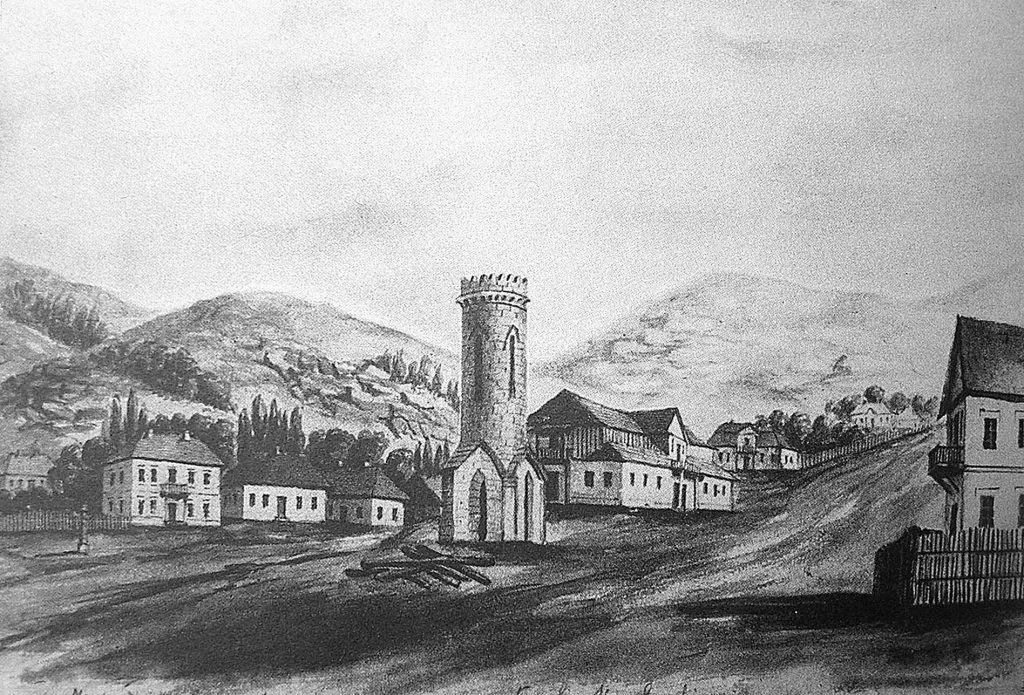
If someone has not managed to be immersed in the spirit of those centuries and transported to Minkivtsi of the 18th–19th centuries, Napoleon Orda will do it: he travelled through our lands and in 1871 depicted the Minkivtsi described above thus