

About roosters on a stick, barrels and the beggar uncle (ethnographic nostalgic memoirs)

· 11 min read
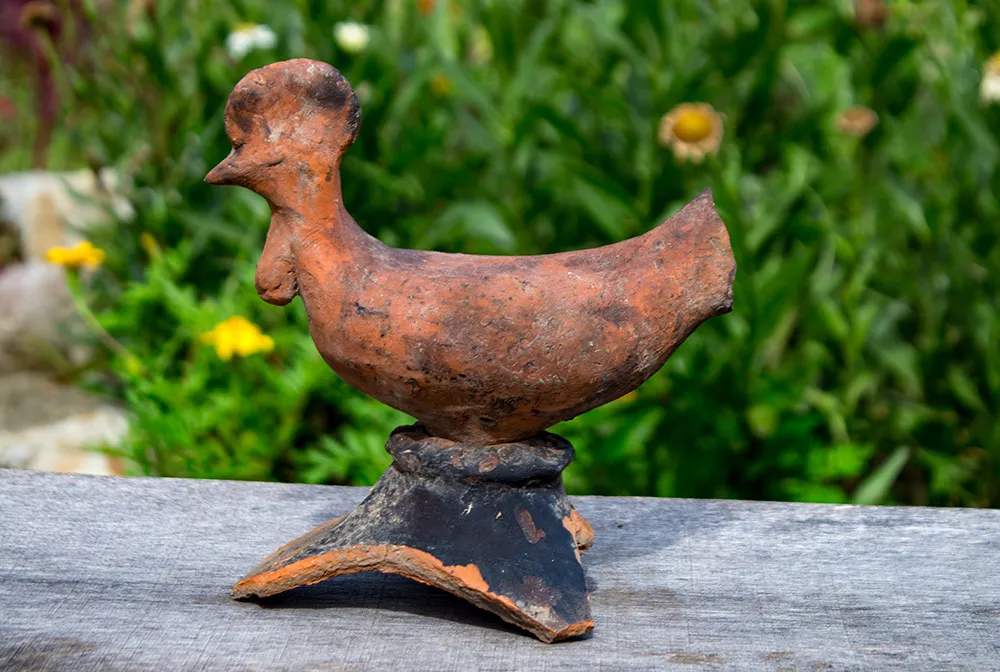
It all began with the find of this rooster
“Virtual Vytrishky” (Virtual Gawking) for Ukraine Incognita
Historical heritage is not only what you can touch and gawk at. Often it is intangible and lives only in memories. Today’s story is about that kind.
First, a preamble. The impetus for publishing this text was a recent and absolutely material find. The author periodically combs the historical part of his native Horodok (Khmelnytskyi Oblast) in search of something interesting. Not unsuccessfully, I should say. In particular, in 2017 a meeting with workers who were digging something as trivial as a septic tank, and an examination of the spoil heap a few months later, grew into full-scale archaeological excavations. The first in the history of Horodok, I should note. We will skip other finds and discoveries, because they are off topic.
This time, too, there was a find. Unfortunately the author reached the site of the earthworks IN A VERY INTERESTING AREA after the fact. Everything had already been filled in and somehow levelled. Among the finds were several fragments of 17th-century pottery and, most importantly, a sizeable clay rooster. Such roosters used to adorn “dymnyky”, special structures that cap the chimneys of Ukrainian houses. Here and there you can still see them in villages and in private housing in small towns. In the same place we were lucky to dig out of the ground many fragments of that “dymnyk”, which by all appearances was of quite an elaborate design. There were also fragments with a date: 1931. How about that!
It was that very rooster that inspired the publication of this text.
***
I do not like our modern markets. They are the same everywhere and rather sad: Chinese mass-market goods, European second-hand clothes, Turkish tomatoes, Ecuadorian bananas and homegrown “kravchuchky” (cheap wheeled shopping trolleys). A rather standard, grey spectacle. Of those old fairs, so juicily described by Gogol, only memories remain.
The “Big Market” traditionally held in our Horodok on Saturdays is no exception. Not what it used to be!
Morning trips to the Saturday “big market” are probably the brightest memory of childhood. Back then, at the turn of the 1960s and 1970s, this event was hardly inferior to Gogol’s descriptions. Horses, carts, cows, squealing piglets, pyramids of earthenware bowls, mugs, painted dishes… Almost all the peasants from the surrounding villages came by horse-drawn transport. Cars were still a rarity. On the carts were mountains of apples, huge orange pumpkins and striped watermelons. Nobody had even heard of imported Kherson ones. There were large local melon fields of our own where huge watermelons were grown. Later the melon fields vanished, and the local varieties disappeared.
Especially impressive were the huge barrels set on the carts, with pickled apples, tomatoes, cucumbers and cabbage. The latter was bought by the bucket. The barrels really were huge, and it wasn’t that I was small. These vessels took up the whole width of the cart. Later I met such barrel “leviathans” only in Crimea, at the Massandra wineries.
Ordinary barrels, however, did not impress us. We could gaze at them quite enough in the yard. In our apartment blocks there were whole “catacombs” of cellars, each family with its own storeroom where potatoes, carrots, onions and all sorts of home preserves were kept. Cabbage and cucumbers were pickled exclusively in barrels. For the summer the empty barrels were taken out into the yard and placed beside the water pump, and filled with water so that they would not dry out. They stood like that until autumn. The water in them was changed at most once or twice in that time. In these improvised “aquariums” all kinds of creatures appeared in the meantime. First of all, mosquito larvae. They were so funny! The larvae usually “swarmed” along the walls. You would peer into the barrel and then thump its rough side with your fist: boom! And the whole “swarm” would dash to the bottom in a crowd.
And in the barrels there also swam mysterious creatures, something like a translucent jelly-like bean with a long thin tail. Unlike the bustling baby mosquitoes, these swam sedately and paid no attention to us.
It was especially joyful if a diving beetle turned up in some barrel (how they got there is still a mystery to me). A crowd of kids regularly gathered by the barrel with the beetle, watching its evolutions in the greenish, smelly water, spellbound. Discovery Channel has nothing on that! Today’s children with their computer toys and dozens of TV channels in the “box” would never understand.
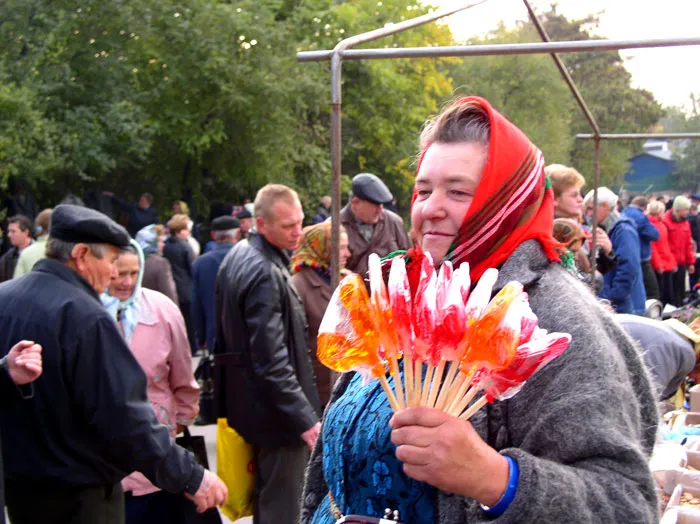
What kind of market is it without roosters on a stick?
But let us return to the market. No, it was not banal “shopping”. It was “going out into the world”. Admittedly nobody dressed in their very best, but turning up at the fair looking shabby was considered bad form. Besides, it was a whole ceremony. Especially for us children. The compulsory programme included buying a rooster. Yes, the one on a stick. The roosters were sold only at the Big Market, right by the entrance. The “rooster” was not a sweet, but… I don’t even know what. We had no shortage of sweets anyway. My parents could afford even chocolate ones, and not only on holidays. But those were ORDINARY sweets from a shop. What was so special about them? A “rooster”, now that was cool. You were not supposed to lick it. You were supposed to walk around with it. For show. The bird was usually licked only towards evening. “Top-level aerobatics” was considered licking the candy down to a minimum while fully preserving its original shape.
Item no. 2 on the programme was buying a clay whistle. The potter-toymaker sat on a stump right by the market gates. In front of him a sackcloth was spread with heaps of whistles gleaming with all the colours of the rainbow. And also miniature (toy) pots, mugs and other crockery, a girlish delight. Four decades have passed. I no longer remember what was on offer in the “real” toy shop then, but the old man with his whistles has stayed in memory like a bright and vivid colour slide.
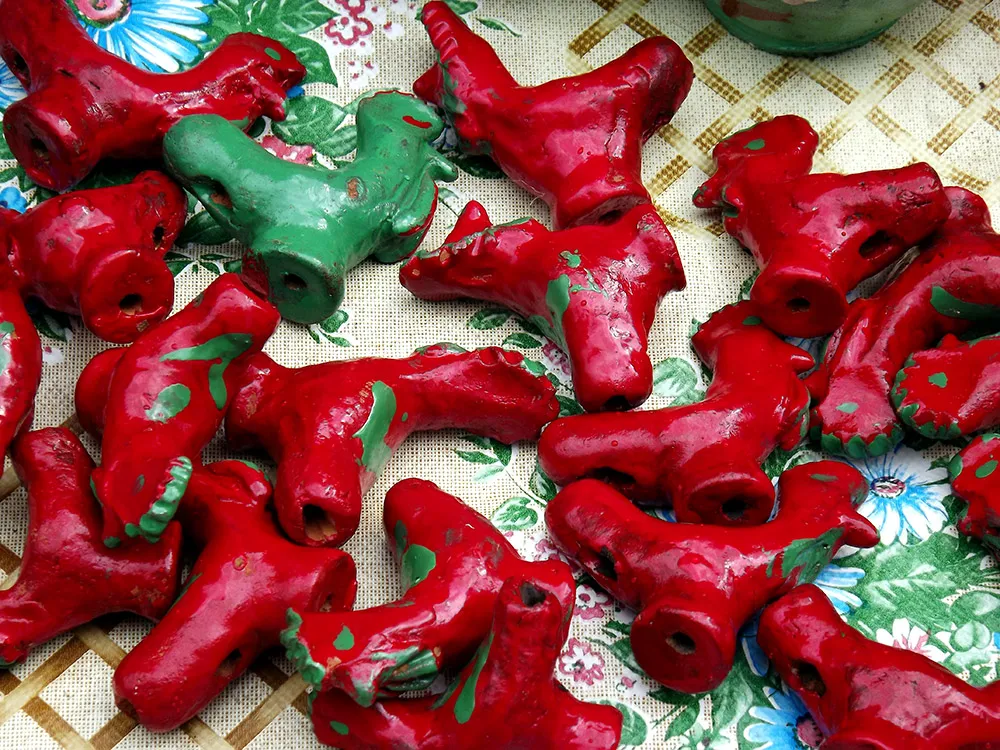
A child’s joy and a horror for adult ears
Whistles were bought for all children without fail. It was an integral part of the market ceremonial. Only naughty children who had already misbehaved too much were deprived of the joy. But parents rarely went to such unthinkable brutality.
Every Saturday the children were bought a new whistle, and not like the previous one. The old man had a good imagination, so you could choose a whistle to any taste and colour. He had whistling roosters and hens, turkeys, little horses, billy goats, little rams, pipes. There were even “rockets”: everyone wanted to be a cosmonaut then…
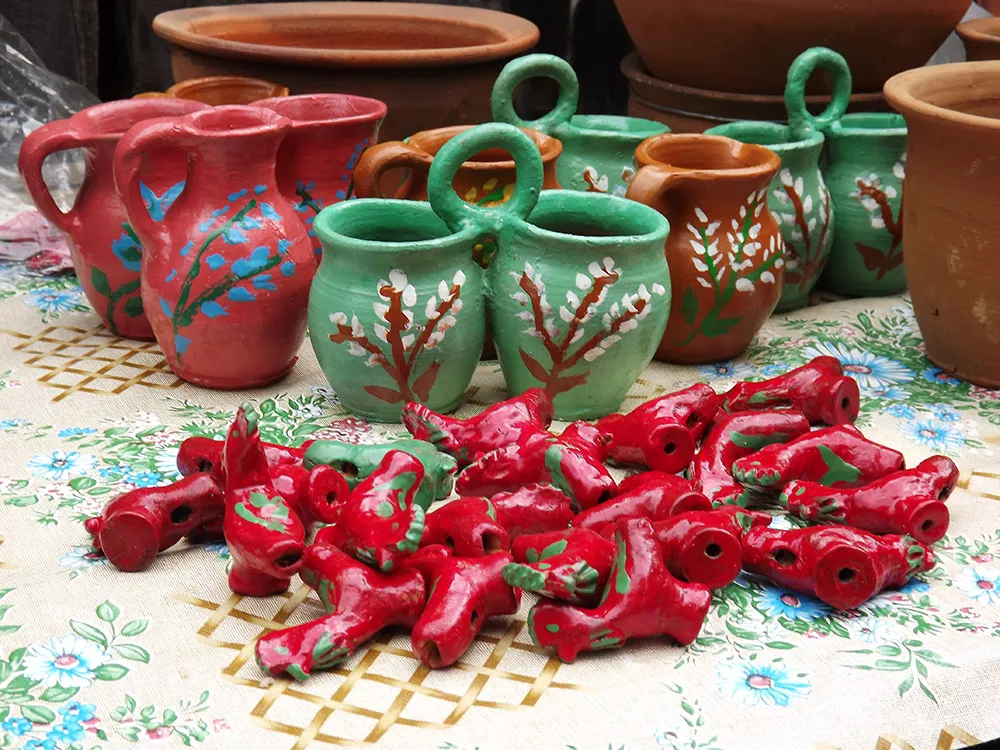
Ceramic happiness
The four-legged beasts differed from each other only in the absence or presence of horns (and their shape). Otherwise the little horse and the billy goat had one and the same face. Only the goat had horns. The coolest whistle was the horse with a rider. It cost a whole 15 kopecks (instead of the usual ten), so it was bought rarely.
You had to blow the whistle.
NON-STOP!
Which we did with enormous enthusiasm. All Saturday and all Sunday our little town was fairly bursting with whistling.
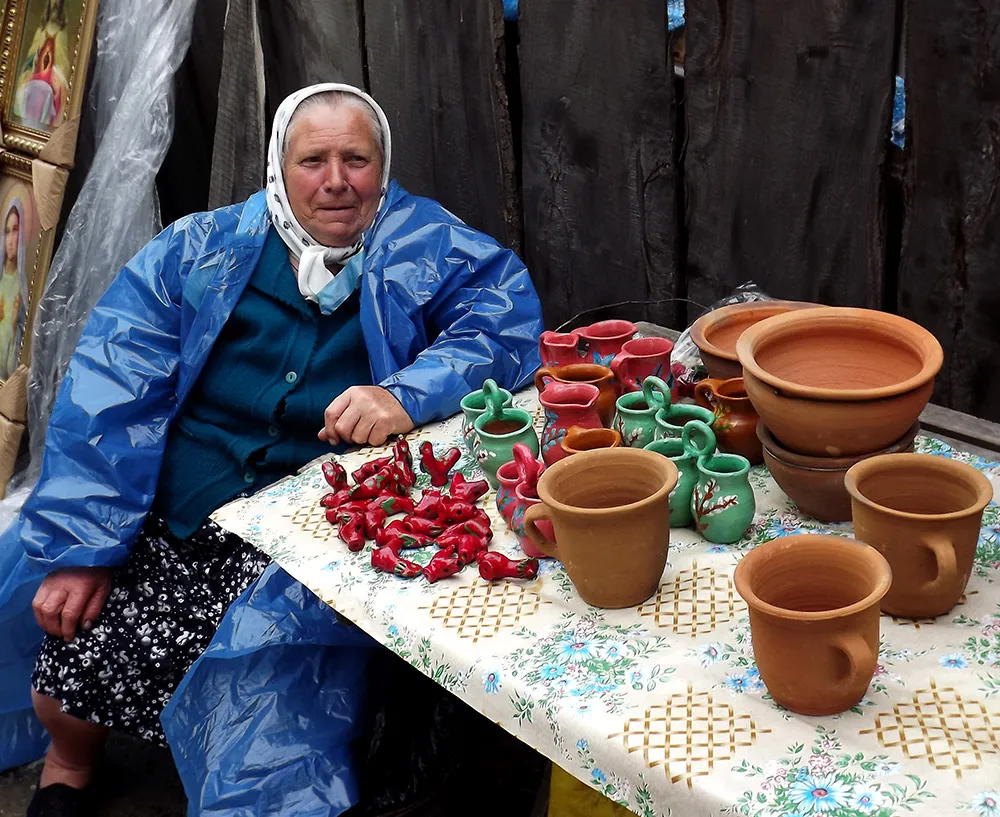
Alas, this granny is history too. Photo of 2013
By Monday the decibel level had somewhat fallen. Fortunately for the grown-ups, the whistles broke easily, and the active street life of children contributed greatly to this. By Wednesday you could hear only the lonely squeaking of little horses and roosters that had miraculously survived. On Thursday silence and bliss set in.
Until Saturday…
Our favourite old man with his loud products was not the only potter at our market. His “adult” colleagues had their own separate base: a huge barrack of rough stone with a red tile roof. In that barrack each potter had a separate nook for storing pots (after all, one could not haul the fragile goods back and forth every Saturday). On market day it all was carried out into the street and stacked in big pyramids. I was especially impressed by the nearly two-bucket makitras (large bowls) for kneading dough.
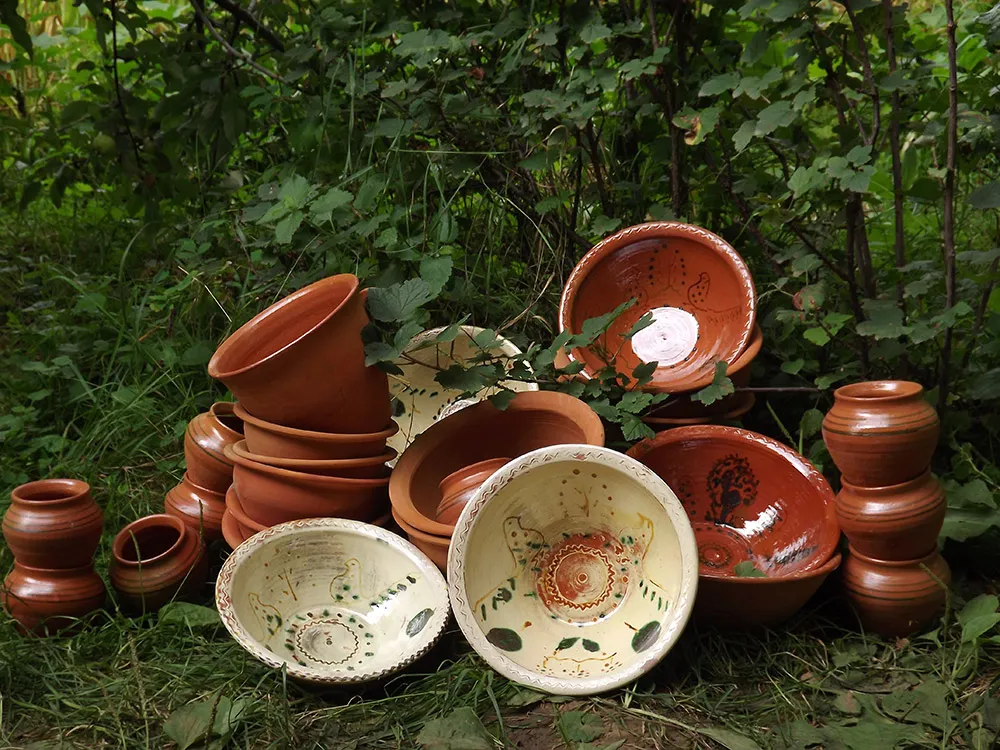
Products of the last potter of Smotrych. Also history now… He has died.
The masters also took individual orders. For example, large pots for palms and other useful and beautiful ficuses. At the customer’s wish the vessels were decorated with moulded little flowers and fanciful ornaments. Such a custom-ordered mega-pot “with flowers” cost crazy money: a whole chervonets (ten roubles)! Considering that potatoes then cost 8 kopecks a kilogram, that was a lot.
Besides makitras, I liked to look at “dymnyky”, the caps on chimneys. They resembled toy houses. They protected the chimney from rain and snow and were its adornment. Unlike the standard jugs and makitras, there was room for creativity here, so the potters put all their heart and all their skill into every dymnyk. All the more so because these “chimney caps” were almost the only “architectural excess” of the traditional Ukrainian house. Especially cool “dymnyky” resembled whole castles with towers and spires. In nine cases out of ten the dymnyk was crowned by the traditional rooster.
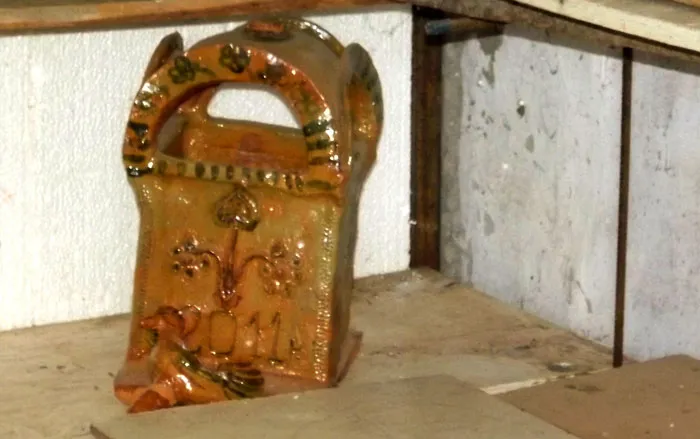
A dymnyk and a rooster.
Fruit and berry abundance was sold both by weight and in “garlands”: cherries were tied by their stalks with thread to a twig, making a nice long cluster.
Carts (sleighs in winter) were the most common kind of transport. Naturally, there were rows with “spare parts” too: horse collars, harnesses, saddles and so on. Besides ordinary cart wheels, “tuned” ones were sold. That is when the wooden spokes were not just plain but had “frills”, and simple carving ran along the outer side of the rim. Such wheels were bought exclusively for the nomenklatura’s tarantasses. All the district bosses drove around in carts, and beside the district executive committee there was a large stable. Only the top district “elite” used the one and only official UAZ “bobik” jeep.
Nearby the coopers offered barrels. They were no different from our yard barrels, except for their shining newness. But the dzhbany, now that was something! It was impressive. For those who don’t know: a “dzhban” is a huge mug, of two or three litres. Like barrels, they were “assembled” from separate boards-staves and bound with hoops.
The rows of fabrics are memorable. In the USSR factory-made clothing was traditionally rather ugly (and expensive), so “decent” clothes were sewn at home or in a tailor’s studio. Accordingly, the demand for fabric was frantic… Rolls of textile lay on plank tables. The advertising was peculiar: several metres of each sample of fabric were thrown over special poles fixed above the counters. Bright “tongues” of multicoloured calico and silk fluttered in the wind like exotic flags. And wherever there was a queue and a crush, scarce and fiercely fashionable krimplen (or perhaps “kremplin”?) was being put out on sale.
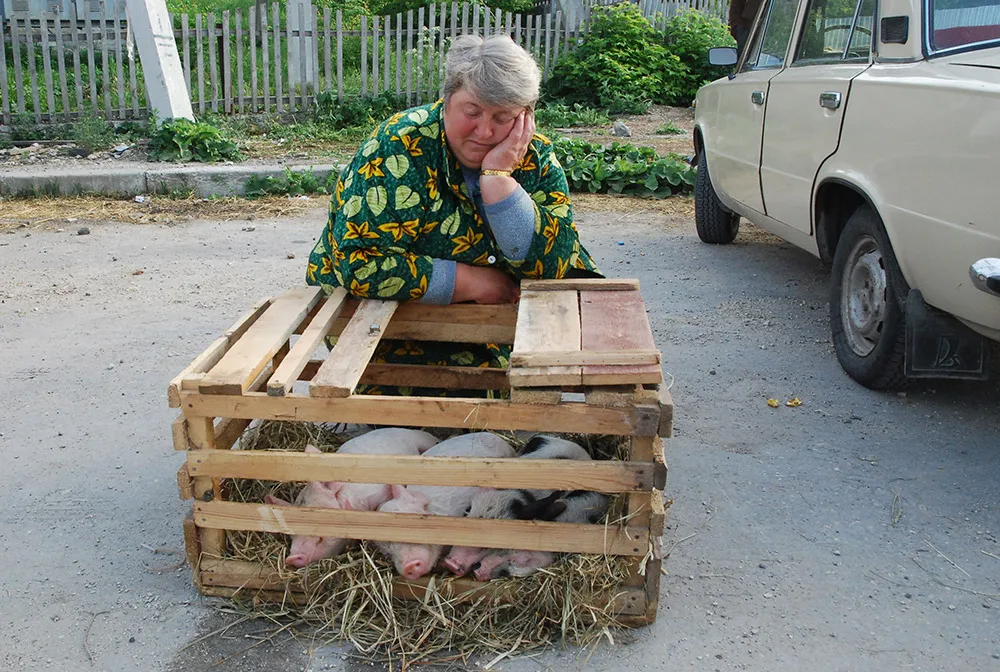
Piglets. This photo is not the author’s but Oleksandr Volkov’s
Not on business at all, but solely for the child’s pleasure, every time we visited the “animal yard”, the place where piglets, calves, kids, lambs, horses, rabbits and various poultry were sold. A sort of district-centre zoo. Children from small towns are very peculiar. In the Big City they are afraid of the Tram, and in the countryside they look warily at the Cow and the Goat. Neither this nor that. An intermediate stage between town and village. The pink piglets were funny, the kids were cute, the geese and turkeys were scary. We didn’t even look at the chicks: every summer several broods ran around our semi-urban yard (on one side stood “Khrushchev-era” three-storey blocks, on the other stretched a “Shanghai” of unauthorized sheds where residents kept all sorts of small livestock).
Once the usual picture of the market universe was disturbed by several groups of swarthy, gold-toothed people. Each included a good ten persons of various ages and sexes, from barely living grannies to infants. The head of the group held an unfolded scrap of paper, and the others stood with outstretched hands. Mum explained to me that these people were not local but from Transcarpathia. There, she said, there had been a severe flood, the water destroyed all their property, and they were “asking for alms”.
I took the information on board.
On the way home, passing a statue in exactly the same pose (an arm stretched forward), I asked: “And what is this uncle asking for?”
My parents did not know what to answer.
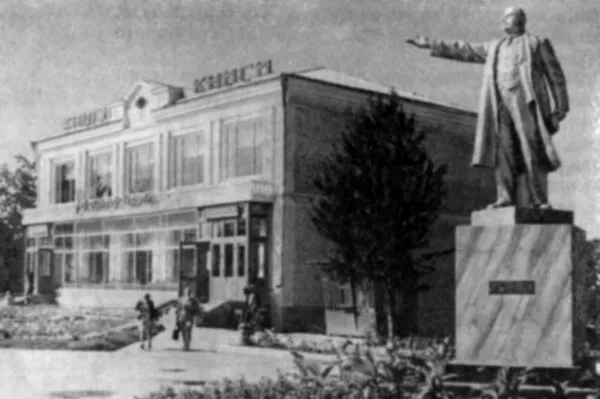
Horodok. The same Lenin who asks (later, around 1975, he was replaced with another, already without the outstretched arm).
“Virtual Vytrishky”
If you liked it, you can thank the author for the work and help the project “Virtual Vytrishky” by transferring a few hryvnias to the PrivatBank card 5168 7554 6511 0969. (Dmytro Poliukhovych)
We will also be very grateful for reposts on social networks.
The “Virtual Vytrishky” project was originally based on Facebook. But after Zuck shut down the very nice “notes” service (where you could post texts with photos like this one), it had to “crawl over” to LiveJournal. Later to Blogspot (you can TAKE A LOOK, there is a lot of interesting stuff there), but that is a very lousy service which for some reason even Google does not index. With the kind consent of Ukraine Incognita, our “Vytrishky” are now registered here.


