

The famous Busha bas-relief without myths and Myrobog

· 7 min read
The “Busha rock temple” is perhaps the most mythologized historical monument in Ukraine. Guidebooks and popular local-history publications usually assign it to ancient pre-Christian times. Indeed! Citing “contactees” and other psychics, the authorship of the bas-relief is sometimes ascribed even to the legendary Atlanteans. There are, for instance, versions that the “televisions” carved into the rocks are disguised devices of ancient civilizations, through which invisible energies and other “torsion fields”™ are pumped. Historians are far more restrained and rational in their conclusions, but who is interested in the boring opinions of specialists?
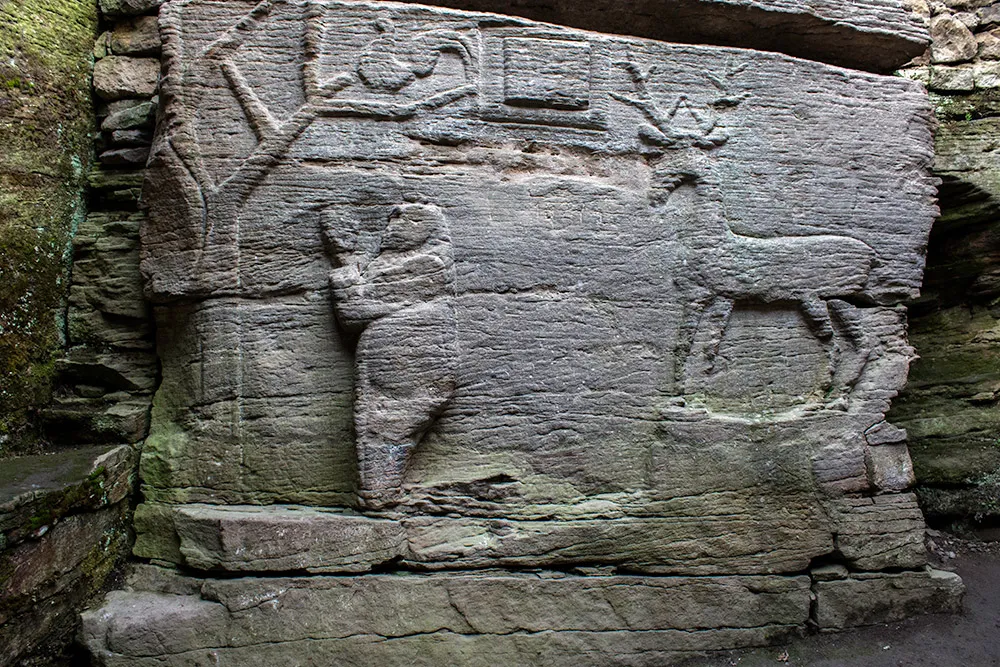
The monument was made a pre-Christian sanctuary by its discoverer (for scholarship), the well-known historian Volodymyr Antonovych, who visited Busha in 1883. In the bas-relief he saw many details that do not exist (in particular a woman with a chalice) and, conversely, failed to notice clearly visible elements that are fundamentally important for understanding the subject and the age of the image. Thanks to this, the version was born that the Busha bas-relief is not just pre-Christian but also extraordinarily ancient.
In his work “On the rock caves on the bank of the Dniester in Podolia Governorate” (Proceedings of the 6th Archaeological Congress, vol. 1, Odesa, 1886), Antonovych noted, among other things:
“The antiquity of the relief’s origin is attested by the fact that the granite rock on which it is carved weathered unevenly after the carving, and deep longitudinal furrows formed on its surface, which cut equally across the smooth surface of the rock and the figures carved on it. In the immediate vicinity of the cave many flint fragments were found, including several specimens of quite obvious struck flint tools”.
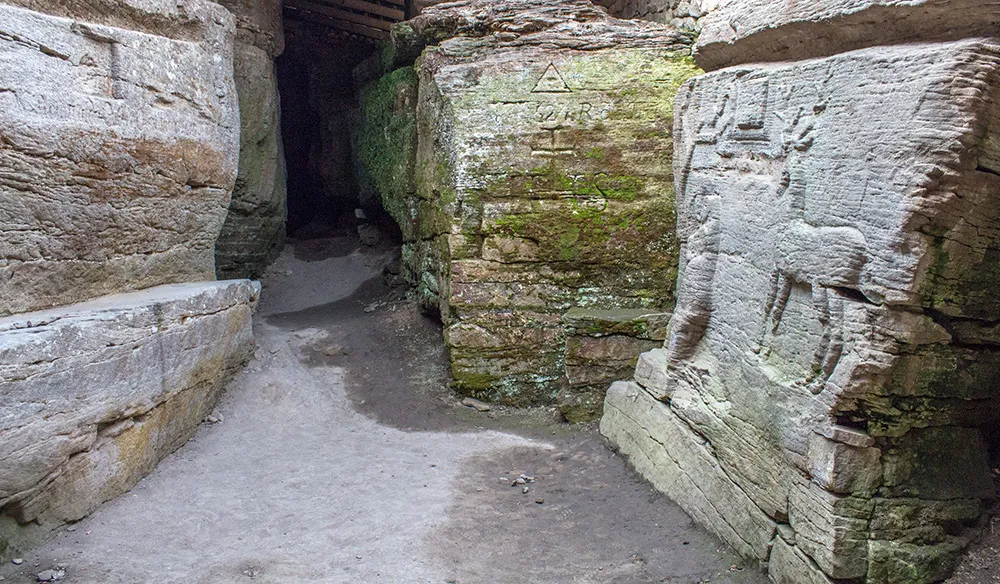
The rock “temple” in Busha
That is, according to Antonovych, the image belonged to the Stone Age altogether! To a large extent this conclusion rested on the mistaken premise of a granite rock. For a granite image to weather even slightly, millennia are needed. In fact the Busha rocks consist of fairly soft sandstone, which lends itself easily both to working and to erosion.
Note that nearby there is indeed a large settlement of the Trypillia archaeological culture. But it is in no way connected with the bas-relief.
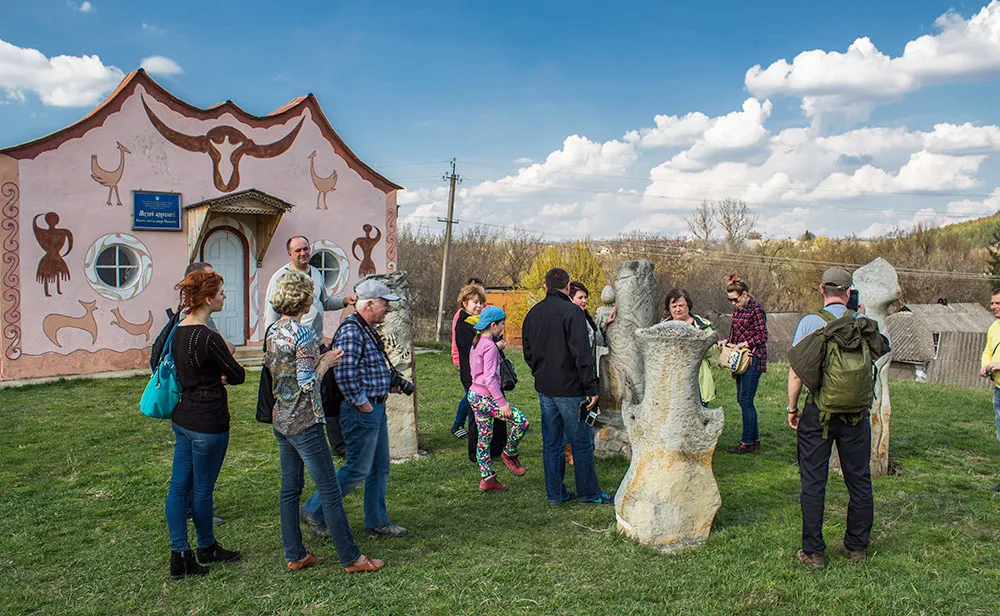
At the site of the Trypillia settlement, a few hundred metres from the “temple”
The Ukrainian Soviet historian Valentyn Danylenko also, for some reason, attributed the Busha rock complex to pre-Christian times. He dated the monument itself to the 6th–7th centuries and the bas-relief to the late 9th – early 10th century. He also studied photographs of the bas-relief taken by the Odesa photographer Raoul in 1884 and “read” the text on the rectangular tablet. In particular, he “saw” the following:
“I am Myrobog, priest of Oleh”.
What is actually written there no one can make out any more, but fans of the pagan version believe that it speaks precisely of a priest named Myrobog.
How this correlates with the purely Christian “I am” is hard to grasp.
The modern Russian “historian” Oleksandr Asov, in his book “Atlantis and Ancient Rus” (well, why not?!), also deciphers the subject of the bas-relief (given in the original language, here translated):
“…The inscription in the frame was deciphered by V. N. Danylenko as ‘I am Myrobog, priest of Oleh’. But I would not claim that this inscription… contains the name of Oleh the Prophetic, or, for example, of Princess Olha…
According to the legends of the ‘Veda of the Slavs’, Bohumyr ascended to the Most High for three years, performed services, and for this the Most High granted him the ‘Bright Book’. This is the subject we see in this image. Here Bohumyr stands kneeling before the World Tree with the Bird Sva (the Messenger of the Most High), and behind him stands the Deer, the sacred animal of the Most High Dazhbog and Guardian of the Gates of Iriy.”
In fact the rock complex in Busha is relatively young and much later than the pagan era. This is confirmed by the results of large-scale archaeological research carried out in the 1980s. It turned out that the oldest of the artifacts found by archaeologists date only from the end of the 16th and the beginning of the 17th century.
In historians’ opinion, it is most likely that from the start a dwelling of a Christian hermit arose among the rocks, who settled here no later than the end of the 16th century. It was at this time that the corresponding spiritual practice spread widely in Podillia, the Bratslav region and Galicia. Later, monasteries arose on the sites of hermits’ caves. It is possible that a small monastery (most likely a Basilian one) also stood by the Busha rocks. According to historians, it operated until about the 1770s.
The patron of hermits since ancient times has been St. Onuphrius the Great, who lived in the 4th century AD. He became famous for withdrawing into the middle of the desert, where he lived for 60 years.
Images of the chief Christian hermit can be seen in many places where lived anchorites who sought to repeat his spiritual feat. The saint was traditionally depicted kneeling with hands raised in prayer. This is exactly the figure we see in Busha. What is more, one can clearly see the extremely long beard and long hair in which the saint wrapped himself instead of clothing.
Critics of the “Onuphrian” version usually point to the deer, asking what this animal has to do with it.
But in this case it is worth recalling the apocryphal story concerning the childhood of the venerable saint.
St. Onuphrius the Great is believed to have been the son of a Persian king. Right after the birth of his firstborn, an angel visited the monarch and conveyed the Lord’s command: to give the baby immediately to a remote desert monastery. He did so; who in his place would have acted otherwise? All the more so when the Lord God Himself sent such a courier with the order.
Meanwhile the monks could not take a wet nurse into the monastery to feed the infant. The problem was solved by a family of deer, who by divine providence came to the monastery every day for several years so that the monks could take milk from the doe for the child. Accordingly, deer became a traditional, though not very widespread, detail of this saint’s iconography.
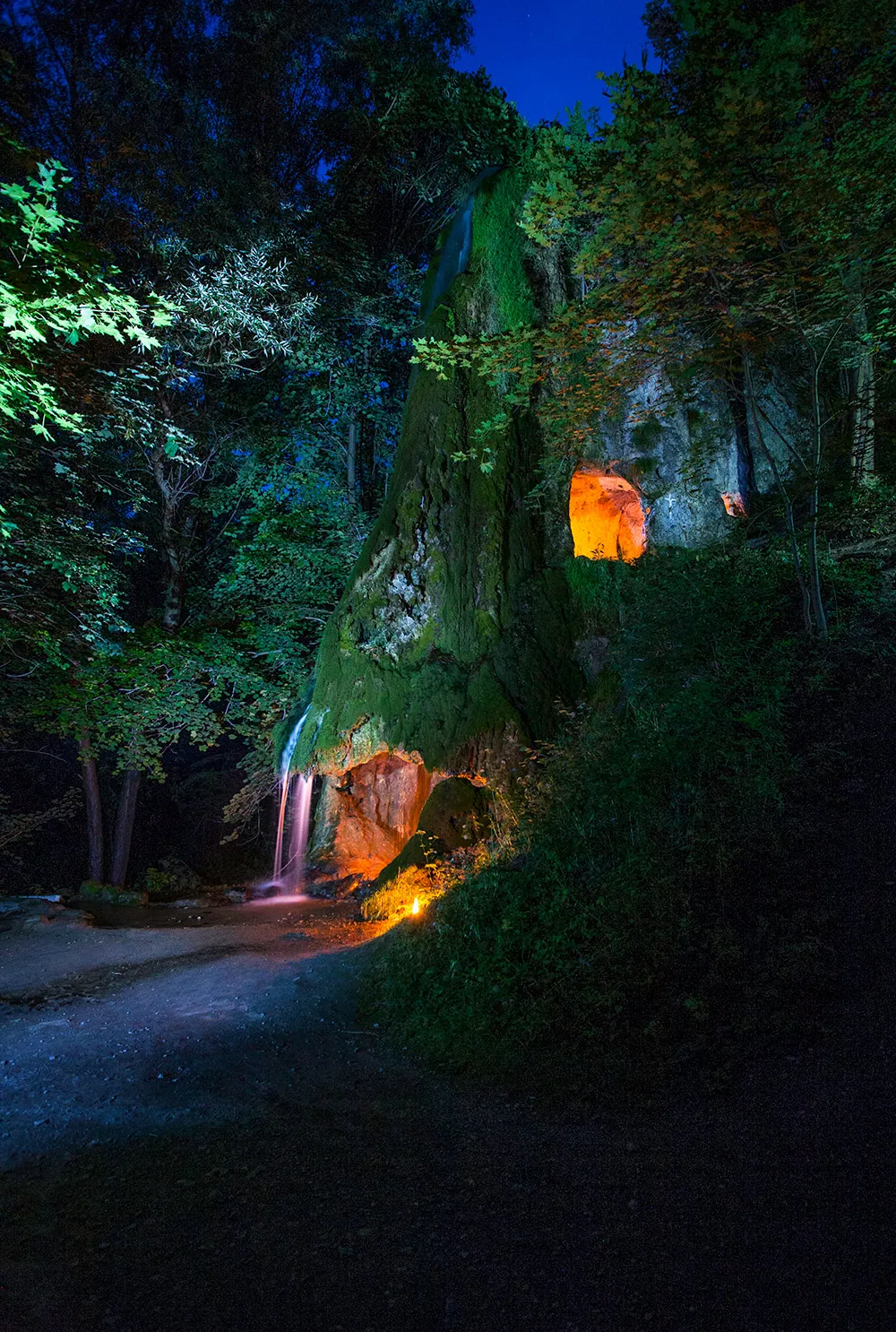
Maliivtsi. A rock with caves and an artificial waterfall
Here it is worth mentioning the sacred sculptural composition “St. Onuphrius and the deer”, which can be seen by the rock with the waterfall in famous Maliivtsi. The rock itself, down which the artificial waterfall flows, is “perforated” with man-made caves. A hermit once lived here, and later there was a monastery. The sculpture is dated roughly to the 18th century and formerly stood in the lower grotto chapel.
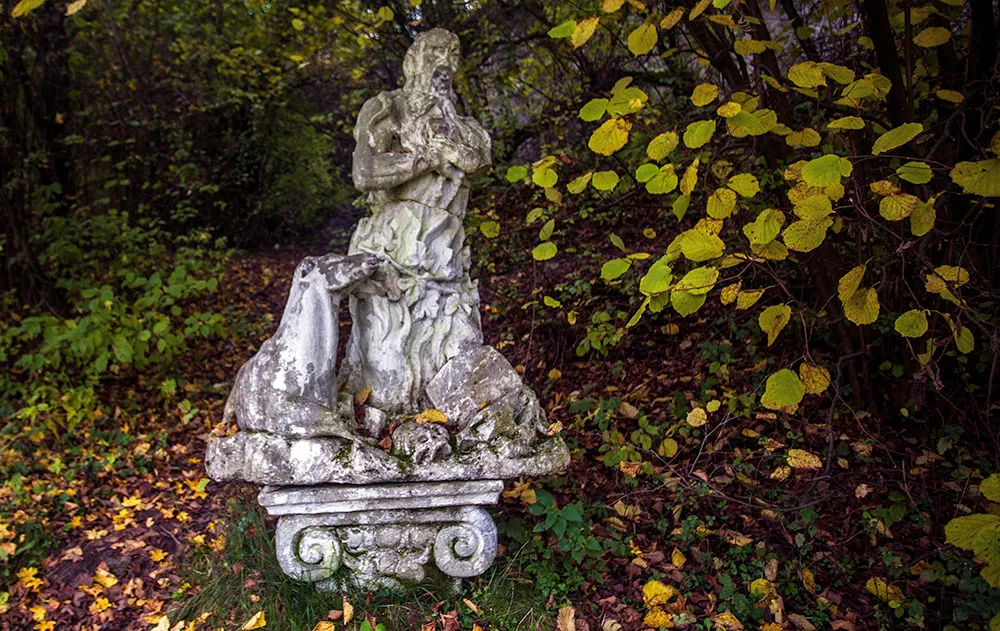
St. Onuphrius and the doe
And finally the rooster sitting on a branch. This too is not a pagan but a purely Christian symbol, embodying resurrection from the dead. What is more, the rooster is a very popular bird in the sacred art of this region.
In particular, the “Ukraine Incognita” expedition, during a survey of the cemetery of the village of Dzyhivka in Yampil district, just 20 km from Busha, found stone crosses of the mid-19th century decorated with exactly the same little roosters as in the Busha cave-and-rock sacred complex!
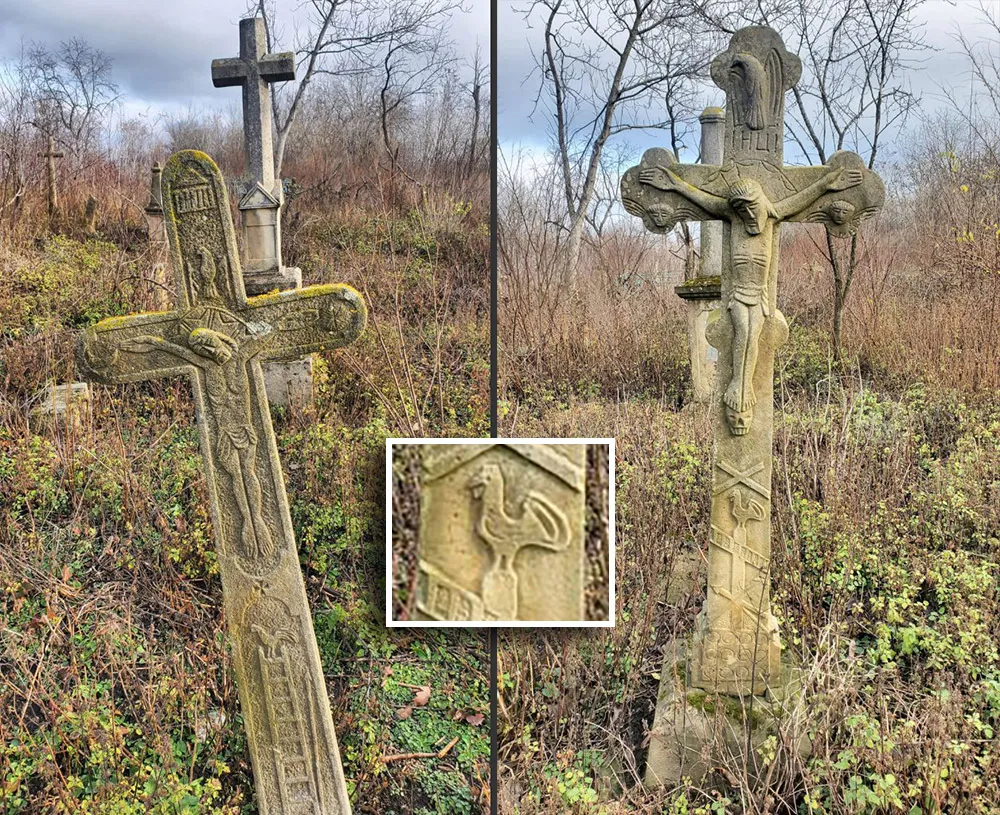
Roosters from Dzyhivka
In a word, no Most High, no priest of Oleh, no Myrobog. In Busha we have a purely Christian subject showing the patron of hermits, St. Onuphrius the Great. And the image is not pre-Christian, let alone of the Stone Age, but of the 17th–18th centuries.
Nor is the sacred complex a “pre-Christian temple”: it is the dwelling place of a hermit with a small chapel. Quite a traditional combination.
Even so, without any inventions the monument as a whole remains no less unique and amazing.


