Shevchenkove. The Church of St. Panteleimon and the Karaite cemetery

· 16 min read
Shevchenkove is a village in the Ivano-Frankivsk district of Ivano-Frankivsk Oblast. The village has a unique monument of antiquity, the Church of St. Panteleimon, which is considered the oldest in Western Ukraine.
The village stands on the right bank of the Limnytsia River near the place where it flows into the Dniester, on a high hill popularly called Vynohradna Hora (Vineyard Hill).
The ancient name of the locality is Sviatyi Stanislav (St. Stanislaus). The monastery that stood on the top of Vynohradna Hora bore the name of this saint (the Catholic bishop Stanisław Szczepanowski, canonised in the 13th century).
Archaeologists have found two places in Shevchenkove where the dwellings of the Rus’ people stood: the Horodyshche tract, where the Church of St. Panteleimon is located, and Nad Krynytsiu. There are also excavated ramparts and ditches around the church dated to the 13th century.
The history of the village of Sviatyi Stanislav is largely connected with the Rus’ church on Vynohradna Hora. In the mid-14th century it was reconsecrated as a Roman Catholic church. For some time it served as the temporary cathedral of the Catholic archbishop. Later a small farmstead formed on the land near the church, and Halych townspeople often grazed cattle on this land for a fee. Around 1575 the church and the farmstead were destroyed by the Tatars and stood deserted for a quarter of a century.
In 1596 King Sigismund III of the Polish–Lithuanian Commonwealth handed the ruined church over to Roman Catholic monks, who rebuilt the church and founded the Halych Monastery of the Holy Cross of the Franciscan order. And in 1611 the Halych starost Stanisław Włodek gave the Franciscans about 170 morgen of field on the lands near Vynohradna Hora. To cultivate it, the monks settled several peasant families. In time a village arose here, whose inhabitants worked on the monastery’s land.
During the Turkish campaign against Halych in 1676, the monastery and the settlement were partly destroyed by Ibrahim Shaitan Pasha. The monastery was restored with the funds of laypeople and church figures later buried in it: the noblemen Hieronim Czarnkowski and Michał Poniatowski, the Halych vogt Kulyczkowski, the Halych vice-notary Baltazar Petliński and others.
From the 17th century the largest landholding in the village belonged to the Franciscan monks. True, as early as the beginning of the 17th century the Halych townspeople were suing the monks for the right to this land. This is reported by numerous court cases that dragged on through the 17th and 18th centuries.
In 1777 Sviatyi Stanislav already consisted of ten houses in which 47 people lived. From this time the village is constantly mentioned in the censuses of the Stryi circle: for 1780, 16 June 1786, 31 May 1787. It is listed in the register of settlements of the Stryi circle of 28 July 1788, the census of 1808 and others. In particular, in 1780 Sviatyi Stanislav numbered 10 houses with a population of 56, and in 1808 17 houses in which 19 families lived, 93 people in all.
The Josephine cadastre of 1788 states that at that time the village owned 9 fields (119 morgen) of land.
Great damage was done to the area by the fire of 1802, in which the church, the monastery and many valuable documents burned.
In 1915 the village of Sviatyi Stanislav and the church were visited by the future emperor of Austria-Hungary, Charles I.
During the First World War the settlement was half destroyed.
In 1918–1939 the village belonged to the urban gmina of Halych in the Stanisławów county.
In the 1920s–1930s Polish societies operated in the village:
– the Rifle Union (founded in 1936)
- the Voluntary Fire Brigade (founded in 1928)
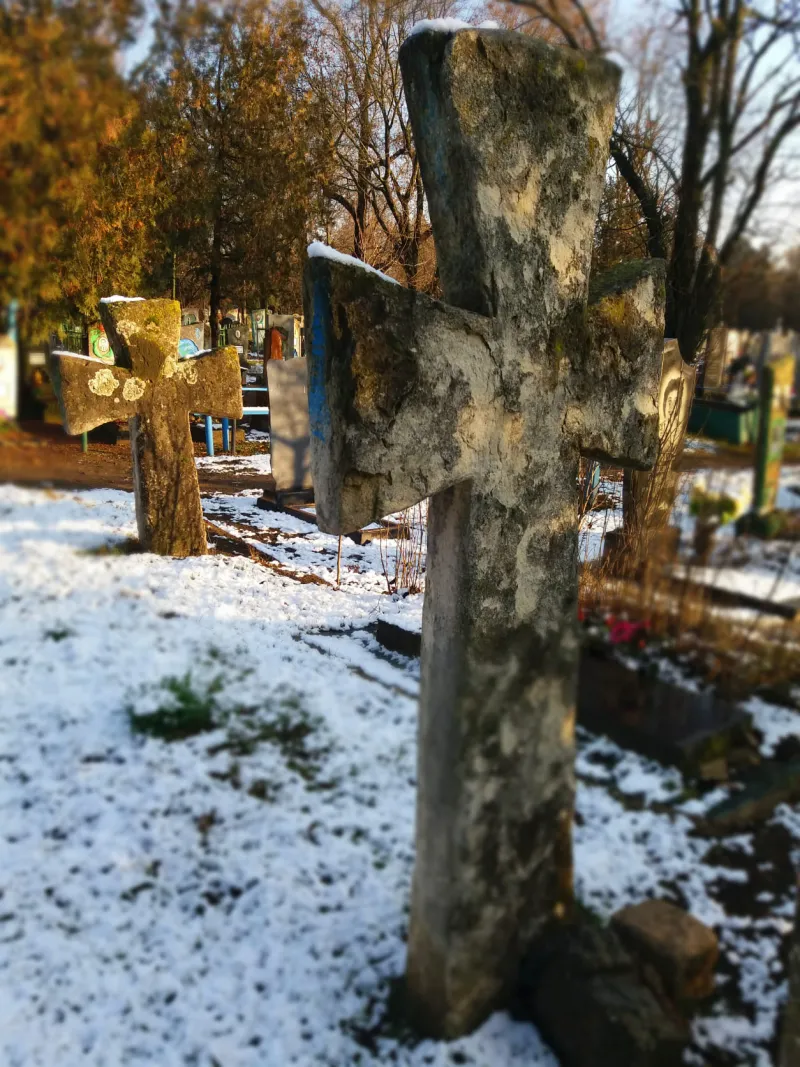
In 1930 a memorial cross was erected in honour of the settlement of Polish colonists in the village.
As of 1 January 1939 the village had 540 residents, of whom 290 were Ukrainian Greek Catholics, 230 Ukrainian Roman Catholics and 20 Poles.
On 16 July 1940 the Soviet occupiers renamed the village of Sviatyi Stanislav as Shevchenkove.
The settlement was occupied by the Nazis on 2 July 1941. Source: Wikipedia.
The Church of St. Panteleimon
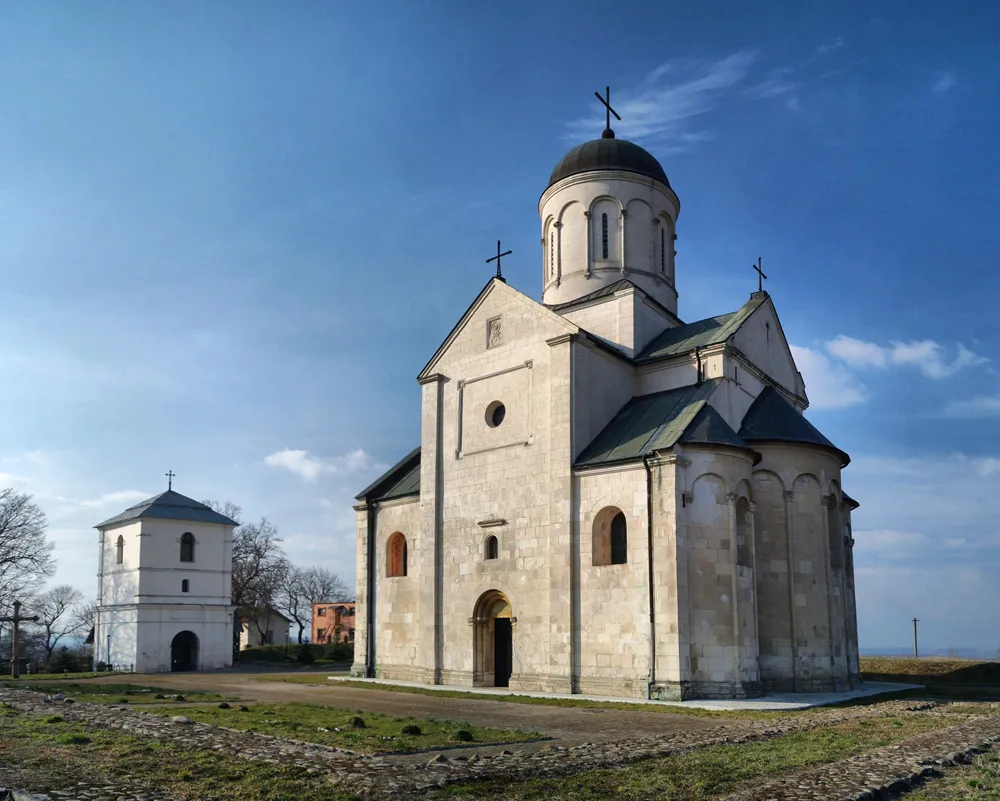
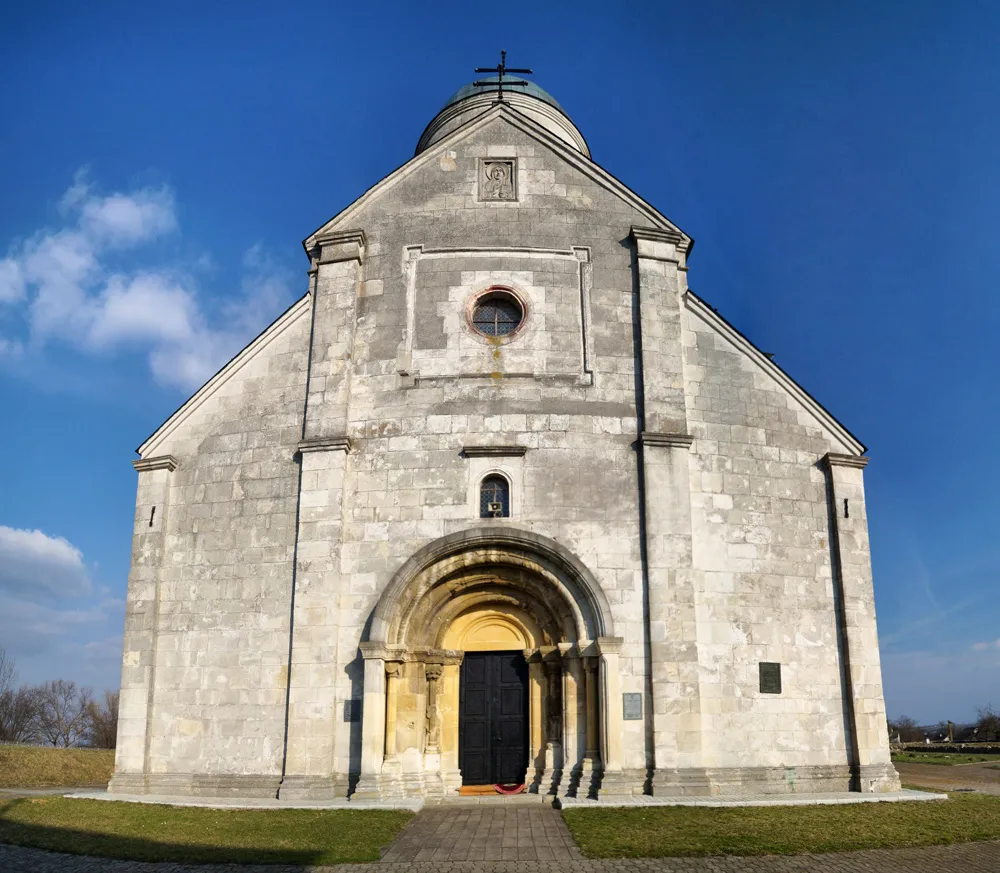
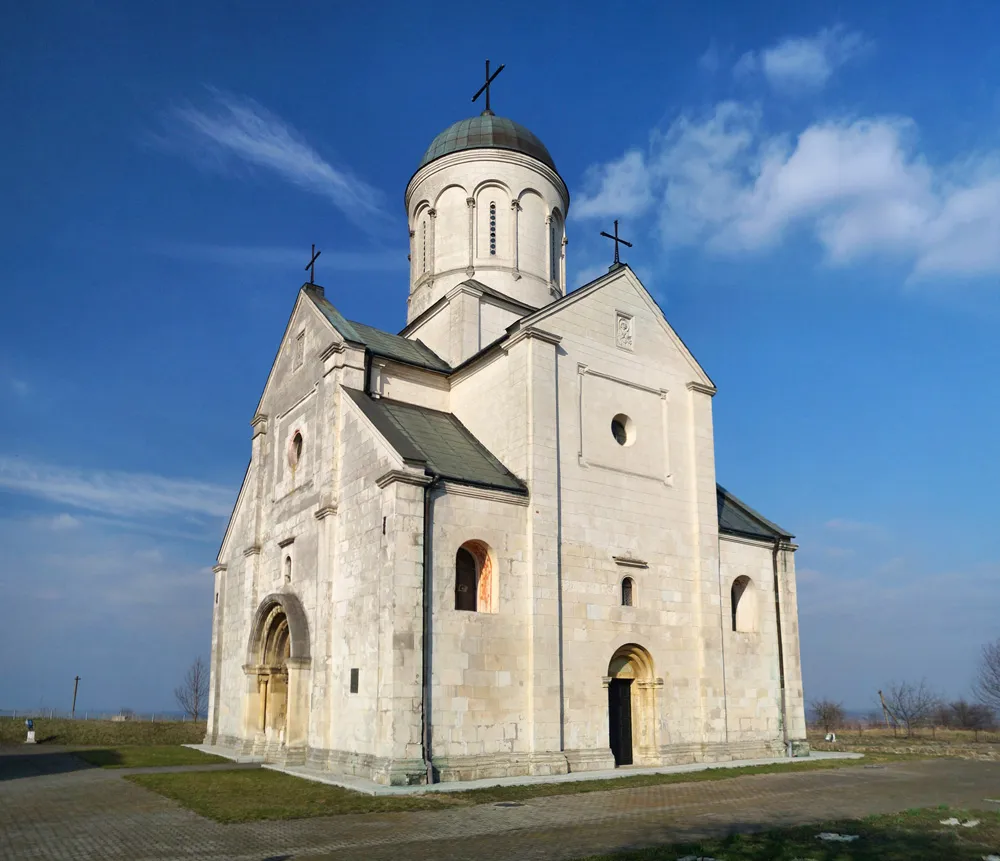
The Church of St. Panteleimon is a Romanesque-style church in Ukraine, in the village of Shevchenkove, Ivano-Frankivsk Oblast. It is the only and the oldest of the churches of the Principality of Galicia–Volhynia to have survived to this day. It is an architectural monument of national significance. A monumental cross-domed church with examples of exquisite white-stone carving and numerous drawings and graffiti on its walls. It stands near modern Halych. It belongs to the Ukrainian Greek Catholic Church. It was built in 1194 by the Volhynian prince Roman Mstyslavych as an Orthodox church and named in honour of his grandfather Panteleimon. In the 14th century it was turned into the Roman Catholic Church of St. Stanislaus. From 1595 it belonged to the Franciscan Order. It was restored in 1926 and 1998. At the end of the 20th century it was handed over to the Greek Catholics. It is part of the Ancient Halych National Reserve.
In 1194, on the approach to Ancient Halych, on Vynohradna Hora, Prince Roman Mstyslavych built a majestic church. This area now lies within the village of Shevchenkove (formerly Stanislav), 7 kilometres west of Halych, at the confluence of the Limnytsia and the Dniester. The church was consecrated in the name of St. Panteleimon, in honour of Roman Mstyslavych’s grandfather, the Kyivan prince Iziaslav, whose Christian name was Panteleimon.
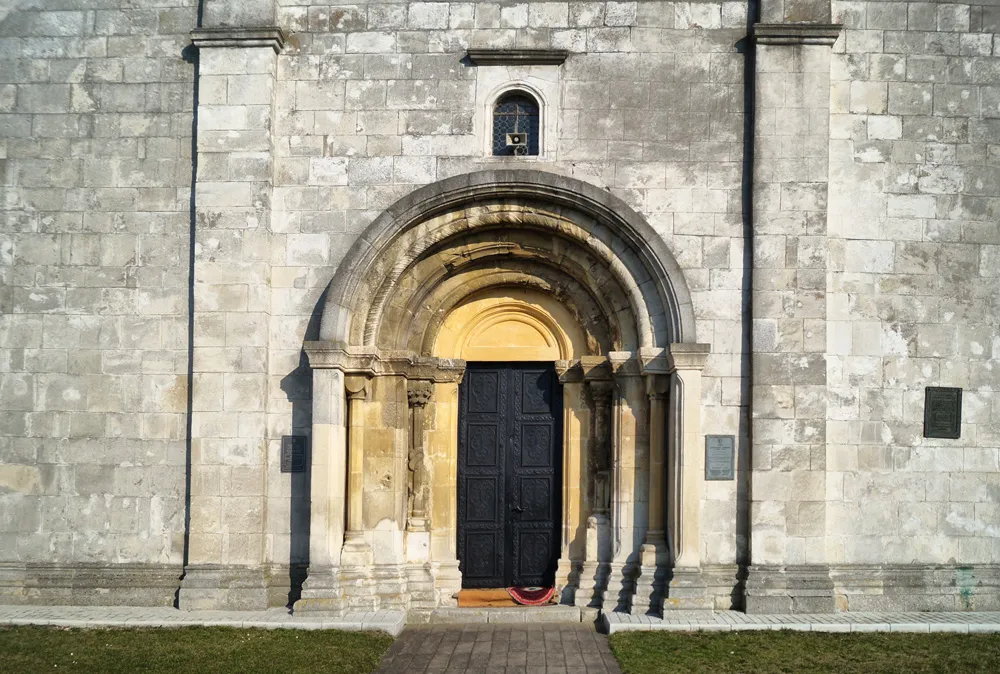
In the second half of the 13th century Halych lost its capital status and the church began to decline. About a century later the church passed to the Catholics, who turned it into the cathedral church of St. Stanislaus. The monument kept this name until 1912. Twice a year, on 8 May (St. Stanislaus’s day) and 9 August (St. Panteleimon’s day), services were held here.
In 1575 the church was destroyed by the Tatars and stood deserted for 20 years.
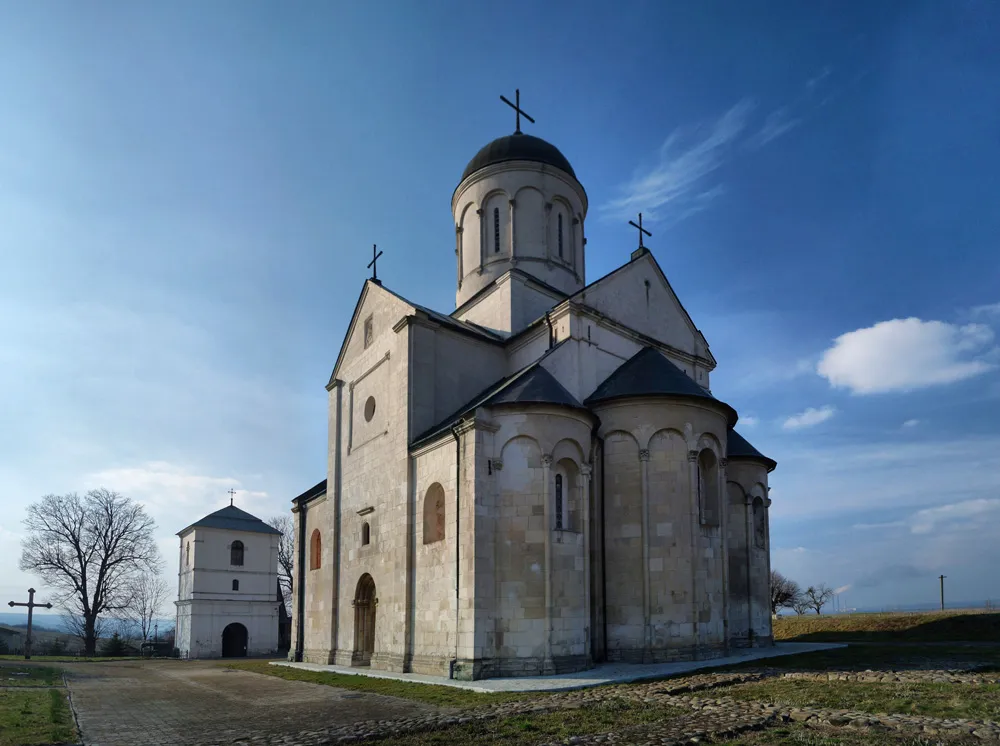
In 1595 the church was handed over to the Franciscans, who in 1598–1611 rebuilt it as a Baroque basilica and also built a monastery complex and defensive ramparts beside it. At the same time a bell tower was erected on the axis of the main entrance to the church.
In 1676 the church suffered during the Turkish campaign against Halych. Great damage was done to the monument by the fire of 1802 and by cannon fire during the First World War.
During the restoration of 1926 the church was almost returned to its former appearance, except for the roof turret. The main portal also remained unrestored. In the interior of the church the plaster was removed from the walls and the hewn stone exposed. It was then that traces of fresco painting were found on the lower layer of plaster, and graffiti on the stone blocks.
The church building was protected as an architectural monument of the Ukrainian SSR (No. 248). In 2018 the church was recognised as a cultural heritage site of national significance and entered in the State Register of Immovable Monuments of Ukraine (No. 090023-N).
The visit to the church in 1991 by Cardinal Ivan Myroslav Lubachivskyi of the UGCC gave an impetus to the revival of the shrine.
In 1998 the church was restored again and acquired its present appearance, as close as possible to that of the traditional white-stone churches of the princely era. In the same year it was reconsecrated as a Greek Catholic church.
In 1909 J. Pełeński, examining the Church of Panteleimon, found numerous inscriptions of the 13th–17th centuries on its facades. One of them contains a date corresponding to 1194 and testifies that the church was built before that date. This inscription is on the south facade of the church, near the third pilaster at a height of 1.50 m from the ground. The text of the inscription consists of 8 lines scratched on a stone block with a sharp object. After deciphering it, the researcher concluded that the founder of the church was the ruler of Galicia–Volhynia, Roman Mstyslavych, who built this church in honour of his grandfather, the Kyivan prince Iziaslav, whose Christian name was Panteleimon.
Stratigraphic observations in individual parts of the church’s territory show that the Church of St. Panteleimon was built on territory that had been little developed or undeveloped in earlier times. The status of the church has still not been determined: whether it was a monastery church (as may be indicated by the construction of the church, characteristic of Cistercian architecture) or the court princely church of a new suburban residence of the princes of Halych.
Dr Oleksandr Holovko suggests that Prince Roman Mstyslavych, who had his residence nearby, could have been buried in the church.
The Tatar-Byzantine decoration of the interior: carpets and the iconostasis.
In the structure of the Church of St. Panteleimon, features of Old Rus’ and Romanesque architecture are interwoven. It is a four-pillar cross-domed church in which a round drum with a domed top rises on transverse arches resting on the pillars.
The richest in form and decoration is the western portal. It projects considerably beyond the plane of the facade wall and in its forms resembles the perspective portals of Romanesque architecture in Western Europe. The portal is decorated with two pairs of columns with capitals. The shafts of the columns closest to the entrance are decorated in the middle with knots. On the edges of the plinths beneath the bases so-called “frogs” are carved. These columns are authentic; they alone were not destroyed by the artillery shelling of 1915.
The south portal is more restrained in its sculptural decoration, but its architectural solution is the same as that of the western one. The form of the archivolt corresponds to the form of the steps.
The apses are decorated with slender half-columns on which an arcature belt rests. The carved capitals of the central apse have a varied design. These capitals and the arcature frieze are authentic.
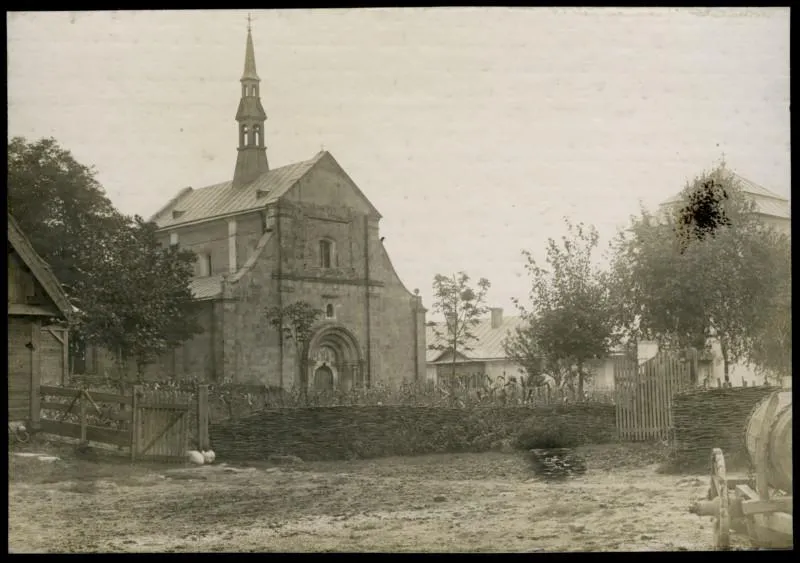
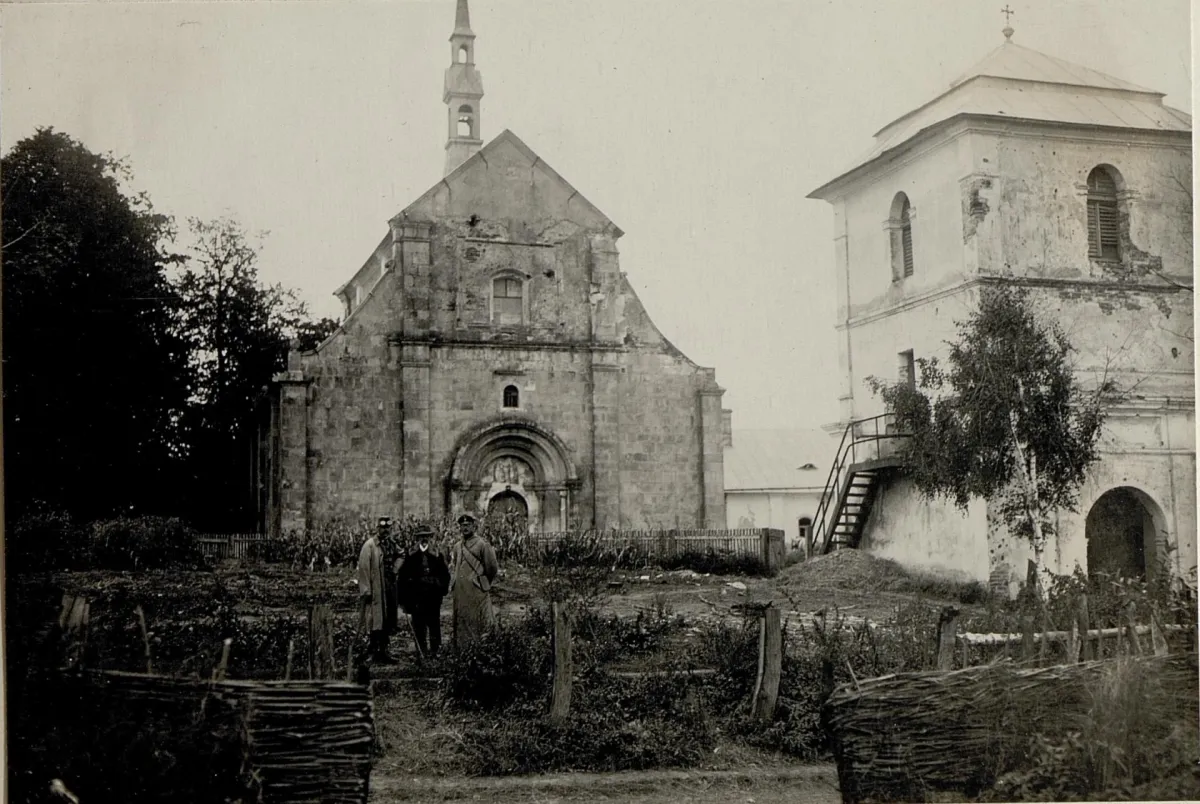
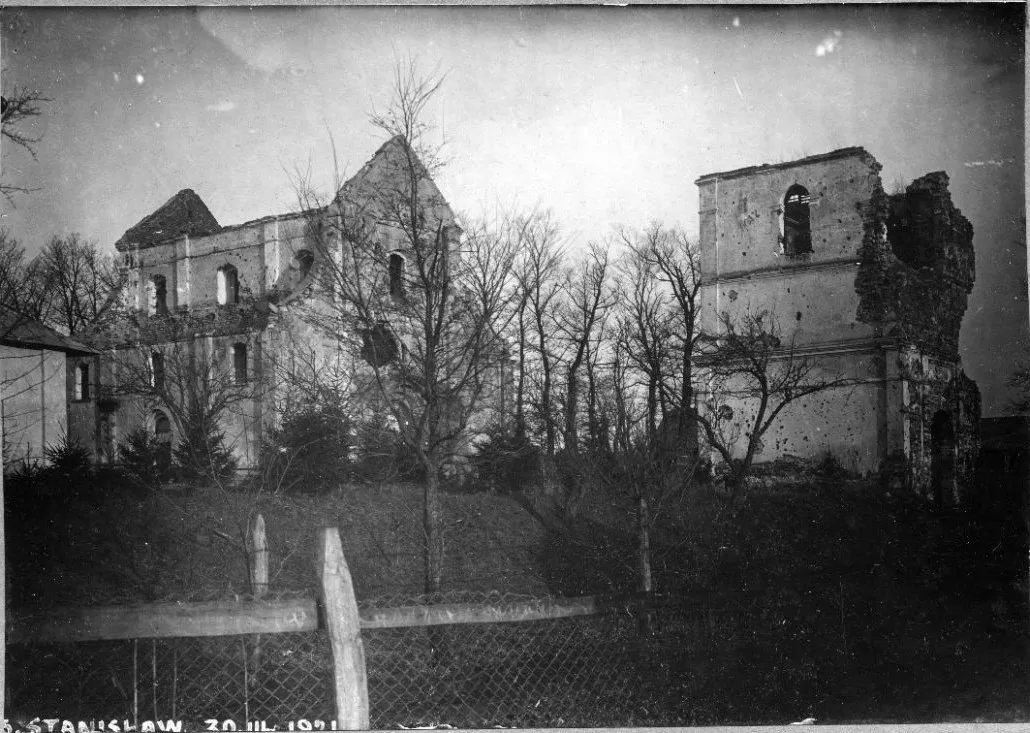
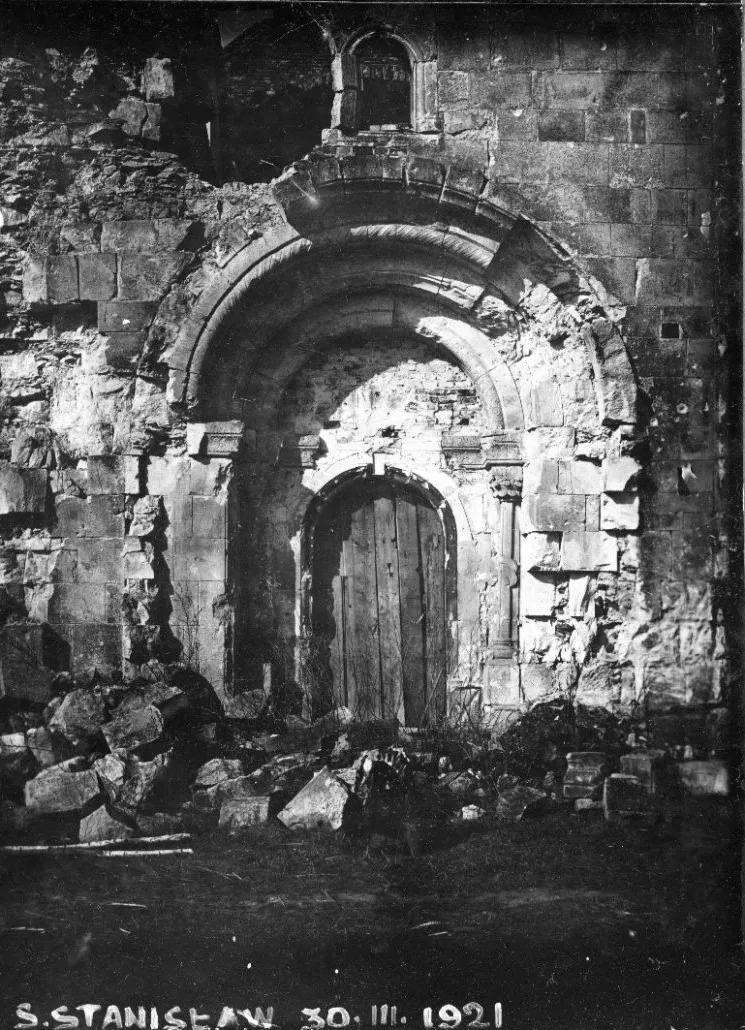
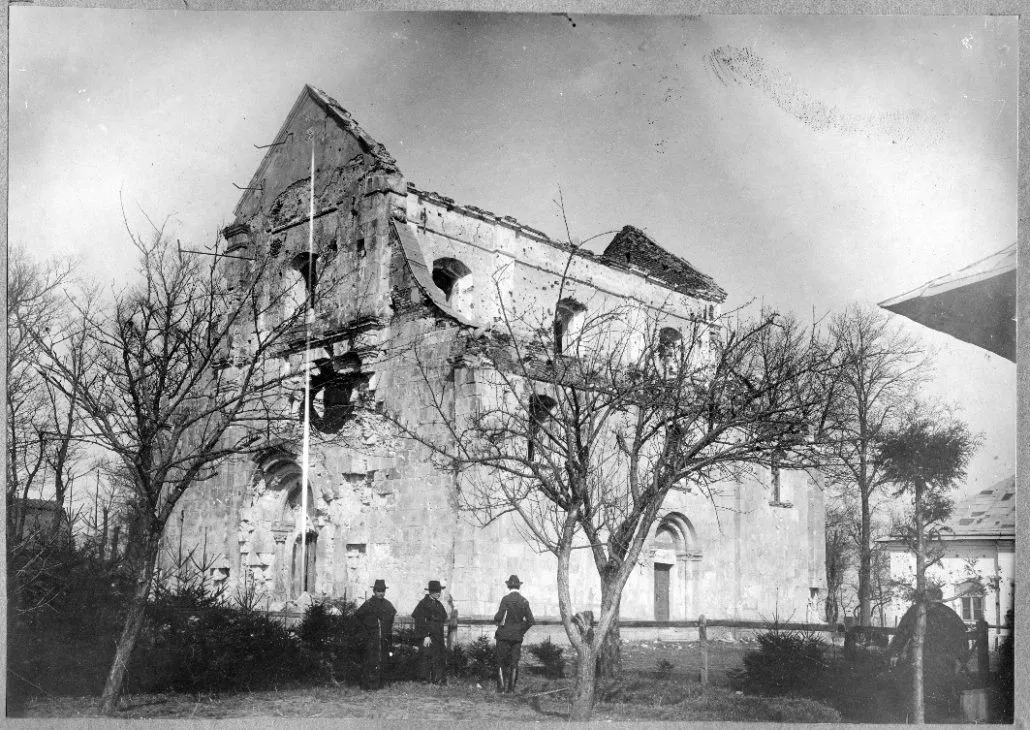
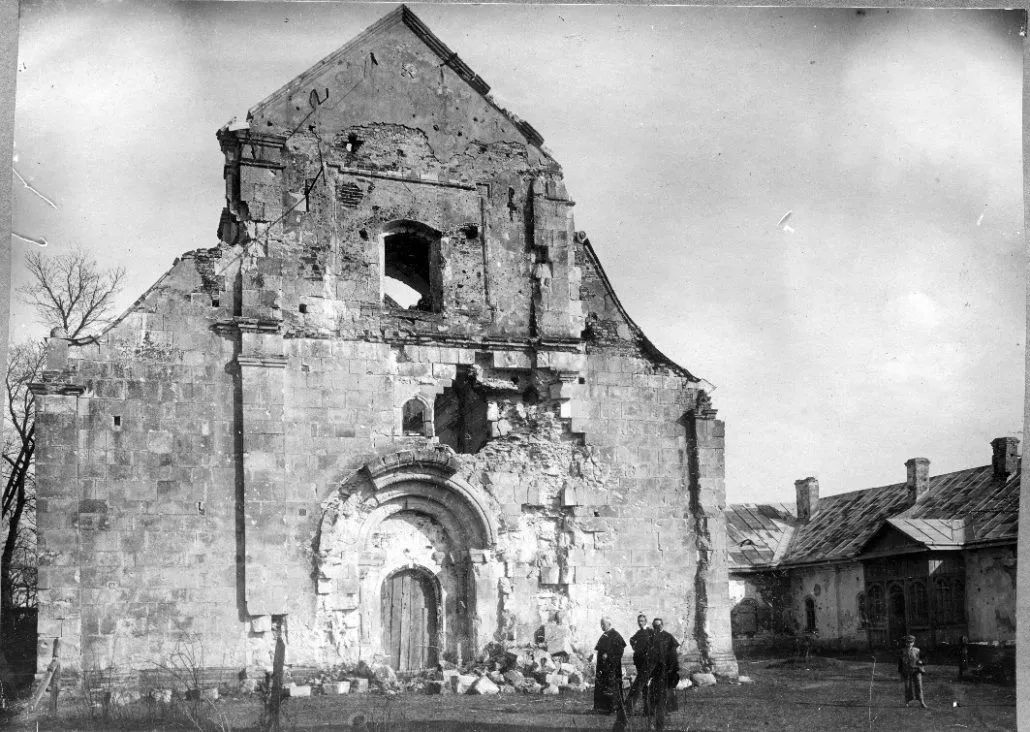
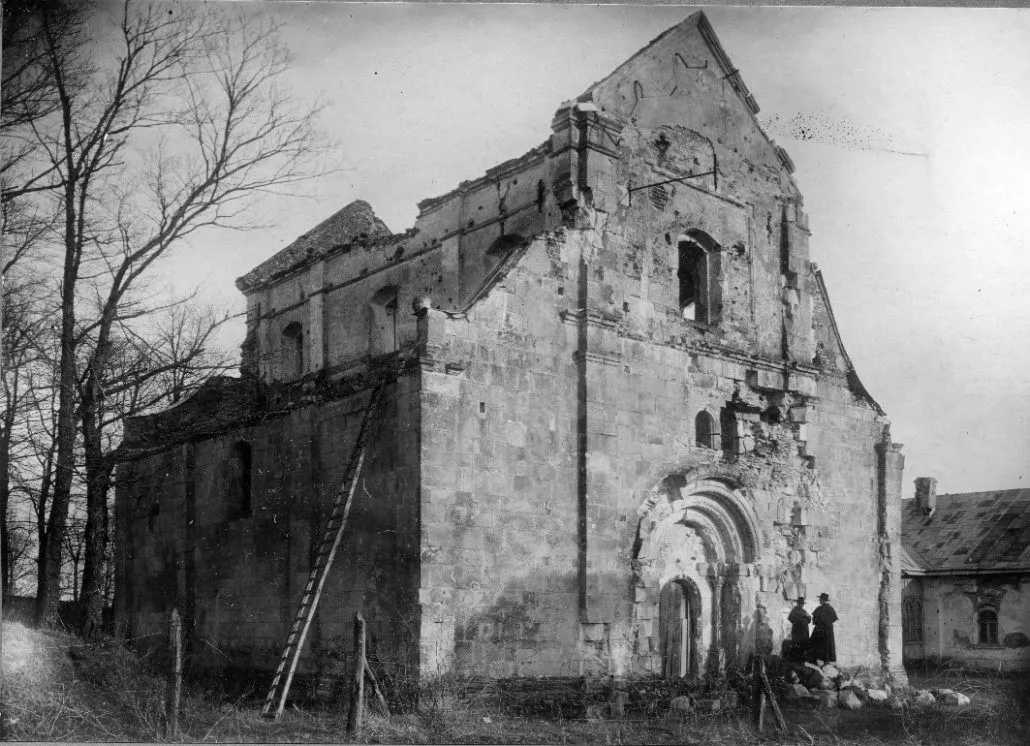
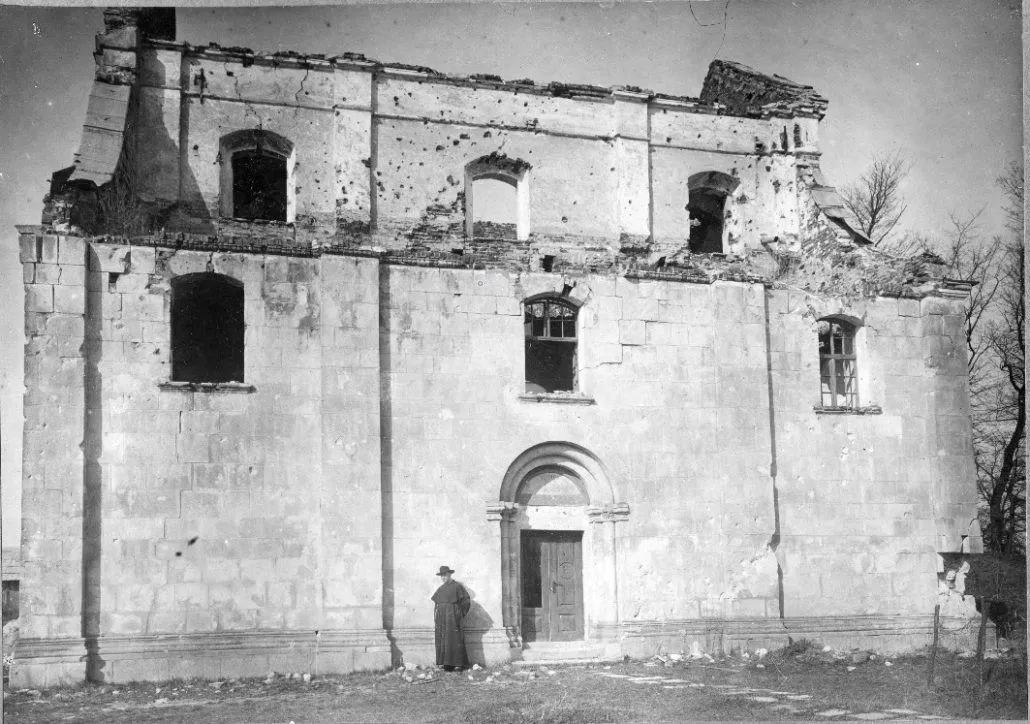
The Church of St. Panteleimon before and after the First World War, when it suffered greatly from artillery shelling. At that time it was a Roman Catholic church. Photo from here
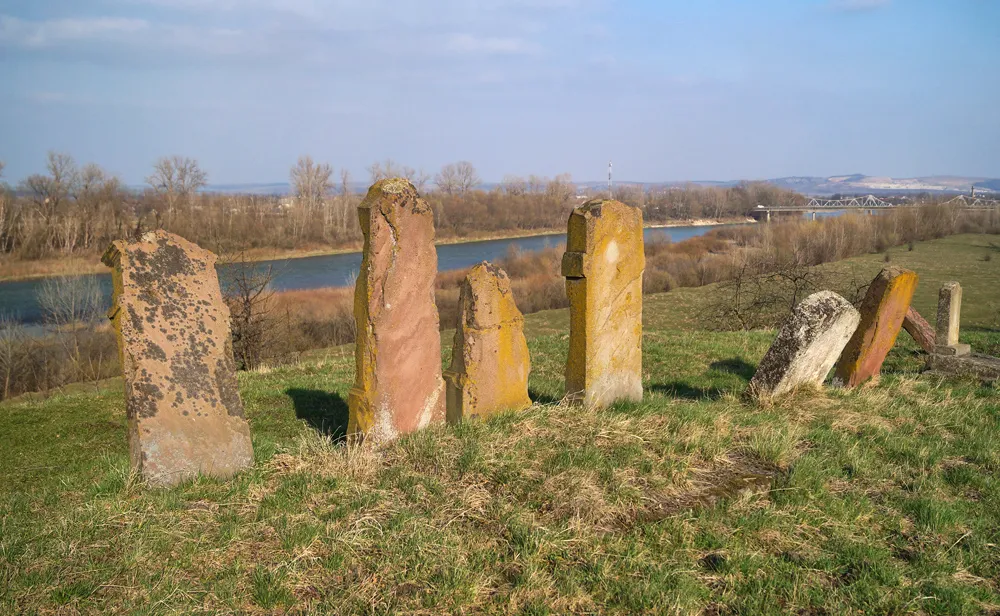
The Karaite cemetery in Halych, 17th–18th centuries, a unique monument to the history of the Halych Karaites
The Karaites are a small Turkic-speaking people whose members profess Karaism. The history of the Halych Karaite community begins, according to one version, in the mid-13th century. The Karaites settled in Halych near Market Square. This street has a very convenient location, since it stretches along the right bank of the Dniester and leads to the town’s main market square, Nativity Square. From this we can conclude that the Karaites were quite influential in the urban environment of Halych.
The 13th–15th centuries are a dark period in the history of the Halych Karaite community. It begins to be mentioned in documents of the late Middle Ages. In 1578 King Stephen Báthory granted the Karaites privileges. The royal estate survey of 1747 mentions Karaite Street in Halych, where 19 Karaite families lived at that time, and it is also known that one of them, Nukhin, was a potter. In Halych there lived approximately no more than 2–3 hundred Karaites. Today the Halych Karaite community has only one member.
In the central part of Karaite Street there was even a kenesa (a Karaite house of worship), and not far from it a People’s House. Unfortunately, however, these buildings have not survived to our days.
Nevertheless, there is now in Halych the Museum of Karaite History and Culture of the Ancient Halych National Reserve, there is Karaite Street, and one of the few historical and cultural monuments of this ethnic group in Ukraine that has survived to the present day: the Karaite cemetery.
In neighbouring Lviv, Lutsk, Kukyziv and other settlements of Western Ukraine where there were Karaite communities, not a trace of the cemeteries remains.
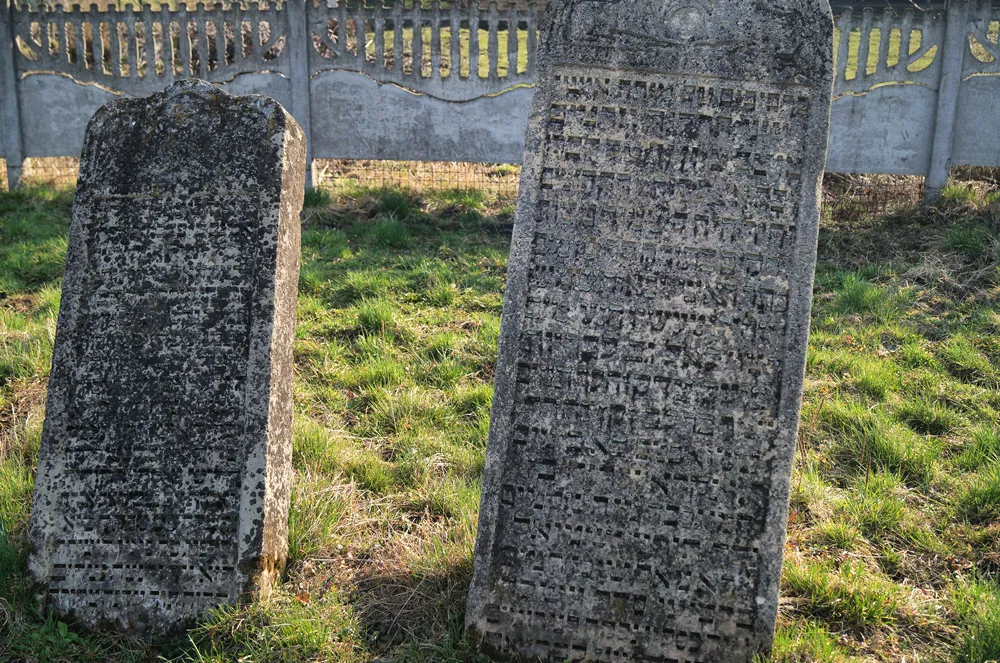
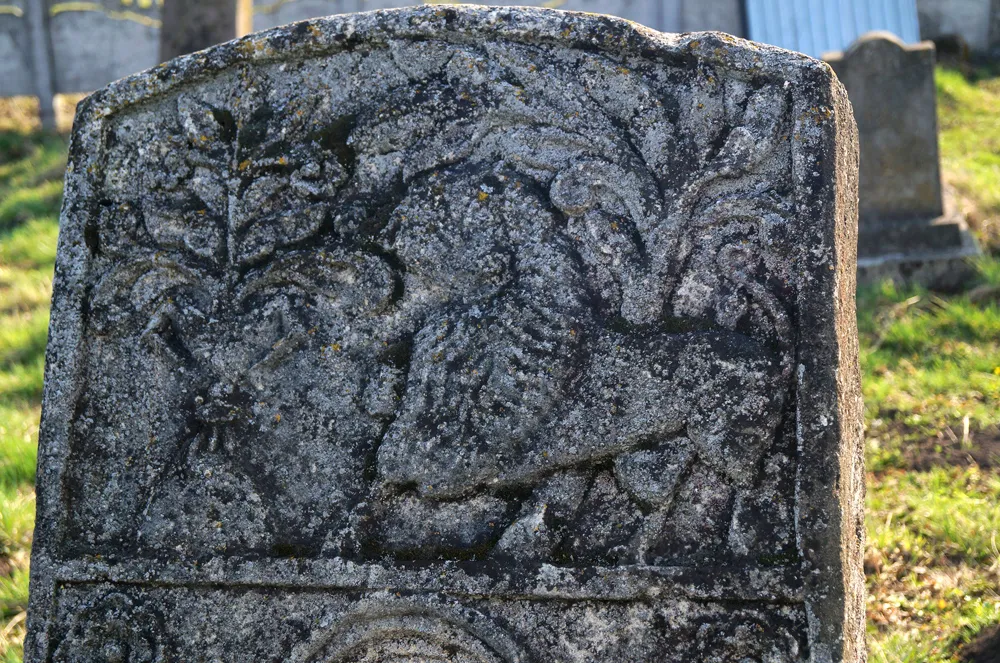
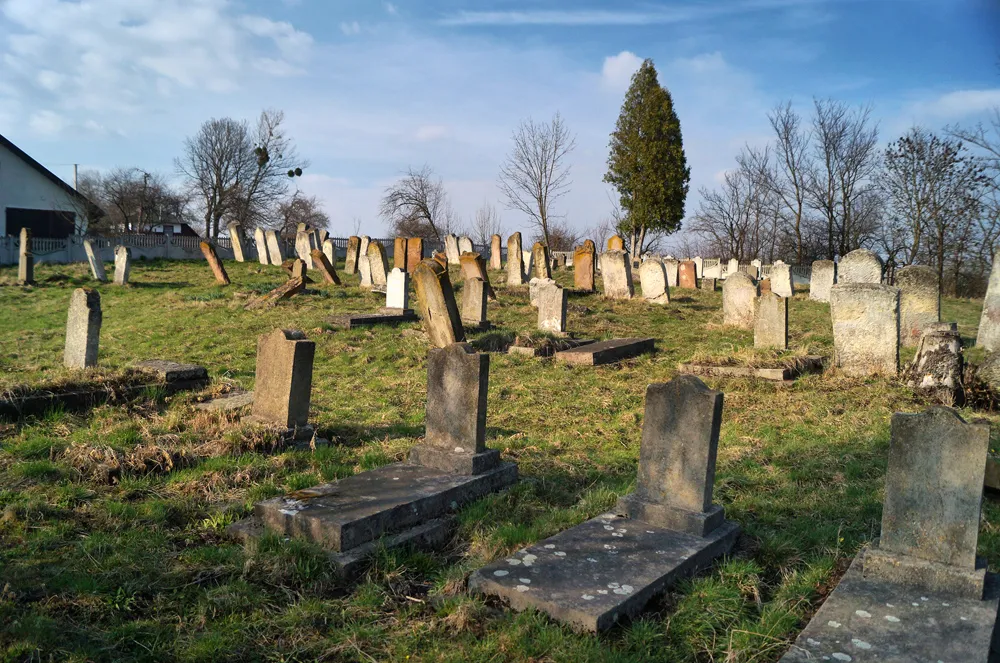
For quite a long period little attention was paid to the study of the Karaite cemetery. It was first studied and researched in detail in 1997–2000 by I. Yurchenko and N. Yurchenko with the support of A. Kefeli and O. Berehovskyi. The result of their fruitful work is the catalogue “The Karaite Cemetery near Halych” (2000). It outlines in detail the recording of the Karaite cemetery, presents a gallery of gravestones, translates the texts of the monuments from Hebrew into Ukrainian, and gives the metric data of the Halych Karaite community from the private archive of Ya. L. Yeshvovych for 1830–1997.
The Karaite cemetery of the town of Halych is located on the right bank of the Dniester, not far from the confluence of its tributary the Lukva. On the north the boundary of the cemetery is formed by the steep bank of an oxbow of the Dniester, on the south by a destroyed Jewish cemetery. To the east and west it is adjoined by household plots with residential and farm buildings. The time of its founding is unknown, but the oldest monuments date from the mid-18th century.
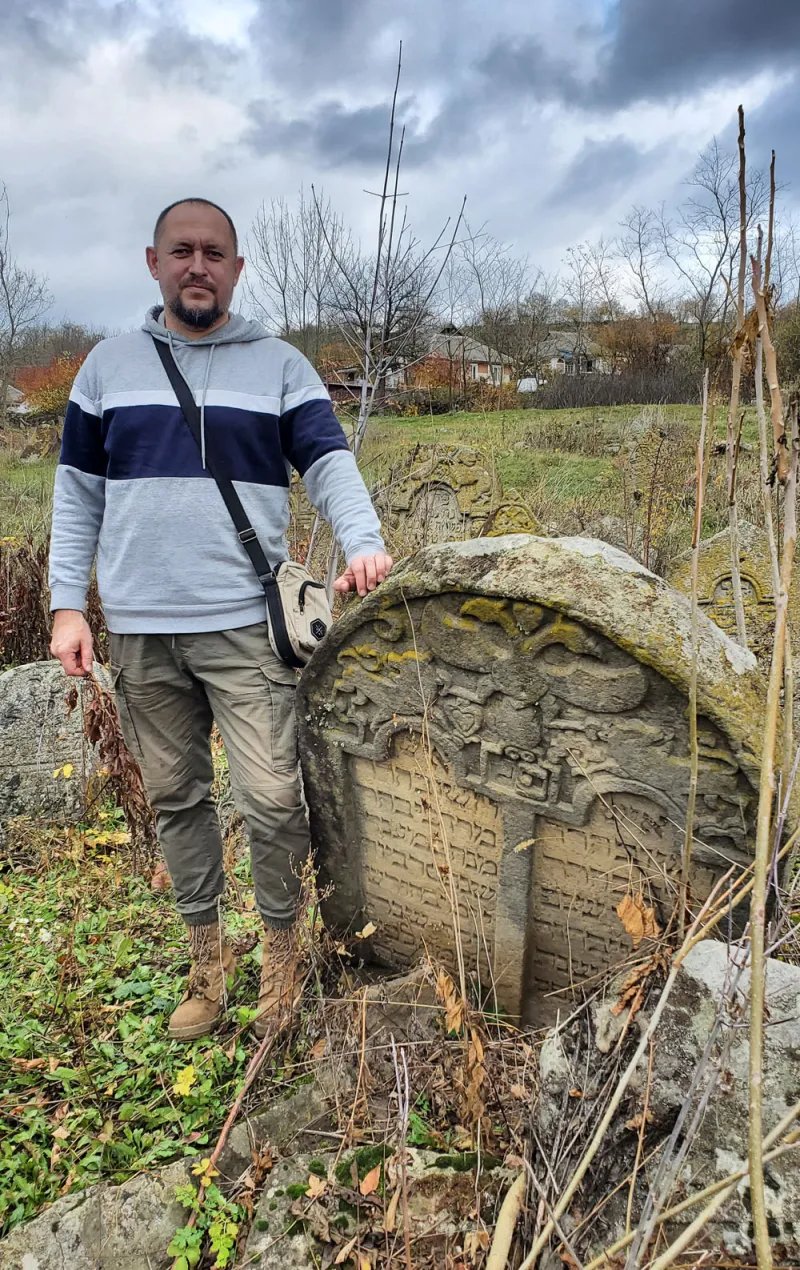
The total area of the Karaite cemetery is 0.4 ha. Its present dimensions: length 77 m, width in the western part 47 m, in the eastern about 27 m. As of 2000 the cemetery had 219 burials. More than 50 old stone gravestones. The monuments are arranged in rows running from east to west. The front side of the monuments faces north.
Four types of gravestones are found: a stone stele, a stone stele on a horizontal concrete base, a concrete stele on a horizontal concrete base, and a horizontal concrete slab.
It is known from history that not far from the Karaite cemetery there was a Dniester quay for ships. According to J. Pełeński, a researcher of Halych, Karaites and Jews lived here because, as merchants, they always settled near the quay. A document of the Franciscan convent in Halych for 1629 states that the convent raises the quitrent, the annual payment, for the “Karaite okopysko”. J. Pełeński found a copy of the document in 1910 in the parish of the Church of St. Peter in Zalukva. It follows that the Karaite cemetery was located in a field that belonged to the Franciscans, and the Karaites paid 8 groszy a year for it. Historians claim that this sum was quite low for those times, and that this quitrent was imposed quite long ago, which points to the antiquity of both cemeteries, the Jewish and the Karaite. According to J. Pełeński, it was one field divided in two. He believed that the Karaite cemetery was founded several hundred years before the Franciscans came to Halych. The Franciscans received this land together with the cemeteries or arbitrarily annexed them to their field.
The author of a work on the Halych cemetery, the Jewish writer Rubin Fan, claims that the oldest gravestones date from the 17th century.
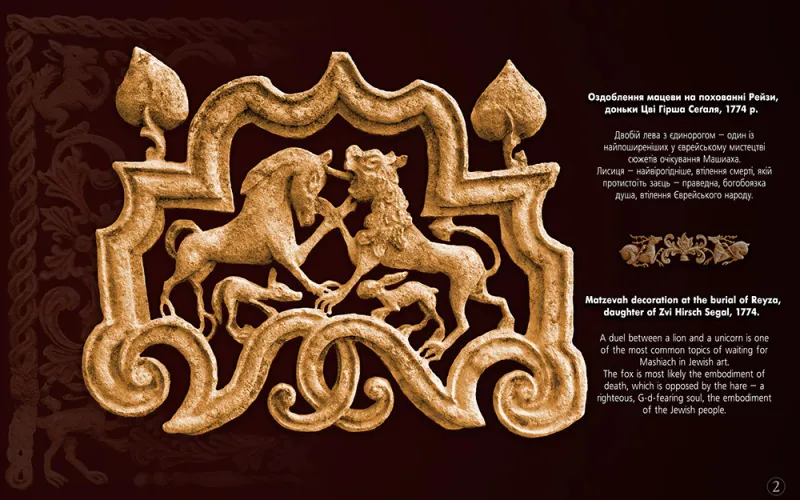
The epitaphs are inscribed with Karaite symbols: the crown of the Torah, broken trees, jugs, two palms (the hazzan’s blessing), the six-pointed Star of David, deer, menorahs and lions. Some are framed with floral ornament.
Many monuments in the Karaite cemetery were destroyed during the First World War. During the Second World War an artillery post was located in the eastern part of the cemetery, since this spot was a convenient position for controlling the crossing and the bridge over the Dniester. This fact, and the presence of a pit that may have been formed by an explosion, explain, in the opinion of the cemetery’s researchers, the absence of burials in this part.
When burying the deceased, a place near the graves of his relatives was chosen, so burials of different times lie side by side. For this reason the researchers were unable to determine the oldest part of the cemetery.
The Karaite cemetery in our town is an important source for historians, art historians and philologists. It gives those interested the opportunity to study various aspects of the life of the Halych Karaite community, family history and genealogy, the art of stonecutting, and literary creativity.
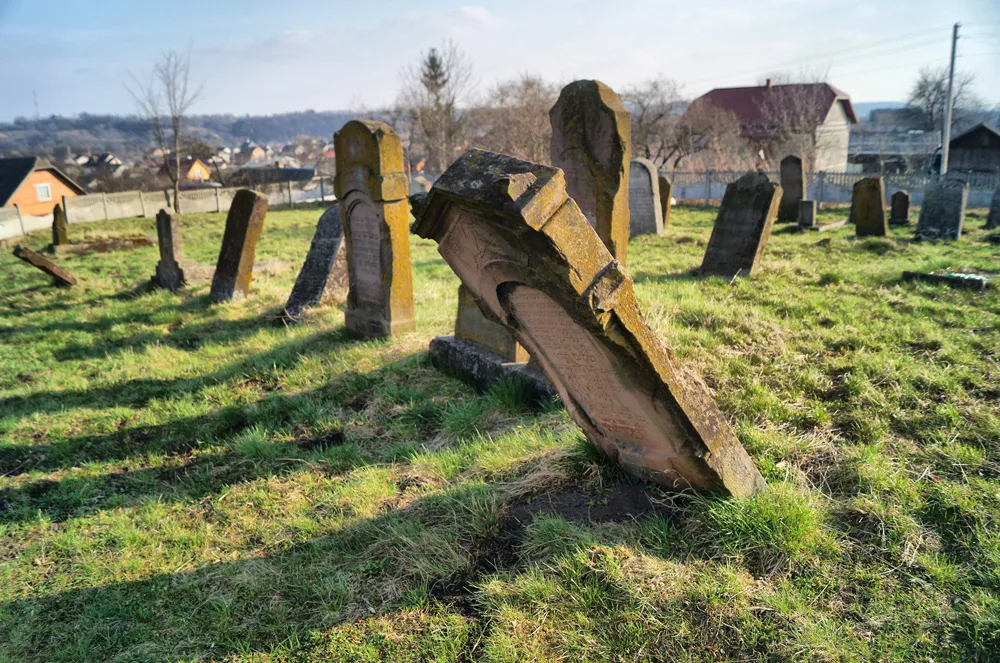
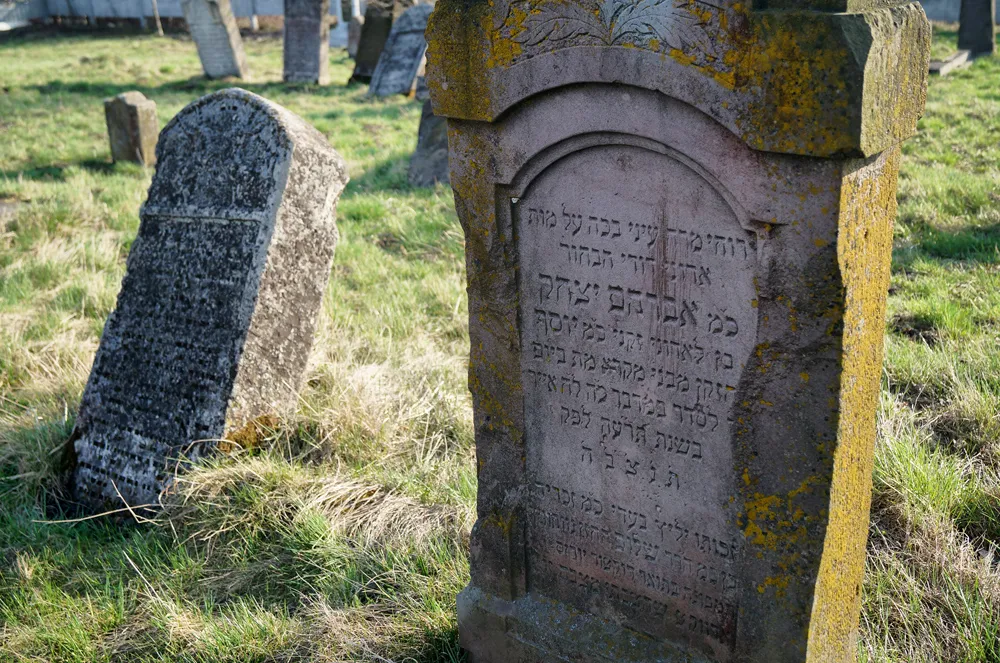
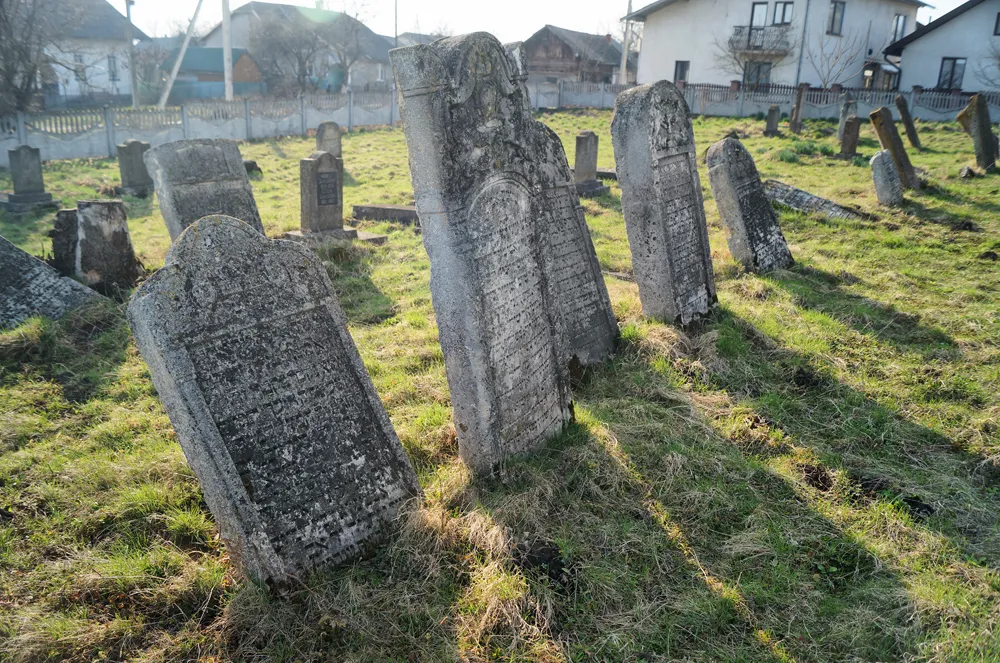
In recent years the staff of the Ancient Halych National Reserve have carried out a number of protective works at the Karaite cemetery: the cemetery has been entered in the State Register of Monuments, and an inventory of the gravestones has been made. Work continues on conserving the cemetery, strengthening its northern and eastern parts, which are being destroyed by natural and anthropogenic influences, and landscaping the territory.
In order to draw attention to the problem of preserving the cultural heritage of the Halych Karaites, the catalogue “The Karaite Cemetery near Halych” was studied in detail and put in order. Signposts for getting there and a sign before the entrance to the territory have been installed. Every year people who live nearby bring fragments of steles that they dig up in their yards during repair work.
The Karaite cemetery is a valuable relic of the history of the Karaite community. It carries weight of international significance, since the Halych Karaites have relatives in Crimea, Poland, Lithuania and Israel, who often come to visit the graves of their ancestors and are not indifferent to their past. The state of the Karaite cemetery must always be monitored in order to preserve it for future generations at least in the condition in which we see it today.
In conclusion, I want to stress that the Karaite cemetery of the town of Halych is a valuable relic of the history of the Karaite community. It is a cemetery of international significance, since the Halych Karaites have relatives in Crimea, Poland, Lithuania and Israel, who often come to visit the graves of their ancestors and are not indifferent to their past. And they are pleasantly surprised that in Halych care is taken to preserve the history of the Karaites, and their cultural heritage is studied and popularised. Recently representatives of the Lithuanian Karaite community visited Halych, visited the cemetery and were once again convinced that one can be at ease about the proper preservation of the past of the Halych Karaites. Some representatives of journalism do not always understand what the steles of the Halych Karaite cemetery tell, and do not wish to delve into and comprehend the fate of a people who lived far from their ancestral home (Chufut-Kale, Crimea) and preserved their religion, language, culture and traditions, and sacredly cared for their preservation and development. In the Halych land he met people who are still not indifferent to the history of the Karaites. The Karaite cemetery in Halych is a kind of museum-necropolis, a book of stone in the open air that must be read, studied and treated with reverence for the bright memory of the Halych Karaites.
Nadiia Vasylchuk. Junior researcher of the Museum of Karaite History and Culture of the Ancient Halych National Reserve. Source