

So when did Horodok on the Smotrych appear?
The NGO “Ukraine Incognita” has long and fruitfully cooperated with the Horodok urban territorial community (Khmelnytskyi Oblast). Our publication has repeatedly reported on the achievements of the partner project “Graves of Ancestors”, carried out together with the Department of Culture, Nationalities, Religions and Tourism of the Horodok City Council.
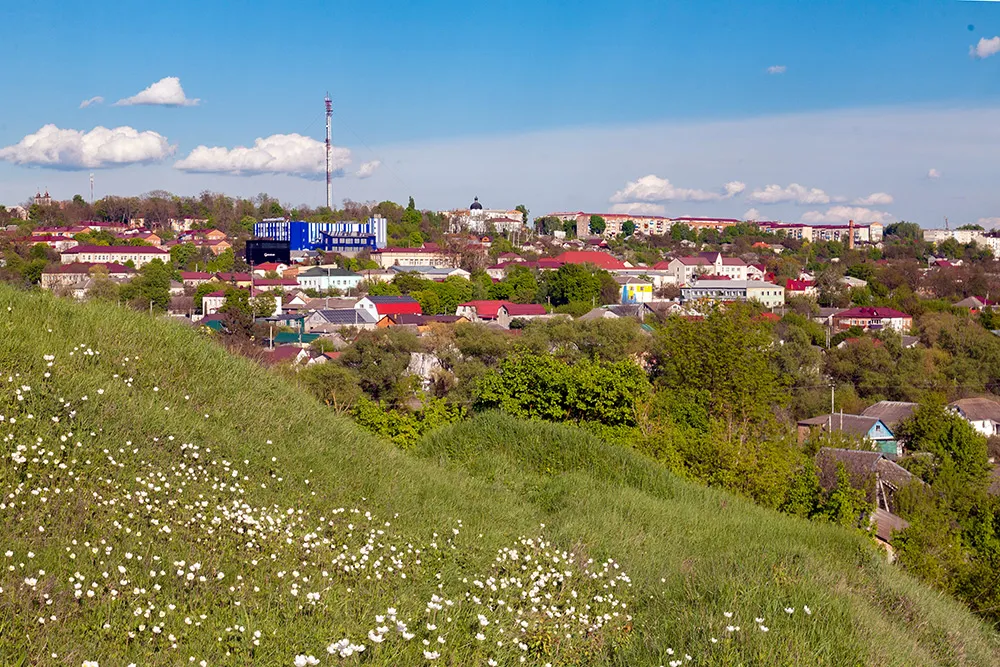
Panorama of Horodok. Photo: D. Poliukhovych
Recall that during the expeditions held as part of the project, researchers study not only ancient necropolises (Ukrainian, Polish and Jewish) but also all the other types of monuments encountered during the trips.
We decided to devote this article to the history of Horodok itself. Not, of course, to all of it, but only to the question of when this settlement came into being.
For a long time the early period of Horodok’s history and the time of its origin remained rather uncertain and mythologized. Even the official dates of the first written mention are doubtful, indeed unhistorical and groundless.
According to Resolution No. 878 of the Cabinet of Ministers of Ukraine of 20 July 2001, in the list of historic towns of Ukraine the founding of the town of Horodok is dated to 1362. For some reason the Cabinet “specialists” of the day tied this date to the Battle of Blue Waters, after which Podillia became part of the Grand Duchy of Lithuania.
But there are absolutely no written mentions of Horodok from that time. We note that this resolution contains many doubtful and curious points and dates that have repeatedly been criticized by scholars.
The fundamental work “History of Towns and Villages of the Ukrainian SSR”, volume 26 (1971), states: “The first written mention of Horodok in historical sources dates to 1392, when the Lithuanian prince F. Koriatovych gave it, together with several villages, to the landowner Bedrykh. Hence the name: Bedrykhiv-Horodok.”
This erroneous claim was taken from Yukhym Sitsinskyi’s work “Historical Information on the Parishes and Churches of the Podillia Eparchy. Kamianets District”. There the “Father of Podillia local studies” wrote the following:
““Bedrykhov Horodok” traces the beginning of this settlement to the end of the 14th and the beginning of the 15th century, when there lived a certain Bedrykh, or Bedryshko, to whom in 1392 Prince Theodore Koriatovych gave four villages in the Chervonohorod district…”
But the Chervonohorod district is located in an entirely different part of Podillia, and the territory of present-day Horodok never belonged to that district. Yet the claim that the village of Bedrykivtsi lies next to Horodok favoured the view that it was Horodok on the Smotrych and not one of the many other Horodoks.
At that time Yukhym Yosypovych did not know that a little farther downstream on the Dniester, in the very heart of the former Chervonohorod district, there is an ancient village, once a town, called Horodok. And a few kilometres from it there is also a village called Bedrykivtsi! It is precisely this Horodok that is mentioned in the ancient deed. The distance between these Horodoks is more than a hundred kilometres.
This claim of Sitsinskyi’s was refuted by historians long ago, yet it still wanders around amateur publications.
We note that later Sitsinskyi himself abandoned this version.
As for other written mentions: given the peculiarity of the toponym and the existence of several settlements called “Horodok” at once (in Podillia alone there are 2!), the time of Horodok’s first written mention is still debated in the scholarly community, because it is not always clear which of the numerous Horodoks is meant.
Given the rather weak documentary base (in the old archives the period of Horodok’s history before the 16th century is a complete blank, and the 17th century is not much better), only archaeological research could settle this question. Such research took place in 2017 and 2021.
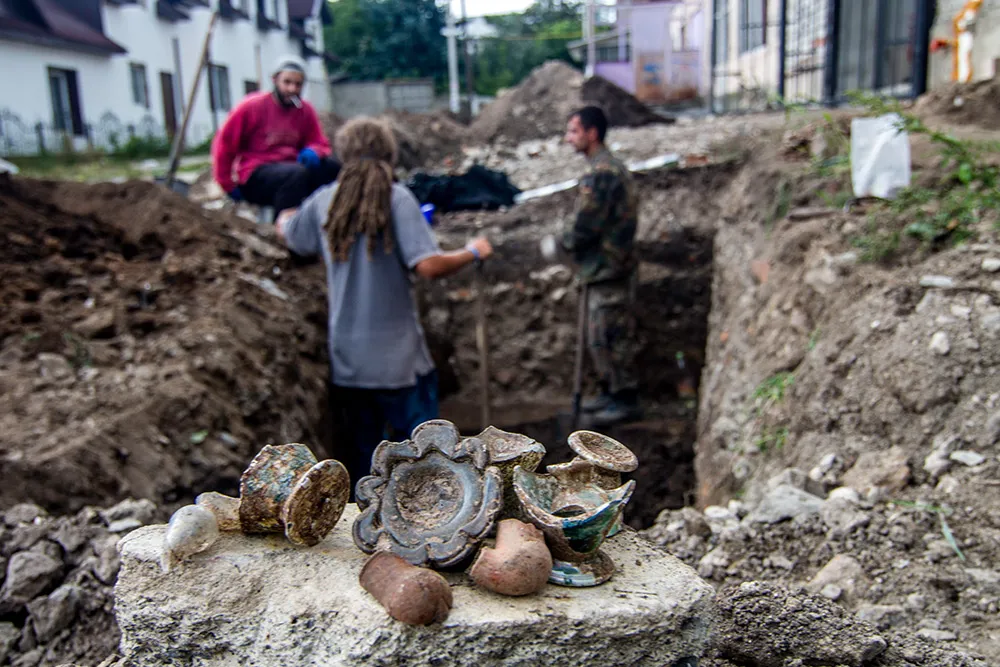
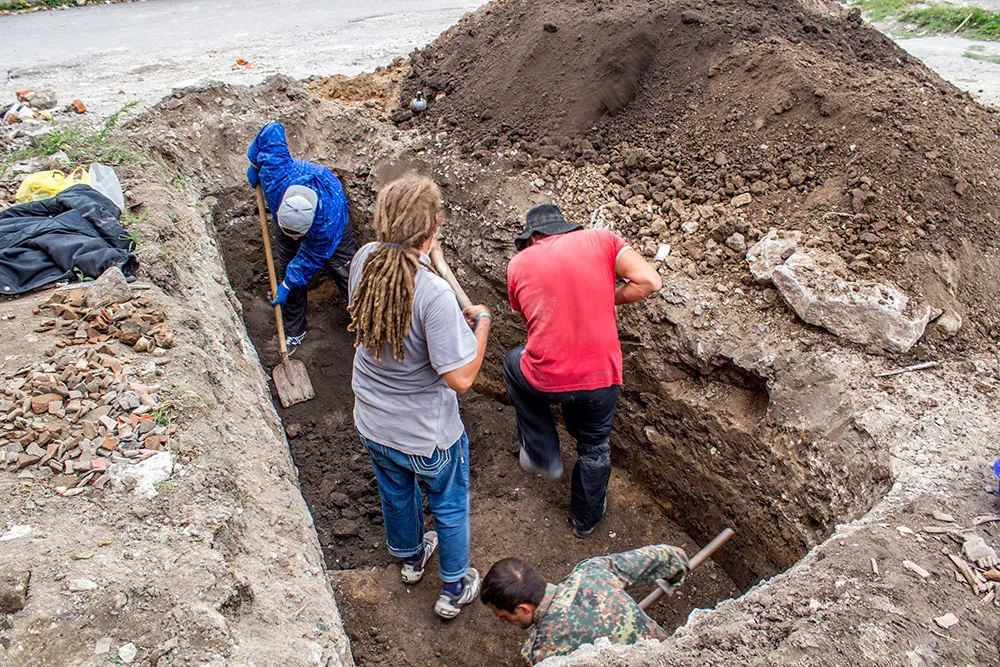
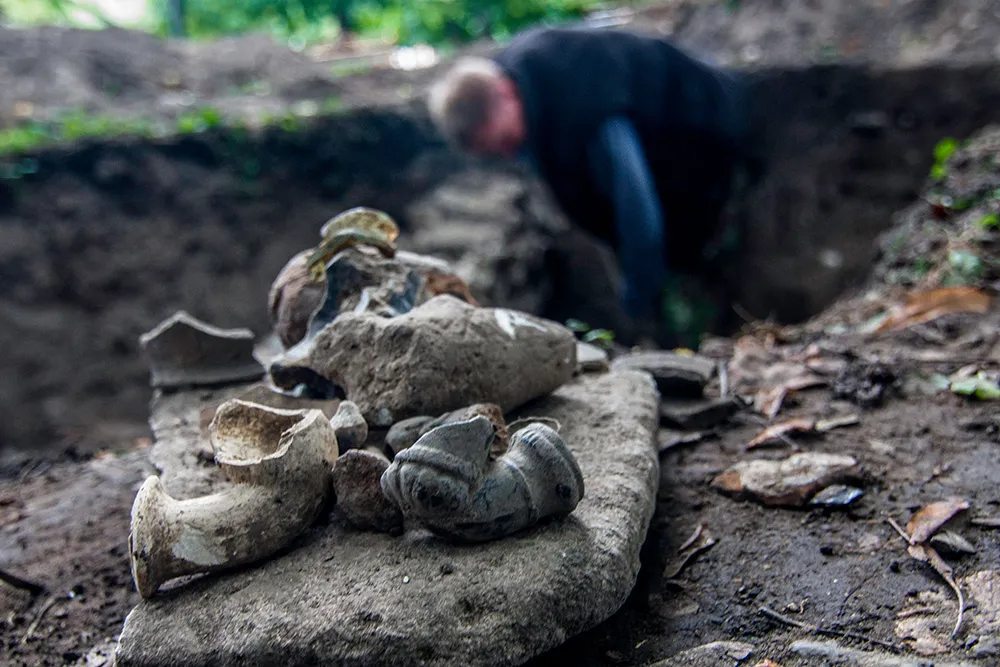
Archaeological research in 2017. Photo: Dmytro Poliukhovych
It was conducted by scholars of the state enterprise “Research Centre “Protective Archaeological Service of Ukraine” of the Institute of Archaeology of the National Academy of Sciences of Ukraine and the Kamianets-Podilskyi architectural and archaeological expedition, headed by the well-known Podillia archaeologist, Candidate of Historical Sciences Pavlo Nechytailo.
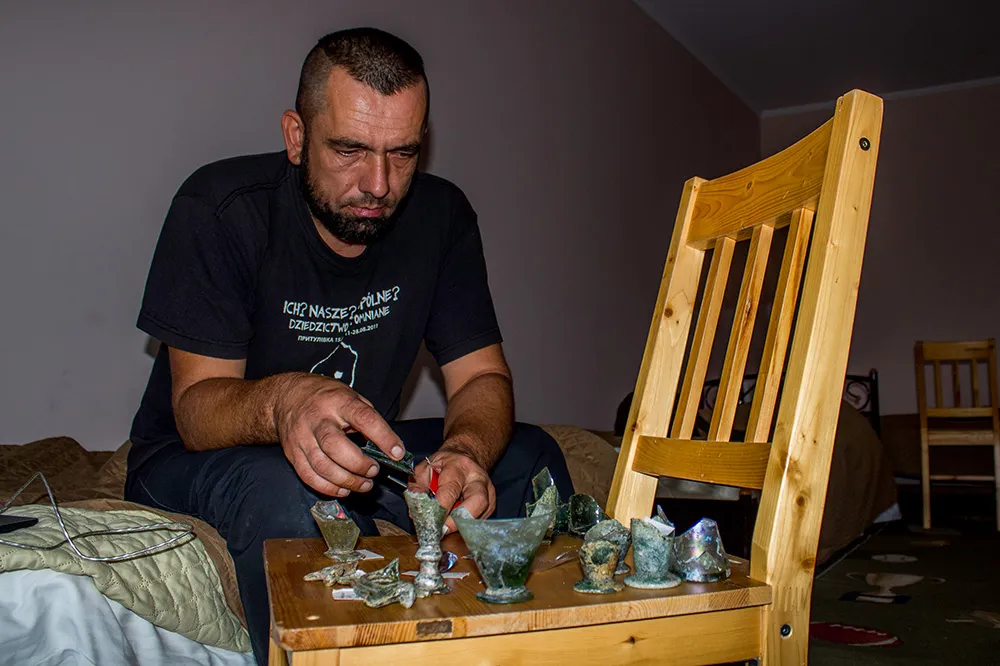
Pavlo Nechytailo analyses the artefacts found (17th-century forest glass). Photo: Dmytro Poliukhovych
An important aspect: this research was initiated and financed by the local community. At the same time, the Department of Culture, Nationalities, Religions and Tourism of the Horodok City Council provided great technical and organizational assistance to the expeditions. This is telling, because the leadership of local communities usually ignores its own history and not only shows no initiative but even displays criminal negligence in cases where, under current legislation, archaeological research should be carried out as a matter of course but is not. Horodok stands out here as one of the towns in Ukraine most friendly to historical heritage and scholarship.
As the archaeological research of 2017, largely initiated by the author of this article, showed, the present-day centre of Horodok, which had previously been considered its historical core as well, began to be settled only from the second half of the 17th century.
In addition, confirmation was found that people had favoured this location, convenient for living, since time immemorial. In particular, one of the excavation trenches revealed traces of a settlement of the Trypillia culture. In another, laid out on the grounds of S. Vynohradskyi Square, besides artefacts of the 17th–18th centuries, fragments of hand-moulded pottery were found, most likely of the early Iron Age.
On the whole, the 2017 research proved successful. We were then lucky enough to find a huge array of artefacts that tell of the culture, daily life and crafts of the town in the 17th–18th centuries. Almost the entire display of the Horodok Local History Museum devoted to this period is now built on these finds.
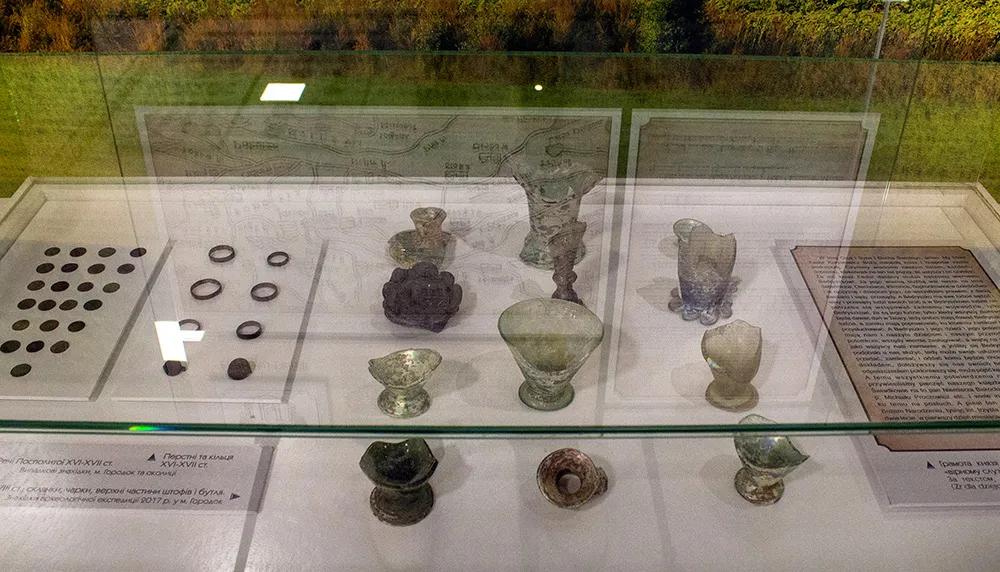
Artefacts found during the 2017 excavations, in the display of the Horodok Local History Museum (G-museum). On the right is a copy of the text of F. Koriatovych’s charter to Bedryshko, which in fact concerns an entirely different Horodok. Photo: Dmytro Poliukhovych
The archaeological research carried out in August–September 2021 by a unit of the Kamianets-Podilskyi architectural and archaeological expedition of the state enterprise “RC “PASU”” of the IA NASU, commissioned by the Horodok City Council, exceeded all expectations.
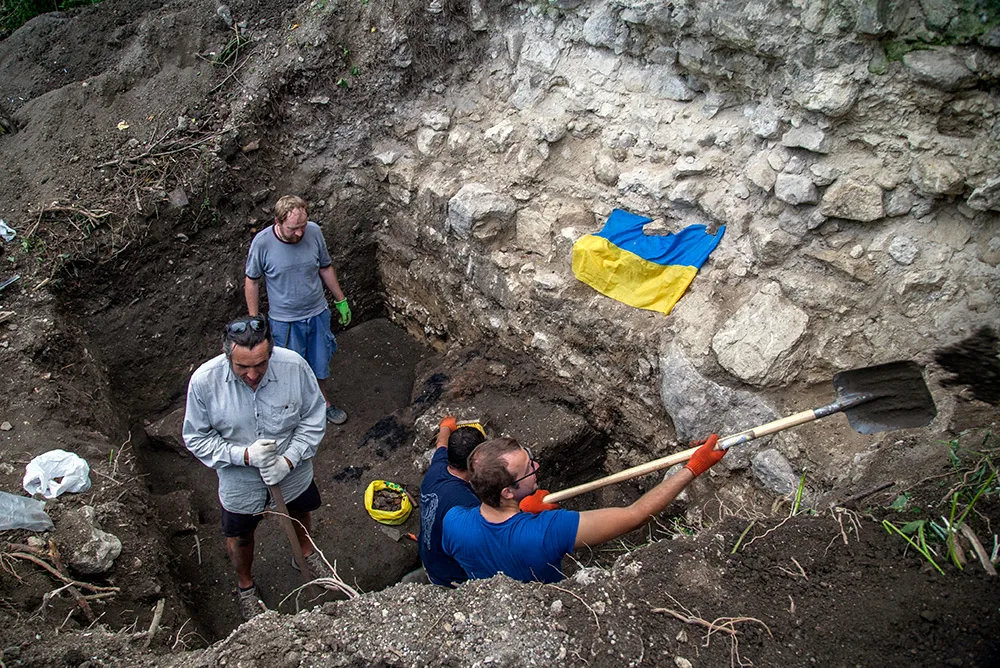
One of the excavation trenches of the 2021 expedition. Photo: Dmytro Poliukhovych
The research was carried out in the part of the town of Horodok on the right bank of the Smotrych River known among old-timers as the “Old Town”.
Fieldwork focused on the castle hill. Several objects and locations were studied: the remains of a stone wall near the former St. Anne’s Church; the plateau of the Lower Fortification; the cave on the castle hill; and the upper part of the castle hill.
We will omit the details and concentrate only on those trenches that shed light on the beginning of Horodok’s history as a separate town.
Trench No. 4 gave the greatest discoveries.
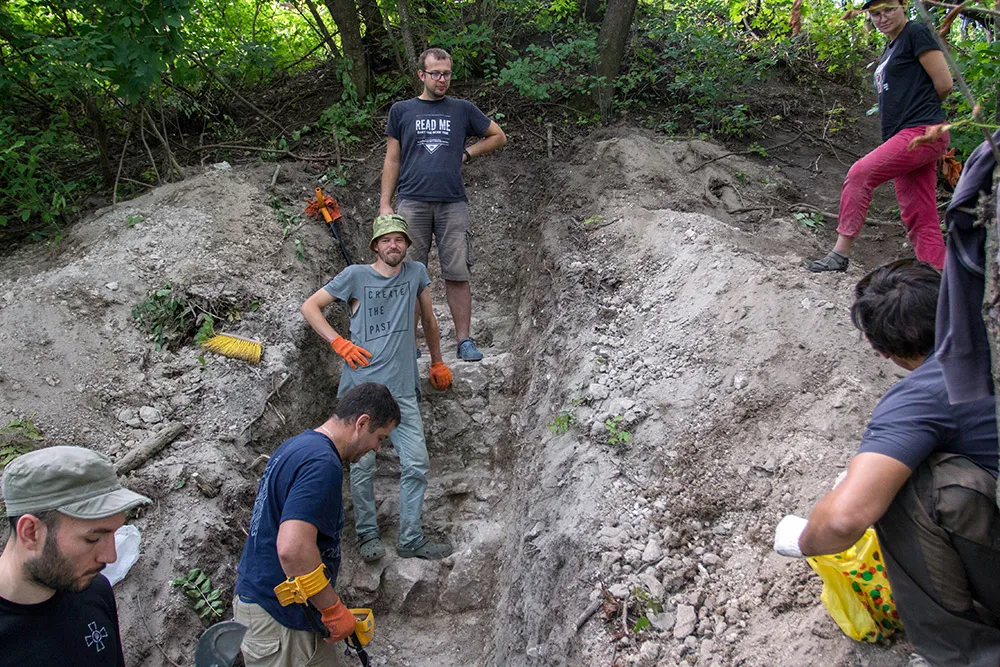
The discovery of the walls of the long-vanished castle turned out to be a pleasant surprise. Photo: Dmytro Poliukhovych
It was first laid out as a trench of 6 x 1 m. The trench was dug on the slope of the castle hill. In the first metre of the trench a fragment of a masonry stone wall was found. The wall lay at a depth of 1 m. It is built of limestone on a light lime-and-sand mortar. The stone in the facing masonry is rectangular. Below it, rubble masonry was traced for 0.6 m.
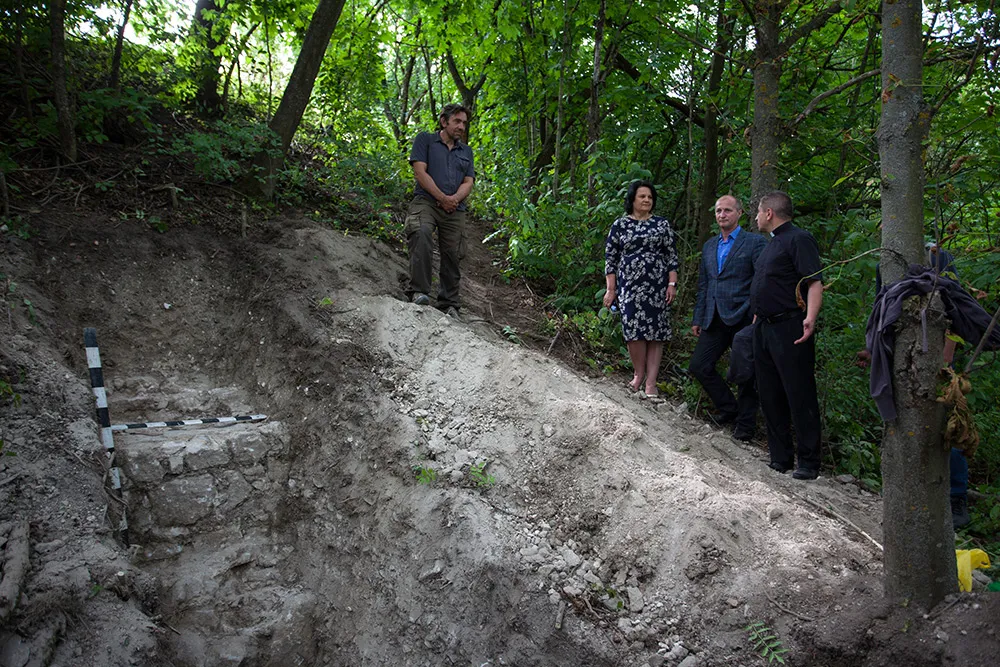
Pavlo Nechytailo shows the town’s mayor Neonila Andriichuk that Horodok is now a town with a castle. Until then, the castle wall existed only on the community’s coat of arms. Photo: Dmytro Poliukhovych
After the wall was found, it was decided to uncover it to the greatest possible length. During the research almost 7 metres of the castle wall were dug out. As it turned out, its width at the base was 2.8 metres! What a stronghold it once was.
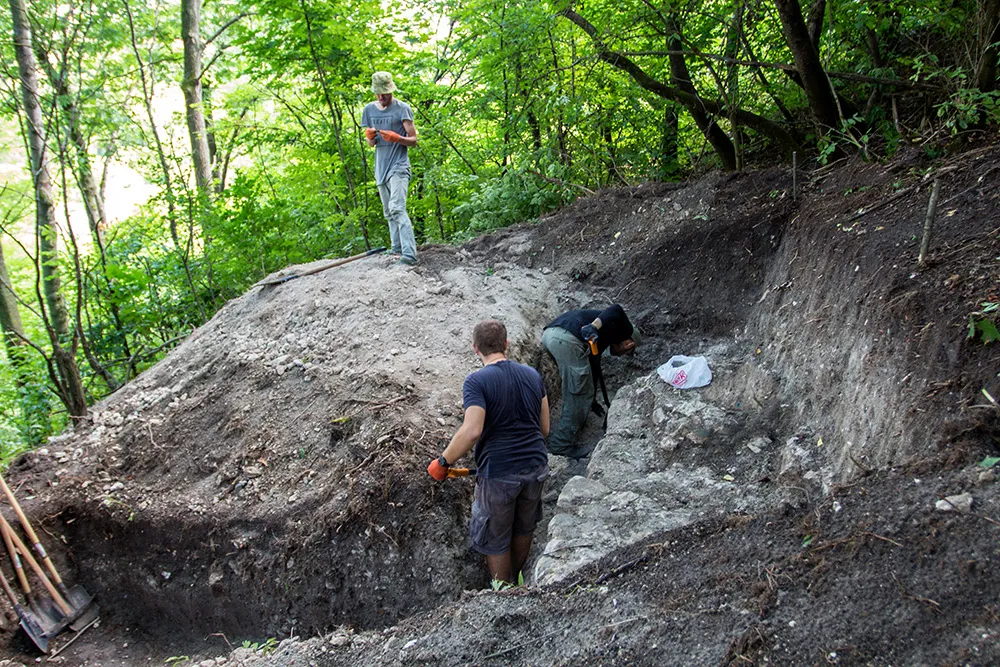
Clearing the remains of the castle wall. Photo: Dmytro Poliukhovych
In the fill of the wall the archaeologists found a substantial cultural layer with materials of the 14th–17th centuries.
We note that for a long time the exact location of the castle, dismantled back in the 18th century, remained unknown. Even on the historical and architectural plan of Horodok commissioned by the city council in 2018 from Kyiv specialists, the hypothetical location of the castle was indicated in an entirely different place. Thanks to this discovery we now have not only the precise location of the castle but also a fragment of it. That is, Horodok has joined the venerable list of towns that have a castle of their own.
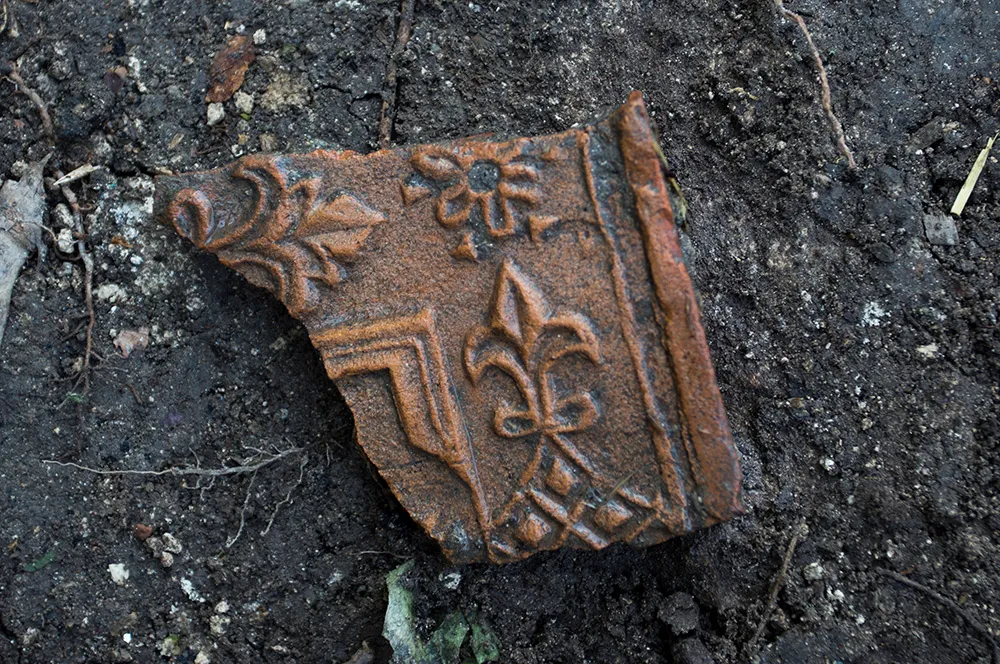
Fragment of a 17th-century stove tile. Photo: Dmytro Poliukhovych
More detailed archaeological research of the castle that was found was planned for the following year, 2022, but the full-scale Russian invasion began. Understandably, while the full-scale war continues, funding such a project from the community’s budget is unrealistic. Perhaps patrons will join in. All the more so because, besides the monument in the form of the cleared castle ruins, it would also yield many interesting exhibits for the Horodok Local History Museum.
Among the numerous finds, above all of 17th-century ceramics, made near the remains of the castle wall, fragments of finger-marked brick (“paltsivka”) are worth singling out. A fragment of daub with the imprint of a wooden stick is interesting. This find testifies to the existence of brick and wattle-and-daub buildings or structures in the castle.
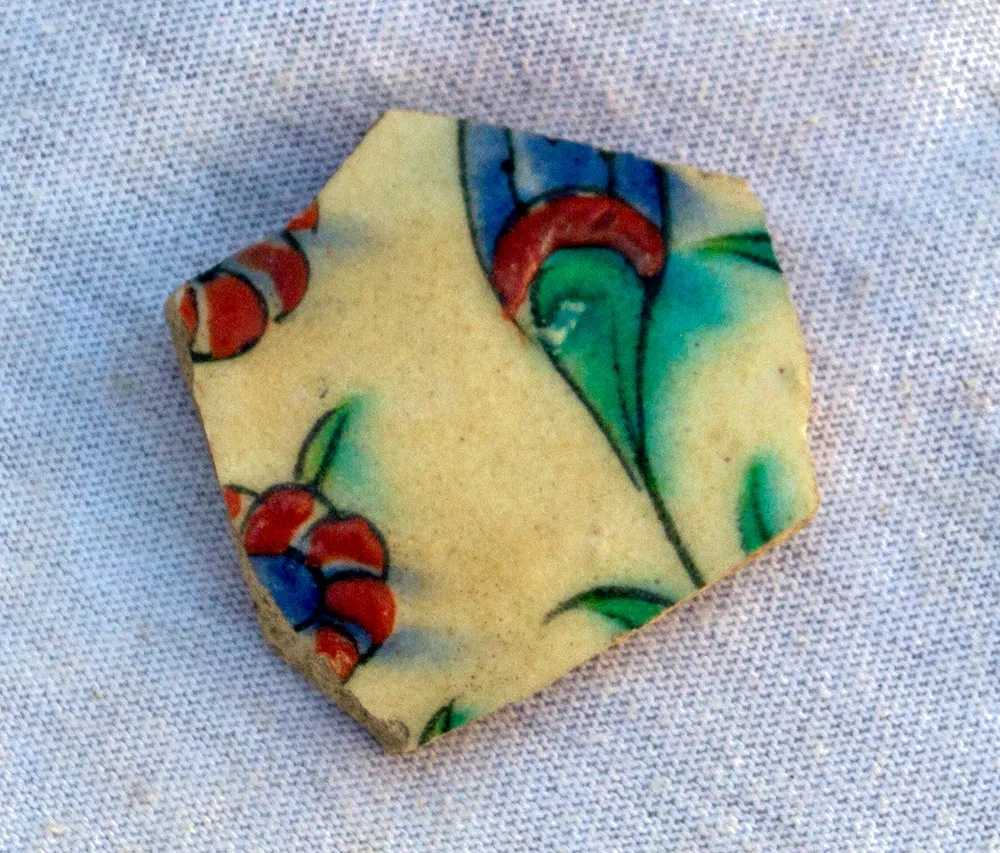
Fragment of Ottoman ceramics. Photo: Dmytro Poliukhovych
An interesting fragment is that of an imported Ottoman faience cup. The cup is decorated with polychrome painting in the “Rhodes” style. It comes from the city of Iznik. On the basis of this find one can cautiously suppose that in the time of the Kamianets Eyalet the Horodok castle may have been the base of an Ottoman garrison.
Now to the finds proper that shed light on the first years, or at least decades, of Horodok’s existence as a separate settlement.
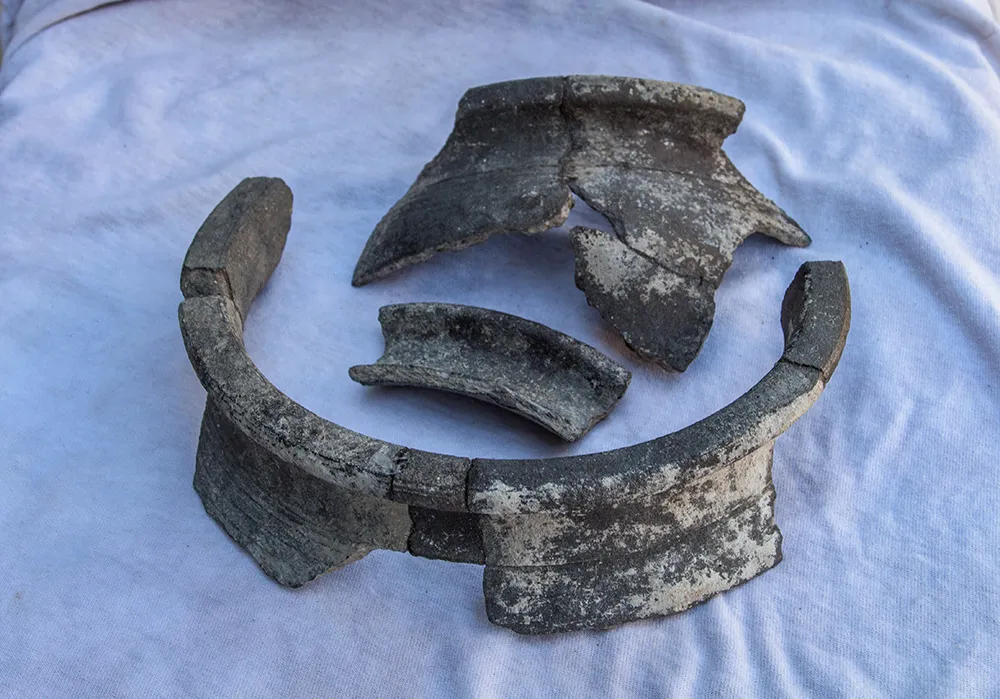
Fragments of archaic pots. Photo: Dmytro Poliukhovych
During the excavations several fragments of characteristic archaic pots were found. In particular, there is a fragment of a pot formed on a slow potter’s wheel. The clay of this pot contains plant admixtures. According to Olena Onohda, this is the so-called “distinctive group”. A fragment with a rim smoothly turned outward and a rounded roll at the edge is interesting. Such a profile leans towards Old Rus’ traditions.
An echo of Old Rus’ traditions can also be felt in the pots’ ornamentation: incised horizontal straight and wavy lines.
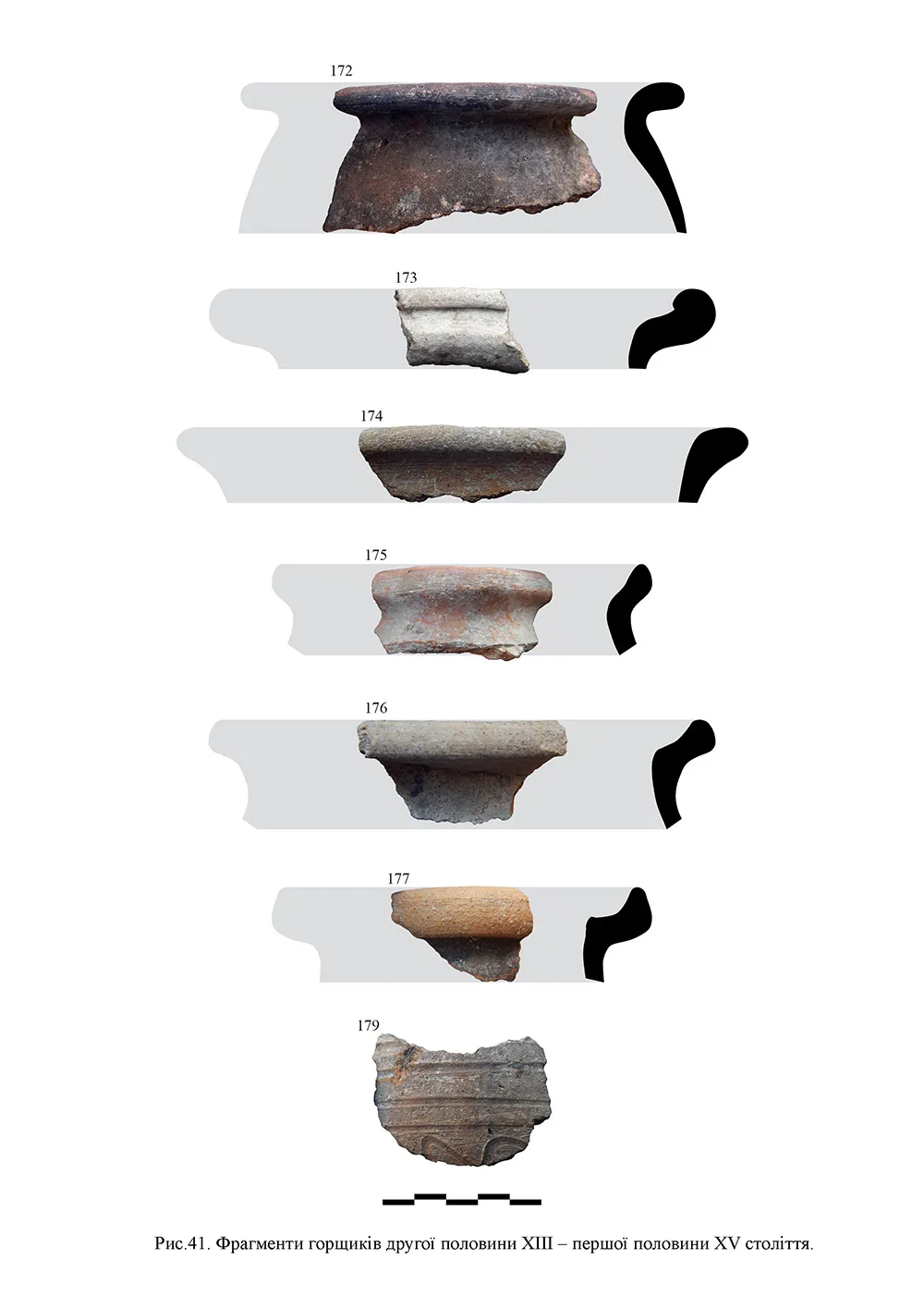
Some of the pot fragments belong to the second half of the 14th and the first half of the 15th century. These are vessels with sherds of different colours, from beige to brick red. They were formed on a fast potter’s wheel. An angular profile of the rim’s bend from the walls takes shape. The rim looks like a massive semicircular roll with a semicircular recess for a lid.
We will omit the other, quite interesting finds. Above we have dwelt only on those that make it possible to establish when Horodok came into being
The excavations made it possible to establish that continuous use of the Castle Hill territory is recorded from the 14th century. This is indicated by finds of characteristic ceramics in trenches Nos. 2, 3 and 4. Most of the finds are fragments of ceramics usually dated by researchers to the second half of the 13th to the first half of the 15th century. However, in the complex of ceramics of this period from Horodok there are no chronological features that would allow it to be attributed to Golden Horde times.
The appearance of the castle on Castle Hill and the emergence of the town of Horodok itself can now be confidently linked with the second half of the 14th century. This version of the time of Horodok’s origin as a town was proposed in the early 20th century, after the erroneous Bedryshko version mentioned above was published, by Yukhym Sitsinskyi himself. Now his theory has received factual confirmation.
Unfortunately, the artefacts found in 2021 could be seen by the general public only at a temporary exhibition organized in 2022 at the Horodok Local History Museum by the author of these lines and the then keeper of the collections and acting museum director Pavlo Zalutskyi. The plan was ultimately to create a separate display that would shed light on the beginning of Horodok’s history, but Pavlo was called up to the Armed Forces.
On 18 March 2023, Pavlo Zalutskyi, a wonderful person, specialist, enthusiast and true museum man, was killed near Bakhmut.
In fact, this is not yet the full stop
It might seem that the 2021 archaeological research closed the question of when Horodok came into being. On the basis of the artefacts collected one can confidently say that Horodok’s continuous history as a separate settlement begins in the second half of the 14th century.
But every “but” has its own “but”!
In 2021 the archaeologists excavated very little. So it is still not possible to speak of any broad generalizations. All the more so as we have a number of interesting pieces of evidence.
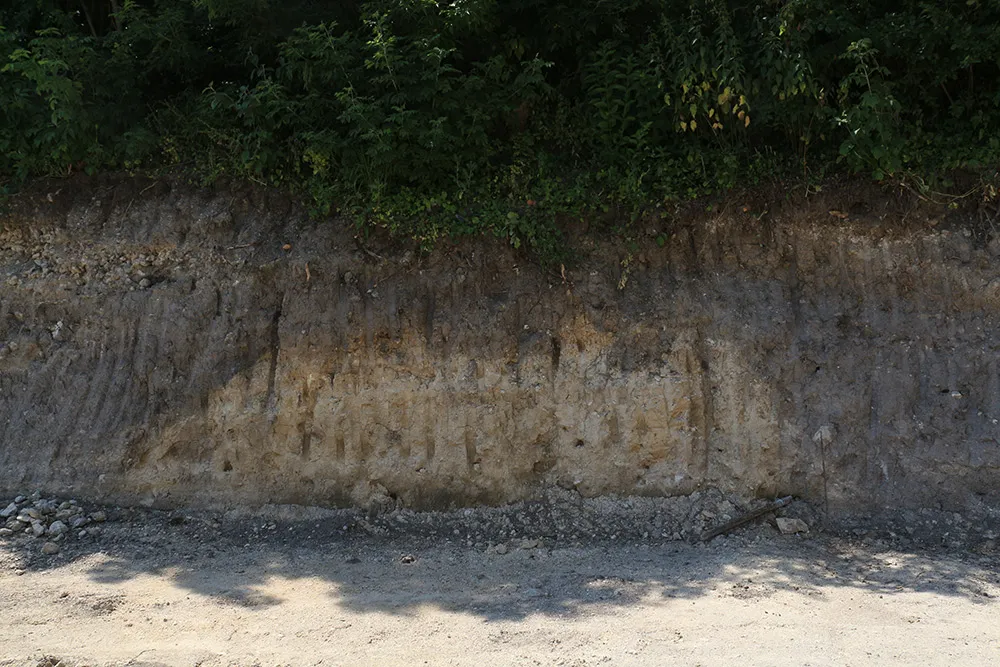
An older rampart buried under a 17th-century rampart. Photo: Dmytro Poliukhovych
In particular, in 2019, during construction work on one of the private properties directly adjoining the rampart of the terrace on which the oldest part of Horodok once stood, a section of the rampart was cut away. The author of this article then discovered, beneath the fill of the second half of the 17th century, traces of an older rampart and ditch. What period this fortification dated from is hard to say. For a number of reasons it is now impossible to investigate this. The cultural layer on the terrace was completely destroyed in the late 1960s and 1970s, when soil was taken from here for the construction of a huge road embankment.
What is important: in the earth spoil heap, 2 fragments of ceramics of the 100% Old Rus’ period were found. But given the unclear circumstances of their discovery, and the fact that they are isolated specimens, no one will draw any scientific conclusions or generalizations on the basis of these 2 sherds. That is impossible in principle. But the fact remains: ceramics of the Rus’ era have been found in Horodok’s historical core.
Second. A survey of local “detectorists” showed that on private vegetable plots under the castle hill quite a few arrowheads have been found, which the “black diggers” attributed to the Rus’ era.
There may be a certain caveat here, however. Detectorists usually attribute all iron arrowheads not belonging to the “Chernyakhiv culture” period automatically to Rus’. Yet the bow and arrows were used on the territory of present-day Ukraine as late as the early 18th century!
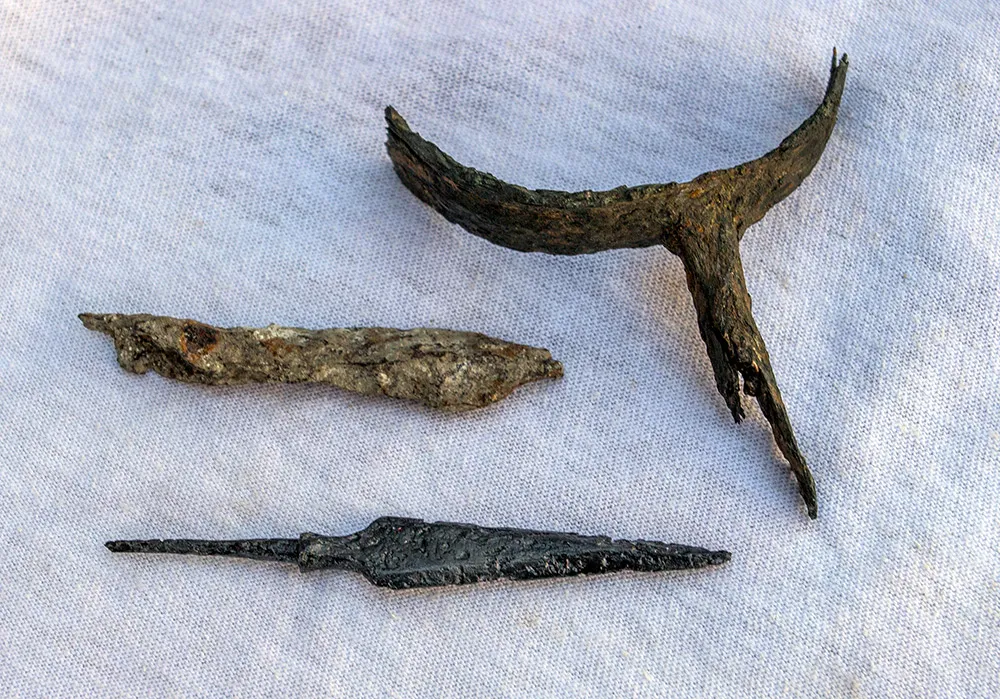
An arrowhead, a crossbow bolt and a spur found during the castle excavations. 2021. Photo: Dmytro Poliukhovych
We note separately that in 2021, during excavations at the castle site, the archaeologists found an iron arrowhead and a crossbow bolt. But they were dated to the 14th–15th centuries.
So the author very much hopes that further research will be lucky enough to make discoveries that extend our town’s history back to the time of Rus’. All the more so because some researchers link the origin of Horodok with the Bolokhiv Horodets.
On this occasion the author wishes to appeal to Horodok’s “detectorists”, many of whom present themselves as researchers of history. If you have come across Old Rus’ artefacts within Horodok, share the information and, if you have them, photos of the finds.
Some other conclusions
The results of the latest historical research make it possible to discard some historical axioms concerning Horodok’s history.
In particular, the name “Bedrykhiv-Hrodok” is not about Horodok on the Smotrych but about Horodok on the Dniester in Ternopil Oblast.
On this basis one should, for example, forget for good about the “trick” of the Cossack mutiny that took place in the summer of 1653 near Horodok. This mutiny is vividly described by Mykhailo Hrushevskyi. Then, recall, the Cossacks demanded in the form of an ultimatum that Bohdan submit to the Orthodox Muscovite tsar. The fateful Pereiaslav agreements became merely the legal embodiment of those sad events.
According to Hrushevskyi, Khmelnytskyi’s army stood for a long time in a camp between Bedrykhiv Horodok and Bedrykivtsi. The author, incidentally, has repeatedly surveyed the places where the camp could hypothetically have stood, but the results are zero. In the ploughed fields one came across the ubiquitous Trypillia, Chernyakhiv and Scythian pottery… But artefacts of the 17th century, none. And this although a many-thousand-strong army that “hung around” for a long time on a relatively small area should have left quite a mess. Again, a survey of Horodok’s detectorists produced no result.
In the vicinity of Horodok the tracts “Kozatskyi Yar” (Cossack Ravine) and “Kozacha Dolyna” (Cossack Valley) are known, but they are by no means connected with the stay of a large army. Besides, there are hundreds of such microtoponyms in Podillia alone.
So the dubious fame of the mutiny that fatally influenced the history of Ukraine should be passed to Horodok’s namesake in Ternopil Oblast.
The until recently textbook truth that at the beginning of its history Horodok bore the name Novodvir (New Court) now also looks doubtful.
In particular, in the “Encyclopedia of the History of Ukraine” we read:
“HORODOK (old names: Novodvir, Horodok-Bedrykhiv, Polish Gródek Podolski) — … Probably founded in the 1430s by the Kamianets castellan Mikołaj-Bedrych of the Świrski family. First mentioned as the castle of Novodvir in 1456.”
Considering that, according to the 2021 archaeological excavations, the settlement already existed in the second half of the 14th century, it could by no means have been some “new court” (incidentally, the name “New Court” is quite common). For if there is a “New Court”, then somewhere there should be some settlement that fits the definition of an “old court”. But according to archaeological research, the period of Horodok’s origin falls in the time of the mass appearance of most other settlements of Podillia, which, after these lands were freed from the rule of the Horde, began to spring up like mushrooms after rain. So the “New Court” version tied to Horodok looks somewhat barren.
However, this topic requires a separate large study and has yet to be sorted out. But for now the author is inclined to classify the “New Court” hypothesis as erroneous.
Prepared by Dmytro Poliukhovych
In preparing this material, we used the paper “On the question of the time of the origin of the town of Horodok” (Pavlo Nechytailo, Dmytro Tymchuk, Dmytro Poliukhovych), which the author of this material presented at the All-Ukrainian scientific and practical conference organized by the National Union of Local Historians of Ukraine in Horodok (25 October 2024), and the REPORT ON HERITAGE PROTECTION RESEARCH ON THE TERRITORY OF THE TOWN OF HORODOK, KHMELNYTSKYI OBLAST, in 2021 (Nechytailo P.O., Tymchuk D.V., Omelchenko O.V., Poliukhovych D.I.)


