Church of St. Nicholas the Wonderworker (on the water): Ukrainian Baroque, gilded gaudiness and the “Russian world”
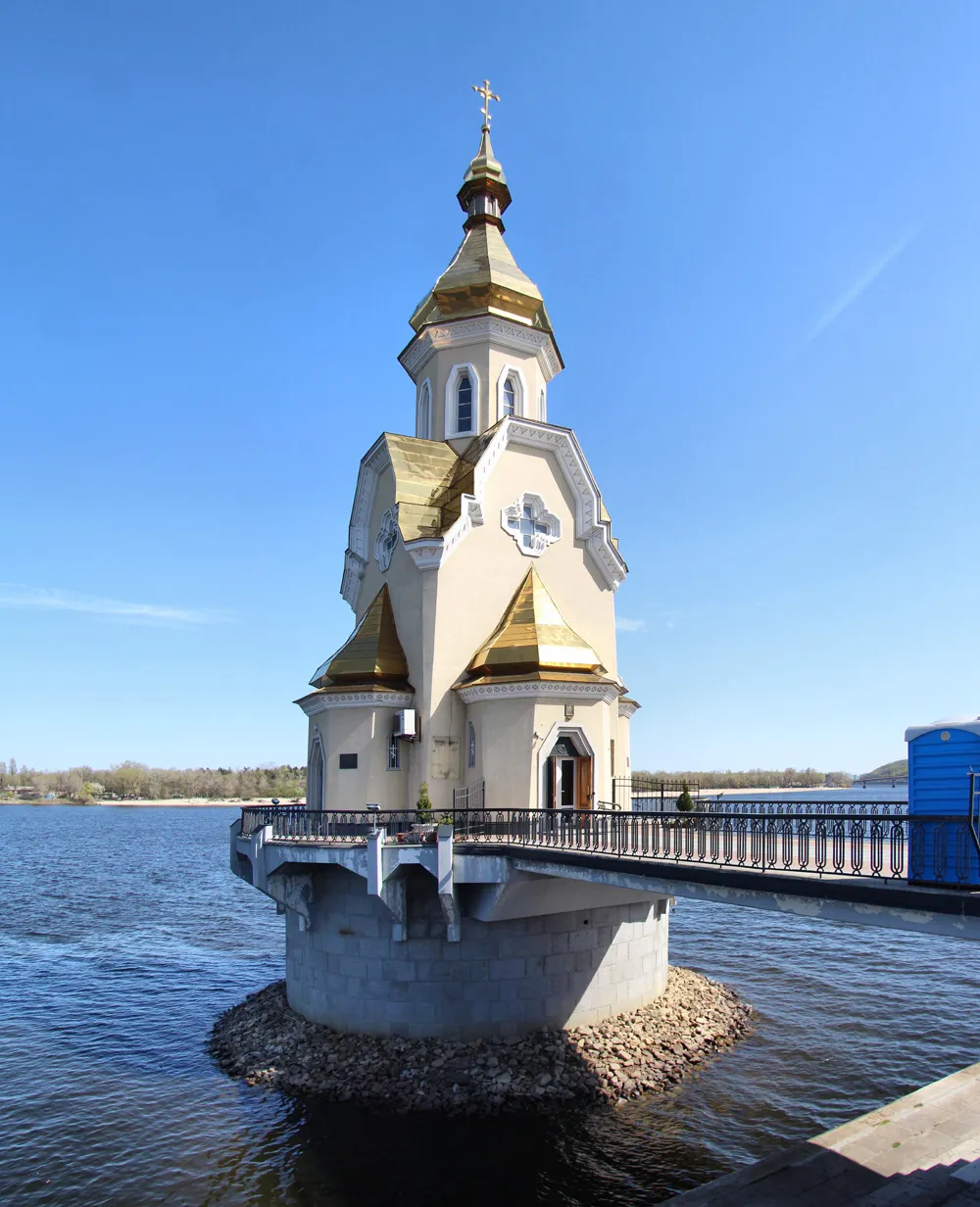
The Church of St. Nicholas the Wonderworker near Naberezhno-Khreshchatytska Street in Kyiv is the only church in Europe that stands right in the middle of a body of water. That is, not on an island (there are plenty of those) but precisely in the middle of the water. Accordingly it is known as the church “on the water” (“on the waters”).
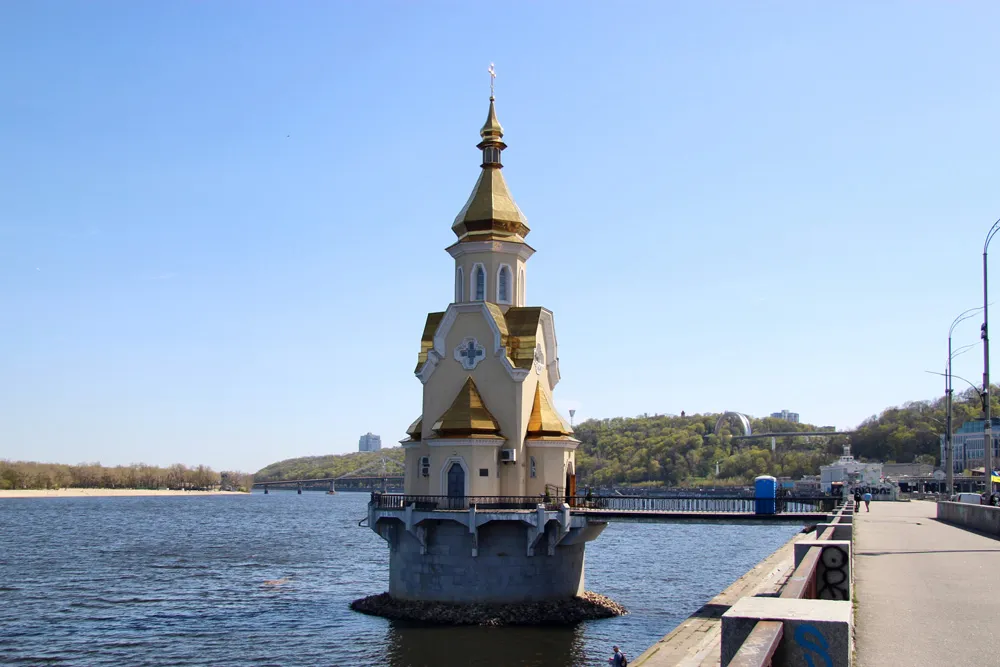
The church was built with funds from the company Ukrrichflot, with the assistance of its head Mykola Slavov. Construction work went on during 2003–2004. The church was consecrated in honour of St. Nicholas on 7 July 2004. The dedication to St. Nicholas is not accidental and is quite transparent. On the one hand this saint is the patron of seafarers (and river navigators too); on the other, he is the heavenly patron of all men named Mykola, including the church’s ktitor (patron-founder) Mykola Slavov. In fact the church came into being as a pompous lifetime monument to Mr. Slavov.
However, Mykola Slavov had nothing to do with what we see in the interiors today. When the church was consecrated, the only things in the interior were the iconostasis, a chandelier and a small mosaic icon of St. Nicholas the Wonderworker on the façade facing the Dnipro.
The church was built to a design by the creative architectural studio “Yurii Losytskyi”; the authors of the project are Yurii Losytskyi and Olena Myroshnichenko. The architectural and spatial solution employs motifs of the pillar-type churches of the Ukrainian Baroque era. The architects approached the task quite creatively, interestingly and skilfully. But the overall impression of the church is spoiled by a large amount of “gilded gaudiness.” It is hardly the architects’ choice. The influence of the patron’s tastes, of the “tough businessmen” cohort (“krepkie khozyaistvenniki”), is clearly expressed here. The latter, for the most part, have considerable gaps in the humanities and culture. But they love everything to be “rich-looking.” One way or another, the large amount of gilding rather badly spoils the look of a church that is quite interesting and refined in its architectural conception.
The church was handed over to the UOC. After the founder’s death, the priests of the Moscow Patriarchate fully revealed, in the wall paintings, the worldview and ideology of the ROC’s branch in Ukraine.
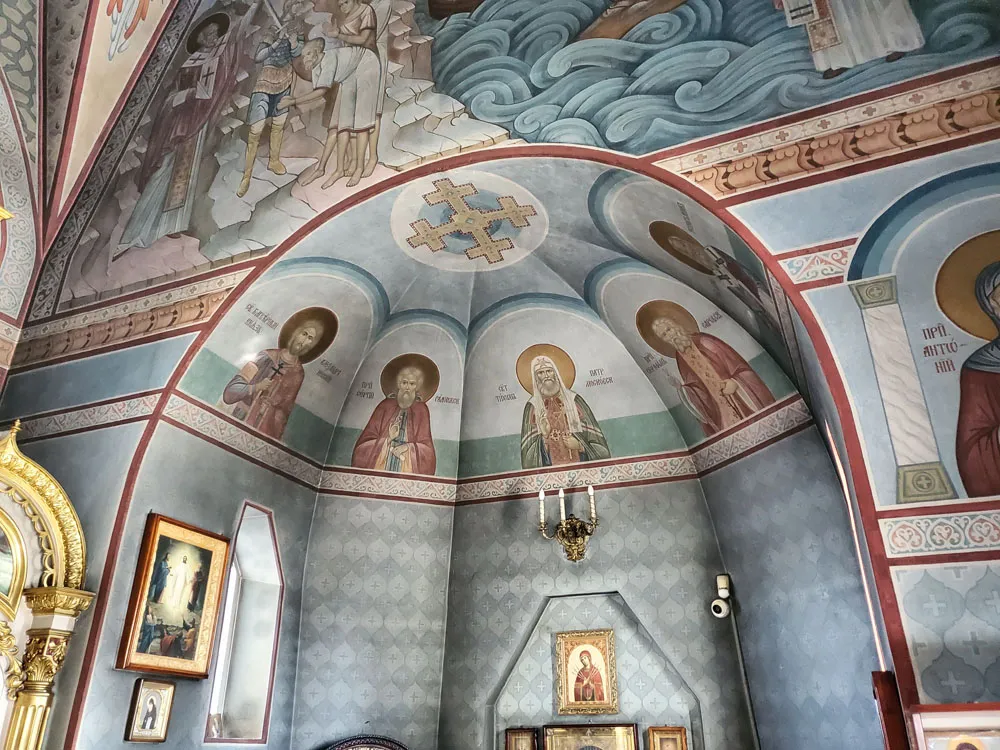
In particular, here we see the host of Muscovy’s main “political” saints: St. Alexander Nevsky, the venerable Sergius of Radonezh, St. Tikhon, Patriarch of Moscow, and the venerable Seraphim of Sarov…
The latter is interesting because it was precisely at the start of the 2000s, when the church-on-the-water was built, that active promotion of this particular “saint” began in Russia. And this took place within the framework of promoting the Russian imperial idea.
Let us note that Seraphim of Sarov was not famous for anything special. He was a monk, became a hermit and led a righteous life. All the miracles associated with his name are unconfirmed, and the most significant ones, like the tale that Emperor Alexander I himself secretly came to him for advice, were long ago refuted. He was a very righteous and sincerely believing man, but no more. At best, the role of a little-known local saint awaited him.
The ROC and its branch in Ukraine under the name “UOC” very much dislike recalling how Seraphim of Sarov was canonized.
It is known that Nicholas II’s wife, Empress Alexandra Feodorovna, was fascinated by mysticism and surrounded herself with all sorts of schemamonks, hermits, holy fools, soothsayers and other charlatans. The story of Grigory Rasputin alone is worth a lot! Few people know that the “elder” had a predecessor: a certain French preacher, Nizier Philippe. In France a whole sect formed around Nizier, which considered him the incarnation of Jesus Christ himself.
The influence of this rogue on the imperial family was enormous. In July 1902 the emperor wrote in his diary: “Mr. Philippe spoke and taught us. What strange hours!”
But after Interior Ministry agents presented a huge report on the charlatan’s suspicious activity, the tsar was forced to send Nizier back to France.
Taking his leave of the tsarina, Nizier reportedly said that the long-awaited heir would be helped into the world by the hermit Seraphim of Sarov, who had died 70 years earlier. The imperial family at once demanded that the Chief Procurator of the Holy Synod, Konstantin Pobedonostsev, immediately canonize Seraphim. A special commission opened Seraphim’s grave: instead of incorrupt relics there lay ordinary bones.
Although all members of the Holy Synod disapproved of the canonization, no one dared to speak openly against the emperor. In July 1903, before an enormous crowd, the “Sarov celebrations” took place. In the press loyal to the tsar this canonization was presented as a vivid example of the unity of the authorities and the people. The people, they said, venerated the Holy Elder, and the tsar-father did everything to officially recognize Seraphim of Sarov as a saint.
A year later the saint indeed gave the tsar an heir: Alexei, who suffered from haemophilia.
In today’s Russia the inflated cult of Seraphim of Sarov is being popularized for the same reason as before the revolution. If the “saint” Tsar Nicholas the Bloody is the sacralization of Kremlin power and the revival of the Empire, then Seraphim of Sarov is the sacralization of the unity of Russian authority and the people. In Ukrainian conditions it is also the sacralization of specifically Russian authority. Plus the constant reminder: holiness can come exclusively from Russia.
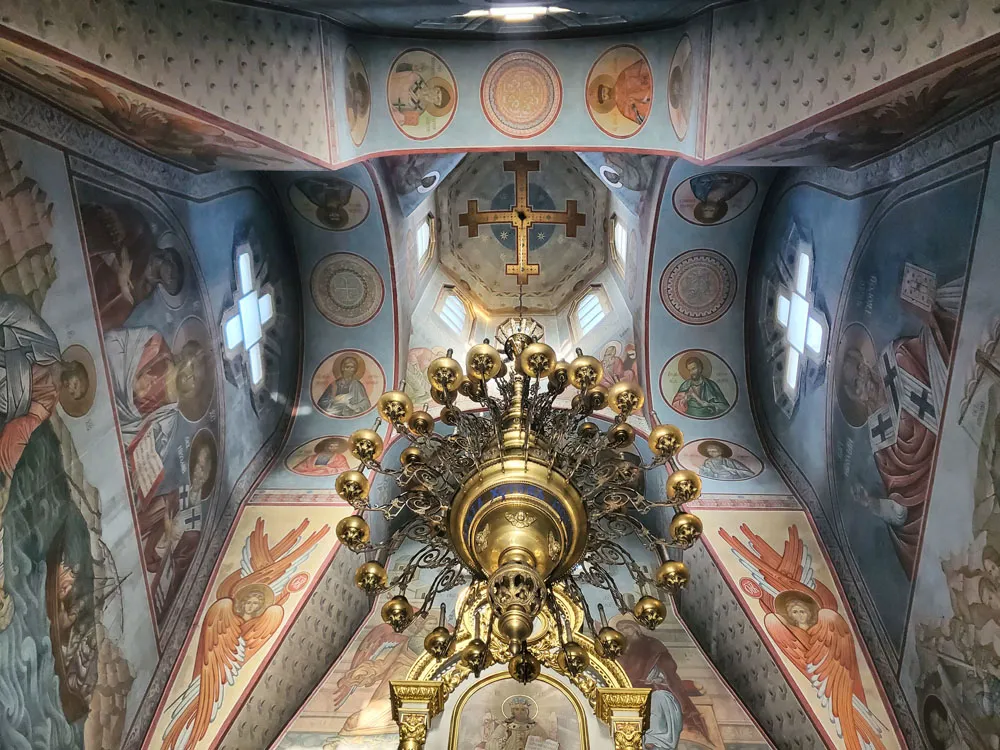
Tsar Nicholas II looks down contemptuously on the Little Russians below
The “saint” Nicholas the Bloody, whose “canonization” by the Moscow “church” took place almost simultaneously with the start of promoting the cult of St. Seraphim of Sarov, has not been forgotten in the church-on-the-water either. Anyone who wishes can admire his face here.
The “saint” Nicholas the Bloody is the calling card, symbol and banner of the Russian church. His icons and likenesses adorn the cult buildings of the UOC of the Moscow Patriarchate, as a symbol of this structure’s devotion to Moscow.
In 2018 a correspondent of the news agency “Novorossiya” wrote as follows about the veneration of the “icon” of the Russian tsar in occupied Luhansk:
“The memory of the Sovereign, of the Imperial family, is a very important part of Russian identity. It is telling that hatred of the Royal Passion-Bearers is shown by people whose Russian identity has been replaced by some other, for example Ukrainian, (…) said Aleksei Selivanov, a parishioner of the church of the Holy Martyrs Gurias, Samonas and Abibus. Recent years have shown that those who came out for the processions of the cross on the Tsar’s days most often turned out to be loyal [to Russia] to the end. Kyivans, Kharkivites, Odesans, who came out in their cities with icons of the Sovereign, were the first to join the militia of Donbas”.
What pleases most in the wall paintings is the face of the “saint” Sergei Alexandrovich Romanov. The son of Emperor Alexander II was for a long time Governor of Moscow and in 1905 died from the terrorist Kaliayev’s bomb. He was also an open homosexual and did not hide it. And what about “spirituality”? What about the “spiritual bonds” (“skrepy”)?
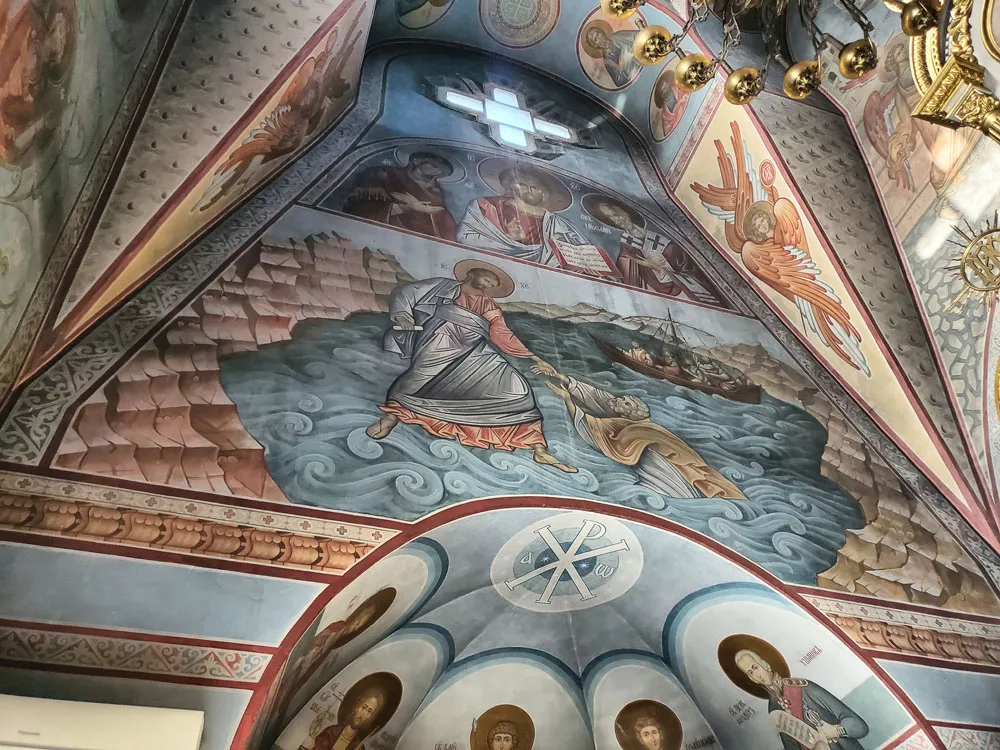
The “saint” Ushakov (bottom, right)
And the cherry on the cake. There is yet another astonishing “saint” here: the Russian admiral Fyodor Ushakov.
Since 2001, Admiral Ushakov has been not only a historical figure but also a “saint righteous warrior” of the ROC and one of the symbols of the “Russian world.” In 2022, at a concert at Luzhniki marking another anniversary of the annexation of Crimea, Putin declared that the date the invasion of Ukraine began was not accidental, as it coincides with the birthday of the “saint” naval commander, proclaimed by Gundiaev the heavenly patron of Russian naval sailors. So when the next missile launched from the Black Sea waters arrives, we know whom to thank for it.
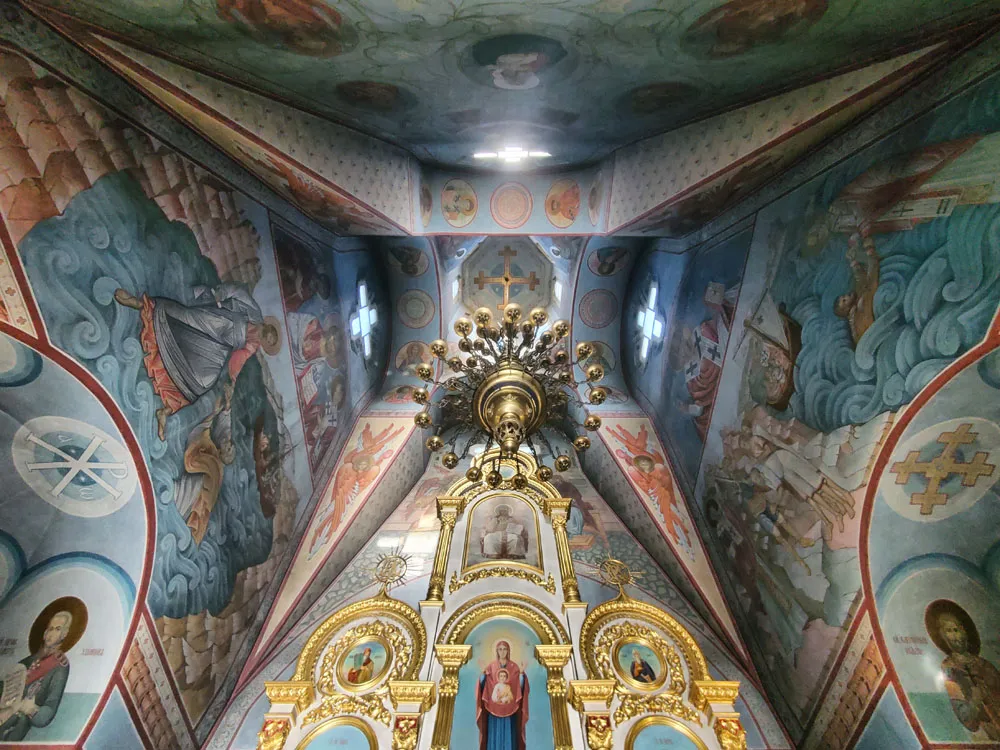
The church-on-the-water is better admired from the outside. Because inside it reeks far too much of the “Russian world”…