

Fragments of an 18th-century “plague cross” found in the forest near the village of Lisovody
A new and, to a degree, sensational discovery, at least at the regional level, has been made by Dmytro Poliukhovych of the Ukraine Incognita team together with Inna Abram, a local historian and researcher from Horodok (Khmelnytskyi Oblast). It concerns a unique stone cross standing outside a cemetery (or rather its fragments), once erected on the burial place of a victim (or victims?) of the plague epidemic of 1770.
The words “sensational” and “unique” are no exaggeration. Eighteenth-century “plague” crosses marking the graves of plague victims outside cemeteries are extremely rare. Today fewer than two dozen such monuments are known to scholarship. So the discovery of each new one is a small historical sensation, and every one of them is unique.
Although plague victims were traditionally buried near their houses (so as not to spread the disease through the village or town) and there were thousands of such burials, extremely few stone grave markers have survived. And it is not only that they have not been preserved: there were few of them to begin with. The explanation is simple: stone crosses were made in craft centres. Then, usually in September, when the harvest was gathered and people had money, merchants known as “cross carriers” took them around towns and villages, where they sold them or exchanged them for grain. Obviously, setting out on such a journey during an epidemic was suicidal. Besides, nobody would have been allowed through anywhere, as quarantine cordons stood everywhere.
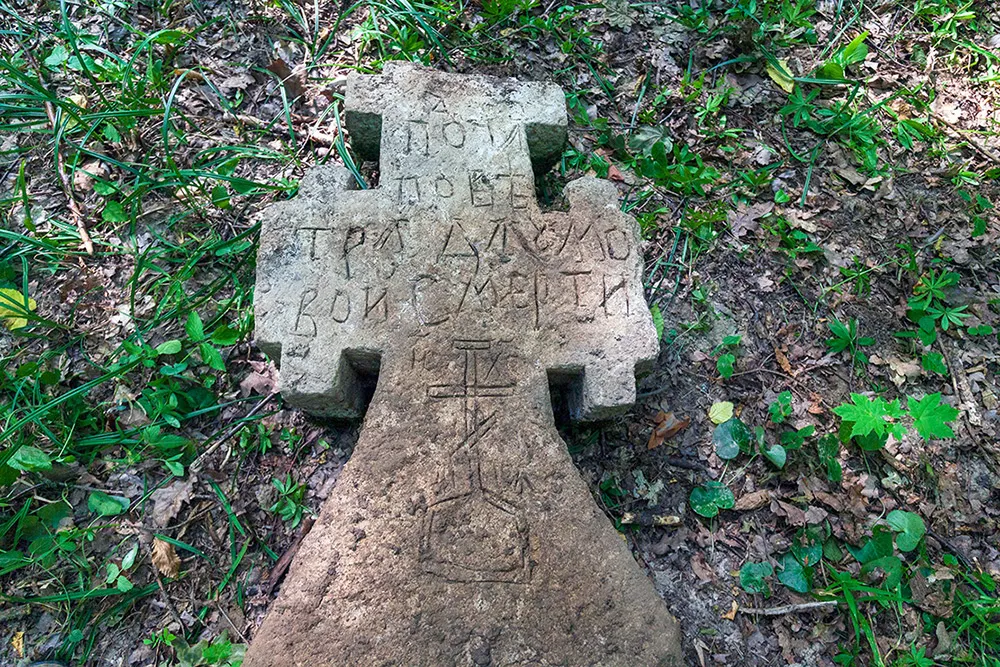
A “plague cross” from the outskirts of Sataniv on the grave of “the maiden Magdalena”, who “passed away from the pestilence of plague-death”. 1770.
There is another aspect: an epidemic is always a huge blow to the economy. One need only recall the losses caused by the COVID-19 restrictions. And a stone cross cost a good deal. Moreover, there were not always relatives left who could put one up. The plague wiped out not only whole families but whole villages.
Interestingly, about 80% of the known plague crosses are concentrated in the territory of the former Horodok district. These are, above all, the villages of Ivankivtsi, Satanivska Slobidka, Krintsiliv, and the Sataniv hamlets of Spasivka and Kamianka. These crosses are linked to the epidemics of 1719, 1770–1771 and 1797–1799. And then there is Lisovody. Until now only one such cross was known in Lisovody, erected on the burial site of a family that died of the plague (a mother and three sons). Ukraine Incognita wrote about it earlier.
The phenomenon of this atypical concentration of “plague crosses” in a small area has a simple explanation: the village of Ivankivtsi near Sataniv, and Sataniv itself, were centres of the stone-cutting trade. Accordingly, the crosses were made on the spot.
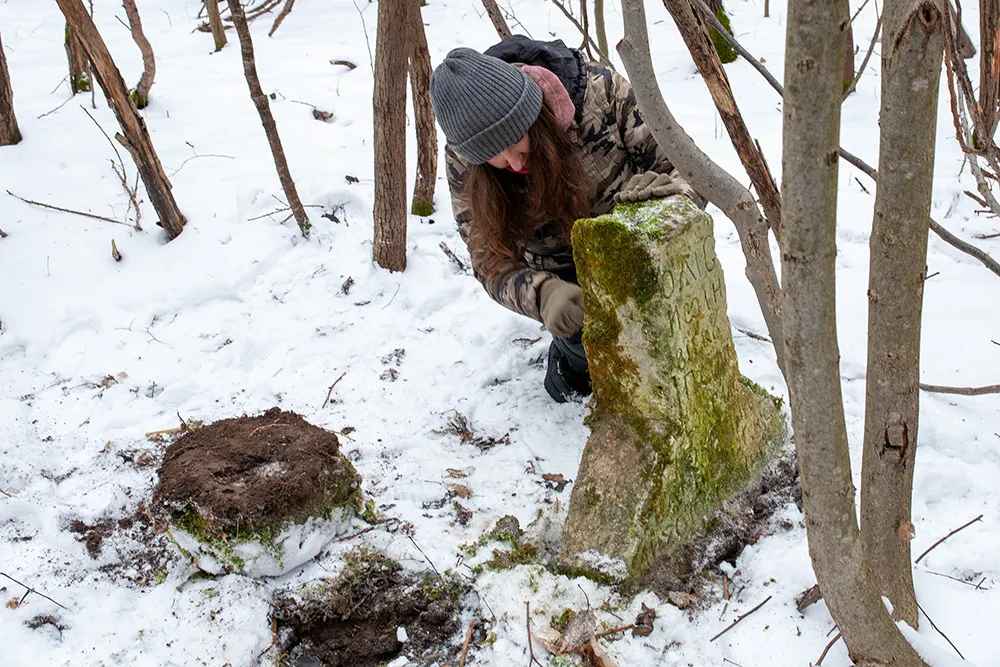
Researchers had known for a long time about the stone cross hidden in the forest near Lisovody. But they did not know exactly where. After more precise information was obtained, an attempt was made to find it, but it failed. Finally, Inna Abram, a researcher and enthusiast of local history, was lucky enough to learn more exact coordinates. After about half an hour of combing the forest, the cross was indeed found.
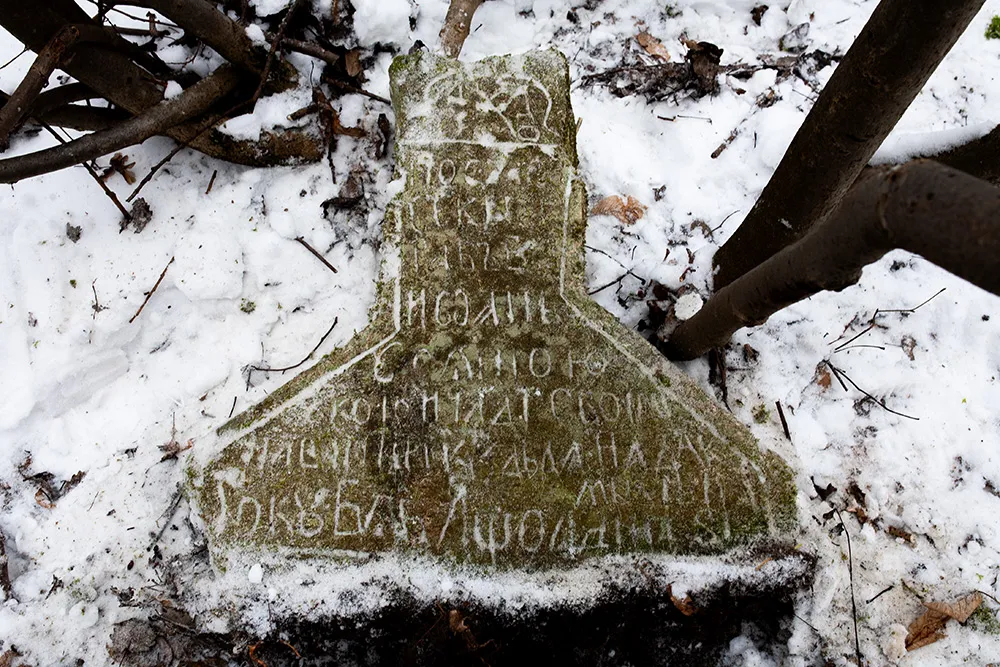
At the bottom the year “АѰО” (1770) is clearly visible. Possibly it is in fact “АѰОА” (1771).
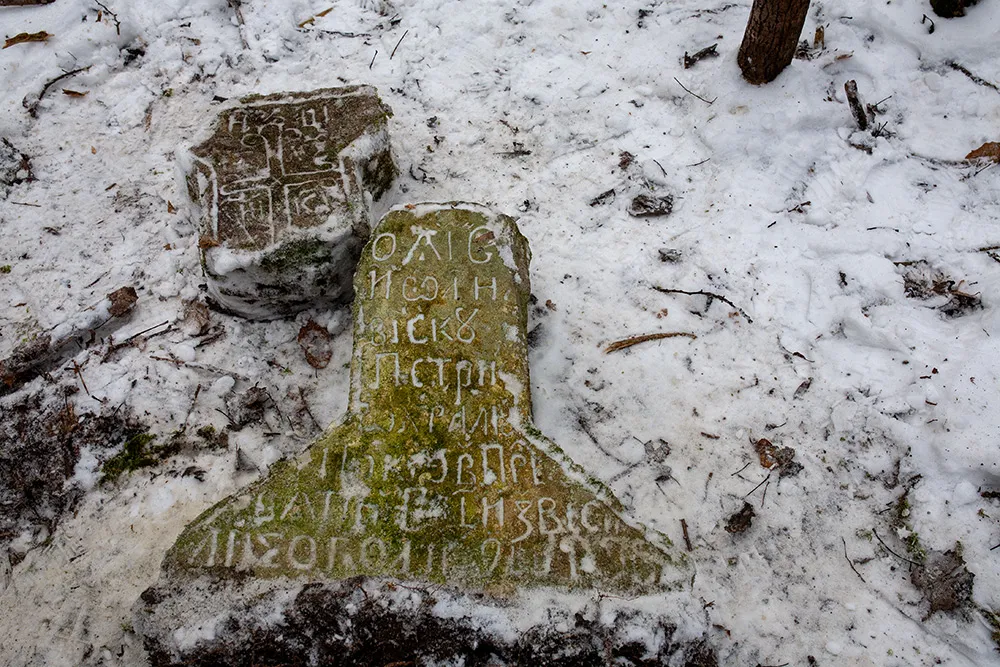
It was not without disappointment. As local villagers told us, ten years ago the cross was still completely intact and stood on a conspicuous mound. Unfortunately, instead of the mound there was now a filled-in pit (the work of “black diggers”), and the cross had been smashed. Its upper part was found 3–4 metres from the main piece. The side arms could not be found, nor could a fragment of the base. Only the broken-off “tongue” turned up, the part of the cross by which it was fixed to the base.
According to local tradition, a woman killed by lightning is supposedly buried in the middle of the forest. However, the researchers doubted this exotic version from the start. Usually such a find indicates that there was once a farmstead here whose inhabitants were mown down by an epidemic. Theories were put forward that this is the burial of victims of one of the 18th-century plague epidemics or, which is also possible, of the terrible cholera epidemic of 1830–1831.
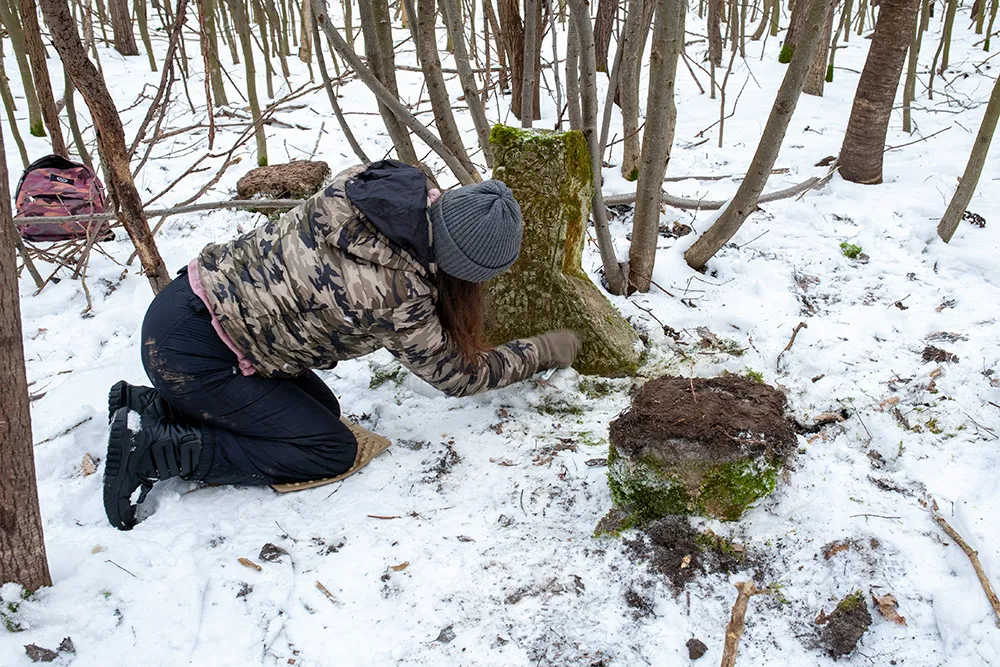
The expedition was purely exploratory, so the find had to be cleaned of moss with improvised means. In the end it turned out that the cross, as expected, is a “plague” cross. This was vividly confirmed by the year, marked in Church Slavonic letters as АѰО, that is 1770, the height of the epidemic of 1770–1771. However, it cannot be ruled out (it is hard to read) that it says “АѰОА”, that is 1771. But that, too, was a time of plague.
Given that the broad flat arms have vanished, it was hard to make sense of the epitaph. In addition, the surface needs to be thoroughly cleaned and washed.
From what could be read: “This cross was erected by the servant of God Ivan with? (over?) his wife?”
On the opposite side there is also a mention of the Church of the Intercession (this parish still exists in Lisovody) and of the “vieska” (village) of Lisovody.
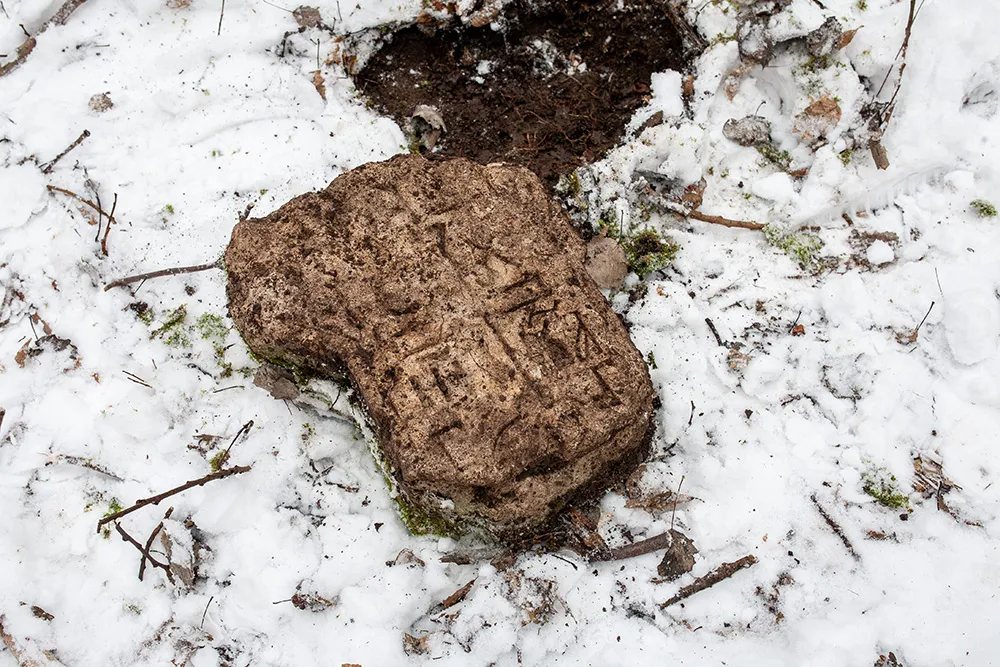
This fragment was found 3–4 metres from the main part of the cross
“I really enjoy uncovering unknown pages of history,” says researcher Inna Abram, summing up the short expedition. “It is a great pleasure to find something new and unknown to the wider public. Besides, it is gratifying to know that, with my direct participation, a small but interesting and important page of the history of our region has been found and preserved.”
“The cross is interesting also because,” says researcher Dmytro Poliukhovych, “its form is similar to that of the other Lisovody ‘plague cross’. And the decorative elements give grounds to say that it is the work of one master. What also unites the Lisovody crosses is that in both cases we see a mention of the Church of the Intercession. On the other ‘plague crosses’ of the Horodok area, churches are not mentioned,” the historian concludes.
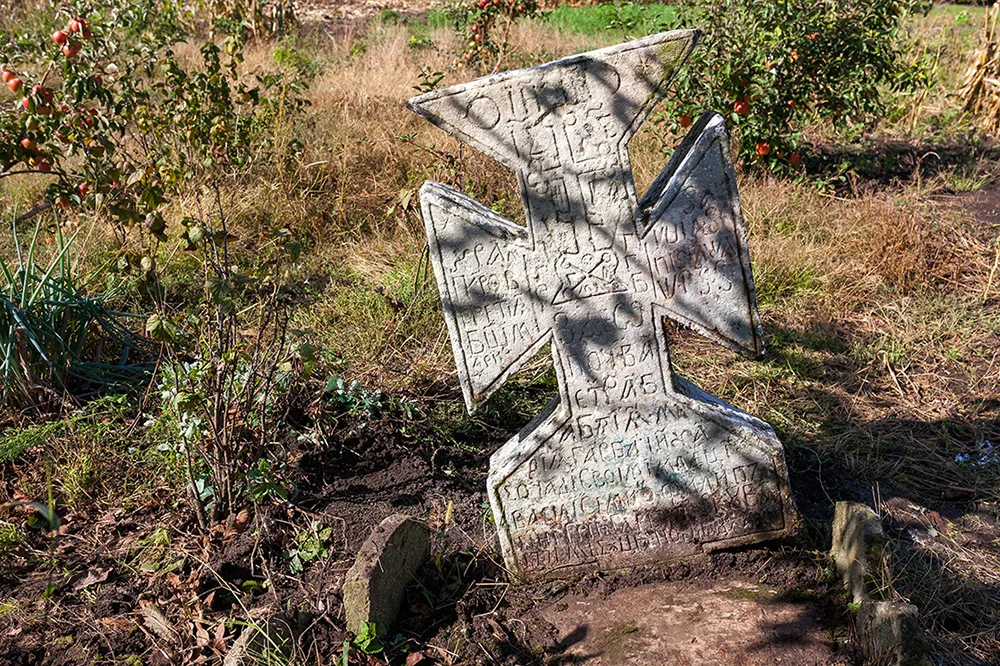
This plague cross from Lisovody (burial of 1771, cross erected in 1772) is identical to the “forest” one
The story is not yet finished. Sometime in March the researchers plan to return to the Lisovody forest:
“When the ground thaws, we want to probe the soil with a rod and find the missing fragments of the cross,” says Inna Abram. “We also need to wash its surfaces in order to finally read all the inscriptions, because it is still unclear whose burial this is.”
Ukraine Incognita will certainly inform readers of the final results of the research.
Photos: Dmytro Poliukhovych


