

A unique mausoleum in Horodok and the great microbiologist Serhii Vynohradskyi
The chapel-mausoleum of the financier Mykola Vynohradskyi (1823–1877), which can be seen in the old Orthodox cemetery of Horodok (Khmelnytskyi Oblast), is a monument that deserves the proud epithet “unique”. And at least three times over.
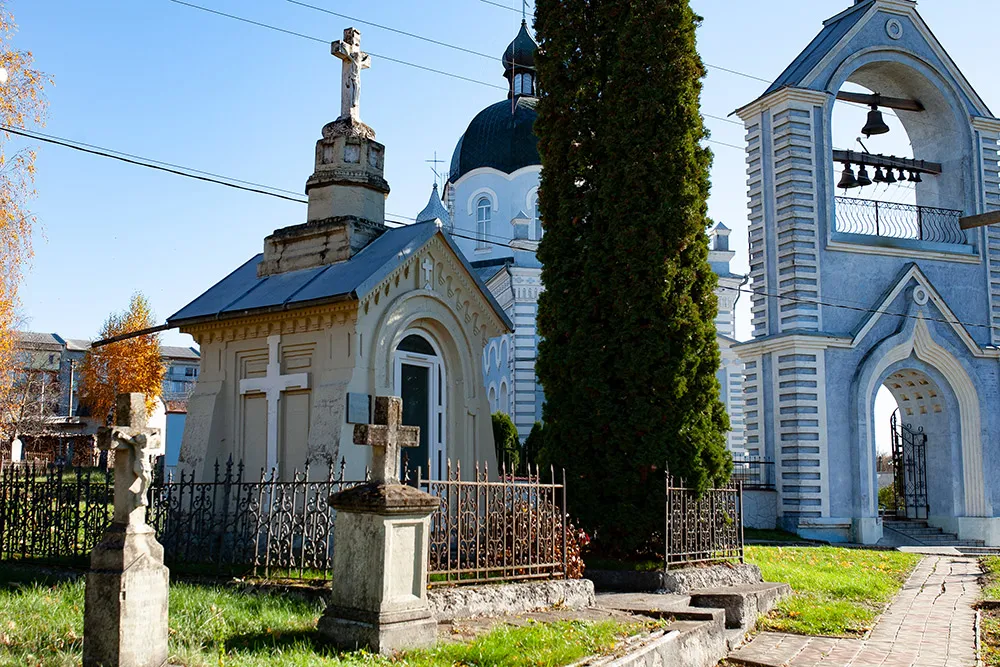
The mausoleum of M. Vynohradskyi
First, chapel-tombs are extremely rare monuments for Khmelnytskyi Oblast. In neighbouring Ternopil region you find them in nearly every third cemetery. Second, such burial vaults are more typical of Roman Catholic (Polish) burials than of Orthodox ones. And, most importantly, it is the only ancient architectural monument in Horodok that has a direct connection to the world-famous microbiologist Serhii Mykolaiovych Vynohradskyi.
Background
For those who are not very interested in science, we recall: it was Serhii Vynohradskyi who in 1887 discovered the process of chemosynthesis, by which some species of bacteria obtain energy (before that scientists knew only photosynthesis).
In the following year, 1898, he was the first to isolate nitrogen-fixing microorganisms.
Chemosynthesis and nitrogen-fixing bacteria are mentioned in the school biology curriculum, so if the reader did not skip lessons too much, they should have heard of this.
Like every sensible person, Serhii Vynohradskyi understood perfectly well what kind of “new world” the Russian Bolsheviks were bringing, so when it became clear that the red madness was serious and long-lasting, he immediately moved to France, where he headed one of the departments of the famous Pasteur Institute. To his beloved Horodok, which until his death Serhii Mykolaiovych considered a “Lost Paradise”, the scientist returned only in 2012. True, already in the form of a monument.
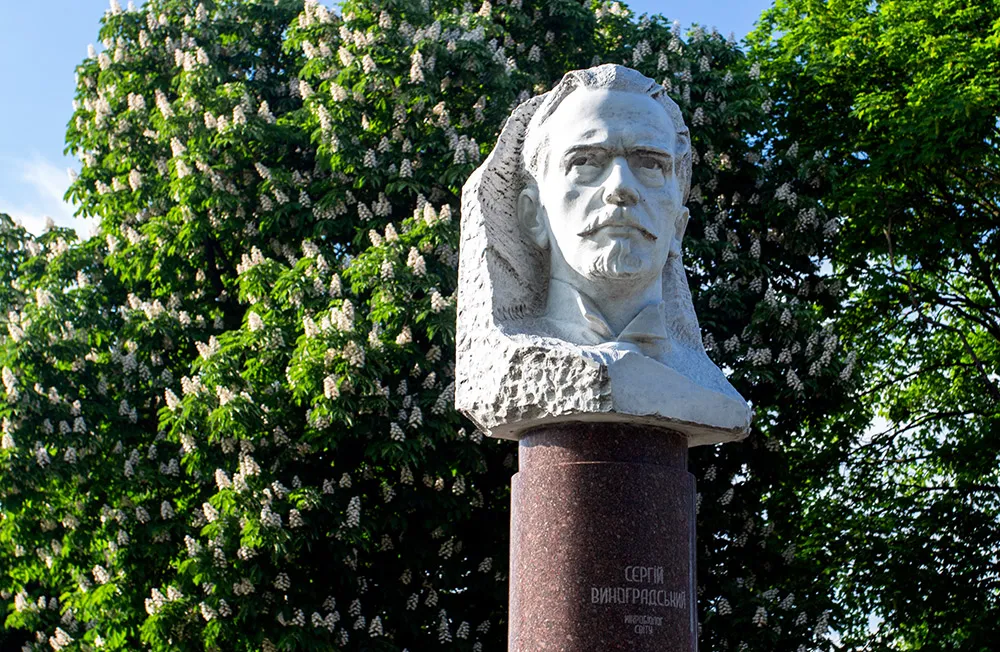
Bust of S. Vynohradskyi in Horodok
The initiator of its installation (who also financed all of it) was Doctor of Medical Sciences, professor and well-known businessman Mykola Humeniuk, a native of the Horodok area. The authors of the monument are Mykola Obeziuk, Honoured Sculptor of Ukraine, and the architect Mykola Bosenko. Mr Humeniuk sincerely regards Serhii Vynohradskyi as his Teacher and thus honoured his memory.
You can learn more about S. Vynohradskyi at the “G-museum” (Horodok)
***
The scientist Serhii Vynohradskyi inherited Horodok and the lands around it after his father’s death. It was he who also erected the above-mentioned mausoleum over his father’s grave. This testifies not only to filial love but also to the aesthetic tastes of the brilliant scientist. The structure, we note, clearly shows that the patron had no small artistic taste and sense of proportion. Which is hardly surprising: he was, after all, an aristocrat, and not some merchant upstart who climbed out of a deep village. As is well known, the latter like kitsch, so long as it is pretty-pretty and costly-rich. Suffice it to recall that the scientist’s mother, Nataliia Skoropadska, came from a respected family that gave Ukraine two hetmans at once: Ivan Skoropadskyi and the head of the Ukrainian State in 1918, Hetman Pavlo Skoropadskyi.
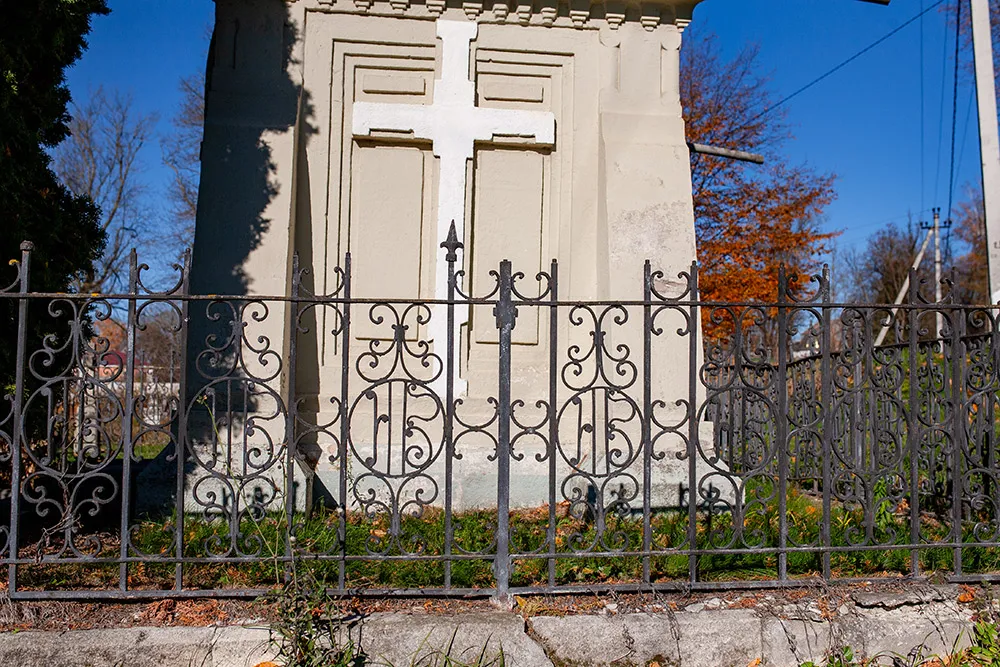
The initials “НВ” on the mausoleum’s fence (Nikolai Vynohradskyi)
It is possible that Serhii Vynohradskyi built the mausoleum as a family burial vault in which he himself planned to find eternal rest one day.
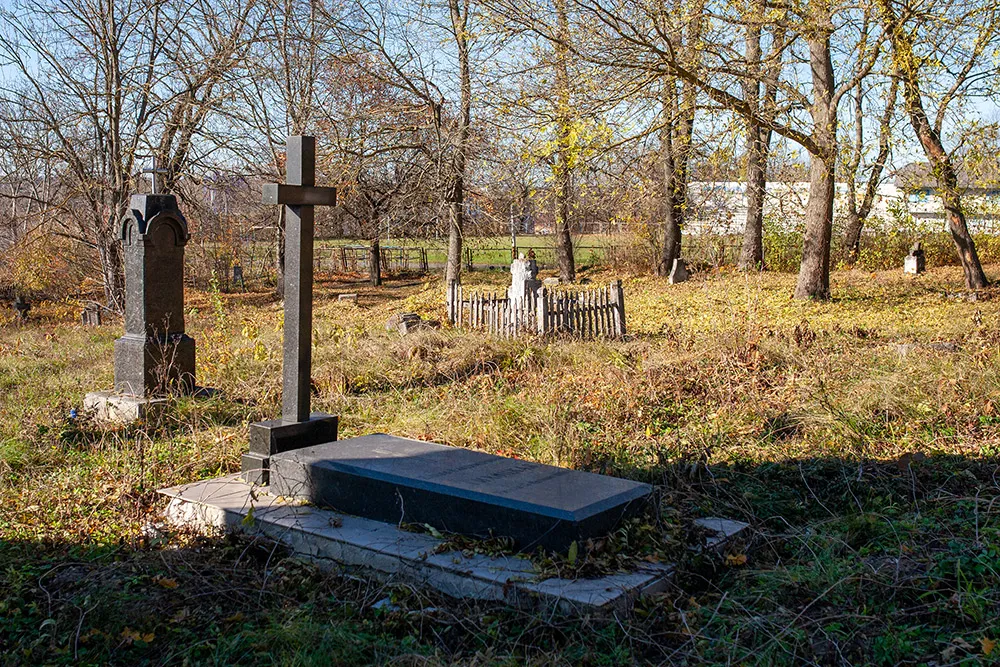
The grave of O. Tykhotska
The mausoleum arose in the most prestigious part of the necropolis, next to the wooden cemetery chapel. Later Olena Tykhotska, the famous scientist’s mother-in-law, was buried nearby.
The numerous and very interesting gravestones on the graves of employees of the “Horodok Sugar Factories Company”, whose main shareholder was the scientist, can also be linked with the name of Serhii Vynohradskyi (there is a lot of interesting material about this factory in the local “G-MUSEUM”).
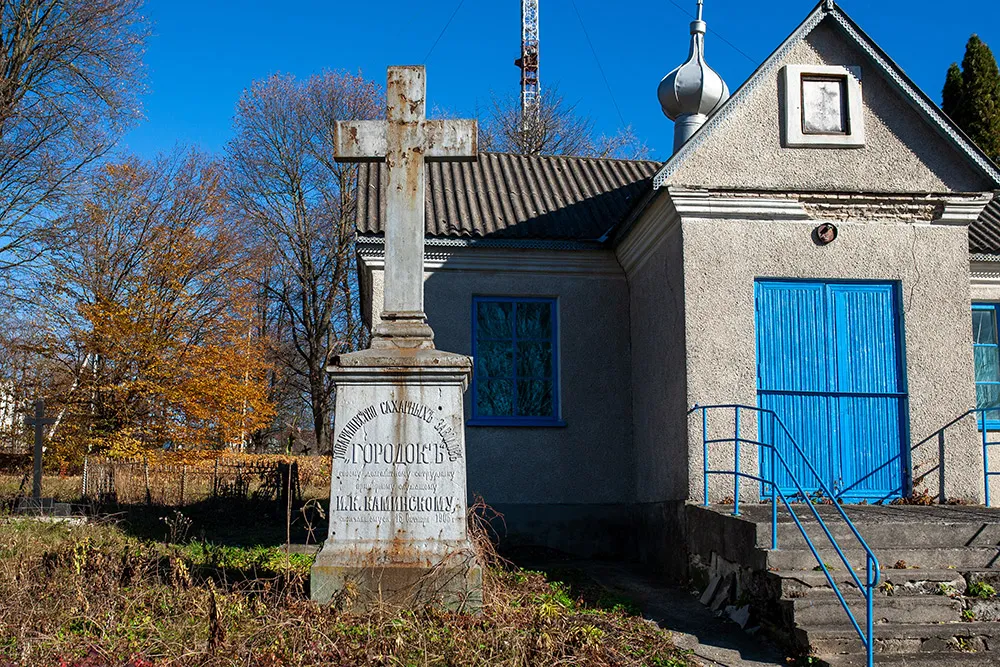
The grave of one of the Company’s employees and a temporary church on the site of the destroyed wooden chapel
The chapel has not survived to our time. It was dismantled sometime in the 1960s (or the 1950s? But that is not important). Only the base of sizeable limestone blocks remained. Probably under that large chapel there were also some crypts with burials. Even in the late 1970s and the very early 1980s the top of an earth-filled, red-brick-faced passage into the cellars was clearly visible.
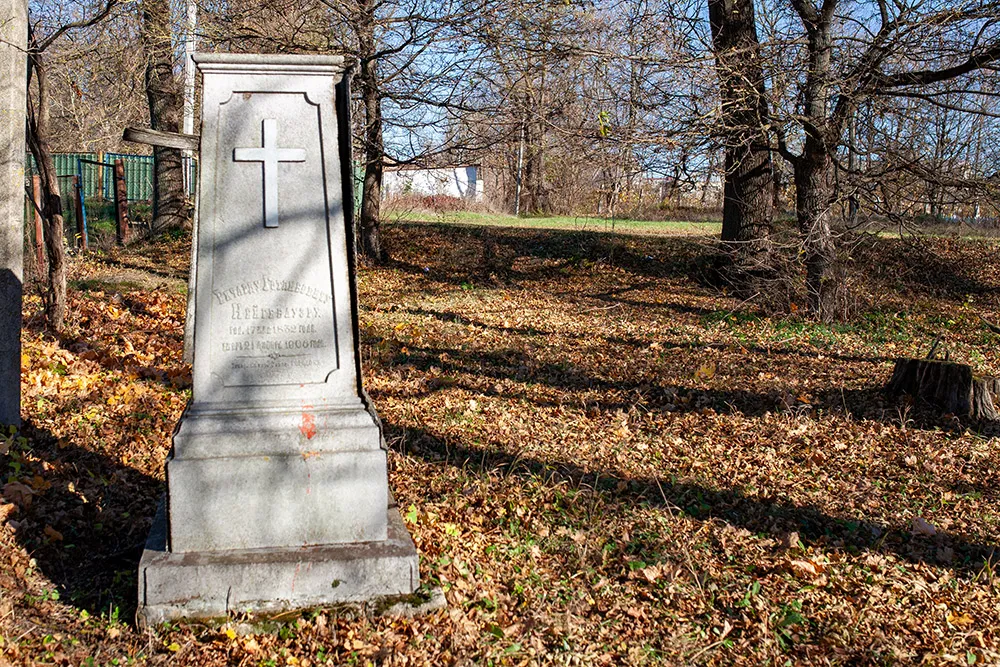
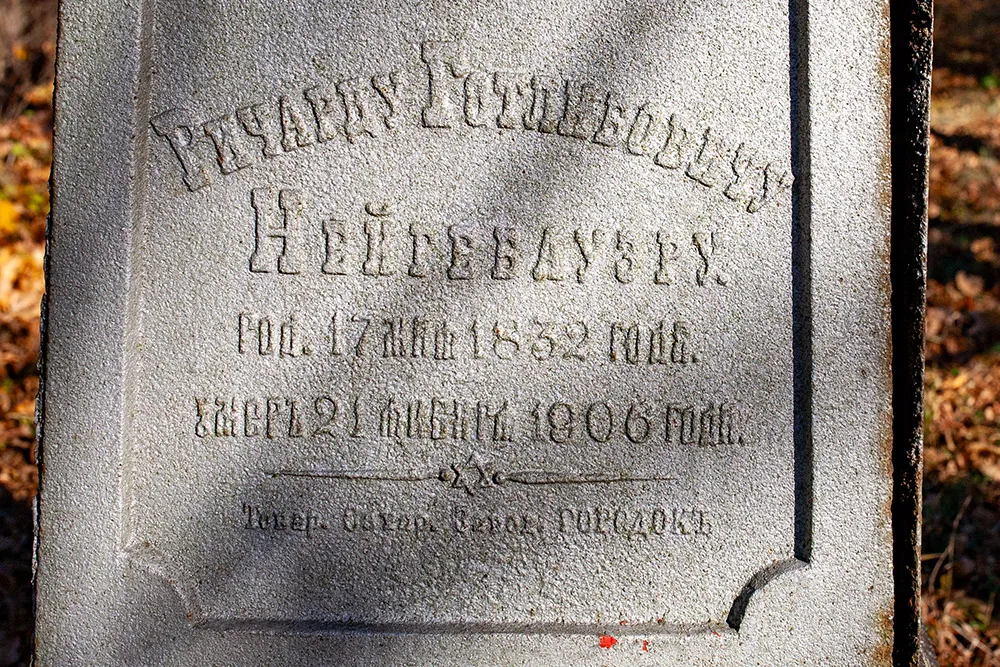
A very unusual gravestone on the grave of an employee of the Company. He was probably buried as a Lutheran German. But the Star of David looks very unexpected here…
It is likely that when the wooden chapel was destroyed, someone was tempted by the valuables that hypothetically might have been in the coffin of a rather wealthy gentleman. The author of these lines remembers well a hastily filled-in pit in the middle of the mausoleum floor (it is possible that there must also be an underground crypt beneath it).
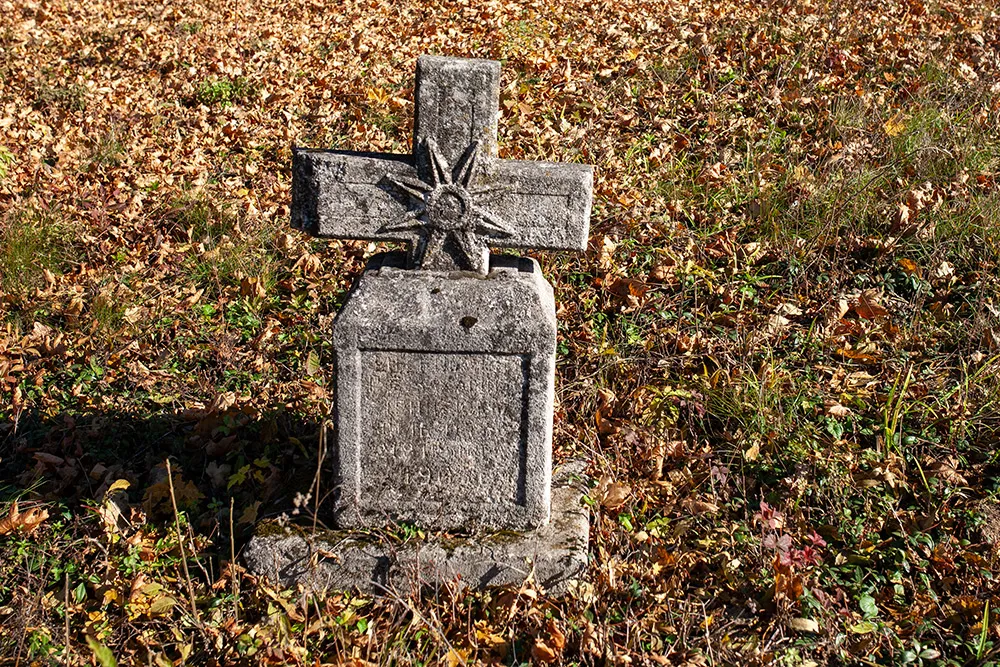
The neglected mausoleum stood among the thickets until the turn of the 1980s and 1990s, when a church of St. Onuphrius began to be built nearby. At that time a temporary church was hastily set up on the masonry base of the wooden cemetery chapel destroyed by the Soviets. Almost simultaneously an attempt was made to put the mausoleum over the scientist’s father’s grave in order as well. On its basis the chapel of St. Nicholas arose.
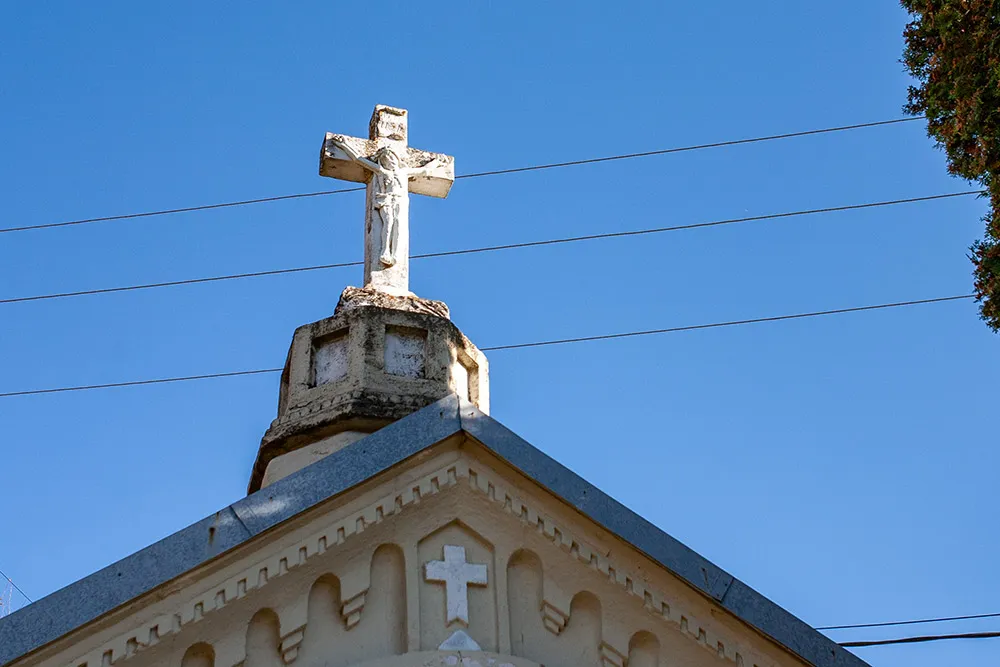
A gravestone instead of the “onion dome”
The word “attempted” is used not without reason. The structure really does look more or less cared for, but to say that its original appearance has been restored would be a huge exaggeration. In particular, for some reason a stone cross with a crucifix, “borrowed” from some old grave, was stuck onto the drum crowning the mausoleum. The glass doors on a white plastic frame look simply awful and out of place.
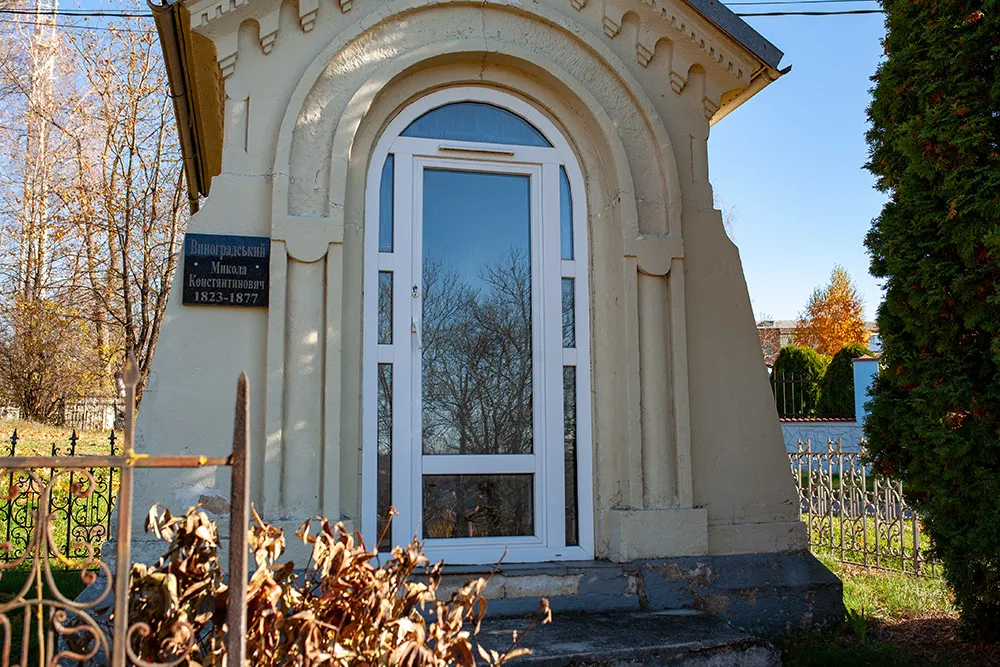
The author of these lines is one of the few old-timers of Horodok who remember what the mausoleum looked like at the beginning. This is one of the vivid memories of my childhood that are etched into my memory for ever.
Every Saturday all the respectable residents of our little town went to the “Great Bazaar”. It was both shopping and “going out among people”. For the youngest it was also a chance to get a sweet caramel rooster on a stick and a clay whistle in the shape of the same bird (or, if you were lucky, a little horse).
The road to the marketplace ran through the old cemetery overgrown with bushes. Gloomy crosses stuck out of the bushes, and it was frightening. As a little boy I clung to my mother’s or grandmother’s hand and looked around fearfully: “what if the Babai (bogeyman) crawls out!” Near the chapel, we note, there was a sort of clearing, so it was sunny there. I remember well the little onion dome on its top with an iron, tilted cross. The rusty sheet metal that covered it had in places already flown off, and the wooden ribs of the frame stuck out. On those ribs sparrows sat in rows and chirped loudly. There were dozens of them. Considering that dry grass showed from behind, there was evidently some kind of sparrow dormitory in that onion dome. More than half a century has passed, but the rusty onion dome with its protruding ribs and the sparrows’ screeching is still preserved in my memory like a bright colour slide.
The onion dome finally collapsed sometime before 1973. At least by 1974 (the author’s first summer school holidays) its fragments were already lying on the ground next to the long-since broken-out wooden door.
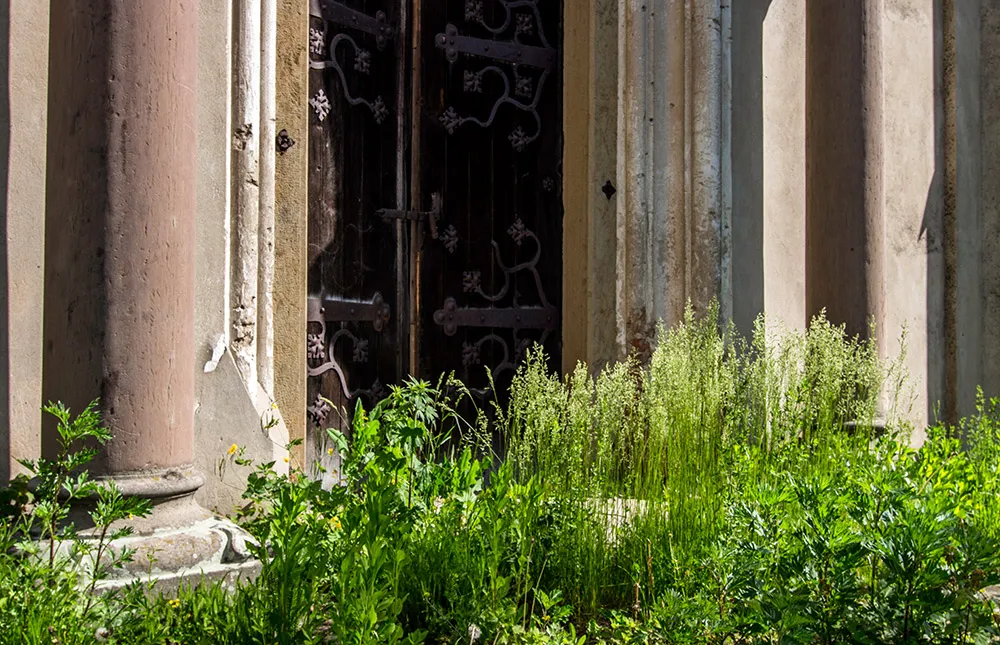
The door looked something like this…
The fate of the very beautiful wrought-iron cross that crowned the mausoleum was also tragic. For a long time it stood leaning against the wall of the tomb. Sometime in the mid-1980s the author (by then a student) saw schoolchildren dragging that cross off for scrap. Older people remember that every Soviet schoolchild had a quota for handing in scrap metal and waste paper. The artefact was confiscated amid a scandal and moved to a shed. Outside, “perestroika”, “glasnost” and even, in places, a spree of “democracy” were by then in full swing. In Horodok there was talk of building a new church. It was for this construction that the relic was planned to be given.
Unfortunately, the cross was fated to be melted down all the same. In the shed, besides coal, firewood and some odds and ends of equipment (a shovel, an axe, a rusty saw), there was nothing valuable, so it was practically never locked. As it turned out, in vain. One of the neighbours carried everything off (even the old skates), and that cross in addition.
It is surprising that no one has so far been concerned about restoring this unique architectural and historical monument of Horodok. And this despite the fact that the project can hardly be called even slightly expensive. In fact, all that is needed is for an architect to draw up a design for the lost onion dome and the cross so that these elements of the structure look appropriate and harmonious. Any graduate of an architecture faculty will cope with this task without problems. Making a wooden frame and covering it with sheet metal is not a problem either (only by no means “gleaming” steel). Forging a new cross is 2–3 days’ work for the Horodok smithy. An ordinary double-leaf door made of boards with artistic metal fittings is not something complicated either.
The monument needs to be restored for a number of reasons:
- It is the oldest sacred building in the town;
- It is the only artistically and architecturally valuable old structure in Horodok that has survived to our time without fatal distortions;
- It is the only historical architectural monument in Horodok directly connected with the world-famous fellow countryman Serhii Vynohradskyi.
As for the last point. It so happened that everything connected with the great scientist was destroyed in the post-revolutionary years. In particular, his house, which arose back in the late 18th century in the time of the then owners of the town, the Zamoyski magnates, was dismantled for stone in the mid-1920s. We have only a few photographs, displayed in the “G-museum”.
The stable, true, stood until the end of the 1970s. The mill, also of the 18th century, on the basis of which the scientist wanted to launch a hydroelectric power station (he even managed to buy the equipment and generators), strangely burned down during the property “showdowns” of the 1990s. Only the remains of the first-floor walls are left of it now.
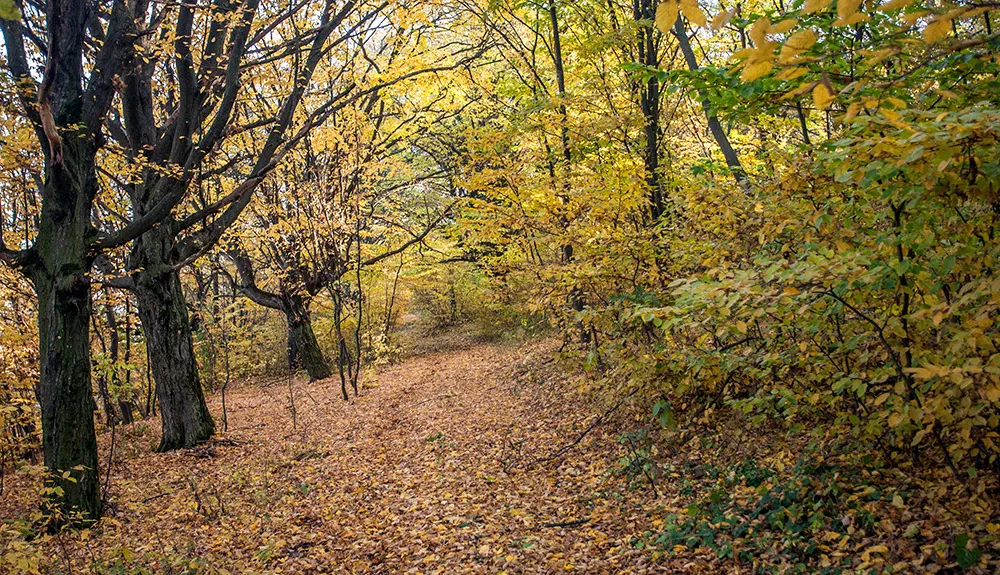
An avenue of the old park
Of the Vynohradskyi estate’s heritage, besides the mausoleum, an ancient overgrown park has also survived. The latter was once assigned to the “aluminium factory”, where spoons and forks were cast and saucepans stamped for Soviet “public catering”. The production was harmful, and the park served so that workers could breathe fresh air there during breaks. The factory “folded” sometime in the late 1980s.
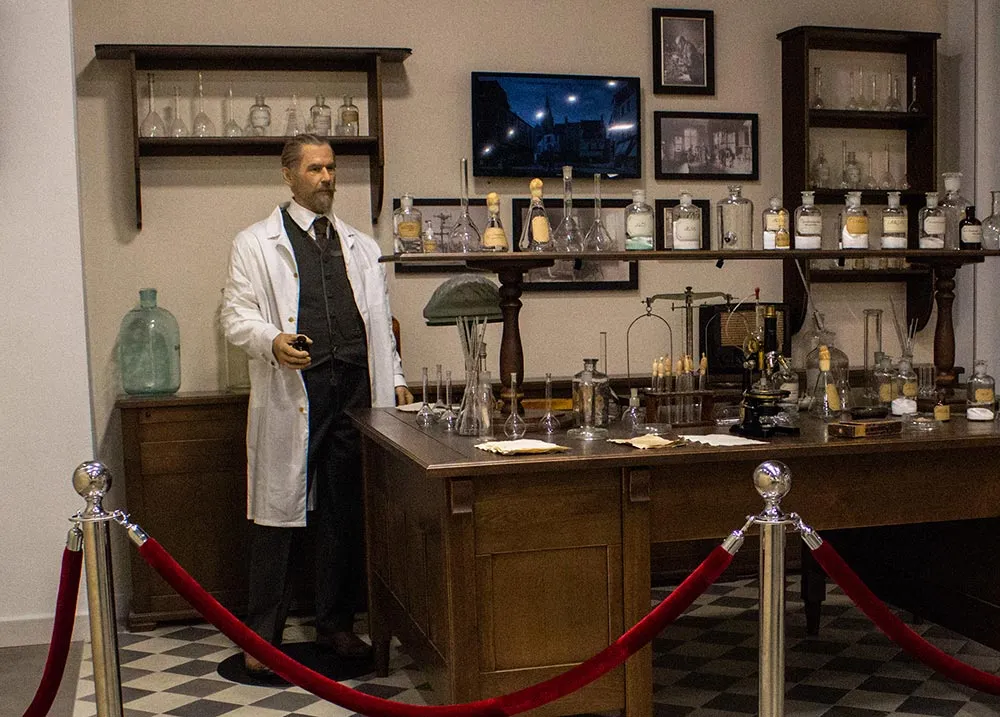
The recreated laboratory of S. Vynohradskyi at the Pasteur Institute and his wax figure. “G-museum”, Horodok
With time the park went wild, though old avenues and enormously thick centuries-old trees can still be seen in those thickets. It would hardly be difficult to return it to its original park state. In Maliivtsi, for instance, the palace park of the Orlovskyi count family was brought from the state of “partisan wilds” to that of an “aristocratic landscape park” in just a few years, by the efforts of volunteers who came to the tolokas from almost all over Ukraine. That park, we note, is three or four times larger than the former park of the Zamoyskis-Geismars-Vynohradskyis in Horodok. True, Maliivtsi has the incomparable Nastia Donets, an activist known across the country, who fires up those around her with her ideas and enthusiasm like a flamethrower. But Nastia deals with real matters, not with travesty and showing off. And of course empty talk without real action about love for Maliivtsi and respect for the Orlovskyi heritage is not for her. She is a person of concrete deeds, not of stupid travesty for the sake of “swagger” and reporting.
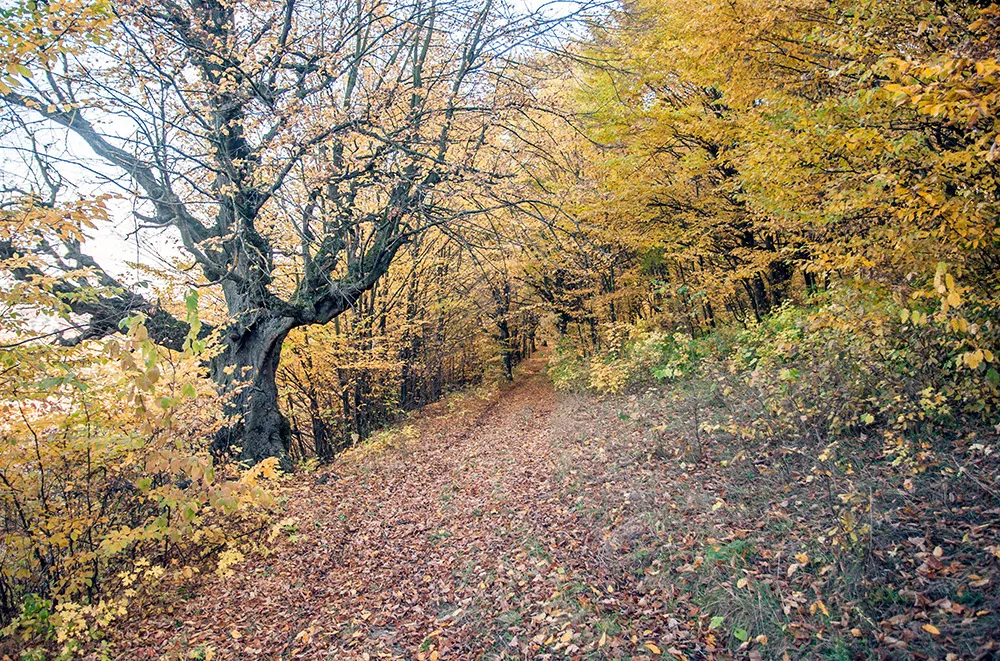
This linden tree may still remember the Zamoyskis
It is a great pity that the park along whose avenues the great scientist once walked is in such a sad state.
Finally, I want to note that putting the material heritage of Serhii Vynohradskyi (the mausoleum and the park) in order is not a question for the town’s leadership. A city hall, especially in wartime, has more urgent tasks. As in the case of Maliivtsi, it would be good for this to become a cause for caring enthusiasts, those who truly, not in empty words but in deed, ache for the fate of our great fellow countryman’s heritage and are concerned about honouring his memory.
Of course, all this can be realised only with the support of patrons. In Maliivtsi, we note, the role of patrons is played by all people who care about the Maliivtsi museum. And there are hundreds of them all over Ukraine. It is they, on the principle of each as much as they can, who finance the numerous Maliivtsi (and not only) projects… And in most cases donating money is combined with helping with one’s own labour at volunteer tolokas. And this gives a visible result…
Text and photos by
Dmytro Poliukhovych


