How the renowned Hetman Petro Konashevych-Sahaidachnyi ruled in Muscovy for half a year, took 14 towns and fought for Ukrainian independence

· 8 min read
Two little-known letters about the feat of Petro Konashevych-Sahaidachnyi, who defeated Muscovy together with the Cossacks.
Yes, we often beat Muscovy before, and we will defeat it this time too.
THE FIRST LETTER
was written from near Moscow by the great Ukrainian hetman himself to Prince Władysław on 24 September 1618.
Petro Konashevych describes the events that preceded the Poles’ request that the Ukrainian army march on Muscovy. He also writes that Skinder Pasha with the Tatars was raiding Ukraine (“Ukraine” is how it is given in the 1618 text). He writes about the difficult conditions of the advance on Muscovy, because the fields are empty and the twenty-thousand-strong Cossack army is having problems with supplies. About the difficulties of river crossings and the many hours of assaults on Muscovite towns.
But, despite all the hardships, he reports numerous Cossack victories, singling out colonels Mykhailo Doroshenko and Bohdan Konsha, the subjugation of Muscovy and firm plans to take Moscow itself.
(The original of the letter is in a Polish archive, and it was published in 1935 by Kazimierz Tyszkowski in “Kozaczyzna w wojnach moskiewskich Zygmunta III: (1605-1618)”. I will give a photocopy in the comments.)
THE SECOND LETTER
is dated 28 December 1618.
Its author is Jacob Spens. He describes the same events near Moscow, but already mentions thirty thousand Cossacks who stood at its gates three months later.
Also about the treachery of Muscovy, which incited the Tatars to attack the lands of Ukraine.
(The original of the letter is in a Swedish archive; it was found by Marina Trattner, the translation was made by Oleksandr Malyshev, and it will be published in our book “Treasures of the Swedish Archives”, which I hope you are all eagerly awaiting ?).
.
How Polish historians assess this expedition:
“During the events described, Sahaidachnyi showed not only leadership and organisational talent but also political talent. One should recall his demands concerning the defence of the Orthodox faith and the property security of the Cossacks during the Moscow expedition, which he secured in June 1618. It should also be noted that, despite his loyalty, he often carried out his intentions with an orientation towards self-reliance or even independence from the Polish authorities, but without provoking open conflict and without allowing treason against the king or the Commonwealth.
Undoubtedly, during the fighting in Muscovy Sahaidachnyi showed enormous command and organisational talent. Thanks to his knowledge of Tatar military art, he carried out swift and effective raids into the remotest regions of the Muscovite state. During the fighting Sahaidachnyi also showed his knowledge of the art of siege, using artillery, ladders, trenches and other stratagems that allowed him to take various fortifications. Nor can we forget the achievements of the Cossack colonels who took part in the Moscow campaign: Doroshenko, Boryspilets, Putyvlets, the Miloszci, Yemets and the Pirskis.
Their joint activity contributed to the enormous success of Sahaidachnyi and the whole Zaporozhian Host. According to P. Sas’s calculations, the Cossacks captured about 14 towns and castles during the Moscow campaign, such as: “Liwny, Jelec, Liebedian, Dankow, Skopin, Riarzsk, Pesoćnja, Sapożok, Szack, Kasimow, Kazar, Buckij, Romanow czy Matijiw Horod”. However, the Cossack campaign was not merely a series of victories. Among other places they defended themselves in Pereslavl Ryazansky, Pronsk, Mikhailov, Zaraysk, Kolomna and Kaluga.
The Cossacks halted at the Arbat Gate and left Moscow itself unconquered, but the devastating activity of Sahaidachnyi’s troops undoubtedly influenced the tsar’s concessions in the negotiations.
Polish and Ukrainian historiography agree that Sahaidachnyi’s participation in the last stage of the “Time of Troubles”, as well as the activity of the Cossacks in the Muscovite state, contributed significantly to the numerous concessions of the Muscovite side. However, I cannot agree with the opinion of some researchers who claim that Sahaidachnyi did not want to take Moscow because of his Orthodox faith. If this had really been the reason, how would one then explain the Cossack killings and plundering of Orthodox inhabitants of the Muscovite state?” writes the historian Kamil Kaczor about these events in his work “Hetman Piotr Konaszewicz-Sahajdaczny. Działalność polityczna i wojskowa w latach 1617-1622”.
.
The reason, in fact, was the miscalculations of the high command of the army of the Commonwealth, which did not allow the matter to be completed. Just as the Poles did not keep the guarantees promised before the war, which the Cossacks made a condition of their participation to the Commonwealth. And this is not so much about a deserved reward for victory and for the Cossacks’ rescue of the crown army, but more about the rights and liberties, the independence of the Ukrainian Church, and so on.
But Hetman Petro Konashevych-Sahaidachnyi returned to Kyiv a victor.
He took the cause of independence into his own hands. He donated enormous sums for the development of the Kyiv Brotherhood School, which would later become the Mohyla Academy.
He went with the Cossacks to Perekop and took revenge for the Tatar attack on Ukrainian lands instigated by Muscovy.
And in 1620 he made the most weighty claim to independence of all:
“In 1620 the ‘Cossack question’ became topical again. This time the cause of the crown’s concern was the secret consecration in Kyiv of an Orthodox hierarchy ‘under the cover of the Cossack sabre’. The restoration of the Orthodox church hierarchy of the Kyiv Metropolis by Patriarch Theophanes of Jerusalem struck directly at the interests of the Polish king,” states N. Bilous in “Between politics and everyday life: from the history of the relations of Crown Hetman Stanisław Żółkiewski with the Voivode of Kyiv Tomasz Zamoyski (in the light of the 1619–1620 correspondence)”.
And a year later, in 1621, Petro Sahaidachnyi wrote his name in golden letters in the history of Europe when he saved it with the Cossack army at Khotyn from the Ottoman invasion. Ukraine celebrated the 400th anniversary of this momentous event in the autumn, about which I made several posts.
.
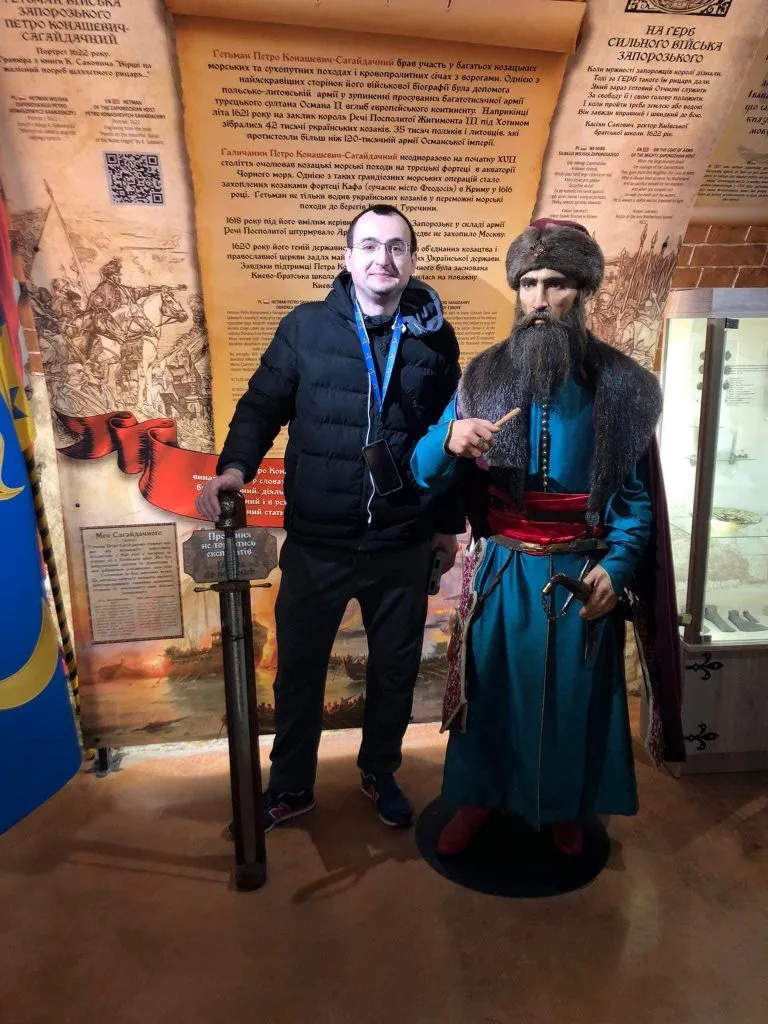
For this feat he received a commemorative antique sword inlaid with gold and diamonds. It bears an inscription in Latin: “To Władysław Konashevych, kosh otaman at Khotyn against Osman”. It is a symbol of high honour and recognition of the merits of the Ukrainian Cossacks in the struggle against the Muscovites and the Turks, and recognition of their knightly status by the royal courts of Europe.
I am holding a replica of this sword in the photo.
Its makers are the couple Yevheniia and Dmytro Eider, who made it for a museum in Lviv.
And in the near future the original of this sword will come to Ukraine and be exhibited for all who wish to see it.
In commemoration of one of the main heroes of Ukrainian history, 400 years since the death of the noble Cossack knight Petro Konashevych-Sahaidachnyi.
As was written in the “VERSES ON THE MOURNFUL FUNERAL OF THE NOBLE KNIGHT PETRO KONASHEVYCH-SAHAIDACHNYI”, published immediately after his death in 1622:
“When kings learned the courage of the Zaporozhians,
they recognised such a knight as their coat of arms.
He was always ready to serve the fatherland
and to lay down his head for its freedom.
And if need be, he would go by land and by water,
skilled in everything and swift in battle.”
“He was always a zealot of the piety of the faith,
from his youth a learned guardian of it.
In the year one thousand six hundred twenty-two
he lay down in the Brotherhood Monastery, in holy Kyiv.
Several thousand he offered to the brethren,
wishing a foundation of learning to exist there.”
“For the fatherland they stood up mightily
and cared nothing for their own health.
He himself preferred, like Codrus, that king in Athens,
to fall so that the fatherland might remain saved.
For it is better to lay down one’s head for the fatherland
than to submit shamefully and fall on one’s knees.
So whoever does not want to die for his land
will in time perish with the fatherland.”
“He went into the glorious Zaporozhian knighthood.
And living there among them no small time,
always diligently guarding the knightly cause,
he achieved that the host elected him hetman,
and bravely with it he defeated Tatars and Turks.
In his hetmanship he took the city of Kafa —
the Turkish emperor felt no small fear there!”
“How those knights mowed them down like grass.
And the northern land too will remember
his knighthood for long, for through them he made himself known!
There he showed no small valour as he went,
ravaging their strongholds, towns and cities.”
“You have earned immortal glory, our hetman,
no, it surely will not fall into oblivion!
As long as the Dniester and the Dnipro flow rich in fish,
so long all your deeds will glorious fly.
You will not fall into the faceless depth of oblivion,
you will not perish in the years: you have eternal glory!
For as Greece praises Nestor the hero,
Achilles, Ajax, and Troy praises Hector,
and the Athenians praise King Pericles,
honouring also the renowned Themistocles,
Rome praises its bold Curtius
and extols Pompey, fortunate in battle,
so let Sahaidachnyi among the Rus’ receive glory,
let them rightfully enter that name into eternal memory,
so that all may know his martial feats,
so that peoples may always honour that name!”
“Whoever reads the writings about the Zaporozhian Host
will involuntarily acknowledge their courage and glory,
for there were always such knights here
who bravely defeated the enemies of the fatherland,
so there is no knighthood more glorious in the world
than the Zaporozhian Host, which terrifies the foe!”
We are waiting for the original sword of P. Sahaidachnyi in Kyiv, where our renowned hetman is buried!
Author: Ihor Poluiektov
The beginning: how Ukrainians ran Moscow in 1604–1610.