

The riddle of the “masons’ marks” of the Strusiv church
The village of Strusiv, near Terebovlia, is one of the tourist “magnets” of the Ternopil region. It attracts numerous travellers with its historical monuments and landscapes. And no wonder: for many years running Strusiv has been near the top of the prestigious ranking of the 10 most beautiful villages in Ukraine. The main architectural landmark of the village is the soaring spire of the Church of St. Anthony and Our Lady of the Holy Rosary. It was built from 1892 to 1906 at the expense of the lord of Strusiv, Count Volodymyr Baworowski, and later, probably, of Józef Hołuchowski, to whom Strusiv, together with the new building, subsequently passed.
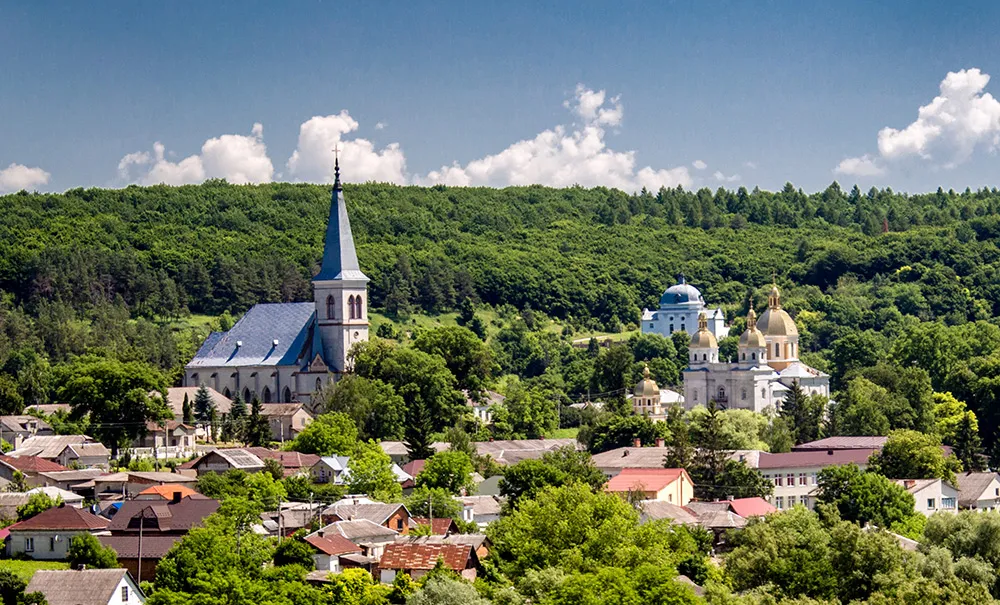
The church was built in the Neo-Gothic style, with a leaning towards minimalism. Accordingly, there are no overly interesting decorative elements. Even so, as a whole the church impresses with its grandeur and its soaring thrust toward the sky. Indeed, any architectural flourishes here would have been completely out of place and would have spoilt the integrity of the design. That is, it was meant to be this way, not because of a lack of funds or of craftsmen.
Note that at that time Strusiv was a centre of the stone-carving trade, and local craftsmen supplied sacred figures for churches and cemeteries to roughly half of Galicia. So there would have been no problem at all in decorating the church with a dozen or so sculptures.
The main architectural element of the church’s artistic expression is its spire, said to be the tallest in the Ternopil Oblast. The impression is strengthened by the fact that the church itself stands on a sizeable hill, which visually adds even more to its height.
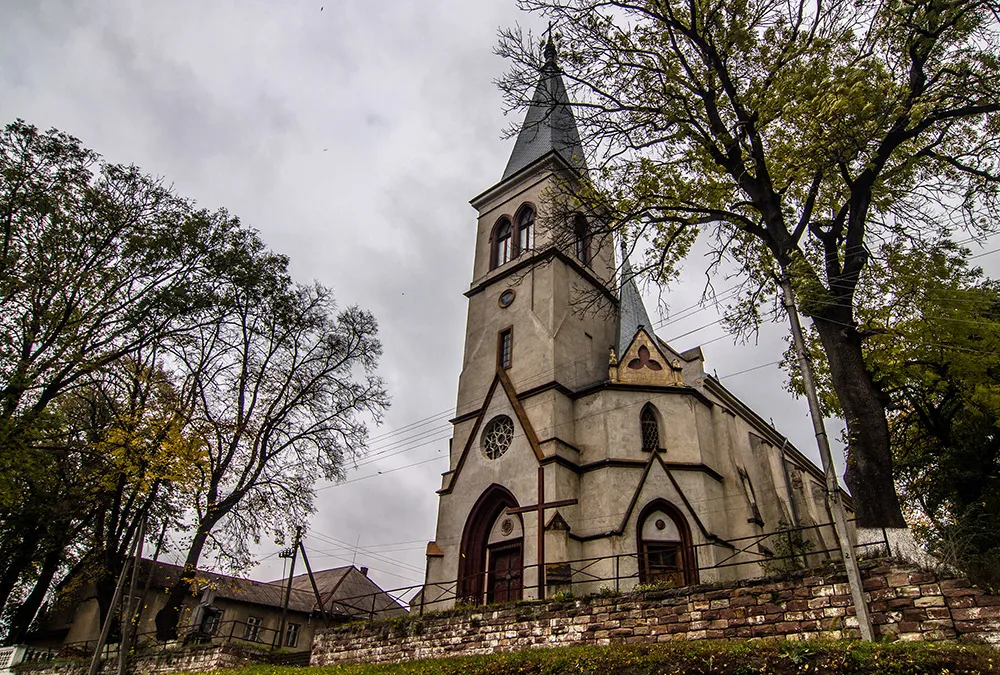
Given the relatively young age of the Strusiv church and its rather ordinary history, this sacred building could not, by definition, hide any riddles at all.
But every rule has its exceptions.
Little crosses, runes and a Crimean Tatar tamga
Arthur Conan Doyle once put into the mouth of his famous literary hero the thought: “If you want to hide something, put it in the most conspicuous place!”
In recent decades thousands of tourists and dozens of historians and local historians of varying degrees of obsession have visited the Church of St. Anthony and Our Lady of the Holy Rosary in Strusiv. Incidentally, the author of these lines has been here about ten times himself. And every time he walked past the Great Riddle at a distance of about a metre (or even less) and did not notice it! Although that confounded Riddle was all but waving its arms and shouting: “Here I am! Come on, look! Right in front of you!..”
But no… When the author learned WHAT he had failed to notice, he nearly bit his elbows. It was a consolation that he was not alone. Quite a few proud researchers did not notice it either. Though that is cold comfort.
But the Riddle was finally seen by a local historian, head of the tourism and local-history clubs at the Mykulyntsi Centre for Children and Youth and a teacher at the Myshkovychi Lyceum, Andrii Kapusta. The settlement of Mykulyntsi, once a small town, we should note, lies only a few kilometres from Strusiv.
Mr Andrii is quite well known in local-history circles not only in the Ternopil region but in Ukraine as a whole. The author of these lines got to know him through a shared interest in studying the monuments of the Terebovlia area.
So which Riddle are we talking about?
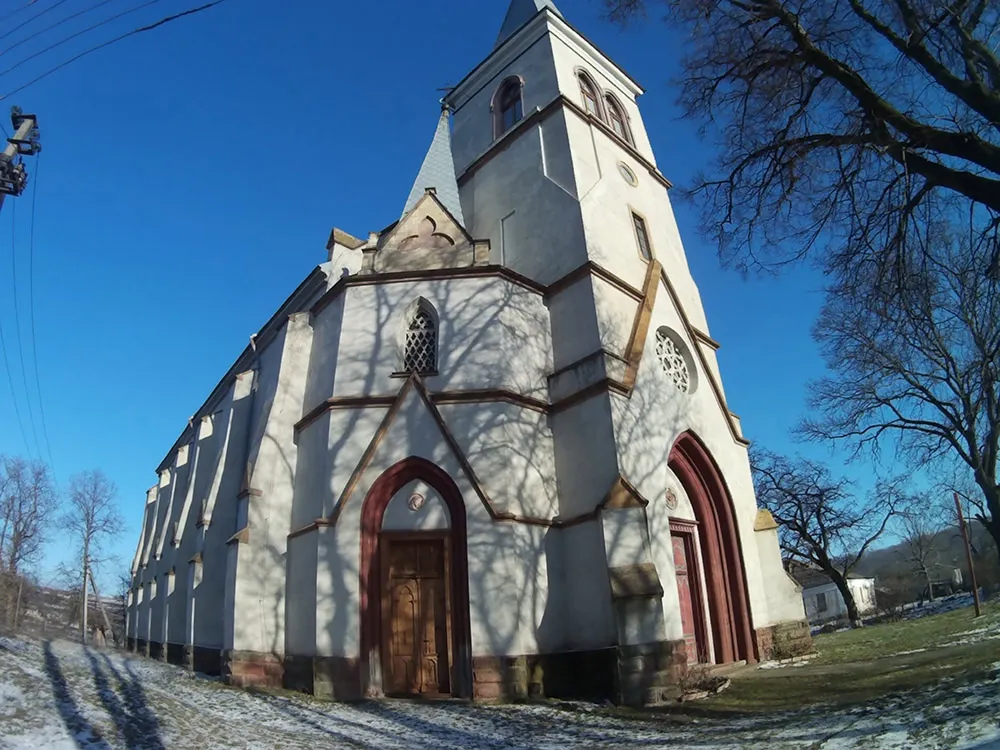
It turned out that the stones of the lower “belt” of the church are adorned with mysterious signs. Photo: Wikipedia
One of the structural elements of the church and, at the same time, an element of its decoration is its base, made of 3-4 rows of large blocks of red Terebovlia sandstone. It turned out that almost 40% of these blocks bear mysterious marks (up to about 10 cm high). The marks vary, from Roman numerals and Latin letters to crosses and incomprehensible squiggles. Indeed! Among them there turned out to be even several marks in the form of a Crimean Tatar tamga and variations on it, and even something resembling ancient Germanic runes. In particular, an exact reproduction of the famous “algiz” rune (the rune of life).
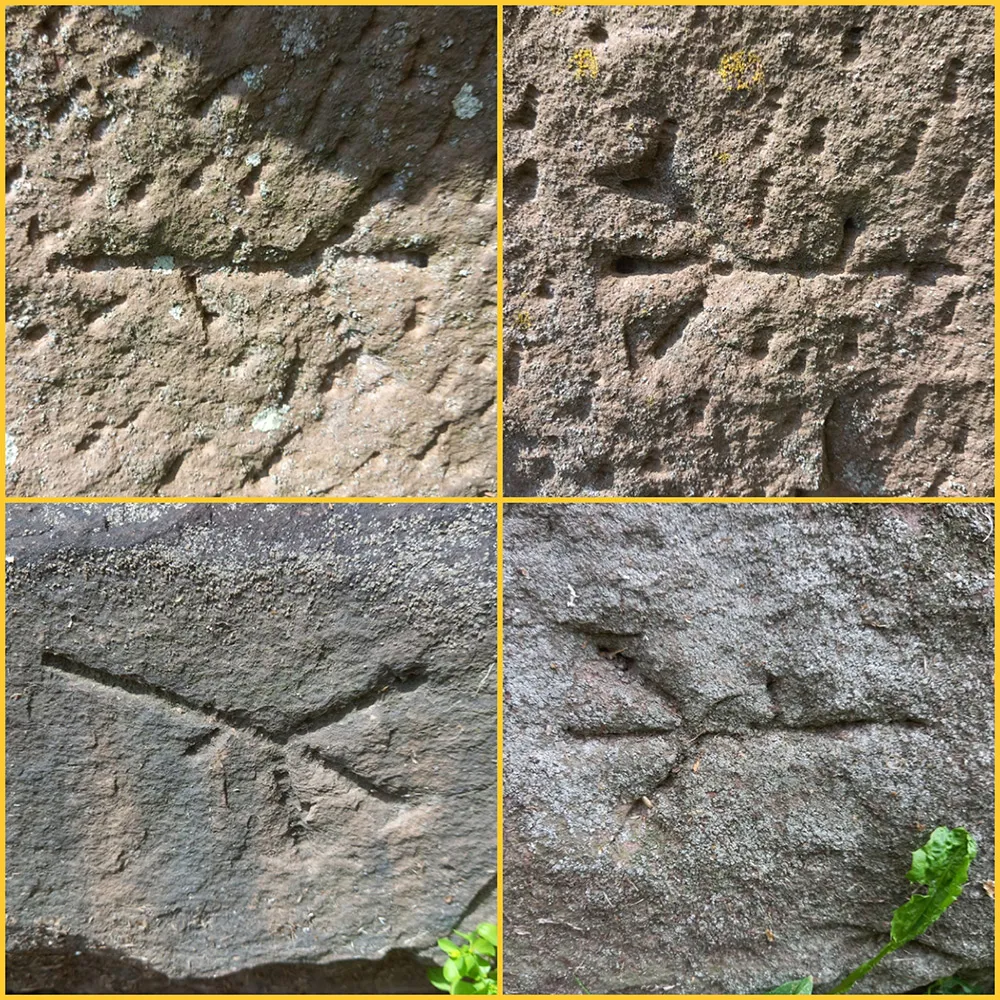
Marks resembling the “algiz” rune. Photo: Andrii Kapusta
Mr Andrii knew well that the author of these lines had in his time found and studied a number of similar graffiti and petroglyphs, so he immediately sent photographs of the finds and asked for a consultation: “What could all this mean?” He also turned for help to a number of other local historians and scholars.
The author first lamented: “Why! Why didn’t I notice it first!?” but then immediately sent the photos to historian acquaintances in Ukraine, Poland, Germany and, just in case, Israel.
Answers came almost immediately, but all boiled down to one thing: “Never come across anything like it. No idea.” Only the well-known archaeologist from Kamianets-Podilskyi, Candidate of Historical Sciences Pavlo Nechytailo, remarked: “I haven’t come across anything similar in Ukraine, nor any mention of such things. But it seems Western European researchers have described similar monuments. I’ll look…”
We had to work out the riddle on our own.
A trace of a ruined castle or an Arian church?
The original discoverer of the Strusiv riddle, Andrii Kapusta, immediately noticed that a considerable part of the signs are shown upside down or “lying” on their side. From this he drew the quite logical conclusion that they appeared on the sandstone blocks before the church was built. Accordingly, he put forward the hypothesis that these stones had earlier been part of some other structure. The author of these lines also considered this version quite probable, especially as the secondary use of stone from older buildings has a fine tradition in Strusiv.
Under the Strus family (16th-17th centuries), who gave the settlement its name, a masonry castle was built in the Chortova Debra tract (on the left bank of the Seret). Little is known about this stronghold. In particular, we know that in 1648 it was captured by Bohdan Khmelnytskyi’s Cossacks. The castle then suffered considerable destruction. A few months later the Tatars finally finished the stronghold off. They also looted and burned the town. The remains of the castle stood until the end of the 18th century (there is vague evidence that they stood even until the mid-19th century), until they were dismantled for building materials. A fairly common practice, we should note.
According to a popular version, the stronghold was used as a “donor” of building material by the town’s then owners, the Lanckoroński family (who bought Strusiv in 1780), who put the castle stone into the construction of a palace. Though this is unlikely, since the main part of the latter is built of brick.
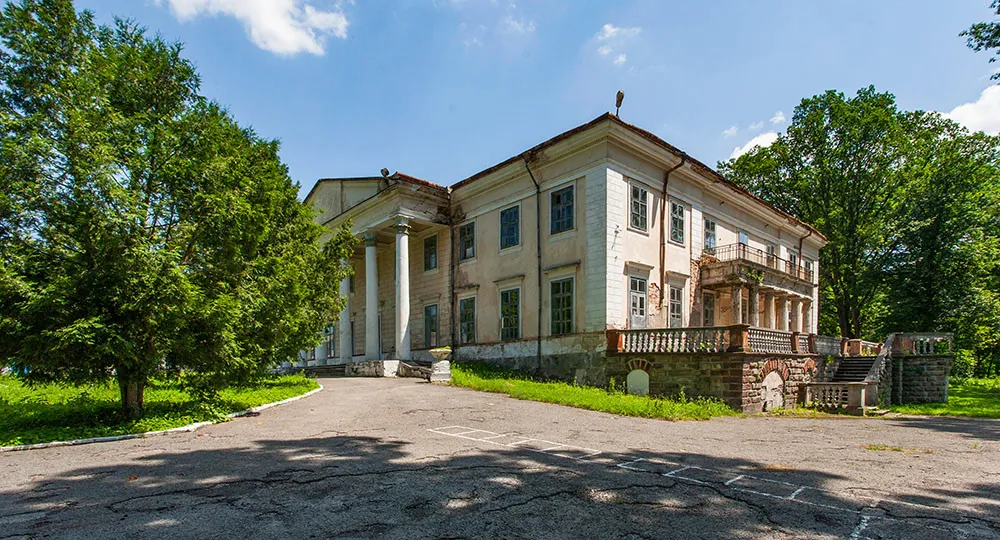
The palace in Strusiv. Photo: Ukraine Incognita
One can assume that in the 18th century the stronghold was not completely dismantled and some part of it remained. It went later into the building of the church.
Incidentally, the above-mentioned Tatar destruction of the castle could explain the image of the tamga.
Here the imagination at once obligingly painted an epic picture of some blood-stained Akhmat or Abdullah, in token of triumph over the infidels after a battle, scratching the sign of his khan on the walls of the conquered stronghold…
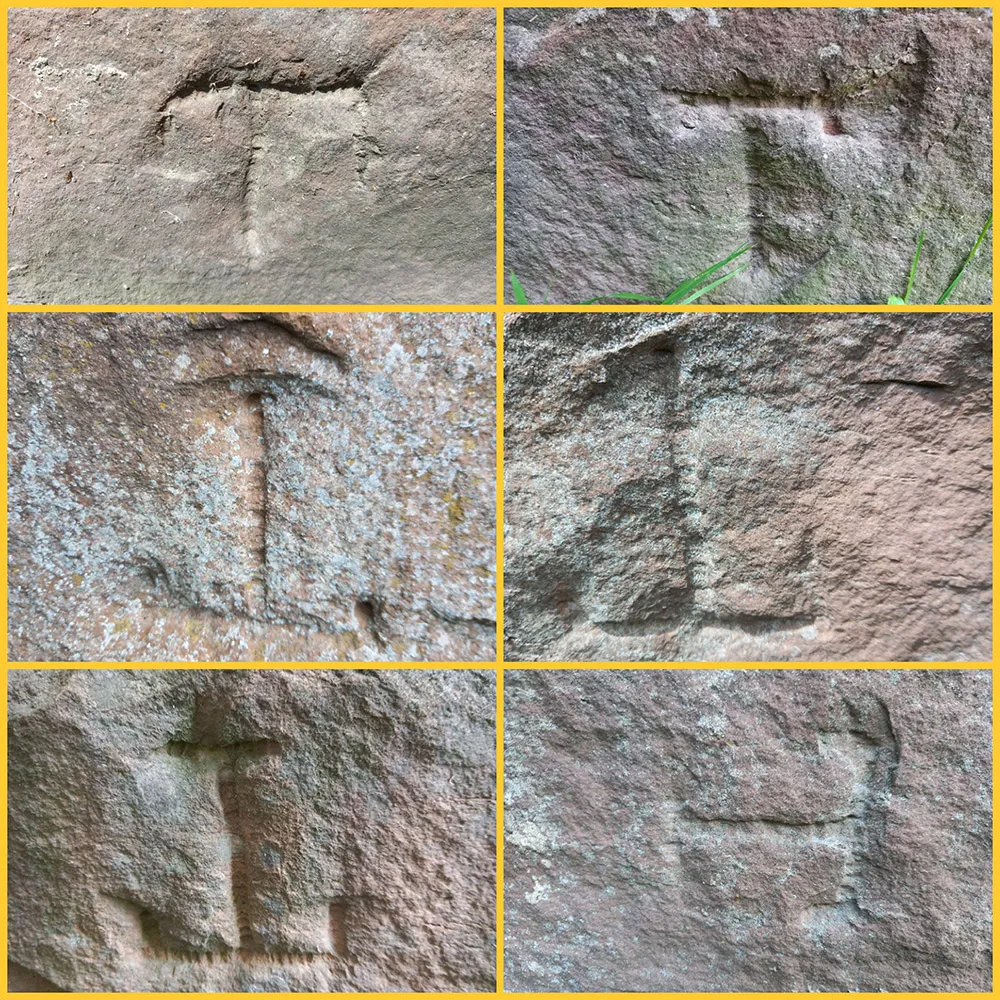
Marks resembling a tamga. Photo: Andrii Kapusta
True, this fog had to be shaken out of one’s head at once. For the sign could equally well be an entirely Christian “Anchor of Salvation” or “Boat of Salvation” (also known as the “Cradle of Christ”). As already noted, the marks were often placed upside down, so in this case saying which is the top and which the bottom is like reading coffee grounds.
Andrii Kapusta also put forward a version that these marks are somehow connected with the Arians. In particular, that as late as the 19th century there were remains of some Arian church or chapel in Strusiv, which was even mentioned by the Austrian-Galician historian, local historian and ethnographer Antoni Schneider. The Stefanyk Lviv Scientific Library holds, in particular, a whole archive of his manuscripts, one of which deals with the town’s old monuments and says that there are: “the ruins of an Arian shrine, traces of caves and catacombs of the old Basilian monastery, and burial mounds in the forest”…
This too is not such a fantastic version and has a right to exist.
However, the author of these lines was bothered by the repetitive marks. While the crosses and little crosses were clear (pilgrims traditionally scratched such to strengthen their prayers), numerous marks such as “FxY”, for example, did not fit anything sacred. But as the marks of craftsmen supplying stone for the construction, they fit perfectly. This last version proved the most probable.
Andrii Kapusta, who is also a collector of brick stamps, likewise considers this version the most probable, because quite clear parallels could be traced.
“Masons’ marks”
Large-scale finds of stonemasons’ signs had not previously been encountered in Ukraine. At least the numerous scholars with whom both Mr Kapusta and the author consulted had not heard of them. By contrast, in Western Europe there are many studies of such marks. Here we should thank the archaeologist Pavlo Nechytailo for providing foreign publications on the subject.
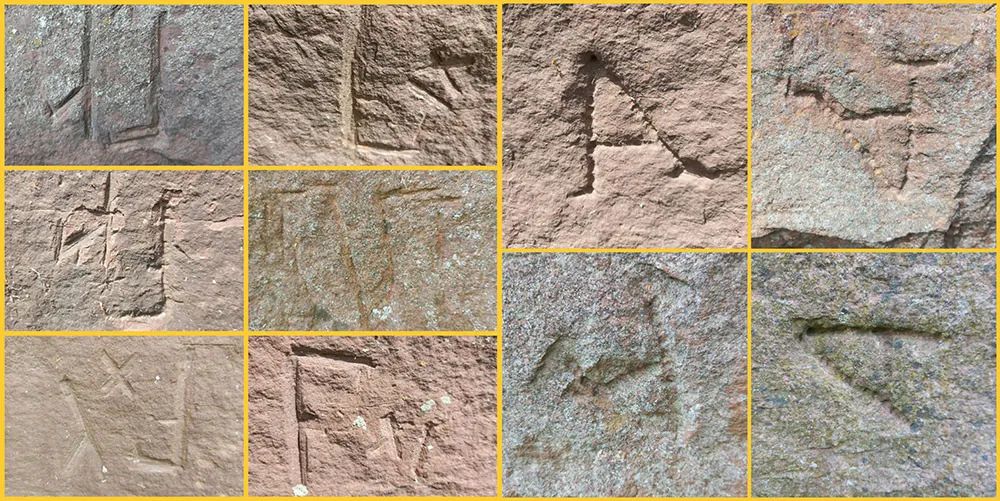
Photo: Andrii Kapusta
Given the Western parallels, in this case we are indeed dealing with “masons’ marks”, that is, stonemasons’ signs or stamps known from deep antiquity. We stress that the term “masons’ marks” has nothing to do with secret societies: here “masons” are simply stonemasons, as distinct from “freemasons”, who usually had nothing to do with building work.
A “mason’s mark” is a symbol carved on the surface of a stone item or a fragment of finished masonry. These “marks” served to ensure payment for labour and, at the same time, as a form of quality control. Considering that in Strusiv we see many inverted “marks”, in this case they pointed solely to the producers of the building blocks, not to the bricklayers who set them.
Incidentally, in complex works there are also “positioning marks”, that is, marks on blocks that allow an element of the structure to be set precisely in the right place. But this does not apply to Strusiv.
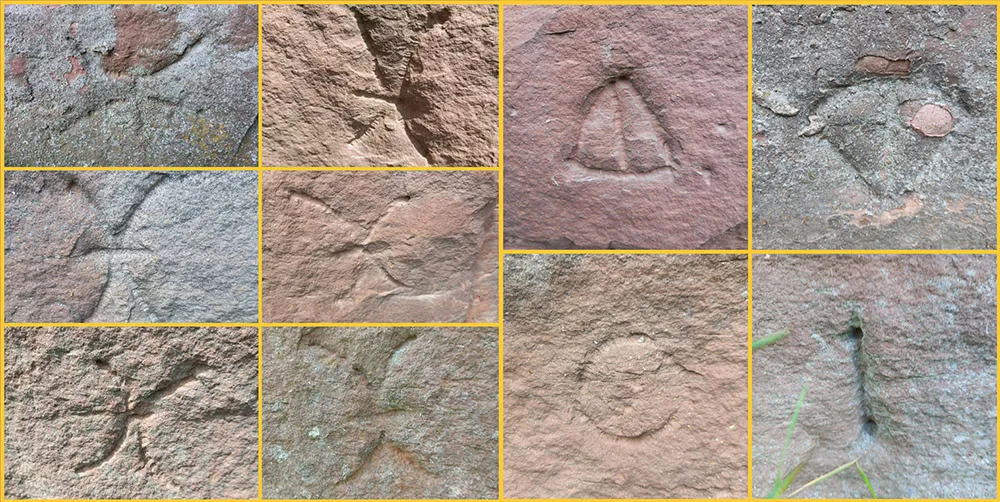
Photo: Andrii Kapusta
We were struck by the large-scale study provided by Pavlo Nechytailo, by researchers of the University of Glasgow, Wallace and Iain Ross (2020), “Leaving a mark on history. The stonemasons’ marks of selected medieval ecclesiastical and secular buildings of central and southern Scotland”.
In their work the authors studied several hundred medieval “masons’ marks” from various historical monuments of Scotland.
What VERY much surprised us was that quite a few marks dating from the 12th-13th centuries are either identical or very similar to marks left by Strusiv craftsmen at the turn of the 19th and 20th centuries!
Unfortunately, the work mentioned has a very strict copyright, so the summary tables with drawings of the “masons’ marks” of medieval Scottish craftsmen cannot be shown; readers will have to take our word for it.
Summing up
The “masons’ marks” on the Strusiv church are a phenomenon unique for Ukraine. Indeed, perhaps even unique for Europe, since the tradition of such “marks” is now disappearing.
In all, the discoverer, Andrii Kapusta, managed to find more than a hundred marks, 7 to 10 cm in size (some 5-6 cm), on the three rows of stone blocks on which the church building stands (measuring 115×30 cm, 100×30 cm, 75×30 cm and 50×30 cm).
All the marks are repeated: some twice or four times, most dozens of times. By grouping similar signs, one can conclude that they were left by the hands of at least 16 people.
The discoverer of the Strusiv “masons’ marks” carried out their preliminary classification.
In particular, there are Roman numerals (XI, X, IX, XL), with and without a frame.
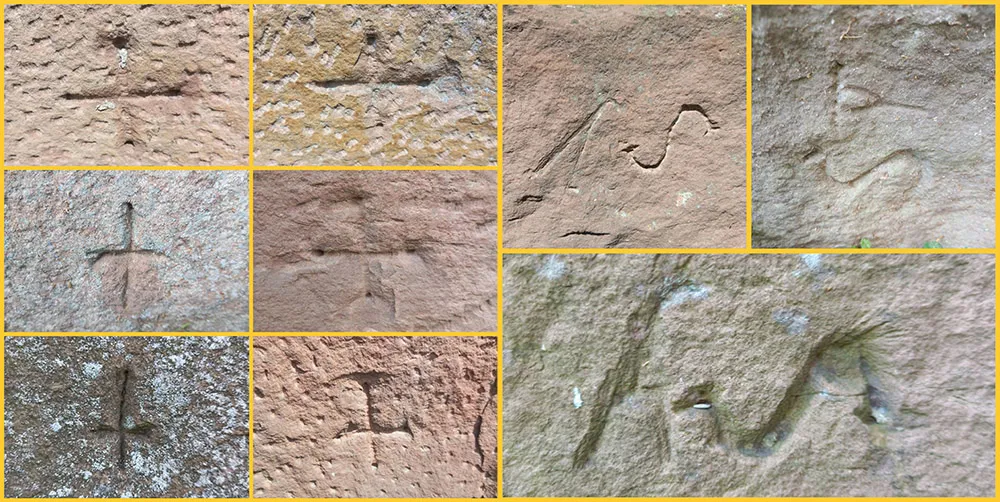
Another group of signs consists of letter marks (A, K, F… including ones turned upside down) and signs that resemble letter symbols.
The next group of marks resembles heraldic signs or tamgas, perhaps runes.
Finally, signs of various shapes that are hard to identify stand out as a separate group.
Mr Andrii also paid attention to the technique used to apply the signs.
In particular, as the researcher found, most were made by a percussion technique using a chisel (each separate blow left one hollow in the stone). These signs consist of many individual pits. A small number of signs were made by cutting a continuous linear groove into the body of the stone. In his opinion it appears that some (if not all) of the signs were applied before the foundation was laid, since identical ones are often turned over.
The appearance of the marks can be explained as follows. Strusiv, as already noted, was a well-known centre of stone working, and on its outskirts there was a sizeable quarry. However, all that production fell under the definition of a “trade” (promysel). That is, these were small family workshops where local men (or small artels) made sacred figures, gravestones and building components (door and window frames, cornices, gutters, steps and so on).
One family or small-artel workshop could quite well supply the necessary materials for the construction of a house or a medium-sized villa. But the building of a huge church was another matter. Accordingly, a considerable number of small producers worked on the order. The marks were needed for two reasons: accounting for payment and, at the same time, quality control.
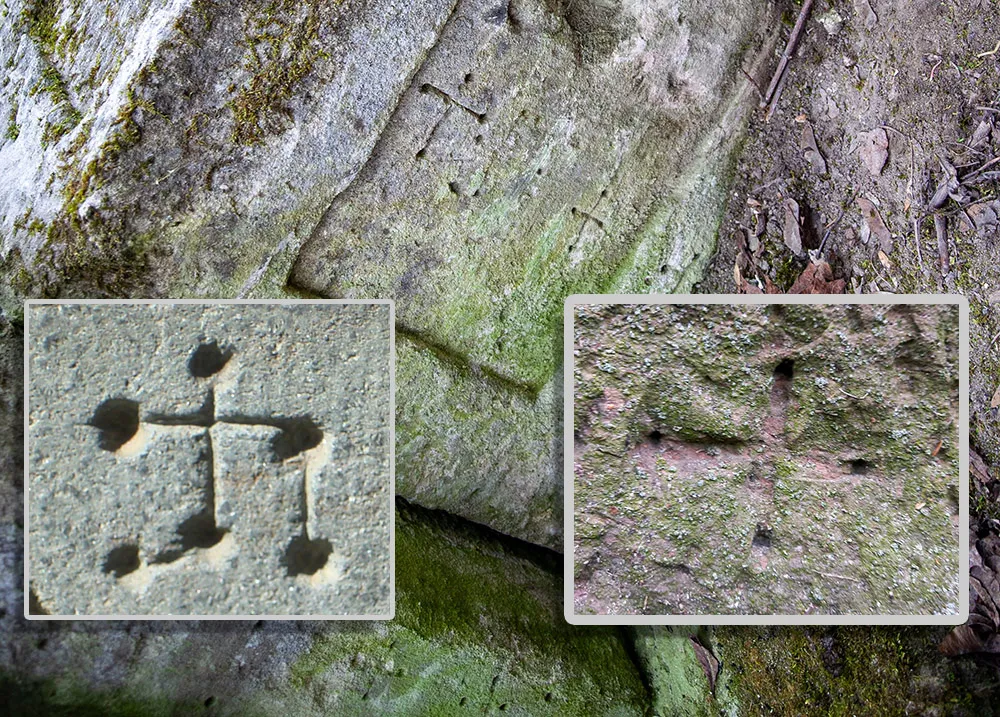
On the left, a cross with pits from Nidaros Cathedral in Trondheim; on the right, from Strusiv; at the top, from Andriivka
It is worth singling out several signs in the form of crosses with dot-like pits at the ends. A similar cross (14th century) from Nidaros Cathedral in Trondheim (Norway) is even the main illustration of the English-language Wikipedia article on “masons’ marks”. But the author is inclined to think that in this case such crosses are not only a craftsman’s sign. In particular, this same year, within the “Graves of the Ancestors” project, a joint initiative of the NGO Ukraine Incognita and the Department of Culture, Ethnic Groups and Religions of the Horodok City Council, a ruined pedestal of some unidentified sacred figure dated 1704 was found in the village of Andriivka, its whole surface covered with similar “four-dot” little crosses. The researchers counted almost three dozen. Such little crosses were applied by pilgrims in especially venerated places to strengthen their prayer. The four dots-holes, we note, are the wounds of Christ left by the nails.
It should be remembered that church builders regarded the building process not as an ordinary construction routine but also as a way of showing reverence to God. It is possible that the stonemasons who cut these blocks thereby dedicated them to the Lord or strengthened their prayer to Him in this way.
As for the discovery itself, scholars should work on it, because this publication is largely amateur. In particular, a full cataloguing needs to be done: which types of “marks” there are, in what quantity, what the proportions are, and so on.
This would, among other things, make it possible to establish how many craftsmen worked in Strusiv and the surrounding villages and the capacity of their production. And so on… It could also help in determining the origin of sacred figures in churches, chapels and cemeteries of the Ternopil region. The author, in particular, has often come across something similar on the back of the bases of cemetery sculptures, but somehow did not pay it any attention.
Publication by Ukraine Incognita team member Dmytro Poliukhovych.
First published in Polish in “Kurier Galicyjski”


