

Zinkiv. The road to the Church and perhaps the most beautiful wooden church in Ukraine I have seen

· 6 min read
The village (once a small town) of Zinkiv in the Khmelnytskyi region is famous across Ukraine for its renowned sausage. But we will leave that to the gastronomic bloggers, all the more so as the author never got to taste this delicious bounty (here we sadly wipe a meagre manly tear from an unshaven cheek). Buying the famous delicacy, sold in almost every house on the town’s main street, was put off until later. And later, as it turned out, everything had been sold. A pity… I should have started with the sausage. All the more so because exploring Zinkiv’s curiosities with a piece of sausage clutched in your fist is much more pleasant than without.
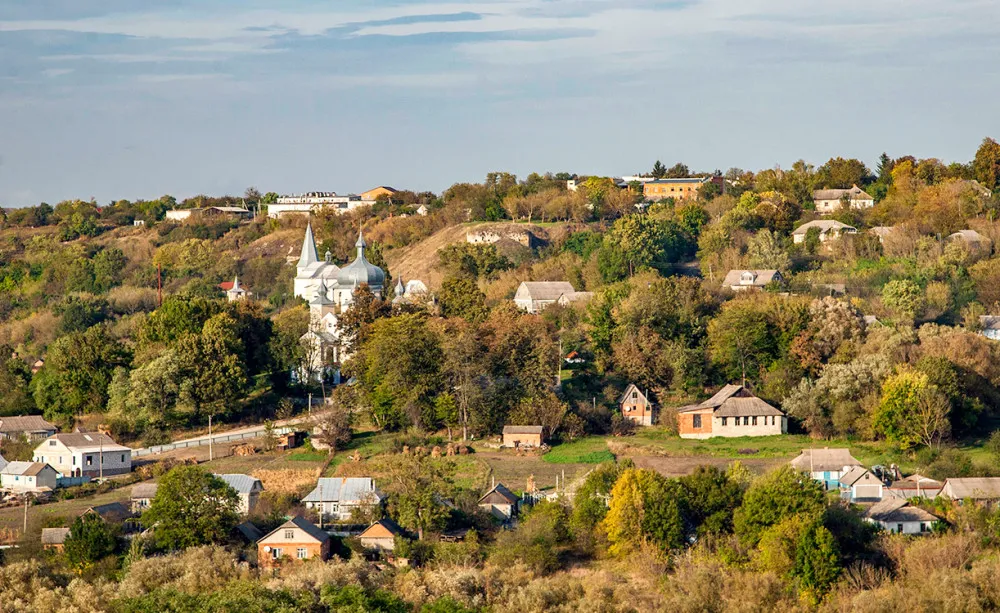
Zinkiv
Today Zinkiv has a rather low status of a village. Once, however, it was not just a respectable town (first mentioned in 1494) but a kind of capital of Podillia. Here stood the main residence of the uncrowned kings of the region, the Sieniawski magnates, an ancient Ruthenian (Ukrainian) but Catholicised family. The holdings of these “krulyeks” (that is, kinglets) could be envied by an average Western European monarch, especially one from the mini-states of then-fragmented Germany. What these “states” were like is clear from the fairy tale “Cinderella”, in which a prince, searching for a beautiful stranger, ordered every girl in the kingdom to try on the crystal slipper. Had such a silly idea occurred to one of the Sieniawskis, the fitting would have dragged on for years. It is worth recalling that the magnates owned such notable towns as Mykulyntsi, Kopychyntsi, Medzhybizh, Stara Syniava, Satanii and others. Not to mention numerous villages.
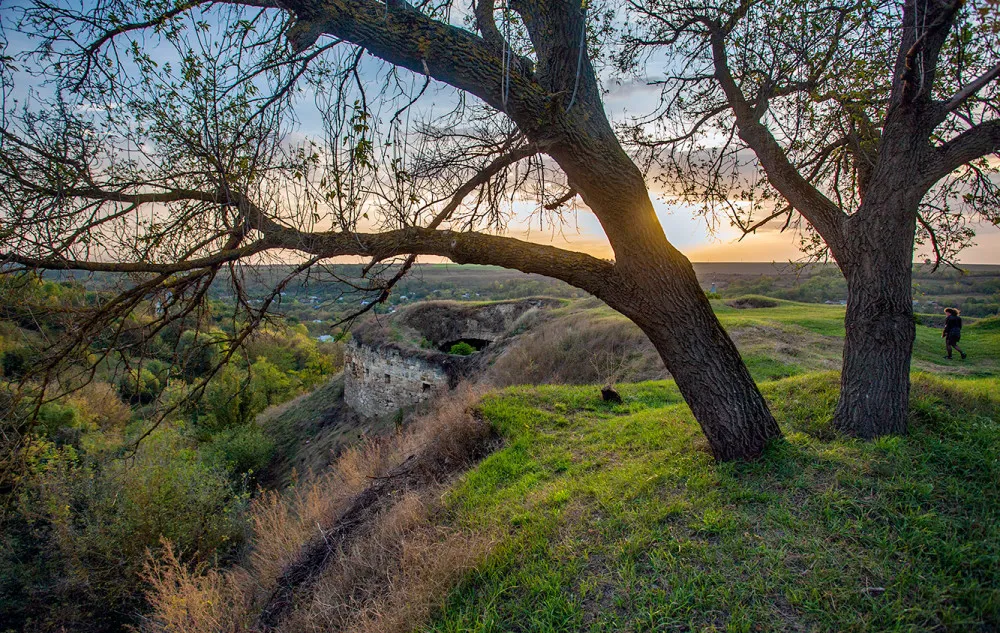
The castle
Of the magnates’ legacy in Zinkiv, only the pitiful remains of a once-majestic castle survive (thrifty Podillians took the fortress apart for stone back in the late 19th century), together with the Church of the Holy Trinity, beneath the castle hill. Today the church is only a pale shadow of its former self. Under the communists it was wholeheartedly wrecked with all proletarian fury. There were neither craftsmen nor funds to rebuild it as it used to be. The budget of a small Roman Catholic community is far from the means of the church’s founder, Adam Mikołaj Sieniawski, one of the richest magnates of the Polish–Lithuanian Commonwealth.
Zinkiv is quite an interesting town, and there is much to tell, but of all its “raisins” the one that touched my soul most is its wooden “Cossack” church.
The author of these lines has been lucky enough to gawk at several dozen different wooden churches. Unfortunately, most of what I saw turned out to be utterly ruined by tasteless makeovers. Those who have travelled a lot know what I mean: plastic siding, “shiny tin” and other prettifications devoid of the slightest aesthetics and taste. All this ugliness is justified by a categorical postulate so beloved in the UGCC: “A church is not a museum! The church is ours, we do what we want, and you, smart alecks, have no say in it!”
If a church has escaped the sad fate of “tinning”, the impression is usually spoiled by the landscape around it. For some reason believers are sacredly convinced that an ancient wooden church is best suited by a sun-baked yard paved with cement paving stones, cheap plaster angels stuck in wherever possible, and statues of the Virgin Mary decorated with faded plastic Chinese garlands (necessarily under a gazebo with a dome gleaming with titanium nitride coating). All this glitter, shine and splendour hurts the eyes and tears at the brain.
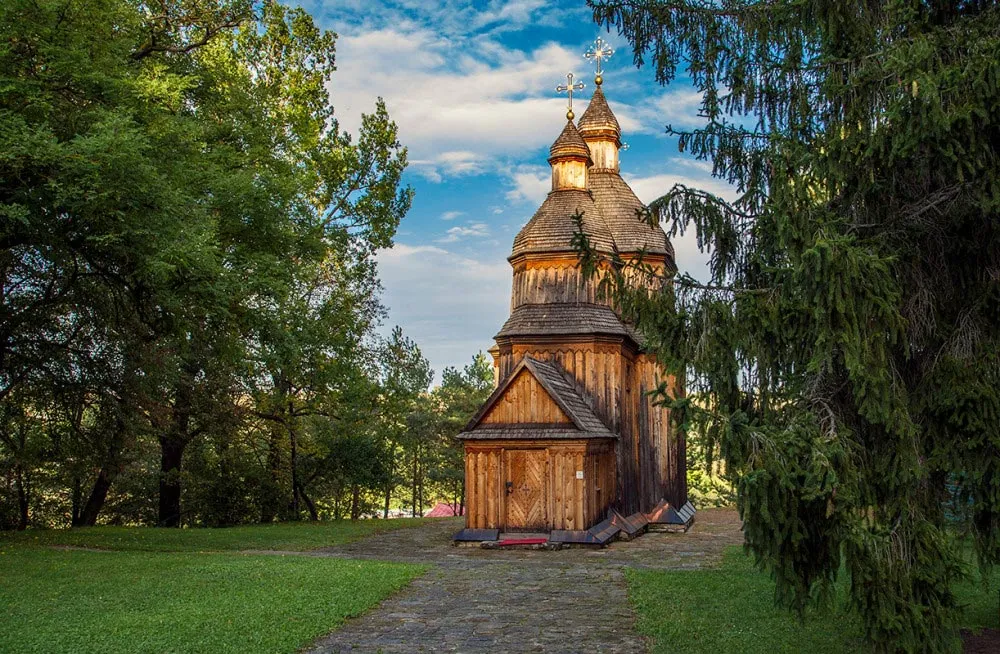
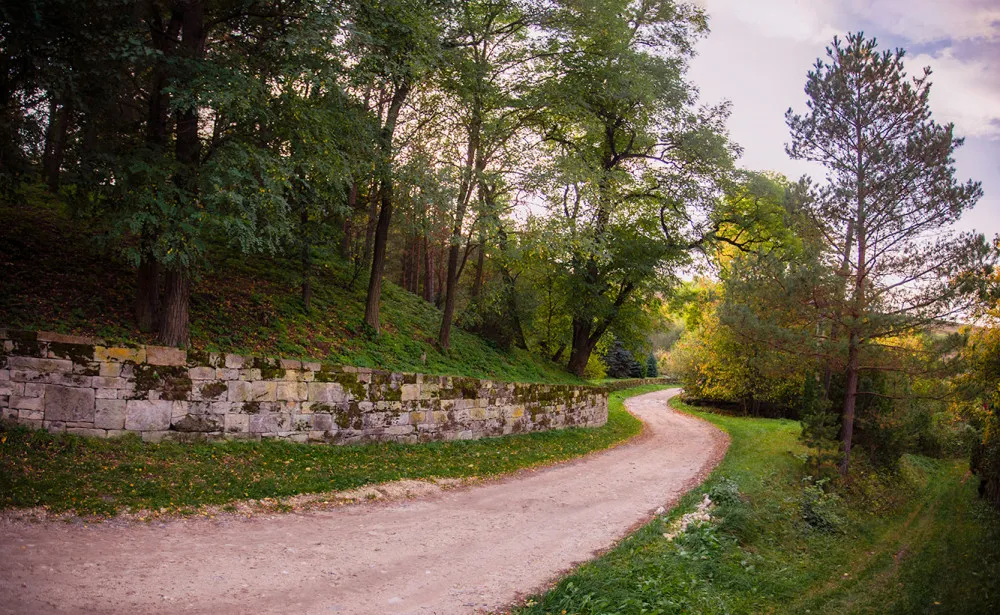
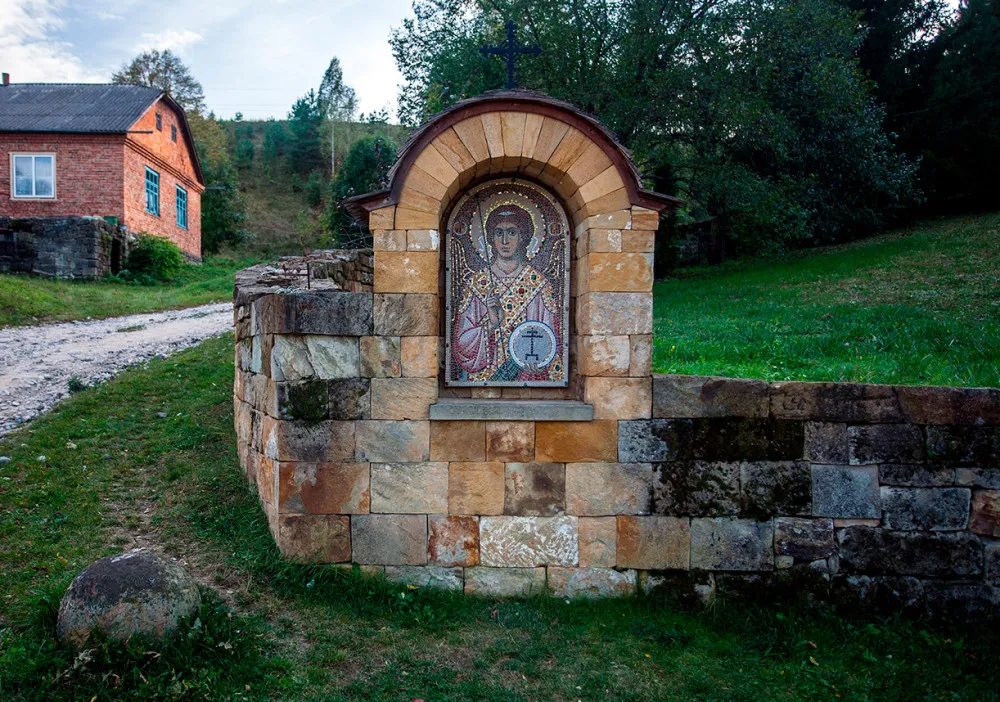
That in Zinkiv everything would be quite different became clear already on the approach to the Church (for some reason I want to write this word here exclusively with a capital letter) of St. Michael the Archangel, which was built back in 1769. In fact, it was in Zinkiv, in all my years of travelling, that I first saw and felt what a true Road to the Church is. The winding road is lined on both sides by “fosy”, as low stone fences and retaining walls are called in Zinkiv. True, the roadside church “fosy” are built of hewn blocks rather than ordinary rubble stone. It is possible that these blocks once stood in the castle walls. Between the road and the “fosy” is neatly mown grass. It is certainly not an English lawn, but it is tidy and free of the usual burdocks and other weeds.
Legends link the building of the Church with the Cossacks, which is reflected in its popular name, the “Cossack Church”. According to one version, it was allegedly built by Cossacks who once settled in Zinkiv. According to another, the church arose on the site of a mass grave of Cossacks who fell in battles near the castle. However, the last fighting near Zinkiv in which Cossacks took part dates only from the time of Verlan’s uprising (1734–1738). It is unlikely that the fallen men’s comrades would have begun building a memorial church only three decades later. In terms of timing, the Koliivshchyna (1768–1769) fits. But historians know of no battles at all from the time of that uprising near Zinkiv, let alone ones involving Cossacks.
In reality, it is an ordinary parish church built at the community’s expense. In the 19th century a small enclosed porch with a roof proportionate to the whole building was added to the babynets (women’s section of the nave). Also, around the turn of the 19th and 20th centuries, the domes were covered with tin. The church was re-roofed, again with tin, sometime in the 1990s.
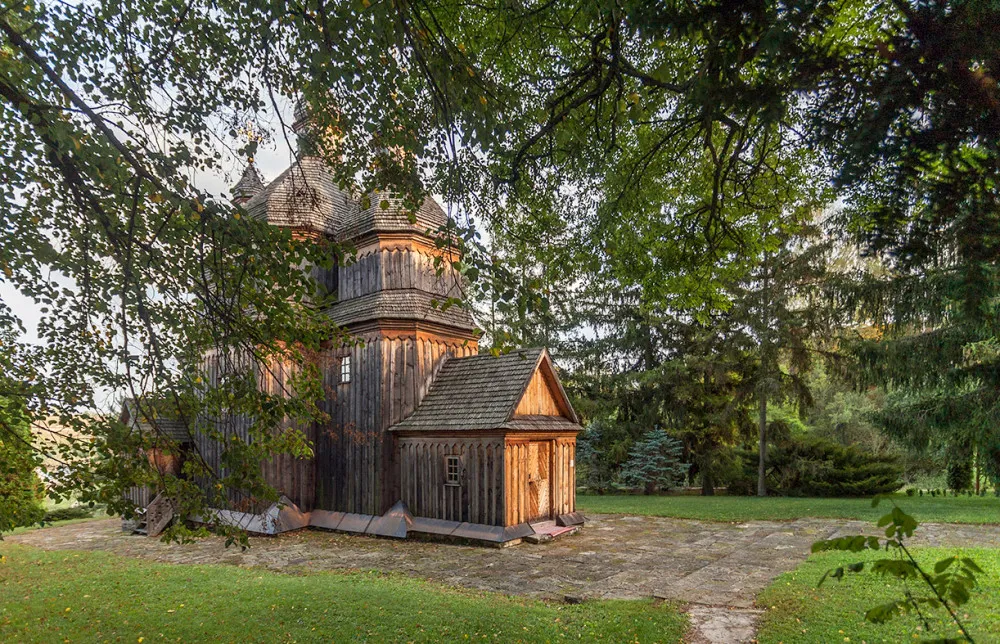
Under the Soviets the monument, which was first turned into a grain store, was saved through the efforts of local historians, researchers and caring citizens, who even organised night watches so that the communists would not burn the church down. Despite its protected status, the church stood empty and was handed over to believers only when Independence came. In 2007, a large-scale restoration was carried out at the state budget’s expense, during which the domes shed their tin and were covered with authentic wooden shingles.
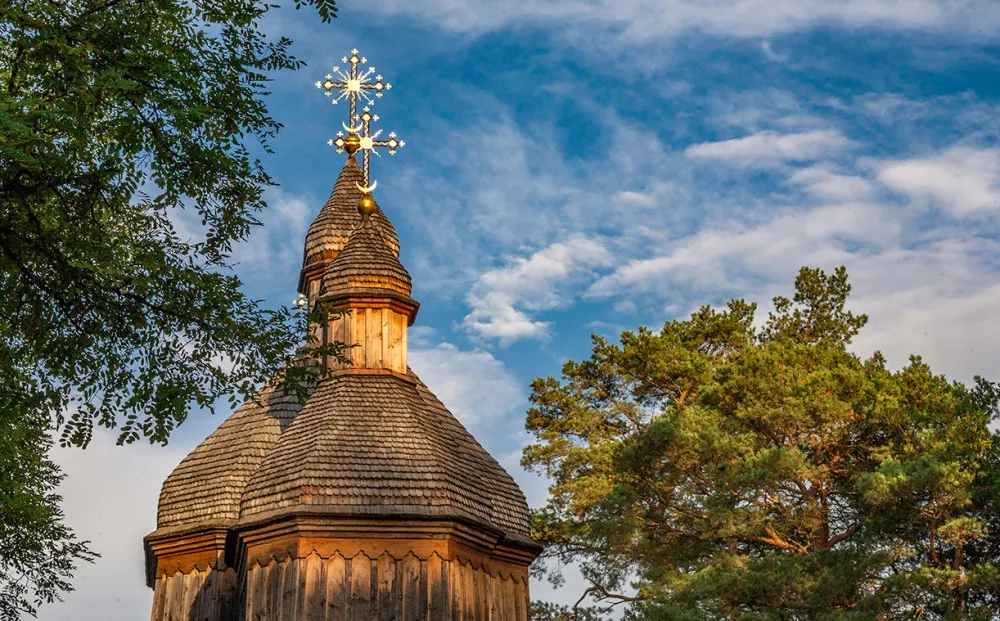
The crosses on the Church are made in the ancient Ukrainian tradition. Let us recall that the “slanted” five-armed crosses, utterly alien to our people, were brought to our lands by the Russian occupiers and the Muscovite church, which came to us on their bloody bayonets…
Finding yourself in the churchyard, you drop out of reality. There is no sign here that it is the 21st century all around. Even the outbuildings are styled to look old. Not a single hateful cement paving tile. Only granite setts. And right by the church there are stone slabs that have lain here since the 18th century. During the restoration they were merely cleared of later layers of soil.
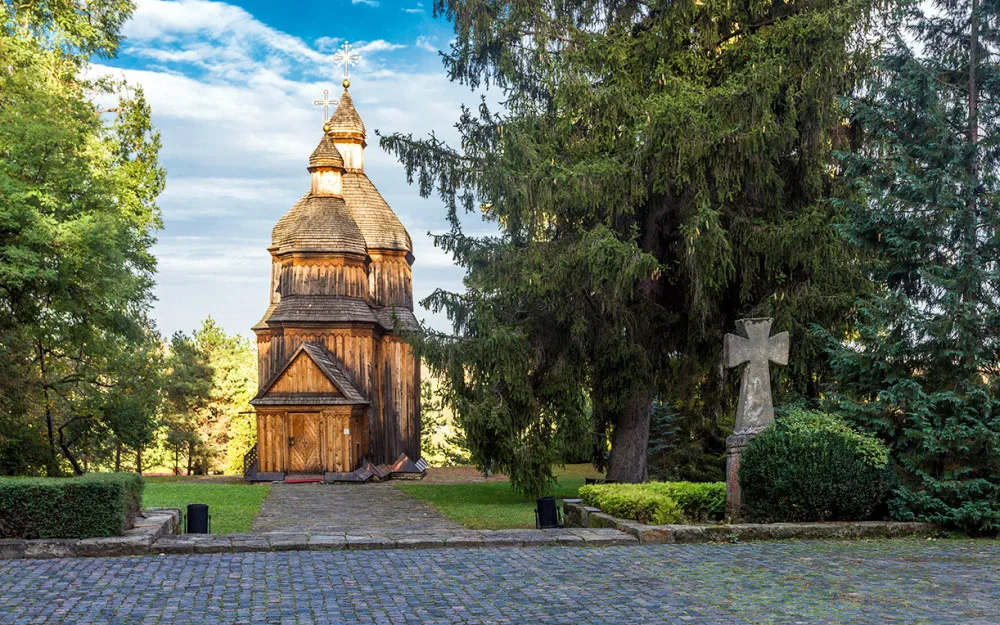
The Church, by the way, is surrounded by a genuine landscape park with rare trees, which is also very unusual. There are no poles or wires in sight. The Church is not electrified. This is not only the preservation of archaic character but also a matter of safety: quite a few wooden churches have burned down because of short circuits. I had previously seen equally atmospheric churches only in the famous open-air museum at Pyrohiv. But that was a museum, whereas here is an ordinary village Church in the backwoods…


