

Ephesus (Efes). Part I
· 12 min read
The beginnings of the city are hidden in the middle of the second millennium BC, and I will not tire you with the history of the little-known Luwians and their state of Arzawa, whose capital was the city then called Apasa. Somewhere nearby, the Hittites and Egyptians, already better known to us, appear, sometimes as adversaries and sometimes as allies. An end to it all was put by the little-known “Sea Peoples”.
The Greeks appear here together with their myths. Supposedly, the Delphic oracle told a certain Androclus that he should found a city at the place indicated by a fish, a fire and a wild boar. When Androclus had worn out his feet and came ashore near the place called Apasa, local fishermen were frying fish. A spark flying from the fire set a bush alight, and out of it an alarmed boar immediately leapt. Thus the wild boar became the symbol of Ephesus, the Greeks its inhabitants, and the local goddess turned into the Greek goddess of the hunt, Artemis. The mythical Androclus even managed to fight the no less mythical Amazons and even to fall in love with one of them, Ephesia. The Greeks believed that the first temple of Artemis in Ephesus was built precisely by the Amazons. Be that as it may, some 500 years later, in 650 BC, the entirely non-mythical Cimmerians attacked the city and destroyed the first temple of Artemis, the one built by the Amazons (legends, legends).
In 612 BC power in the city was seized by Pythagoras. Not the one of the theorems, but a tyrant. Although a tyrant among the Greeks is merely a sole ruler who gained power by means of weapons or political agility, not what we have. Though he acted typically as the majority wants now: confiscate property from the rich and hand it out. 73% of the people, that is, the demos, will support you. Strangely, perhaps the gods still lived among people then, but crop failures and diseases began to plague the city. To distract the people, one has to set them a “great” goal and also make peace with the priests. Pythagoras’s grandest idea became the building of communism: the new temple of Artemis, in which the Ephesians were helped by their neighbours the Lydians. Judging by everything, the idea inspired the people so much that the tyrant’s son and grandson went on ruling them. All would have been well, but Croesus, the new Lydian king and uncle of the ruler of Ephesus, decided in 560 BC to annex Ephesus to his possessions. His nephew Pindar for some reason did not comply with the demand for voluntary submission, and it came to war. During the siege, when one of the towers was destroyed and defeat became inevitable, Pindar, still the master of the city, stretched a rope one and a half kilometres long from the city gates to the columns of the temple of Artemis, so as to make the city part of the goddess’s sanctuary, which it would be sacrilege to invade.
How Croesus reacted to this is unknown. Though who knows what is in the head of a man who tested 12 oracles for truthfulness. Croesus sent to ask each of the sanctuaries what he was doing at that moment. The most accurate answer was that of the Pythia of Delphi: the king was boiling a tortoise and a lamb in a bronze cauldron.
So during the siege the inhabitants of Ephesus managed to save the city from bloodshed, whether because of the rope, or because of the banishment of Croesus’s nephew, or because of their skill at bargaining, which they would prove more than once. Croesus, “rich as Croesus”, subjugated all the Greek poleis of Asia Minor except Lycia and Cappadocia. One of the mythically rich rulers decided to build a new, unprecedented temple of Artemis.
The temple began to be built, but the Ephesians proved “ungrateful”, and to draw up laws they invited to the city the Athenian Aristarchus, who was not tied to local deputies and oligarchs. Thanks to his wise laws and advice he won favour, and power in the city was handed over to a college of Curetes (one of the streets, which we will still stroll along, was named after them), which governed the city collectively.
Taking advantage of the confusion and fear caused by Croesus’s defeat by Cyrus, another tyrant, Athenagoras, seized power in the city. After that the city was ruled in turn by various tyrants, who either supported the Persians or rebelled. An interesting fact occurred precisely during one of the Persian sieges of the city. Supposedly the philosopher Heraclitus explained to them so well that “everything flows, everything changes” that there was no point in destroying the city. The inspired philosopher persuaded the next tyrant to cede power to his protégé Hermodorus, with whose support he hoped to establish a “perfect order” in the city. But the Ephesians understood the philosopher’s words well: “You cannot step twice into the same river”. That is, the rule of tyrants too comes to an end, something has to be changed. Hermodorus was driven out, and the offended Heraclitus gave up his legislative initiatives and spent his last years as a hermit in the mountains. He himself said: “It would not be better for men if they got all they wish for”.
During the Greco-Persian and the Athenian-Spartan wars the city kaleidoscopically changed the side it supported.
And then in 356 BC an epoch-making event occurred: the temple of Artemis was burnt by Herostratus, who had a manic desire to become famous.
Then Alexander the Great freed Ephesus from Persian rule, then came the wars and changes of power among the Diadochi, until the city ended up within the Roman Empire.
In the age of Augustus Ephesus became one of the richest, and therefore most beautiful, cities of the Roman Empire. The city’s population reached 200,000–250,000 inhabitants, and it was the second city in the Roman Empire in size and importance.
In the 2nd–3rd centuries Xenophon of Ephesus, the author of ancient Greek novels, lived here. Some believe that part of the plot and imagery of his “Ephesian Tale” was borrowed by William Shakespeare for the play “Romeo and Juliet”.
Naturally, Ephesus became an important centre for early Christianity. First of all, Christian-era Ephesus is famous for the visits and epistles of the Apostle Paul.
The Apostle John the Theologian also lived and preached here and wrote his Gospel; he is buried in the church named after him. The Mother of God also spent her last years here. Ephesus became the seat of a bishop, and later also a city where several Ecumenical Councils were held during the 5th century. Near the city there is also the cave of the Seven Sleepers of Ephesus, who hid from persecution in the period of Late Rome, under the Emperor Decius.
In AD 262 the Goths took the “excess” gold and valuables from the city. Emperor Justinian built the church of the Apostle John here, but that was already the last great structure. The greatest blow to the city was dealt by nature. After a great earthquake the sea level near Ephesus dropped by 57 metres, which caused the city’s rapid decline. Today the ruins are about 10 kilometres from the seashore.
The remains of ancient Ephesus are hidden under a swamp. Only in 1869 did English scholars carry out the first archaeological excavations of the founded city; they were looking for the ruins of the Temple of Artemis.
Hellenistic Ephesus
You have not forgotten that Ephesus had a port and the city stood on the coast? The Harbour Street was bound to impress at once: 500 metres and a bit long and 11 metres wide. Columns run on both sides. The first building is the Harbour Baths. It is a huge structure of 160x170 metres and 28 metres high. So, once you have washed your face and body, you are ready for Artemis. The street led out to the Great Theatre. The theatre has come down to us in splendid condition. It is divided into three sections: the stage, the orchestra and the cavea, the hall for spectators. The theatre’s capacity is about 24,000–25,000 seats. It has 66 rows, divided into 3 tiers, with a total height of 18 metres.
The Great Theatre of Ephesus was used not only for plays and concerts but also for speeches by politicians and philosophers, gladiator fights, and religious ceremonies. In one day, up to 50 gladiator fights, among themselves and with animals, were sometimes held on the theatre’s stage.
The ruins of the Agora date from the Roman Empire period. It was most likely built in the reigns of the emperors Augustus and Claudius. The Agora was decorated with a double colonnade of a portico, under which the market stalls were placed. It was the centre of commercial activity, to which merchants came from all corners of the Empire. There was also a slave market here, and popular assemblies were held.
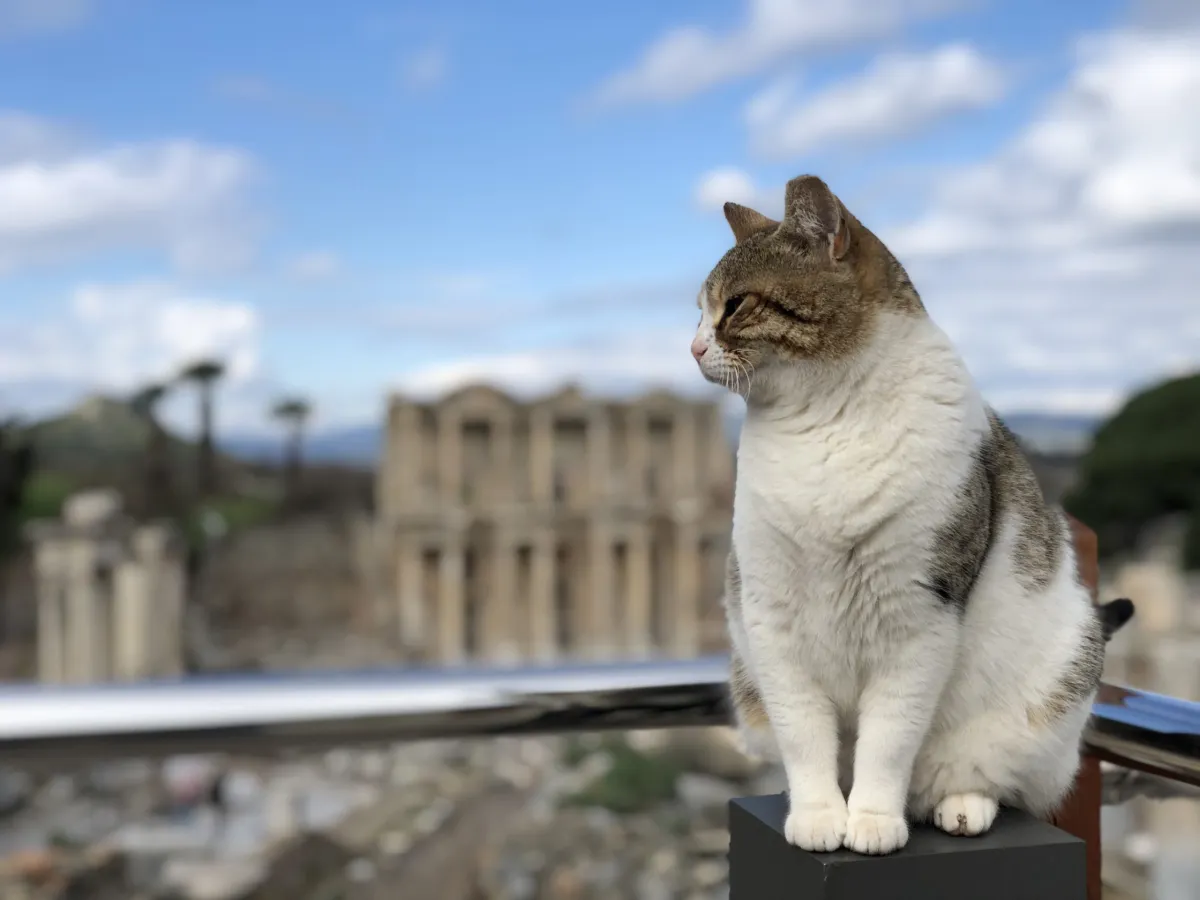
The marble road from the Great Theatre leads to Ephesus’s greatest attraction, the Library of Celsus, which was built in the imperial era, in the reign of Hadrian, to the design of the architect Tiberius Julius Aquila. He dedicated it to his father, Tiberius Julius Celsus. His tomb was also here on the ground floor. Construction began in 114 and was completed in 135 by the heirs of Tiberius, who bequeathed a large sum of money for buying books and maintaining the library. This library was the third largest after those of Alexandria and Pergamon; it held approximately 12,000 parchment scrolls, which were stolen or destroyed during the Gothic invasion.
The two-tier façade was restored by Austrian archaeologists. The columns of the first tier stand on the podium of a central staircase of nine steps. The columns of the upper tier are smaller. This creates a certain optical effect: the building seems larger. The building is adorned with four sculptures that symbolize some virtues.
Opposite is a brothel, to which an underground passage led from the library. The men of the city must have been very fond of reading books.
On the pavement leading to the brothel one of the world’s earliest advertisements has survived, containing the image of a girl’s head, next to which is an imprint of a left foot, showing the way. Is this not where the well-known expression “to go left” comes from?
The baths were built with the money of a wealthy townswoman named Scholastica. Such a name. They functioned the longest, right until the Turkish period.
The public toilet was part of the baths. In the middle was a pool surrounded by columns.
The Curetes Street, which stretches along the slope from the Library of Celsus and the Gate of Hercules. It is one of the three main streets of Ephesus, and it was here that the elite preferred to live. Its paving of marble and stone is complemented by columns, stone pedestals, podiums, statues and the remains of shops and residential houses alongside.
On this and other streets of the city there were pits covered with gratings, where those convicted of murder or rape were placed. Every passer-by had the right to spit into the pit. On the street there is also a marble wall on which all the city’s laws are engraved. Laws in those days were not changed.
On it stands a temple built in honour of the divine Emperor Hadrian. In front of the entrance to the temple are 4 pedestals on which statues of other emperor-gods stood.
On the opposite side of the Temple of Hadrian stands an original ensemble of houses called the “Terrace Houses”, facing the Curetes Street. Mostly members of the elite lived here, which is why the street has a second name, “the houses of the rich”. They are arranged so that each house serves as a terrace for the house following it. The numerous rooms inside the houses have mosaic floors and wall frescoes.
The fountain of another deity, Emperor Trajan, was built in honour of Artemis of Ephesus and Emperor Trajan. His sculpture stood in front of the fountain basin beside figures of Aphrodite, Dionysus and members of the emperor’s family. Now they have all moved to the Selçuk Archaeological Museum.
In the centre of the ceremonial hall of the Municipal Palace an eternal flame burned, symbolizing the heart of Ephesus. Religious ceremonies, official receptions and banquets were held here. During excavations 2 statues of Artemis were found, which are now in the Ephesus Museum.
The Odeon in Ephesus, for theatrical performances and senate sessions, had 2 levels and was designed for 1,500 people. A wooden roof protected the Odeon from above.
In antiquity a prytaneion was a building intended to house the clerical officials, the prytaneis, where solemn receptions and banquets for the city’s notable persons were also held. It can be compared with a modern municipality. In the Temple of Hestia adjacent to the Prytaneion a sacred fire burned constantly, maintained by the prytaneis, priests who took part in cult rites and sacrifices. At a certain time the prytaneis chewed opium and, intoxicated, went dancing from the prytaneion to the Temple of Artemis. If at that moment a thief being taken to execution or punishment was noticed by a priest, he was automatically released.
The temple of yet another emperor, Domitian, was dedicated to the citizens of Ephesus by the ancient Roman Emperor Domitian. Among other things he became famous for his persecution of St. John the Theologian.
The Baths of Varius are another complex for gatherings, meetings, and discussions of important and not so important matters: a social network before the invention of Facebook.
About the temple of Artemis of Ephesus, the House of the Virgin Mary, the church of the Apostle John, the fortress and the mosque, read in the second part
Text and photos by Serhii Shcherbii



