Cossacks at Dunkirk

· 22 min read
This topic has not exhausted itself for decades. Every few months it flares up again somewhere, from one side or the other. Two marginal opposites try to overcome their likes on the other flank of the myth. On one side are the adherents of the myth about Cossacks in their chaikas who stormed into Dunkirk and defeated everyone, while Sirko lectured at the Sorbonne and so on. On the other, exactly the same kind of myths: that it was all invented by I. Borshchak, that the French knew nothing about Cossacks, and other similar nonsense from a certain Russian forum, which the well-known “Inter” (read: Moscow) propagandist Mustafin copy-pasted into “IstPravda” without a shadow of doubt or critical thought.
I have been studying the Cossacks’ participation in the so-called “Fifteen Years’ (Thirteen Years’) War” and the “Thirty Years’ War” for a long time. I have read to tatters not only all the Ukrainian sources worthy of attention, but also the excellent studies by diaspora scholars and Poles and, above all, the foreign sources of the countries directly connected with a possible Cossack presence there. In particular, for the closing episode of the Thirty Years’ War in 1646 at Dunkirk, they are French. I did not limit myself to the memoirs of direct participants, but also looked at French archives, newspaper publications of the period and so on. I have already set out some of my observations in the form of posts, but I continue to collect material in order to write an article that will put an end to a discussion more than 150 years old.
So when a new study on this topic appears, presented by a recognized authority, Doctor of Historical Sciences Leontii Voitovych , my heart starts pounding from two opposite but equally exciting feelings: first, as a researcher, I am glad that someone has perhaps discovered something new on the subject, or even put a full stop to this scholarly problem; second, as someone who has devoted several years to it, I am saddened that it was not I who did this ?
So, first I will quote excerpts from the latest scholarly study on the subject, and at the end I will add my own thoughts.
Briefly, I would remind you that Dr. L. Voitovych is the author of over 600 works on military and political history, including co-author of such fundamental works as “History of the Ukrainian Cossacks. In 2 vols.” and “History of Wars and Military Art. In 3 vols.” and others.
His new article “PROBLEMS OF THE PARTICIPATION OF THE UKRAINIAN COSSACKS IN THE THIRTY YEARS’ WAR” came out in the second half of 2020, is published here and contains the following theses:
“The Thirty Years’ War (1618–1648) was the first pan-European war, in which more than a hundred large and small states took part…
…Poland’s direct participation in this war was limited to its military operations against the Swedes within the Polish-Swedish war… At the same time, Poland did not object to its subjects taking part in mercenary contingents, first on the side of the Catholic League and then of France.
The Thirty Years’ War was a period of flourishing of professional mercenary armies. Training soldiers was expensive and lengthy. For example, arquebusiers or musketeers, for whom only volley fire was effective, were trained for years. Therefore whole companies and regiments of trained soldiers were hired, who arrived with their own weapons and their own officers and were ready for use on the battlefield.
In the Polish and Lithuanian parts of the Polish-Lithuanian Commonwealth, the possibilities for recruiting professional mercenaries were limited. From the potential pool one must exclude the protracted noble banners (chorągwie), with whose recruitment and upkeep even the hetmans themselves had problems, as well as the court banners of princes and individual magnates, who maintained them at their own expense. This was mostly armoured cavalry, from which the hussars stood out, being, unlike the others, heavy cavalry in the Polish army. Infantry was especially lacking. In 1563 the so-called quarter army (wojsko kwarciane) was created, maintained from a quarter (kwarta) of the revenues of royal estates (territories that paid taxes directly into the crown treasury). This army numbered only 3,000 cavalry and 1,000 infantry (Nowak, Wimmer, 1981: 292)… Therefore the shortage of infantry was made up with mercenaries…
On the territory of the Commonwealth there were only two military formations from which qualified professionals could be recruited: the Ukrainian Cossacks and the Polish Cossacks, called lisowczycy. From the Ukrainian Cossacks one could recruit experienced infantry musketeers (Voitovych, 2012: 64–79), from the Polish Cossacks, light cavalry…
In Western Europe the Ukrainian Cossacks were well known…The Polish Cossacks became better known after the lisowczycy took part in the Thirty Years’ War. In general, “Cossacks” mostly meant the Zaporozhian Cossacks, that is, Ukrainian Cossacks. Also, in Western Europe all natives of the Commonwealth’s lands were generally called Poles. All these things must be taken into account when studying the military contingents from the Commonwealth on the battlefields of the Thirty Years’ War, understanding at the same time that mounted units could be recruited both from the lisowczycy and from the Zaporozhians, while foot units only from the Zaporozhians (Nalyvaiko, 1998: 223)…
The short-sighted policy of the Polish government on the Cossack question pushed the Cossack elite into mercenary military service for foreign rulers.
…in Western Europe foreign mercenary contingents were a common phenomenon. They were hired for certain periods, as whole units with their own officers, for a fixed payment, after which they returned home. The government of the Commonwealth did not object to the hiring of Cossacks, hoping that in this way their problems would be solved by themselves. It is also clear that it was not the registered Cossacks, whom the government maintained, who were hired, but the non-registered Cossacks, who were always many times more numerous and with whom the government had problems, not wishing to recognize the real state of affairs. The Cossack hetmans, whom the government called elders (starshi) (Brekhunenko, 2011: 119–129), enrolled some of the non-registered Cossacks as servants (dzhury) or even shared the pay received, but this happened in periods of war, while between wars there were enough experienced warriors among the Zaporozhians who could be hired for service.
These events led to the start of hostilities, which began in June 1618… Austrian emissaries (ambassador Count Adolf Altgen and Peter Fuchs (Baran, 1970: 76)) with the tacit consent of King Sigismund III began recruiting Cossacks for Austrian service… On 21–22 November 1619, near the village of Strypsko near Humenné, the Cossacks and lisowczycy routed Rákóczi’s 7,000-strong army (2,500 hussars, 2,000 county militia and 2,500 Hungarian hajdú infantry), which lost up to two thousand and retreated to Sárospatak, and then shut itself up in the powerful Makovica castle, which the Cossacks besieged (Nagy, 1969: 182–199; Papp, 2011: 915–973; Borbély, 2014: 295–309; Borbély, 2015: 110–208)…
The papal nuncio in Venice, in a report to Rome of 20 August 1620, reported the arrival in the imperial army of 5,000 Cossacks “from beyond the Black Sea”, led by Captain Hasan Taras (Gayecky, Baran, 1969: 75). Therefore the possible participation of Ukrainians in the famous Battle of White Mountain on 8 November 1620 cannot be ruled out…
After this battle Stanisław Rusinowski with part of the Cossacks returned to Poland and took part in the Battle of Khotyn (1621), where he was severely wounded, after which some time later he again found himself in imperial service (Starowolski: 1978: 272). But in Tilly’s army there remained the Polish-Ukrainian regiment of Colonel Stanisław Strojnowski, which in 1622 numbered from 3,800 to 5,000 men (Theatrum Europaeum oder Warhafftige beschreibung alter…, 1662: 545). It is clear that the overwhelming majority of the Cossacks who filled its ranks after the Khotyn War were Zaporozhians, because more than 30,000 people with experience of this war remained outside the register, whereas of the lisowczycy there remained literally a few hundred, gathered later by Rusinowski after the 1624 Sejm upheld the resolution of the sejmik in Wisznia (1622) condemning all lisowczycy to infamy (loss of honour) and banition (exile).
The famous commander tried to hire as many Cossacks as possible, but ran into opposition from the Polish government amid confrontation with Moscow and Sweden and the constant possibility of serious Crimean raids. In addition, in 1626 under the command of Baron Di Don 4,000 Cossacks already served in Wallenstein’s army and were discharged without pay for the last three months, which also affected the recruitment of new contingents, which the generalissimo announced on 8 December 1631, promising a daily ration of 2 pounds of bread, 1 pound of meat, 2 of beer and 1 of wine, half a korets of oats per week for the horse, and pay of 6 Rhenish thalers a month. Therefore in 1632 only 2,000 Ukrainian Cossacks fought in Wallenstein’s army in Silesia. On 29 January 1633, near Strehlen, the Cossacks were routed by the Swedes and lost more than 500 men. Then, despite King Władysław IV’s ban on hiring and withdrawing troops from the Commonwealth, the number of Cossacks in February 1633 reached 6,000. But this included the remnants of those units that had fought in Lombardy, near Lake Como and on the Rhine. They no longer formed a single formation but were scattered among various regiments of Wallenstein’s army (Baran, 1978: 40–51).
Then Władysław IV ordered Cossack colonel Kostiantyn Vovk, a participant in the Battle of Khotyn and a rittmeister of the crown army in the Smolensk campaign of 1632–1634, to recruit one and a half thousand Sich men well versed in naval matters and to arrive at Kovno (Kaunas). At the same time, in Lithuanian Jurbarkas, the construction of 30 chaikas began under the supervision of a Cossack master, with the necessary equipment delivered at the government’s expense. On 19 July 1635 the flotilla of chaikas under the command of Colonel Vovk set out from the mouth of the Neman to Königsberg. But by then hostilities in the Baltic had died down and negotiations had begun, in the course of which the Swedes captured the flagship frigate of the Polish fleet, the “Black Eagle”. And the king ordered an attack on the Swedish squadron stationed at Pillau. On the night of 30 to 31 August Vovk led his chaikas and unexpectedly attacked the Swedes, capturing in a boarding fight a large Swedish transport, which was later exchanged for the Polish flagship frigate. After this fight the Cossack chaikas cruised for another two weeks between Pillau and Königsberg. On 12 September 1635 a peace for 26 years was concluded. On 23 September 1635 the king ordered the Cossacks to be paid off, giving them 15,000 zlotys in Toruń and allowing them to keep the trophies they had taken. The chaikas with their munitions were to be taken to Kovno and stored there until new needs arose (Mamchak, 2005: 111–114).
At the same time, under an agreement of 23 September 1635, Colonel Paweł Noskowski brought a Cossack contingent into the imperial army at a pay of 6 thalers per rank-and-file Cossack. The colonel himself was to receive 200 thalers. The Cossacks fought in Picardy and Alsace, but in the autumn of 1636 they left service because of perpetual problems with pay (Voitovych, Holubko, 2018: 143–144).
The Polish government did not pay the Cossacks who had taken part in the Smolensk campaign and did not much resist the recruitment of Cossacks into the imperial army, which was conducting a victorious campaign on the Rhine. The Cossacks took part in the Hessian campaign of 1636, in particular in the capture of Soest (27 September 1636) and other towns (Baran, 1974: 20–21). 4,000 Cossacks led by Colonel Taraskyi fought as part of the imperial army in Luxembourg against the French army of Prince Louis de Bourbon, Count of Soissons (1.05.1604–6.07.1641) (Courcelles Jean-Baptiste-Pierre Jullien de, 1821: 43–46). They distinguished themselves by the victory at Ivoix (Fedoruk, 2006: 460–463).
.
[Here I will recall my post describing these events: https://www.facebook.com/ipllm/posts/2877742805665982]
.
The question arises: who is Colonel Taraskyi? Was he not Taras Fedorovych, nicknamed Triasylo (d. 1639), hetman of the non-registered Cossacks (1630, 1634–1635), registered colonel of Chyhyryn (1632) (Kovalets, 2016: 33–45), a participant in the Smolensk campaign who defeated the Muscovite army at Shchelkanov (10 April 1634) (Gayecky, Baran, 1969: 140). At the January council of 1635 he not only gave up the hetmancy but also burned his own homestead and left the Cossack lands (Zorin, 2017: 64). It is believed that the former hetman immediately rushed to seek refuge on the Don and in Muscovite service, but the Taras Chornyi who appears in documents of this period is more likely a relative of Hetman Hryhorii Chornyi than Taras Fedorovych. It seems, nevertheless, that Taras Fedorovych with his supporters went into imperial service and distinguished himself in the battles in Luxembourg.
The most debatable remains the question of the participation of Ukrainian Cossacks in the capture of Dunkirk in 1646 (Fedoruk, 1999: 87–98).
France’s entry into the Thirty Years’ War on the side of the Protestant union forced it to fight on several fronts with considerable losses. Already the head of the French government, Cardinal Armand-Jean du Plessis, Duke of Richelieu (9.08.1585–4.12.1642), through his ambassador on 3 March 1637 appealed to the Polish government with a request to engage Cossack contingents in French service (Pamiętniki Albrychta Stanisława X. Radziwiłła kanclerza w. Litewskiego, 1839: 337). Until then Poland had allowed troops to be hired only by the emperor and the Catholic coalition. Therefore the negotiations were difficult. Richelieu’s successor, Cardinal Giulio Mazarin (14.07.1602–9.03.1661), continued these negotiations. The French helped the Poles settle a dispute with Württemberg over the contribution from the Silesian duchies of Opole and Racibórz, which were under Polish protectorate, and in return the Poles did allow them to recruit a Cossack contingent in 1645. On 21 September 1644 the Vicomte de Brégy, the French envoy at the Polish court, reported to Cardinal Mazarin about establishing contacts with the Cossacks, noting that “… the now very capable commander Khmelnytskyi” was involved in the negotiations, “he is respected here at court”. In October 1644 de Brégy wrote: “…these days one of the elders of the Cossack nation, Colonel Khmelnytskyi, about whom I had the honour to write to Your Eminence, was in Warsaw. He came to see me, and I had two conversations with him. He is an educated, intelligent man, strong in Latin; as for the service of the Cossacks to His Majesty, if there is no war with the Turks, Khmelnytskyi is ready to help me in this matter” (Polovtsov, 1902: 123). It is clear that this was not about hiring registered Cossacks; it was simply that contact with the Zaporozhians could only be established through the registered officers. Soltenko and Colonel of the crown army Przemski also took part in the negotiations. They agreed to recruit 1,800 infantrymen and 800 cavalrymen at a pay of 12 reichsthalers, and 120 for the officers (Borshchak, 1922)…
The recruited contingent of about 2–2.5 thousand infantrymen was assembled in Gdańsk, where on 24 April 1646 Count de Brégy arrived to personally check the concentration and dispatch of this force, and then, with Pierre Chevalier and Colonel Przemski, these Cossacks were transported by sea to Copenhagen and on to Calais, where they came under the command of Major General Claude de Létouf, Baron de Sirot (12.07.1600–6.04.1652). The baron began his career at 15 as a volunteer in the Dutch army, where he remained until 1620. Then he served in the army of the Duke of Savoy in Genoa, fought against Prince Gabriel Bethlen (1625), then in the army of Duke Franz Albrecht of Saxe-Lauenburg, fought in the Catholic army against Denmark (1627) and the Swedish king Gustavus Adolphus (1635), returned to France and distinguished himself at Arras (1640) and in the Battle of Rocroi (1643). After Dunkirk he became lieutenant general. He died of a musket wound. His memoirs were published in Paris in 1683 (Mémoires et la vie messire Claude de Létouf…, 1693). Thanks to Ilko Borshchak, Baron Sirot became Colonel Ivan Sirko (Borshchak, 1922), which led to a stereotype that persists to this day…
…having taken Furnes, Prince Condé cut off the canals by which one could get from Dunkirk to the Belgian towns. In addition, 10 ships of the line and 15 frigates of the allied Dutch fleet hindered the Spanish squadron. Prince Condé had 10,000 infantry and 5,000 cavalry at his disposal. The army at once set about building a circumvallation line to defend against a possible advance by the imperial field marshal Piccolomini aimed at relieving the fortress. Marshals Jean de Gassion (20.08.1609–2.10.1647) and Josias Rantzau (18.10.1609–14.09.1650) took up the flank positions that rested on the coastline, and Condé himself took the centre. The Cossack regiment under Baron Sirot was part of Marshal Gassion’s corps. The difficulty of supplying provisions and the harsh climate did not allow the siege to be prolonged. 60 guns were placed in the approaches and the first assault took place on 24–25 September, which the Marquis of Leyden repelled with considerable losses. On 1–2 October the French repeated the assault. The garrison repelled it, although it lost one of the bastions, in whose storming the Cossacks took part. The Marquis of Leyden hoped for help from the sea, but the Spaniards did not dare to attack the Dutch squadron and turned back. The garrison tried to break out through the French positions next to the beach, but was thrown back. The Cossacks also took part in this counterattack. After that the garrison capitulated on honourable terms on 11 October 1646 and the Cossacks entered the city as a separate unit under their own banners (Histoire du Siége de Dunkerque par M. le Prince…, 1649; Coste, 1748: 86–95; D’Aumale Henri d’Orléans duc, 1889: t. 5, p. 93; t. 7, p. 169).
Then some of the Cossacks, dissatisfied with the delay in pay, went over to Spanish service. The rest were transferred to Lorraine, from where they returned home (Polovtsov, 1902: 123–124; Borshchak, 1922; Krypiakevych, 1990: 48–49).
Bohdan Khmelnytskyi and Ivan Sirko were not at Dunkirk, and probably Soltenko was not either, but this by no means means that only Polish mercenaries were there, because French military authors and diplomats called them Poles (Wójcik, 1973: 575–585; Antsyshkin, 2005: 120–122; Holobutskyi, 1985: 132–140), just as to this day in Europe all natives of the former Soviet Union are called Russians. There was no physical possibility of hiring trained Polish infantry in 1645, because, apart from the quarter-army and the lan infantry, the rest of the Polish infantry consisted of Hungarian and German mercenaries. The Poles would not have allowed any of these formations to be taken away, especially considering the military plans of King Władysław IV. There were no lisowczycy left at this time either, and in any case they had no infantry. And why, to recruit Polish infantry, was it necessary to involve the Cossack officers Khmelnytskyi and Soltenko? And why did Count de Brégy order for Mazarin “books written in the Ruthenian language”? (Verhun, 1980: 625). This problem, like many others connected with the participation of Ukrainian Cossacks in the Thirty Years’ War, requires further in-depth research” (c).
Voitovych L. 2020.
While paying tribute to the work of the eminent historian, on some points I nevertheless disagree with him, and I will certainly set this out in a separate article some day. Here I will note the main thing he proves: the participation of Cossacks in the “Thirty Years’ War” has been described many times and confirmed by numerous foreign sources, and therefore is of interest to scholarship only from the point of view of analysing individual episodes and interesting details. I always advise reading the two-volume work by O. Baran and H. Gayecky (The Cossacks in the Thirty Years War, 1960; unfortunately still not translated), as well as the dissertation by A. Fedoruk (THE MERCENARY COSSACK ARMY OF THE 16TH – MID-17TH CENTURIES: IDEOLOGY, ORGANIZATION AND MILITARY ART, 2000), which drew a line under the question of the participation itself and many of its details.
But for some reason it is precisely the final episode of this war that has gained such wide publicity among us and has long provoked disputes, with the description of which I began this post.
I do not know whether it was the very moment of the end of the war and one of its important final episodes, or the charms of an impregnable fortress by the sea, with a name derived from “Church in the Dunes”, that had such an effect, but it is Dunkirk that gives many people no peace. Even though it is precisely the possible participation of Cossacks there that is the most debatable, unlike other episodes. And here I agree with the conclusion of O. Baran and H. Gayecky that the interest in, and overestimation of, the possible participation of Cossacks at Dunkirk remains incomprehensible when we have far better-confirmed and more interesting episodes of their participation in other battles of the Thirty Years’ War.
The esteemed author of the article offered his view on this episode too, considering the participation of Cossacks there possible.
I can only be glad that the topic that interests me, and which I have been researching for several years, does not lose its relevance ?
And also stress that the article, again, does not put a full stop but, on the contrary, states that the topic still “requires further in-depth research”.
I do not want to reveal prematurely what deserves a separate article, so for now I will set out in brief theses what I can already state as facts from my research:
1. The French negotiations with the Commonwealth about hiring troops really were conducted at the highest level. Including in the last years of the Thirty Years’ War (almost two years). Including not only with the King of the Commonwealth.
2. Because, as the Polish historian K. Kwiatkowski, who studied the biography of Władysław IV, testifies: “The King categorically refused to give permission to hire from among the Polish army… he passed the question to the Senate, but even there they could not reach any decision… except that the hiring of a private army on the territory of the Commonwealth cannot be forbidden to the French”. From this it becomes obvious that the hiring could not have been made from troops that were suitable and under the king’s control. A hint that I will not develop here ?
3. But at the same time, the process had to be fully controlled from the point of view of the Commonwealth’s security, since the only way to send such a contingent to distant lands is by sea, namely the northern Polish port of Danzig (Gdańsk).
4. For this purpose, back in 1645, the French were offered to continue negotiations with a certain Przyiemski (so the Poles seemingly did not refuse outright, but also did not give permission to hire the Polish army or registered Cossacks).
5. Only on 27 March 1646 in Warsaw was one of the contracts concluded that has survived to this day and attests to one of the moments of hiring soldiers from the territory of the Commonwealth for French service at Dunkirk. It was undertaken by Christophe Priemski and Anadré Priemski (later joined by Georges Cabray, and also Guciński). The contracts were concluded by the same Messieurs le vicomte de Brègy (Ambassadeur de France en Poulongne), to whom the widely known letter of Pierre Chevalier is dedicated, which extols the merits of the Zaporozhian Cossacks and Bohdan Khmelnytskyi (the dedication to the French book about the Cossacks, which was printed in 1663 (and before that several parts of it in the form of notes)).
6. According to the French data, the payment of the troops’ reward, like the transport, was at France’s expense. The organization of the sea expedition may have been handled by the Dutch (although they were categorically unhappy about such a prospect).
7. It is a myth that the troops hired and sent from Danzig were completely unfit (such a conclusion is often drawn on the basis of a brief mention in the memoirs of one of the participants in the battle). In fact, the French History of Dunkirk describes as many as four episodes of participation of these hired troops in the hottest moments of the assault on the fortress.
8. Interesting is a peculiarity of their stay on the front line at Dunkirk mentioned in several sources: “…accustomed to war in the countryside, these soldiers did not try to settle in tents, but dug burrows in the sand like foxes [trenches, which were strange to the French but are widely known to us]”.
9. And also the episode that: “…later, these hired troops caused much chaos, cruelty and violence in the neighbouring villages… beating and robbing many locals…”.
10. From numerous sources we know that this contingent, called “Polish” everywhere, consisted of 2,000 to 2,500 soldiers. Moreover, everywhere, for simplicity, they are called simply “Poles” (Polonois). Although the same sources (both the contracts and the Memoirs and histories of Dunkirk) indicate that among these 2,400 (2,000–2,500) mercenaries there were from 700 to 1,000 Germans (the figure differs in various sources). That is, it is obvious that the name Polonois did not refer to an ethnic characteristic, nor even to subjects of the King of the Commonwealth, but simply became the name of the unit commanded by the genuinely Polish Priemski.
Everyone can draw their own conclusions. I will publish my conclusions and research results in a separate article.
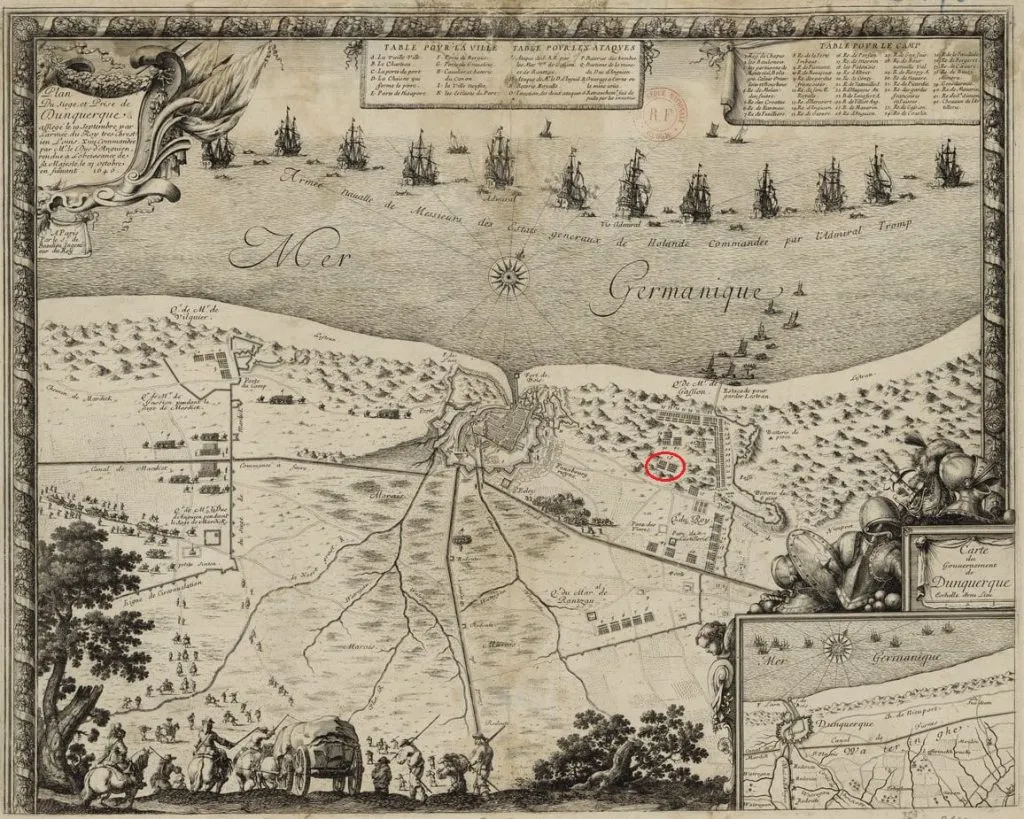
But here I will share a map of 1646 that I found in the French archives, previously unknown in Ukraine and Poland, which shows this so-called Polish unit (number 18) on the front line of the fighting for the Dunkirk fortress (circled).
It is also worth noting that a beautiful copper commemorative plaque of thanks “for the participation of the Cossacks in the capture of Dunkirk” has recently been hanging on the old gates of Dunkirk, telling visitors to the city that there is such a distant and unknown land of the Cossacks, Ukraine, which is somehow tangential to world history).
Author: Ihor Poluektov
Beginning: