Radomyshl. Treasury of landmarks

· 5 min read
Radomyshl is one of the most visited by tourists towns of Zhytomyr Oblast. The reason is the “Radomysl” Castle, a museum-hotel-entertainment complex created from a water mill. It is a really great site, to which excursion buses and cars head at the weekend; it is an example of correct reconstruction, as a result of which an architectural monument received a second life.
The “Radomysl” Castle (text from Wikipedia).
In 1902 a large mill was built in the town of Radomyshl where the Myka River flows into the Paperianskyi Pond; it worked until the 1960s.
In 2007 the mill was bought by Olha Vadymivna Bohomolets to set up the “Radomysl Castle” museum. During the reconstruction of 2007–2011 it was discovered that the structure had been built on the remains of the foundation of an older building. As a result, a version was put forward that, since the part of the town where the mill building stands is called Papirnia (“Paper Mill”), the Radomyshl paper mill known from the chronicles, built between 1612 and 1615 by order of Yelysei Pletenetskyi (between 1550 and 1554–1624), archimandrite of the Kyiv Pechersk Lavra, used to stand on this site.


The “Radomysl” Castle.
The research carried out during the reconstruction and restoration works also established the defensive character of the structure that housed the paper mill. In addition, it was found that the building was erected on an underground granite rock that goes several metres deep into the earth.
The lady of the Castle is Dr. Olha Bohomolets. The “Radomysl Castle” historical and cultural complex
During the restoration the interiors of the 17th–19th centuries were recreated. In 2008–2009 a 35-metre tower, on which a bell was installed, was added to the main building.
In 2009, near the mill building, on the current of the Myka River, a monument was installed to Yelysei Pletenetskyi, the founder of the Radomyshl paper mill. It is the first monument in Ukraine to this outstanding church figure and the first monument to a person on a water surface.


The Icon Museum.
The official opening of the “Radomysl Castle” historical and cultural complex took place on 30 September 2011.
The main attraction of the “Radomysl Castle” historical and cultural complex is the Museum of Ukrainian Home Icons. Its exhibition and holdings number more than 5,000 images and sculptures (Orthodox, Uniate and Catholic), created in the 16th–20th centuries in various corners of Ukraine, from Transcarpathia to Sloboda Ukraine and from the Sivershchyna to Crimea. Among them are home iconostases several metres long and tiny travelling icons, Cossack “arks” and Hutsul folding icons, icons painted on canvas, cast in metal and carved from wood.
Much more about the “Radomysl” castle can be found on Wikipedia.
Radomyshl is one of the ancient towns of Polissia and Ukraine. Radomyshl did not receive its present name at once. Radomyshl is first mentioned in a chronicle of 1150 under the name Mychesk, later Mykhorod. The old name of the Drevlian town comes from the name of the Myka River, and that in turn from the common Slavic verb “mykaty”, meaning “to make quick and sharp movements”. Such a name may indicate that in old times the Myka River may have had a swift current. Today Mykhorod is the name of the modern district of Radomyshl where a well-known brewery has operated for over a hundred years.


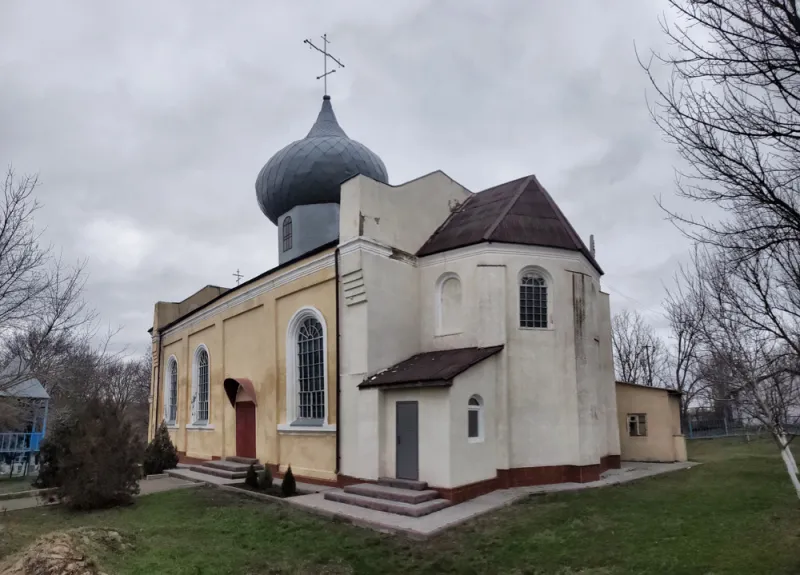
St. Nicholas Church.
In the princely era Myk-horod had advantageous strategic conditions for placing a fortification and building a hillfort, since it was washed on both sides by the Teteriv and Myka rivers. As legends say and as Mykhailo Hrushevskyi mentions in his works, a fortress was set up on present-day Mykhorod.
1390: in a charter of the Kyiv Prince Volodymyr Olgerdovych the town is mentioned under the name Mytsko on the Teteriv.
Approximately in the 1st half of the 16th century a new name of the town appeared. After another Tatar invasion it was moved from Mykhorod to a more strategically advantageous place, the steep left bank of the Teteriv River. According to folk etymology, the “joyful thought” (“radisna mysl”) about the resettlement gave the settlement its new name, Radomysl. According to another version, it comes from a person’s name (compare Zemomysl, Osmomysl). Some authors suggest that Radomysl or Radomysl meant a person named or honoured as a trade or an instrument of a trade. The first written mention of the name “Radomysl” dates from 1569. Since 1946 the modern name “Radomyshl” has been used.
The name “Radomysl” or “Radomysl” was most likely brought by settlers from Volhynia or Red Ruthenia, where towns with exactly this name have survived to this day.
Text from Wikipedia.

The water tower.

The Roman Catholic church.


The district hospital.


The gymnasium.
In the 19th century Radomyshl was a district centre. Every district centre had a number of mandatory institutions and corresponding buildings. Radomyshl had them too: a district hospital, gymnasiums (for boys and for girls), court offices, a district prison, and so on. Some of these buildings have survived.
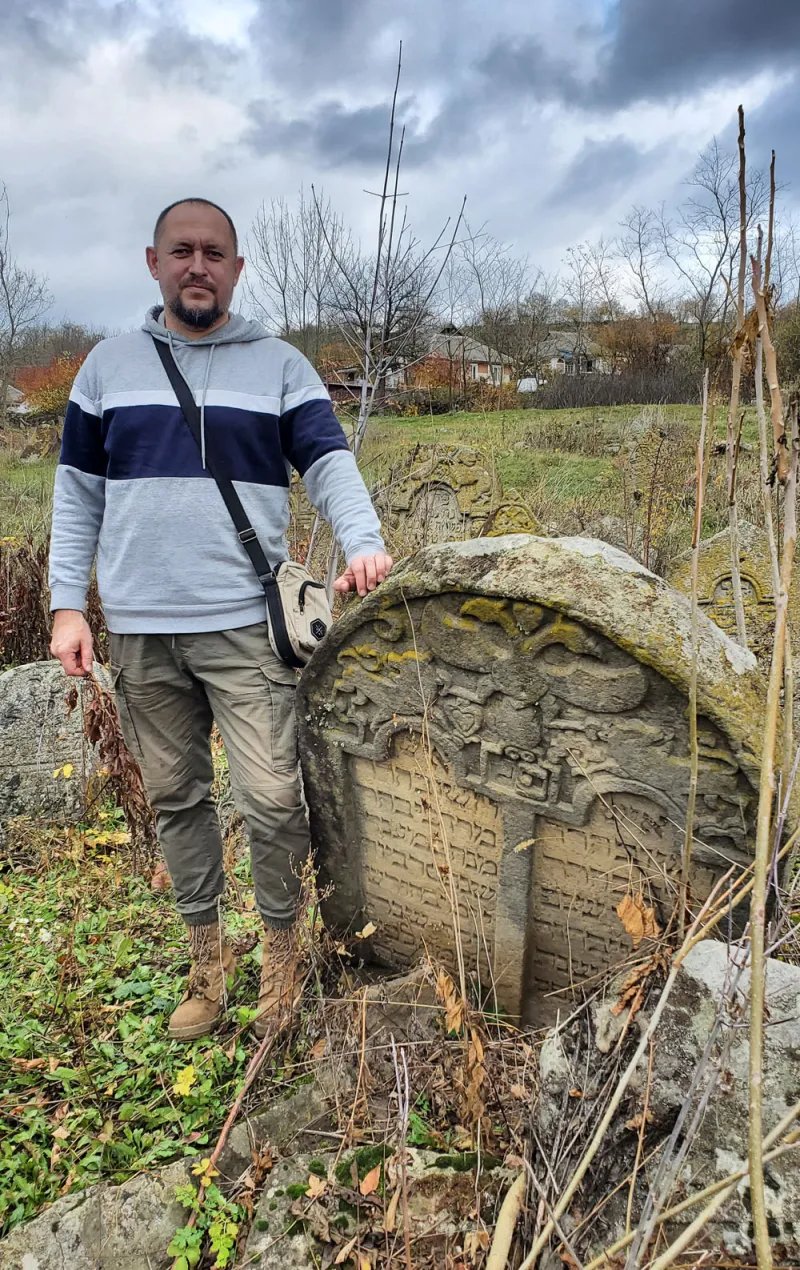
At the end of the 19th century more than 50% of Radomyshl’s population were Jews. Some Jewish residential buildings and a large kirkut have survived.
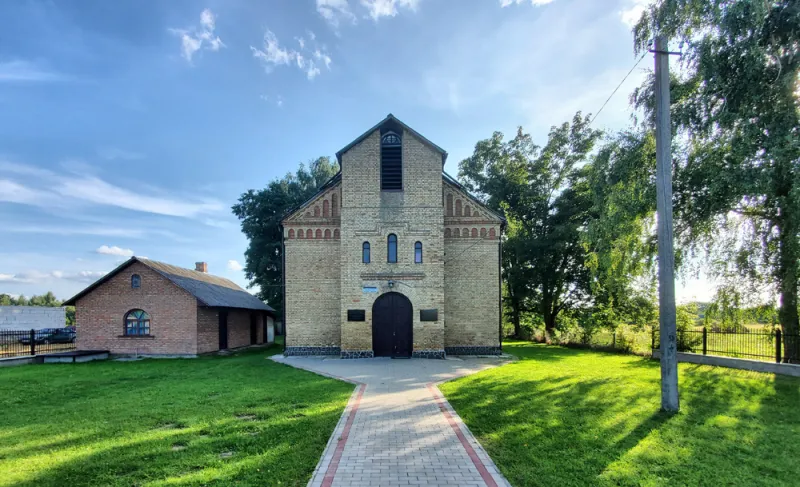
Radomyshl has a Lutheran church, which now serves as a multi-apartment house. The oldest building in the town is the Roman Catholic church, which in the Soviet period was so badly disfigured that it is hard to recognize in it not only a church but anything old at all.
In the centre of the town there are two dominant features: St. Nicholas Cathedral, built in 1877–1882, and a water tower built in the Soviet period. The central part of the town has preserved the layout of the 19th-century streets, which occupied quite a large area, and if only the buildings had survived… On the whole Radomyshl is an interesting town with a considerable number of buildings from the 19th and early 20th centuries. The town has several beautiful manors, although finding them is not easy at all.
Radomyshl has the potential to turn into a real tourist centre, but for now tourists go only to the “Radomysl” Castle.
Photos by Roman Malenkov and Serhii Shcherbii.


One of the town’s manors.


Town buildings.


The former German Lutheran church.


The Jewish cemetery.