

Tykhomel. The Arian tower

· 8 min read
Ancient Tykhomel is a chronicle town in Volhynia that for a long time was a bone of contention between the principalities of Halych and Volodymyr. It was possibly founded in the 10th century, when Volhynia was joined to Kyivan Rus (981). It is first mentioned in the chronicles in 1152 as a town of the Principality of Volhynia, during the war between Izyaslav Panteleimon Mstyslavych, Prince of Kyiv and Volhynia, and Volodymyrko Volodarovych, Prince of Halych. Thanks to Izyaslav Mstyslavych’s efforts, Volhynia became the patrimony of the Izyaslavychi for a long time. But while the Izyaslavychi’s rights to Volodymyr and Lutsk were hard to dispute, a fierce struggle was waged for the lands of southern Volhynia bordering what was then Galicia.
In the mid-12th century the town of Tykhomel, together with the whole Pohoryna region, was claimed by the principalities of Halych, Volhynia and Kyiv. Taking advantage of Izyaslav Mstyslavych’s defeat near Kyiv, Volodymyr Yaroslavych, Prince of Halych, seized the adjacent southern districts of Volhynia, including the lands of the Upper Pohoryna, which he held only briefly. Izyaslav, having returned to the Kyiv throne, tried to regain what he had lost, allied himself with the Hungarian king Géza II and defeated the Galicians near the San in 1152. Despite the lenient terms of the Peremyshl truce for Volodymyr, he did not honour the agreement. In 1152 Volodymyr Yaroslavych died, and his successor Yaroslav Volodymyrovych acknowledged his dependence on the Prince of Kyiv, yet did not give up the districts that had belonged to his father. So Izyaslav gathered an army, and, as the chronicler writes, “there was an evil battle, and they fought from noon till evening”. In this battle Izyaslav Mstyslavych defeated Yaroslav Volodymyrovych and took from him the towns of the Pohoryna.
From 1157 the Pohoryna was set apart as a separate district centred on Tykhomel. From 1199 Tykhomel became part of the unified Principality of Galicia-Volhynia, headed by Prince Roman II Mstyslavych. However, Prince Roman’s short, six-year rule (1199 to 1205) did not allow the new Galicia-Volhynia Rus to be secured on the political map of medieval Europe. Two minor heirs, Danylo and Vasylko Romanovych, together with their mother, could not hold the state together when boyar feuds began and pressure came from external enemies who started a struggle for the throne of Galicia-Volhynia.
From 1212 Tykhomel was part of the Principality of Volodymyr (Volhynia) under Prince Oleksandr of Belz, to whom this principality was given by the Polish king Leszek the White. This happened soon after the death of Roman Mstyslavych, Prince of Galicia-Volhynia. In order to seize Galicia, the heirs to the Galician throne, Danylo and Vasylko, sons of Roman, were sent away to Volhynia together with their mother in 1214 and were given the districts of Tykhomel and Peremyl (Peremyshl) in Volhynia. At that time Tykhomel became the residence of the younger prince, Danylo Romanovych, after which the town became well fortified, with developed trade and crafts. It was in Tykhomel that the childhood and teenage years of the great Ukrainian prince and state-builder, later the first king in the history of Ukraine, were spent.
The Novgorod prince Mstislav the Daring helped the Romanovychi to regain Galicia; in 1218 he arrived in Kyiv and appealed to the Rus princes to stand up for the Galicians. Having driven the Hungarian king out of Halych, Mstislav the Daring took the Principality of Halych for himself and gave the Principality of Volodymyr to Danylo and Vasylko Romanovych. However, the Hungarian and Polish kings did not stop laying claim to Rus lands, first of all Galicia. As a result of Mstislav’s rash actions and his illness, the Hungarians seized the Galician throne again, and in 1227 Tykhomel came under the rule of the Hungarian king Andrew. Danylo continued to fight for the independence of the Principality of Halych. Only after the death of the Hungarian king did Danylo Romanovych finally establish himself on the Galician throne, giving the Principality of Volodymyr to his younger brother Vasylko. In 1233 Danylo invited the next Prince of Kyiv, Izyaslav, and the Polovtsian khan Kotian to help in the struggle against the Hungarians. But, despite the Kyiv prince’s oaths: “Prince Izyaslav Mstyslavych committed treachery (betrayal) and …they took Tykhomel and returned”. This was the last mention of Tykhomel as a significant town of Galicia-Volhynia Rus. From then on it began to lose its importance and decline, and after the Tatar invasion the ruined town eventually turned into an ordinary village.
After the coronation of Danylo Romanovych in 1253 in Dorohochyn and his receiving the title of King of Rus, Tykhomel became part of the Kingdom of Rus, but it no longer had the importance for the kingdom that it once had. After the decline in the mid-14th century of the first Ukrainian kingdom in history, the Kingdom of Galicia-Volhynia, Tykhomel, like the whole of Volhynia, became part of the Grand Duchy of Lithuania and after some time became the property of the Seniuta family.
Tykhomel in the era of Lithuanian and Polish rule
In the 1340s, after the final fall of the Tatar-Mongol yoke in Rus, Tykhomel became part of the Lithuanian-Rus state. This led to the gradual revival of the town, which was owned by the Kobakovych-Seniuta family, close to the house of the Princes of Ostroh, who held 15 towns and 100 villages. After the Union of Lublin in 1569 the town came under the Polish Crown of the Polish-Lithuanian Commonwealth and was part of the Kremenets county of the Volhynian Voivodeship.
In the 16th century a reform movement swept Western and Central Europe, and it also reached the Ukrainian lands, which at that time belonged to the Polish-Lithuanian Commonwealth. The main currents of Protestantism on the territory of the Commonwealth were Calvinism, Lutheranism and Antitrinitarianism (Socinianism). The Antitrinitarians departed significantly from the dogmas of traditional Christianity, the main departures being the denial of the unity of the Trinity and the recognition of the human nature of Jesus Christ. Among the people they were nicknamed “Arians” after the Alexandrian priest Arius. In time, under the influence of the Reformation and Protestantism, the Orthodox Kobakovych-Seniuta family adopted the Socinian heresy. Arianism, revived and developed on the wave of the Reformation, found many adherents in the Commonwealth, particularly among the nobility. In Ukraine the heresy spread widely in Volhynia, where the main Socinian communities were located: Liakhivtsi, Tykhomel, Ostroh, Hoshcha, Shumsk and others. Well-known Ukrainian noble families that supported Socinianism included the Chaplychi, Hoiski, Kholonevski, Seniuty, Liubenetski, Nehalevski and others. However, Socinianism did not become a mass popular religion, remaining only the creed of a certain circle of nobles and townspeople.
On 30 January 1535 the brothers Hryts and Roman Seniuta sold the Tykhomel hillfort to the Bishop of Vilnius, Prince Janusz, son of the Polish king Sigismund I the Old and Katarzyna Telniczanka of Silesia. The new owner of Tykhomel built a new small town on the opposite bank of the Horyn, which was later named Janušpol (Janusz’s town), afterwards Yanpol/Yampol, and now Yampil, a satellite town of Tykhomel. However, Janusz’s premature death in 1538 did not allow him to develop Janušpol together with Tykhomel, and the town with its surrounding lands passed to Janusz’s sister Beata Kościelecka, the future wife of Illia Ostrozky and mother of Halshka Ostrozka, who developed the town. In the future Tykhomel, together with neighbouring Janušpol, would belong to the Zbarazky princes.
On 2 June 1616 the king, at the request of the landowner Abraham Seniuta, issued a privilege under which the settlement received Magdeburg law and was exempted from taxes for 15 years.
From 1631 the town belonged to the Wiśniowiecki princes, later to the Jabłonowski family (in particular, the well-known patron Józef Aleksander Jabłonowski was born in the manor at Tykhomel), from 1741 to the Radziwiłłs, and from 1806 to the Counts Chodkiewicz.
The Arian tower-chapel
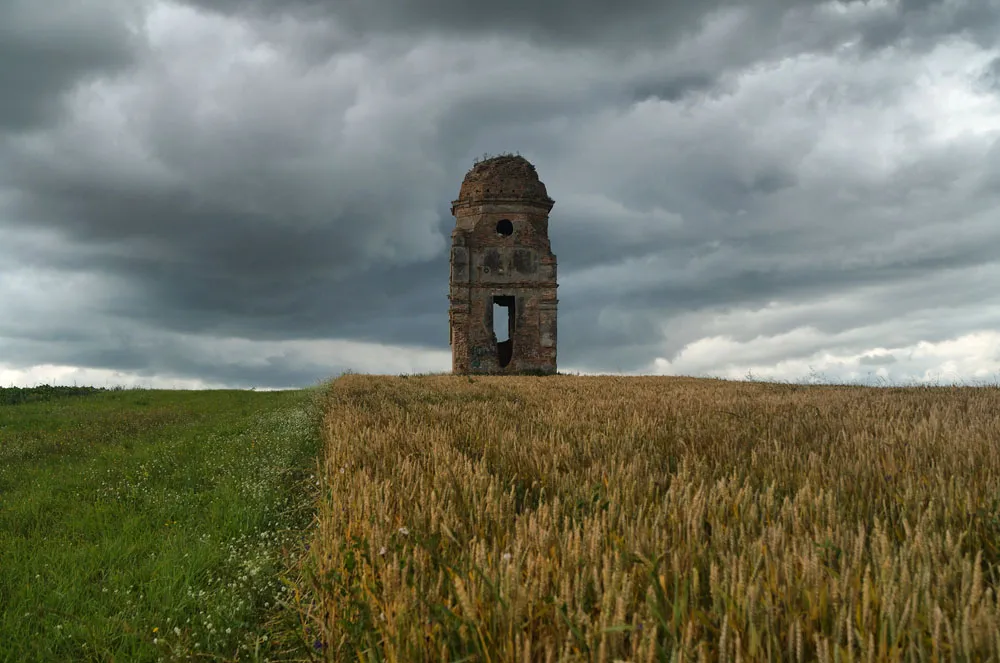
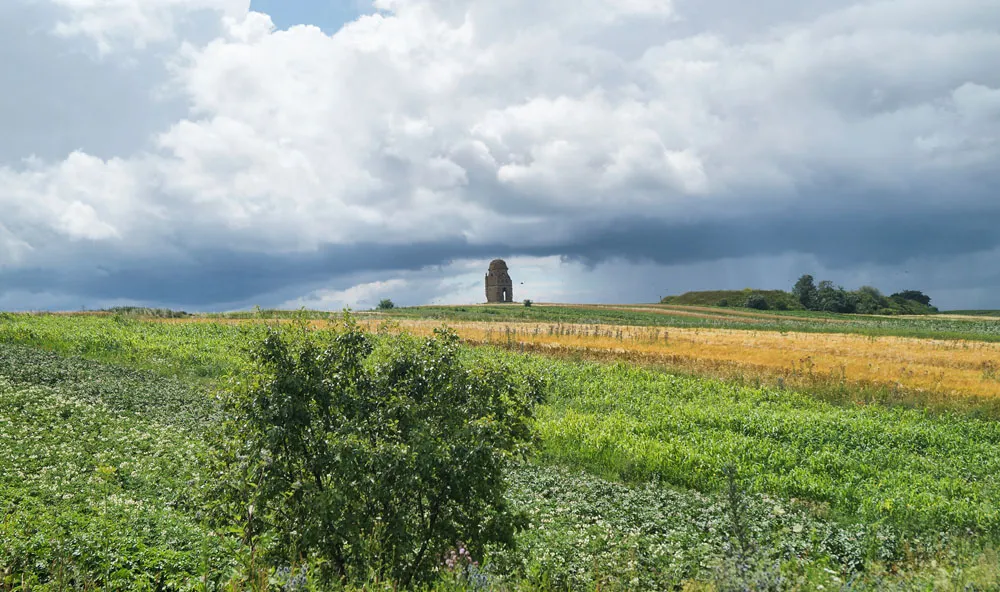
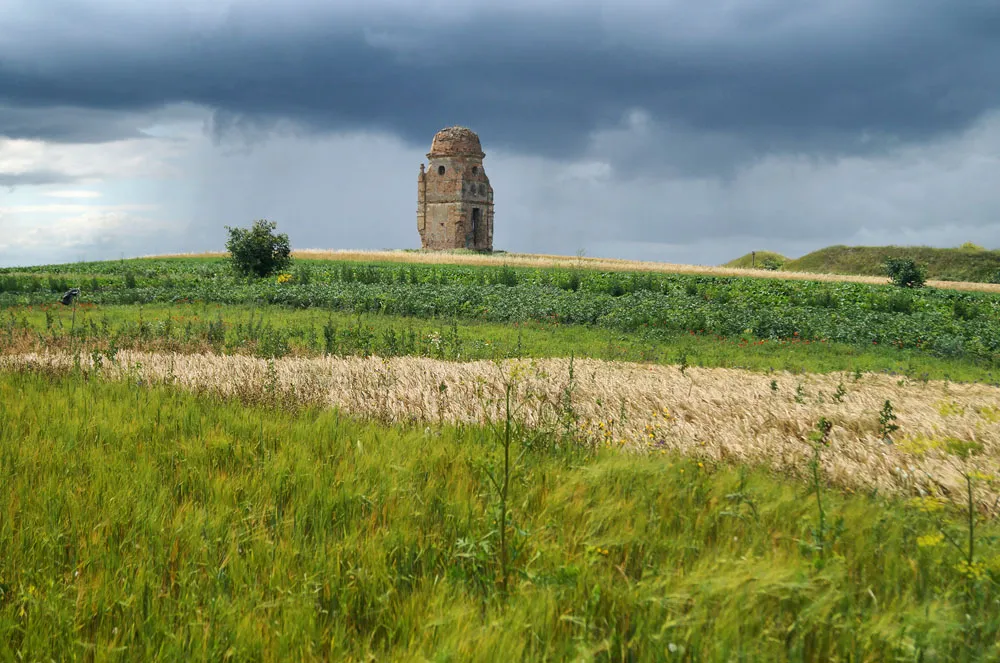
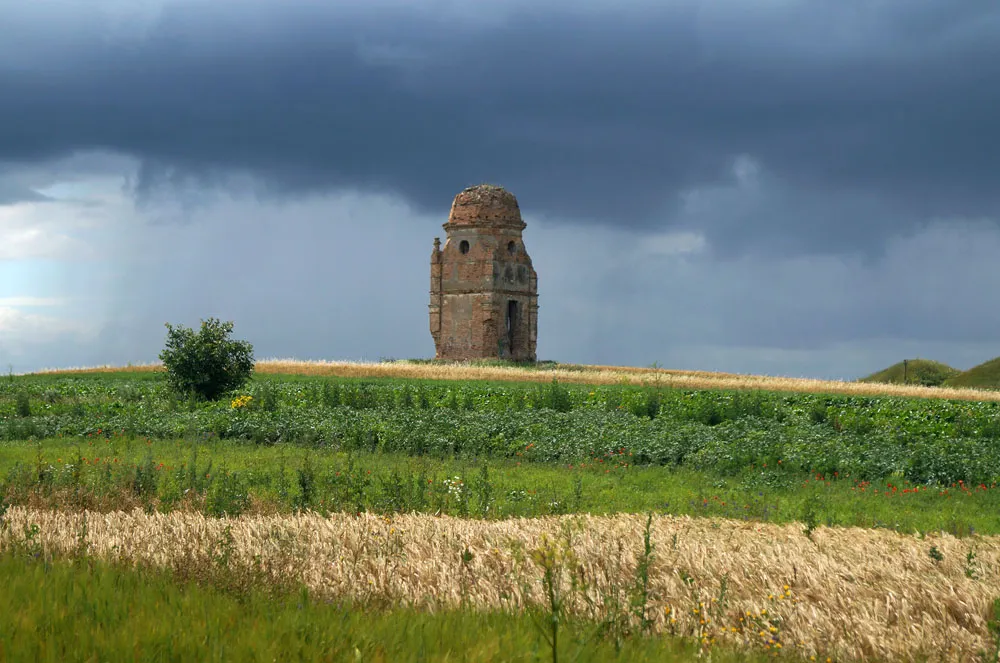
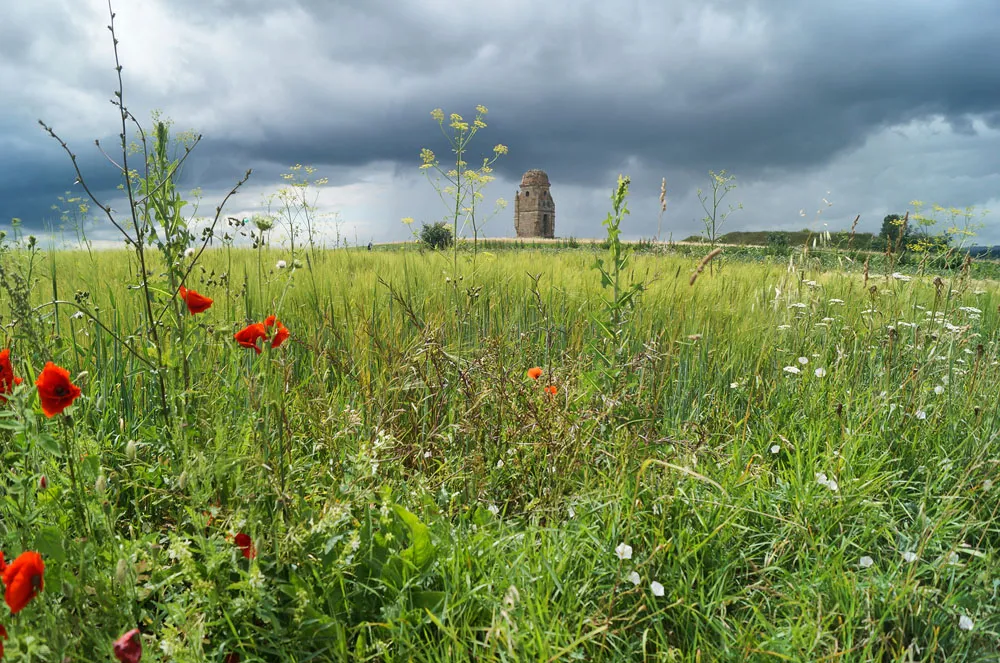
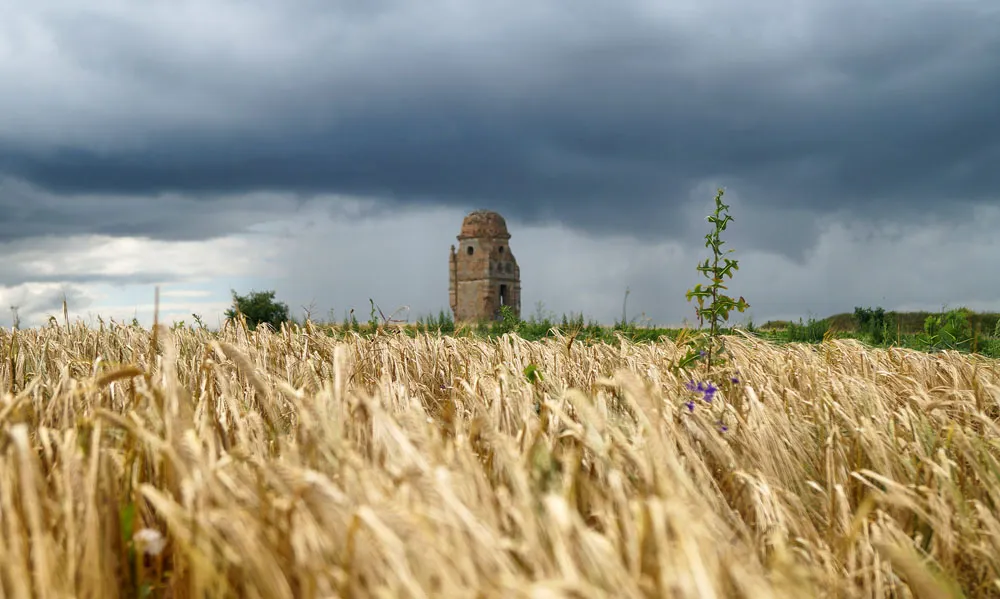
The Arian (Socinian) tower-chapel (also the Seniuta tomb (Polish: Grób Aryański Sieniutów), the Seniuta chapel) is a religious building, the only partly surviving monument of the village of Tykhomel in the Bilohiria district of Khmelnytskyi Oblast, Ukraine. In a drawing by Napoleon Orda it is dated to 1628. Traditionally it is dated to the first quarter of the 17th century.
It stands on the territory of the suburb (posad) of an early medieval hillfort of the 11th–13th centuries, on the high bank of the Horyn river above the historic Royal Road, a section of the main transport artery of Europe that connected the capitals of kingdoms in the 15th–17th centuries. The landowner Abraham Seniuta, who was, however, a Calvinist rather than an Arian, is regarded as the founder of the building. The designation of the chapel as the burial vault of the Seniutas rests on an oral local tradition that spread thanks to 19th-century authors.
The attribution of the monument as an Arian tomb of members of the Seniuta family did not raise objections from the authoritative Polish researcher of the Reformation Janusz Tazbir, although he does not dwell on this question in detail.
Text from Wikipedia, photos by Roman Malenkov.


