The Minkivtsi State. The story of an 18th-century independence on Ukrainian lands

· 16 min read
In the previous post I described the history and beauty of the region, as well as the preconditions in which the local residents’ aspiration to freedom and democratic principles took shape.
Here we will touch directly on a short description of the hero of our story and begin its account with the most important foundation of the existence of any state: LAW.
Magdeburg law, which Minkivtsi received as early as 1637, contributed to the emergence here of a fairly strong layer of Ukrainian townspeople who passed down from generation to generation their skill in furriery and tanning, because under that town law they were not obliged to perform corvée labour [Vasyl Harba, “The Kingdom of Minkivtsi” / Novi Dni. Canada. 1968].
Later, out of the need somehow to deal with the approaching black cloud of the occupying rules of the Russian Empire, which relentlessly advanced on the Podillian lands from the end of the 18th century, a worthy answer was given here and revolutionary laws were introduced that can serve as an example for us even today.
The main hero of our story will be Count Ignacy Marchocki (Ścibor-Marchocki, Redux-Marchocki) (1755–1827), one of those outstanding figures of the Polish-Lithuanian Commonwealth, Ukraine and, above all, Podillia in the last quarter of the 18th and the first quarter of the 19th century, who through their active public-political and reformist activity shook the foundations of the then autocratic Russian and Austrian empires. We will talk in more detail about his outstanding biography in my next post. Here let us concentrate purely on his legal reforms.
In particular, under Russian rule Marchocki managed, in an unconventional way, by building on his large estate the so-called Minkivtsi State, in Ushytsia district of the Podillia Governorate, to attempt to put into practice, on the basis of a constitutional order, legal relations, the liberation of peasants from serfdom, the development of local education, culture and so on, the ideas of the Great French Revolution, of the Enlightenment thinkers Voltaire and Rousseau, of the Polish Constitution of 3 May 1791 and of other progressive projects of that time which promoted reform of socio-political relations in Europe. His transformations fell in the period of crisis of the feudal-serf system in the Russian Empire, when the best reformers of the countries of Europe and Muscovy were seeking ways out of it, and in this case similar experiments were carried out within the borders of autocratic power [Bazhenov L. THE LIFE AND ACTIVITY OF COUNT IGNACY MARCHOCKI IN UKRAINIAN AND POLISH FICTION AND HISTORIOGRAPHY OF THE 19TH – EARLY 21ST CENTURIES // International Collection of Scholarly Papers. Ternopil, 2011. Issue 5: Ukraine – Europe – the World: Historical, Political and Humanitarian Aspects of Development, in 2 parts, Part 2. Pp. 241–247].
Already in the first years of his rule over these lands, on 29 December 1791 a small constitution was drawn up, the “Law of the Town of Minkivtsi”, which became one of the most modern documents of its type in the world. It fixed the separation of powers and defined the rights and duties of the President, the Voit, the Scribe, the Councillors and the judges; it described in detail the order in which these were elected. All citizens, regardless of origin, were made equal in rights, and ideals so important and groundbreaking at the time as “Rights, Freedoms, Prerogatives, Privileges” were declared, which now applied equally not to a certain dominant class but became part of the life of the whole society.
The “Law” consists of 6 Sections, together with attached model Oaths for the President, the Voit, the Scribe and the Councillors. The first Section indicates the legal basis for this form of local self-government, including the decisions of the Warsaw Sejm of 1768 and of the Sejms of the General Conference from 1773 to 1775, which were, as stated, “between the Commonwealth and the Russian Empire”. Evidently the Warsaw Constitution, concluded only at the beginning of the year, was also taken into account. The equality of representatives of different religions was stressed, and among them were listed the Catholic, Uniate and Armenian religions, as well as the Protestant, Lutheran and Greek non-Uniate. A separate Section 6 (in the text “O Zydach”) is devoted to Jews, their rights, the Synagogue and the jurisdiction of court cases. The greatest attention is devoted not merely to the legal position of Craftsmen, Masters and Journeymen but also to practical aspects of their activity and contractual work. It is evident that the authors understood and realised that the body of any state can be sustained only by a powerful economy, in which crafts, masters and trade were given decisive importance. Interesting are the provisions on exemption from taxes for ten years for those who build a house by their own efforts, as well as other similar progressive notions, which it would be good to tell to contemporaries who are unfamiliar with the laws of economics and in every way seek to tax business as much as possible and to kill any enterprise altogether. Yet independence and enterprise have traditionally been the driving force of the Ukrainians in all ages. So, as we see, our ancestors were wiser.
The document signed on behalf of the landowner Marchocki.
.
Besides the said “constitution”, there later appeared “The Basic Laws of the State”, “The Agreement of the Lord with his Subjects the Husbandmen”, “Privileges of Finances”, “The Law of the Nobility”, “Statutes on the Organisation of Hereditary Estates”, and so on.
The foundations for a correct understanding of Marchocki’s historical merits lie in ideas aimed at consolidating established, highly moral forms of behaviour, skills, concepts, everything that makes up the backbone of a healthy community. The guideposts of the community’s life, its spiritual and moral norms that ensured social unity, were Marchocki’s deep conviction that relations between members of the community must be based on honour, reason, learning, virtue, truth, labour and order [Stepaniuk A. “THE MINKIVTSI STATE” AND IGNATII MARCHOCKI AS ITS FOUNDER // Commercial (Arbitration) Court of Khmelnytskyi Oblast: Historical and Legal Essays, Portraits. Kamianets-Podilskyi, 2006. Pp. 305–326].
The same researcher writes that, alongside absolute monarchical power, there came to the former Commonwealth lands, among other things, a judicial power regulated by the legislation of the Russian Empire. There the court was built on the principle of “sosloviie”, that is, social estate. Its activity was complicated, confusing and inaccessible to ordinary people (that is, the absolute majority of the population). A landowner, by his own authority, could hand his peasants over to convict companies or workhouses, subject them to arrest, flog them, send them into the army or exile them to Siberia. Court proceedings were bureaucratic. Cases were heard behind closed doors without the parties present. All evidence was divided into perfect and imperfect. Priority was given to the testimony of a nobleman over a commoner, of a rich man over a poor one, of a clergyman over a layman. Testimony of persons of another faith against an Orthodox believer was not taken into account. Class privilege, lack of publicity, endless delays and administrative-police arbitrariness reigned in Russian courts. This was the product of the autocratic-serf order.
In contrast to this Russian order, which they had already tried to impose on Ukrainian lands, the court in the Minkivtsi State was free from the influence of officials of other branches of power. Each year the whole adult population elected a certain number of judges, called jurors. Every village of the Minkivtsi State had its own collegial court. It heard cases as a court of first instance. In administering justice the jurors were guided by the articles and provisions of Roman law. The highest form of judicial punishment was exile to the so-called Pontic possessions. These were lands in the Kherson Governorate where the patriarch had built a settlement. But we will write about this at the end of our story, in the next post.
.
A real breakthrough was the abolition of serfdom in Marchocki’s state, which he introduced by his own decision, many decades ahead of others. And an even greater one were the “Laws of the Husbandmen” of 2 January 1804, an extraordinarily interesting document that is best quoted in full, but for lack of space I will limit myself to a few excerpts from it:
“We, the common people of the hereditary lands of Myslibor, Zarichchia, Katerynivka, Antonivka, Kruzhkivtsi, Otrokiv, Khapanivka, Prytulia, Tymkiv, Pobiina, Pobiianka, Syvorohy, Stsibor, Ostoia, Vesela and Marchocice, which form the MINKIVTSI LANDHOLDING in Ushytsia district of the Podillia Governorate, have gathered together to consider and draw up firm laws… we have become convinced: that the most precious gift with which the Supreme Creator of Nature has endowed the human race is FREEDOM. …the attempt to take away Freedom is the vilest act against Nature itself of which tyranny is capable”
This is a fairly transparent hint at the tyrannical order of the new occupation administration from Muscovy, which had begun to impose its rules on Ukrainian lands.
“…remembering the ancient Statutes, Constitutions, Rights and Privileges of the Nation, and in particular those approved in the years 1347, 1420, 1433, 1496, 1503, 1510, 1523, 1538, 1543, 1573, 1578, 1588, 1613, 1699 and 1768, we adopt, recognise and proclaim the following Articles…”
The historical continuity and understanding of their place in history among our ancestors was an order of magnitude higher than in the present generation. The so-called “fragmentariness of Ukrainian history”, which one sometimes has to hear about, is nothing but the fragmentariness of the knowledge and thinking of such modern claimants themselves. Whereas historical continuity and the understanding that what has meaning and significance is not changing signboards but real people who have lived here for millennia, had their own rules, traditions and so on, passed down from generation to generation, were characteristic of our ancestors.
“II. The condition and calling of the Husbandman, the largest part of the Nation and the most productive force of the Country, whose hands and labour are the source of the greatest wealth of the land, is a condition utterly necessary and useful, and therefore much honoured and significant.Oh, how pleasant is the life of the Husbandman who, in his homestead, together with his family, is occupied with household labour, surrounded by ploughland, fields, vineyard and orchard, gets his livelihood from cows, sheep, goats and all domestic livestock, and constantly feels the happiness, contentment and benefits that the Earth, our Mother, brings him as a reward for his labour. So to neglect one’s condition and calling, to shun labour, to abandon the Land which our Forefathers and Fathers tilled in the sweat of their brow and in which their bones rest to this day, is unacceptable, mere wantonness, a disorderly and empty life that provokes disgust. Therefore We and our Children wish always to be bound to this Land, shall not leave it for any reason, shall live on it and continue our line for all time, and decree to fulfil the duties of the Condition and our calling as Husbandmen” (as if God himself had written it!)
“V. Neither the present Lord of the Manor nor His Heirs or Successors shall be able to sell individually any Husbandman, nor an entire Family, nor an entire Community. If a Person is not anyone’s property, he can neither be sold nor exchanged, either for himself or for anyone else. In the event that Lords of the Manor and owners of land transfer it and the right to it to someone else, then the produce and fruits of the land, the land itself and the dues, rents and contributions connected with it may be sold, but not people. Likewise, deeds of sale and purchase agreements that contain imprudent conditions contrary to the Laws of Nature shall have no force and shall not be carried out”
This is a direct challenge to the Russian Empire, where people were accustomed to being sold like dogs (literally, as the sources attest), and this had been established with them for hundreds of years.
“XXI. The proper arrangement and straightening of roads, public roads and secondary routes from villages to markets and fairs, eases the delivery of foodstuffs and vegetables to towns and various other works and needs; it also preserves human and animal health and the integrity of carts. Therefore Communities shall maintain them as well as possible, provide them with substantial and wide bridges and equip them with sturdy railings; according to the distribution and corresponding order, each village shall always keep them in good repair, take care that the signs of distances in miles and the signposts of the places to which roads lead are protected, that planted trees are properly preserved, and that healthy ones are planted in place of dried, uprooted, broken and felled ones. That is, as regards public works in which every member of the Community must take part, we additionally undertake the following:…”
Next are listed the measures which the Community undertakes for the development of infrastructure, describing quite progressive practices that could be written on the wall of every village council today, so that people would do this themselves rather than wait for help from somewhere.
“XXIV. Police, local Order in the village serves for our own good, safety and peace; it provides for cleanliness and tidiness, fencing, locking of dwellings, grazing, caution with fire and ways of rescue, protection against contagious diseases and epidemics from which people and livestock may suffer, vigilance regarding newcomers, beggars, fugitives, suspicious and passportless persons, ways of constructing strong and fire-resistant buildings; it promotes husbandry and the punctual payment of taxes, teaches reverence for God and customs, eradicates bad habits and immorality, preserving rules; we must treat the Superiors who watch over all this with meekness, and carry out such orders sincerely”.“XXIX. Since among people, in very large and small gatherings, there are no communities without conflicts, disputes and matters requiring judicial examination, which could bring the parties satisfaction and reassurance, and since all these circumstances require expenses, take time and hinder husbandry, we wish that the farming folk should not idle needlessly, nor be distracted from the farmstead and the labour that feeds them; acknowledging the principles of the Laws of the Land, especially those of Władysław Jagiełło of 1433, the Statute and the cardinal Law of 1748, mentioned in Article 18 of the Constitution, we decree the following. As regards one or several persons who have committed offences for which the death penalty or other criminal liability is provided, such criminals fall under the jurisdiction of the state. In other differences of a civil nature, disputes and cases between Husbandman and Husbandman, Husbandman and any other inhabitant of the Minkivtsi Landholding of whatever condition and category, or other plaintiffs from wherever, we shall apply in the established manner to the Justiciary of the Dominium of Minkivtsi, whose members we elect each year, and if dissatisfied with its verdict, the parties may appeal to the Administrative Court, whose every decision the parties are obliged to accept and carry out, since its proceedings do not violate Proprietas & Directum Dominium, as the National Law of 1768 states”.
“…This Agreement of 30 Articles and the voluntarily accepted obligations stipulated by them, which are accepted for all time, can never be arbitrarily annulled, just as the voluntarily accepted conditions and the duties connected with them…”.
.
While appreciating such important reforms as the abolition of serfdom in his domains on 1 January 1795, the introduction of the rule of Minkivtsi autonomy, state institutions (border posts, a supreme court, a militia, its own money and so on), constitutional and legal foundations, access to education, the introduction of liberal practices and more, we should not close our eyes to Marchocki’s negative traits. So we will not idealise him as the initiator of reforms, but will give due to the Community itself, which was not an observer but a direct participant in these changes (including internal ones).
On the other hand, Ignacy Marchocki was not the only figure among the Podillian aristocracy who, under the influence of European (French and Polish) revolutionary achievements of the late 18th century, were ready for progressive transformations in their domains. Thus Wiktoryan Dzieduszycki (1754–1832), owner of Serebriia, Slobidka Yaryshivska and other villages in Mohyliv district of the Podillia Governorate, at the turn of the 18th–19th centuries began replacing corvée with a monetary quitrent for serf peasants. The next owner of Yaryshiv, Slobidka Yaryshivska and other villages of the Mohyliv region and Galicia, Włodzimierz Dzieduszycki (1825–1899), under the influence of the European revolution of 1848 also abolished serfdom in his domains and put peasants on quitrent, and so on. But in their reforms they did not go as far as I. Marchocki [Bazhenov L. THE LIFE AND ACTIVITY OF COUNT IGNACY MARCHOCKI IN UKRAINIAN AND POLISH FICTION AND HISTORIOGRAPHY OF THE 19TH – EARLY 21ST CENTURIES].
As we can see, whatever historical myths imperial historians have built over two centuries, the fact is evident that Ukrainian lands and people were in inseparable connection with pan-European processes and tendencies of change and reformation.
On 3 May 1791 the extraordinary Sejm of the Commonwealth in Warsaw adopted one of the world’s first written constitutions, based on the principle of the separation of powers (legislative, executive and judicial), which proclaimed civil liberties, abolished the election of the monarch and declared the Sejm the supreme legislative body of the country. And on 15 December 1791 the state of Virginia ratified the first ten amendments and additions to the US Constitution, known as the “Bill of Rights”, thanks to which they came into force across the whole country. Then in December of that same year the Minkivtsi State responded with its own small constitution, which we have examined above.
On 20 April 1792 France declared war of a “free people against the unjust aggression of kings”, and later, as a result of an armed uprising, the royal residence in Paris was seized, Louis XVI was deprived of power, and within a month the monarchy in France was abolished and a republic proclaimed. And in September of that year the first group of Zaporozhian Cossacks under Colonel Savva Biłyi landed at Taman: 3,847 foot Cossacks with cannons had set sail on 16 August 1792 from the Ochakiv estuary and became the first settlers of the Black Sea Cossack Host to set foot on Kuban land. Meanwhile in the Minkivtsi State “Rights, Freedoms, Prerogatives, Privileges” of an almost republican type were being introduced.
On 4 February 1794 the French Convention issued a decree abolishing slavery in the colonies and equating the rights of former slaves with those of other citizens of the country. In the Minkivtsi State serfdom was abolished in 1795.
On 21 March 1804 a decree of the First Consul of France Napoleon Bonaparte put into force the “Civil Code of the French”, which became the foundation of the Romano-Germanic civil law tradition, has been supplemented and remains in force to this day. In the Minkivtsi State in December 1804 the revolutionary “Laws of the Husbandmen” appeared, generously quoted above, which even today could serve as an example of refined lawmaking.
The inhabitants of that small and in many ways experimental Independence clearly realised their place in the world, relied on a centuries-old legal tradition and continuity, and became an example of how, even in the least favourable conditions and under threat of destruction, to remain not merely human beings but Citizens.
Author: Ihor Poluiektov
Continued:
The Minkivtsi State. The beginning
Podillia and the Minkivtsi State
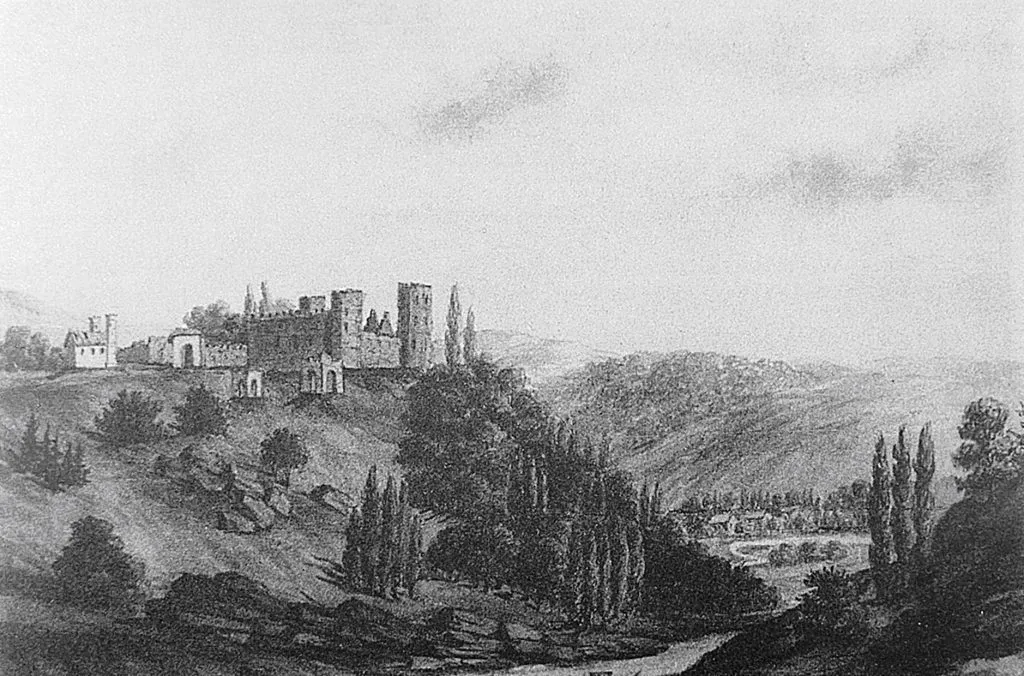
Drawing of Otrokiv and Minkivtsi, 1871, by Napoleon Orda