

Stare Porichchia: sand stalactites of Podillia
Unfortunately, because of certain technical problems there will be no photos from this village. Instead there will be a verbal description. But we will show clearly what sand stalactites are and explain what makes them unique.
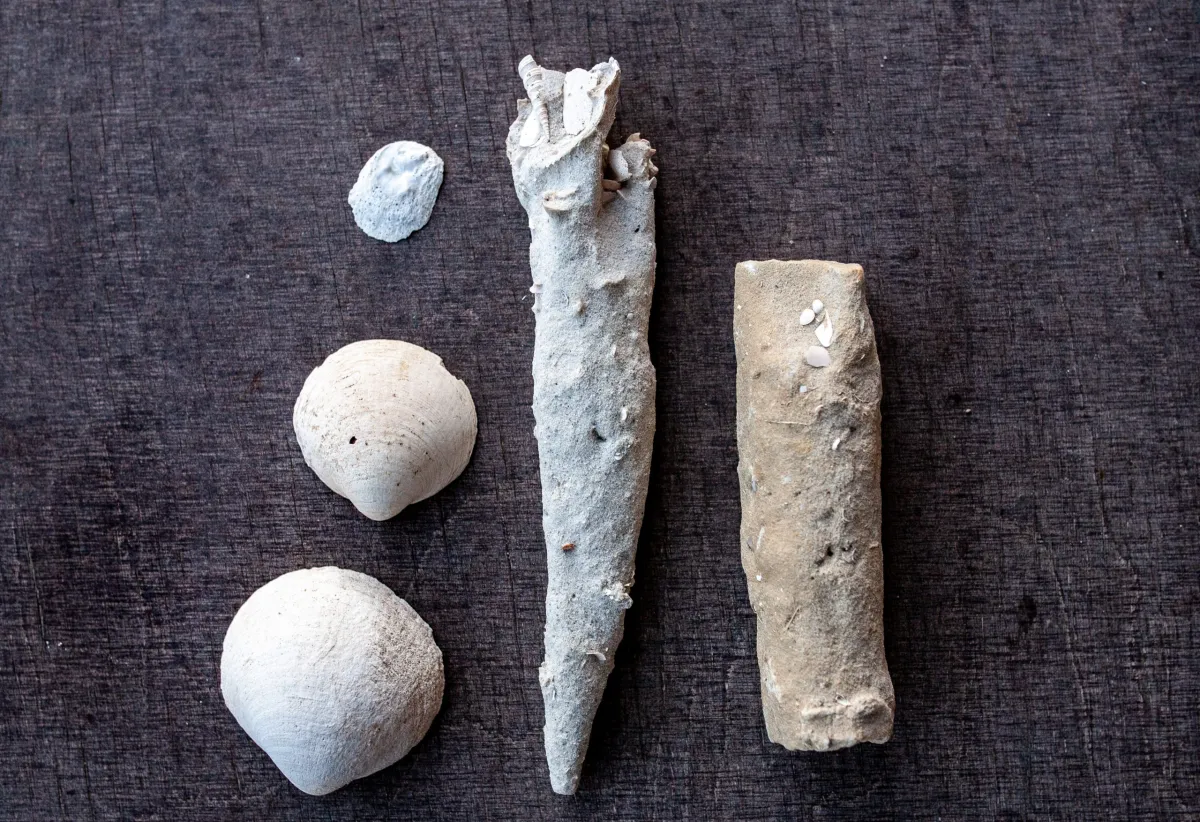
The central “icicle” is almost 20 cm long
Stare Porichchia, part of the Horodok amalgamated territorial community in Khmelnytskyi Oblast, lies right next to Nove Porichchia. “Ukraine Incognita” has repeatedly written about the numerous historical monuments of this village. The “old” namesake is short on man-made monuments. But it has very beautiful landscapes. Especially impressive are the steep cliffs with rocky ridges overhanging the deep valley of the little Trostianka river (a tributary of the Smotrych).
Looking from the river, you can clearly see that beneath the exposure of not very thick limestone deposits (1–2 metres) a layer of sand is visible.
Here we have a remote offshoot of the famous Toltry Ridge — a barrier reef of biogenic origin (that is, formed by living organisms) from the ancient Miocene sea. The main Toltry ridge is some twenty kilometres from here.
Once there were considerable depths here, where thick reserves of sand accumulated. When the sea began to retreat, a shoal formed, which was colonised by various marine organisms — bryozoans, serpulid worms, “stone algae” lithothamnia and so on. On top of the sand they built a reef. The process of the sea “withdrawing” was of course not simultaneous and lasted millions of years (given the thickness of the limestone layer, in this area it is more a matter of hundreds of thousands of years). As a result, today we have thick layers of sand capped with a limestone “skin”.
The quarry in Stare Porichchia, we should note, supplies sand to almost the entire Horodok community. It differs from other local sands in its pale colour. The others are yellowish to varying degrees because of clay impurities, which is not good in construction work. So everyone tries to take the Porichchia sand.
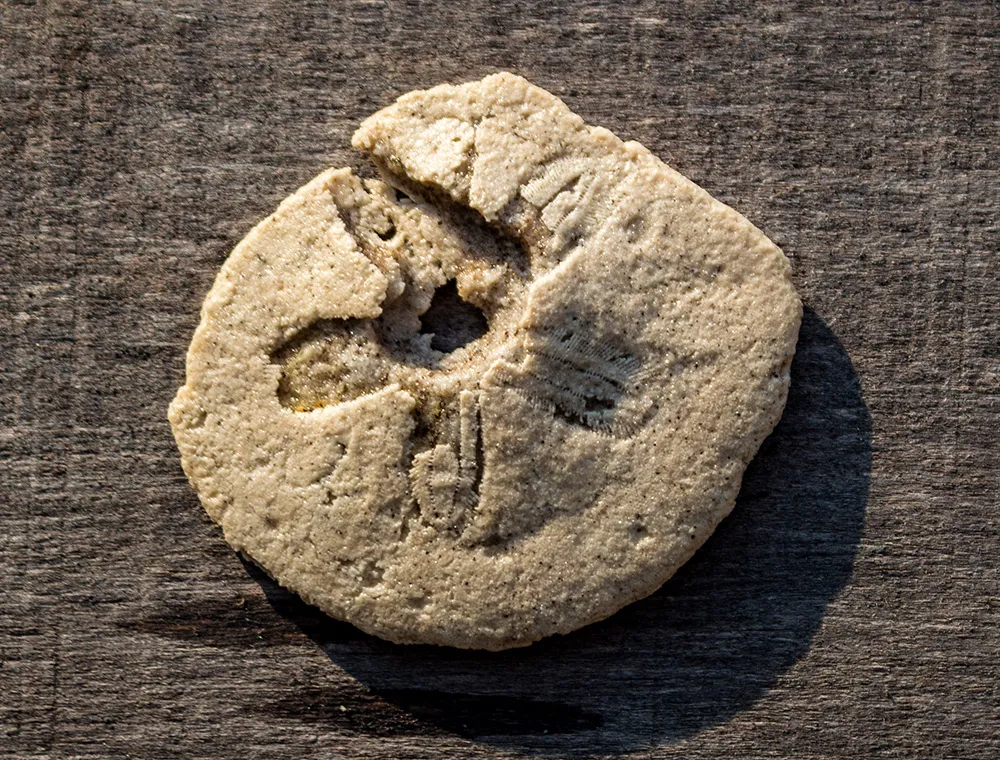
Sea urchin
The author of these lines also has his own reason not to pass by a single heap of white sand: it contains many fossils — various shells, sea urchin tests, fragments of fish skeletons… Once I was lucky enough to find a sizeable vertebra, which was thought to belong to a dolphin. But when it was handed over to Kyiv scientists, it turned out to be a baby sperm whale. There is no separate photograph of it, but there is a photo in a collage that was once used as an illustration for an article about local fossil remains.
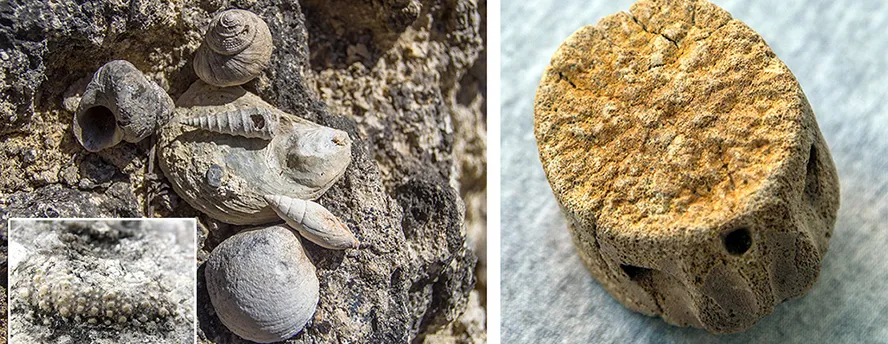
Also, fragments of hard sandstone columns, which look as if dug out and resemble cave stalactites and stalagmites, are often found in the Porichchia sand.
As it turned out, these are indeed stalactites! But sand ones…
Sand stalactites
Sand stalactites (pseudospeleothems) are formations that arise in a mass of sand beneath a cover of limestone rock. Everything is as in classic cave stalactites: water saturated with calcium first seeps through the limestone. If a cave cavity lay beyond, a stalactite icicle would form. But below there is sand. Once it gets into the sand, the mineralised water cements the sand grains, forming dripstone structures resembling cave stalactites. Such processes demonstrate the interaction of sedimentary and karst processes outside cave space.
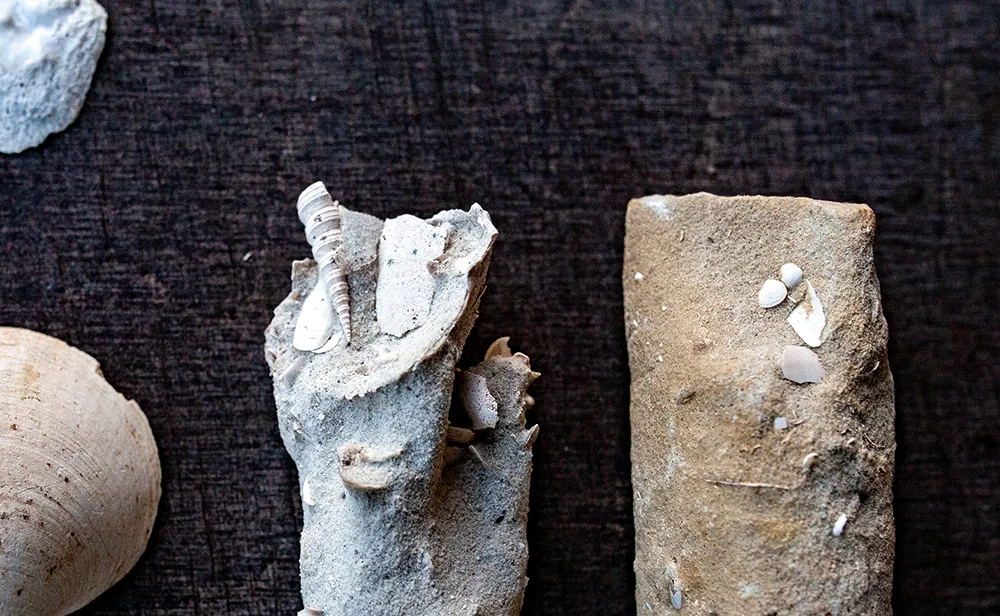
Inhabitants of the Sarmatian Sea, embedded in a stalactite
This is an extremely rare phenomenon, showing how nature can reproduce familiar images (cave stalactites) in a completely different environment — in sand. That is, we have a kind of “hybrid” between sedimentary rocks and karst processes.
Note that there are extremely few places on our planet where sand stalactites (pseudospeleothems) form en masse. They can be counted on the fingers of one hand. And among them is the area around Stare Porichchia in Podillia!
Why there are so few such places
- Necessary conditions: the sand layer must be in contact with a limestone cover so that water can bring dissolved minerals.
- A rare combination: sand beds often have no limestone “ceiling”, so the cementation process does not start.
- Locality: even where the conditions exist, the formations are not always abundant — stable water circulation is needed.
Note that sand stalactites vary in size. The author took the “icicle” shown in the article purely because of its small size. It fitted just right into a sandwich bag. Nearby lay one over half a metre long and about 15 centimetres thick. But dragging a hefty rock, dirty and smeared with wet sand, into the car seemed somehow not on…
Text and photos: Dmytro Poliukhovych


